Gut Bacteria and Weight: The ‘Fat Bug’ Myth, Corrected
Let me start with the question that sent me digging through papers instead of sleeping.
Why does my friend eat what I eat — same lunches, same late-night snacks — and stay thin?
Search that long enough and you land on an answer that feels like it explains everything. Your gut bacteria. Specifically a group called Firmicutes, which the internet nicknamed the “fat bugs.” The story goes: heavier people carry more of them, they pull extra calories out of your food, and you fix it by taking Lactobacillus probiotics and eating more fiber.
I went looking for the evidence behind that story. I want to be honest about what I found.
It falls apart at the first step.
Not “it’s more nuanced than that.” The advice contradicts itself, on a fact anyone can check in one click. And the 2006 paper everyone treats as the origin of the “fat bug” idea never called those bacteria harmful.
So this is a correction, not a retelling. There is somewhere genuinely useful to land at the end of it.
One thing first. I am not a doctor or a dietitian, and this is general information, not medical advice. Nothing here diagnoses, treats, cures, or prevents any disease. If you are managing your weight or considering a supplement, that belongs in a conversation with a health care professional who knows your history.

Photo: Kampus Production / Pexels
“Fat bugs” has one fatal problem: Lactobacillus is a Firmicutes
Here is the fact that collapses the framing.
Firmicutes is not a bacterium. It is a phylum — one of the largest branches on the bacterial family tree, holding thousands of species.
Now look at where Lactobacillus sits. NCBI Taxonomy, genus Lactobacillus, ID 1578, full lineage:
Bacteria > Bacillota (phylum) > Bacilli > Lactobacillales > Lactobacillaceae > Lactobacillus
“Bacillota” is the current valid name for the phylum formerly called “Firmicutes.” Same phylum. LPSN, the reference list for prokaryotic names, records it as Bacillota Gibbons and Murray 2021, with Firmicutes listed as a homotypic synonym — a second name for the identical thing. The nomenclature is still being formally debated, so you will see both in print.
Which means the advice at the center of the myth translates to:
Take a Firmicutes to suppress your Firmicutes.
Every Lactobacillus in every yogurt, kefir, and probiotic capsule on the US market is a Firmicutes.
Who is actually in this phylum
It gets worse for the villain story. Some of the most useful bacteria in the human gut are in there too.
| Organism | Phylum | What it is |
|---|---|---|
| Lactobacillus | Bacillota (= Firmicutes) | The most common probiotic genus sold in the US |
| Faecalibacterium prausnitzii | Bacillota (= Firmicutes) | One of the most abundant human gut bacteria; a major butyrate producer |
| Blautia | Bacillota (= Firmicutes) | One of the most abundant genera in the adult gut |
| Roseburia, Eubacterium rectale, Ruminococcus bromii | Firmicutes | The bacteria that ferment dietary plant fiber |
| Bifidobacterium | Actinomycetota — not Firmicutes | The other major probiotic genus, a different phylum entirely |
| Akkermansia | Verrucomicrobiota — not Firmicutes | The most-studied “next-generation” metabolic-health microbe |
Source: NCBI Taxonomy Browser, IDs 1578, 853, 572511, 1678, 239934.
Of the two probiotic genera you will actually see on a US label, one is a Firmicutes and one is not. The myth’s own recommended supplement belongs to the phylum it claims to be fighting.
Calling an entire phylum “bad bugs” is like calling the animal kingdom dangerous because it contains sharks.
One footnote, since it confuses people at the shelf. A 2020 revision split the old genus Lactobacillus — 261 species at the time — into 25 genera, which is why labels now read Lacticaseibacillus, Lactiplantibacillus, Limosilactobacillus and the like. Many familiar species were renamed, but all 25 genera stayed in the same family, order, class and phylum. The split changed names, not the branch.

The 2006 paper that started this called both groups “beneficial”
This is the part I did not expect.
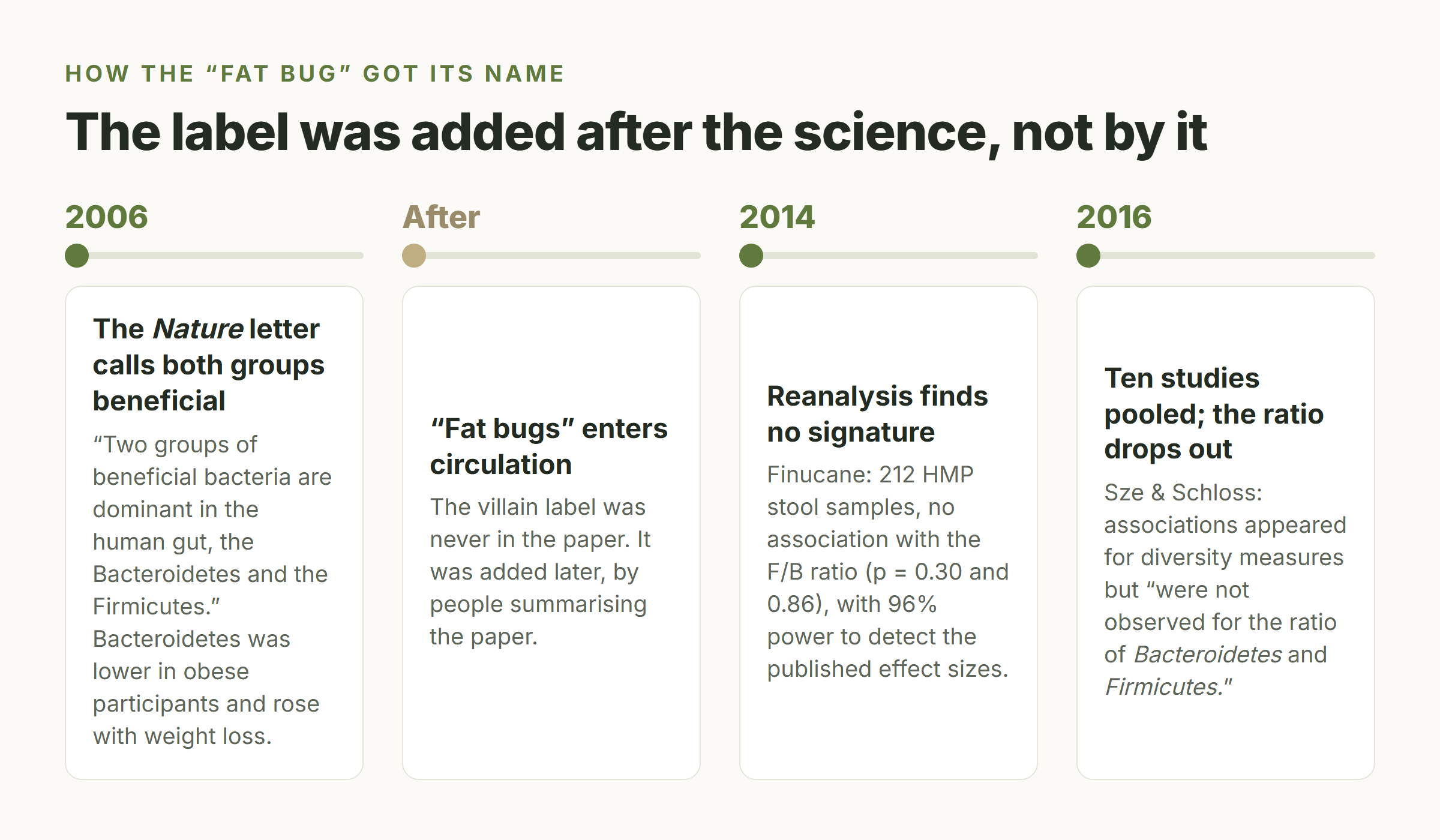
The story traces back to a 2006 research letter in Nature by Ley, Turnbaugh, Klein and Gordon. Its abstract opens, word for word:
“Two groups of beneficial bacteria are dominant in the human gut, the Bacteroidetes and the Firmicutes. Here we show that the relative proportion of Bacteroidetes is decreased in obese people by comparison with lean people, and that this proportion increases with weight loss on two types of low-calorie diet.”
Read that first sentence again. Beneficial — and note that the authors applied the word to both groups, Bacteroidetes and Firmicutes together, as two normal residents of a healthy gut.
I want to be careful not to overcorrect. That sentence does not mean Firmicutes protect you from gaining weight, and the paper claimed nothing of the sort. It means one thing only, but it means it clearly: the “fat bug” label was never in the science. It was added later, by people summarizing the science.
Does the Firmicutes/Bacteroidetes ratio actually track obesity?
The 2006 finding was real and interesting. The question is whether it held up when other labs went looking.
Largely, it did not.
The strongest check is Sze and Schloss, mBio, 2016, pooling 10 studies found through a systematic search. Significant associations with obesity status did appear — for Shannon diversity, observed OTUs, and evenness. Then, verbatim:
“They were not observed for the ratio of Bacteroidetes and Firmicutes or their individual relative abundances.”
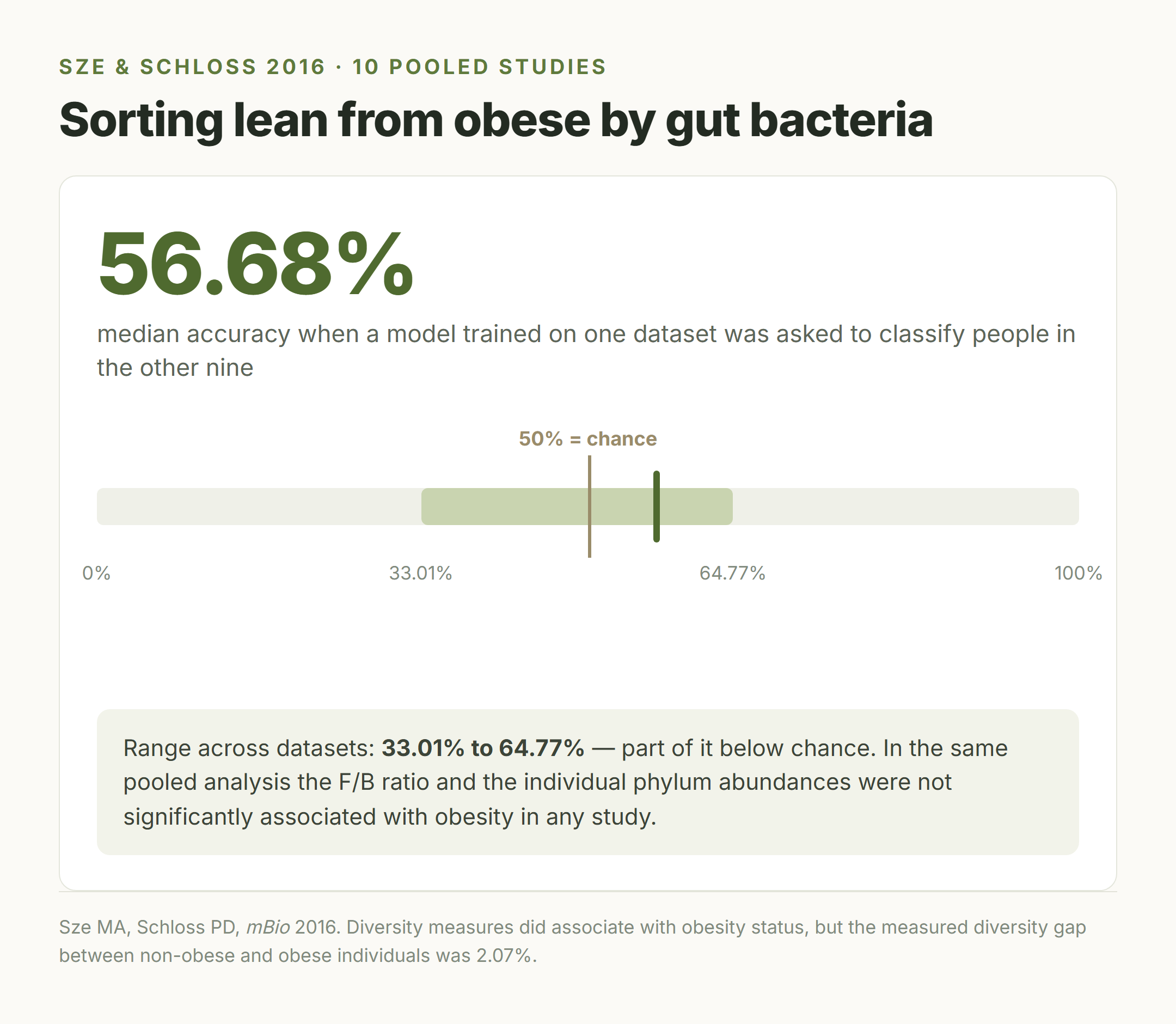
The body of the paper is blunter: “The B/F ratio and the relative abundance of Firmicutes were not significantly associated with obesity in any study.”
Then they ran the practical test — train a model on one dataset, ask it to sort people into obese or not in the other nine. Median accuracy: 56.68%, range 33.01% to 64.77%.
That is a coin flip with slightly better manners.
It was not a sample-size problem, either. Finucane and colleagues (PLoS ONE, 2014) reanalyzed Human Microbiome Project data — 212 stool samples, 24 obese and 123 lean — alongside MetaHIT and the original datasets. No association with the F/B ratio (p = 0.30 and 0.86); continuous BMI regression p = 0.41. They had 96% statistical power to detect the previously published effect sizes. Their conclusion: “there is no simple taxonomic signature of obesity in the microbiota of the human gut.” A separate 2014 meta-analysis by Walters, Xu and Knight landed in the same place.
To be fair to the other side, a 2020 review in Nutrients offered a gentler reading — that “it is currently difficult to associate the Firmicutes/Bacteroidetes ratio with a determined health status” — blaming inconsistent methods between labs rather than a truly absent effect.
That distinction matters, so I will state it plainly. “We cannot measure this reliably” is not the same as “this effect is zero.” But neither one supports buying a test to check your ratio, or rebuilding your diet around it.
The counterexample that flips the arrow
If a high Firmicutes-to-Bacteroidetes ratio made people heavier, a diet that reliably causes weight loss should push it down.
It does the opposite.
A 2025 meta-analysis in Gut Microbes pooled 14 studies of very-low-calorie ketogenic diets in people with obesity. The diet increased the F/B ratio — standardized mean difference 1.01 (95% CI 0.67 to 1.34, p < 0.0001). It also increased Akkermansia (SMD 1.76) and decreased Bifidobacterium (SMD −1.23, p < 0.0001), the genus most people would call the “good” one on a label. The authors cautioned that the diet’s “bidirectional effects on microbial ecology warrant caution.”
The tidy good-bug/bad-bug map does not survive contact with real intervention data.
Do these bacteria “boost sugar absorption”?
No source I could find supports that specific claim.
There is one real number in the neighborhood, and it is worth knowing precisely because it gets inflated so often. In 2011, Jumpertz and colleagues ran an energy-balance study in the American Journal of Clinical Nutrition: 12 lean and 9 obese adult men, fed 2,400 or 3,400 kcal a day for three days per arm, with stool bomb calorimetry to measure energy actually absorbed. Verbatim:
“A 20% increase in the proportional representation of Firmicutes was associated with an increase in nutrient absorption of ≈150 kcal, whereas a 20% increase in Bacteroidetes was associated with a decrease in absorption (≈150 kcal).”
Now the fine print, which usually goes missing:
- It measured total energy absorption, not sugar absorption.
- It was 21 men, three days per arm. Tiny and short.
- It is an association, not a demonstrated cause.
- The association appeared in the lean participants, not the obese ones.
- The 150 kcal came with a 20 percentage-point shift in phylum composition — an enormous microbial change, not a Tuesday.
Real, modest, fragile, and pointing the wrong way to work as an explanation for weight gain.
Is a “weight-gain constitution” a real thing?
This is where the myth gets its emotional grip — the idea that your bacteria handed you a fixed body type, and your thin friend simply drew a better hand.
The evidence does not support that.
The cleanest test is Rothschild and colleagues, Nature, 2018, in 1,046 healthy people of several distinct ancestral backgrounds sharing a broadly common environment. Verbatim: “the gut microbiome is not significantly associated with genetic ancestry, and … host genetics have a minor role in determining microbiome composition.”
And this, which I keep coming back to: “there are significant similarities in the compositions of the microbiomes of genetically unrelated individuals who share a household, and … over 20% of the inter-person microbiome variability is associated with factors related to diet, drugs and anthropometric measurements.”
Housemates who share no DNA have more similar gut microbiomes than relatives who do not share a kitchen.
The other half of the answer is speed. In a 2014 Nature study, David and colleagues put people on entirely animal-based or entirely plant-based diets and watched the community restructure within days — enough to overwhelm the differences between individuals. And note which way it moved: the animal-based diet decreased Roseburia, Eubacterium rectale and Ruminococcus bromii, the Firmicutes that ferment plant fiber.
Which lands on the last piece of the myth. Fiber does not suppress Firmicutes. Fiber feeds them. The advice was right; the reason given for it was backwards.
Mice are not people
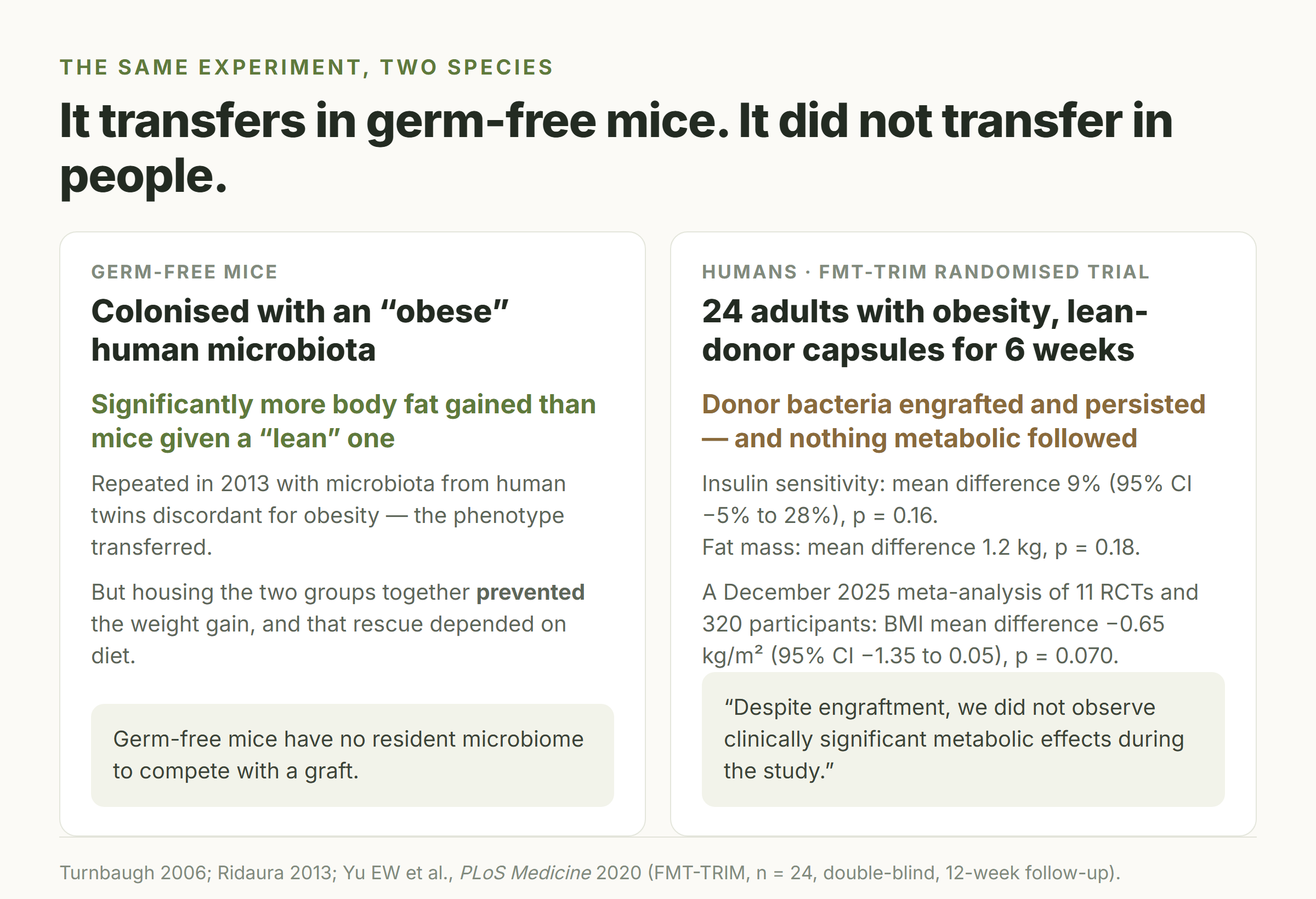
The strongest-sounding evidence for the myth comes from mice, and it is genuinely striking. Colonize germ-free mice with an “obese” human microbiota and they gain significantly more body fat than mice given a “lean” one (Turnbaugh 2006). Ridaura and colleagues repeated it in 2013 using microbiota from human twins discordant for obesity, and the phenotype transferred — though housing the two groups of mice together prevented the weight gain, and that rescue depended on diet.
Then someone tried it in humans.
The FMT-TRIM trial (Yu and colleagues, PLoS Medicine, 2020) gave 24 adults with obesity weekly oral lean-donor fecal transplant capsules or placebo for six weeks, double-blind, followed for 12 weeks. The donor bacteria engrafted and persisted, so this was not a delivery failure. Insulin sensitivity: mean difference 9%, 95% CI −5% to 28%, p = 0.16. Fat mass: mean difference 1.2 kg, p = 0.18. The authors’ summary, verbatim: “Despite engraftment, we did not observe clinically significant metabolic effects during the study.”
A December 2025 meta-analysis of 11 RCTs and 320 participants agreed: BMI mean difference −0.65 kg/m² (95% CI −1.35 to 0.05, p = 0.070), not significant, with lipid outcomes null.
Germ-free mice have no resident microbiome to compete with a graft. You do.
So what does the evidence actually support?
Here is the part that survived. Less exciting than a bacterial villain, considerably more useful.
Fiber — the least controversial item on this page
A 2019 series of systematic reviews and meta-analyses in The Lancet found benefits showing up at intakes of at least 25 to 29 grams of fiber per day. Highest versus lowest intake: 15–30% lower all-cause and cardiovascular mortality, and 16–24% lower incidence of coronary heart disease, stroke, type 2 diabetes and colorectal cancer. Translated into people: about 13 fewer deaths and 6 fewer cases of coronary heart disease per 1,000 participants.
The honest caveat: much of that pooled evidence is observational cohort data within the review. A strong association, not a controlled experiment.
For context, MedlinePlus puts the recommendation for older children, adolescents and adults at 21 to 38 grams a day, and notes Americans currently average about 16 grams. Most of us are not close.
One practical warning, worth quoting directly: “Adding fiber to the diet slowly, instead of all at one time, can help reduce gas or diarrhea.” Doubling your fiber tomorrow buys you a miserable week.
The mechanism runs through short-chain fatty acids, the end products of fiber fermentation, produced largely by Faecalibacterium, Roseburia, Eubacterium rectale and Ruminococcus — all Firmicutes. Even there, researchers note that “a lack of well-designed and controlled human studies has hampered our understanding of the significance of SCFA in human metabolic health.”
Fermented foods — the best positive intervention data
The most interesting recent human trial came out of the Sonnenburg lab at Stanford, published in Cell in 2021. Seventeen weeks, 18 healthy adults per arm, randomized to a high-fiber diet or a high-fermented-food diet.
The result: “The high-fermented-food diet steadily increased microbiota diversity and decreased inflammatory markers.”
And the caveat most coverage dropped — the high-fiber arm’s primary outcome, a cytokine response score, was unchanged. That arm did show more microbiome-encoded fiber-degrading enzymes, but community diversity stayed stable, and the three distinct immune trajectories among high-fiber eaters tracked their baseline diversity.
One more thing that matters: this trial did not measure weight loss. It is evidence about diversity and inflammation, not about the scale.

Photo: Beatrice B / Pexels
Diversity — the real signal, and still a small one
If anything in the microbiome tracks body weight, it is diversity and richness, not a phylum ratio.
The MetaHIT consortium reported in Nature in 2013 that among 123 non-obese and 169 obese Danish individuals, “individuals with a low bacterial richness (23% of the population) are characterized by more marked overall adiposity, insulin resistance and dyslipidaemia and a more pronounced inflammatory phenotype.” Those low-richness individuals with obesity also gained more weight over time.
But hold it next to the pooled numbers. Across those 10 studies, Sze and Schloss put the risk ratios at 1.30 for low richness, 1.27 for low Shannon diversity and 1.20 for low evenness — and measured the entire diversity gap between non-obese and obese individuals at 2.07%. Their own words: “it is questionable whether that risk is biologically or clinically relevant.”
Diversity is the best-supported microbial correlate of body weight. It is also a weak one. Both halves are true, and I would rather give you both.
Ultra-processed food — cut it for a proven reason, not a bacterial one
The most convincing weight study in this whole pile has nothing to do with bacteria.
Hall and colleagues, Cell Metabolism, 2019: 20 weight-stable adults admitted to the NIH Clinical Center, randomized crossover, two weeks on an ultra-processed diet and two weeks on an unprocessed one. The meals were matched for presented calories, energy density, macronutrients, sugar, sodium and fiber. Participants ate as much or as little as they wanted.
On the ultra-processed diet they ate 508 ± 106 more calories per day (p = 0.0001) and gained 0.9 kg — about 2 pounds — in two weeks, versus losing the same amount on the unprocessed diet.
The design point is the whole story. Because sugar and fiber were matched, neither explains the effect. And the study did not attribute it to gut bacteria at all.
One common additive does appear to touch the microbiome directly: a 2022 controlled-feeding trial in Gastroenterology found 15 g/day of the emulsifier carboxymethylcellulose “perturbed gut microbiota composition in a way that reduced its diversity” and lowered fecal short-chain fatty acids. Real — but 16 people over 11 days, so hold it loosely.
The accurate framing is not that junk food feeds bad bacteria. It is that a low-fiber diet starves the fiber-fermenting ones and lowers short-chain fatty acid production.

Asparagus and burdock: fine foods, not a strategy
Two vegetables come up constantly here, usually side by side as if interchangeable. In USDA FoodData Central, they are not.
| Food | Total dietary fiber per 100 g (about 3.5 oz) |
|---|---|
| Asparagus, raw | 2.1 g (SR Legacy) / 1.88 g (Foundation) |
| Burdock root, raw | 3.3 g |
Asparagus at roughly 2 grams per 100 grams is a low-to-moderate fiber vegetable. Reaching a 25-gram day from asparagus alone would take well over a kilogram of it. Burdock carries about 57% more fiber per 100 grams and is a notable inulin source — one 2026 analysis measured about 5 grams per 100 grams fresh weight in burdock root, though single-study inulin figures swing a lot with method and growing conditions, so I would not rank it against anything.
Both are good vegetables. Neither is a fiber powerhouse. Beans, lentils and whole grains do far more of the work, and variety across many plants does more than any single vegetable.

Photo: douglas miller / Pexels
Do probiotic pills help with weight?
The honest answer: a little, maybe, and less than you would hope.
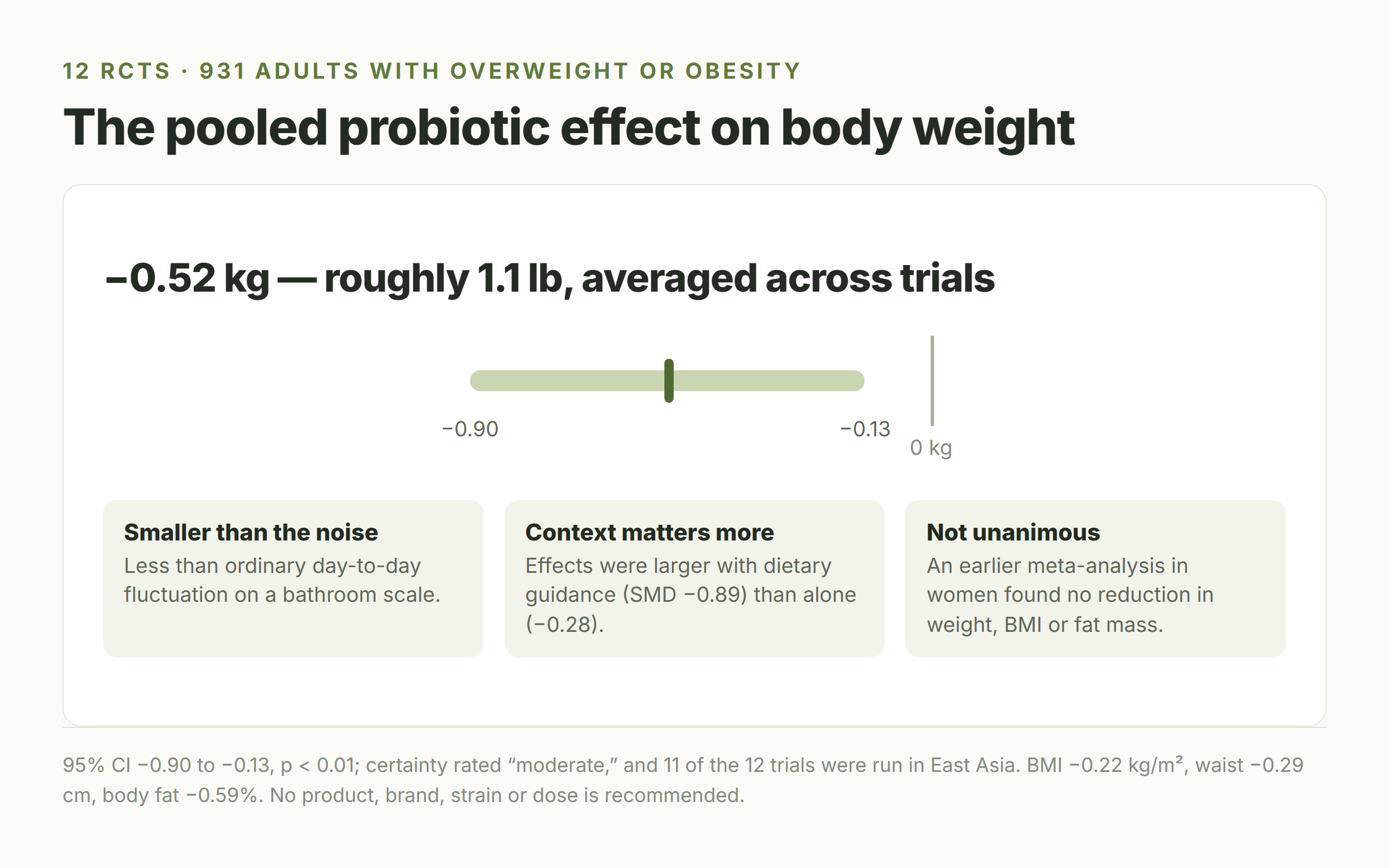
The most recent meta-analysis I found, published in March 2026 in Frontiers in Public Health, pooled 12 RCTs and 931 participants in overweight and obese adults:
- Body weight: −0.52 kg (95% CI −0.90 to −0.13; p < 0.01)
- BMI: −0.22 kg/m²; waist circumference: −0.29 cm; body fat: −0.59%
- Total cholesterol and triglycerides: not significant
Half a kilogram. Roughly 1.1 pounds, averaged across trials — smaller than ordinary day-to-day fluctuation on a bathroom scale. Certainty of evidence was rated “moderate,” with the authors noting that “future research could alter current conclusions.”
Three details shrink it further. Most trials were small and single-center. Eleven of the twelve were concentrated in East Asia, which raises real questions about applicability for a US reader. And effects were notably larger when the probiotic came combined with dietary guidance (SMD −0.89) than alone (SMD −0.28).
It is also not unanimous. An earlier meta-analysis restricted to overweight and obese women found probiotics significantly reduced waist circumference (SMD −0.39), insulin and LDL — but pooled data from seven of those studies found no reduction in body weight, BMI, or fat mass at all. Both results belong on the table.
The same pattern shows up in Akkermansia research, which draws a lot of excited coverage. In a 2019 proof-of-concept study in Nature Medicine, pasteurized A. muciniphila improved insulin sensitivity by 28.62% (p = 0.002) in overweight volunteers — but body weight (−2.27 kg, p = 0.091) and fat mass (−1.37 kg, p = 0.092) were not statistically significant, and the authors stated the study “was not powered to deliver definitive conclusions.”
Two notes from NIH’s NCCIH. “Many probiotics are sold as dietary supplements, which don’t require FDA approval before they are marketed” — quality, dose and strain content vary between products. And NCCIH’s probiotics page contains no statement supporting probiotics for obesity or weight at all.
They are also not risk-free. Per NCCIH: “Cases of severe or fatal infections have been reported in premature infants who were given probiotics,” and “the FDA has warned health care providers about this risk.” “The risk of harmful effects from probiotics is greater in people with severe illnesses or compromised immune systems.”
I am not recommending any product, brand, strain or dose here, and I would be skeptical of anyone who does.
When to talk to a clinician
Some of this needs a professional, not an article.
- Before starting any supplement, including probiotics, if you are pregnant or breastfeeding, immunocompromised, seriously ill, have a central venous catheter, or are caring for a premature infant.
- Before a large change in dietary fiber, if you take prescription medication, have diabetes or a diagnosed GI condition such as IBD, IBS or celiac disease, or have had GI surgery.
- If you want to lose weight and have not discussed it with a clinician. NIDDK notes that beyond eating and activity changes, options include weight-loss medicines and metabolic surgery, all of which require medical evaluation.
- Promptly, for unexplained weight loss or gain, persistent abdominal pain, persistent diarrhea or constipation, blood in the stool, or new severe digestive symptoms. These need evaluation, and they are not something to self-treat with fiber or probiotics.
- Before making a health decision based on a direct-to-consumer gut microbiome test. The evidence above is exactly why — microbiome-based classification of obesity status ran at about 57% accuracy.
The short version
Compressed into a few lines, it comes out like this.
“Firmicutes” is a phylum, not a bug — and Lactobacillus, the probiotic you were told to take to suppress it, is one. The 2006 paper that launched the story called both dominant phyla beneficial. The ratio built on top of it did not replicate across 10 pooled studies, and sorts lean from obese at about 57% accuracy. A weight-loss diet raises that ratio rather than lowering it. And your microbiome is shaped far more by your kitchen than by your genes.
What is left is unglamorous and boringly reliable. Eat more fiber, from more different plants, working up gradually. Add fermented foods. Cut ultra-processed food — not because it feeds anything, but because it made 20 people in a metabolic ward eat 508 more calories a day without noticing.
Which brings me back to my thin friend.
Whatever explains the difference between us, it is not a fixed bacterial body type I was issued at birth. That was the part of the myth that quietly stung — the idea that the outcome was already decided, and the only question was which bacteria I had been assigned.
The evidence says otherwise. Most of what shapes a gut microbiome is the part you can still change, and it moves within days.
That is a smaller promise than “kill your fat bugs.” It also happens to be true — and I would rather build on something that holds.
Disclaimer: This article is general information, not medical advice. It does not diagnose, treat, cure, or prevent any disease. Every effect size quoted here comes from a specific study population and is an average across a group, not a prediction for any individual. No product, brand, or supplement is recommended. Dietary supplements, including probiotics, are not approved by the FDA before they are marketed. Talk to a health care professional before substantially changing your diet or starting any supplement.
References
- Ley RE, Turnbaugh PJ, Klein S, Gordon JI (2006). “Microbial ecology: human gut microbes associated with obesity.” Nature 444:1022–1023.
- Turnbaugh PJ, et al. (2006). “An obesity-associated gut microbiome with increased capacity for energy harvest.” Nature 444:1027–1031.
- Sze MA, Schloss PD (2016). “Looking for a Signal in the Noise: Revisiting Obesity and the Microbiome.” mBio 7(4):e01018-16.
- Finucane MM, Sharpton TJ, Laurent TJ, Pollard KS (2014). “A Taxonomic Signature of Obesity in the Microbiome?” PLoS ONE 9(1):e84689.
- Walters WA, Xu Z, Knight R (2014). “Meta-analyses of human gut microbes associated with obesity and IBD.” FEBS Lett 588:4223–4233.
- Magne F, et al. (2020). “The Firmicutes/Bacteroidetes Ratio: A Relevant Marker of Gut Dysbiosis in Obese Patients?” Nutrients 12(5):1474.
- Wang S, et al. (2025). “The impact of very-low-calorie ketogenic diets on gut microbiota in individuals with obesity.” Gut Microbes 17(1):2566305.
- Jumpertz R, et al. (2011). “Energy-balance studies reveal associations between gut microbes, caloric load, and nutrient absorption in humans.” Am J Clin Nutr 94:58–65.
- David LA, et al. (2014). “Diet rapidly and reproducibly alters the human gut microbiome.” Nature 505:559–563.
- Ridaura VK, et al. (2013). “Gut microbiota from twins discordant for obesity modulate metabolism in mice.” Science 341:1241214.
- Rothschild D, et al. (2018). “Environment dominates over host genetics in shaping human gut microbiota.” Nature 555:210–215.
- Yu EW, et al. (2020). “Fecal microbiota transplantation for the improvement of metabolism in obesity (FMT-TRIM).” PLoS Medicine 17(3):e1003051.
- “Effects of fecal microbiota transplantation on glycemic and lipid profiles in overweight or obese patients with metabolic disorders” (2025). Front Endocrinol.
- Le Chatelier E, et al. / MetaHIT (2013). “Richness of human gut microbiome correlates with metabolic markers.” Nature 500:541–546.
- Reynolds A, Mann J, Cummings J, Winter N, Mete E, Te Morenga L (2019). “Carbohydrate quality and human health: a series of systematic reviews and meta-analyses.” The Lancet 393:434–445.
- Wastyk HC, et al. (2021). “Gut-microbiota-targeted diets modulate human immune status.” Cell 184:4137–4153.e14.
- Depommier C, et al. (2019). “Supplementation with Akkermansia muciniphila in overweight and obese human volunteers.” Nature Medicine 25:1096–1103.
- Hall KD, et al. (2019). “Ultra-Processed Diets Cause Excess Calorie Intake and Weight Gain.” Cell Metabolism 30:67–77.e3.
- Chassaing B, et al. (2022). “Randomized Controlled-Feeding Study of Dietary Emulsifier Carboxymethylcellulose.” Gastroenterology 162:743–756.
- Morrison DJ, Preston T (2016). “Formation of short chain fatty acids by the gut microbiota and their impact on human metabolism.” Gut Microbes 7:189–200.
- den Besten G, et al. (2013). “The role of short-chain fatty acids in the interplay between diet, gut microbiota, and host energy metabolism.” J Lipid Res 54:2325–2340.
- Zheng J, et al. (2020). “A taxonomic note on the genus Lactobacillus.” Int J Syst Evol Microbiol.
- “Efficacy of probiotic supplementation for body weight management in overweight and obese adults” (2026). Front Public Health.
- Burabaev A, et al. (2026). “Evaluation of inulin content in selected plant species for functional applications.” Natural Product Research.
- NCBI Taxonomy Browser (IDs 1578, 853, 572511, 1678, 239934); LPSN, phylum Bacillota.
- USDA FoodData Central (FDC 168389, 2710823, 169974).
- MedlinePlus (NLM/NIH), “Dietary fiber”; NIH NCCIH, “Probiotics: What You Need To Know”; NIDDK, “Overweight & Obesity.”