Omega-3 Gone Rancid? How to Choose and Spot Bad Fish Oil
Let me start with a confession.
For years, I kept a big bottle of fish oil on the kitchen windowsill. Right there in the sun, next to the toaster. It looked wholesome — like something a healthy person would own. I took one most mornings and felt vaguely virtuous about it.
I now know that windowsill was slowly turning my “health supplement” into something closer to spoiled cooking oil.
That is the uncomfortable thing about omega-3. It is genuinely good for you — and it is also one of the most fragile things in your cabinet. Taken wrong, or stored wrong, a fish oil capsule can go rancid, lose its potency, and taste like the inside of a bait bucket. So if you have ever wondered whether your fish oil could be doing more harm than good, this is worth reading.
One honest note before we start, though.
I am not your doctor, and none of this is medical advice. It is general information drawn from sources like GOED, peer-reviewed studies on PubMed, and consumer testing labs. Supplements complement a balanced diet — they are not treatments. If you take blood thinners, are pregnant, or have surgery coming up, the details in the safety section below are for you, but the final call belongs to your doctor or pharmacist.

Photo: Supplements On Demand / Pexels
Why omega-3 goes rancid so fast
Here is the part the shiny label leaves out.
The very thing that makes omega-3 valuable — those EPA and DHA fatty acids — is also what makes it fragile. Their molecules are full of double bonds, and double bonds are chemically twitchy. Expose them to oxygen, heat, or light and they start to break down in a process called lipid peroxidation. In plain English: they oxidize. They go rancid.
And it happens faster than you would think.
According to fish oil specialists, a single day sitting in the sun or in a hot car is enough to start the oxidation clock. My sunny windowsill, in other words, was doing real damage. Those broken-down molecules — lipid peroxides — are exactly what create that “fish gone bad” smell and taste.
So the number of milligrams of EPA and DHA on the box was never the whole story. Freshness matters just as much.

Photo: Atlantic Ambience / Pexels
It helps to remember why we bother with any of this. Fatty fish like salmon is the original, unbeatable source of EPA and DHA, and a supplement is only ever a stand-in for it. That is worth keeping in mind — a fresh fillet does not have a rancidity problem.
The three numbers that measure rancidity
If you want to get technical, rancidity is actually measurable, and it is worth knowing the vocabulary.
There are three common markers:
- Peroxide Value (PV) — measures the primary oxidation products.
- Anisidine Value (p-AV) — measures the secondary oxidation products.
- TOTOX — the “total oxidation” score that combines both, calculated as (2 × PV) + p-AV.
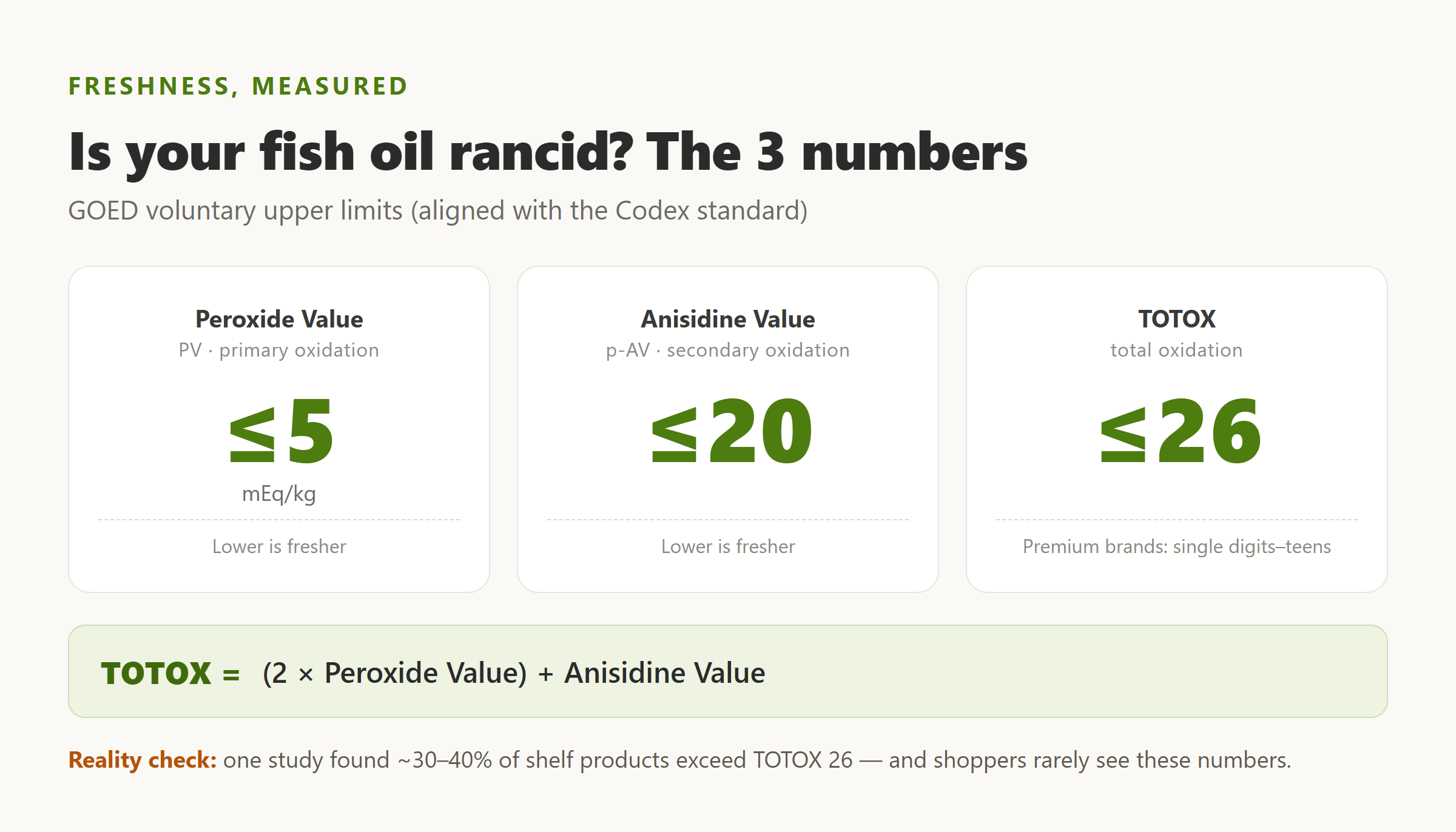
The industry group GOED publishes voluntary upper limits, which also line up with the international Codex standard:
- Peroxide value at or under 5 mEq/kg
- Anisidine value at or under 20
- TOTOX at or under 26
Good brands aim well below those ceilings — many premium fish oils land in the low teens or single digits. The catch is that the average shopper never sees these numbers unless a brand publishes a certificate of analysis. And plenty of products would not look great if they did: one study of 72 over-the-counter omega-3 supplements found that 68% of flavored ones and 13% of unflavored ones exceeded the TOTOX limit, and broader estimates put roughly 30–40% of shelf products above TOTOX 26.
That is not a fringe problem. That is a big chunk of the shelf.
So — is rancid fish oil actually harmful?
This is where I have to be careful, because the honest answer is messier than the scary headlines suggest.
You have probably seen claims that rancid fish oil is “toxic” or even “carcinogenic.” I want to be straight with you: that is not established in humans.
The clearest, best-supported downside of rancid fish oil is simpler and less dramatic — it loses potency, it can taste and smell awful, and it may cause digestive discomfort. In other words, you are likely wasting your money and your morning burps on a degraded product.
On the question of real bodily harm, human evidence is genuinely mixed:
- A study of 52 women taking oxidized versus fresh fish oil for 30 days found no significant impact on cholesterol or blood pressure.
- Another randomizing 83 people to oxidized fish oil, fresh fish oil, or sunflower oil for several weeks found no significant changes in inflammation, oxidative stress, or heart-risk markers.
- GOED, for its part, says the science does not support claims that rancid fish oil is toxic.
There are more concerning signals in animal studies — for instance, oxidized fish oil worsened alcohol-related liver injury in mice — but animal findings are not proof of human harm.
Photo: Nataliya Vaitkevich / Pexels
So here is my honest read. Do not panic that your old bottle is poisoning you. But do not take rancid oil either — because at best it is doing nothing, and “an expensive supplement doing nothing” is its own kind of harm to your wallet and your routine.
How to choose a good omega-3
Two things separate a fresh, well-absorbed omega-3 from a mediocre one: the form and the packaging.
Look for the rTG form
Fish oil comes in different molecular forms, and they are not absorbed equally.
The re-esterified triglyceride (rTG) form most closely mimics the natural structure of omega-3 in actual fish, and it absorbs better than the cheaper, more common ethyl ester (EE) form. Reported figures suggest the triglyceride form has roughly 50–70% better bioavailability than ethyl ester — one trial put it at about 124% relative bioavailability for the triglyceride oil versus around 73% for ethyl ester.
I will add one honest caveat, because the marketing rarely does. The re-esterification process is imperfect — in some “rTG” products, only about 55–60% of the oil is actually in that rTG form. So treat rTG as a reasonable preference, not a magic guarantee.
Prefer protective packaging
Remember the enemies: oxygen, heat, light. Good packaging fights all three.
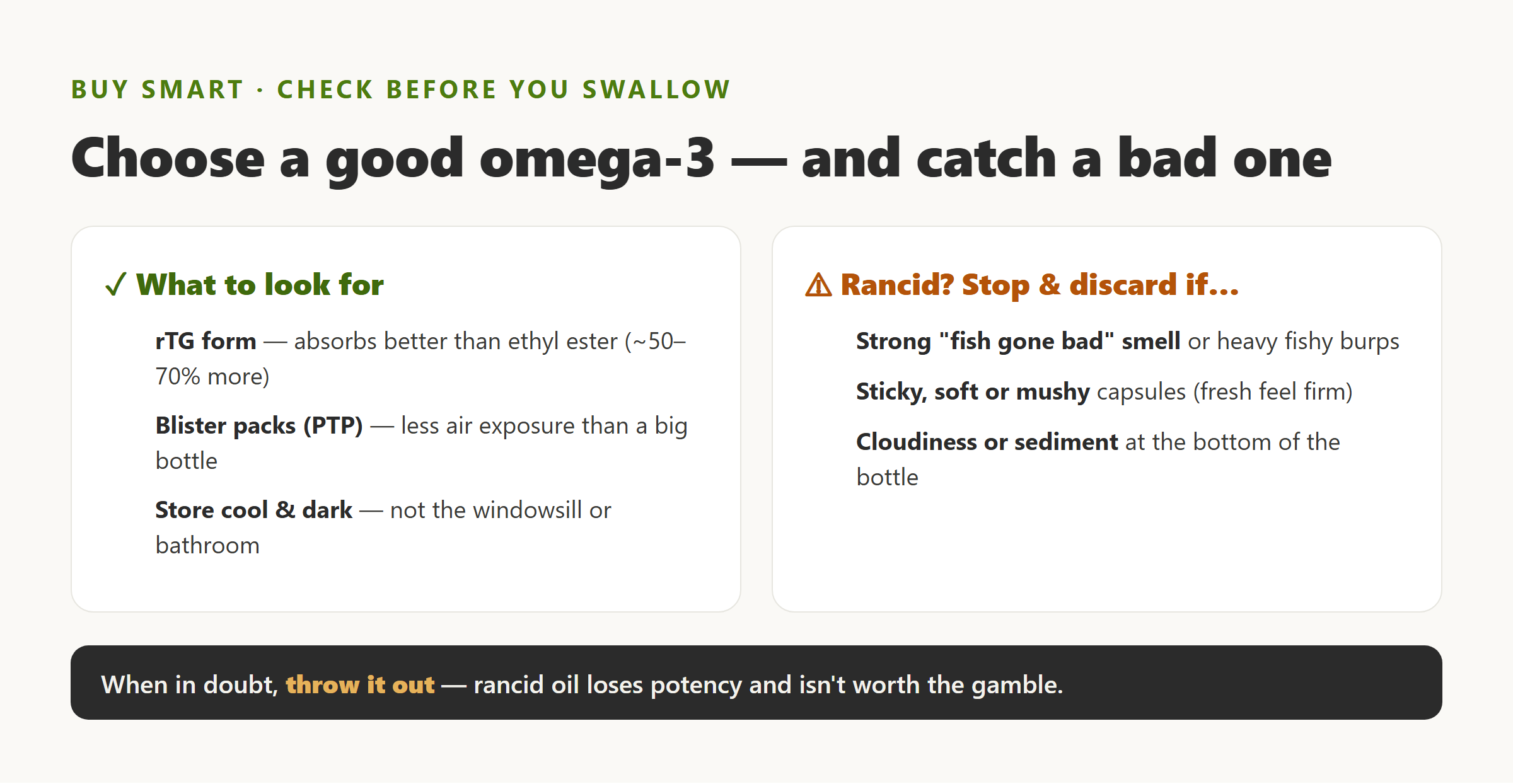
Individually sealed blister packs (PTP) limit air exposure far better than a big bottle you open every single day. Every time you crack a large bottle, you let a little more oxygen in to work on the remaining capsules. Double-layer and UV-blocking packaging help too. Then store the thing properly — cool, dark, tightly closed. Not the sunny windowsill. Not the bathroom cabinet. Not next to the stove.
How to spot a rancid capsule
You do not need a lab to catch the obvious cases. Your nose and eyes do most of the work.
Stop and discard if you notice:
- A strong “fish gone bad” smell — fresh fish oil should be relatively mild. A sharp, sour, deeply fishy odor is a red flag.
- Excessive fishy burps or an unpleasant aftertaste.
- Sticky, soft, or mushy capsules — fresh capsules feel firm and bounce back.
- Cloudiness, splotchiness, or sediment settling at the bottom of the bottle.
If your fish oil hits any of these, do not push through it. Toss it. When in doubt, throw it out — a rancid capsule is not worth the gamble, and it certainly is not delivering the benefit you bought it for.
The safety part — please don’t skip this
Most of this article is about quality. This part is about not getting hurt.
Omega-3 has a mild blood-thinning effect. For most people at normal doses that is harmless, but it matters in a few situations:
- Blood thinners. With warfarin or other anticoagulants, the interaction is usually minor at typical doses but can become meaningful at higher doses — generally above 3 grams a day — where bleeding time can lengthen. If you take an anticoagulant, talk to your doctor before adding omega-3.
- Surgery. Many surgeons advise stopping fish oil about 1 to 2 weeks before elective surgery, especially if you are also on blood thinners.
- Other supplements. High-dose vitamin E and some other supplements can add to that bleeding effect.
- A common general range is 1 to 3 grams a day; go higher only under medical supervision.
- Pregnant, managing a chronic illness, or on prescriptions? Check with a clinician first.
Interestingly, the FDA has said omega-3 drugs do not increase the risk of clinically significant bleeding — yet many clinicians still play it safe. Both things can be true, which is exactly why the decision should be yours and your doctor’s, not a stranger on the internet’s.
The short version
If I had to compress all of this onto a sticky note, it would read like this.
Omega-3 is good for you and fragile as glass. It oxidizes with oxygen, heat, and light, and a big chunk of the market is already past the freshness line. Rancid oil is probably not poisoning you, but it is likely doing nothing — so choose the rTG form, prefer blister packs over a giant bottle, and store it cool and dark. Trust your nose: a strong fishy smell, sticky capsules, or sediment means toss it. And if you take blood thinners or have surgery coming, loop in your doctor before your next dose.
None of this makes fish oil do more than it can. What it does is make sure the fish oil you actually swallow is fresh enough to be worth swallowing.
Because the version quietly oxidizing on my old windowsill was never really a health supplement.
It was just expensive spoiled oil in a nicer bottle.
References
- GOED — “Oxidation in Omega-3 Oils: An Overview” (peroxide, anisidine, TOTOX limits)
- PMC — “Fishing for answers: is oxidation of fish oil supplements a problem?”
- PLOS One — 16-week trial on re-esterified triglyceride omega-3 bioavailability
- Drugs.com — Fish Oil + Warfarin interaction
- OmegaQuant / ConsumerLab — how to tell if fish oil is rancid