
How to Choose a Multivitamin and Avoid Side Effects
Let me start with a confession.
I once paid a small fortune for an imported, “high-potency” multivitamin because someone I trusted online swore by it. It had impressive numbers on the label — percentages in the hundreds, ingredients I couldn’t pronounce. And for a few weeks I felt very responsible, right up until I noticed my urine had turned an alarming neon yellow and started to wonder what, exactly, I was paying for.
Here is what I eventually learned.
That expensive bottle was not necessarily better than a cheap one. A lot of what I was swallowing was heading straight into the toilet — and the neon color was actually the clue. So if you are standing in the vitamin aisle trying to figure out how to choose a multivitamin without wasting money or risking side effects, let me save you the tuition I paid.
First, the honest disclaimer.
I am not a doctor or a dietitian, and this is general information, not medical advice. It draws on sources like the NIH Office of Dietary Supplements, Harvard’s Nutrition Source, and the U.S. Preventive Services Task Force. Supplements complement a balanced diet — they are not treatments, and they do not cure disease. If you think you are deficient in something, the right move is a blood test and a conversation with your doctor, pharmacist, or a registered dietitian.

Photo: Future Kind Vegan Supplements / Pexels
The myth of “the more, the better”
Let me get the biggest misconception out of the way first.
A higher dose is not automatically better, and it is not necessarily better absorbed. Your body uses a limited amount of most vitamins at any given time. Past that point, the extra is either flushed out or, for some vitamins, stored — but “stored” is not the same as “extra benefit.”
This is where the neon urine comes in.
That bright yellow is mostly riboflavin — vitamin B2 — leaving your body. The recommended amount of riboflavin is only about 1.1 milligrams a day, yet supplements often pack in 25 to 75 milligrams. Riboflavin is water-soluble, so your body simply excretes the enormous excess. The color is not a sign the vitamin is “working.” It is a sign you paid for more than you can use.
So that “premium potency” you were sold? A good chunk of it may be a very expensive way to make your pee glow.
Why water-soluble and fat-soluble vitamins are a different game
Here is the distinction that actually matters for safety.
Vitamins fall into two groups, and they behave very differently once they are inside you:
- Water-soluble vitamins (the B-complex and vitamin C) cannot be stored. As Harvard’s Nutrition Source puts it, any that your body does not use “is primarily lost through urine.” Excess is usually low-risk.
- Fat-soluble vitamins (A, D, E, and K) dissolve in fat and “tend to accumulate in the body.” They are stashed in your liver and fatty tissue — and too much, for too long, can build up to genuinely toxic levels.
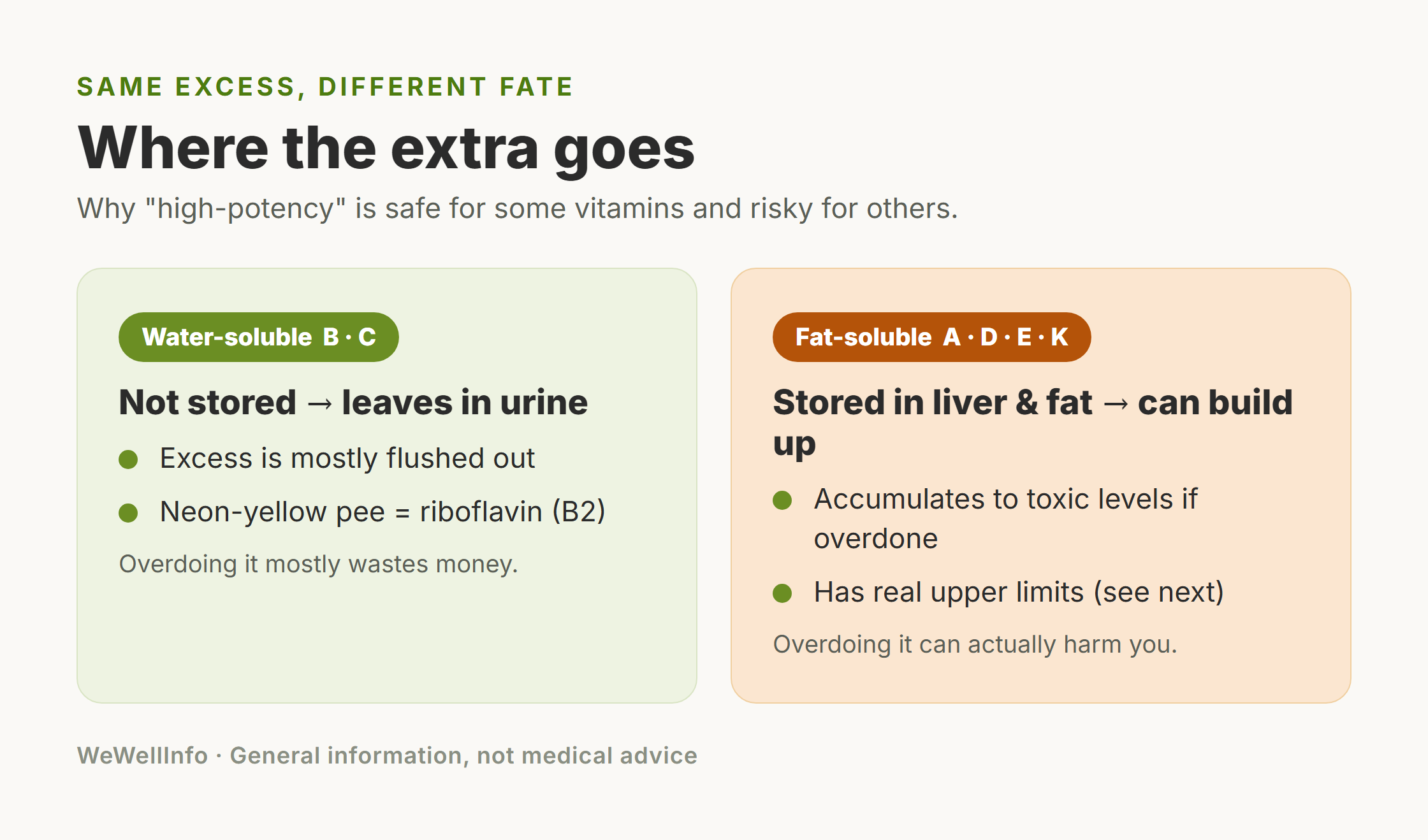
That is the real reason a “high-potency” label deserves a second look. Overdoing water-soluble B and C mostly wastes money. Overdoing the fat-soluble ones can hurt you.
One quick correction while we are here, because people misread it: the neon urine is a riboflavin thing. It tells you nothing about your fat-soluble vitamin levels, which do not announce themselves in the toilet at all.
The ceilings you should not blow past
Because fat-soluble vitamins accumulate, they come with an upper limit — the Tolerable Upper Intake Level, or UL. It is the most you can take daily without likely harm, and for these vitamins it is lower than you might think.

For adults, the daily upper limits are roughly:
- Vitamin A: 3,000 mcg RAE (about 10,000 IU). Chronic excess can damage the liver.
- Vitamin D: 100 mcg (4,000 IU).
- Vitamin E: 1,000 mg of supplemental alpha-tocopherol. High-dose vitamin E has been linked to a higher risk of hemorrhagic stroke.
The B vitamins and vitamin C do not have set upper limits, because your body clears the excess — but “no limit” is not an invitation to megadose. It just means toxicity is rare.
The trap with a “high-potency” formula is stacking. If your multivitamin is generous with fat-soluble vitamins, and you also eat fortified foods and pop a separate vitamin D, those numbers add up toward the ceiling faster than anyone intends.
Do you even need a multivitamin?
This is the question the supplement aisle would rather you skipped.
Food first, honestly. Harvard’s Nutrition Source is blunt about it: a diet with plenty of fruits, vegetables, whole grains, good proteins, and healthful fats “should provide most of the nutrients needed for good health.” For a reasonably well-fed, healthy adult, a daily multivitamin generally won’t extend your life or prevent disease. You buy one to fill a specific gap — not as insurance against a bad diet.
The evidence backs this up. In 2022, the U.S. Preventive Services Task Force found insufficient evidence that multivitamins prevent heart disease or cancer in healthy adults, and it recommended against beta-carotene (which raises lung cancer risk, especially in smokers) and against vitamin E.
But “most people don’t need one” is not the same as “nobody does.” Some people genuinely benefit:
- Older adults (50+), who absorb less B12 and are often advised to get it from fortified foods or a supplement.
- Anyone pregnant or planning pregnancy, who needs folic acid (0.4 to 0.8 mg a day) to help prevent neural tube defects — a prenatal is standard here.
- People on restricted diets, like vegans and vegetarians who need B12 and often iron.
- People with malabsorption conditions — celiac, IBD, or after bariatric surgery — who benefit from supplementation at any age.

Photo: SHVETS production / Pexels
If you are a smoker or former smoker, one more caution: avoid multivitamins loaded with beta-carotene or high vitamin A, because of the lung cancer risk. This is a case where “more” is not just wasteful — it is the wrong direction entirely.
How to actually read the label
Say you have decided you have a real gap to fill. Now comes the part the influencer’s affiliate link skipped: scrutinizing the formulation.
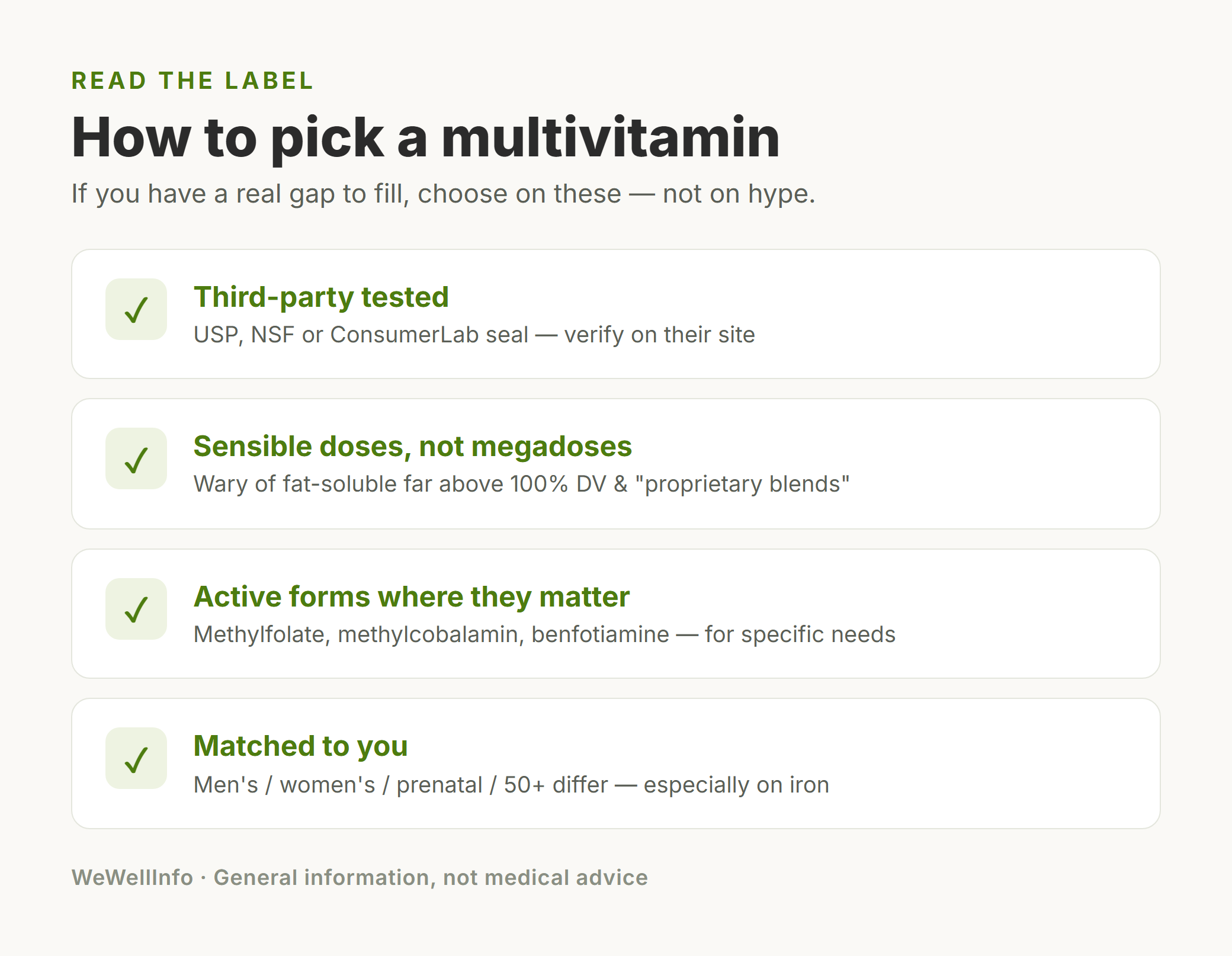
Here is what I look for now.
Third-party testing
The supplement industry is not pre-approved by the FDA for what’s actually in the bottle. So I look for a seal from USP, NSF, or ConsumerLab, and I verify it on the certifier’s own website. Independent testing checks that the pill contains what the label claims, in the right amount, without heavy metals or contamination. A transparent brand will publish who tested it and post batch results.
Sensible doses, not megadoses
I compare the percent Daily Value and get suspicious of anything far above 100% on the fat-soluble vitamins, or of “proprietary blends” that hide how much of each ingredient you’re actually getting. Bigger numbers are a marketing tactic more often than a health one.
Active forms, where they matter
This is the one genuinely useful bit of formulation nerdery. Some ingredients come in “active” forms your body can use directly:
- Methylfolate instead of folic acid, and methylcobalamin instead of cyanocobalamin — the active forms of folate and B12, which can matter for people with certain gene variants (MTHFR).
- Benfotiamine, a fat-soluble form of vitamin B1 that reaches nerve tissue more effectively — of specific interest for diabetic neuropathy or alcohol-related B1 depletion, not something everyone needs.
I want to be balanced here, though. For most healthy people, the practical advantage of these active forms over standard ones is modest. They matter for specific situations, not as a reason to pay triple.
Matched to you
A men’s formula, a women’s, a prenatal, and a 50+ blend differ for real reasons — iron needs, especially. Many men and post-menopausal women don’t need added iron, so a formula loaded with it isn’t automatically “better.”
The safety part worth slowing down for
Most of this article is about not wasting money. This part is about not getting hurt.
Fat-soluble overdose is a real risk, not a theoretical one. Do not exceed those upper limits — vitamin A 3,000 mcg, vitamin D 4,000 IU, vitamin E 1,000 mg for adults — without medical supervision. And remember the whole premise: supplements complement a balanced diet; they do not treat or cure disease. Suspect a deficiency? Get a blood test rather than self-prescribing from a label.

Photo: cottonbro studio / Pexels
Interactions deserve the same caution:
- Vitamin K can work against warfarin and other blood thinners. If you take an anticoagulant, keep intake steady and ask your doctor before adding any.
- Iron, calcium, and magnesium can block the absorption of some medications, including certain thyroid drugs and antibiotics — space them apart.
- St. John’s Wort interacts with a long list of prescriptions.
- If you are pregnant, managing a chronic illness, or on any medication, talk to a clinician before starting something new.
None of this is meant to scare you off supplements. It is meant to move the decision out of the marketing and into your actual life.
The short version
If I could go back and hand my younger, neon-urined self one card, it would say this.
Higher potency is not automatically better, and a lot of it just leaves in your urine — that’s the riboflavin talking. Water-soluble B and C are hard to overdo; fat-soluble A, D, E, and K accumulate, so respect the upper limits. Most healthy, well-fed adults don’t need a multivitamin at all — check your actual diet and life stage first. And if you do buy one, choose it on third-party testing, sensible doses, and the right forms, not on a stranger’s enthusiasm.
The expensive imported bottle wasn’t the answer. Paying attention was.
Because in the end, the smartest supplement decision usually starts on your plate — and, when in doubt, with someone who can actually see your bloodwork.
References
- Harvard T.H. Chan School of Public Health — The Nutrition Source, “Vitamins and Minerals”
- NIH Office of Dietary Supplements — Multivitamin/Mineral Supplements Fact Sheet
- U.S. Preventive Services Task Force (2022) — Vitamin, Mineral, and Multivitamin Supplementation to Prevent CVD and Cancer
- Johns Hopkins Medicine — “Is There Really Any Benefit to Multivitamins?”
- Cleveland Clinic — “Vitamin A Toxicity: How Much Vitamin A Is Too Much?”