Smiling Depression: A Self-Check and Path to Healing
Let me describe a particular kind of tired.
You get through the day. You answer the messages, you laugh at the right moments, you tell everyone you are doing great — and you might even mean it, in the moment. But when the door closes and the room goes quiet, something drains out of you. An emptiness you would never let anyone see.
If you are smiling on the outside but crumbling on the inside, this article is for you.
One honest note before we go further, though.
I am not your therapist, and this is not a diagnosis. It is general information drawn from sources like WebMD and the National Institute of Mental Health. The self-check below is a gentle mirror, not a verdict. If it resonates, the kindest thing you can do is bring it to a mental health professional — not to a search bar.
Photo: Ivan S / Pexels
What “smiling depression” really is
Let me clear up the term first, because the framing matters.
“Smiling depression” — sometimes called masked or high-functioning depression — is a popular, everyday phrase. It is not a formal diagnosis. As WebMD notes, some clinicians use it to describe people who are depressed but look and act happy, and it “isn’t an official diagnostic category.” You will not find it in the psychiatric manual, the DSM-5.
So what is actually going on underneath?
Experts believe it may correspond to a real depressive disorder — often major depression with atypical features, or persistent depressive disorder, a milder but long-lasting form. The symptoms are essentially those of depression. What makes this version different is that they are felt intensely on the inside and shown almost nowhere on the outside.
That is the whole paradox. The pain is real. The mask is convincing.
Why it hides so well
Here is what makes this so easy to miss — including for the person living it.
People with smiling depression, as WebMD puts it, “power through daily activities as usual.” They are high-functioning. They excel at work, keep up their friendships, meet every responsibility — all while carrying an inner sadness or emptiness. From the outside, nothing looks wrong.

Photo: Andrea Piacquadio / Pexels
The split usually runs along a public-private line. Cheerful in the group chat; numb alone at night. Humor and busyness and taking care of everyone else — all deployed, sometimes without thinking, to keep the attention off yourself. There may be crying that only ever happens in private.
WebMD notes this shows up more often in certain people: those from cultures where mental illness carries heavy stigma, those living outwardly successful lives, and perfectionists with a deep fear of appearing weak. If that is you, please hear this — the fact that you are so good at hiding it is not a strength you owe anyone.
A gentle self-check (for reflection, not diagnosis)
Find a quiet moment for these. There is no grade at the end.
- I feel a persistent sadness, emptiness, or numbness that I hide from others.
- I still function — work, friends, responsibilities — but it feels hollow.
- I have lost interest in things I used to enjoy.
- My sleep or appetite has shifted from its usual pattern.
- I feel unusually tired, or find it hard to concentrate.
- I carry feelings of worthlessness or heavy, out-of-place guilt.
- I cry, or feel like crying, mostly when no one can see.
- I have had thoughts of death, or that others would be fine without me.

Two things about this list.
First, timing matters. The National Institute of Mental Health describes a depressive episode as at least two weeks of low mood or lost interest, alongside several of these signs. A hard day is human. A hard fortnight that will not lift is worth taking seriously.
Second, and I want to be direct here — if that last item is present for you, please do not wait. Skip to the section on getting help below, or reach out right now. In the US, you can call or text 988 at any hour.
Why hiding it is the dangerous part
I want to name the risk plainly, without drama.
When you are depressed, WebMD explains, you think more negatively about yourself and the world — and that can raise the risk of suicide. There is a specific concern with the smiling, high-functioning version: because a person still looks capable and energetic, the danger can be easy for everyone, including them, to underestimate.
That is exactly why the mask is not just exhausting. It can be dangerous.
So if you take one thing from this article, let it be this: you do not have to be visibly falling apart to deserve support. “Managing” is not the same as “fine.” Reaching out while you still look okay is not an overreaction. It might be the wisest thing you do.
Two feeders of hidden depression — and how to answer them
Two habits tend to keep this cycle turning. Naming them is the first loosening.
Feeder one: caring too much about how you appear
Perfectionism, stigma, the fear of looking weak — these are what hold the mask in place.
The answer is not a performance of positivity. It is quieter than that. It is letting yourself, internally, be not-okay. Giving up the exhausting project of appearing fine at all times.
There is a phrase for it that has become a little worn, and I still believe in it: it is okay to not be okay.

Photo: Kaboompics.com / Pexels
And there is a concrete step attached to it. WebMD’s own self-help guidance includes having honest conversations with people you trust. You do not have to announce it to everyone. One person, one true sentence — “I have not actually been okay” — is often where the mask finally sets down.
Feeder two: suppressing every negative feeling
The other engine is avoidance. Pushing every difficult emotion down and out of sight.
The trouble is, suppressing thoughts and feelings does not make them lighter. Research on emotional inhibition suggests it actually increases your mental load — you are spending energy holding the lid on.

Photo: cottonbro studio / Pexels
This is where emotion journaling earns its place. Writing about emotional challenges is associated with lower levels of anxiety and depression, drawing on a research tradition that goes back decades. It seems to work in a few ways at once: it releases what you have been holding in, it gently exposes you to the feelings until they lose some of their charge, and it helps you build a coherent story out of the mess — which brings clarity and a shift in perspective. Studies suggest it helps most when you write with acceptance rather than judgment.
So the practice is simple, if not easy. Write privately and honestly about how you actually feel — not a highlight reel, not what you would post. Name the emotion. Let it be what it is. It is one of the few reliable ways to hear your own true inner voice again.
Healing that lasts — and why self-help is not the whole answer
I want to be careful here, because I have just spent two sections on journaling and honesty, and those things genuinely help.
But they are supports, not substitutes.
Depression is treatable, and the treatments work. The main approaches, per WebMD and NIMH, are psychotherapy — talk therapy like cognitive behavioral or interpersonal therapy, in person or virtual — and medication, or a combination of both. If your low mood persists or simply will not go away, NIMH’s guidance is direct: talk to a health care provider.
And if part of you feels like reaching out would be an overreaction, consider the scale of this. NIMH estimates that around 21 million U.S. adults — about 8.3% — had a major depressive episode in a single year. You are in enormous, unremarkable company. There is nothing rare or shameful about needing help for this.
So please do not let “I will just journal my way out of it” become another, gentler version of the mask. Journaling and self-acceptance are wonderful next to treatment. They are not meant to stand in for it when it is needed.
When and how to reach for help
Let me make this part unmistakable.
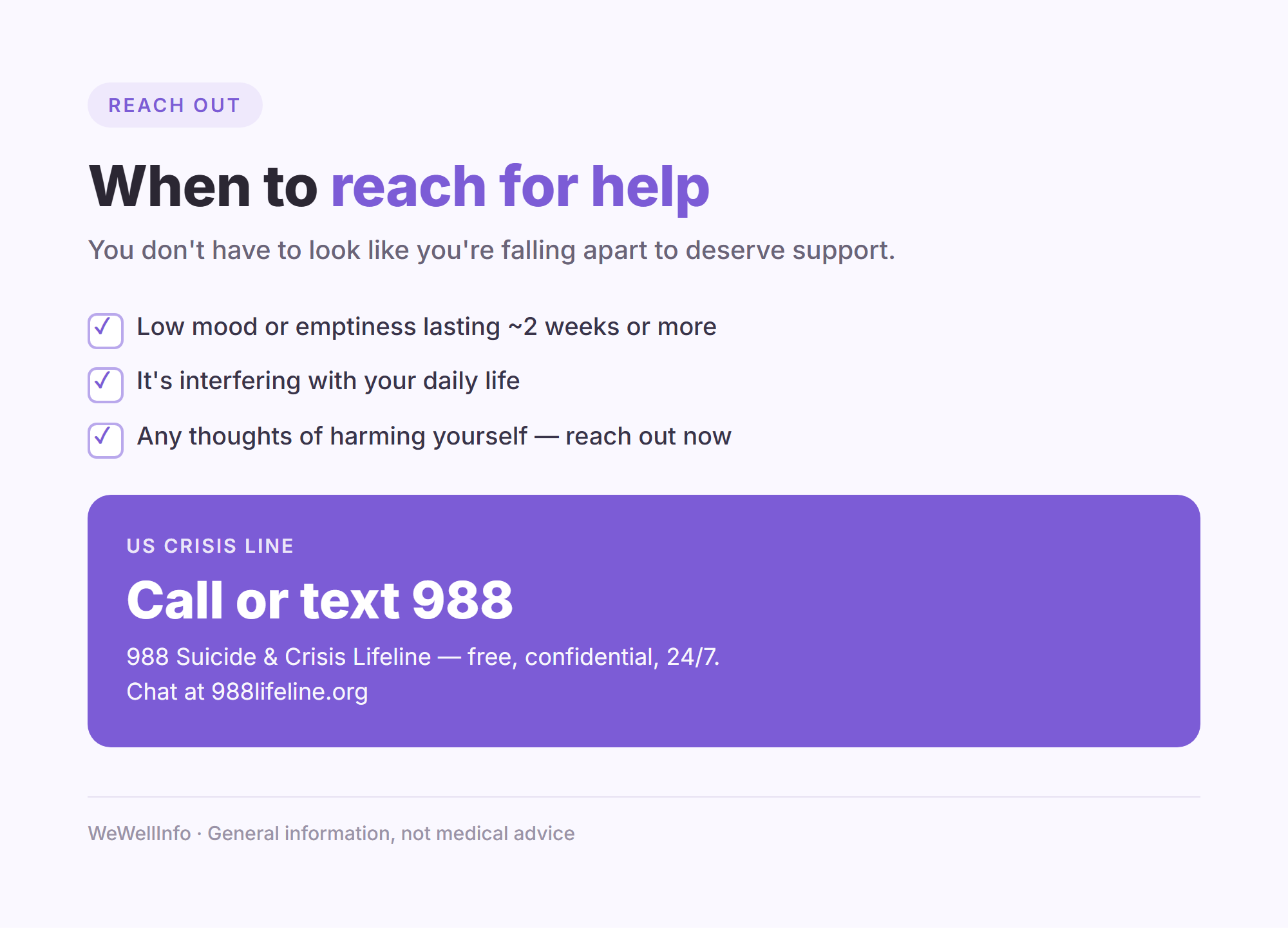
If your sadness or emptiness has lasted around two weeks or more, if it is interfering with your life, or if you have any thoughts of harming yourself — reach out to a mental health professional. A psychiatrist, a psychologist, or a licensed therapist. This is what they are for, and it works.
And for the moments that feel like too much to hold:
In the United States, call or text 988 to reach the 988 Suicide & Crisis Lifeline. You can also chat at 988lifeline.org. It is free, confidential, and available 24 hours a day, every day, in English and Spanish, with interpretation in more than 240 languages. A trained counselor will listen. You do not have to be in a specific kind of crisis to be allowed to call.
The short version
If I had to compress all of this, it would be these few lines.
“Smiling depression” is a popular name, not an official diagnosis — but the pain behind the smile is real, and it may be a depressive disorder worth taking seriously. It hides because the person keeps functioning, which is exactly what makes it dangerous. Watch for internal sadness or emptiness lasting two weeks or more. Answer it by dropping the internal mask — it is okay to not be okay — and by journaling honestly instead of suppressing. And when it is more than self-help can carry, let a professional help you. That is not weakness. It works.
You have carried the smile long enough.
If you are crumbling quietly behind it, I hope you will let one person see the truth — and, if you need it, let a professional in too. The version of you underneath the mask is not too much, and it is not a burden. It has just been waiting a long time to be heard.
Because you deserve to be okay on the inside, too — not only to look it.
References
- WebMD — “Smiling Depression: Risks, Symptoms, and Treatment Options”
- National Institute of Mental Health (NIMH) — “Depression” and “Major Depression” statistics
- Baikie & Wilhelm — “Emotional and physical health benefits of expressive writing,” Advances in Psychiatric Treatment
- SAMHSA / 988 Suicide & Crisis Lifeline — 988lifeline.org
This article is general information and is not a substitute for professional diagnosis, treatment, or advice. “Smiling depression” is a popular term, not a formal diagnosis. If your symptoms persist or worsen, please speak with a qualified mental health professional. In a crisis, call or text 988 (988 Suicide & Crisis Lifeline).