
Brain Fog Recovery: How to Regain Mental Clarity
I’ll be honest with you. For a long stretch last year, I kept walking into rooms and forgetting why I was there. Names slipped. Sentences stalled halfway out of my mouth. I called it “brain fog” without really knowing what I was naming.
That vagueness turns out to be the whole point. Brain fog isn’t a disease you can be diagnosed with. It’s a description of how thinking feels when something underneath isn’t working right. And if you want to recover mental clarity, the honest first step is to stop treating the fog as the problem and start looking for what’s causing it.
What brain fog actually is (and isn’t)
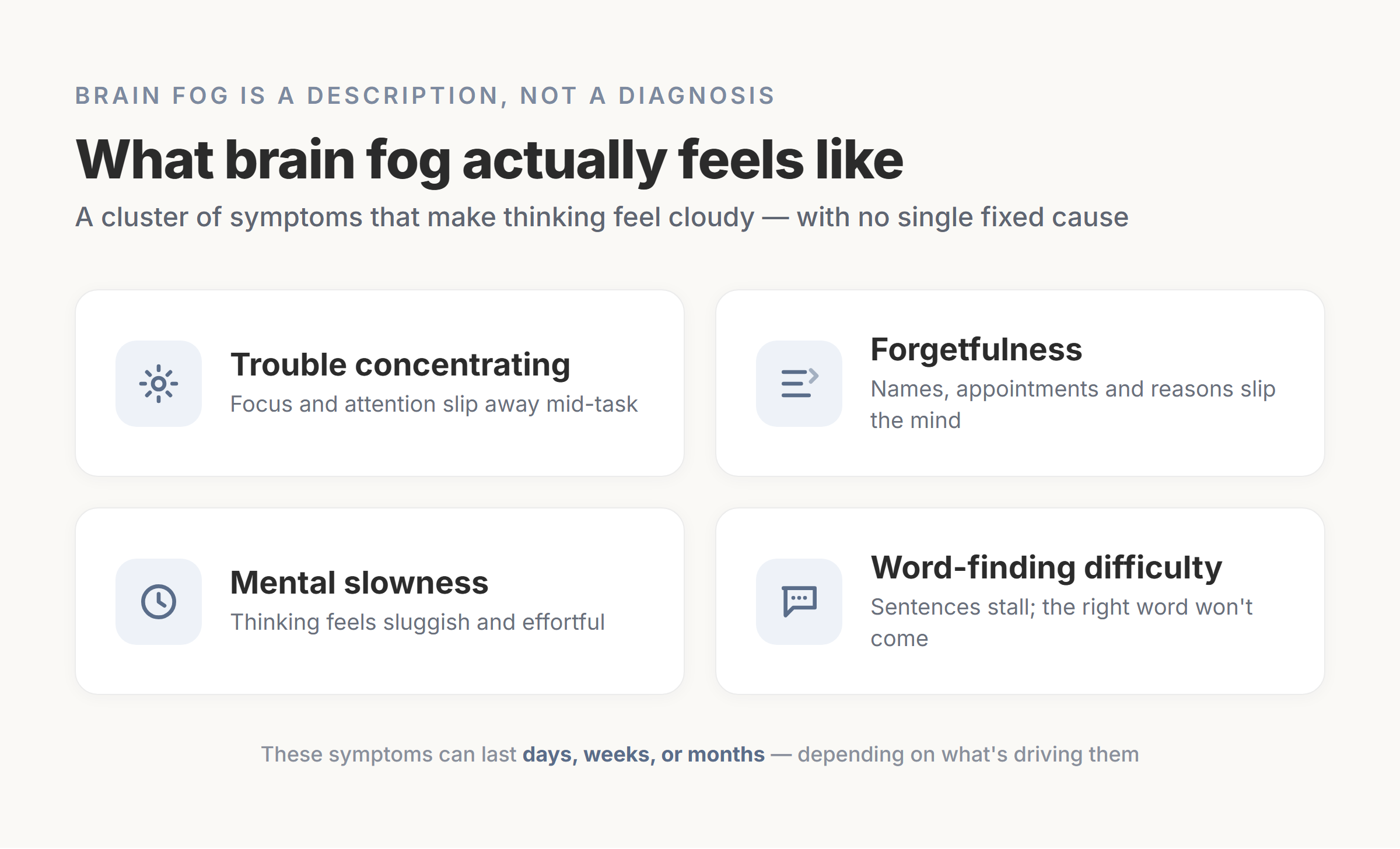
The Cleveland Clinic defines brain fog as “a term for a range of symptoms that cause cognitive impairment” — trouble with clarity of thinking, focus, concentration, memory, and attention. In plain terms: difficulty concentrating, confusion, fatigue, forgetfulness, losing your train of thought, mental exhaustion, word-finding trouble, and slowed thinking.
Notice what that list is. It’s a cluster of symptoms, not a condition with a fixed cause or a set timeline. According to the Cleveland Clinic, brain fog has no fixed timeframe — it can last days, weeks, months, or longer, depending on what’s driving it.
Here’s a detail I found strangely reassuring. Neuropsychologist Jacqueline Becker of Mount Sinai notes that brain fog often differs from measurable cognitive impairment. Patients report real memory and attention problems that may not show up as deficits on formal testing. So if your fog feels very real but a test comes back “normal,” that doesn’t mean you imagined it.
Why it happens: the usual drivers
Because brain fog is a symptom, recovery depends on finding the underlying driver. The Cleveland Clinic and National Geographic list a broad range of documented contributors:
- Insufficient or poor sleep
- Chronic stress, anxiety, and depression
- Autoimmune conditions (lupus, multiple sclerosis, fibromyalgia)
- Thyroid disorders, diabetes, or low blood sugar
- Hormonal changes (pregnancy, perimenopause and menopause, as estrogen declines)
- Poor nutrition and vitamin B deficiency
- Post-COVID-19 (long COVID) and ME/CFS, chemotherapy, prolonged hospitalization
- Gut microbiome disruption, sleep apnea, and certain medications
The list is long on purpose. That’s exactly why clinicians emphasize identifying the reversible causes first. Many of the most common drivers — sleep, stress, blood sugar, a thyroid that’s off — are treatable once you actually find them.
The neuroinflammation hypothesis — a leading idea, not the whole story
You may have read that brain fog is a sign of “chronic neuroinflammation.” I want to be careful here, because this is where a genuinely interesting theory gets flattened into a slogan.
Neuroinflammation is an immune response inside the brain. When the brain’s resident immune cells — the microglia — activate in response to a challenge, that activation can temporarily affect how the brain processes information, and it can influence learning, memory, and emotional regulation. When this response stays switched on longer than needed, it may weigh on cognition and energy.
National Geographic describes neuroinflammation as “one of the biggest hypotheses” for what underlies brain fog — especially in long COVID and other post-infectious or autoimmune states. A PMC review of long COVID lays out proposed mechanisms: direct viral effects on neurons, neuroinflammation, a “leaky” blood-brain barrier, microvascular problems, and low oxygen, with some patients developing autoantibodies against brain tissue.
But here’s the honest caveat. Reviewers also note that brain fog “lacks a universally agreed-upon clinical definition,” and neuroinflammation is best evidenced in post-viral and autoimmune contexts. It is a leading hypothesis and common pathway — not proof that every foggy, tired afternoon equals inflammation in your brain. I’d rather tell you that than oversell a clean answer that doesn’t exist yet.

Modern life, sleep, and diet
A lot of people want to blame their phones. I understand the instinct. But the evidence is more indirect than the headlines suggest.
What is well documented is sleep. Harvard Health reports that sleeping six hours or less per night is associated with impaired cognition — memory especially — and with increased amyloid-beta, the protein linked to Alzheimer’s plaque. Sleep is a first-line recovery lever, full stop.
Diet has a signal too, though it’s observational. A Harvard study found that people eating the most ultra-processed food had a 58% higher risk of developing dementia than those eating the least. Conversely, people eating the most whole, minimally processed foods had a 41% lower dementia risk and a 24% lower risk of cognitive impairment without dementia. Researchers suggest ultra-processed foods may drive the chronic inflammation tied to brain and mental-health problems.
And the smartphone question? A direct “information overload causes brain fog” study wasn’t confirmed in credible sources. The honest framing is this: constant task-switching and screen overload feed stress and steal sleep, and those are the proven pathways. So it’s real, but it works through the back door — not as a standalone cause.
Evidence-based ways to recover clarity
Here’s the part I actually find hopeful. The levers with the best support are also the least glamorous.
Move — even a light walk
During exercise, the body drives more oxygen and blood to the brain, raising cerebral blood flow and supporting the prefrontal cortex, which handles decision-making and reasoning. A randomized controlled cross-over trial in sedentary older men found that aerobic training improved both cerebral blood flow and executive function. Harvard Health puts it simply: exercise means “more oxygen and nutrients in, toxins out.”
One caveat worth keeping: at least one systematic review notes that the direct link between exercise-driven blood flow and cognitive gains still needs more evidence. The mechanism is solid; the last mile is still being mapped.
Eat for your brain — with realistic expectations
Flavonoids in blueberries may improve memory, learning, and executive function, and a flavonoid-rich diet is associated with protection against cognitive decline. Wild-blueberry studies report improved processing speed in older adults and children. Berries and nuts are a reasonable, low-risk addition — just remember most of this evidence is about cognition and protection, not a measured drop in brain inflammation.
Fix sleep, lower stress, and rehabilitate
The Cleveland Clinic’s practical recommendations are refreshingly plain: better sleep, nutritious meals, about 30 minutes of daily physical activity, taking breaks, and psychotherapy or CBT — with medication only if lifestyle steps fall short. For persistent fog, clinicians can look for reversible causes and offer cognitive rehabilitation therapy, described by the NIH’s Dr. Avindra Nath as “exercise for the brain’s affected domains.”

Photo: MART PRODUCTION / Pexels
When to see a specialist
This is educational, not a substitute for individualized medical advice. Please see a healthcare provider if brain fog disrupts your daily activities, makes you forget appointments or tasks, or impairs your attention in conversation — or if it persists for weeks despite better sleep, diet, and exercise.
Where to start:
- Primary-care physician first, for a workup that checks thyroid, vitamin B12, blood sugar, sleep, and medications.
- Neurologist for persistent or worsening cognitive symptoms, or suspected neurological disease.
- Psychiatrist or mental-health clinician when anxiety, depression, or chronic stress are prominent drivers.
- Post-COVID clinics manage long-COVID fog specifically.
One more thing, and it matters. Sudden confusion, a severe headache, weakness or numbness, trouble speaking, or rapid cognitive decline are not brain fog. Those can signal something serious, like a stroke, and they are emergencies. Call for help right away.
[Internal link: related post – Sleep and cognitive health]
I stopped chasing a single cure for my fog, and that’s when things slowly improved. I slept more. I walked most days. I ate fewer things out of a plastic wrapper. None of it was dramatic, and I can’t tell you which lever mattered most.
Maybe that’s the quiet truth of brain fog. It’s rarely one villain and one fix. It’s a signal — your body’s way of saying that something upstream needs attention. The clarity comes back not when you defeat the fog, but when you finally listen to what it was pointing at.
References (research basis): Cleveland Clinic (Brain Fog); National Geographic (“What exactly is brain fog?”); Harvard Health (ultra-processed foods and cognitive decline; sleep and cognition; exercise and the brain); Harvard T.H. Chan School of Public Health; NCBI/PMC (long COVID neuroinflammation review; aerobic exercise and cerebral blood flow RCT); PubMed (blueberry and cognition systematic review).