
Stuck Picking a Movie? Decision Paralysis Isn’t a Diagnosis
Thirty minutes deep into picking a Netflix movie. Eleven synopses read, two review sites open, and the popcorn has gone cold.
That scene has a popular name: decision paralysis. I went looking for what the phrase means clinically, and the first surprise was that it does not mean anything clinically. It is not a diagnosis. The second surprise was that most of the advice built on top of it — the jam study, the willpower battery, the five-second timer — is either contested or has no trial behind it at all.
So this is a correction piece. The feeling is real and measurable. The story usually told about it is mostly not.
Please read this first. This article is general health information. It does not diagnose, treat, or substitute for evaluation by a licensed clinician. “Decision paralysis” is a colloquial phrase. Only a qualified professional can tell whether difficulty deciding reflects depression, an anxiety disorder, OCD, OCPD, something else, or nothing clinical at all. If you are having thoughts of suicide, call or text 988 now, or call 911 in a life-threatening emergency.
Is decision paralysis a real diagnosis?
No. Cleveland Clinic, on a page reviewed by therapist Natacha Duke (June 8, 2026), puts it plainly: “Analysis paralysis is not a mental health disorder, as per the Diagnostic and Statistical Manual of Mental Disorders (DSM-5-TR).”
Because it is not a diagnosable entity, nobody counts it. There is no U.S. prevalence figure for decision paralysis, and any percentage you see quoted for it was invented somewhere along the way.
What is real is that indecisiveness appears as a criterion inside actual diagnoses — and where it appears matters more than most articles admit.
Where indecisiveness is actually listed
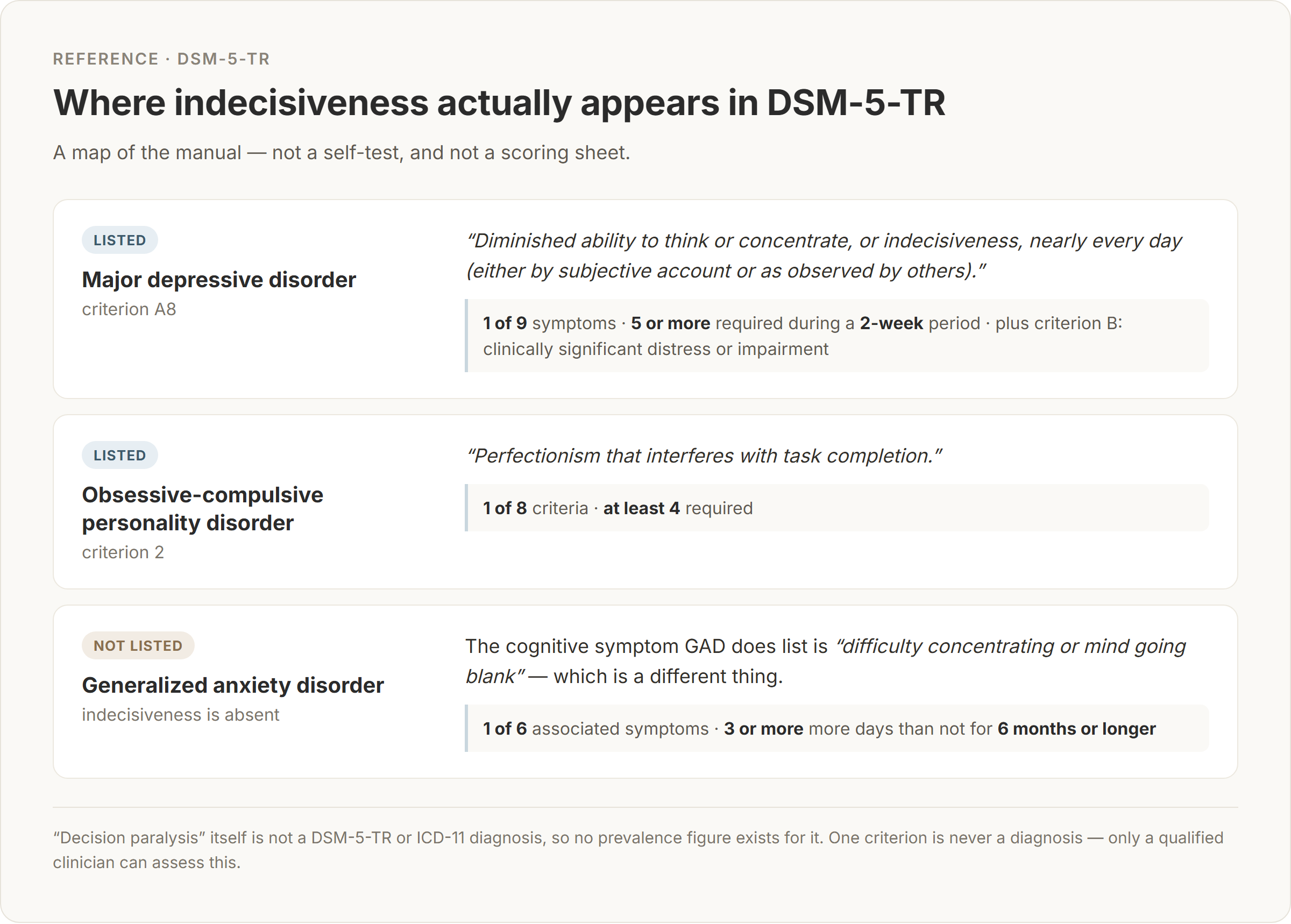
Major depressive disorder, DSM-5-TR criterion A8, verbatim: “Diminished ability to think or concentrate, or indecisiveness, nearly every day (either by subjective account or as observed by others).”
Read the rest of the criterion set before you do anything with that. It is 1 of 9 symptoms, of which 5 or more must be present during a 2-week period, with at least one being depressed mood or loss of interest. And criterion B still has to be met: “The symptoms cause clinically significant distress or impairment in social, occupational, or other important areas of functioning.”
One symptom out of nine is not a diagnosis. It is a line in a manual.
Obsessive-compulsive personality disorder, DSM-5-TR criterion 2, verbatim: “Perfectionism that interferes with task completion.” That is the one people recognize as “I cannot decide because it is not right yet.” OCPD requires at least 4 of 8 criteria. Prevalence figures in StatPearls (based on DSM-IV criteria) run 3–8% lifetime in the general population, 8.7% in outpatient settings and 23.3% in inpatient settings, diagnosed more often in men.
Generalized anxiety disorder does not list indecisiveness at all. This is the error I saw most often while reading around the topic. GAD’s cognitive symptom is “difficulty concentrating or mind going blank” — one of six associated symptoms, of which 3 or more must be present more days than not for 6 months or longer. Indecisiveness is an MDD criterion and an OCPD feature. It is not a GAD criterion, and treating the two as interchangeable muddies a real distinction.
OCD requires obsessions (“recurrent and persistent thoughts, urges, or images… intrusive and unwanted”) and/or compulsions that are “time-consuming or cause clinically significant distress,” at a prevalence of 1–3% of the global population. Re-checking whether the front door is locked can be a compulsion. Re-reading forty movie reviews is not automatically one. The difference is intrusiveness, distress, and time.
ICD-11 has no decision paralysis entry either. The closest structure is the Anankastia trait domain (6D11.4) — “a narrow focus on one’s rigid standard of perfection and of right and wrong” — and the coding note says it “should only be used in combination with a Personality disorder category… or Personality difficulty.” Even there, perfectionism is a descriptor attached to a diagnosis, never a label on its own.
Why perfectionism shows up here — but only half of it
Perfectionism is not one thing. It is measured in subscales, and only some of them track indecisiveness.

Photo: Mizuno K / Pexels
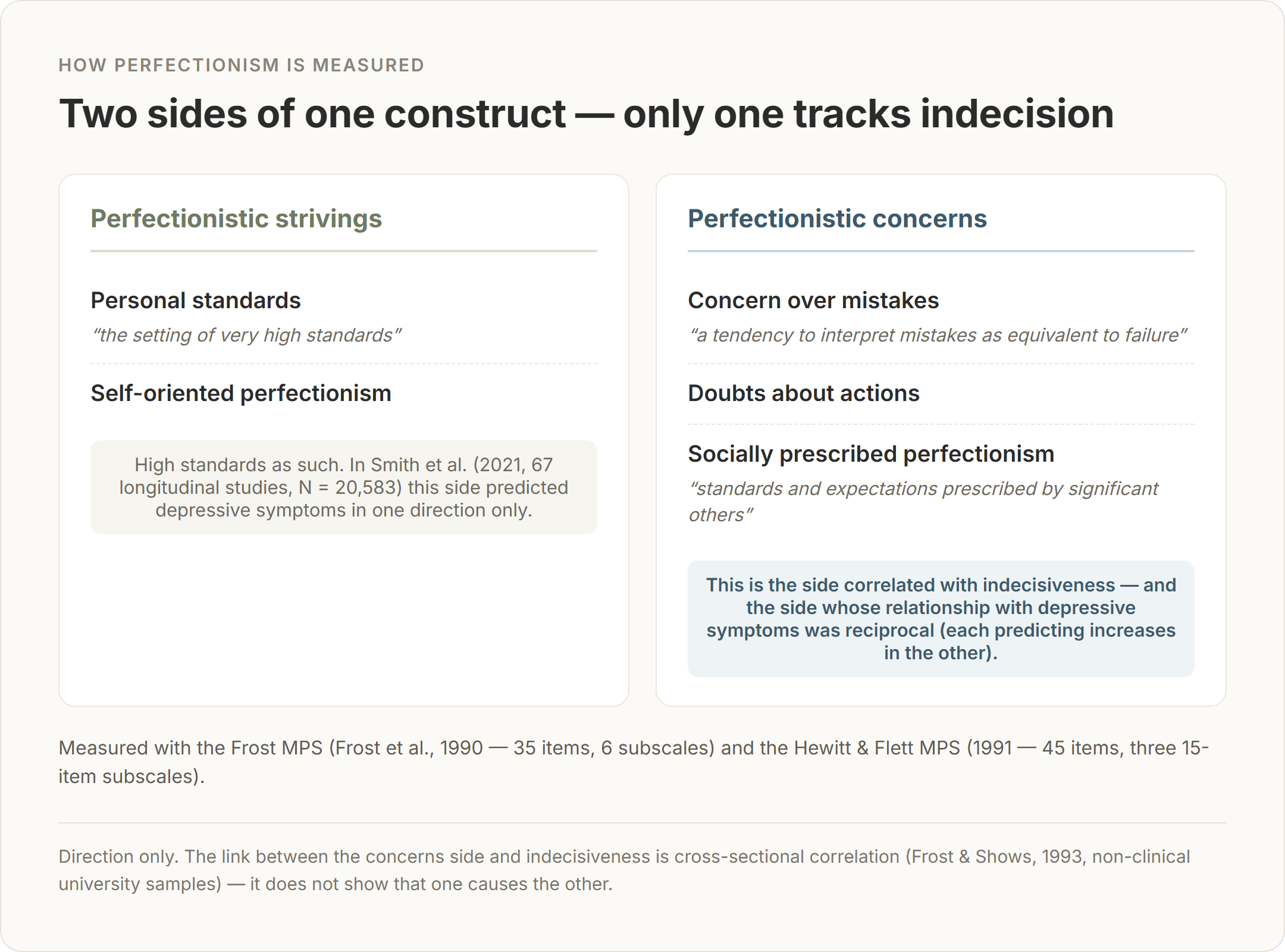
The Frost Multidimensional Perfectionism Scale (Frost et al., 1990; 35 items, 6 subscales) separates Concern over Mistakes — “negative reactions to mistakes, a tendency to interpret mistakes as equivalent to failure” — and Doubts about Actions from Personal Standards, which is simply “the setting of very high standards.” The Hewitt & Flett scale (1991; 45 items, three 15-item subscales) adds socially prescribed perfectionism: “the perceived need to attain standards and expectations prescribed by significant others.”
Frost and Shows (1993, three studies in non-clinical university samples) found that their Indecisiveness Scale “was correlated with measures of obsessionality and compulsive checking” and “with the maladaptive evaluative concern dimensions of perfectionism.” Indecisive participants also “had longer latencies on an experimental decision-making task.” The exact correlation coefficients were not in the material I could retrieve, so treat that as direction, not magnitude.
Here is the part worth keeping: it is the fear-flavored dimensions that track indecision, not high standards as such. So the popular line — that someone agonizing over a trivial choice is “really hiding” a fear of failure and criticism — is directionally reasonable and overstated as stated. All of that evidence is cross-sectional correlation. Nothing in it shows the fear causes the deliberation, and nothing shows the fear is hidden.
Indecisiveness also tracks intolerance of uncertainty. In a 2017 study of 255 adults, indecisiveness, self-oriented perfectionism and the need for predictability were unique correlates of trait worry or GAD status — but “IU was the strongest unique correlate.” Perfectionism is one road in, not the road in.
The most quotable finding in this whole literature is the definition of clinical perfectionism from Shafran, Cooper and Fairburn (2002): “the overdependence of self-evaluation on the determined pursuit (and achievement) of self-imposed personally demanding standards of performance in at least one salient domain, despite the occurrence of adverse consequences.” And the mechanism that keeps it running: “if they do meet their standards, the standards are re-evaluated as being insufficiently demanding.”
The goalpost moves even when you win. That is the trap, and it matters for the advice section later.
“Too many options paralyze you” — the science flipped twice
If you have read anything on this subject, you have met the jam study.

Photo: Yuwanda Sandhi / Pexels
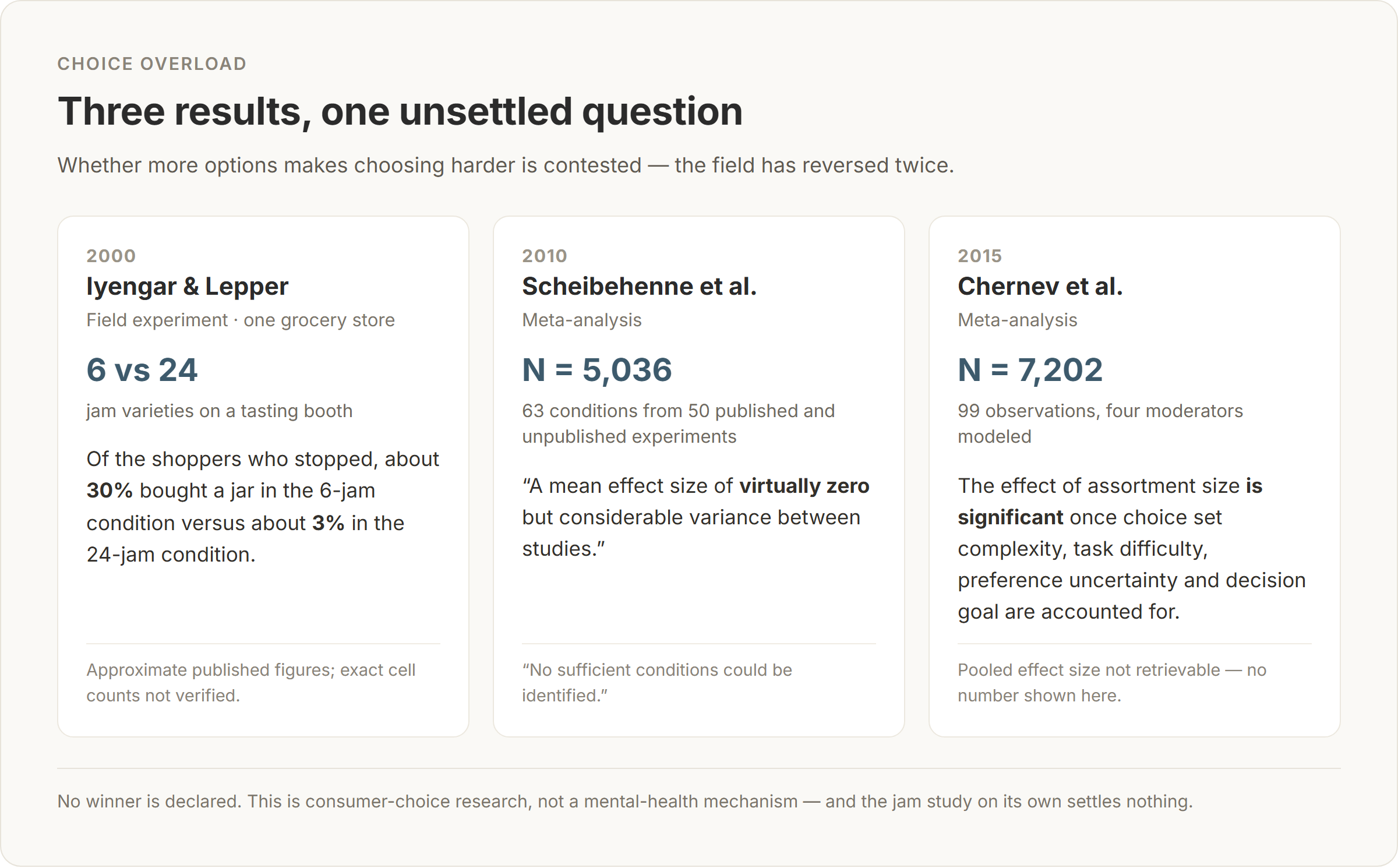
Iyengar and Lepper (2000) ran a tasting booth at Draeger’s, an upscale grocery in Menlo Park, California, alternating between 6 and 24 jam varieties. In the widely reproduced figures, about 60% of passing shoppers stopped at the 24-jam display versus about 40% at the 6-jam display — but of those who stopped, about 3% bought a jar in the 24-jam condition versus about 30% in the 6-jam condition. (Some secondary summaries circulate a “40% versus 3%” version of that purchase comparison. The figure that traces back to the paper is 30% versus 3%.)
Then the field pushed back. Scheibehenne, Greifeneder and Todd (2010) pooled 63 conditions from 50 published and unpublished experiments, N = 5,036, and reported “a mean effect size of virtually zero but considerable variance between studies,” adding that “no sufficient conditions could be identified.”
Then the pushback got pushed back. Chernev, Böckenholt and Goodman (2015) pooled 99 observations, N = 7,202, modeled four moderators — choice set complexity, decision task difficulty, preference uncertainty, decision goal — and found the effect of assortment size is significant once those moderators are accounted for, “a finding counter to the data reported by prior meta-analytic research.” A more recent econometrics working paper (Dean, Ravindran and Stoye) argues existing tests are “likely to be underpowered” and that choice overload “may occur more often than the literature suggests.”
The honest summary: whether more options makes choosing harder depends on the situation, and the field has reversed itself twice. Citing the jam study alone, as settled fact, is the single most common error in articles on this topic. It is also not a mental health mechanism — it is a consumer-choice finding.
Maximizers, satisficers, and what that research can carry
Schwartz and colleagues (2002) coined the split most people know: maximizers who search for the best possible option, satisficers who take the first good-enough one. Across seven samples, Study 1 reported “negative correlations between maximization and happiness, optimism, self-esteem, and life satisfaction, and positive correlations between maximization and depression, perfectionism, and regret.”
Direction only, please. Study 1 is cross-sectional; the other studies are lab tasks about satisfaction within a single decision. I could not find longitudinal or experimental evidence that converting a maximizer into a satisficer improves mental health, and the exact correlation values were not retrievable in this research. Being a maximizer is not established as a cause of anything.
Does overthinking small choices damage your mental health?
Partly, and more modestly than the usual telling.
What is supported. Limburg and colleagues (2017) pooled 284 studies and 2,047 effect sizes and concluded that both perfectionism dimensions are associated with “various forms of psychopathology” — a transdiagnostic factor, in their words. Smith and colleagues (2021) ran a meta-analytic test of 67 longitudinal studies, N = 20,583, and found that “the relationship between perfectionistic concerns and depressive symptoms was reciprocal,” each predicting increases in the other, while perfectionistic strivings predicted depressive symptoms in one direction only. An earlier Smith meta-analysis of 10 longitudinal studies, N = 1,758, found that all seven perfectionism dimensions had small positive relationships with later depressive symptoms after controlling for baseline depression and neuroticism.
Small and reciprocal. Those two words do a lot of work, and they are the words the evidence supports — not “perfectionism causes chronic anxiety and lethargy.” No study I found tested that pathway. Depressive indecisiveness is more often a symptom of the depression than its cause, which is exactly why it sits in criterion A8.
What is not supported. The idea that deliberating drains a finite mental battery is the ego-depletion story, and it failed its largest replication. Hagger and colleagues (2016) ran a Registered Replication Report across 23 laboratories, total N = 2,141, and reported “the size of the ego-depletion effect was small with 95% confidence intervals (CIs) that encompassed zero (d = 0.04, 95% CI [-0.07, 0.15]).”
So if someone tells you to decide fast because every choice spends willpower you cannot get back, that mechanism did not survive testing.
The part the light version of this topic leaves out. Smith and colleagues (2018) pooled 45 studies, N = 11,747, and found that perfectionistic concerns, perfectionistic strivings, parental criticism and parental expectations had small-to-moderate positive associations with suicide ideation, and that socially prescribed perfectionism “predicted longitudinal increases in suicide ideation.” Perfectionistic concerns, parental criticism and parental expectations also showed small positive associations with suicide attempts.
That is why this cannot be written as a light productivity piece, and why the care section below is not boilerplate. If any of this is close to home right now, call or text 988.
If you recognize yourself more in the exhaustion than in the indecision, our guides on employee burnout and recovery and on depression that hides behind a smile cover adjacent ground.
About that five-second timer
The advice attached to this topic is usually some version of: count down from five, force the decision, repeat until deciding stops feeling dangerous.
I went looking for the trial behind it and I could not find one. A PubMed search for “five-second rule” returns four records, all of them about food dropped on floors and bacterial transfer — none about decision-making. Searches pairing the rule with procrastination or decision-making, and searches for randomized tests of countdown techniques, returned zero records (searched September 2026). The rule originates with Mel Robbins’ 2011 TEDx talk and 2017 book. The “backed by science” framing around it is the author’s and publisher’s, not a finding I was able to locate.
That is a specific claim, and I want to keep it specific: I could not find a clinical trial of the countdown itself. That is not the same as proving it does nothing. For a movie or a lunch order, a timer is harmless and may well help. It is simply not a treatment, and it should not be sold as one.
What does sit behind the general idea, at a lower evidence tier:
- Clinician-reviewed guidance. Cleveland Clinic suggests simplifying small decisions within time limits to build confidence, recognizing when you have enough information, accepting uncertainty — “not all choices are simply right or wrong” — taking breaks, and practicing self-compassion. That is a professional’s recommendation, not evidence of efficacy.
- A close cousin with real numbers, borrowed carefully. Implementation intentions — “if X happens, I will do Y” — were pooled by Gollwitzer and Sheeran (2006) across 94 independent tests and more than 8,000 participants, yielding d = .65 on goal attainment, including the initiation of goal striving. That research is about acting on goals, not about picking a movie faster, so applying it here is an extrapolation and I am labeling it as one.

Photo: Letícia Alvares / Pexels
What actually has randomized evidence
If the deliberating is genuinely perfectionism-driven and genuinely costing you something, the evidence points at a treatment rather than a trick.
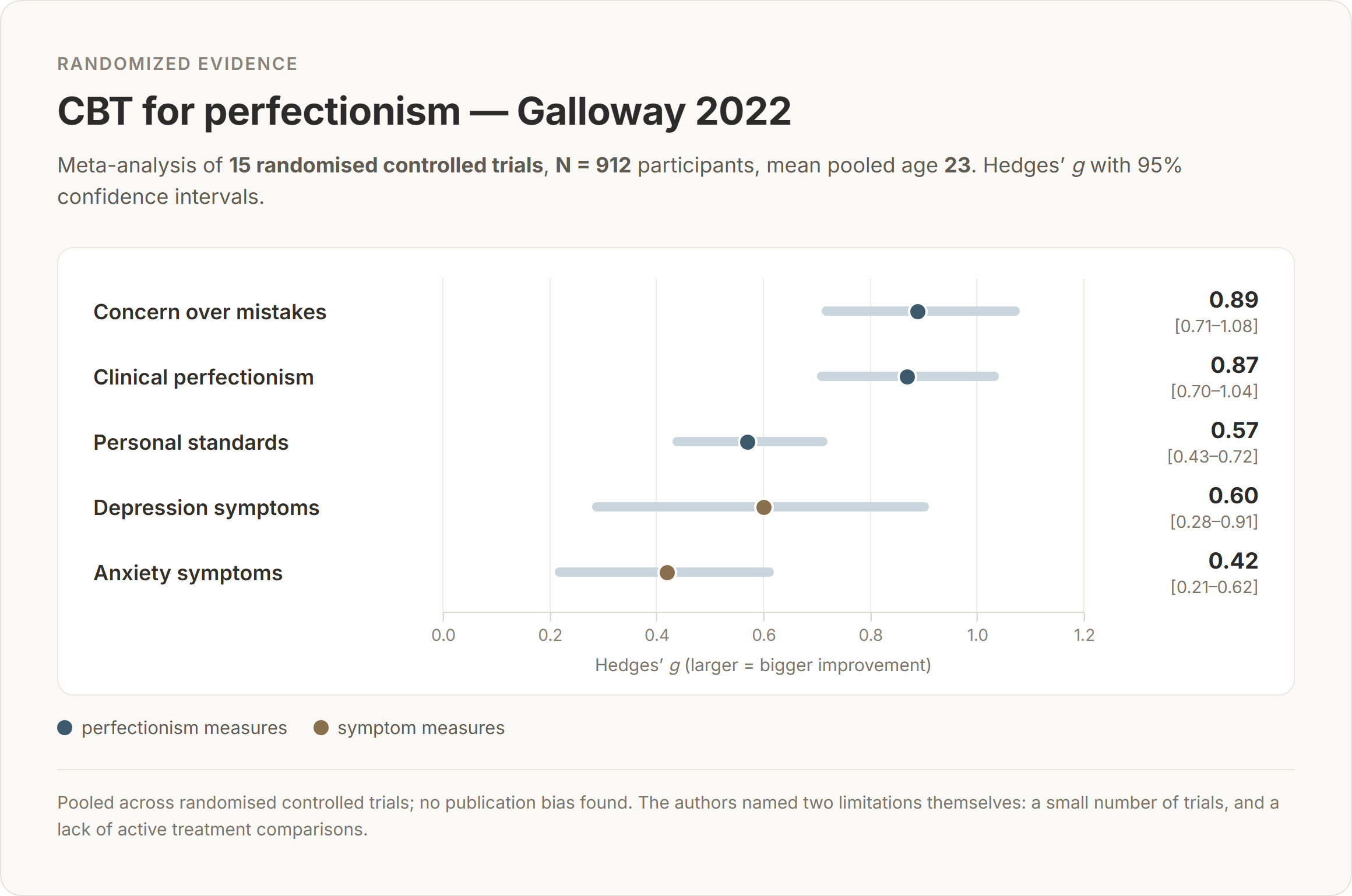
CBT for perfectionism. Galloway and colleagues (2022) pooled 15 randomized controlled trials, N = 912 participants, mean pooled age 23 years, and found a large effect on concern over mistakes (g = 0.89, 95% CI 0.71–1.08), a large effect on clinical perfectionism (g = 0.87, 95% CI 0.70–1.04), and a medium effect on personal standards (g = 0.57, 95% CI 0.43–0.72). Symptom outcomes were more modest: depression g = 0.60 (95% CI 0.28–0.91) and anxiety g = 0.42 (95% CI 0.21–0.62). The authors found no publication bias, and named two limitations themselves — a small number of trials, and a lack of active treatment comparisons.
An earlier review by Lloyd and colleagues (2015) covering 8 studies reported large pooled effects for personal standards, concern over mistakes and self-oriented perfectionism, and medium effects for anxiety and depression symptoms — but that pooling included uncontrolled pre-post designs, which is weaker than an RCT-only synthesis, and the exact values were not in the material I could retrieve.
One number you will see misused. A 2024 trial randomized 138 adults seeking help for perfectionism to eight weeks of internet-delivered CBT for perfectionism or an internet Unified Protocol, both with therapist guidance on demand. Within-group effects on the Clinical Perfectionism Questionnaire were large — d = 2.03 for iCBT and 2.51 for the comparator — and held at 6 and 12 months, with no between-group difference (β = 0.02, SE = 1.04, p = .98). Those are within-group changes measured against an active comparator, with no inactive control group. They do not mean internet CBT beats doing nothing by that margin, and anyone quoting d = 2.03 that way is misreading the design.
The field’s own caution. Twenty-one years after the clinical perfectionism model was published, Egan and colleagues (2023) note that the model and its therapy “has been controversial,” and call for independent evaluations, comparisons with active treatments, dismantling trials, and work on the causal processes involved. When the researchers say the mechanism is unsettled, a blog post should not be more confident than they are.
What you can reasonably try this week
Scope first, because this part goes wrong easily. Everything below applies to low-stakes, reversible choices only — which movie, which lunch, which shade of grey paint. It does not apply to medication, medical decisions, finances, legal matters, or anything involving safety. “Getting it wrong doesn’t matter” is a fine attitude toward a Tuesday dinner and a terrible one toward a prescription.

Photo: kaboompics.com / Pexels
- Put a clock on small reversible decisions. Five seconds, two minutes, whatever is small enough to feel silly. Evidence level: clinician-reviewed guidance, no trial located.
- Decide in advance what “enough information” is. Three reviews, not thirty. Cleveland Clinic frames information overload as one of the drivers worth interrupting. Evidence level: guidance.
- Write an if–then plan for the decision that stalls you every week. “If it is 7 p.m. and we have not picked, we watch the top item in the saved list.” Evidence level: strong for goal initiation (94 tests, d = .65), extrapolated to trivial choices.
- Practice accepting uncertainty rather than resolving it. Not all choices are simply right or wrong. Evidence level: guidance.
- Treat each attempt as an experiment that cannot be failed. This one matters most for perfectionists, because of Shafran’s finding that standards get re-rated upward after success. Without that framing, “decide faster” quietly becomes one more standard to fall short of.
- Skip the willpower framing entirely. You are not spending a battery (Hagger 2016, 23 labs, N = 2,141, d = 0.04).
None of the six is a treatment for depression, an anxiety disorder, OCD or OCPD. If that is what is going on, these will not touch it — which is the whole point of the next section.
If overthinking tends to peak at night, quieting a racing mind before sleep is a related read, and if the slowness feels more like mental fog than fear, brain fog and mental clarity may fit better.
When to get help, in three tiers
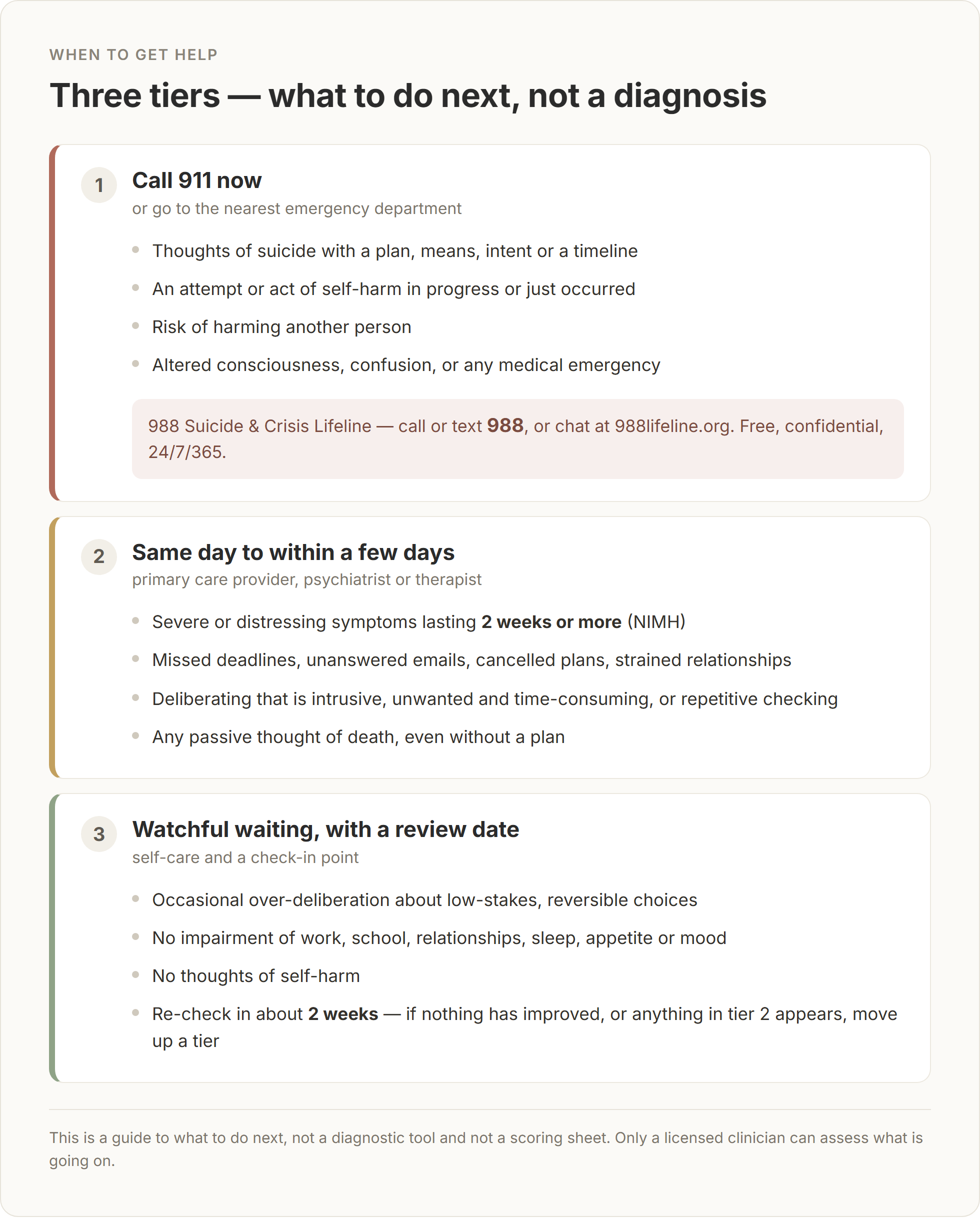
Tier 1 — call 911 now, or go to the nearest emergency department. Thoughts of suicide with a plan, means, intent or a timeline; any suicide attempt or act of self-harm in progress or just occurred; risk of harming another person; altered consciousness, confusion or any medical emergency. Do not leave the person alone.
988 Suicide & Crisis Lifeline. Call or text 988, or chat at 988lifeline.org — free, confidential, 24/7/365, across the United States and its territories. Spanish: dial 988 and then press 2, or text AYUDA to 988, or chat at linea988.org. Deaf or hard of hearing: TTY users dial 711 then 988; ASL support is available through the 988 Videophone. Veterans and service members: call 988 and press 1, or text 838255. In life-threatening situations, call 911. (Verified on 988lifeline.org, September 20, 2026.)
Tier 2 — same day to within a few days, contact a primary care provider, psychiatrist or therapist. NIMH advises seeking professional help for “severe or distressing symptoms that have lasted 2 weeks or more,” such as difficulty sleeping, changes in appetite or unplanned weight change, difficulty getting out of bed in the morning because of mood, difficulty concentrating, loss of interest in things you usually enjoy, “inability to complete usual tasks and activities,” or irritability, frustration and restlessness. Add the impairment test the DSM uses across MDD, GAD and OCD — “clinically significant distress or impairment in social, occupational, or other important areas of functioning.” Missed deadlines, unanswered emails, lost income, cancelled plans. Deliberating that has become intrusive, unwanted and time-consuming, or that involves repetitive checking or reassurance-seeking you feel driven to perform, is worth screening for OCD. Any passive thought of death, even without a plan, belongs here and not on a waiting list.
Tier 3 — watchful waiting with self-care, and a review date. Occasional over-deliberation about genuinely low-stakes, reversible choices, with no impairment of work, school, relationships, sleep, appetite or mood, and no thoughts of self-harm. Use the six steps above. Then set an explicit review point: if nothing has improved in about two weeks, or anything in Tier 2 appears, move up a tier. If a clinician-delivered option is available, CBT for perfectionism has randomized evidence behind it (15 RCTs, N = 912) and is worth asking a provider about rather than waiting indefinitely.
Access is its own obstacle, and worth naming. In 2021, an estimated 21.0 million U.S. adults (8.3%) had at least one major depressive episode, and 61.0% of them received treatment in the past year — roughly four in ten did not.
The bottom line
- Decision paralysis is not a diagnosis in DSM-5-TR or ICD-11, so there is no prevalence figure for it. Indecisiveness is an MDD criterion (A8, 1 of 9, five or more over two weeks, plus impairment) and an OCPD feature (criterion 2, 1 of 8, four or more required). It is not a listed GAD criterion.
- Choice overload is unsettled, not proven. Scheibehenne 2010 (50 experiments, N = 5,036) found a mean effect near zero; Chernev 2015 (99 observations, N = 7,202) found a significant effect once moderators were modeled. The jam study alone settles nothing.
- The five-second timer: I could not find a clinical trial of the countdown itself. That is what I looked for and did not find — not a proof that it fails. Use it as a harmless habit for trivial choices, not as treatment.
- The willpower-battery explanation is refuted, not merely doubtful: 23 labs, N = 2,141, d = 0.04, 95% CI [-0.07, 0.15] (Hagger 2016).
- Perfectionism and depressive symptoms feed each other over time, with small effects across 67 longitudinal studies, N = 20,583 — which is a more modest claim than “overthinking causes chronic anxiety.”
- What has randomized evidence is CBT for perfectionism: 15 RCTs, N = 912, mean age 23, concern over mistakes g = 0.89 (95% CI 0.71–1.08), depression g = 0.60, anxiety g = 0.42 (Galloway 2022).
- “Getting it wrong doesn’t matter” applies to low-stakes, reversible choices only — never to medication, finances, legal matters or safety.
Thirty minutes on a movie is not a disorder, and it is also not nothing. What it usually is, if the research is read honestly, is a habit of self-evaluation that has attached itself to a choice far too small to carry it. The fix is rarely a faster timer. It is noticing that the standard moved again — and, if it keeps moving, asking someone qualified to look at it with you.
Disclaimer. This article is general health information and does not diagnose, treat, or substitute for evaluation by a licensed clinician. Nothing here is a self-test, and no checklist in it can confirm or rule out a condition; indecisiveness is one criterion among many, and labeling yourself from a blog post risks both over-pathologizing an ordinary trait and mistaking a treatable depression for “just being a perfectionist.” Time-boxing small decisions is everyday advice, not treatment. If symptoms persist two weeks or more, or interfere with work, school or relationships, talk to a clinician. If you are in crisis, call or text 988 (chat at 988lifeline.org), and call 911 in a life-threatening emergency.
Sources. DSM-5-TR criteria via NCBI Bookshelf and StatPearls; WHO ICD-11 (6D11.4 Anankastia); Cleveland Clinic, “What Is Analysis Paralysis?” (reviewed June 8, 2026); Iyengar & Lepper 2000; Scheibehenne et al. 2010; Chernev et al. 2015; Dean et al. (working paper); Schwartz et al. 2002; Frost et al. 1990; Frost & Shows 1993; Hewitt & Flett 1991; Shafran et al. 2002; Limburg et al. 2017; Smith et al. 2016, 2018, 2021; Hagger et al. 2016; Gollwitzer & Sheeran 2006; Galloway et al. 2022; Lloyd et al. 2015; Egan et al. 2023; NIMH, Caring for Your Mental Health; 988 Suicide & Crisis Lifeline.