
Wrist Brace for Tingling Fingers: Not Proven to Stop Surgery
I’ll start with a confession about my own desk.
By late afternoon, my right hand basically lives on the mouse. More than once I’ve caught myself shaking it out — the way you shake a pen that has stopped writing.
So when a post kept showing up in my feed — “Fingertips tingle and your grip goes weak every time you grab the mouse? Brace tips to stave off wrist surgery” — I read it closely. Then I read what the research actually says, and the two didn’t match.
Here is the short version.
Tingling in the thumb-side fingers and a weakening grip really are classic signs of carpal tunnel syndrome (CTS). A carpal tunnel wrist brace that holds your wrist straight, mostly at night, is the one kind of brace that major medical sources recommend and that has been tested in trials, and it’s a cheap, low-risk first step that helps some people. But the benefit is modest and uncertain. The “glove for mouse days, strap for stiffness, neoprene over metal” rules don’t hold up. And whether any brace lowers your chance of needing surgery is uncertain — the evidence on that is rated very low certainty.
This article is general health information, not medical advice, and it does not replace an exam by a licensed clinician. Tingling or numbness in the hand has several possible causes — carpal tunnel syndrome, a pinched nerve at the elbow or neck, diabetes-related nerve damage, and others — and only an exam (sometimes with nerve testing) can tell them apart. Wrist braces are low-risk, but no brace has been shown to cure carpal tunnel, and whether one keeps you out of the operating room is uncertain. Sudden numbness or weakness on one side of the body, face drooping, or trouble speaking is a stroke warning — call 911.
Key takeaways
- Desk work isn’t proven to cause carpal tunnel. The AAOS 2024 guideline workgroup’s opinion is that high keyboard use isn’t associated with CTS — a consensus statement built on very-low-quality evidence, and it doesn’t address the mouse. Heavy mouse use and bent-wrist postures may still bring on symptoms.
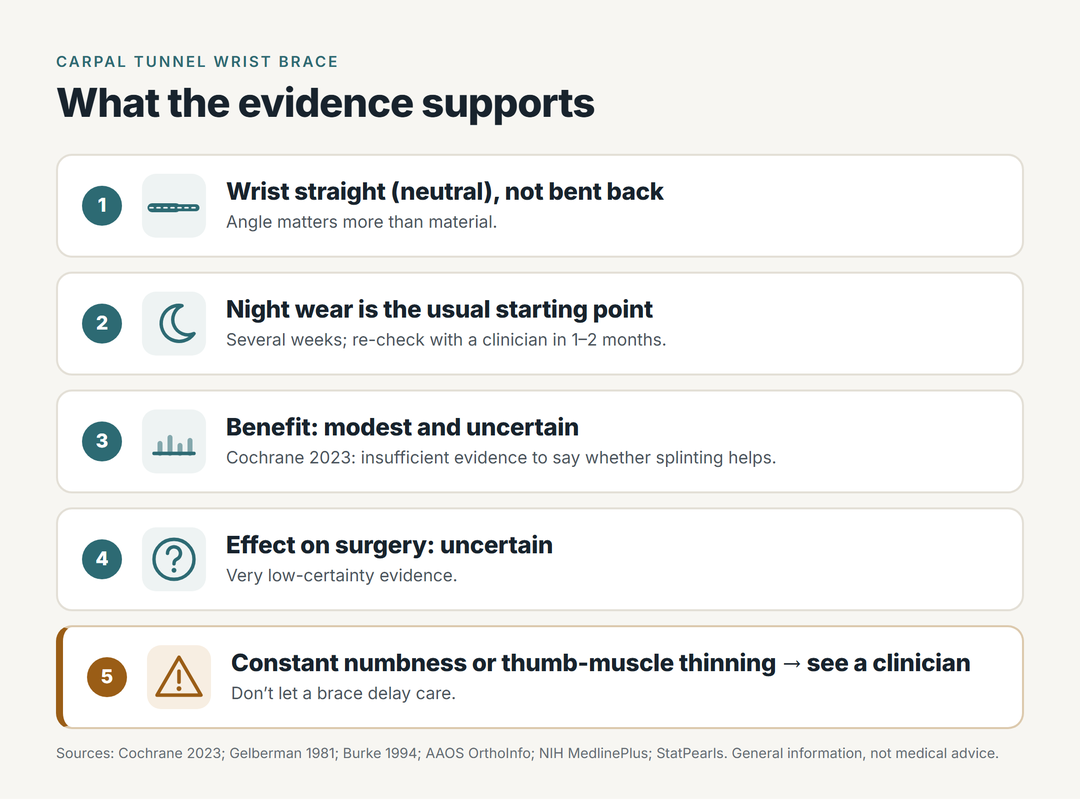
- Angle matters more than material. The brace should hold your wrist straight (neutral), not bent back. Rigid vs soft has no proven winner.
- Night is the usual starting point. The benefit is modest and uncertain — a 2023 Cochrane review found insufficient evidence to say whether splinting helps.
- Surgery odds: uncertain. Whether splinting reduces referral to surgery is uncertain (very low-certainty evidence).
- Don’t let a brace delay care. Constant numbness, a thinning thumb muscle, or dropping things means see a clinician. Sudden numbness on one side of the body means call 911.
Tingling fingers at the mouse: does it sound like carpal tunnel?
It might.
The median nerve runs through a narrow tunnel at the base of your palm. When it gets squeezed, the symptoms follow a fairly recognizable pattern, according to AAOS OrthoInfo, NIH MedlinePlus and StatPearls:
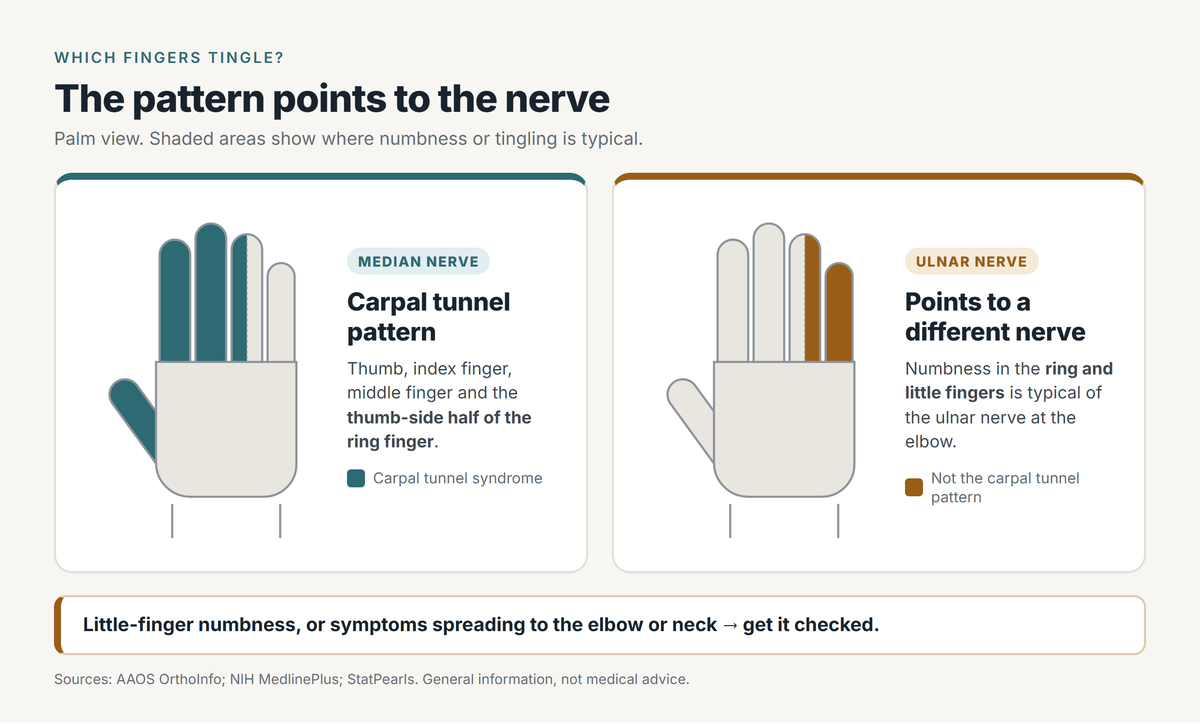
- Numbness, tingling or burning in the thumb, index finger, middle finger and the thumb-side half of the ring finger.
- Symptoms that often wake you at night, and that ease when you shake the hand out.
- A weak grip, clumsiness, or dropping things. MedlinePlus calls weak grip “a common complaint.”
- In advanced or long-standing cases, wasting of the muscle at the base of the thumb.
OrthoInfo also notes that during the day, symptoms often show up when you hold something for a long time with the wrist bent forward or backward — a phone, a steering wheel, a book.
But here is the part the viral post skipped.
Tingling in the little finger points somewhere else. Numbness in the ring and little fingers is typical of the ulnar nerve at the elbow, which tends to act up when the elbow stays bent, and OrthoInfo notes that leaning on your elbow for long periods can press on that nerve. StatPearls also lists a pinched nerve in the neck (cervical radiculopathy), diabetic neuropathy, thoracic outlet syndrome and even stroke among the conditions that can look similar.
So “my fingers tingle at the mouse” isn’t a diagnosis yet. Which fingers matter.
Does mouse and keyboard work cause carpal tunnel?
This is where the hook and the evidence part ways.
The idea that office workers are especially prone to carpal tunnel feels obvious. The research doesn’t back it up well.

Photo: cottonbro studio / Pexels
- AAOS 2024 guideline: “In the absence of reliable evidence, it is the opinion of the workgroup that there is no association between high keyboard use and carpal tunnel syndrome.” That is a consensus opinion based on very-low-quality evidence, and it addresses keyboarding only — not the mouse.
- NIH MedlinePlus: “Studies have not proved that carpal tunnel is caused by typing on a computer, using a mouse” or repetitive work movements — though these activities can inflame tendons in the hand and narrow the tunnel.
- Two large cohorts (Mediouni, BMJ Open 2015): 1,551 French workers and 711 newly hired US clerical, service and construction workers, followed 3–5 years. The group with the highest computer exposure had lower adjusted odds of new CTS (OR 0.39 and 0.16). The authors suggested prevention should focus on forceful hand work.
- A meta-analysis of 6 studies (Mediouni 2014): mouse use OR 1.94 (95% CI 0.90–4.21) — not statistically significant.
That said, the mouse isn’t completely off the hook.
A Danish study of 5,658 workers (Andersen, JAMA 2003) found that using a mouse more than 20 hours a week was associated with possible CTS symptoms — measured by questionnaire and interview, not nerve testing — with no significant link to keyboard use. Even so, those authors concluded computer use “does not pose a severe occupational hazard.” And in a lab study of 14 healthy volunteers (Keir 1999), pressure inside the carpal tunnel while dragging with a mouse reached 28.8–33.1 mmHg, about 12 mmHg higher than just resting the hand on the mouse.
So the honest framing is this: desk work isn’t proven to cause carpal tunnel, but long mouse sessions and bent wrists can bring on symptoms.
The better-established risk factors are less about your job title (MedlinePlus, OrthoInfo, StatPearls):
- Age 30 to 60, and being female — women are affected about 3 times as often as men.
- Obesity — StatPearls says the risk is about doubled.
- Diabetes, rheumatoid arthritis, thyroid disease (if that last one sounds familiar, here’s how hypothyroidism is diagnosed).
- Fluid retention in pregnancy or menopause, a naturally smaller tunnel (heredity), wrist fractures or arthritis.
- Vibrating hand tools and long periods in extreme wrist bending.
Choosing a carpal tunnel wrist brace: angle matters more than material
If you only remember one thing from this article, make it this section.
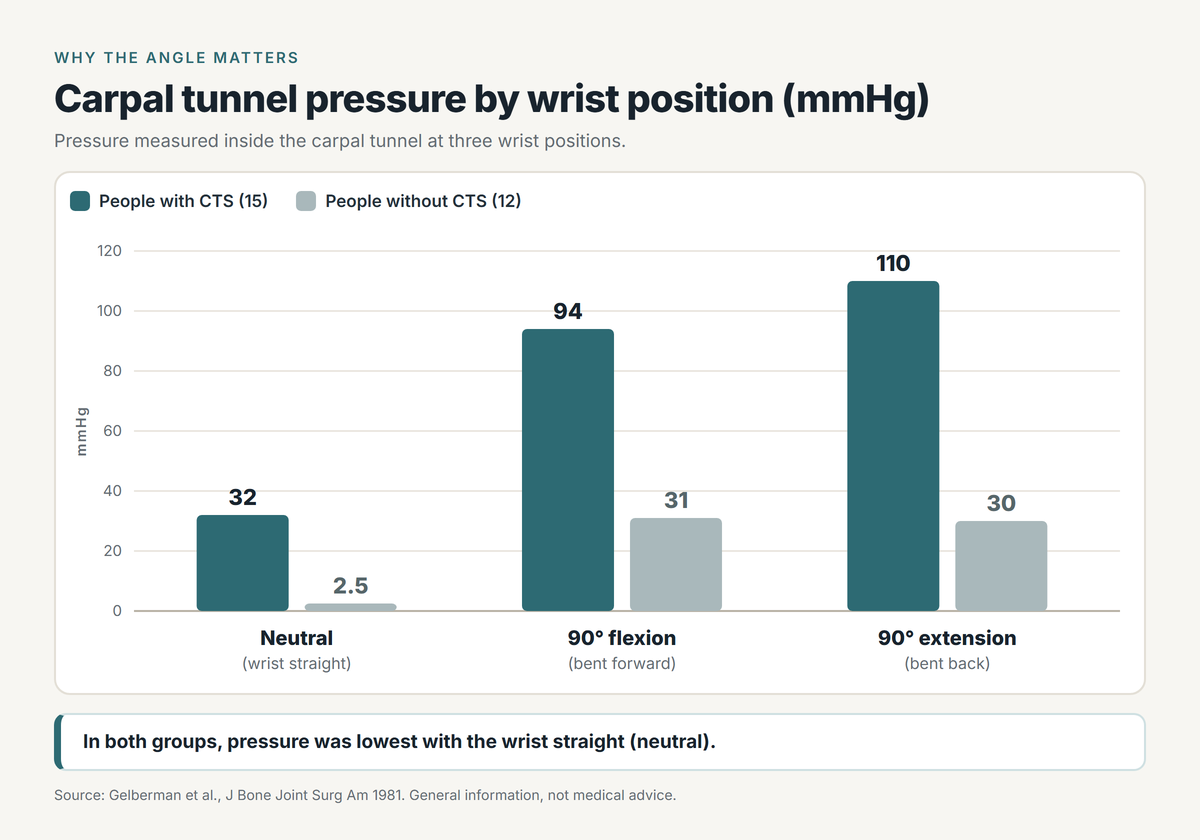
The pressure that irritates the median nerve is the pressure inside the tunnel. And that pressure is driven by wrist position.
- In 15 people with CTS, average tunnel pressure was 32 mmHg with the wrist neutral, 94 mmHg at 90° of flexion, and 110 mmHg at 90° of extension (Gelberman 1981). In 12 people without CTS, it was 2.5, 31 and 30 mmHg.
- In 20 healthy volunteers, pressure was lowest with the wrist at about 2° of extension — essentially straight (Weiss 1995).
- In a blinded trial, splints set at neutral gave better symptom relief than splints cocked back at 20° of extension (Burke 1994).
Here’s the practical catch. According to a 2014 study’s background review, many prefabricated orthoses on the market don’t assure a neutral wrist position (Mlakar 2014).
So when you try one on, look at your wrist from the side. It should sit roughly in line with your forearm — not bent back.
What about the specific rules from that viral post?
“Padded glove for mouse days, strap brace for stiffness.” I couldn’t find support for either. The research behind this article found no study of padded glove-type braces for carpal tunnel. And stiffness isn’t a typical CTS symptom in the first place — numbness, tingling, burning, pain and weakness are. For friction at the wrist while mousing, the fix is the desk setup, which I’ll get to below.
“Neoprene over metal stays, so the brace doesn’t press on the nerve.” No source I reviewed says a metal stay presses on the median nerve. A stay that holds the wrist straight isn’t a problem in itself, and a hand therapist can adjust or custom-make a brace if an off-the-shelf one won’t sit at neutral. On rigid vs soft, a 2022 narrative review found no statistically significant difference between them, and suggested a neutral or slightly extended position (0–15°, most often 0–5°).
One more thing, because it’s easy to misread.
A 2026 trial (Atroshi, NEJM Evidence) compared a rigid wrist splint with a soft bandage and found no clear difference. That soft bandage was the placebo — it allowed full wrist motion and wasn’t meant to treat anything. The trial doesn’t show that soft braces work. It shows that, in that group, neither option clearly beat the other.
A few other options exist. A small, non-randomized study of 24 patients (Golriz 2016) found a splint that also limited finger bending did better than a standard wrist splint over 6 weeks. And in a pilot trial of 24 people (Figueiredo 2020), custom night orthoses trended better than commercial ones, but the difference wasn’t statistically significant.
My takeaway: pick the brace that keeps your wrist straight, fits comfortably, and that you’ll actually wear.
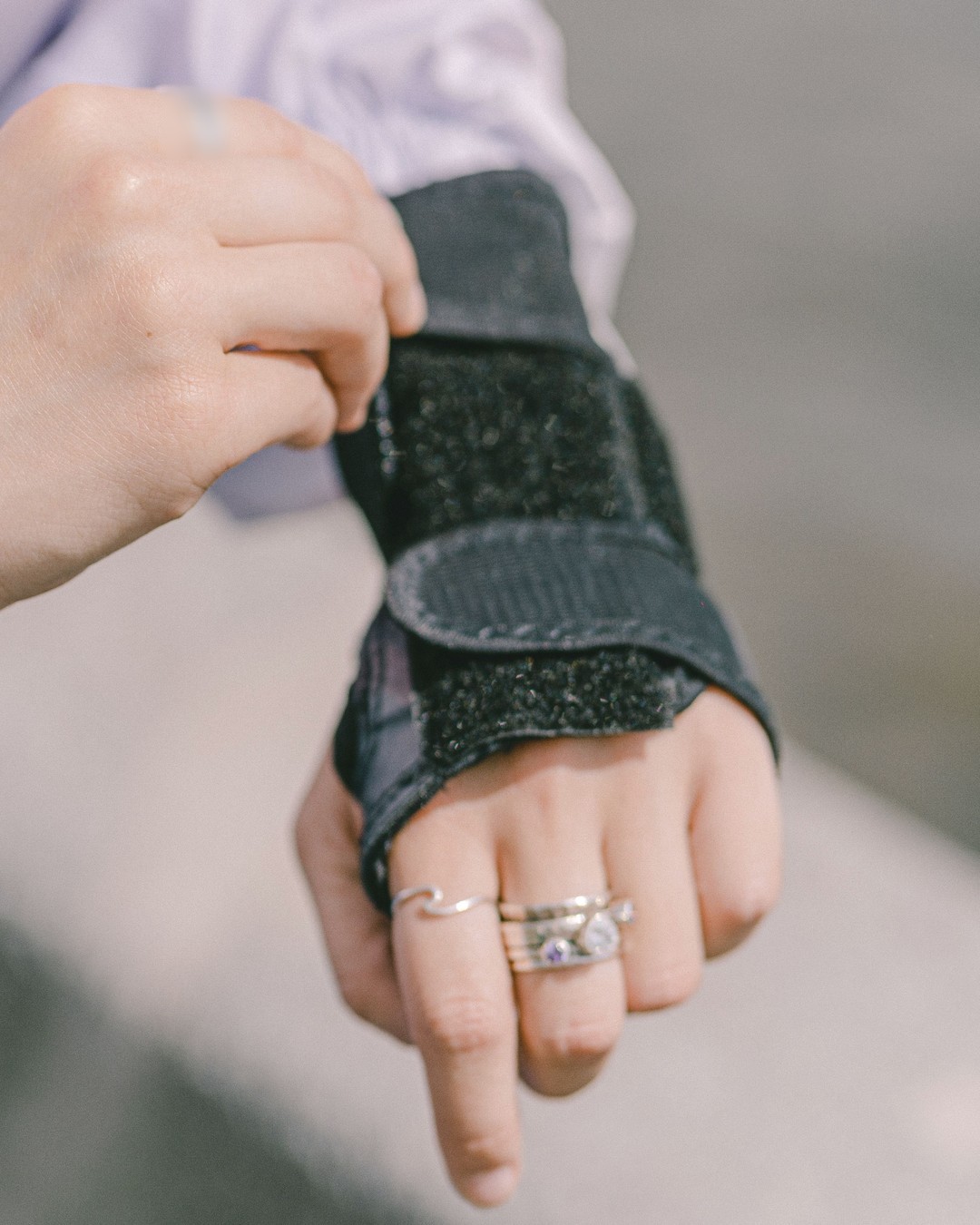
Photo: SHVETS production / Pexels
How much does a night wrist splint actually help?
Here I want to be careful, because both “it works” and “it’s useless” overstate things.
The case for trying it. OrthoInfo, MedlinePlus, Cleveland Clinic and StatPearls all list a wrist splint, especially at night, as a first step. The idea is simple: it keeps you from curling your wrist while you sleep. MedlinePlus suggests wearing it at night for several weeks, and adding daytime wear if that doesn’t help. StatPearls suggests re-checking with a clinician in 1 to 2 months.
The case for modest expectations. The 2023 Cochrane review (29 trials, 1,937 adults) concluded there is “insufficient evidence to conclude whether splinting benefits people with CTS.”
- Short term, symptom scores improved by 0.37 points on a 1–5 scale compared with no treatment (6 studies, 306 people, low certainty). A difference people actually notice is about 1 point.
- In one trial of 80 people (low certainty), night splinting was linked to a higher chance of overall improvement (RR 3.86).
- Cochrane still called splinting “relatively inexpensive” with “no plausible long-term harms,” and said small effects could justify it — especially for people who’d rather avoid injections or surgery.
The 2026 placebo-controlled trial is the newest piece. In 142 people with untreated CTS referred to an orthopedic department in Sweden, a rigid splint (70 patients) did no better than a soft placebo bandage (72 patients) on symptom change at 12 weeks (adjusted difference 0.08, P = 0.478). Keep in mind that’s a referred group, likely more severe than someone with occasional tingling at a desk.
Side effects are real but small. In one trial, 7 of 40 (18%) splinted patients reported adverse effects versus 0 of 40 untreated — and those were transient. In the 2026 trial, 12 patients in each group had minor local problems. The study protocol also noted that splints “may cause discomfort and limit daily and work activities.”
Night only or all day? Nobody knows for sure. Cochrane says the optimal schedule is unclear. In a small VA study (17 patients completed), full-time instructions gave better nerve test results — but 73% of the full-time group wore it less than half of their waking hours. Start at night, and talk to a clinician before wearing one all day.
One important exception: after carpal tunnel surgery, don’t put a brace on yourself. AAOS 2024 says, based on moderate evidence, that a splint or brace should not be used after carpal tunnel release. Follow your surgeon’s instructions.
Does a wrist brace change your odds of carpal tunnel surgery?
This is the heart of the hook, so let me lay it out plainly.
It’s uncertain. The 2023 Cochrane review put it this way: “We are uncertain if splinting decreases referral to surgery” — RR 0.47 (95% CI 0.14 to 1.58), 3 studies, 243 participants, very low-certainty evidence. That confidence interval runs from a large reduction to a large increase.
The trials that tracked surgery tell a similar story:
| Study | Who | What happened |
|---|---|---|
| Atroshi, NEJM Evidence 2026 (Sweden) | 142 untreated, referred CTS patients | Surgery within 1 year: 57.1% (40/70) with a rigid splint vs 51.4% (37/72) with a placebo bandage |
| Gerritsen, JAMA 2002 (Netherlands) | 176 patients, night splint vs surgery | 41% (32/79) of the splint group also had surgery by 18 months |
| Cochrane 2024 (14 trials, 1,231 people) | Surgery vs non-surgical care | 44% (41/93) of people in splint groups were referred to surgery |
In the Gerritsen trial, success rates were also higher with surgery — 80% vs 54% at 3 months and 90% vs 75% at 18 months. The 2024 Cochrane review found surgery gave more clinical improvement long term (RR 2.10, moderate certainty), but the differences in symptom and function scores were not clinically important. Its authors suggested that people with tolerable symptoms who want to avoid surgery can start with non-surgical options and have surgery only if necessary.
And the big-picture numbers genuinely conflict:
- MedlinePlus says symptoms often improve without surgery, but “more than one half of cases eventually need surgery.”
- StatPearls says 70% to 90% of mild-to-moderate cases respond to conservative treatment.
I’m not going to pick one. They describe different groups, and the trials above involve people referred to specialists. There isn’t a single honest “X% of people avoid surgery with a brace” number.

Photo: SHVETS production / Pexels
When is surgery the right call? OrthoInfo says it may be recommended for long-standing cases with constant numbness and wasting of the thumb muscles, when non-surgical treatment hasn’t helped, or when nerve tests show significant changes. Waiting too long carries its own risk — both OrthoInfo and MedlinePlus warn that untreated compression can cause permanent numbness and weakness.
For context on other treatments, AAOS 2024 says steroid injections can give short-term relief but no long-term improvement (strong evidence), and oral anti-inflammatory pills, magnets and supplements haven’t beaten placebo (limited evidence).
Desk setup for mouse users: what OSHA suggests
If mousing brings on your symptoms, changing the desk is cheap and sensible. OSHA’s Computer Workstations eTool suggests:
- Keep wrists straight. They shouldn’t bend up, down or to either side while typing. Elbows close to the body, forearms roughly parallel to the floor.
- Lower the keyboard if needed, and skip the keyboard feet if they tilt your wrists upward.
- Put the mouse right next to the keyboard, not out to the side.
- Use a light grip. Don’t clamp the mouse. Set the pointer sensitivity so a light touch moves it, and use keyboard shortcuts to cut down on mousing.
- Let your hands float while typing. When resting, the pad should touch the heel or palm of your hand, not your wrist. A good rest is soft and rounded, at least 1.5 inches (3.8 cm) deep.
- Take breaks. OSHA’s line: “Every hour, take a five-minute break from computer tasks.”

Photo: cottonbro studio / Pexels
Now the honest limit. Ergonomic gear has limited proof. OSHA itself says research doesn’t provide conclusive evidence that alternative keyboards prevent discomfort and injury. A Cochrane review (2 trials, 105 people) found insufficient evidence for ergonomic equipment in treating CTS. I found no randomized trial showing that a vertical mouse prevents or treats carpal tunnel.
What has some trial support is a forearm support board. It reduced upper-body pain or disorders in 182 call-center workers (Rempel 2006) and 206 engineers (Conlon 2008) — though those trials weren’t about carpal tunnel specifically. If your neck and shoulders also take a beating at the desk, I went through which tech-neck gadgets actually help in a separate post.
Buying a carpal tunnel brace: labels, FDA status and coverage
A few facts I wish I’d known before standing in the pharmacy aisle.
FDA status. Wrist and hand braces are Class I “limb orthosis” devices under 21 CFR 890.3475, exempt from 510(k) premarket notification. In plain terms, the FDA doesn’t review whether an over-the-counter brace works before it goes on sale. So “FDA approved” or “FDA cleared” wording wouldn’t be accurate for these braces.
Advertising claims. The FTC’s Health Products Compliance Guidance (December 2022) says health claims need “competent and reliable scientific evidence,” and that randomized controlled trials are generally what experts expect. Given the trials above, I’d read “cures carpal tunnel” or “clinically proven” on a brace box with real skepticism.
Insurance. Medicare Part B covers braces when medically necessary and ordered by a doctor or other provider, and you pay 20% of the Medicare-approved amount after the Part B deductible. Medicare describes braces as “rigid and semi-rigid devices.” Private plans, HSA/FSA rules and workers’ comp weren’t verified for this article — check your plan, and expect that a clinician’s order may be needed.
What to check, without naming brands:
| What to check | Why |
|---|---|
| Wrist held straight, about 0°, not bent back | Tunnel pressure is lowest near neutral (Weiss 1995); neutral splints relieved symptoms better than 20° extension (Burke 1994) |
| Built for night wear | Night is the standard starting point (OrthoInfo, MedlinePlus, Cleveland Clinic) |
| Comfortable fit, straps not too tight | Adverse effects occurred in trials, though they were transient |
| Fingers free to move | The typical wrist splint design; finger-limiting versions exist but evidence is small |
| Rigid or soft — your choice | No proven difference; wearing it consistently matters more |
| Won’t sit at neutral? | A hand or occupational therapist can adjust or custom-make one |
Stop or loosen any brace that causes more numbness, finger swelling, color change, skin breakdown or pain.

When to see a doctor about tingling fingers
A brace is a small first step. It shouldn’t be the reason you wait.

Photo: Vitaly Gariev / Pexels
Call 911 now
- Sudden numbness or weakness in the hand or arm on one side of the body, especially with face drooping, trouble speaking, confusion or leg weakness. That’s a possible stroke — here’s a refresher on stroke warning signs and why minutes matter.
- Severe hand or wrist pain with rapidly worsening numbness after a wrist injury or fracture — this is treated urgently. Go to the ER.
See a doctor the same day or within days
- Numbness that has become constant rather than coming and going.
- Visible thinning of the muscle at the base of the thumb, clear weakness, or dropping things.
- Numbness that includes the little finger, spreads to the forearm, elbow or neck, or comes with neck pain.
- Symptoms in both hands if you have diabetes, thyroid disease or rheumatoid arthritis, or are pregnant. If diabetes is part of your picture, nerve damage can show up in the feet too — see diabetic foot care.
Book a routine visit (within a few weeks)
- Any recurring carpal tunnel–type symptoms.
- No improvement after about 1–2 months of night splinting and desk changes, or symptoms that keep coming back.
- You’re considering an injection or surgery — ask about nerve testing (nerve conduction studies/EMG).
Watch and wait (self-care is reasonable)
- Occasional, mild tingling that comes and goes, clearly tied to long mouse sessions or bent-wrist positions, with completely normal strength and feeling in between. Straighten the workstation, lighten your grip, take an hourly 5-minute break, and try a neutral wrist splint at night for several weeks. Move up a tier if symptoms become constant, spread, or cause weakness.
If your symptoms are work-related, tell your employer or occupational health early. And if you’re pregnant, ask your OB or clinician — pregnancy-specific guidance wasn’t covered here.
I still shake my hand out at the end of the day sometimes.
What changed is where I look first. Not at the brace’s material, or whether it’s a glove or a strap — but at the angle of my wrist, at night and at the desk.
If I had to put it on a sticky note, it would be this.
“Keep the wrist straight, especially at night — the angle matters more than the material. Constant numbness, a shrinking thumb muscle, or a tingling little finger means see a clinician. Sudden numbness on one side means call 911.”
A brace can be a reasonable first step. It just isn’t a promise about what comes after — and knowing that is what keeps you from waiting too long.
A note on what this article is and is not
This article is general health information, not medical advice, and does not replace an exam by a licensed clinician. Hand tingling and numbness have several possible causes, and only an exam — sometimes with nerve testing — can tell them apart. Wrist braces are low-risk, but none has been shown to cure carpal tunnel, and whether a brace lowers the chance of surgery is uncertain. Don’t let a brace delay care if numbness becomes constant, the thumb-base muscle looks thinner, or you’re dropping things; long-standing compression can cause permanent nerve damage. Stop or loosen a brace that causes more numbness, swelling, color change, skin breakdown or pain. After carpal tunnel surgery, follow your surgeon’s instructions rather than self-applying a brace. Sudden numbness or weakness on one side of the body, face drooping, or trouble speaking is a stroke warning — call 911.
References
- American Academy of Orthopaedic Surgeons — Management of Carpal Tunnel Syndrome, Evidence-Based Clinical Practice Guideline (May 18, 2024)
- AAOS OrthoInfo — Carpal Tunnel Syndrome; Ulnar Nerve Entrapment at the Elbow (Cubital Tunnel Syndrome)
- NIH MedlinePlus — Carpal tunnel syndrome (reviewed 6/4/2025); Stroke
- Sevy JO, Sina RE, Varacallo MA — Carpal Tunnel Syndrome, NCBI StatPearls (updated Oct 29, 2023)
- Cleveland Clinic — Carpal Tunnel Syndrome (updated 1/12/2024)
- OSHA — Computer Workstations eTool: Keyboards; Pointer/Mouse; Wrist/Palm Supports; Work Process and Recognition
- eCFR — 21 CFR 890.3475, Limb orthosis; openFDA device classification
- Medicare.gov — Braces (arm, leg, back, & neck)
- Federal Trade Commission — Health Products Compliance Guidance (December 2022)
- Karjalainen TV et al. — Splinting for carpal tunnel syndrome, Cochrane Database Syst Rev 2023
- Lusa V et al. — Surgical versus non-surgical treatment for carpal tunnel syndrome, Cochrane Database Syst Rev 2024
- O’Connor D et al. — Ergonomic positioning or equipment for treating carpal tunnel syndrome, Cochrane Database Syst Rev 2012
- Atroshi I et al. — Wrist Splinting versus a Placebo Soft Bandage for Carpal Tunnel Syndrome, NEJM Evidence 2026
- Mediouni Z et al. — J Occup Environ Med 2014; BMJ Open 2015
- Thomsen JF, Gerr F, Atroshi I — BMC Musculoskelet Disord 2008
- Andersen JH et al. — Computer use and carpal tunnel syndrome: a 1-year follow-up study, JAMA 2003
- Keir PJ, Bach JM, Rempel D — Ergonomics 1999
- Gelberman RH et al. — J Bone Joint Surg Am 1981; Weiss ND et al. — J Bone Joint Surg Am 1995
- Burke DT et al. — Arch Phys Med Rehabil 1994; Walker WC et al. — Arch Phys Med Rehabil 2000
- Gerritsen AA et al. — Splinting vs surgery in the treatment of carpal tunnel syndrome, JAMA 2002
- Rempel DM et al. — Occup Environ Med 2006; Conlon CF et al. — Occup Environ Med 2008
- Georgiew FS et al. — Reumatologia 2022; Mlakar M et al. — Prosthet Orthot Int 2014
- Figueiredo DS et al. — Musculoskelet Sci Pract 2020; Golriz B et al. — Prosthet Orthot Int 2016