Home Blood Pressure Monitor: Upper Arm vs Wrist Type
Let me be honest first.
The first time I stood in a pharmacy aisle looking at home blood pressure monitors, I reached for the wrist one. It was smaller, it looked easier, and I figured a monitor is a monitor.
I was wrong about that last part.
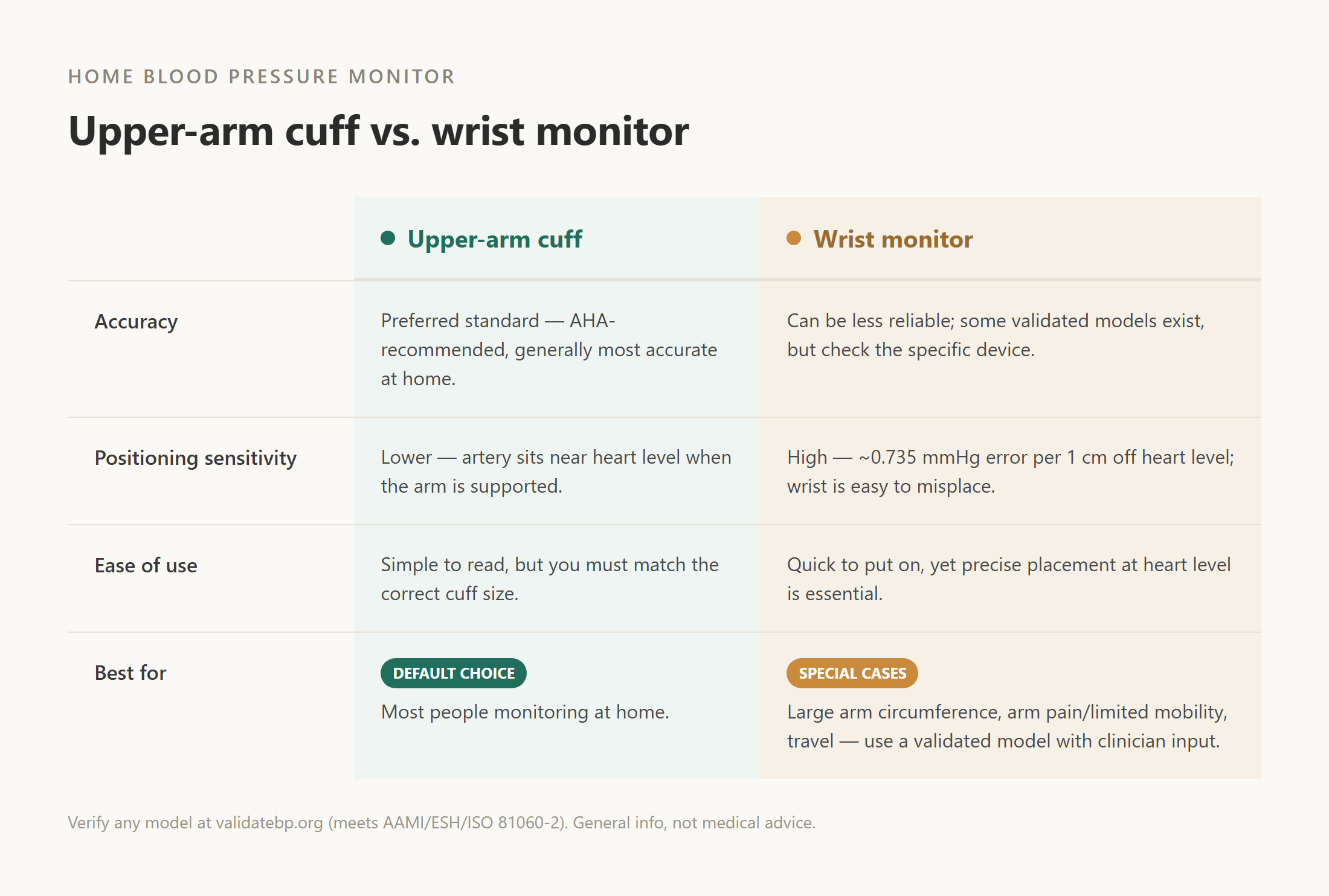
If you are choosing a home blood pressure monitor and wondering whether the upper-arm or wrist type is the better call, the short answer is upper-arm. The American Heart Association recommends “an automatic, cuff-style, upper arm (biceps) monitor” and specifically discourages wrist and finger monitors because they “give less reliable readings.” That is the headline. But the fuller picture is more interesting than a simple verdict, and there are real cases where a wrist device still makes sense.
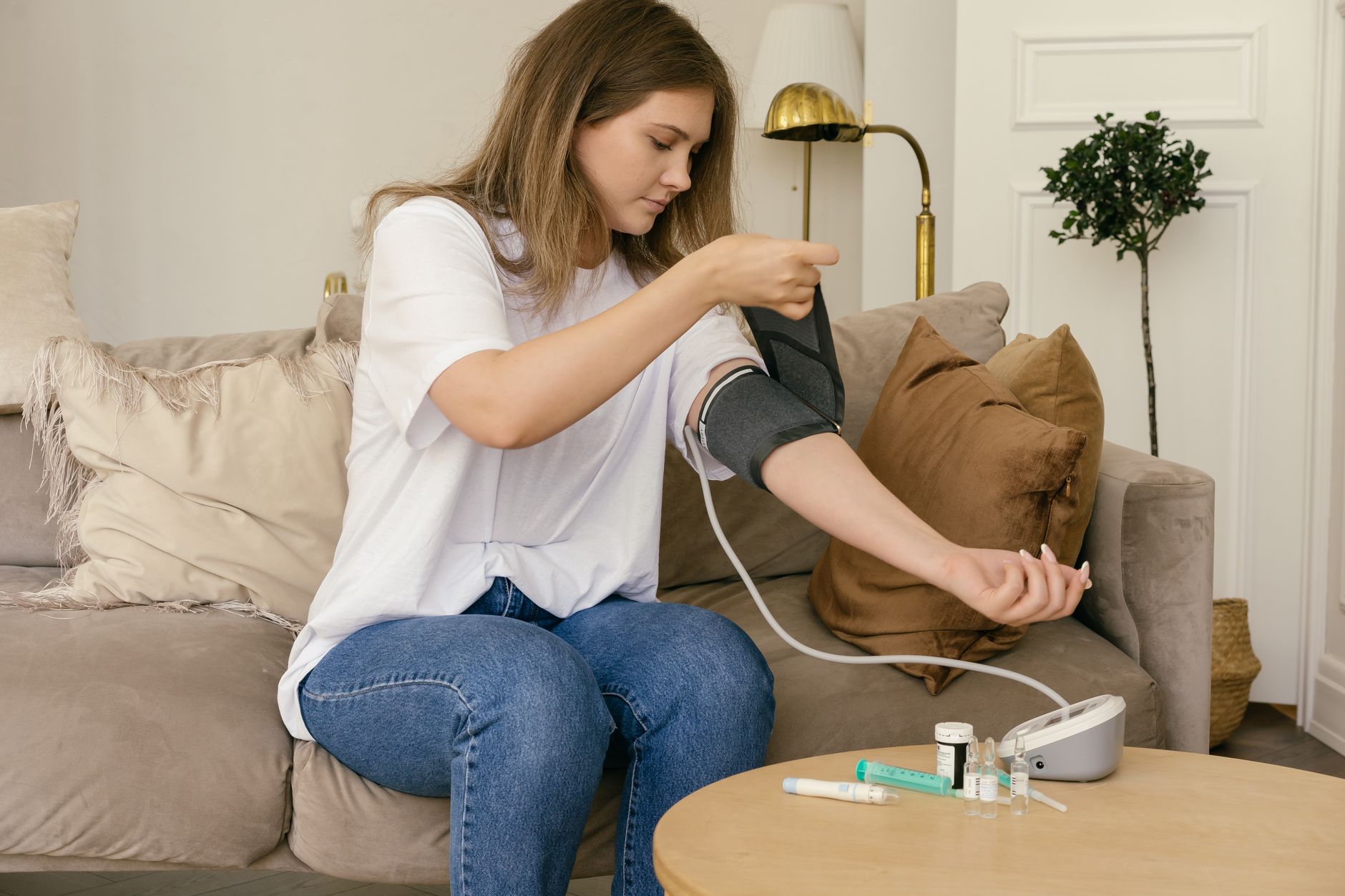
Photo: Mikhail Nilov / Pexels
Why upper-arm is treated as the standard
The reason comes down to anatomy.
The brachial artery in your upper arm sits close to the heart, and it is easy to compress cleanly with a cuff. So the oscillometric sensor reads the pulse wave without much fuss. That is why the AHA, the AMA, Cleveland Clinic, Mayo Clinic, and the AAFP all treat the upper-arm cuff as the preferred device for home monitoring. Mayo Clinic puts it plainly: “Digital monitors that are fitted on the upper arm are often the most accurate.”
The wrist is a harder place to measure, and it is worth knowing why.
- The wrist (radial) arteries are narrower and closer to the skin, so a clean pulse signal is harder to capture.
- The wrist sits farther from the heart, which makes height and position errors much larger.
- Cleveland Clinic also notes that blood pressure naturally differs between the wrist and upper-arm arteries — so a “correct” wrist reading is not identical to an arm reading, even when you do everything right.
There is a commonly cited ranking for accuracy: digital upper-arm first, manual arm second, and wrist last.
So how far off can a wrist reading be?
This is where I have to add a careful note.
Consumer Reports summarized one set of figures worth knowing. In a supervised office setting, wrist systolic readings ran about 2.5% lower than arm readings. But at home, without supervision, wrist systolic readings averaged 5.6% higher and diastolic 5.4% higher than arm readings.
Read that gap again — supervised versus at home.
It tells you the wrist device is not hopeless. It tells you the wrist device depends enormously on doing everything correctly, and most of us at home quietly do not. I want to be fair here: this is a single reported figure set describing a study population, not a fixed law for every device. Treat it as direction and magnitude, not a guarantee.
The one wrist error almost everyone makes
If you take away one number from this article, make it this one.
Blood pressure changes by roughly 0.735 mmHg for every 1 cm the cuff sits above or below heart level. On the wrist, that is the whole ballgame. When your wrist rests below your heart — on a table, on your lap, hanging at your side — the weight of the blood column adds to the reading, and it comes out falsely high. Hold it too high, and it reads falsely low.
The trouble is that a wrist can be held almost anywhere. That freedom is exactly the problem.
Cleveland Clinic lists the usual mistakes: placing the wrist above or below heart level, resting it on a table or lap, or letting the arm hang straight down at the side. The correct form is quieter than people expect — gently place your hand on your chest so the wrist sits at heart level, then stay still and silent.

Photo: SHVETS production / Pexels
And there is a human factor underneath all of this. As Healthline points out, people assume they can “just place a wrist monitor on and hit a button.” Precise placement per the manual is not optional. It is the whole thing.
“Validated” is the word that actually matters
Here is something that surprised me.
The upper-arm-versus-wrist question, as real as it is, is not the first question. The first question is whether the device is clinically validated at all. A monitor is validated when independent testing shows it meets the AAMI/ESH/ISO Universal Standard (ISO 81060-2:2018). The core pass criterion is a mean difference of 5 mmHg or less against a reference, with a standard deviation of 8 mmHg or less, for both systolic and diastolic, tested across a required spread of age, sex, blood pressure range, and cuff sizes.
You do not have to memorize that. You just have to check a list.
In the United States, that list is free and searchable: the US Blood Pressure Validated Device Listing (VDL) at validatebp.org. It was developed under the AMA’s Target:BP initiative and is the first US list of blood pressure devices independently reviewed for clinical accuracy. Manufacturers submit devices voluntarily, and an Independent Review Committee of 13 physician experts reviews them against the VDL criteria. As of the sources reviewed, the VDL listed 57 clinically accurate devices — including at-home and in-office upper-arm devices, wrist-cuff devices, kiosks, and 24-hour ambulatory monitors.
Notice the detail there: wrist-cuff devices can appear on that list too.
Validation is done per model, not per category. Some wrist models pass the standard. Some arm models are not validated at all. So the honest rule is to check the specific model you are about to buy, rather than trusting the shape of the cuff.
When a wrist monitor is a reasonable choice
I would not want you to walk away thinking the wrist device is always the wrong answer. It isn’t.
There are people for whom an upper-arm cuff simply does not work, and for them a validated wrist device — ideally with a clinician’s approval — is a defensible choice. Cleveland Clinic and Healthline point to a few situations:
- A large upper-arm circumference that does not fit the available arm cuffs.
- Pain or medical conditions that make upper-arm inflation unsafe or hard to tolerate (for example, lymphedema concerns or certain surgeries — confirm with a clinician).
- Limited arm or hand mobility that makes positioning a large cuff difficult.
- Quick, non-critical, or travel readings.
If a wrist device is the one for you, the care instructions matter more, not less. Pick a validated model. Follow the manual’s exact placement. Keep the wrist at heart level, stay still and quiet, and periodically cross-check it against a clinic’s upper-arm reading.
The part nobody wants to hear: technique beats the device
I keep coming back to this because the research keeps coming back to it.
The device you choose matters. How you use it may matter just as much. Poor technique alone can shift readings by 4 to 20 mmHg, and the specifics are sobering:
- Resting your arm in your lap instead of supported at heart level overestimated systolic pressure by about 4 mmHg (a JAMA Internal Medicine 2024 randomized trial, cited by the AHA).
- Using a standard cuff on an arm that needs a large cuff overestimated systolic pressure by about 20 mmHg (a 2023 randomized trial). A wrong cuff size can be off by 5 to 10 mmHg routinely.
So before you blame the monitor, it is worth checking the basics. Here is the technique the AHA recommends for any monitor:
- No caffeine, smoking, or exercise for 30 minutes beforehand, and empty your bladder first.
- Rest quietly for at least 5 minutes, and do not talk or use your phone during the measurement.
- Sit with your back supported, legs uncrossed, and feet flat on the floor.
- Support your arm on a flat surface with the cuff at heart level, on bare skin.
- Take two readings one minute apart, and measure at the same time each day — morning and evening, for example.
Keep a log or use the monitor’s memory, and bring it to your appointments.
How to choose, in one list
If you want the selection criteria in a single glance:
- Validated for accuracy — confirm it on validatebp.org (meets AAMI/ESH/ISO 81060-2).
- Correct cuff size — measure your upper-arm circumference and match it; the wrong size routinely costs 5 to 10 mmHg.
- Automatic, upper-arm style, preferred over wrist or finger.
- Memory and averaging — stores readings and, on some models, supports multiple users.
- Irregular-heartbeat screening — some models flag an irregular rhythm during a reading. One caveat: with an irregular heartbeat, any home monitor may be less reliable, so confirm those readings with a clinician.
- Nice-to-haves: a large or backlit display and an easy-to-read risk indicator.
One more thing worth remembering. Home monitoring is genuinely useful — the AHA and AMA endorse it to confirm a diagnosis and track control, and it can reveal white-coat or masked hypertension that a single office visit misses. But it is a tool for the conversation with your clinician, not a replacement for it. Do not change any medication based on home readings without medical advice, and report unusually high numbers or symptoms to a professional. This is a your-health-and-money topic, and the reading on the screen is only the start of the story.
I went home that day and put the wrist monitor back.
Not because it is useless — it isn’t, and for some people it is the right tool. I put it back because I knew myself. I knew I would rest my hand on the desk, hit the button, and trust a number that was quietly wrong by the weight of a few centimeters.
If you are deciding between the two, start with the upper-arm cuff, check the model on validatebp.org, and get the technique right before you blame the device. And when a reading looks off or worrying, talk to your clinician or pharmacist — because the number only means something once someone who knows your history helps you read it.
참고자료 (Sources)
- American Heart Association — Monitoring Your Blood Pressure at Home
- Cleveland Clinic — Do Wrist Blood Pressure Monitors Work?
- Healthline — Are Wrist Blood Pressure Monitors Accurate?
- Mayo Clinic — Get the most out of home blood pressure monitoring
- US Blood Pressure Validated Device Listing (validatebp.org) / AMA Target:BP
- AHA Hypertension — Universal Standard for Validation of BP Measuring Devices (ISO 81060-2:2018)
- JAMA Internal Medicine (2024) and AHA Hypertension (2025) — measurement technique studies
- Consumer Reports — Accuracy of Wrist-Cuff Blood Pressure Monitors
- American Family Physician (AAFP) — Home Blood Pressure Monitoring