

Infrared Heat Lamp for Arthritis: Relief, Not a Cure
Let me start with a confession.
The first time I noticed one, it was angled over a treatment table at a clinic — a lamp with a warm red glow, parked beside the bed like a piece of furniture. I remember thinking, “Why don’t I just get one of those for home?”
If you’ve seen them at a physical therapy, chiropractic, or acupuncture clinic, you may have had the same thought. The pitch you’ll find online goes further: an infrared heat lamp for arthritis sends heat deep into your joints, flushes out pain, and works far better than a heating pad.
I went and read what the FDA, the arthritis guidelines, and the burn research actually say.
Here is the short answer, up front.
An infrared heat lamp is a real, FDA-regulated device, and it can give “temporary relief of minor … arthritis pain” — the same modest, short-lived benefit other forms of heat give. It warms the skin and the few millimeters beneath it. I found no evidence that it beats a heating pad or hot pack. It doesn’t treat arthritis. And the main risk is a burn you may not feel coming.
The rest of this guide is about what that means for buying one and using one.
This article is general information, not medical advice. An infrared heat lamp may offer temporary relief of minor muscle and joint pain; it is not an arthritis treatment. Talk with your doctor or physical therapist before using heat if you have diabetes or nerve damage, poor circulation, a heart condition, are pregnant, have cancer or a bleeding problem, have a joint that is hot and swollen, or have had recent surgery in the area. Always follow your device’s manual. No brand or product is recommended here.
Photo: Towfiqu barbhuiya / Pexels
What an infrared heat lamp for arthritis actually is, according to the FDA
This part surprised me in a good way. These lamps aren’t a gray-market gadget.
The FDA defines an infrared lamp as a device that “emits energy at infrared frequencies (approximately 700 nanometers to 50,000 nanometers) to provide topical heating.” It is a Class II medical device, and an infrared therapeutic heating lamp is exempt from 510(k) premarket notification (21 CFR 890.5500, product code ILY).
Notice the word “topical.” That’s the FDA’s own description of what the device does.
What the label is allowed to promise
Many lamps have gone through FDA’s 510(k) process anyway. One cleared over-the-counter lamp (510(k) K171087, 2017) lists its use as:
“temporary relief of minor muscle and joint pain and stiffness, minor arthritis pain, or muscle spasm; the temporary increase in local blood circulation; and/or the temporary relaxation of muscle.”
Another cleared lamp (K162590, 2017) says “the temporary relief of minor joint pain associated with arthritis.”
Read those again slowly. Temporary. Minor.
That wording is the ceiling of what these clearances cover. It isn’t a floor to build on.
When marketing goes past that ceiling
The FDA does act on this.
- In a December 26, 2019 warning letter, the FDA cited a company whose LED heat lamp was cleared only for temporary relief of minor muscle and joint pain and arthritis. Its marketing had said things like “Natural Neuropathy Treatment in Only 7 minutes.” The FDA called the device adulterated and misbranded.
- In a July 22, 2025 warning letter, the FDA cited a company whose infrared lamp was cleared for topical heating and temporary relief of minor pain. Its marketing claimed the device “can cure” conditions such as tendonitis, bursitis, and plantar fasciitis. The FDA treated that as a major change to the intended use — misbranded.
So if an ad says a lamp heals, cures, or reduces inflammation, that claim is outside what these clearances cover.
Why “registered” doesn’t mean approval
You’ll see “FDA registered” on a lot of listings.
Federal rules are blunt about it. Registering a device establishment “does not in any way denote approval,” and any representation that creates an impression of official approval because of registration “is misleading and constitutes misbranding” (21 CFR 807.39).
So when a heat lamp is sold as “FDA approved,” I read that as a red flag, not a selling point. Heating lamps are 510(k)-exempt or 510(k)-cleared. That’s a different thing.
That red glow isn’t the heat — and red light therapy is a different device
Here’s a detail I had never thought about.
The red glow you see from a heat lamp is visible light. Infrared starts beyond the visible range. The heating comes from the part you can’t see.
That matters because of a second product that gets mixed up with heat lamps all the time: “red light therapy” panels and low-level lasers, also called photobiomodulation.
They sound similar. They are not the same.
- A Cochrane review of low-level laser therapy for rheumatoid arthritis (2005) said its effect “is not thermal, but rather related to photochemical reactions in the cells.”
- The FDA uses a separate product code for them — NHN, a non-heating light or laser device for adjunctive pain therapy, which requires 510(k). The FDA’s own definition says it “does not provide therapeutic topical heating.”
You may see impressive-sounding red light numbers. For example, a knee osteoarthritis meta-analysis (22 randomized trials, 1,063 people, BMJ Open 2019) found lasers reduced pain by about 14 mm on a 100-mm scale versus placebo at the end of therapy — at specific clinic laser doses. That result is about lasers. It says nothing about a heat lamp.
The reverse is also true. Heat-lamp evidence doesn’t carry over to LED panels.
| Infrared heat lamp | Heating pad / hot pack | Red light therapy (LED or low-level laser) | |
|---|---|---|---|
| How it works | Warms the skin surface | Warms the skin surface by contact | Light-based; described as non-thermal |
| FDA product code | ILY (Class II, 510(k) exempt) | — | NHN (Class II, 510(k) required) |
| Evidence you can borrow | Heat evidence in general | Heat evidence in general | Its own trials only |

How far does infrared heat actually reach?
This is where the popular story breaks down.
You’ll often see the phrase “deep heat” in ads, or the promise that the warmth reaches into the joint. The physics says otherwise.
Photo: Nishant Aneja / Pexels
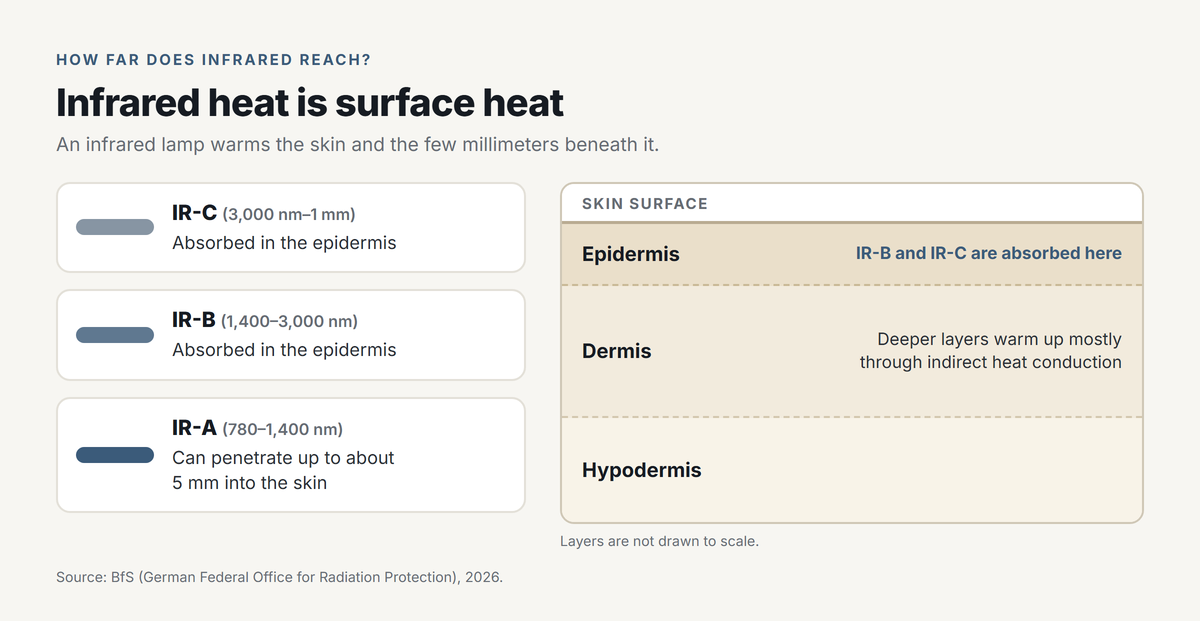
According to Germany’s Federal Office for Radiation Protection (BfS, page dated August 11, 2026):
- IR-A (780–1,400 nm) can penetrate “up to some 5 millimetres” into the skin.
- IR-B (1,400–3,000 nm) and IR-C (3,000 nm–1 mm) “are absorbed in the upper layer of skin, the epidermis.”
- Deeper layers warm up mostly through indirect heat conduction — the surface warms, and some of that warmth spreads inward.
Many consumer “far-infrared” ceramic-plate lamps (the “TDP” type) emit in the IR-C range. One 250-watt model’s 510(k) lists an emission spectrum of 5 to 25 microns (K162590). By the BfS description, that’s absorbed in the epidermis.
So an infrared lamp warms your skin and the few millimeters below it. It is surface heat.
Is an infrared lamp better than a heating pad?
I couldn’t find evidence that it is.
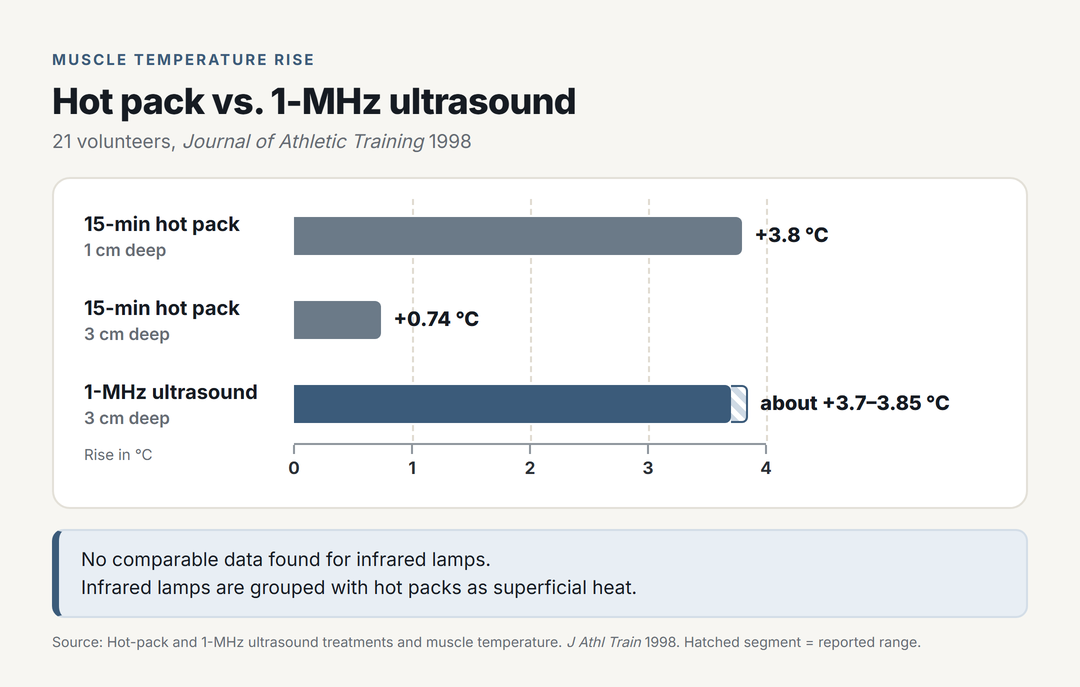
In physical therapy, the tools that actually heat deeper tissue are therapeutic ultrasound and diathermy — not lamps, and not hot packs. One study shows the gap clearly. In 21 volunteers (Journal of Athletic Training, 1998), a 15-minute hot pack raised muscle temperature 3.8 °C at 1 cm deep but only 0.74 °C at 3 cm. One-megahertz ultrasound added about 3.7–3.85 °C at 3 cm.
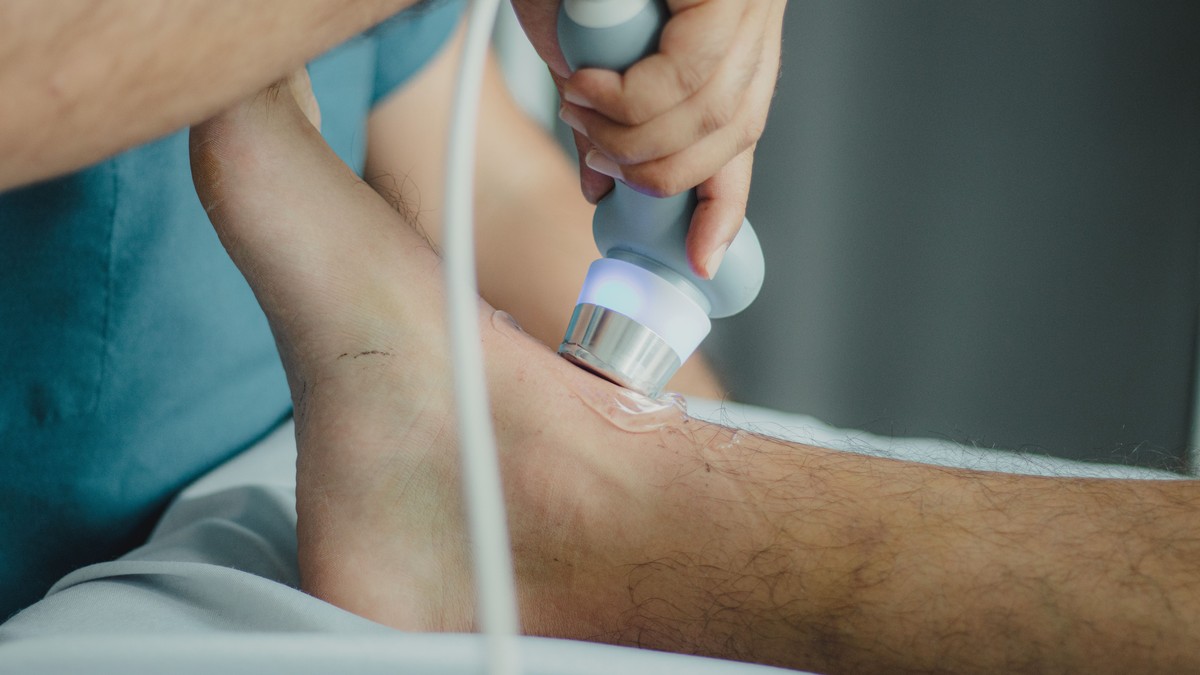
Photo: Juan Manuel Montejano Lopez / Pexels
Infrared lamps are grouped with hot packs as superficial heat. I found no head-to-head study showing that an infrared lamp heats deeper or relieves pain better than a hot pack or heating pad.
That doesn’t make the lamp useless. It makes it one more way to apply surface heat.
The honest reasons to pick a lamp over a pad are practical ones. There’s nothing to strap on, and nothing presses on a sore spot. Those are preferences, not medical advantages.
Does heat help arthritis pain? What the evidence says
The honest answer is a small, qualified yes — for heat in general, not lamps in particular.
Warmth widens blood vessels
This part holds up. The Arthritis Foundation explains that when you warm a sore joint or tired muscle, your “blood vessels get bigger,” letting more blood, oxygen, and nutrients reach the area. A 2015 review in Postgraduate Medicine says heat increases “blood flow, metabolism, and elasticity of connective tissues.” The FDA-cleared lamp wording matches: a “temporary increase in local blood circulation.”
You may also read that heat “flushes out pain substances.” The only source I found saying something like that was an industry-supported expert-opinion paper (Journal of Pain Research, 2024), which described vasodilation as stimulating the “wash-out of toxic metabolites.” I found no study measuring pain substances being cleared by a heat lamp. I’d treat it as a hypothesis, not a fact.
The guidelines: conditional, and short-lived
- ACR / Arthritis Foundation (2019): “Thermal interventions (locally applied heat or cold) are conditionally recommended” for knee, hip, and/or hand osteoarthritis. The reason it’s only conditional: “heterogeneity of modalities and short duration of benefit.” The evidence the guideline named was moist heat, diathermy, ultrasound, and hot and cold packs. It does not name infrared lamps.
- Cochrane, knee osteoarthritis (2003; 3 randomized trials, 179 patients): ice massage helped strength, range of motion, and function, but “hot packs had no beneficial effect on edema” compared with placebo or cold. The review found little evidence for heat.
- Cochrane, rheumatoid arthritis (2002; 7 studies, 328 people): superficial moist heat and cold “can be used as a palliative therapy.” The trials were of poor quality, and no harmful effects of thermotherapy were reported.
- Cochrane, low back pain (2006; 9 trials, 1,117 participants, acute and sub-acute pain): “moderate evidence in a small number of trials that heat wrap therapy provides a small short-term reduction in pain and disability.” That’s heat wraps, not lamps, and not chronic pain.
And the gap that matters most for a buyer: in the research I relied on, no randomized trial of a home infrared heat lamp for osteoarthritis pain turned up. That’s the result of a limited search, not proof that none exists. But it means nobody can honestly tell you a lamp is proven for arthritis.
One more thing from the same ACR guideline. It strongly recommends exercise for osteoarthritis. Heat is an add-on to movement, not a substitute for it.
Photo: SHVETS production / Pexels
When heat is the wrong tool for a sore joint
This is the section I’d most like people to remember.
A hot, red, swollen joint should not go under a heat lamp.
The Arthritis Foundation says it plainly: “Stay away from heat if you have an acute injury or are having a flare.” For a sudden onset of swelling and redness, it points to cold instead. Cleveland Clinic, quoting a rheumatologist on gout, says ice “can calm the flare-ups,” and calls it “one arthritis issue where cold works best.”
So the rule is simple.
- Stiff, achy, not swollen? Gentle heat may help for a while.
- Hot, swollen, red, or just injured? Skip the heat. Use cold, and get it checked if it’s new or severe.
Photo: Markus Winkler / Pexels
Heat lamp burns: how gentle warmth can still hurt you
I used to think burns came from hot surfaces. Low, steady heat felt harmless.
It isn’t.
Low heat over time is enough
A classic burn study (Moritz and Henriques, 1947, as reported in a 2021 PLoS One systematic review) found that at 44 °C (111 °F), about 6 hours of contact heat was enough to kill surface skin cells. Between 44 °C and 51 °C, each 1 °C increase cut the time roughly in half.
That’s physics, not a “safe time” chart. But it explains why falling asleep under a lamp is a real danger.
Infrared can under-warn you
This detail genuinely changed how I think about these lamps.
BfS notes that the skin’s heat and pain receptors “are less sensitive to IR-A radiation than to IR-C and IR-B radiation.” You may feel less warning than you’d expect. And that natural protection “may be impaired or can fail” under the influence of medication, alcohol or drugs. Pain sensation may also be reduced or absent in scar tissue.
People with diabetes or nerve damage
The NIH’s diabetes institute (NIDDK) warns: “If you have nerve damage from diabetes, you may burn your feet and not know you did … Do not put a hot water bottle or heating pad on your feet.”
In a chart review of 37 hospitalized people with diabetes and burns (Journal of Family Practice, 1987), 10 (27%) had preventable leg or foot burns linked to sensory loss. Most came from heat they had used to care for themselves, including a heating pad.
If you or the parent you’re buying for has neuropathy, this is a conversation for the doctor before any heat device comes home.
Photo: Ksenia Chernaya / Pexels
Never over a pain-relief rub or patch
This one is easy to miss.
On September 13, 2012, the FDA warned that with over-the-counter menthol, methyl salicylate, or capsaicin products, you should “do not apply local heat (heating pads, lamps, hot water in bags or bottles) because doing so can increase the risk of serious burns.” The FDA identified 43 burn cases across its reporting systems and the medical literature, ranging from first- to third-degree, many after a single application.
Lamps are named in that warning, word for word.
Weeks of warmth can mark the skin
Repeated, prolonged heat below burning level can cause erythema ab igne — a lacy, red-brown pattern on the skin from “repeated and prolonged exposure to direct heat or infrared radiation” (StatPearls, 2025). Most cases fade once the heat source is stopped. Prolonged exposure may lead to permanent pigment changes or, in rare cases, malignant transformation.
Protect your eyes
BfS also notes that “the eyes are particularly sensitive to thermal effects.” Don’t look into the lamp. The same office says suitable protective goggles can protect the eyes from excess infrared exposure.
Buying an infrared heat lamp: a checklist before you order
If you’ve read this far and still want one, that’s a reasonable choice. Here’s what I’d check — specs and standards only, no brands.
| What to check | Why it matters |
|---|---|
| Sold as a medical infrared heating lamp, with readable indications for use; a 510(k) number if it has one | The FDA claim limits apply to medical lamps (21 CFR 890.5500) |
| Claims stay within temporary relief of minor pain, stiffness, or spasm | Anything beyond that is outside the clearances (FDA warning letters 2019 and 2025) |
| No approval claims that lean on “registration” | Registration does not denote approval (21 CFR 807.39) |
| An auto shut-off timer with short settings, not only a long maximum | Cleared lamps were tested at 10–15 minute sessions; long unattended heat drives burns |
| Distance guidance printed in the manual, plus a stable, adjustable arm | Skin temperature changes with distance |
| A certification mark from an OSHA-recognized testing lab (for example UL, Intertek/ETL, or CSA) | Electrical safety |
| Clear warnings about rubs, numb skin, drowsiness, and eyes | Signals the maker takes burn risk seriously |
A guard or grille over the hot element and good tip-over stability are sensible things to look for too. I couldn’t find a standard that requires them, so treat that as a practical tip rather than a rule.

How to check a lamp’s FDA status yourself
- Look on the box or manual for a 510(k) number (it starts with “K” followed by six digits) or an FDA product code.
- Search that number in the FDA’s 510(k) Premarket Notification database and read the Indications for Use.
- Because heating lamps are 510(k)-exempt, some won’t have a K-number. The company should still appear in the FDA’s Establishment Registration & Device Listing database. But remember: a listing is not an approval.
- Compare the ad to the cleared wording. “Heals,” “cures,” “reduces inflammation,” “neuropathy,” or “anti-aging” go beyond what these clearances cover.
Why wattage and “safe distance” claims don’t tell you much
It’s tempting to compare lamps by wattage. BfS notes that it’s “not possible based on the number of watts alone” to judge how much radiated power actually reaches your body — that depends on the distance, among other things. (BfS said this about infrared cabins, but the physics applies to lamps too.)
Distance matters a lot. In one ceramic lamp’s 510(k) bench test (K162590), skin temperature reached 45 °C at 8 inches, 43 °C at 10 inches, and 41 °C at 12 inches. Another cleared lamp’s file described 40–45 °C as the generally accepted range for therapeutic heat during a recommended 10-minute treatment (K171087).
I want to be careful here. Those are manufacturer test figures for specific models, not universal rules. Your lamp may run hotter or cooler. Follow your own manual’s distance, and start farther away rather than closer.
The same goes for time. Timers on these lamps can go “up to 60 minutes” (K162590), while the cleared treatment testing was at 10–15 minutes. A long maximum on the dial isn’t a recommended dose.
Will insurance pay for it?
Maybe, under specific conditions.
Medicare’s durable medical equipment list says heat lamps are “covered if” the contractor’s medical staff “determines patient’s medical condition is one for which the application of heat in the form of a heat lamp is therapeutically effective” (NCD Manual §280.1). Heating pads carry the same wording. The exact paperwork is something to confirm with your doctor and supplier.
Separately, Medicare does not cover infrared light or heat therapy for peripheral sensory neuropathy or for wounds and ulcers of the skin (NCD 270.6, effective 2006). I didn’t verify private insurance or HSA/FSA rules.
How to use a heat lamp at home without getting burned
These are the habits the research points to. Your manual comes first.
- Use the timer every time. Never use the lamp when you’re drowsy, have had alcohol or sedating medicine, or could fall asleep.
- Start at the manual’s distance or farther. Don’t creep closer because it “doesn’t feel hot yet” — infrared can under-warn you.
- Bare, clean skin only. Nothing applied under the lamp: no menthol, methyl salicylate, or capsaicin creams, gels, or patches.
- Not on numb skin, scars, or broken or irritated skin, and not on the feet if you have diabetic neuropathy.
- Don’t look into the lamp. Protect your eyes.
- Check the skin during and after each session. If redness persists, stop and see a clinician. A lacy brown-red pattern after weeks of use means stop heating that spot and get it looked at.
- Keep it away from children and pets, and don’t leave it running unattended.
- Skip it on a hot, swollen joint. Cold is the better choice for a flare.
Photo: Kindel Media / Pexels
If you do get a minor burn
MedlinePlus (reviewed April 9, 2026) advises running cool — not ice-cold — water over a minor burn with unbroken skin for at least 5 to 30 minutes, then covering it with a dry sterile bandage. Over-the-counter ibuprofen or acetaminophen can help with pain. Don’t break blisters, and make sure tetanus shots are up to date. Don’t put butter, oil, ice, or home remedies on a severe burn.
When to see a doctor
Call 911 now if:
- A burn is large (about the size of the person’s palm or larger), looks full-thickness (white, leathery, charred, or numb), or you aren’t sure how serious it is.
- There are signs of shock, or someone got an electrical injury from the lamp.
- Anyone shows signs of a heart attack or stroke while using heat (the usual emergency rule, not specific to lamps).
See a doctor the same day or within a few days if:
- A blistering burn is wider than 2–3 inches, or it’s on the hands, feet, face, groin, buttocks, or over a major joint — MedlinePlus classes these as major burns.
- Anyone with diabetes or reduced sensation gets a burn, or the burn is on a young child or an older adult.
- A burn shows infection signs: drainage or pus, fever, increasing pain, red streaks, or swollen lymph nodes.
- A joint is suddenly hot, red, and swollen, especially with fever or trouble bearing weight. Don’t heat it — get it evaluated.
- A minor burn is still painful after 48 hours.
- You burned skin where you’d used a topical pain reliever, or you notice pain, swelling, or blistering where one was applied. The FDA says to “stop using the product and seek medical attention immediately.”
Watch and care for it at home if:
- Mild pinkness fades within a few hours with no blister. Cool the area, stop for now, and next time increase the distance or shorten the session.
- A faint lacy brownish-red pattern appears after repeated use. Stop heating that spot and mention it at your next visit — sooner if the skin thickens, breaks down, or changes.
- Joint stiffness eases with gentle heat and movement, without swelling, redness, or fever. Keep up your exercise plan, and check in with your doctor if the pain keeps getting worse.

Key takeaways
- It’s an FDA-regulated Class II device (21 CFR 890.5500). Heating lamps are 510(k)-exempt, and cleared labels are limited to “temporary relief of minor” muscle and joint pain, stiffness, minor arthritis pain, or spasm, plus a temporary increase in local circulation (K171087, 2017).
- “FDA registered” does not mean approved (21 CFR 807.39). The FDA cited over-claiming lamp marketers in 2019 and 2025.
- It’s surface heat. IR-A reaches up to about 5 mm; IR-B and IR-C are absorbed in the epidermis; warmth spreads deeper by conduction (BfS, 2026). Deeper heating in rehab comes from ultrasound or diathermy.
- No head-to-head study was found showing an infrared lamp heats deeper or eases pain better than a heating pad or hot pack.
- Heat’s benefit is modest and short-lived. ACR 2019 conditionally recommends heat or cold for knee, hip, and hand osteoarthritis because of “short duration of benefit,” and doesn’t name infrared lamps. No randomized trial of a home infrared lamp for osteoarthritis turned up in a limited search. Exercise remains the strongly recommended core.
- Red light therapy is a different device (non-thermal, FDA code NHN). Its study results don’t apply to heat lamps.
- No heat on a hot, swollen joint. Flares, acute injuries, and gout attacks call for cold.
- Burns are the main risk. At 44 °C, about 6 hours of contact heat killed surface skin cells, and each 1 °C rise roughly halved that time (Moritz and Henriques 1947, via a 2021 review). Never use a lamp over pain-relief rubs (FDA 2012), on numb skin, or when you could fall asleep.
- Distance figures like 45 °C at 8 inches are one model’s test data, not a rule. Follow your own lamp’s manual.
Related reading: if the lamp is for a parent with diabetes, this guide to daily diabetic foot care explains why numb feet and heat don’t mix. For another at-home pain device with its own evidence gaps, see TENS massagers: gel pads vs. joint wraps. And if a hot, swollen big toe is the problem, preventing gout flares is the better place to start.
When I started, I pictured that clinic lamp as a small piece of treatment I could bring home.
What I found was more ordinary. It’s a way to put warmth on your skin — regulated, legitimate, and modest. It can make a stiff morning a little easier for a while. It can’t reach into a joint and fix it, and it can burn you quietly if you let it run.
If you use one, I’d hold on to one sentence: surface heat, short sessions, a real timer, the manual’s distance — and never on numb skin, over a rub, or on a hot, swollen joint.
The lamp isn’t what keeps a stiff joint moving over the years. You are, because the movement is what the evidence backs most.
References
- 21 CFR 890.5500, Infrared lamp; 21 CFR 890.9; 21 CFR 807.39 (Cornell LII copy of the CFR).
- FDA Product Classification, product codes ILY and NHN (openFDA classification data).
- FDA 510(k) summary K171087 (2017) and K162590 (2017), infrared heat lamps.
- FDA Warning Letter to Vevazz LLC (Dec 26, 2019); FDA Warning Letter to Spectra Therapy LLC (Jul 22, 2025).
- FDA Drug Safety Communication: rare cases of serious burns with OTC topical muscle and joint pain relievers (Sep 13, 2012; archived fda.gov page).
- CMS Medicare National Coverage Determinations Manual, §270.6 Infrared Therapy Devices and §280.1 DME Reference List.
- Kolasinski SL, et al. 2019 ACR/Arthritis Foundation Guideline for the Management of Osteoarthritis of the Hand, Hip, and Knee. Arthritis Care Res 2020.
- Cochrane: French SD, et al. Superficial heat or cold for low back pain (2006). · Brosseau L, et al. Thermotherapy for treatment of osteoarthritis (2003). · Robinson V, et al. Thermotherapy for treating rheumatoid arthritis (2002). · Brosseau L, et al. Low level laser therapy for treating rheumatoid arthritis (2005).
- Stausholm MB, et al. Low-level laser therapy for knee osteoarthritis. BMJ Open 2019.
- BfS (German Federal Office for Radiation Protection). Applications of infrared radiation (Aug 11, 2026).
- Barolet D, et al. Infrared and skin: friend or foe. J Photochem Photobiol B 2016.
- Hot-pack and 1-MHz ultrasound treatments and muscle temperature. J Athl Train 1998.
- Malanga GA, et al. Mechanisms and efficacy of heat and cold therapies for musculoskeletal injury. Postgrad Med 2015.
- Springborg AD, et al. Human contact burn injury model: a systematic review. PLoS One 2021 (reporting Moritz and Henriques 1947).
- Gervasoni F, et al. Italian position paper on low-level heat wrap therapy. J Pain Res 2024 (industry-supported).
- StatPearls: Erythema Ab Igne (updated Sep 14, 2025). · MedlinePlus: Burns (reviewed Apr 9, 2026). · NIDDK: Diabetes & Foot Problems.
- Lower extremity burns related to sensory loss in diabetes mellitus. J Fam Pract 1987.
- Arthritis Foundation: Heat Therapy Helps Relax Stiff Joints. · Cleveland Clinic: Should You Use Ice or Heat for Pain? (2025).
- OSHA: Nationally Recognized Testing Laboratory Program.


