Diabetic Foot Care: Why a Numb Foot Is the Dangerous One
I believed something about bodies that turned out to be wrong.
I believed that a foot problem announces itself. Something goes wrong, it hurts, you deal with it. That is how most of us have been trained by every injury we have ever had.
Diabetic foot care breaks that rule, and it breaks it at the worst possible moment.
The nerve that would tell you a blister is forming is often the first thing diabetes takes. Roughly half of diabetic neuropathy is asymptomatic — people do not know sensation is gone until something has already happened (StatPearls; Hicks & Selvin, 2019).
So the most dangerous foot is not the one that hurts. It is the one that doesn’t.
This is the careful version of the advice. What is actually going wrong inside the foot, what the daily routine really looks like, the sock advice that is half wrong, the things you should never do, and the point where you stop reading and call your care team today.
Photo: SHVETS production / Pexels
Why a numb foot is the dangerous one
You have probably heard the short version: high blood sugar wrecks your nerves and your circulation. That is directionally right and genuinely unhelpful, because it blurs together four separate things that need separate answers.
The JAMA 2023 review splits neuropathy into three types, and each one has a different job in this story.
Sensory neuropathy removes protective sensation. You cannot feel the stone in the shoe, the seam rubbing, the blister forming, the hot surface. This is the one that creates the injury.
Motor neuropathy weakens the small muscles of the foot. The result is deformity — claw or hammer toes, prominent metatarsal heads, ankle equinus — and deformity means pressure lands in places it was never meant to land.
Autonomic neuropathy takes out sweat and oil regulation and changes the skin itself.
That last one deserves a line of its own, because it corrects something almost everyone gets backwards.
Cracked heels are not primarily a circulation problem. Dry, fissured skin in diabetes traces mainly to autonomic neuropathy, per the same JAMA review. Blaming circulation sends people looking for the wrong fix.
And callus, while we are here, is not cosmetic. Callus over a high-pressure area is described in that review as a pre-ulcerative lesion.
Circulation is the healing variable, not the injury variable
Peripheral artery disease (PAD) is a separate problem that happens to travel with the first one. The ADA puts it plainly: diabetes narrows and hardens the blood vessels of the foot and leg, which makes the foot less able to fight infection and to heal. NIDDK says the same in simpler words.
About 50% of people with a diabetic foot ulcer also have PAD (JAMA 2023).
Here is the distinction worth carrying: a foot with perfectly good pulses can still ulcerate. Sensation is what determines whether you get hurt. Circulation is what determines whether it heals. Do not merge them.
The one most articles leave out
Charcot neuroarthropathy is the danger I would most want an older reader to recognize.
NIDDK describes it starting with redness, warmth, and swelling. Later the bones in the foot and toes can shift or break, and the foot takes on an odd shape — a “rocker bottom.” It happens in a numb foot, because the person keeps walking on it.
A suddenly warm, red, swollen foot that does not hurt is urgent, not minor. StatPearls flags a temperature difference of about 3–4 °C between the two feet as a signal of infection or acute Charcot.
Photo: Andrey Matveev / Pexels
The numbers, and the part nobody prints next to them
I want to give you the real figures. I also want to refuse the sentence they usually get attached to — the one that goes “ignore a small wound and you’ll lose your foot.”
That framing is fear, and fear is not the same thing as accuracy.
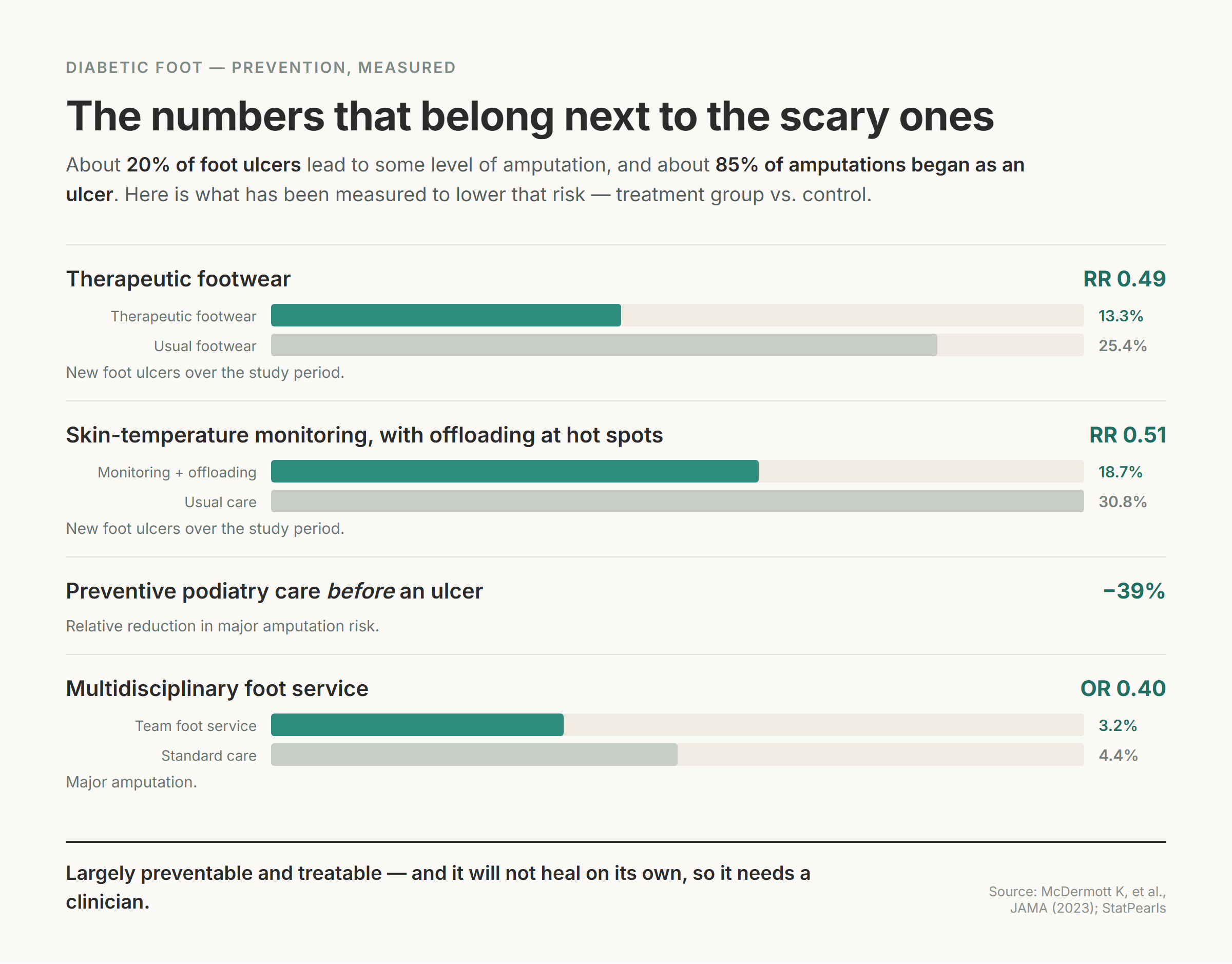
The honest version: the lifetime risk of a foot ulcer in diabetes is roughly 19–34% (NEJM 2017; JAMA 2023 puts it near 34%). About 20% of ulcers lead to some level of amputation, and about 85% of amputations began as an ulcer (StatPearls). Five-year mortality after a diabetic foot ulcer is around 30%, and over 70% after a major amputation (JAMA 2023). Only 30–40% of ulcers heal by 12 weeks, and 23% are still unhealed at a year.
Now the numbers that almost never appear in the same paragraph.
| Prevention step | Effect | Source |
|---|---|---|
| Therapeutic footwear | Ulcers 13.3% vs 25.4% (RR 0.49) | JAMA 2023 |
| Skin-temperature monitoring with offloading at hot spots | Ulcers 18.7% vs 30.8% (RR 0.51) | JAMA 2023 |
| Preventive podiatry care before an ulcer | Major amputation risk −39% | JAMA 2023 |
| Multidisciplinary foot service | Major amputation 3.2% vs 4.4% (OR 0.40) | JAMA 2023 |
Read those two blocks together and you get the accurate message, which is neither reassuring nor terrifying.
This is largely preventable and it is treatable — and it will not heal on its own, so it needs a clinician.
The daily check — what the guideline actually says
The ADA Standards of Care in Diabetes—2026 (Recommendation 12.30) asks for preventive foot self-care education for everyone with diabetes, including those who have already lost protective sensation, covering “palpation or visual inspection with an unbreakable mirror” for daily surveillance.
Three things in that sentence get misquoted constantly.
It says daily. Not weekly, and emphatically not “whenever it hurts.” Pain is the signal that is missing.
It says palpation or a mirror. The mirror is not mandatory. And NIDDK explicitly allows a third option: if you cannot see the bottoms of your feet, ask someone else to look. Mirror, hands, or a caregiver — all three count.
It says unbreakable. Keep that word. A glass mirror on a bathroom floor is its own laceration hazard for a foot that cannot feel.
You will also see “every evening, under bright light” repeated everywhere, including in things I have written notes on. I like the habit — shoes are off, and the day’s pressure marks are visible. But no guideline says it. Treat it as a sensible anchor for the habit, not as the rule itself.
What you are looking for, per ADA, APMA, and Mayo Clinic: sores, cuts, cracks, blisters, redness, dry or cracked skin, ingrown toenails, redness around the nails, red streaks, swelling, and changes to the toenails such as thickening or discoloration. The sole and the spaces between the toes matter most, and they are the two places people skip.
IWGDF 2023 adds the half that gets dropped: examine daily and, if you find or suspect a lesion, contact an appropriately trained professional quickly. An inspection nobody acts on is just a ritual.
The rest of the routine
- Wash daily in warm, not hot, water. Test it with a thermometer (90–95 °F is safe) or your elbow — not your feet (NIDDK).
- Dry thoroughly, especially between the toes (ADA).
- Moisturize the tops and bottoms — never between the toes. NIDDK is blunt: “Do not put lotion or cream between your toes because moistness might cause an infection.” Between the toes stays dry; NIDDK mentions talcum powder or cornstarch there.
- Trim nails straight across, and do not cut into the corners (NIDDK, ADA, IWGDF). File sharp edges with an emery board.
- Move. APMA recommends walking for weight and circulation, and IWGDF 2023 recommends a supervised 8–12 week foot-ankle exercise program for people at low-to-moderate risk, continued afterward.

Photo: Angela Roma / Pexels
Socks — white is right, cotton is not
This is the piece of advice I most wanted to check, because “always wear white cotton socks” is repeated so confidently.
Half of it is literally ADA text. The other half is folk wisdom running in the opposite direction.
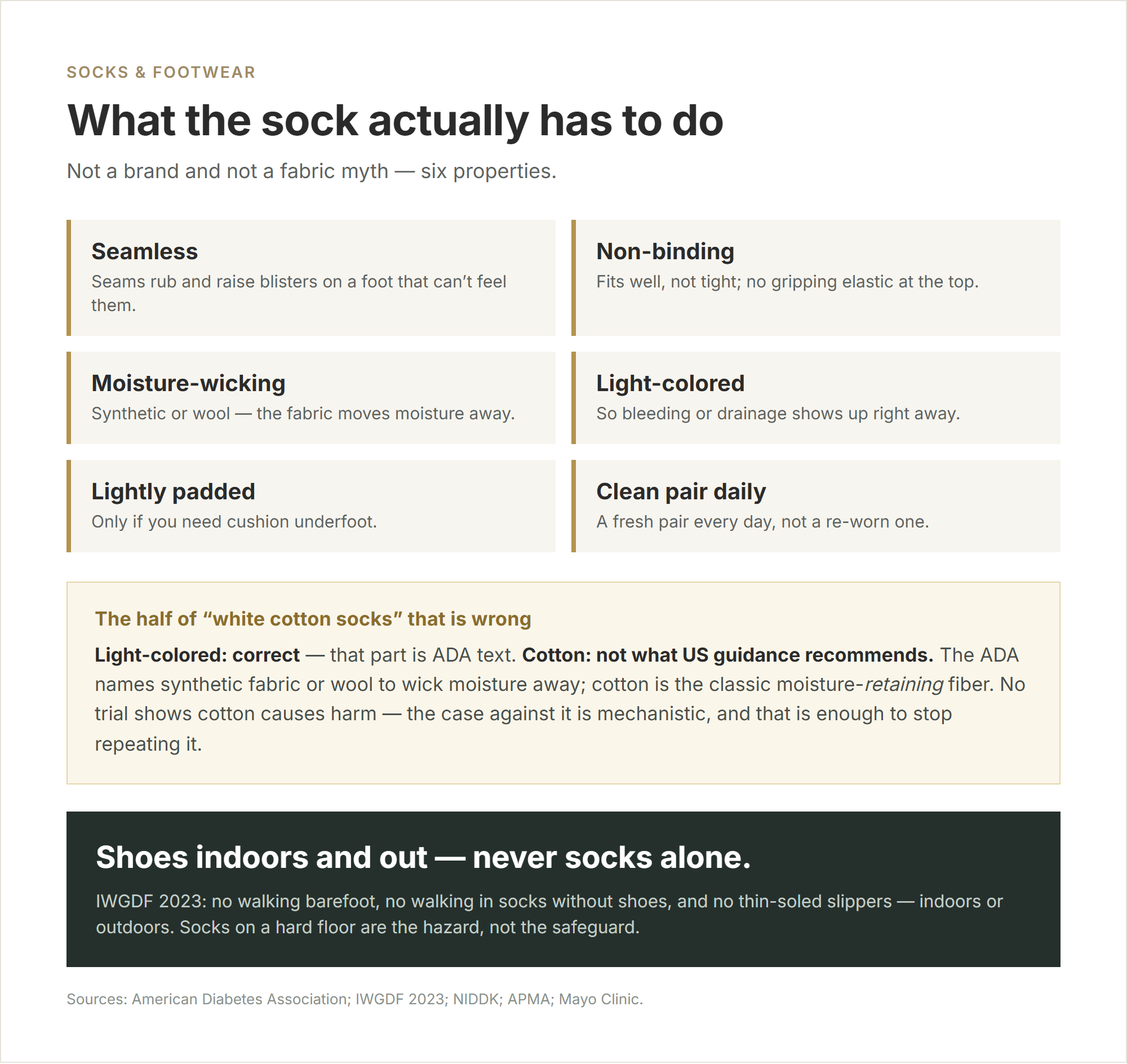
Light-colored: correct. ADA’s “8 Tips to Protect Your Feet” says socks should be white or light-colored “to make it easy to spot any bleeding or drainage.” On a foot you cannot feel, color is a substitute alarm.
Cotton: not what US guidance recommends. The same ADA page says socks should be “made of a synthetic fabric or wool to wick away moisture,” and the ADA foot-complications page says “wear moisture-wicking socks.” Cotton is the classic moisture-retaining fiber. Mayo Clinic frames diabetic socks the same way — the fabric wicks moisture away.
Let me be precise about how strong that correction is, because overstating it would be its own error. No source I found says cotton has been shown to cause harm in a trial. The case against it is mechanistic — it holds moisture — plus the fact that ADA names a specific alternative. That is enough to stop repeating “cotton,” and not enough to call it dangerous.
So the properties, not a brand and not a fabric myth:
- Seamless — ADA says no seams; APMA warns seams rub and cause blisters; NIDDK says seamless is best
- Non-binding — fits well, not too tight; Mayo notes no elastic at the top
- Moisture-wicking — synthetic or wool
- Light-colored — so bleeding or drainage shows
- Lightly padded if you need cushion underfoot
- Clean pair every day (Mayo Clinic)
One more honest note. A February 2026 systematic review in Diabetes/Metabolism Research and Reviews looked at diabetic socks in both the literature and the market and concluded the evidence is limited, with clinical trials of poor methodological quality — six studies averaged 28.6% on quality assessment. It also observed that IWGDF specifies therapeutic footwear but is notably silent on socks, and that novel-fiber marketing claims lack clinical support.
So: society-endorsed patient education, sensible mechanism, weak trial evidence. That is the truthful shelf to put it on. And compression socks are not a blanket recommendation — ADA says ask your provider about them if you have venous insufficiency.
Shoes indoors, and never socks alone
Here is the correction that surprised me most, because the common version has it exactly backwards.
The rule is not “wear socks even indoors.” The rule is shoes indoors, and never socks alone.
IWGDF 2023 is explicit about “not walking barefoot, not walking in socks without shoes, and not walking in thin-soled slippers, whether indoors or outdoors.” NIDDK says do not walk barefoot or in just socks, even inside. ADA says get fitted for the right footwear and wear shoes indoors and out — and never put shoes on without socks. APMA: don’t go without shoes, even in your own home.
Socks on a hard floor are a slip risk and a puncture risk with no protection. They are the hazard, not the safeguard.

Photo: Cara Denison / Pexels
The list I would tape inside a cabinet door
Every one of these is sourced, and every one of them is something people do with good intentions.
- Don’t cut or shave corns and calluses. NIDDK: “Do NOT cut corns and calluses.” ADA warns it can lead to ulcers and infection.
- Don’t use OTC corn removers or medicated corn plasters. NIDDK names both liquid removers and medicated pads — they “can damage your skin and cause an infection.” ADA says chemical agents can burn the skin.
- Don’t use heating pads, hot water bottles, electric blankets, or hot water on your feet. With neuropathy the burn goes unfelt until the damage is done (NIDDK, ADA).
- Don’t soak your feet. ADA: soaking dries the skin. Mayo says clean gently with lukewarm water, but don’t soak.
- Don’t walk barefoot — and skip flip-flops and open-toed shoes in warm weather (ADA).
- Don’t cut nails short or into the corners.
- Don’t wait out a wound. NIDDK: call right away for a cut, blister, or bruise that has not started to heal after a few days.
- Don’t keep smoking. ADA 2026 pairs smoking-cessation counseling with specialist referral for people with prior complications, lost sensation, structural abnormalities, or PAD.
What a real foot exam includes, and how often
ADA Recommendation 12.23 asks for a comprehensive foot evaluation at least annually. It should include skin inspection, assessment of deformity, and neurological testing with a 10-g monofilament or the Ipswich Touch Test, plus at least one additional method — a 128-Hz tuning fork, ankle reflexes, or pulse palpation.
IWGDF 2023 then sets the pace by risk tier.
| IWGDF risk | Who | Screening |
|---|---|---|
| 0 | No lost sensation, no PAD | Annually |
| 1 | Lost sensation or PAD | Every 6–12 months |
| 2 | Two of: lost sensation, PAD, deformity | Every 3–6 months |
| 3 | Above plus prior ulcer, amputation, or end-stage renal disease | Every 1–3 months |
StatPearls goes further for anyone with sensory loss, prior ulceration, or a prior amputation: check the feet at every visit.
Because monofilament testing does get skipped in busy primary care, there is one concrete, non-pushy thing you can do at your next appointment. Ask: “Have my feet been checked with a monofilament this year?”
ADA 2026 also asks for vascular referral — ankle-brachial index with toe pressures — for leg fatigue, claudication, rest pain relieved by dangling the leg, or decreased or absent pedal pulses. And it recommends an interprofessional approach led by a podiatrist for high-risk feet: dialysis, Charcot, prior ulcer or amputation, PAD.
Medicare — what is covered, and what genuinely isn’t
Worth knowing before you assume either way.
Therapeutic shoes and inserts (Part B). Covered when you have diabetes plus severe diabetes-related foot disease, and the doctor treating your diabetes certifies the need. Qualifying conditions include prior partial or complete foot amputation, previous ulceration, pre-ulcerative callus, nerve damage with callus problems, poor circulation, or foot deformity. They must be prescribed by a podiatrist or other qualified doctor and supplied by a Medicare-enrolled supplier. Per calendar year: custom-molded shoes plus 2 extra pairs of inserts, or extra-depth shoes plus 3 extra pairs. You pay 20% of the Medicare-approved amount after the Part B deductible.
The foot exam. Medicare Part B covers a foot exam and treatment for diabetic peripheral neuropathy with loss of protective sensation — no more often than every six months, provided you haven’t seen a foot care specialist for another reason in between (CMS NCD 70.2.1). That visit can cover ulcers, calluses, and nail management. Loss of protective sensation is diagnosed by testing five sites on the sole of each foot with the 5.07 monofilament.
What isn’t covered: ordinary routine foot care — nail trimming or callus removal for comfort — is excluded unless a qualifying condition like diabetes with lost sensation or peripheral vascular disease is documented.
Coverage rules and amounts change, and Medicare Advantage plans differ. Verify current coverage with Medicare or your plan rather than taking this as a guarantee.

Photo: Adventure Studio / Pexels
Red flags — call your care team today
Not at your next appointment. Today.
- A cut, blister, or bruise that has not started to heal after a few days (NIDDK)
- Skin that is red, warm, or painful — possible infection (NIDDK)
- A suddenly warm, red, swollen foot, with or without pain, or a foot that no longer fits yesterday’s shoe — possible acute Charcot or infection
- Black or dark tissue, foul odor, drainage or pus, red streaks spreading up the foot or leg, fever, or feeling generally unwell with a foot wound — signs of infection
- If you monitor foot temperature: a left-to-right difference over 2.2 °C (4 °F) on two consecutive days — reduce walking and contact a professional (IWGDF 2023)
- New numbness, a sudden inability to feel the floor, or a foot that is changing shape
This is not a diagnostic checklist. If something on it is happening, the call is the right move regardless of how it turns out.
What stays with me from all of this is the shape of the mistake.
We are trained to wait for pain, and this is the one condition where waiting for pain means waiting for the thing that will never come. So the whole strategy has to move earlier — to a scheduled look, a good pair of shoes on the floor by the bed, and a phone call that feels premature.
If you take one thing from this, take the smallest one. Tonight, sit down, take the socks off, and look — the soles and between the toes, with your hands or an unbreakable mirror or someone else’s eyes.
It takes about a minute. And a foot that can’t call for help needs someone else to check on it.
This article is general health information, not medical advice, diagnosis, or treatment. It contains no wound-care or self-treatment instructions on purpose — an ulcer, an infection, a callus, or a corn is a clinician’s job, not a home project. Talk with your diabetes care team, primary care provider, or a podiatrist about your own feet. If you have a wound that isn’t healing, a red, warm or swollen foot, black tissue, foul odor, spreading redness, or fever, contact your clinician today or seek emergency care.
References
- American Diabetes Association — 12. Retinopathy, Neuropathy, and Foot Care: Standards of Care in Diabetes—2026, Recommendations 12.23 and 12.30
- American Diabetes Association — 8 Tips to Protect Your Feet with Diabetes; Foot Complications
- NIH / NIDDK — Diabetes & Foot Problems
- IWGDF — Practical Guidelines on the Prevention and Management of Diabetes-Related Foot Disease (2023 update)
- McDermott K, et al. — Diabetic Foot Ulcers: A Review, JAMA (2023)
- Armstrong DG, Boulton AJM, Bus SA — Diabetic Foot Ulcers and Their Recurrence, N Engl J Med (2017)
- StatPearls (NCBI Bookshelf) — Diabetic Foot Care
- APMA — Diabetes and Foot Health
- Diabetic Socks: A Systematic Review of the Literature and Commercially Available Products, Diabetes Metab Res Rev (February 2026)
- Medicare.gov — Therapeutic Shoes & Inserts; Foot Care (for Diabetes); CMS NCD 70.2.1
- Hicks CW, Selvin E — Epidemiology of Peripheral Neuropathy and Lower Extremity Disease in Diabetes (2019)
- Mayo Clinic — patient education on diabetes and foot care; AAOS OrthoInfo and Cleveland Clinic — Charcot foot