
Indigestion in Older Adults: Not Just Aging, Not Soft Food
I sat down to write a practical article about soft meals for an aging parent.
The plan was simple, and I suspect it is the same plan most families arrive with. A parent puts down the fork after a third of the plate. They say they are full. So you cook softer — minced meat instead of a steak, vegetables boiled down, everything easier to get through. Kind, obvious, harmless.
Two of those three assumptions did not survive the research.
Indigestion in older adults is not a normal consequence of getting old, and the “just soften it” reflex is associated with the exact malnutrition families are trying to prevent. Neither of those is my opinion. Both are what the published evidence says, and I found them uncomfortable enough that I rewrote the whole outline.
This article is general information, not medical advice. It contains no drug names and no doses on purpose.

Photo: cottonbro studio / Pexels
“Full after a few bites” has a clinical name — and it is on the alarm list
The symptom has a term. Early satiation means feeling full soon after starting to eat, out of proportion to how little was actually eaten. Its companion, postprandial fullness, means the meal seems to sit there long after it is over. Both are core symptoms of dyspepsia, which is the medical word for indigestion.
The NIDDK describes indigestion as pain, burning, or discomfort in the upper abdomen, feeling full too soon while eating, feeling uncomfortably full after a small amount, plus bloating, nausea, or belching.
There is a formal diagnosis that fits this picture. Under the Rome IV criteria, functional dyspepsia requires bothersome symptoms with onset at least six months earlier and active in the last three months — and, critically, no evidence of structural disease that explains them. The meal-related subtype, postprandial distress syndrome, is the one that matches “full after a few bites.” In secondary care the reported split is roughly 38% postprandial distress, 27% epigastric pain, 35% overlap.
Here is the part that changes how the rest of this article has to be written.
Functional dyspepsia is a diagnosis of exclusion. “No structural disease” is built into the definition. Which means a parent who has never been evaluated cannot be assumed to have it — not by me, and not by a family at a dinner table. The label is something a clinician arrives at after looking, not something we can reason our way to.
Before any recipe: age 60 changes the plan
This is the single most important paragraph in the article, so I will keep it plain.
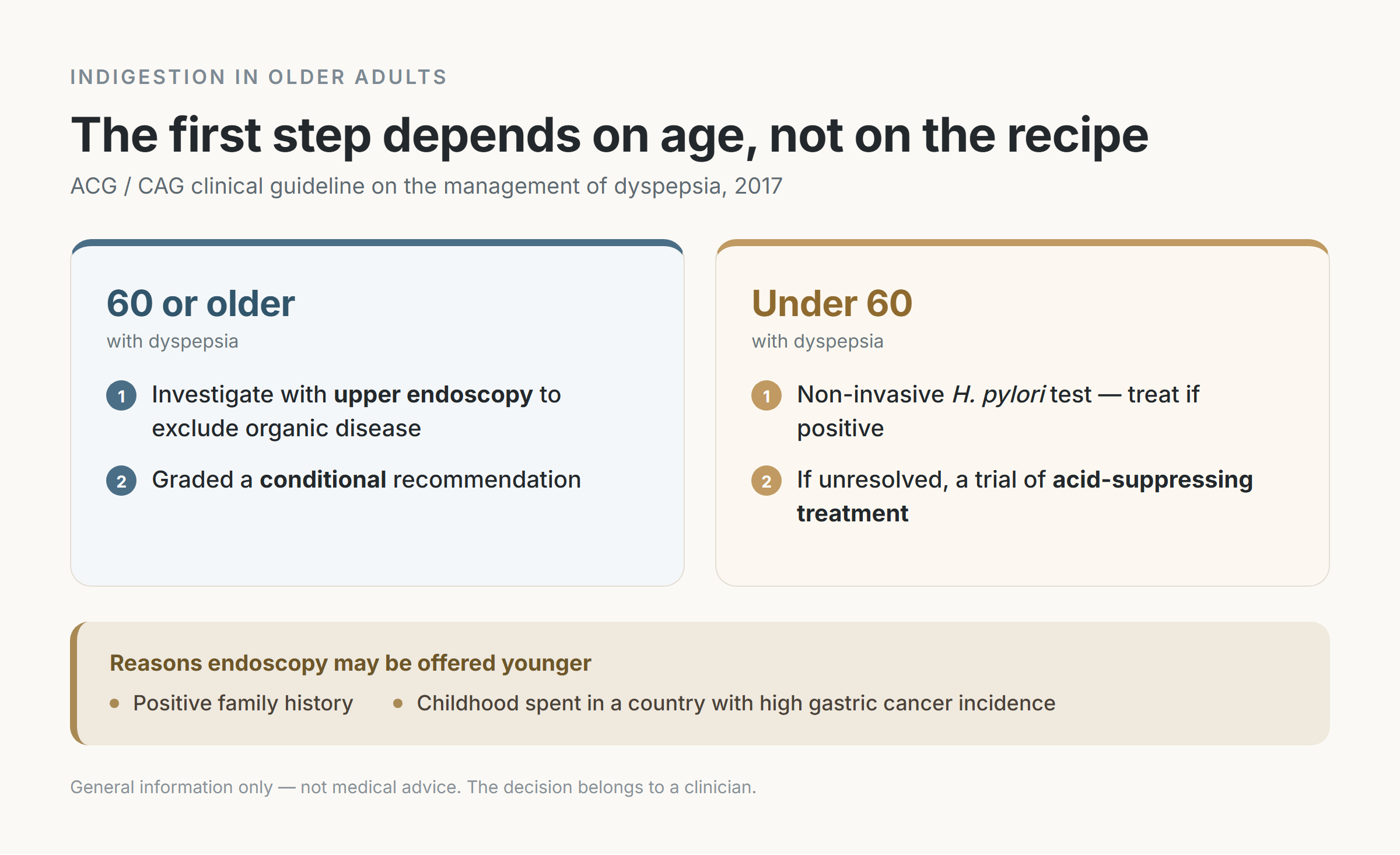
The 2017 ACG and CAG clinical guideline on the management of dyspepsia — from the American College of Gastroenterology and the Canadian Association of Gastroenterology — sets the approach by age. For a patient aged 60 or older with dyspepsia, the guideline calls for investigation with upper endoscopy to exclude organic disease. It is graded as a conditional recommendation, and I am paraphrasing it rather than quoting it.
For patients under 60, the strategy is different: non-invasive testing for H. pylori and treatment if positive, then a trial of acid-suppressing treatment if that does not resolve things.
| Age | Guideline strategy (ACG/CAG, 2017) |
|---|---|
| 60 or older with dyspepsia | Investigate with upper endoscopy (conditional recommendation) |
| Under 60 | Non-invasive H. pylori test, treat if positive; then a trial of acid suppression |
The guideline also notes that people at higher risk of malignancy may be offered endoscopy younger — including those with a positive family history and those who spent childhood in a country with high gastric cancer incidence.
So the honest version of “my parent has had indigestion for a few months” is not a nutrition question yet. It is an appointment.
Why a US reader should not borrow Korea’s or Japan’s screening age
This deserves saying out loud, because families with roots in East Asia often hear a very different number from relatives.
The age-60 threshold is calibrated to low-incidence US and Canadian epidemiology. Countries with high gastric cancer incidence — Japan and Korea among them — run population screening starting substantially younger, with lower thresholds, because their base rate justifies it. Those programs are not wrong. They are answering a different question in a different population.
That is exactly why the immigrant carve-out inside the ACG/CAG guideline matters here. If a parent spent childhood in a high-incidence country, that fact belongs in the conversation with their clinician, and it may lower the threshold for them specifically.
Alarm features: act on them, but do not read them as a verdict
Certain symptoms move this from “schedule something” to “be seen promptly.”
- Unintentional weight loss — more than 5% of body weight over 6 to 12 months. It occurs in 15 to 20% of older adults, and malignancy accounts for up to one-third of cases.
- Trouble swallowing or painful swallowing
- Persistent vomiting
- Anemia or iron deficiency — a possible sign of slow, invisible blood loss
- Vomiting blood, or black tarry stools — this one is emergency-level
- A palpable lump in the abdomen
- New early satiation itself
And one mimic that older adults and their families miss constantly: chest, jaw, neck, or arm pain can be cardiac, not digestive. NIDDK also flags severe constant abdominal pain, shortness of breath, and jaundice.
Now the nuance, because this is where health articles usually go wrong in one direction or the other.
A landmark systematic review and meta-analysis in Gastroenterology (2006) found that alarm features have a low positive predictive value for upper GI malignancy — but a high negative predictive value across every individual feature. In plain terms: most people who have one of these will not turn out to have cancer, but their absence is genuinely reassuring. A more recent analysis in patients under 60 found dysphagia, unintentional weight loss, and persistent vomiting significantly associated with higher upper GI cancer risk, while anemia alone was not.
The American Cancer Society’s 2026 US estimates give the scale: about 31,510 new stomach cancer cases, roughly 1.5% of all new US cancer diagnoses, with an average age at diagnosis of 68 and about 6 in 10 diagnosed at 65 or older. Lifetime risk is around 1 in 104 for men and 1 in 153 for women.
Low base rate. High-risk age band. An alarm symptom sitting right there on the list.
That combination is the argument for getting it checked. It is not an argument for fear.
The stomach-acid myth, and why reversing it is good news
Almost every article on this subject opens with some version of “stomach acid declines with age, which is why older people get indigestion.”
That is largely false, and the correction is the most useful thing in this article.
Feldman and colleagues, in a prospective study published in Gastroenterology in 1996, found that after adjusting for histology, H. pylori infection, and other variables, age had no independent effect on acid output. The lower acid observed in older groups tracked the higher prevalence of chronic atrophic gastritis, not the birthdays. A 1994 study reached the same conclusion from the other side: gastritis with atrophy was the only factor with an independent negative effect on acid secretion.
A 2025 review in Biomedicines on age-related decline of gastric secretion is blunter still. Studies including patients over 80 without gastric atrophic lesions showed acid secretion unchanged with increasing age, with about 90% having normal acid output. Age-related achlorhydria has not been confirmed in symptomatic or healthy cohorts.
So when acid output really is low in an older adult, the usual explanations are atrophic gastritis — most often driven by long-standing H. pylori infection — or long-term use of acid-suppressing medication. Not age.
Why does this matter enough to spend four paragraphs on it?
Because “it’s just old age” is a conclusion with nothing on the other side of it. It ends the conversation. Whereas H. pylori is testable and treatable, and atrophic gastritis is a gastric cancer risk state that deserves medical attention rather than a softer casserole.
And treatment works at this age. A 2023 comparison of H. pylori management in older versus younger European patients found first-line eradication effectiveness of 90% versus 88% — age is not a barrier to success. Effective treatment exists, and a test of cure after finishing therapy is standard practice. I am deliberately naming no regimens and no drugs; that is the clinician’s territory.
For context on how common this is: North American H. pylori prevalence runs around 30 to 40% and has been falling, though it remains above 60 to 70% in some areas and subgroups. One analysis put the US decline at 58.2% in 1980–1990 down to 43.1% in 2011–2020.
What actually explains “full after a few bites”
The other half of the folk explanation is that the stomach’s muscles get weak and slow with age, so food just sits there. That one is not false so much as overstated and confounded.
A review in the American Journal of Physiology (2003) put it this way: gastrointestinal motility changes associated with age are relatively subtle, and in many instances only conflicting data exist. A more recent wireless motility capsule study found that geriatric inpatients showed significant delays in gastric emptying while community-dwelling older adults did not — and attributed the delay in the inpatient group to frailty, reduced muscle mass and strength, and lower physical activity. That is health status, not chronological age. Where delays do appear, some evidence suggests they may be limited to the liquid phase.
The better-supported mechanism comes from the anorexia-of-aging literature, and it is more specific.
The upper stomach normally relaxes and expands to accommodate a meal. That adaptive relaxation of the gastric fundus decreases, so food reaches the lower stomach sooner and fullness registers early. Alongside it sit increased levels and effectiveness of the satiety hormone CCK, reduced sensory-specific satiety, and a dulled sense of smell and taste that takes the pleasure out of eating before the plate is finished.
It is also not universal. Reduced or lost appetite affects about one in five community-dwelling older adults; one systematic review put the weighted prevalence of anorexia of aging at 11.3%, rising to 20.5% among frail and pre-frail people.
Which is the point. Filling up after a few bites is common enough to recognize and uncommon enough that it should not be waved through as normal.

Photo: Marina Gr / Pexels
The medicine cabinet is the most commonly missed cause
This was absent from my original outline entirely, and it may be the most fixable thing here.
Medications are a frequent cause of indigestion in this age group. The drug categories commonly implicated include NSAID and COX-2 pain relievers, bone medicines of the bisphosphonate class, certain diabetes medicines, iron supplements, potassium supplements, and corticosteroids, with anticholinergics and calcium channel blockers contributing more through reflux and motility effects. Polypharmacy multiplies all of it, and also compounds interaction risk. These are categories to raise with a prescriber, not a list to act on.
The NSAID numbers alone are striking. NSAIDs account for up to 30% of adverse-drug-reaction admissions. Prescription NSAID use has a point prevalence of 10 to 15% in people over 65. And 20 to 30% of all hospitalized ulcer complications in people over 60 are directly attributable to NSAIDs.
Now the practical part, which is the real takeaway.
Much of that NSAID use is over the counter, and therefore invisible to the prescriber. Pills for arthritis, back pain, headaches — bought at a drugstore, not written on any list, and not thought of as “medicine” by the person taking them.
So the useful move is embarrassingly low-tech: bring every bottle to the appointment. Prescriptions, over-the-counter painkillers, antacids, supplements, the ones in the kitchen drawer and the ones in the handbag. Or photograph the labels. AAFP also lists medication use and polypharmacy among the causes of unintentional weight loss in older adults, noting that drugs can interfere with taste or induce nausea.
One line that is not negotiable: do not stop, skip, or reduce any prescribed medication on your own. Some of these drugs are prescribed for serious reasons, and stopping certain heart, thyroid, or steroid medicines abruptly is dangerous. The complete list goes to the prescriber or pharmacist. They decide what changes, if anything does.
Why “just make it soft” is the wrong reflex
Here is where my original outline collapsed.
The advice I was going to give — mince the meat, boil the vegetables soft, puree what is left — is the intervention most consistently associated with worse nutrition in older adults.
Wright and colleagues (Journal of Human Nutrition and Dietetics, 2005) found that older people on texture-modified diets had lower intakes of energy and protein than those eating a normal hospital diet, with the likelihood that other nutrients were inadequate too. A 2021 study in the JAMDA literature found texture-modified diets associated with poor appetite in older adults in post-acute rehabilitation. The M3 “Making the Most of Mealtimes” project found modified-texture food use associated with malnutrition in long-term care. And among aged-care residents on texture-modified diets, a 2022 Nutrients study reported 48% at risk of malnutrition and 38% malnourished.
Pureed food carries less energy, less protein, and fewer micronutrients than regular texture, and minced and pureed foods tend to look unappetizing and taste worse. So the food gets easier to swallow and harder to want.
The honest caveat, which I refuse to skip: most of this evidence is observational, and it carries confounding by indication. People placed on texture-modified diets were sicker to start with. Nobody has proven that softening food causes malnutrition. What the evidence supports is narrower and still decisive: texture modification is consistently associated with lower intake and worse nutritional status, it is not nutritionally free, and it must not be adopted casually. It is a clinical intervention with a real cost — not a kindness.
Thickened liquids deserve their own warning
The evidence here is weaker still, and it points in an uncomfortable direction.
A 2024 RCSLT position paper states there is limited evidence that thickened fluids reduce dysphagia-related complications including aspiration pneumonia — most of the supporting data comes from what happens during a bedside or videofluoroscopic exam, not from longer-term outcomes. It also notes growing evidence of adverse effects including dehydration, malnutrition, and reduced quality of life. In one trial, at 90 days the honey-thick group had more dehydration, more and longer hospitalizations for pneumonia, and more deaths. A recent recommendation update issued a weak recommendation against the use of thickening agents for liquids, based on two randomized trials.
This contradicts a great deal of common institutional practice, and I am not telling anyone to override a clinical instruction. If a parent has been prescribed thickened fluids, that is a conversation to have with the team that prescribed them — not a decision to reverse at the kitchen sink.
What is appropriate when chewing or swallowing trouble is real
None of the above means texture never has a place. Swallowing problems are common: roughly one in three community-dwelling older adults by some measures, with prevalence in nursing home residents reported at 58.69% on one instrument and 53.60% on another. In community-dwelling elders, a simple water swallow test found 12.14% while more thorough assessments found 30.52% — the tool changes the answer, which is itself the argument for a proper assessment rather than a family’s guess.
Two things follow.
First, assessment comes before modification. Modification of diet texture and liquid viscosity is the primary way speech-language pathologists manage confirmed oropharyngeal dysphagia — it is a prescribed clinical intervention, not a cooking style. Instrumental assessment such as a modified barium swallow study is optimally performed by an SLP with a radiologist, and its stated objectives include developing intake and diet-texture plans with the physician and team.
Second, ask about IDDSI. The International Dysphagia Diet Standardisation Initiative framework — released in 2016, published in 2017, updated in 2019 — is a continuum of 8 levels (0 to 7): drinks are levels 0 to 4, foods 3 to 7, each identified by number, text label, and color code. It exists precisely because “soft,” “minced,” and “nectar-thick” meant different things in different buildings. It has been adopted in 30-plus countries and translated into 22 languages, with the US implementation launch dated May 1, 2019. Knowing the term lets a family read a discharge sheet and ask a precise question.
And when texture modification is genuinely indicated, it needs nutritional reinforcement. In that 2022 Nutrients study, residents on texture-modified diets with oral nutritional supplements were able to meet protein requirements — though they still fell short on energy and carbohydrate. A randomized trial has shown texture-modified diets can be engineered to be nutritionally adequate. That engineering is exactly what ad-hoc home pureeing lacks.

Photo: Sarah Chai / Pexels
Check the teeth before you soften the food
This is the most under-discussed lever in the whole topic, and it sits directly upstream of everything above.
Older adults with tooth loss are at greater risk of malnutrition than those with functionally adequate dentition. People with fewer functional teeth avoid difficult-to-chew foods, meat in particular — the exact food group supplying the protein that fights muscle loss. Severe tooth loss and impaired chewing are associated with limited intake of fruits and vegetables, more sugary and easy-to-chew foods, and significantly lower intake of protein, fiber, minerals, and vitamins.
Restoring chewing helps. Reconstruction of occlusal support and recovery of masticatory ability through dentures can contribute to improving and maintaining nutritional status.
But there is a catch worth remembering: prosthodontic treatment combined with dietary counseling is more effective than prosthodontic treatment alone. New dentures do not undo the eating habits formed over years of not being able to chew. Somebody has to actually revisit what goes on the plate.
Fixing a broken denture is a better answer than pureeing a steak forever.
The cycle this is all really about
The reason any of this matters is the chain that follows a shrinking plate.
Malnutrition, sarcopenia, and frailty are closely interrelated geriatric syndromes that overlap substantially, and a considerable share of older adults have two or all three at once. The association between malnutrition and frailty appears to be partly mediated by sarcopenia — and, interestingly, physical activity moderates it: sarcopenia acted as a mediator in older adults with moderate physical activity but not in those with low activity.
The honest limitation: evidence of a causal association between malnutrition risk and incident sarcopenia is scarce, and the relationships are likely bidirectional. Linked and associated are the right words. Causes is not.
The consequences, though, are concrete. Unintentional weight loss in older adults is associated with functional decline in activities of daily living, increased in-hospital morbidity, increased hip fracture risk in women, and increased overall mortality.
One caution on sarcopenia numbers. Two competing standards exist, and they disagree. EWGSOP2 treats muscle strength as the primary parameter, with a verified grip strength cutpoint for men of under 27 kg; the SDOC definition uses grip strength plus gait speed and does not rely on muscle mass at all, with a women’s cutpoint of under 20.0 kg. Applied to the same cohort, the two definitions produced prevalence of 10.2% versus 19.4%. So treat any single sarcopenia prevalence figure with suspicion, including that one.
What actually helps, with the evidence graded honestly
The ESPEN practical guideline on clinical nutrition and hydration in geriatrics (2022) is the strongest anchor available, and its guiding values are simple: about 30 kcal per kg of body weight per day and at least 1.0 g of protein per kg per day, both individually adjusted for nutritional status, activity, disease, and tolerance. The broader geriatric literature notes most older adults with acute or chronic disease need 1.2 to 1.5 g/kg/day.
Then the intervention that fits this problem better than any other.
Food fortification. ESPEN describes fortification using natural foods or specific nutrient preparations as a way to increase the energy and protein density of meals and beverages, enabling higher intake while eating similar amounts of food. For someone who fills up after a few bites, that is the whole game: do not ask them to eat more, make what they do eat count more.
Protein spread across the day has good short-term evidence and less certain long-term evidence. Expert guidance suggests at least 25 to 30 g of high-quality protein per meal for older adults, with muscle protein synthesis maximally stimulated at roughly 0.4 g/kg per meal. Balanced distribution across three meals produced greater 24-hour muscle protein synthesis than an unbalanced one at equal daily totals. But a systematic review on dose, frequency, and timing tempers this: acute synthesis gains do not automatically become long-term muscle or function. Call it promising guidance, not a proven prescription.
For this particular symptom, breakfast and lunch are the leverage points — higher protein intake at breakfast and lunch is associated with higher total daily protein intake in older adults. Most families back-load protein into dinner, which is the worst meal to depend on if fullness accumulates through the day.
Small, frequent, lower-fat meals are mechanistically sensible: high-fat meals delay gastric emptying and augment CCK release, reinforcing the fundic relaxation and hypersensitivity described earlier. But the plain truth is that the impact of diet modification on dyspepsia symptom intensity or frequency has never been reported in randomized prospective studies. Slowing the pace, chewing thoroughly, cutting distractions, keeping mealtimes low-stress — all reasonable, all low-risk, none proven. I would rather say that than pretend otherwise.
Oral nutritional supplements come after food, not instead of it — ESPEN positions them as prescribed in addition when an enriched diet does not reach nutritional goals. The evidence is real but modest. A 2026 Cochrane network meta-analysis of individual participant data found that in hospitalized older people at nutritional risk, supplements may reduce mortality and serious adverse events at 30 days — with low to very low certainty. Weight gain is the most consistent finding, with about +1.50 kg over 60 days in one open-label randomized trial. Effects on muscle strength are inconsistent. Supplements reliably add weight; they do not reliably add strength or extend life on current evidence. No brands here, and this is a clinician’s call.
Where a US family can actually start
Two facts frame this. Malnutrition affects 30 to 50% of hospitalized patients, yet among more than 7.3 million Medicare inpatient claims, only 12% carried a documented malnutrition diagnosis. In the community, a nationally representative 2017 NHATS sample found 68% nourished, 26% at risk, 6% malnourished, with residential care residents more likely to be malnourished than community-dwelling adults (12% versus 5%).
Which is to say: this gets missed inside hospitals routinely. A family noticing it at the dinner table is doing something genuinely valuable.
Three concrete starting points:
- The Medicare Annual Wellness Visit is covered at 100% under Part B when the provider accepts assignment, and it includes personalized health advice and referrals for issues including diet and nutrition, weight management, and falls prevention. It is the cheapest door in the building.
- Medical Nutrition Therapy coverage is limited and diagnosis-dependent — notably tied to conditions such as diabetes and kidney disease. Do not assume Medicare pays for a dietitian for indigestion. Check the specific plan.
- Older Americans Act Title III-C nutrition services, run through Area Agencies on Aging under the Administration for Community Living and in place since 1965, provide congregate meals and home-delivered meals to older adults in need. It is the largest such program in the country, and the local Area Agency on Aging is a phone call.
One caution on screening tools. The MNA-SF is designed to screen people 65 and older in under five minutes and is the best-validated nutrition screening tool for this age group; the MST is shorter still. But a 2023 analysis was titled, more or less, that malnutrition screening tools are not sensitive enough to identify older hospital patients with malnutrition. A negative screen does not rule anything out. Treat these as conversation starters with a clinician, not home verdicts.
Related reading: [Internal link: Unintentional weight loss in older adults: when to worry]
Related reading: [Internal link: Protein needs after 65 and how to actually meet them]

Photo: Kampus Production / Pexels
The short version
If I compress the whole thing, it comes down to four sentences and one order of operations.
It is probably not the aging. Age had no independent effect on acid output once histology and H. pylori were accounted for, and about 90% of people over 80 without gastric atrophy have normal acid secretion. When acid is low, look for atrophic gastritis or long-term acid suppression — one of which is testable and treatable, with eradication working about as well at 80 as at 40.
Sixty is a threshold, not a number I made up. Under the 2017 ACG/CAG guideline, dyspepsia at 60 or older is an indication for upper endoscopy, and family history or a childhood spent in a high-incidence country can lower that bar. US thresholds are not East Asian thresholds, and neither set is wrong.
The medicine cabinet is the most fixable cause and the most commonly missed one — much of it bought over the counter and never mentioned to anybody.
And softening the food is a clinical decision with a nutritional price tag, associated with lower energy and protein intake, poorer appetite, and more malnutrition. The evidence is observational and confounded, so I will not call it proven harm. I will call it a reason not to reach for the blender first.
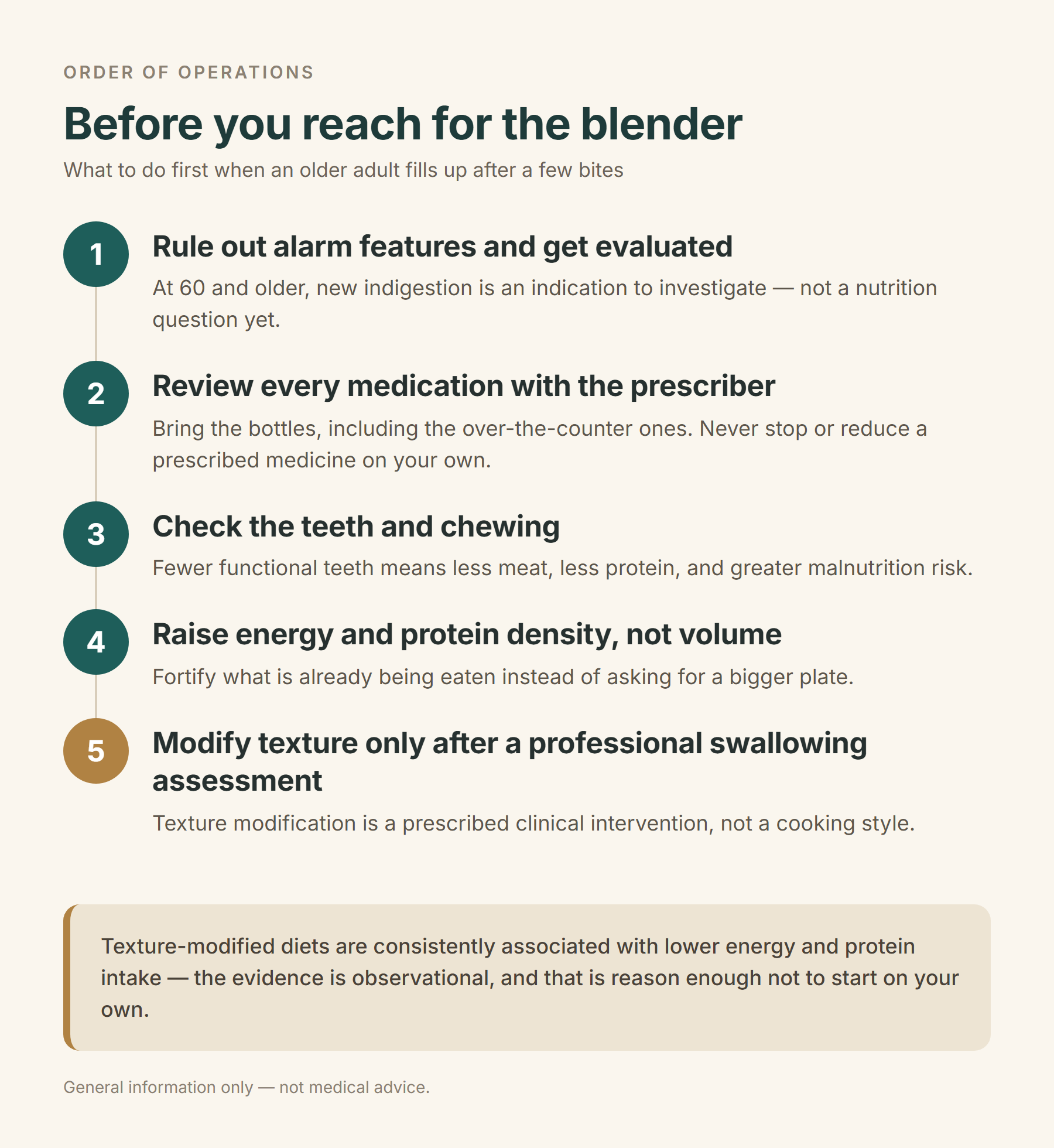
The order that follows from all of that:
- Rule out alarm features and get evaluated.
- Review every medication with the prescriber — bring the bottles.
- Check the teeth and chewing.
- Raise energy and protein density, not volume.
- Modify texture only after a professional swallowing assessment.
What stayed with me was not any single statistic. It was how neatly the two comfortable beliefs fit together — it’s just age, so soften the food — and how each one quietly removes a reason to look further.
A parent who stops eating is telling you something. The kind response is not a smoother plate.
It is an appointment, with every pill bottle in a bag on the passenger seat.
Red flags — see a clinician promptly
Unintentional weight loss, trouble or pain when swallowing, persistent vomiting, anemia or iron deficiency, vomiting blood or black tarry stools, a palpable lump in the abdomen, or new early satiation. Treat chest, jaw, neck, or arm pain as potentially cardiac and seek emergency care. Vomiting blood or black tarry stools is emergency-level. These features carry a low positive predictive value for cancer and a high negative predictive value — they are a reason to be examined, not a diagnosis.
And bring every medication bottle to the appointment, including the over-the-counter ones.
References
- American College of Gastroenterology and Canadian Association of Gastroenterology — ACG and CAG Clinical Guideline: Management of Dyspepsia, American Journal of Gastroenterology, July 2017 (age-60 endoscopy threshold, conditional; test-and-treat under 60; risk-factor carve-outs)
- ESPEN — Volkert D, et al., ESPEN practical guideline: Clinical nutrition and hydration in geriatrics, Clinical Nutrition, 2022 (30 kcal/kg/day, ≥1.0 g protein/kg/day, food fortification, ONS positioning)
- Feldman M, et al. — Effects of aging and gastritis on gastric acid and pepsin secretion in humans: a prospective study, Gastroenterology, 1996
- Age-Related Decline of Gastric Secretion: Facts and Controversies, Biomedicines, 2025
- Effect of age, Helicobacter pylori infection, and gastritis with atrophy on serum gastrin and gastric acid secretion in healthy men, 1994
- Vakil N, et al. — Limited Value of Alarm Features in the Diagnosis of Upper Gastrointestinal Malignancy: Systematic Review and Meta-analysis, Gastroenterology, 2006
- Alarm symptoms and the risk of upper gastrointestinal cancer in patients below the age of 60, Digestive and Liver Disease, 2025
- American Cancer Society — Stomach (Gastric) Cancer Key Statistics, 2026
- NIDDK / NIH — Indigestion (Dyspepsia): definition, symptoms, when to see a doctor
- Rome IV criteria for functional dyspepsia; StatPearls, Functional Dyspepsia
- Clinical and physiological aspects of gastrointestinal motility and aging, Am J Physiol Gastrointest Liver Physiol, 2003
- Wireless motility capsule transit study in aging populations, Digestive and Liver Disease, 2024 (geriatric inpatients versus community-dwelling older adults)
- Satiety and the anorexia of ageing, 2009; The anorexia of ageing, Maturitas systematic review; Poor Appetite in Frail Older Persons — A Systematic Review, 2023
- Dyspepsia as an adverse effect of drugs, Best Practice & Research Clinical Gastroenterology; Drug-induced gastrointestinal disorders, 2023; StatPearls, Strategies to Reduce Polypharmacy in Older Adults
- Gaddey HL, Holder K — Unintentional Weight Loss in Older Adults, American Family Physician, 2021
- Wright L, et al. — Comparison of energy and protein intakes of older people consuming a texture modified diet with a normal hospital diet, J Hum Nutr Diet, 2005
- Texture-Modified Diets are Associated with Poor Appetite in Older Adults Admitted to a Post-Acute Rehabilitation Hospital, 2021; Modified Texture Food Use is Associated with Malnutrition in Long Term Care (M3 project)
- A Comparison of Dietary Intake and Nutritional Status between Aged Care Residents Consuming Texture-Modified Diets with and without Oral Nutritional Supplements, Nutrients, 2022
- RCSLT — Position paper on the use of thickened fluids in the management of people with dysphagia, 2024; systematic review and meta-analysis on thickened liquids in neurogenic dysphagia, 2025
- Prevalence and Methods for Assessment of Oropharyngeal Dysphagia in Older Adults: A Systematic Review and Meta-Analysis, 2022
- IDDSI — The IDDSI Framework (2016, published 2017, updated 2019); ASHA; Academy of Nutrition and Dietetics (US launch May 1, 2019)
- ASHA Special Interest Groups — The Modified Barium Swallow Study for Oropharyngeal Dysphagia: Recommendations From an Interdisciplinary Expert Panel, 2021
- Tooth Loss and Nutritional Status in Older Adults: A Systematic Review and Meta-analysis, 2021; The Association of Poor Oral Health Parameters with Malnutrition in Older Adults, 2018
- Exploring the complex associations among risks of malnutrition, sarcopenia, and frailty in community-dwelling older adults, 2024; Association between the risk of malnutrition and sarcopenia at 4.2 years of follow-up, 2024
- EWGSOP2, Age and Ageing, 2019; SDOC definitions; comparison studies, 2023–2024 (10.2% versus 19.4% prevalence)
- Kiesswetter E, et al. — Oral nutritional interventions in hospitalised older people at nutritional risk: a network meta-analysis of individual participant data, Cochrane Database of Systematic Reviews, 2026
- The impact of an oral nutritional supplement on body weight gain in older adults with malnutrition: an open-label RCT, Trials, 2023
- The Role of Diet in Functional Dyspepsia Management; narrative review on dietary interventions for functional dyspepsia, Digestive and Liver Disease, 2026
- A higher protein intake at breakfast and lunch is associated with a higher total daily protein intake in older adults, 2021; protein distribution and 24-h muscle protein synthesis literature; The effect of dose, frequency, and timing of protein supplementation on muscle mass in older adults, 2024
- Comparison of the management of Helicobacter pylori infection between the older and younger European populations, 2023 (90% versus 88%)
- NHATS 2017 malnutrition prevalence; Malnutrition Prevalence and Economic Burden Among US Hospitalized Older Adult Patients; Malnutrition Screening Tools Are Not Sensitive Enough to Identify Older Hospital Patients with Malnutrition, 2023; MNA / MaNuEL validation review
- NCOA and Enhancing Care for Older Adults Through the Medicare Annual Wellness Visit, 2026; Administration for Community Living — OAA Nutrition Services Basics; Congressional Research Service IF10633
This article is general health information and is not medical advice. It cannot diagnose anyone, and it does not create a clinician–patient relationship. It deliberately contains no drug names, no doses, and no product recommendations. Medication decisions belong to the prescribing clinician or pharmacist — never stop, skip, or reduce a prescribed medicine on your own. Decisions about swallowing, diet texture, and thickened fluids belong to a speech-language pathologist and registered dietitian after assessment, not to a family kitchen. Anyone with the red-flag features listed above should seek prompt medical evaluation.