
Insomnia in Older Adults: Why 3 a.m. Waking Isn’t Aging
I had the explanation wrong, and I had it wrong confidently.
When my mother started waking at 3 a.m. — every night, wide awake, no getting back down — I already knew the answer. Melatonin dries up as you age. Not enough daylight. Get thirty minutes of morning sun, keep naps to fifteen minutes, done.
Three of those four things turned out to be either unproven or pointed in the wrong direction.
That is worth saying plainly, because insomnia in older adults is a topic where the popular explanation is not just incomplete — for the 3 a.m. pattern specifically, part of it is backwards. Morning light, the single most repeated piece of advice, is what a sleep clinician might avoid for someone in that pattern.
So here is the careful version. What actually changes with age, what the 3 a.m. waking usually points to, what the guidelines put first, and where the familiar advice comes from when it doesn’t come from a guideline.
Photo: SHVETS production / Pexels
Insomnia in older adults isn’t simply low melatonin
Start with the correction, because everything else follows from it.
Insomnia is the most common sleep problem in adults 60 and older, according to the National Institute on Aging. How common depends entirely on how you count. Peer-reviewed reviews put it at roughly 17–60% under formal diagnostic criteria and 8.2–74.8% when you count symptom complaints — up to about three-quarters of older adults reporting some insomnia symptom. One US prospective cohort in adults over 65 found 23–34% with insomnia and 7–15% with chronic insomnia.
That spread isn’t sloppiness. It’s the difference between “I slept badly this week” and a clinical diagnosis. Anyone quoting you a single tidy percentage has picked one and dropped the definition.
The number that reframes the whole thing
Ohayon and colleagues published a meta-analysis in SLEEP in 2004 covering 65 studies and 3,577 healthy people aged 5 to 102. Total sleep time, sleep efficiency, deep slow-wave sleep and REM all declined with age. Sleep latency, time awake after falling asleep, and light-stage sleep all increased.
Then the part that gets left out.
Those changes largely stopped around age 60. Wake after sleep onset and light N1 sleep rose from 20 to 60, with no significant further change afterward.
So if sleep falls apart at 72 or 79, “it’s just aging” doesn’t survive contact with the data. The aging part had mostly finished a decade earlier. A new or worsening problem in later life is a signal.
And sleep need doesn’t shrink either. The NIA still puts older adults at 7–9 hours a night. “Older people need less sleep” is a myth that delays diagnosis, and I’d retire it entirely.
The melatonin question, honestly
Here is where I have to give you both sides, because the sources genuinely disagree.
Reviews of normal aging do report reduced melatonin secretion, an earlier evening melatonin onset, and a weaker circadian rhythm in people over 65. That literature exists and it isn’t fringe.
But Zeitzer and colleagues, in the American Journal of Medicine in 1999, measured plasma melatonin under controlled constant-routine conditions in 34 healthy, drug-free adults aged 65–81 against 98 healthy young men — and found no significant difference in the circadian amplitude of the melatonin rhythm. Their conclusion was that the results do not support the idea that falling melatonin is a general feature of healthy aging.
The reconciliation most likely sits in the confounders. Illness, low daytime light exposure, and medications all suppress melatonin — beta-blockers are specifically noted to lower it. A population of 75-year-olds carries more of all three than a population of 25-year-olds.
There’s also a practical test that settles the question for everyday purposes. If low melatonin were the engine, replacing it would fix the problem. The American Academy of Sleep Medicine recommends against melatonin for chronic insomnia. More on that below.
Melatonin is part of the picture. It is not the whole picture, and it is not the fix.
Why 3 a.m.? Five causes worth ruling out first
Waking at 3 a.m. is a specific clue, not generic bad sleep. It usually maps onto one of a short list — and each item has a different answer.

1. The body clock ran early (advanced sleep-wake phase)
Older adults’ circadian rhythms tend to be phase advanced — shifted earlier. Sleepy at 8 p.m., awake at 4 a.m. Advanced sleep phase isn’t defined by age, but it is more prevalent in older adults.
The signature is distinctive: falling asleep is easy, staying asleep until a reasonable hour is not.
There’s a striking piece of national data supporting this. CDC/NCHS reports that trouble falling asleep actually decreases with age — from 18.3% in adults 18–34 to 12.8% in those 65 and older. Yet sleep-aid use runs the other way, rising to 15.8% of adults 65 and older. Less trouble falling asleep, more sleep aids. That gap is the maintenance problem showing up in the numbers.
2. Nocturia — the most frequent single cause
This one deserves more attention than it gets, because it’s often treated as a nuisance rather than the reason.
The literature describes nocturia as the most frequent cause of disturbed sleep in older adults. A NHANES analysis of 4,698 US adults aged 65–85 found nocturia in 49.7% — 51.7% of men, 47.6% of women. Using a two-or-more-voids definition, community-dwelling prevalence in 65+ reaches 58.5%, and 80–90% by age 80 in both sexes. A National Sleep Foundation survey found nocturia was the attributed cause of nearly nightly sleep disturbance in 53% of people aged 55–84.
The drivers overlap in ways that matter: reduced bladder capacity, reduced kidney filtration, nocturnal polyuria, early diabetes, heart failure, sleep-disordered breathing, and diuretic use and timing.
That last item is a conversation with a prescriber, not a decision to make at home.
3. Sleep apnea, hiding in plain sight
Obstructive sleep apnea prevalence estimates span 9–38% in the general population, running higher in men and in older patients.
The trap is the presentation. In older adults, OSA may show up as insomnia or confusion rather than the loud snoring and daytime sleepiness everyone screens for. Nocturia travels with it — 35.2% of men and 59.8% of women with obstructive sleep apnea syndrome in one series. Insomnia and OSA also coexist often enough to have their own name (COMISA), and those patients have worse sleep, worse quality of life and worse CPAP adherence.
Diagnosis is by sleep study. Treatment improves sleepiness, mood, nocturia and cognition. Restless legs syndrome sits alongside OSA as the other common geriatric sleep disorder — RLS runs roughly 10–30% among OSA patients, up to 32.3% in one series.
4. Depression, pain, and sundowning
In the older-adult insomnia literature, depression shows the strongest association among comorbidities, followed by cardiovascular disease, hypertension, chronic pain, nocturia, anxiety and cognitive impairment. Older adults with severe insomnia report more comorbid illness than those without.
There’s a functional cost too — roughly a 5% increase in fall risk per additional insomnia symptom, plus associations with frailty.
For someone with dementia, the NIA describes sundowning as restlessness, agitation, irritability or confusion that begins or worsens as daylight fades. Contributors can include disruption of the biological clock, exhaustion, unmet needs like hunger or thirst, depression, pain, or boredom. The NIA’s coping guidance is a schedule, daily sunlight, daily activity without over-scheduling, no late alcohol or caffeine, discouraging long naps and late dozing, and a quiet evening with low lights.
5. The medicine cabinet
Several common classes are implicated in disrupted sleep: diuretics (nighttime urination, and timing matters), beta-blockers (insomnia and nightmares, and they lower melatonin — an iatrogenic drop, not an aging one), corticosteroids, some SSRIs, and decongestants such as pseudoephedrine. The NIA also advises against alcohol as a sleep aid.
One honest caveat: that list comes from clinical and consumer medical references rather than a single government guideline table. Treat it as “commonly implicated,” not as a settled enumeration.
And nobody should stop or change a prescription over a blog post. The only action here is to bring the full list — prescriptions, over-the-counter products and supplements — to a clinician or pharmacist for review.

Photo: Kampus Production / Pexels
The light timing trap — where the usual advice backfires
This is the correction I most want to land, because I gave the wrong advice myself.
For delayed phase — can’t fall asleep, can’t get up — morning light is the right tool. It pulls the clock earlier.
But for advanced sleep-wake phase, which is the 3 a.m. pattern, the AASM’s 2015 clinical practice guideline on circadian rhythm sleep-wake disorders suggests treating adults with evening light therapy. Evening, not morning.
The reason is mechanical. Morning light advances the clock further. If your clock has already run early, that pushes it in the direction you don’t want.
The primary evidence is old but clean: an early trial exposed people with early-morning-awakening insomnia to bright light of about 2,500 lux in the evening, from 8 p.m. to midnight, on two consecutive evenings. Temperature rhythm markers delayed 2–4 hours, melatonin markers 1–2 hours, and mean final wake time moved from about 4:59 a.m. to about 6:11 a.m.

So where did “30 minutes of morning sunlight” come from?
Not from a US clinical practice guideline, as far as I can find.
Trials in the literature commonly used 10,000 lux for 20–45 minutes daily; some used 3,000 lux for three hours; some used two half-hour sessions. A head-to-head trial in elderly subjects with sleep-onset insomnia compared 20 versus 45 minutes of morning bright light, and 45 minutes did better at three months, with the 20-minute group drifting back toward baseline by six months. Note the population — sleep-onset insomnia is the phase-delayed pattern, so morning light was appropriate there.
The “30 minutes” figure circulating online traces to popular press, sleep-tracker company blogs and hospital wellness pages. That’s expert opinion, not guideline. The NIA’s own light advice carries no minute figure at all — arrange a time to go outside or sit by a window to get sunlight each day.
The part of the advice that does hold up is the intensity argument, and it’s a good one. A dim bedroom is 30–40 lux. A brightly lit kitchen is about 500. A typical office is 300–500. Overcast morning daylight outdoors is 5,000–10,000 lux, and bright sun reaches roughly 100,000. Even a gray day outside is an order of magnitude beyond your living room.
Light therapy itself is worth having in the picture, with realistic expectations. A 2023 systematic review and meta-analysis in the Journal of Sleep Research found light therapy effective for insomnia disorder (g = 0.47), improving time awake after sleep onset by about 11 minutes versus control. Eleven minutes is real. It is also modest — an adjunct, not a replacement.
If you’re waking at 3 a.m., the timing is the whole question, and it’s worth having a clinician set it rather than guessing.
About naps — the 15-minute rule isn’t a rule
I repeated this one too, and I can’t find a guideline behind it.
The figure that actually circulates in the clinical and consumer literature is 20–30 minutes, early afternoon, roughly 1–3 p.m. — long enough to restore alertness, short enough to avoid the grogginess of waking out of deep sleep, and timed to the natural circadian dip. Naps of 60 minutes or more reach deeper stages, produce harder awakenings, and interfere more with the coming night.
But be careful even with that. The 20–30 minute number comes from consumer-health and secondary sources attributing it to the AASM; I could not locate a primary AASM guideline document stating it. So: commonly recommended by sleep clinicians, not a guideline instruction.
The NIA’s actual position is qualitative — avoid napping in the late afternoon or evening, discourage long naps and late dozing.
One more thing worth saying kindly. Daytime napping increases with age in the aging-sleep literature. Napping is partly a symptom of fragmented night sleep, not just a bad habit to police. And for anyone in active CBT-I, nap rules come from their therapist, because restricting daytime sleep is a deliberate part of the therapy.
CBT-I is the first-line treatment, and it isn’t a pill
If you take one thing from this article, take this.
The AASM’s 2021 clinical practice guideline on behavioral and psychological treatments recommends that clinicians use multicomponent cognitive behavioral therapy for insomnia (CBT-I) for chronic insomnia disorder in adults — a STRONG recommendation, and the only strong recommendation in the entire document.
The American College of Physicians, in Annals of Internal Medicine in 2016, recommends that all adult patients receive CBT-I as the initial treatment for chronic insomnia — a strong recommendation on moderate-quality evidence. The ACP specifically found that CBT-I improves sleep and daytime functioning in older adults as well as in general adults, and is likely to have fewer harms than drug treatment.
CBT-I isn’t mysterious. It combines stimulus control, sleep restriction and scheduling, cognitive restructuring, relaxation, and sleep-hygiene education as one component among several, over roughly a handful of sessions. Stimulus control, sleep restriction and relaxation each have independent conditional support from the AASM on their own.
One age-specific caveat the guideline itself raises: sleep restriction can be harder for older adults, who may struggle to find activities to fill the extra out-of-bed time.

Photo: Graham Roy / Pexels
A 2026 AASM guideline on combination treatment adds nuance — it suggests CBT-I plus medication over medication alone, and suggests against CBT-I plus medication over CBT-I alone, both conditionally. The framing is that CBT-I by itself is the most efficacious first-line treatment, with medication adding modest benefit on some outcomes such as total sleep time.
The access problem, said out loud
A recommendation you can’t act on isn’t much use, so here’s the uncomfortable half.
Reporting from CBT-I access advocacy sources states that fewer than 800 clinicians nationwide are certified to deliver CBT-I, that only about 3% of Medicare patients receive it as their sole treatment, and that only 56% of surveyed CBT-I providers accept any insurance, with essentially no Medicare acceptance. Medicare Part B does cover CBT-I when medically necessary as psychotherapy, per consumer-facing summaries.
Digital delivery is the emerging route. The CY2025 Medicare Physician Fee Schedule created HCPCS codes G0552–G0554 for Digital Mental Health Treatment devices — supply and onboarding, plus monthly management — used as part of a clinician’s behavioral health treatment plan, with the device requiring FDA clearance or authorization. The CY2026 Final Rule extended eligibility to a device category that includes insomnia.
I want to be precise rather than encouraging here. Those codes exist and the device categories expanded. That is not the same as a promise that your plan will cover a digital CBT-I program. The crisp version circulating on commercial sites overstates it. Ask your clinician, then verify with your plan, because this is new and still moving.
For scale on why it’s worth the effort: a 2023 analysis of 107 studies and more than 8,000 people reported CBT-I as the most effective treatment, with an 81% probability of better sleep after treatment and 71% probability of sustained improvement at one year. That figure reaches us through a secondary citation, so hold it as indicative rather than exact.
Sleep hygiene alone was never the treatment
This is the fact I’d most like every reader over 65 to have, because it lifts a specific kind of guilt.
The same AASM 2021 guideline suggests that clinicians not use sleep hygiene as a single-component therapy for chronic insomnia disorder in adults — a conditional recommendation against. The stated rationale is that sleep hygiene recommendations do not constitute an effective stand-alone therapy.
Read that again if you’ve spent two years doing the checklist and concluding you’re broken.
You’re not broken. The checklist was never a treatment.
The NIA’s healthy-sleep advice — avoid caffeine late in the day, avoid alcohol, keep the TV and computer out of the bedroom, avoid large meals within 2–3 hours of bed, talk to your doctor about sleep problems — is a sensible baseline. Supporting habits. Not the cure.

Photo: Max Vakhtbovych / Pexels
Sleeping pills and melatonin — what geriatricians actually say
Now the part where age changes the answer.
Beers 2023 governs here
The 2023 AGS Beers Criteria says to avoid in older adults: benzodiazepines (short-, intermediate- and long-acting alike), the Z-drugs (eszopiclone, zaleplon, zolpidem), first-generation antihistamines, tricyclic antidepressants, and barbiturates.
The reasoning is specific. Benzodiazepines carry increased risk of cognitive and psychomotor impairment, falls, fractures and motor vehicle accidents. The Z-drugs are described as having adverse events similar to benzodiazepines in older adults — delirium, falls, fractures, increased emergency room visits and hospitalizations, motor vehicle crashes — with minimal improvement in sleep latency and duration.
The first-generation antihistamines are the “PM” in over-the-counter PM products. Diphenhydramine, doxylamine. Strongly anticholinergic, and anticholinergics appear on Beers’ delirium-risk list. The nightly OTC habit that feels harmless is on the avoid list.
There’s a collision worth naming rather than hiding. The AASM’s 2017 pharmacologic guideline lists several agents as weakly suggested for in adults generally — including eszopiclone, zaleplon, zolpidem, triazolam and temazepam. Beers, which is age-specific, says avoid these in older adults. For this audience, Beers governs the caution. The AASM guideline is written for adults in general; Beers is written for people over 65.
The AGS-aligned approach is consistent: first-line treatment for older adults with insomnia is CBT-I; if that alone is unsuccessful, consider short-term pharmacological therapy through shared decision-making. Even the agents with some effectiveness in older adults are framed as short-term.
I’ve deliberately named no doses and no “ask for this one.” Agent selection depends on kidney function, other medicines, cognition and fall risk — a prescriber’s judgment, not a paragraph’s.
The FDA boxed warning
On April 30, 2019, the FDA required a new Boxed Warning on eszopiclone, zaleplon and zolpidem after reports of rare but serious complex sleep behaviors — sleepwalking, sleep-driving, and other activities while not fully awake, including unsafe stove use — that resulted in injuries and deaths. The FDA identified 66 cases over the prior 26 years with serious injury or death, and added a contraindication: these drugs should not be used in anyone who has previously experienced a complex sleep behavior on them. The warning went into prescribing information and patient Medication Guides.
Melatonin, in the American market
The AASM’s 2017 guideline suggests that clinicians not use melatonin for sleep-onset or sleep-maintenance insomnia in adults — a weak recommendation against, reflecting insufficient evidence of efficacy. Trazodone, tiagabine, diphenhydramine, tryptophan and valerian sit in the same “suggested against” group.
Then there’s the product itself. NCCIH notes that in the US, melatonin is a dietary supplement, regulated less strictly than a prescription or over-the-counter drug, and that the FDA is not authorized to review supplements for safety and effectiveness before marketing.
What that means in practice was measured. Erland and Saxena, in the Journal of Clinical Sleep Medicine in February 2017, analyzed 31 melatonin supplements across 16 brands:
- Actual melatonin content ranged from −83% to +478% of the labeled amount
- Lot-to-lot variability within a single product reached 465%
- One chewable tablet contained 9 mg against a 1.5 mg label
- Serotonin — a far more tightly controlled substance — was found, unlabeled, in 26% of the products tested
On effectiveness, NCCIH cites a 2022 review of 12 studies and 2,666 participants suggesting melatonin improved sleep-onset latency and daytime sleepiness, but did not improve sleep quality or time awake during the night. Which is to say it did not help the exact problem this article is about.
One nuance in fairness. Prolonged-release melatonin is approved by the European Medicines Agency for primary insomnia in patients aged 55 and older, approved in 2007, with trial evidence at three weeks and six months showing improvements versus placebo in sleep quality, latency, morning alertness and quality of life. It is not FDA-approved in the United States. That’s a different product with different formulation and quality control — it explains why European and American advice diverge, and it is not an argument for the supplement aisle.
Short-term melatonin use appears relatively safe per NCCIH; long-term safety has not been established. Any decision here belongs with a clinician.
Red flags — when to stop managing this at home
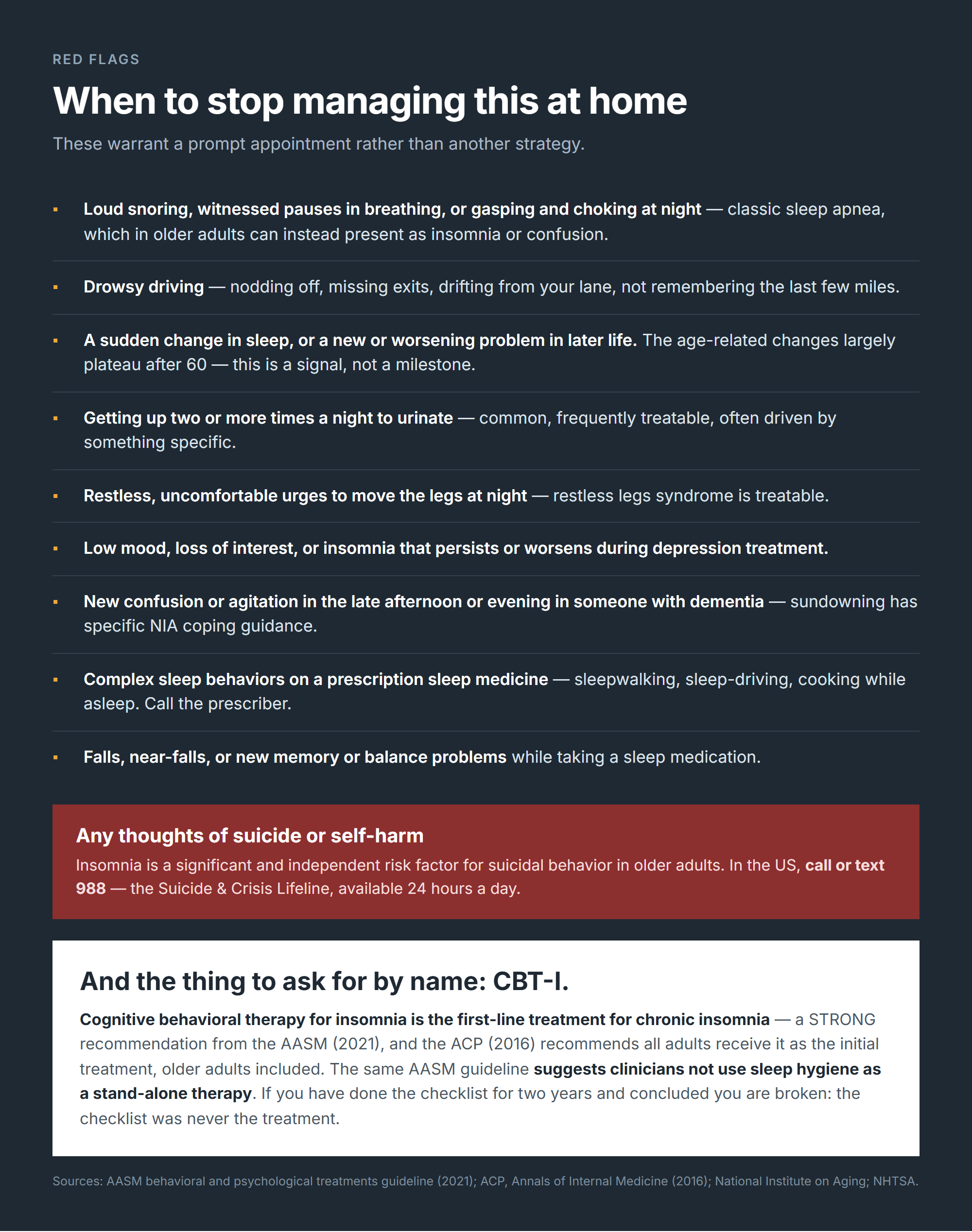
Some of these warrant a prompt appointment rather than another strategy:
- Loud snoring, witnessed pauses in breathing, or gasping and choking at night — classic sleep apnea, which in older adults can instead present as insomnia or confusion.
- Drowsy driving — nodding off, missing exits, drifting from your lane, not remembering the last few miles. NHTSA recorded 795 deaths from drowsy-driving crashes in 2017; drivers with sleep apnea have more than twice the crash risk.
- A sudden change in sleep, or a new or worsening problem in later life — the architecture changes largely plateau after 60, so this is a signal, not a milestone.
- Getting up two or more times a night to urinate — common, frequently treatable, and often driven by something specific.
- Restless, uncomfortable urges to move the legs at night — restless legs syndrome is treatable.
- Low mood, loss of interest, or insomnia that persists or worsens during depression treatment. In one Johns Hopkins-reported analysis, patients whose sleep worsened had 11.9 times the odds of a minor depression diagnosis and were 10% more likely to report suicidal thoughts.
- New confusion or agitation in the late afternoon or evening in someone with dementia — sundowning, which has specific NIA coping guidance.
- Complex sleep behaviors on a prescription sleep medicine — sleepwalking, sleep-driving, cooking while asleep. Call the prescriber.
- Falls, near-falls, or new memory or balance problems while taking a sleep medication.
- Any thoughts of suicide or self-harm. Insomnia is a significant and independent risk factor for suicidal behavior in older adults. In the US, call or text 988 — the Suicide & Crisis Lifeline, available 24 hours a day.

Photo: RDNE Stock project / Pexels
What stays with me isn’t that I was wrong. It’s how reasonable the wrong version sounded.
Melatonin declines, so top it up. Not enough light, so get morning sun. Nap less. Each step follows from the last, and the whole chain can still point away from the thing that’s actually happening — a clock that ran early, a bladder waking someone twice a night, an untreated breathing problem, or a pill taken at the wrong hour.
If I could go back and do one thing differently, it wouldn’t be buying a lamp or a supplement. It would be sitting down with her full medication list, writing down what time she actually fell asleep and actually woke, and taking both to a clinician — and asking about CBT-I by name.
That’s a smaller ask than an overhaul of somebody’s evening. And it’s the one the guidelines put first.
Nobody outgrows the need for a full night. The body didn’t stop asking for seven to nine hours just because the calendar moved on.
This article is general health information, not medical advice. It does not diagnose any condition and does not recommend or rule out any specific medication or dose. Insomnia in older adults frequently has a treatable underlying cause — sleep apnea, restless legs syndrome, nocturia, pain, depression, or a medication side effect — that requires a clinician to identify. Do not start, stop, or change any prescription, over-the-counter product, or supplement based on this article. Bring your full medication list, including OTC sleep aids and supplements, to your doctor or pharmacist for review. If you are having thoughts of suicide or self-harm, call or text 988 (Suicide & Crisis Lifeline) in the United States, available 24 hours a day. If you have chest pain, trouble breathing, or another medical emergency, call 911.
References
- National Institute on Aging (NIH) — Sleep and Older Adults; Tips for Coping with Sundowning
- CDC / NCHS — Health E-Stat No. 116, Use of Sleep Aids Among Adults Age 18 and Older, United States, 2024; Data Brief No. 559, Short Sleep Duration and Sleep Difficulties Among Adults
- AASM — Edinger JD et al., Behavioral and Psychological Treatments for Chronic Insomnia Disorder in Adults, JCSM 2021 (CBT-I STRONG; sleep hygiene conditional against)
- AASM — Sateia MJ et al., Clinical Practice Guideline for the Pharmacologic Treatment of Chronic Insomnia in Adults, JCSM 2017
- AASM — Auger RR et al., Clinical Practice Guideline for the Treatment of Intrinsic Circadian Rhythm Sleep-Wake Disorders, JCSM 2015 (evening light for advanced sleep-wake phase)
- AASM — Combination Treatment for Chronic Insomnia Disorder in Adults, clinical practice guideline (2026)
- ACP — Qaseem A et al., Management of Chronic Insomnia Disorder in Adults, Annals of Internal Medicine, 2016
- American Geriatrics Society — 2023 Updated AGS Beers Criteria, JAGS 2023
- FDA — Boxed Warning for risk of serious injuries caused by sleepwalking with certain prescription insomnia medicines (April 30, 2019)
- NCCIH (NIH) — Melatonin: What You Need To Know
- Ohayon MM et al., Meta-analysis of quantitative sleep parameters from childhood to old age in healthy individuals, SLEEP 2004
- Zeitzer JM et al., Do plasma melatonin concentrations decline with age?, Am J Med 1999
- Erland LAE, Saxena PK, Melatonin natural health products and supplements: presence of serotonin and significant variability of melatonin content, JCSM 2017
- Chambe J et al., Light therapy in insomnia disorder: a systematic review and meta-analysis, J Sleep Res 2023
- Insomnia in Older Adults — review of prevalence, comorbidity, falls risk and CBT-I (PMC7731454)
- NHANES 2005–2012 nocturia analysis in US adults 65–85; nocturia and disturbed sleep in the elderly
- NHTSA — Drowsy Driving
- CMS — Digital Mental Health Treatment codes G0552–G0554 (CY2025 PFS) and CY2026 Final Rule device-category expansion
- Lack L, Wright H — Evening bright light for early morning awakening insomnia
- EMA — Circadin (prolonged-release melatonin) EPAR
- Johns Hopkins Bloomberg School of Public Health — Persistent and worsening insomnia may predict persistent depression in older adults