Protein Supplements for Seniors: Exercise Comes First
I started this article intending to answer one question: which protein powder should I buy for my mother.
She had been getting diarrhea from the last one. I had a shortlist, a browser full of tabs, and a plan that felt sensible — find the gentler formula, switch her over, problem solved.
The research took the question away from me.
Not because the answer was hard to find, but because the answer turned out to be in a different order than I had it. Protein supplements for seniors are not the first move against age-related muscle loss. They are close to the last one. The strongest guideline evidence puts resistance exercise first, food second, and a powder third — filling a specific gap, if one exists.
And one thing I believed going in was simply wrong, in a way I want to correct out loud rather than quietly.
None of what follows is medical advice, and there are no doses in it on purpose. A protein target depends on body weight, kidney function, and illness — three things an article cannot know about your parent.

Photo: Golboo Maghooli / Pexels
What actually happens to aging muscle — and how fast
Let me start with the honest version of the problem, because the marketing version is louder.
Muscle mass does decline with age, but more slowly than the headlines suggest. A quantitative review by Mitchell and colleagues (Frontiers in Physiology, 2012) put cross-sectional mass loss at roughly 0.47% a year in men and 0.37% in women, rising to about 0.6–1.0% a year in adults past 75. That is real, and it is not a cliff.
Here is the part that matters more.
Strength disappears 2 to 5 times faster than mass. In one illustrative dataset of 1,678 older adults followed for five years, men lost about 16% of their strength while losing only 5% of their mass. The same review notes that even the age at which decline begins is disputed — reported onsets range from 27 to 45 to 60 years, depending on how you measure.
Sarcopenia — the clinical condition — affects roughly 10–20% of US older adults, and that range is not sloppiness on my part. Westbury and colleagues (Journal of Cachexia, Sarcopenia and Muscle, 2023) found prevalence of 10.2% by European EWGSOP2 grip-strength cutpoints versus 19.4% by the US-led SDOC criteria in the same population. Same men, two definitions, a twofold difference.
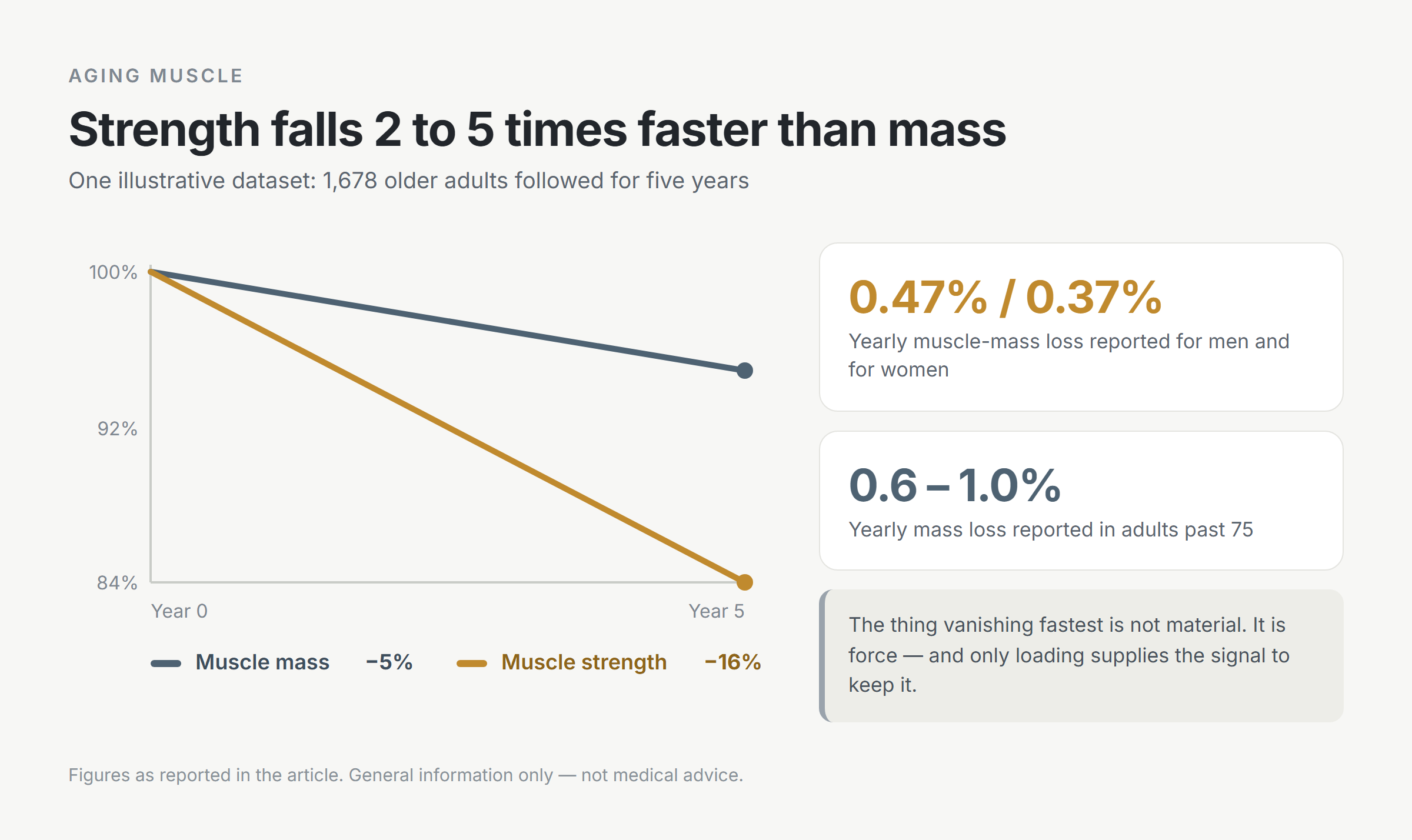
So it is common. It is not universal. And the thing vanishing fastest is not substrate — it is force.
That distinction decides everything about what to do next. A powder supplies material. Only loading supplies the signal to keep the force.
Step one is not a purchase. It is resistance exercise
This is the section I would keep if I had to delete every other one.
The ICFSR International Clinical Practice Guidelines for Sarcopenia (Dent et al., 2018) graded their recommendations formally. Resistance-based physical activity received a strong recommendation. Protein supplementation and a protein-rich diet received a conditional — that is, weak — one. Vitamin D and anabolic hormones received no recommendation at all.
Those are not two versions of the same advice. They are two different grades of confidence, and the gap between them is the whole point of this article.
Then there is the study that changed my mind entirely.
ten Haaf and colleagues (American Journal of Clinical Nutrition, 2018) ran a systematic review and meta-analysis of protein supplementation in non-frail, community-dwelling older adults — which describes most parents most people are shopping for. Their finding: no beneficial effects on lean body mass, muscle strength, or chair-rise ability.
Not a small effect. No beneficial effect.
I want to be precise about what that does and does not say. It concerns supplementation without an exercise program, in people who are not frail and are living independently. It is not a verdict on protein in malnutrition, illness, or hospital settings — and I am citing the conclusion qualitatively, because the pooled numbers were not retrievable when this was researched.
But read plainly, it means this: handing an independent, reasonably nourished older adult a tub of powder and changing nothing else is an intervention the evidence expects to do very little.

Photo: SHVETS production / Pexels
What exercise plus protein actually adds
Now the fair counterweight, because protein does earn a place — on top of training, not instead of it.
The ICFSR subgroup analyses found that resistance training combined with protein supplementation produced the most significant improvements in handgrip strength and gait speed. So the combination is the best-performing arm.
The size of protein’s contribution is where honesty is required. A 2025 network meta-analysis in Frontiers in Nutrition pooled 19 randomized trials and 997 healthy adults aged 60 and over, and — crucially — compared supplements plus resistance training against resistance training alone. Everyone in the analysis was already lifting.
- Protein + training vs training alone: strength SMD 0.45 (95% CI 0.20–0.69); muscle mass +0.37 kg (95% CI 0.04–0.70).
- Creatine + training: no significant strength effect; muscle mass +2.18 kg.
- HMB + training: not significant for either.
About a third of a kilogram of extra muscle, added to the gains training already produced. Genuine, measurable, and modest.
And it appears to get more modest with age. Morton and colleagues (British Journal of Sports Medicine, 2018) confirmed that protein supplementation augments resistance-training gains in healthy adults — while reporting that the effect on fat-free mass was reduced as age increased. There is dissent even here: an AJCN commentary notes at least one meta-analysis concluding protein supplementation did not augment lean body mass gains in older individuals during resistance training.
So the powder is the junior partner. That is not a rhetorical flourish. It is what the grading, the comparator arms, and the effect sizes all say.

Step two is food, and the gap is usually the schedule
The Academy of Nutrition and Dietetics position on nutrition for older adults is explicitly food-first: food-based approaches come before supplementation products wherever possible. A 2025 systematic review in Nutrition Reviews treated whole-food routes to higher protein intake as an intervention in their own right, not a fallback.
There is also a practical reason. Research consistently finds older adults prefer whole foods and tend to avoid shakes and unfamiliar products. Adherence is not a footnote when the plan runs for years.
But is the premise even true — are American seniors short on protein?
Mostly, no.
NHANES analyses found roughly 6% of men over 70 and 12% of women over 70 consuming less than the Estimated Average Requirement, with other analyses of the same era putting older women in a 20–24% range depending on method. About 19% of women aged 71 and older fell below the RDA. Broader trend work (Berryman et al., AJCN) shows average US protein intake sitting at or above the RDA.
So “everyone over 65 is deficient” is not supported. A meaningful minority — especially women in their seventies — genuinely fall short. A much larger group meets the official RDA while falling short of the higher target the geriatric societies recommend, which brings me to a live disagreement worth naming.
The RDA argument, with both sides
The US RDA for protein applies one figure to all adults, and it has not been revised. It remains the official American number.
PROT-AGE (Bauer et al., JAMDA, 2013) and the ESPEN geriatric practical guideline (Volkert et al., 2022) both recommend that healthy older adults eat more than that, and more still during acute or chronic illness. Indicator amino acid oxidation tracer studies push the estimate higher again, concluding the current recommendation for older adults is underestimated by roughly 30–40%.
The counterpoint deserves equal air. The RDA came from nitrogen balance work, whose limits the tracer literature disputes — but disputing a method is not the same as an official revision, and none has occurred. This is a real gap between a national standard and society guidance, not a settled correction.
The more actionable finding is about distribution. The recurring theme in this literature is that hitting a sufficient amount at each meal matters as much as the daily total, and typical American eating is heavily back-loaded — very little protein at breakfast, most of it at dinner. For a lot of older adults, the fix is a rearrangement, not a purchase.

Photo: Mohammed-Ali Hamadache / Pexels
Now the part I got wrong: goat milk and the diarrhea
This is the correction I owe, because it is the single most repeated claim in this space and it does not hold up.
But before the correction, the reframe — because it changes the question more than the answer does.
Malabsorption is not the same as intolerance
The NIDDK reports that about 36% of people in the United States have lactose malabsorption, and about 68% of the world’s population does. That number gets quoted constantly as if it means a third of Americans cannot drink milk.
It does not. NIDDK draws the line explicitly: “not all people with lactose malabsorption have lactose intolerance.” Malabsorption is a reduced ability to digest lactose. Intolerance is malabsorption plus actual symptoms. Only the symptomatic half is intolerant.
NIDDK also notes that malabsorption develops after infancy as a gradual, lifelong decline in lactase — which is exactly why it can surface or worsen in later life, in a parent who drank milk without trouble for sixty years.
The condition is also more common among African American, American Indian, Asian American, and Hispanic/Latino Americans, and least common among people of European descent. NIDDK names the groups but publishes no per-group US percentage, so I will not invent one.
How much lactose is actually tolerable
Here is the finding I wish I had known first.
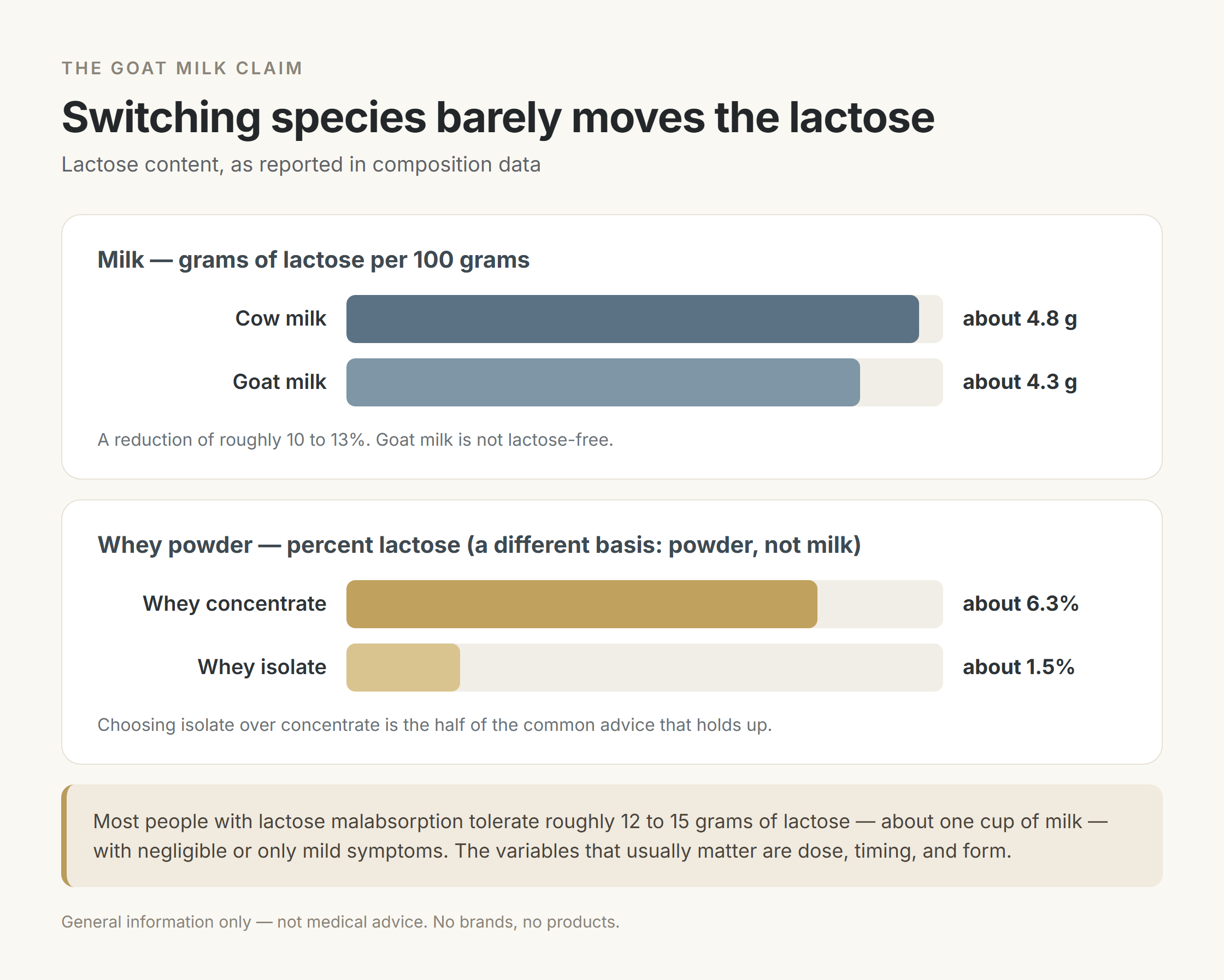
The NIH Consensus Development Conference on Lactose Intolerance and Health (2010) and the reviews that followed found that most people with lactose malabsorption tolerate roughly 12 to 15 grams of lactose — about one cup of milk — with negligible or only mild symptoms, especially taken with food or spread across the day. Symptoms typically appear somewhere in the 20 to 50 gram range.
Read that against the instinct it contradicts. “Milk upsets him, so cut all dairy” throws out a food group over a threshold most people have not actually crossed. The variables that usually matter are dose, timing, and form — not abstinence.
That reframing does more work for a struggling parent than any brand comparison I had bookmarked.
Goat milk does not solve a lactose problem
Now the claim itself.
Goat milk contains lactose at essentially the same level as cow milk. Composition data put goat at about 4.3 grams per 100 grams against cow’s ~4.8 grams, and peer-reviewed goat milk composition reviews state it plainly — the amount of lactose in bovine and goat milk is similar, with goat reported around 4.42–4.44%.
That is a reduction of roughly 10 to 13%. In practical terms, a cup of cow milk carries about 11–12 grams of lactose; a cup of goat milk carries about 10–11.
Goat milk is not lactose-free, and it cannot be recommended as the fix for lactose-driven diarrhea. If lactose is the trigger, switching species barely moves the number.
The “easier to digest” belief is about something else entirely
The goat-milk reputation is not invented. It is just filed under the wrong problem.
The literature supports genuine compositional differences:
- Lower αs1-casein and higher αs2-casein than cow milk, which is the basis for goat milk being better tolerated by some people with cow’s milk protein allergy — an immune reaction to protein.
- Smaller fat globules, cited for softer curd formation and faster gastric handling.
- An oligosaccharide profile closer to human milk than cow milk’s.
None of those lower the lactose load. Not one.
And goat is not a clean answer to milk allergy either — sources caution that cross-reactivity is common, with some patients allergic to goat milk tolerating cow milk and vice versa, because the casein differences are minor at the primary-structure level.
Two claims, two mechanisms. “Goat milk digests differently” has some support, about protein. “Goat milk solves lactose intolerance” is false.
Where the original advice was right: isolate
I want to give credit precisely, because half of what I believed was well supported.
Dairy science composition data — not marketing copy — puts whey protein concentrate (WPC-80) at about 6.3% lactose, and whey protein isolate at about 1.5%. Isolate is made by ultrafiltration, diafiltration, or ion exchange, which permeates lactose, water, and salts out while retaining protein. Residual lactose in isolate powders is characterized in the literature as under 2%.
For someone taking a serving or two a day, that is a real and meaningful difference. Choosing isolate over concentrate is sound advice, and it was the correct half of the instinct I started with.
One caveat belongs with it. “Isolate” on the front of the tub does not guarantee a low-lactose finished product — many products are isolate-and-concentrate blends, and flavoring systems can add dairy solids. The Nutrition Facts panel’s total carbohydrate and sugars lines are the practical check, not the word on the label.
The genuinely lactose-lowering options, categorically: whey isolate, lactose-free or lactase-treated dairy protein, lactase enzyme products taken with the dairy, and plant proteins, which contain no lactose at all. Milk protein isolate and casein still carry lactose unless specifically processed, so they are not an automatic fix.
On plant protein, two findings sit in tension and both deserve stating. Whey produced a 91–130% greater rise in blood leucine than pea protein in young and older adults (Nutrients, 2024), and plant sources generally score lower on essential amino acids. Yet the same literature concludes pea and whey have comparable properties for maintaining muscle protein synthesis, and that pea protein can be recommended for older people who do not eat enough animal-source protein. One frequently cited study showing a leucine-fortified plant blend matching whey was conducted in mice — I am not going to present that as human evidence.
“Digestive enzymes” on the label are usually the wrong enzyme
This one is a straightforward category error, and once you see it you cannot unsee it.
The “digestive enzyme blends” added to protein powders are almost always proteases — typically fungal or microbial. Proteases do nothing for lactose. The enzyme that addresses lactose-driven diarrhea is lactase. Two different molecules, two different problems.
So a powder advertising a digestive enzyme blend is not, on that basis, solving a parent’s diarrhea.
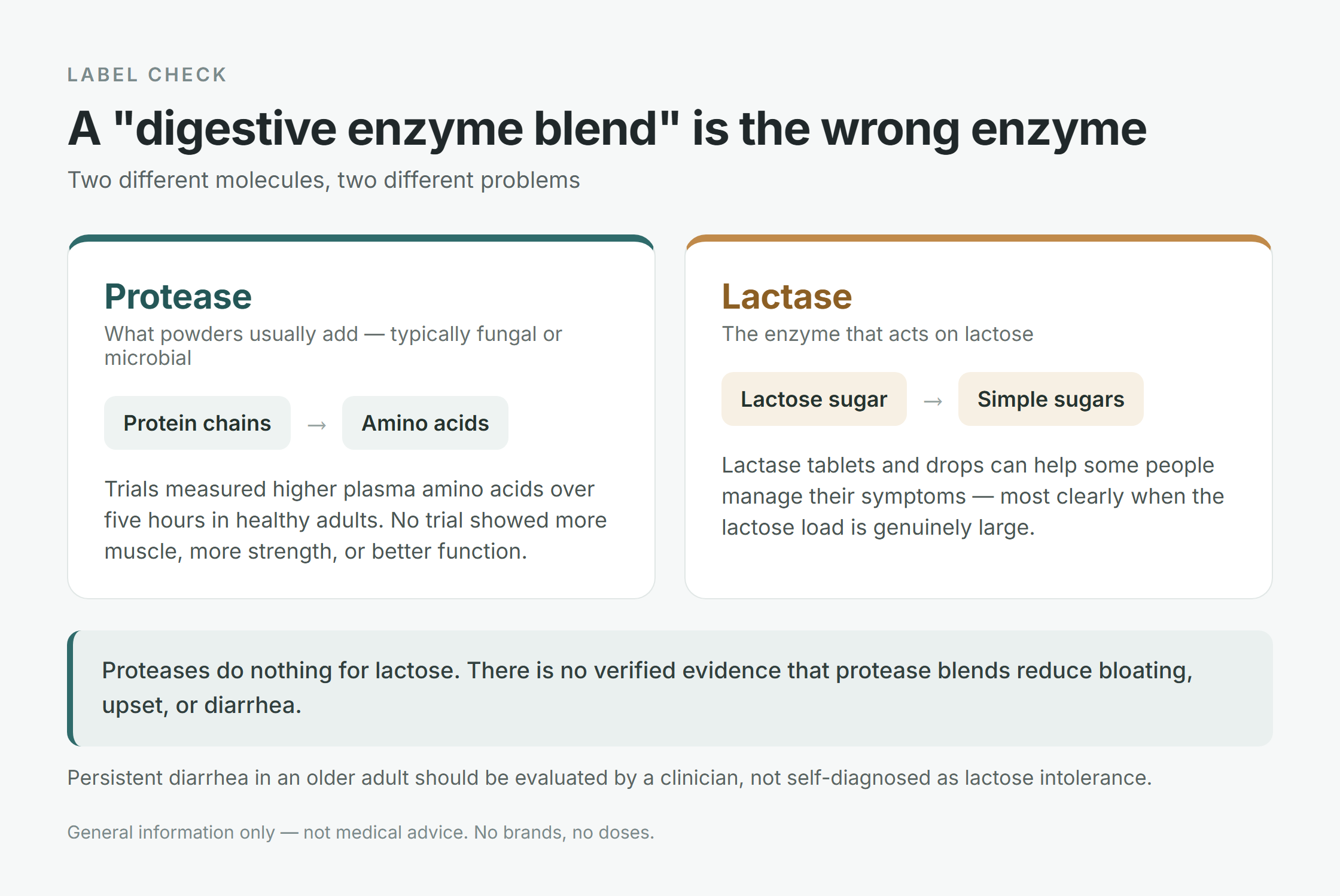
The protease research is real, and its limits are the story. A randomized, double-blind, placebo-controlled trial in the Journal of Nutrition (2024) gave 24 healthy adults pea protein with or without a three-protease mixture and found higher plasma total amino acid concentrations over five hours. A parallel crossover trial tested the same blend with whey concentrate, and a 2023 crossover reported earlier amino acid release.
Four limitations apply to all of it:
- The studies are acute — hours, not months.
- They enrolled healthy adults, not older adults with GI symptoms.
- The endpoint is blood amino acid concentration, a surrogate. No trial demonstrated more muscle, more strength, or better function.
- Several are industry-sponsored or ingredient-supplier driven, testing branded blends.
And there is no verified evidence that protease blends reduce bloating, upset, or diarrhea.
Lactase products are the relevant tool, and even they are modest. NIDDK says lactase tablets and drops “can help some people manage their symptoms.” A systematic review of management strategies found that among trials using control doses at or below 12 grams of lactose, none of four found significant improvement in overall symptoms, while two of five trials at higher lactose loads did. Which fits the tolerance threshold above: lactase matters most when the lactose load is genuinely large.
No supplement sends protein “straight to muscle”
I saw this phrasing on more than one label and more than one forum, and it is physiologically false.
Splanchnic first-pass extraction is significantly higher in older adults. Volpi and colleagues (American Journal of Physiology-Endocrinology and Metabolism, 1999) measured phenylalanine first-pass splanchnic extraction during amino acid ingestion and found it significantly greater in the elderly. The gut and liver take their share before anything reaches the leg.
The same paper carries the encouraging half: despite that higher extraction, delivery to the leg and muscle protein synthesis still increased similarly in young and elderly participants. It is a tax, not a blockade.
Beyond the splanchnic cut, a share of ingested protein is oxidized — under 15% over a four-hour postprandial window in Trommelen’s work — and the remainder distributes across other body proteins. Only a fraction of what you swallow ends up in muscle protein. I have seen a specific percentage quoted for that fraction; it could not be traced to a primary source, so I am not repeating it.
What actually raises the muscle-bound share is a sufficient amount at a single meal, high protein quality, and — most of all — a recent bout of resistance exercise.
Leucine belongs in that quality picture, carefully. Zaromskyte and colleagues (Frontiers in Nutrition, 2021) reviewed the leucine trigger hypothesis across 29 studies and found 16 study arms supporting it and 13 refuting it, with support concentrated in older adults and with isolated protein sources. So leucine is a meaningful marker of protein quality, particularly for exactly this population and this product category. It is not a switch that guarantees muscle growth.
Before buying anything: the kidney conversation
If you take one practical instruction from this article, take this one.
About 34% of US adults aged 65 and over have chronic kidney disease (CDC), rising to a crude prevalence of 38% among adults 70 and older. And roughly 9 in 10 adults with CKD — about 87% — do not know they have it.
That is one in three older Americans, most of them unaware. It is precisely the population being handed a protein supplement by a well-meaning adult child.

Photo: Kampus Production / Pexels
The collision, stated plainly
Here are two pieces of credible, current guidance that point in opposite directions.
PROT-AGE and ESPEN recommend that healthy older adults eat more protein than the general adult RDA, and more still during illness — the entire rationale for the supplement aisle’s senior section.
KDIGO’s 2024 CKD guideline recommends that adults with CKD stages G3–G5 maintain protein intake at the general adult level rather than above it, and includes a practice point to avoid high protein intake in adults with CKD at risk of progression. PROT-AGE itself carves out severe kidney disease as an explicit exception to its own advice.
I am not going to resolve that for you, because it cannot be resolved from the outside. Which guideline applies to your parent depends on their kidney function, and that is a number from a blood test. Given that most people with CKD do not know they have it, “she seems fine” is not a safe default at 65 and over.
KDIGO’s own nuance runs both ways, and it is worth knowing before the appointment: the guideline warns against low-protein diets in metabolically unstable patients, and says that in older adults with frailty and sarcopenia, higher protein and calorie targets should be considered. This is a clinical judgment, made with the labs in hand — which is the argument for the conversation, not against it.
What the evidence says for normal kidneys
Reassuring, and thin.
A 2025 systematic review in Nutrition Reviews on protein intake and kidney function in community-dwelling older adults found 5 of 6 included studies reported no statistically significant association, with one study linking higher plant protein to slower eGFR decline. The authors’ own verdict was insufficient evidence, and that research is lacking. A meta-analysis of randomized trials in adults without CKD found high-protein diets raised eGFR without consistent biochemical evidence of renal injury — but the studies were short and relied on creatinine-based estimates, leaving long-term implications uncertain.
So: no established harm to healthy kidneys, on a thin and short-term evidence base. That is a different sentence from “protein is proven safe for everyone’s kidneys,” and I am not going to blur them.
Gout, in the reassuring direction
Readers often assume the opposite here, so it is worth correcting.
Choi and colleagues (New England Journal of Medicine, 2004) found a strong inverse relationship between dairy consumption — especially low-fat dairy — and gout incidence, and found that higher total animal or vegetable protein intake was not associated with increased gout risk. Milk proteins have a uricosuric effect and dairy is low in purines, so dairy protein lowers urate without the purine load that meat and seafood carry. A 2024 systematic review reported a 31% reduction in hyperuricemia risk with dairy intake, with low-fat dairy performing best.
Dairy protein is protective, not a gout trigger. Anyone with active gout should still work this out with their clinician, since total dietary context matters.
Liver disease is a different matter, and one I am deliberately leaving alone. Protein management in liver disease is a specialist question that this research did not verify to a primary guideline, so the only responsible line is: ask your clinician before adding protein supplements.
Related reading: [Internal link: Chronic kidney disease in older adults: what an eGFR result actually tells you]
How to read a label under US rules
The legal framework is the least exciting section of any supplement article and one of the most useful.
The FDA does not approve dietary supplements or their labeling before they are sold. There is no pre-market proof of safety or efficacy, unlike drugs. In FDA’s own framing, most products can be lawfully brought to market without the agency even knowing they exist.
Structure/function claims — “supports muscle health,” “helps maintain strength” — are not pre-approved. The manufacturer must hold substantiation that the claim is truthful and not misleading, and notify FDA within 30 days after marketing. Any product carrying such a claim must display the disclaimer that FDA has not evaluated it and that the product “is not intended to diagnose, treat, cure or prevent any disease.”
That sentence is not boilerplate. It is a notice that nobody checked.
Disease claims are prohibited on supplements. A structure/function claim may not explicitly or implicitly link the effect to a disease. Which gives you a genuinely useful screen: a protein powder marketed as treating, preventing, or reversing sarcopenia is making an illegal claim, and that tells you something about the seller.
The FTC separately enforces advertising substantiation under its Health Products Compliance Guidance.
What third-party seals do and don’t cover
USP Verified tests for identity, potency, purity, and dissolution. NSF Certified for Sport verifies label claims against actual contents and screens for roughly 280 banned substances and undeclared ingredients.
Neither evaluates efficacy, bioavailability, or dose adequacy — per USADA’s third-party testing guidance and NSF’s own materials. The seals answer “is what’s on the label in the tub, and is anything bad in it.” They do not answer “does it work.”
Heavy metals, with the source type labeled
In January 2025, the Clean Label Project — a non-profit advocacy organization, not a regulator — published testing of 160 products from 70 brands, roughly 36,000 tests. It reported that 47% of products exceeded California Proposition 65 limits for lead, with 21% exceeding twice that level; that organic powders carried about 3× more lead; that chocolate-flavored products carried about 4× more lead than vanilla; and that plant-based powders tested highest while whey-based tested lowest.
The criticism belongs in the same breath. The Council for Responsible Nutrition, an industry trade group, disputed the methodology, and trade press covered the report as controversial. The core methodological objection is fair: Proposition 65 is a California warning threshold, not a federal safety limit, and it is far more conservative than most toxicological benchmarks.
Report it as what it is — an advocacy group’s testing, disputed by industry, using a warning trigger rather than a safety limit. It is not a government finding. It is still a reasonable argument for preferring third-party-verified products, and the whey-versus-plant contrast is worth knowing given everything above.
When symptoms mean a doctor, not a different powder
The instinct I started with — swap the product, fix the symptom — is the one worth interrupting.
Persistent diarrhea in an older adult should be evaluated, not self-diagnosed as lactose intolerance. Celiac disease, inflammatory bowel disease, infection, medication effects, and malignancy can all present the same way. This was the single biggest gap in my own thinking, and it is not a small one.
Talk to a clinician before starting a protein supplement if any of these apply:
- Known kidney disease, or unknown kidney function at 65 and over.
- Diabetes, which carries both higher sarcopenia prevalence and kidney risk.
- Any prescription medication — take that one to a pharmacist.
- Liver disease.
- Active gout.
- Unexplained weight loss, poor appetite, or suspected malnutrition — that needs clinical assessment, not a tub of powder.
- Persistent diarrhea or any persistent change in bowel habit.

Photo: SHVETS production / Pexels
The short version
If I could hand my earlier self one card before he opened all those tabs, it would say four things.
The order matters more than the product. Resistance exercise has a strong recommendation; protein has a conditional one. Protein supplementation without exercise produced no benefit to lean mass, strength, or chair-rise in non-frail community-dwelling older adults. Start with loading, then food, then a supplement for whatever gap is left.
The powder’s honest contribution is modest. On top of training, roughly a third of a kilogram of extra muscle and a moderate strength effect — and that effect shrinks with age.
Goat milk does not fix lactose. It carries nearly as much as cow milk. Whey isolate genuinely does carry far less, and that half of the common advice is correct. Most people with lactose malabsorption tolerate about a cup of milk’s worth of lactose anyway, so the answer is more often dose and form than abstinence.
Know the kidneys first. One in three Americans over 65 has CKD and most do not know it, and the geriatric protein target and the CKD ceiling point in opposite directions. That is a blood test and a conversation, before anything gets bought.
Related reading: [Internal link: Strength training after 65: how to start safely at home]

Photo: Emma / Pexels
I never did buy my mother the powder on my shortlist.
We bought a pair of light dumbbells instead, and she asked her doctor about the diarrhea, and it turned out to be worth asking about. The shake question is still open. It just moved to the end of the list, where the evidence says it belongs.
That is the part I keep thinking about. The answer was never which product to trust — it was which question to ask first.
References
- Dent E, et al. — “International Clinical Practice Guidelines for Sarcopenia: Screening, Diagnosis and Management” (ICFSR), 2018
- ten Haaf DSM, et al. — “Effects of protein supplementation on lean body mass, muscle strength, and physical performance in nonfrail community-dwelling older adults,” American Journal of Clinical Nutrition, 2018;108(5)
- Morton RW, et al. — “A systematic review, meta-analysis and meta-regression of the effect of protein supplementation on resistance training-induced gains,” British Journal of Sports Medicine, 2018
- “Nutritional intervention combined with resistance training on muscle strength and mass in healthy older adults: a network meta-analysis,” Frontiers in Nutrition, 2025
- Milne AC, et al. — “Protein and energy supplementation in elderly people at risk from malnutrition,” Cochrane Database of Systematic Reviews, CD003288, 2009
- Mitchell WK, et al. — “Sarcopenia, dynapenia, and the impact of advancing age on human skeletal muscle size and strength: a quantitative review,” Frontiers in Physiology, 2012
- Cruz-Jentoft AJ, et al. — “Sarcopenia: revised European consensus on definition and diagnosis” (EWGSOP2), Age and Ageing, 2019
- Westbury LD, et al. — “Recent sarcopenia definitions — prevalence, agreement and mortality associations,” Journal of Cachexia, Sarcopenia and Muscle, 2023
- Bauer J, et al. — “Evidence-based recommendations for optimal dietary protein intake in older people” (PROT-AGE Study Group), JAMDA, 2013
- Volkert D, et al. — “ESPEN practical guideline: Clinical nutrition and hydration in geriatrics,” Clinical Nutrition, 2022
- Academy of Nutrition and Dietetics — Position paper: “Food and nutrition for older adults: promoting health and wellness”
- Berryman CE, et al. — “Protein intake trends and conformity with the Dietary Reference Intakes, NHANES 2001–2014,” American Journal of Clinical Nutrition
- Rafii M, et al. — Dietary protein requirement of adults over 65 by indicator amino acid oxidation
- NIDDK/NIH — Lactose Intolerance: Definition & Facts; Treatment; Eating, Diet & Nutrition
- NIH Consensus Development Conference — Lactose Intolerance and Health, 2010
- “Effective management strategies for lactose intolerance” — systematic review, NCBI Bookshelf
- “Global comprehensive review and meta-analysis of goat milk composition,” Small Ruminant Research, 2024
- “A2 Bovine Milk and Caprine Milk as a Means of Remedy for Milk Protein Allergy,” Dairy (MDPI), 2021
- Whey protein concentrate WPC-80 and whey protein isolate composition data, PMC6164859
- “Circulating Amino Acid Concentration after Consumption of Pea or Whey Proteins in Young and Older Adults,” Nutrients, 2024
- “Acute Microbial Protease Supplementation Increases Net Postprandial Plasma Amino Acid Concentrations After Pea Protein Ingestion,” Journal of Nutrition, 2024
- Volpi E, et al. — “Oral amino acids stimulate muscle protein anabolism in the elderly despite higher first-pass splanchnic extraction,” American Journal of Physiology-Endocrinology and Metabolism, 1999
- Zaromskyte G, et al. — “Evaluating the Leucine Trigger Hypothesis,” Frontiers in Nutrition, 2021
- CDC — Chronic Kidney Disease in the United States
- KDIGO — 2024 Clinical Practice Guideline for the Evaluation and Management of Chronic Kidney Disease
- “Association Between Dietary Protein Intake and Kidney Function in Community-Dwelling Older Adults: A Systematic Review,” Nutrition Reviews, 2025
- Choi HK, et al. — “Purine-Rich Foods, Dairy and Protein Intake, and the Risk of Gout in Men,” New England Journal of Medicine, 2004
- FDA — Structure/Function Claims; Questions and Answers on Dietary Supplements
- FTC — Health Products Compliance Guidance
- USADA — Third-Party Testing Guidance; USP Verified and NSF Certified for Sport program materials
- Clean Label Project (non-profit advocacy organization) — Protein Powder Safety Report, January 2025; industry response from the Council for Responsible Nutrition, January 2025
This article is general information and is not medical advice. It does not establish a clinician–patient relationship and is not a substitute for individual diagnosis or treatment. It deliberately contains no dosing guidance, no product or brand recommendations, and no regimen. Dietary supplements are not reviewed by the FDA for safety or effectiveness before they are sold, and nothing here is intended to diagnose, treat, cure, or prevent any disease. Please talk with a physician, pharmacist, or registered dietitian before starting a protein supplement — especially if you have or may have kidney disease, take prescription medication, or live with liver disease, diabetes, or gout. Persistent diarrhea, unexplained weight loss, or a lasting change in appetite in an older adult should be evaluated by a clinician rather than managed with a change of product. In an emergency, call 911.