Sarcopenia Checklist for Seniors: Self-Test and Steps
Let me start with a small, honest moment.
My father is the one who made me look into this. Nothing dramatic happened. He just mentioned, almost in passing, that getting up out of his favorite armchair had started to take “a bit of a push.”
That quiet change has a name. It is called sarcopenia.
If you have noticed the stairs feeling longer, jars getting harder to open, or standing up needing a little momentum, you are in exactly the right place. This is a plain checklist: a ten-second self-test, a few questions, and the two things that actually help.
One promise before we start. I am not a doctor, and this is general information, not medical advice. Anything here that raises a flag is a reason to talk to your doctor, not to diagnose yourself at the kitchen table.
Photo: Mikhail Nilov / Pexels
What is sarcopenia, and why should you care?
Sarcopenia is the age-related loss of muscle mass, strength, and physical function. It happens slowly, which is exactly why it is easy to miss.
Here is why it is worth catching early.
Muscle, especially in your legs, is what lets you rise from a chair, climb stairs, carry groceries, and keep your balance. As it fades, all of those get harder, and fall risk goes up. Left unchecked, sarcopenia is linked to frailty, loss of independence, and worse health outcomes over time.
None of that is meant to frighten you. The opposite, really. Because unlike a lot of aging changes, this one responds to what you do about it.
The finger-ring test: a ten-second self-check
This is my favorite part, because it costs nothing and takes seconds. It is called the finger-ring, or “yubi-wakka,” test.

Here is how to do it.
- Make a ring with the thumbs and index fingers of both hands.
- Wrap that ring around the thickest part of your non-dominant calf (your lower leg).
- Read the result:
- Your calf is bigger than the ring and you cannot close it: lowest risk.
- It just fits: intermediate risk.
- There is a gap, the calf is smaller than the ring: highest risk.
A “smaller” result does not mean you have sarcopenia. It means it is worth paying attention and mentioning to your doctor. In studies, this simple test has even tracked with longer-term risk, which is remarkable for something you can do sitting on the edge of your bed.
A quick function checklist
The finger-ring test looks at size. This next check looks at what you can actually do. It is based on a screening tool called SARC-F. Ask yourself how much difficulty you have with each of these.
- Strength: lifting or carrying about 10 pounds.
- Walking: getting across a room.
- Rising: getting up from a chair or bed.
- Stairs: climbing a flight of about 10 steps.
- Falls: how many times you have fallen in the past year.
The more difficulty you notice, and the more falls you count, the more reason to follow up. Again, this is a nudge toward a conversation with your clinician, not a verdict.
Pillar one: are you getting enough protein?
Here is something many people over 60 are surprised to learn. You likely need more protein than you did at 40, not less.
The reason is that aging muscle becomes a little “deaf” to protein, so it takes more to get the same muscle-building signal.
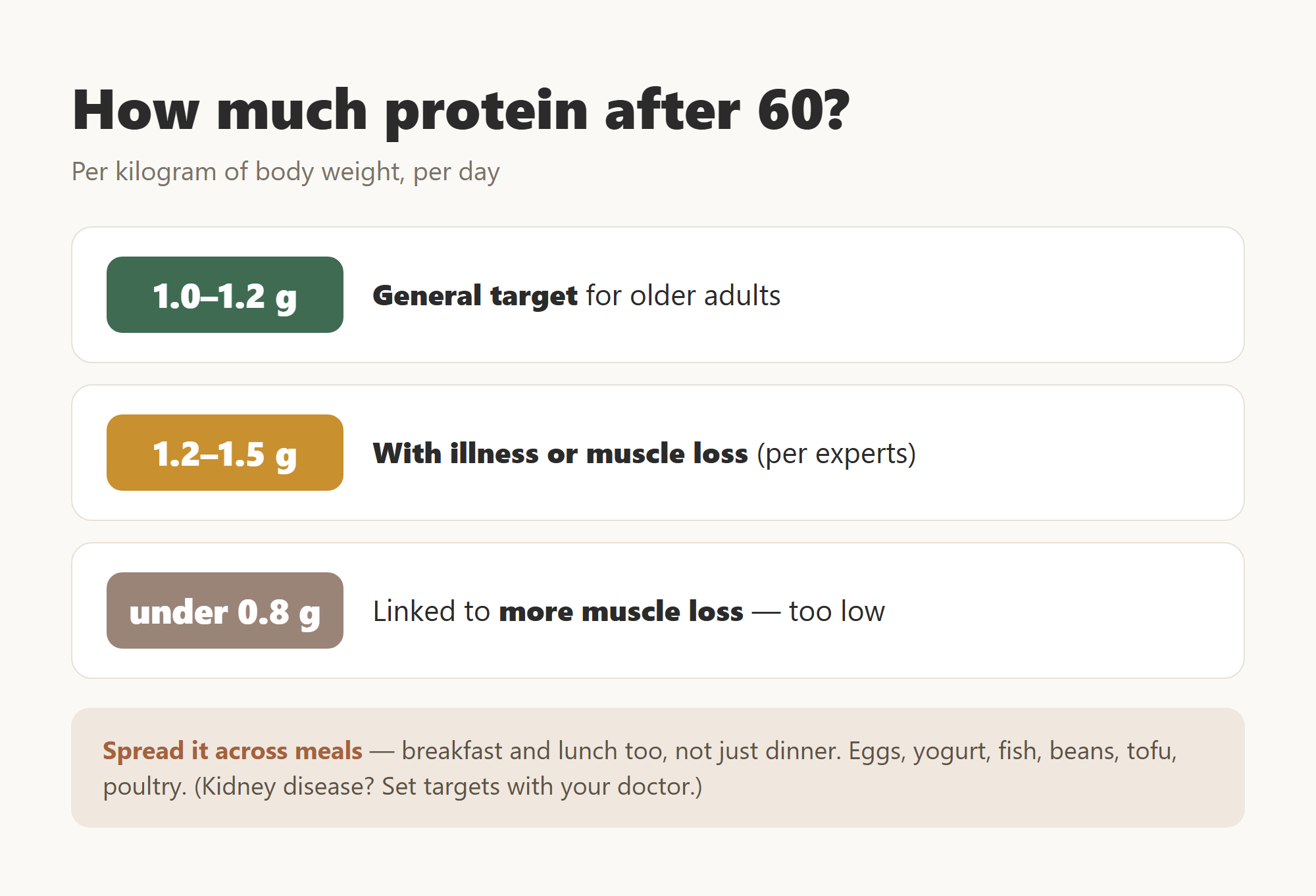
- A common general target is about 1.0 to 1.2 grams of protein per kilogram of body weight per day.
- With illness or existing muscle loss, some experts suggest more, around 1.2 to 1.5 grams per kilogram.
- Intakes below the old standard of 0.8 grams per kilogram are linked to more muscle loss.
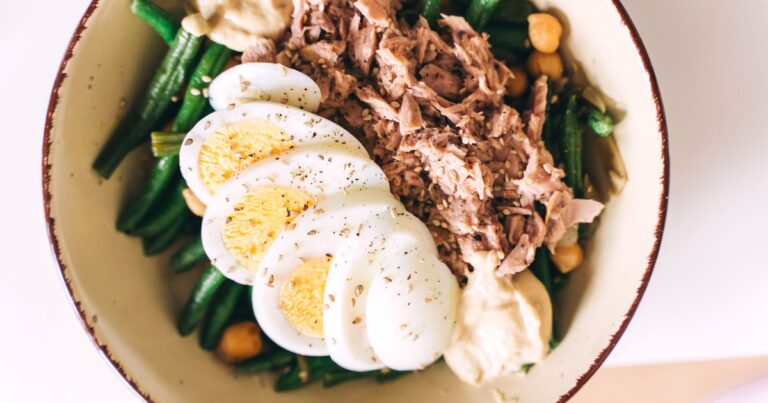
A practical tip that actually helps: spread protein across the day. A good amount at breakfast and lunch, not just a big dinner, gives your muscles a steadier supply. Think eggs, Greek yogurt, fish, beans, tofu, poultry.

Photo: Jeremy Wong / Pexels
One honest caveat. If you have kidney disease, protein targets need to be set with your doctor, so please do not just push your intake up on your own.
Pillar two: lower-body strength, two or three times a week
If protein is the raw material, strength training is the signal that tells your body to build. And of all the exercise types, this is the one that matters most here.
A 2025 review of trials found that resistance training beats cardio for building muscle in adults over 55. Older adults in these studies gained meaningful strength and lean muscle. Your legs are where to focus, because that is what keeps you independent.

A simple, functional starting set:
- Sit-to-stand: rise from a sturdy chair and sit back down, slowly. It is the single most useful move, because it is daily life.
- Chair squats: lower toward the chair without fully sitting, then stand.
- Heel raises: rise onto your toes, holding a counter for balance.
- Step-ups: step up onto a low, stable step and back down.
Aim for two to three sessions a week. The payoff is concrete: walking farther, better balance, and getting in and out of a chair or the shower with less effort.

Photo: RDNE Stock project / Pexels
How to start without overdoing it
I want to be careful here, because enthusiasm can backfire.
Start gentle, and progress slowly. A few repetitions with good form beats a heroic first day that leaves you too sore to move for a week. Muscles and joints that are older need a gradual ramp.
And please, talk to your doctor or a physical therapist before you begin, especially if you have heart disease, high blood pressure, joint problems, osteoporosis, or any balance trouble. A physical therapist can tailor moves to you, which is worth its weight in gold.
A few common-sense rules:
- Keep a sturdy chair or counter within reach for balance.
- Stop if you feel chest pain, dizziness, or sharp joint pain.
- Pair the exercise with the protein. Neither pillar works nearly as well alone.
The short version
If I gather all of it into a few lines, here it is.
Sarcopenia is muscle loss that comes with age, and it is worth catching because it threatens your balance and independence. Do the finger-ring test and the quick function check. If they raise a flag, tell your doctor. Then lean on the two things that genuinely help: enough protein spread through the day, and lower-body strength work two or three times a week, started gently.
My father, by the way, now does sit-to-stands during TV commercials. He grumbles about it. But he also gets out of that armchair without the push now.
And that, more than any number, is the point.
References
- PubMed — Finger-ring (yubi-wakka) test for sarcopenia self-screening
- PMC — SARC-F, SARC-CalF, and calf circumference as screening tools
- PROT-AGE Study Group / EU Geriatric Medicine Society — protein requirements for older adults
- Frontiers in Nutrition — dietary protein in older adults with sarcopenia
- UT Southwestern; 2025 systematic review — resistance training for age-related muscle loss