Vaginitis Types, Symptoms & Prevention Habits
Let me start with the thing that keeps people guessing in the pharmacy aisle.
The symptoms of the most common vaginal irritations look a lot alike. Itching, discharge, an odor that seems off — they can all point to several very different things. And the treatments for those things are not interchangeable. So the guess you make while standing in front of the shelf actually matters.
So if you are trying to understand vaginitis — what the types are, how their symptoms differ, and what actually helps prevent it — this is a plain, careful walk through what the medical sources say.
One thing first, though.
I am not a doctor, and this is general information, not medical advice. Because these conditions share symptoms and can even mimic sexually transmitted infections, an accurate diagnosis really does need a healthcare provider — especially the first time, if symptoms do not clear, or if you might be pregnant.

Photo: Kaboompics.com / Pexels
What “vaginitis” actually means
Vaginitis is simply inflammation or irritation of the vagina. It is not one condition — it is a category.
Three types cause most cases:
- Yeast infection (candidiasis) — an overgrowth of a fungus, usually Candida, that normally lives in the vagina in small amounts.
- Bacterial vaginosis (BV) — an imbalance of the normal vaginal bacteria, where certain bacteria overgrow the protective ones. It is the most common type in people of reproductive age.
- Trichomoniasis (“trich”) — caused by a parasite, and it is sexually transmitted. It is considered the most common curable STI.
There is a fourth, atrophic vaginitis, which comes from lower estrogen and is common after menopause. But the three above are what most people are trying to tell apart.
How the symptoms differ
Here is the part everyone wants, so let me put it plainly. The clues are useful — but they are clues, not a diagnosis.

- Yeast tends to bring intense itching and a thick, white, “cottage cheese”-like discharge, usually without a strong odor.
- Bacterial vaginosis tends to bring a thin, grayish discharge with a strong “fishy” odor — often more noticeable after sex or around your period — and sometimes very little else.
- Trichomoniasis can bring a greenish-yellow, sometimes frothy discharge, and it is the one that often causes pain or burning when you urinate. And here is the catch: about 70% of trich infections cause no symptoms at all.
So if you are itching with a cottage-cheese discharge, yeast is a reasonable suspicion. A fishy odor points more toward BV. Pain urinating with a green-yellow discharge leans toward trich. But notice how much these can overlap — which is exactly why the next section matters.
Why guessing is so often wrong
I want to be honest about this, because the self-treatment habit is strong and understandable.
Self-diagnosis of these conditions is frequently wrong. Studies have found error rates as high as around 89%, and in one study, only about 11% of women correctly identified their own yeast infection. Even people who have had one before often get the next one wrong.
That matters because the treatments do not overlap. Yeast needs an antifungal. BV and trich need antibiotics or antiparasitics — such as metronidazole, with tinidazole also used for trich. If you treat a BV or a trich infection with an over-the-counter yeast cream, you have not treated it at all. You have just delayed the right care.
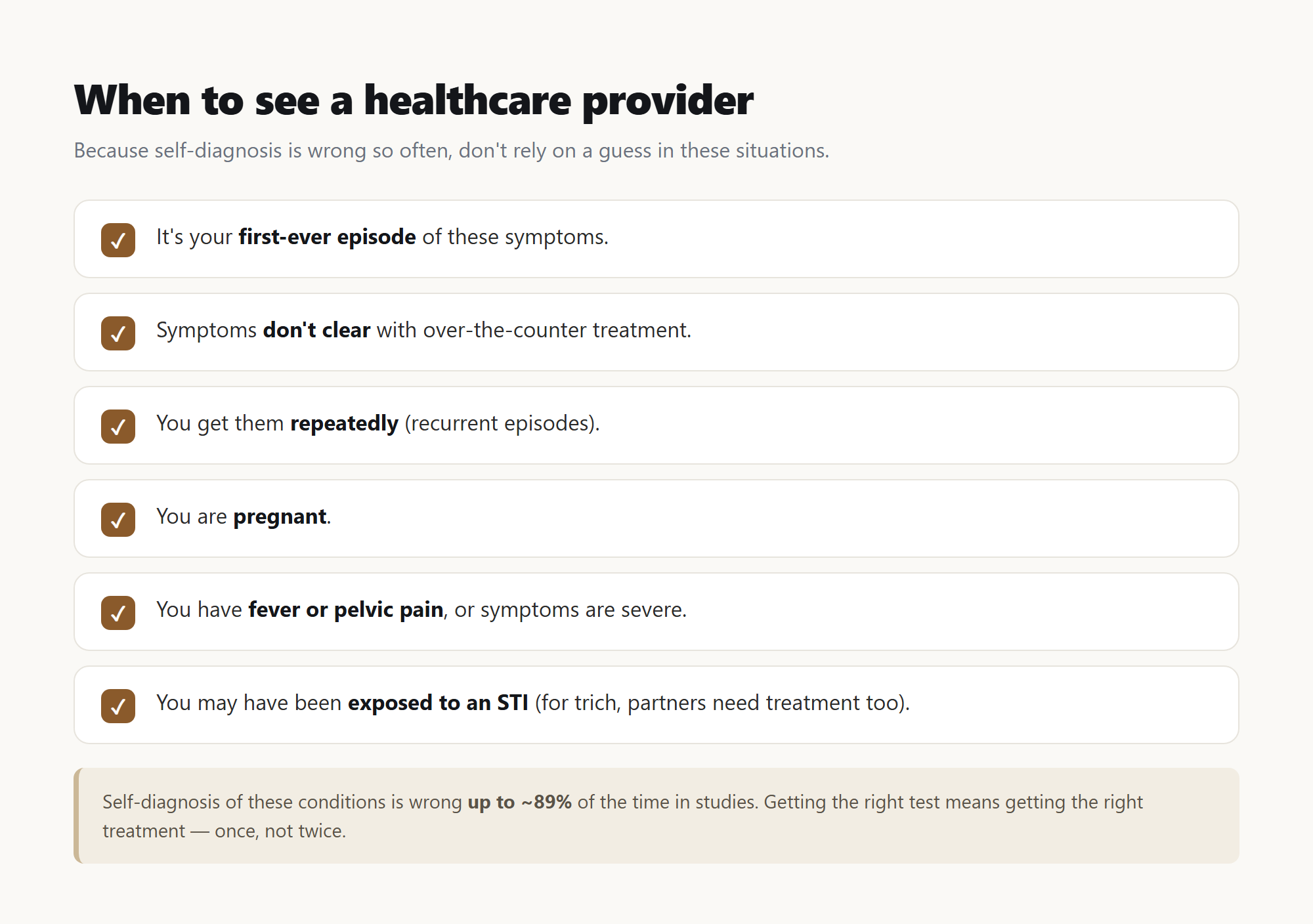
So when should you stop guessing and get checked? See a healthcare provider if it is your first-ever episode, if symptoms do not clear with over-the-counter treatment, if you get them repeatedly, if you are pregnant, if you have fever or pelvic pain, or if you may have been exposed to an STI. For trichomoniasis specifically, partners usually need to be treated too, or reinfection just bounces back.
None of that is meant to scare you. Most of these are common and very treatable. It is just that “treatable” depends entirely on treating the right one.
Prevention habits that actually make sense
Here is the reframe that helps most: the goal is not to scrub the area cleaner. It is to avoid disrupting the balance that is already protecting you.
The single most important habit follows directly from that.
Do not douche. Repeated douching washes out the healthy bacteria that keep the vagina in balance, and it can actually raise your risk of infection. The vagina is self-cleaning. Washing the vulva — the outside — with water, and mild soap at most, is genuinely enough.

Photo: Ron Lach / Pexels
A few more habits worth building:
- Skip scented and harsh products down there — deodorant sprays, scented pads or tampons, perfumed washes. They irritate and unbalance.
- Choose breathable cotton underwear (or a cotton crotch), and do not sit around in wet swimsuits or sweaty clothes. Dry is your friend; so is not wearing painfully tight pants all day.
- Wipe front to back.
- For trich, reduce STI risk — condoms help, and so does limiting the number of partners.
A realistic word on probiotics
You will see probiotics marketed hard for “vaginal balance,” so let me be straight about what the sources say.
Mayo Clinic says there is no good evidence that an oral probiotic improves the bacterial mix in the vagina. The CDC does not recommend oral or vaginal probiotics for this — a specific vaginally delivered Lactobacillus is being studied, but it is not FDA-approved.
So probiotics probably will not hurt, but do not lean on them as prevention or treatment, and definitely not in place of seeing a clinician.

Photo: cottonbro studio / Pexels
The short version
If I had to compress all of this into a few lines, it would be this.
There are three common types of vaginitis — yeast, bacterial vaginosis, and trichomoniasis — and although their symptoms overlap, their treatments do not. Itching with a cottage-cheese discharge leans yeast; a fishy odor leans BV; pain urinating with a green-yellow discharge leans trich. But the leaning is not the answer.
For prevention, the theme is gentle: do not douche, skip the scented products, keep things breathable and dry, and treat probiotics as unproven rather than magic.

Photo: Polina Tankilevitch / Pexels
And keep one line bright in your mind: the clues on this page can help you ask better questions, but they cannot replace a test. Because the whole point of getting it right is not to worry more — it is to treat the actual thing, once, instead of guessing at it twice.
That is the one place here worth handing over to someone who can actually look.
References
- ACOG — “Vaginitis” FAQ (types, symptoms, evaluation)
- Mayo Clinic — “Vaginitis: Symptoms & causes” and diagnosis/treatment (prevention; probiotics evidence)
- CDC — Trichomoniasis Fact Sheet; Candidiasis and bacterial vaginosis pages (symptoms; probiotics not recommended)
- U.S. Office on Women’s Health — “Vaginal yeast infections”
- Planned Parenthood; Cleveland Clinic — prevention and the unreliability of self-diagnosis