PMDD Is a Real Medical Condition, Not Just Bad PMS
I’ll be honest with you. For a long time, I thought “PMS” was just something everyone learned to push through. A rough week, a short temper, then it passed. So when a friend told me the days before her period felt less like moodiness and more like a switch being flipped inside her, I didn’t really understand it. I do now.
Because there’s a name for what she was describing, and it isn’t “bad PMS.” It’s PMDD — premenstrual dysphoric disorder — and it’s a recognized medical condition, not a personality flaw or a lack of willpower. That distinction matters more than almost anything else I can tell you here.
This isn’t medical advice, and nothing below replaces a conversation with a real clinician. But if you’ve ever wondered whether what you feel each month is “normal” or something more, I hope this gives you language for it.
Photo: Burst / Pexels
What PMDD actually is
Let me start with the part that surprised me most.
PMDD is listed in the DSM-5 — the manual clinicians use to diagnose mental health conditions — and it sits under depressive disorders. That’s not a small detail. It means the medical field treats PMDD as a genuine mood disorder, on the same page as conditions we already take seriously.
During the symptomatic days, the functional impairment can be comparable to major depression. This is the week or two before your period, when work, relationships, and just getting through the day can feel genuinely hard.
Here’s the part I want to say plainly, because I think a lot of people need to hear it:
If this is you, you are not being dramatic. You are not weak. Your brain is responding to something real.
PMDD is not just “PMS turned up louder”
This is the misunderstanding I had, and it’s a common one. PMDD is not an intensity dial on ordinary PMS. PMS is a broader, milder pattern of premenstrual symptoms. PMDD involves marked mood symptoms — the kind that cause significant disruption to work, relationships, or social life during those days.
The thing that separates them is severity and impact, not just discomfort.
The timing pattern is the tell
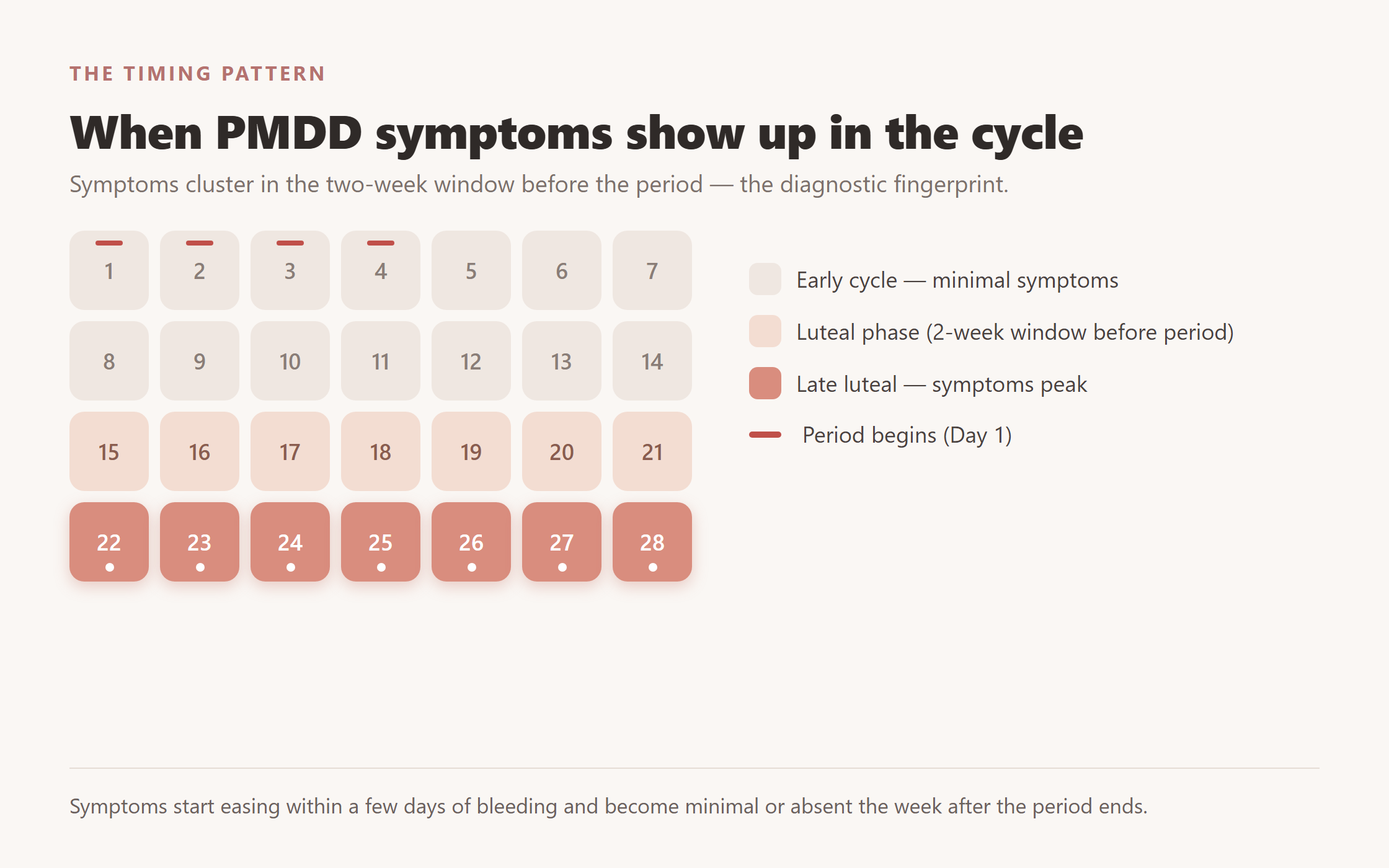
What makes PMDD distinctive is when it happens, and this is actually part of how it’s diagnosed.
- Symptoms cluster in the final week before your period (the late luteal phase).
- They start improving within a few days after bleeding begins.
- They become minimal or absent in the week after your period ends.
That cyclical rise-and-fall is the diagnostic fingerprint. It’s what separates PMDD from a chronic mood condition that simply gets worse before your period — something clinicians call premenstrual exacerbation. If your low mood never really lifts, that’s a different conversation to have with your doctor.
How PMDD is diagnosed
The DSM-5 has specific criteria, and I think it helps to see them, because “I get moody sometimes” and “I meet clinical criteria” are not the same thing.
In most cycles over the past year, at least 5 of 11 symptoms must appear in the final week before your period, improve within a few days of it starting, and fade the week after.
At least one has to come from the core emotional cluster:
- Marked mood swings, sudden sadness, tearfulness, or sensitivity to rejection
- Marked irritability, anger, or more conflict with people around you
- Marked depressed mood, hopelessness, or self-critical thoughts
- Marked anxiety, tension, or feeling “keyed up” or “on edge”
At least one more comes from a second group to reach the total of five, including things like:
- Losing interest in your usual activities
- Trouble concentrating
- Fatigue or a real lack of energy
- Appetite changes, overeating, or food cravings
- Sleeping too much or too little
- Feeling overwhelmed or out of control
- Physical symptoms — breast tenderness, joint or muscle pain, bloating, weight gain, headache
There’s one more thing worth knowing.
A proper diagnosis ideally comes from tracking your symptoms daily, prospectively, over at least two cycles — not from memory. Looking back tends to over-diagnose, because our recall of a bad week isn’t always accurate. So if you suspect PMDD, one of the most useful things you can do is start charting how you feel each day and bring that record to your appointment.

How common is it, really?
Here’s where I have to be careful, because the numbers genuinely conflict depending on how strictly you count.
- The DSM-5 estimates roughly 2–5% of people who menstruate.
- A strict estimate — limited to community samples that fully followed diagnostic criteria with confirmed diagnosis — drops to about 1.6%.
- Estimates based on self-report or provisional diagnosis run higher, around 7.7%, because retrospective recall tends to inflate the number.
So the honest answer is a range: somewhere around 1.6% to 5%, depending on how rigorously it’s diagnosed and whether daily tracking was used. That’s not a rounding error — it’s the difference between guessing and confirming. But even at the low end, that’s a lot of people quietly carrying this.
Why it happens
I want to be careful here too, because this is a place where it’s easy to oversimplify. PMDD is multifactorial, and there isn’t a single tidy cause. But the leading model is genuinely fascinating, and it reframes the whole thing.
Most people with PMDD have normal hormone levels. Their estrogen and progesterone aren’t abnormal. What’s different is how their brain responds to normal hormonal fluctuations.
The main character in this story is a molecule called allopregnanolone — a metabolite of progesterone. In most people, as it rises in the luteal phase, it acts on the GABA-A receptor (the brain’s main calming, inhibitory system) and has a naturally soothing, anti-anxiety effect.
In PMDD, that system appears dysregulated. The normal rise in allopregnanolone fails to produce the usual calming effect. Instead of settling the brain down, the signal doesn’t land the way it should, which increases excitability and produces the mood and anxiety symptoms. There’s also evidence of heightened stress sensitivity in the luteal phase.
Serotonin is involved too, which is part of why one class of medication works so well and so quickly.
So this isn’t abnormal hormones. It’s an abnormal response to normal ones. I find that a much kinder — and more accurate — way to understand it.
What actually helps
The good news is that PMDD is treatable, and there’s solid evidence behind the main options. Treatment should always be individualized and guided by a clinician, but here’s the landscape.
SSRIs — the first-line medication
SSRIs are the gold-standard, first-line medication for PMDD. This is backed by a large body of research — at least around 40 placebo-controlled trials — and roughly 60–70% of patients respond, compared with about 30% on placebo.
Two things stand out compared with treating depression:
- The effective doses are often lower.
- The response can be faster — sometimes within days — which fits neatly with that neurosteroid mechanism.
There are two dosing strategies:
- Continuous (daily) dosing, or
- Luteal-phase-only dosing — typically starting around 14 days before your expected period and stopping at or shortly after bleeding begins.
Which is better? Mostly a wash. There’s no strong evidence that continuous dosing beats luteal-phase dosing, though one meta-analysis found continuous dosing worked slightly better. Both are legitimate, and the choice comes down to your symptom pattern and your preference. That’s a conversation for you and your prescriber.
Hormonal options
A combined oral contraceptive containing drospirenone and ethinyl estradiol on a 24/4 schedule (24 active pills, 4 inactive) is FDA-approved for PMDD. It’s also a first-line option — recommended by ACOG — for people who also want contraception.
In trials, after about three months, people on this pill had less severe premenstrual symptoms than those on placebo, and reported better functioning and social activity. A Cochrane review notes the benefit for symptoms, while also flagging a real placebo effect and things to consider about staying on it.
More intensive hormonal approaches exist for severe or treatment-resistant cases, but those are reserved for specialist care.
CBT and lifestyle support
Here’s something I didn’t expect: cognitive behavioral therapy (CBT) has solid evidence for PMDD.
In one trial it was about as effective as an antidepressant overall — and it held up better at the one-year follow-up. So there’s a real trade-off worth understanding: medication tends to bring relief faster, while CBT gains tend to last longer. It’s not either/or, and some people benefit from combining or sequencing them.
CBT works on coping, distress, anxiety, and the impact on relationships — not on the underlying hormone sensitivity itself. Supportive habits like exercise, sleep, and stress management are commonly recommended alongside, though the evidence for them is weaker than for SSRIs or hormonal treatment.

Photo: Polina Zimmerman / Pexels
When to see a specialist
Please don’t white-knuckle this alone.
Persistent severe symptoms, real disruption to your life, or any thoughts of self-harm deserve evaluation by an OB-GYN or psychiatrist. Tracking your symptoms across two or more cycles gives your clinician something concrete to work with and helps confirm what’s actually going on.
And if you’re ever in crisis in the U.S., you can call or text 988 (the Suicide & Crisis Lifeline), any time.
[internal-link: Related post – Understanding the menstrual cycle and hormonal health]

Photo: Pavel Danilyuk / Pexels
If there’s one thing I’d want you to take from all of this, it’s the reframe.
PMDD isn’t a failure of character, and it isn’t something to be embarrassed about. It’s a diagnosable condition with real biology behind it and real treatments that help. For too long, people have been told to just power through — to be quieter, tougher, less “difficult.” I don’t think that’s fair, and I don’t think it’s true.
Naming something is the first step to treating it. So if what you’ve read here sounds like your own life, the bravest and most useful thing you can do isn’t to endure it more quietly.
It’s to write it down, and bring it to someone who can help.
References (research basis): DSM-5 (APA); StatPearls (NCBI); American Journal of Psychiatry (Epperson et al.); Frontiers in Psychiatry / Global Women’s Health reviews; ACOG guidance (2023); Cochrane Library (drospirenone OCs); ScienceDirect and NCBI/PMC allopregnanolone–GABA-A research.