HPV Vaccine Timing: When to Get It and Why It’s for Everyone
Let me start with the fact that reframed this whole topic for me.
There’s a vaccine that can prevent more than 90% of HPV-related cancers. Not manage them. Not catch them early. Prevent them. When I first really sat with that, it struck me how quietly remarkable it is — and how much the conversation around it still gets tangled up in old assumptions.
The HPV vaccine — most people know it as the “cervical cancer vaccine” — is one of the few tools we have that stops a cancer before it can start. But two things about it get misunderstood constantly: when to get it, and who it’s actually for.
This isn’t medical advice, and vaccination decisions — especially for adults — should be made with your own clinician. But if you’ve been unsure about the timing, or you assumed this was a “women only” issue, I’d like to walk through what the evidence actually says.
Photo: Pavel Danilyuk / Pexels
Why this vaccine matters so much
Persistent HPV infection causes nearly all cervical cancers. That’s not a hedge — it’s about as direct a cause-and-effect as we get in cancer.
But it doesn’t stop there. HPV also causes cancers of the vulva, vagina, anus, penis, and the oropharynx (the back of the throat), plus genital warts. In the U.S., the CDC estimates about 37,000 HPV-attributable cancers happen every year across both sexes.
For cervical cancer specifically, 2024 estimates put it at roughly 13,820 new invasive diagnoses and about 4,360 deaths in the U.S.
Here’s a hopeful number, though. New cervical cancer diagnoses fell more than 50% from around 1975 to 2010, driven largely by screening — and, increasingly, by vaccination. This is one of those rare stories where the trend line has been moving the right way for decades.
How the vaccine works — and why timing is everything
This is the single most important thing to understand, so I’ll say it plainly.
The HPV vaccine works prophylactically. It prevents infection. It does not treat an infection you already have.
That one fact explains everything about the timing. The vaccine builds protection before exposure, which is why it’s recommended so early — before someone is likely to encounter the virus.
The vaccine used in the U.S. is Gardasil 9 (the 9-valent version), and it has been the only HPV vaccine used here since late 2016. It protects against oncogenic HPV types 16, 18, 31, 33, 45, 52, and 58, plus types 6 and 11, which cause most genital warts. Types 16 and 18 alone are behind about 70% of cervical cancers; the five added types broaden the coverage further.

Photo: Victoria Emerson / Pexels
When should you get it? (The schedule by age)
This is where the practical questions live, so let me lay it out clearly.
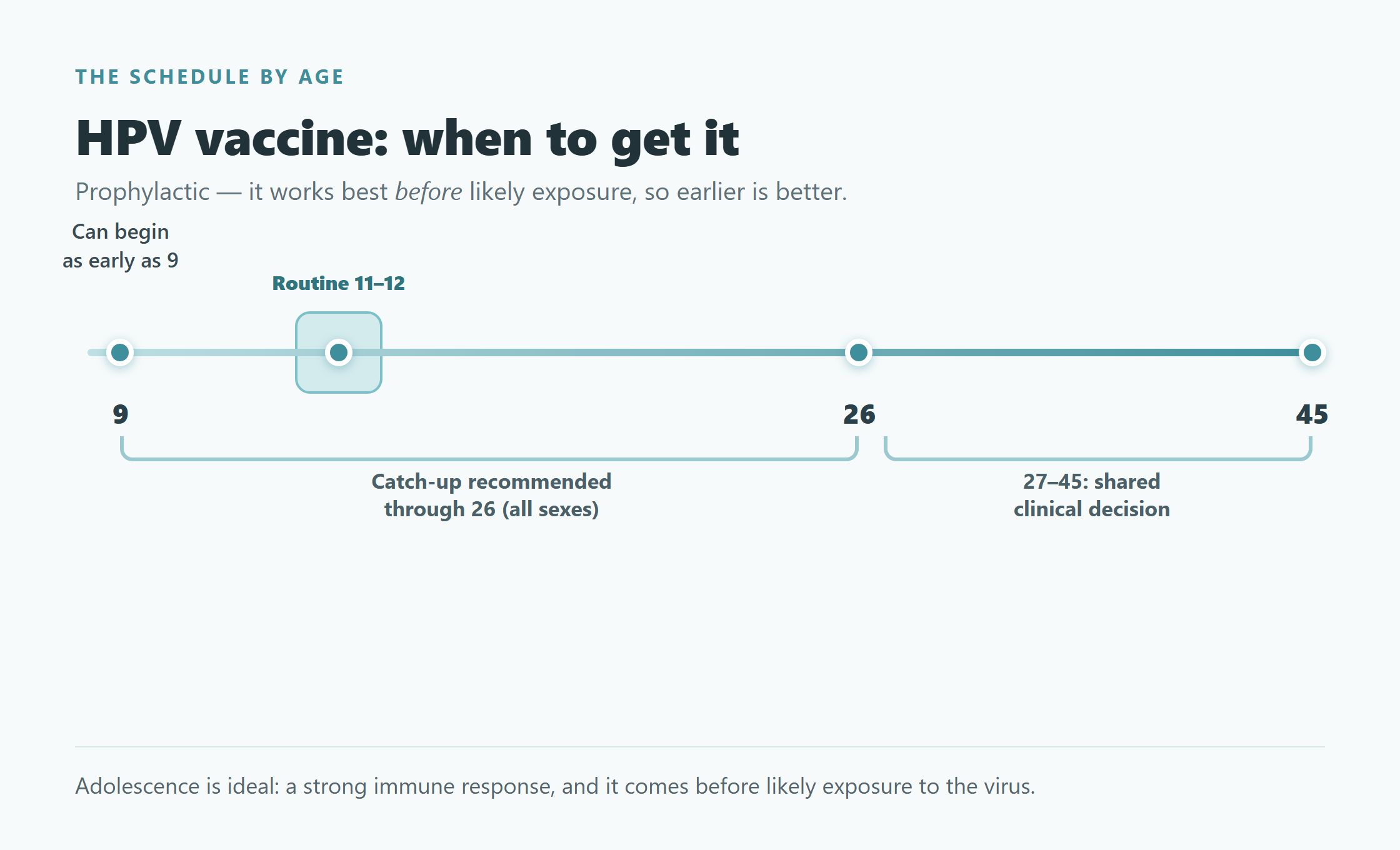
- Routine age: 11 or 12 years old. Vaccination can begin as early as age 9. Adolescence is ideal because the immune response is strong and it comes before likely exposure.
- Catch-up is recommended for everyone through age 26 if they weren’t adequately vaccinated earlier. ACIP has harmonized this catch-up for both males and females through age 26.
- Adults 27 to 45: this is not a routine recommendation. It’s a shared clinical decision you make with your clinician. Some adults in this range still benefit, but on average the benefit is lower because they’re more likely to have been exposed to HPV already.
The number of doses depends on the age you start:
| Age at first dose | Number of doses | Schedule |
|---|---|---|
| 9–14 years | 2 doses | 0, then 6–12 months later |
| 15–45 years (or immunocompromised at any age) | 3 doses | 0, 1–2 months, 6 months |
So starting younger doesn’t just improve protection — it also means fewer shots. That’s a genuinely nice bit of alignment.

Why this isn’t a “women only” issue
If there’s one myth I’d most like to retire, it’s this one.
HPV causes disease in men too. Genital warts, yes — but also cancers of the oropharynx, anus, and penis. In fact, oropharyngeal cancer in men is now a leading HPV-related cancer in the U.S., and the CDC estimates roughly 12,500 oropharyngeal cancers in men each year.
There are two reasons vaccinating both sexes matters.
Direct protection. A recent study suggested HPV vaccination reduced the risk of all HPV-associated cancers in men by about 50%, including head and neck cancers. That’s protection for the person getting the shot, full stop.
Reducing transmission — the herd effect. Vaccinating both sexes lowers how much HPV circulates in the population overall. Scotland’s real-world data even showed evidence of herd immunity in unvaccinated women. Gender-neutral programs also protect groups who benefit less from female-only vaccination — including men who have sex with men.
So no — this was never just a women’s health topic. It’s everyone’s.

Photo: Shovan Datta / Pexels
The proof it works
I find the real-world evidence more convincing than any single statistic, so here it is.
In Scotland, among women born between 1988 and 1996 who were fully vaccinated at ages 12–13, researchers detected no cases of invasive cervical cancer. Zero.
A 7-year Scottish study showed HPV 16/18 prevalence dropping from 30.0% in the 1988 cohort to 4.5% in the 1995 cohort — a vaccine effectiveness of about 89.1% for those vaccinated at 12–13.
One honest caveat, because it matters: that landmark “zero cases” data came from the bivalent vaccine cohort. Gardasil 9 broadens the type coverage, but the longest-horizon “zero invasive cancer” evidence is strongest for those earliest-vaccinated groups. The direction is clear; the story is still being written for the newer vaccine.
Is it safe?
The safety record for Gardasil 9 is well-established.
The most common side effects are mild and local: injection-site pain, swelling, and redness, plus headache. Nothing there should be surprising for a vaccine.
One thing worth knowing: fainting (syncope) — sometimes with brief seizure-like movements — has been reported after HPV and other adolescent vaccines. That’s why a short ~15-minute seated, observed period afterward is standard practice. It’s a sensible precaution, not a sign of danger. Large post-marketing surveillance continues to support a reassuring safety profile.
Two things the vaccine does not do
I want to be balanced here, because overselling helps no one.
It doesn’t replace screening. The vaccine doesn’t cover every oncogenic HPV type, so cervical cancer screening — Pap and HPV testing — is still recommended, even for vaccinated women. Please don’t read “vaccinated” as “done.” The two work together.

Photo: Cedric Fauntleroy / Pexels
It doesn’t treat an existing infection. The vaccine prevents new infections; it can’t clear one you already have or treat existing lesions. That’s the whole reason the “vaccinate before exposure” message exists.
One more note, for anyone who’s read about a single-dose schedule: WHO has endorsed single-dose HPV vaccination internationally, but as of 2025 the U.S. Gardasil 9 label had not adopted it. The FDA asked for more data first. So in the U.S., the 2-dose or 3-dose schedule remains the current standard — single-dose is an emerging area, not yet the norm here.
[internal-link: Related post – Cervical cancer screening: what Pap and HPV tests actually check]
When I step back from all the numbers, what stays with me is how preventable so much of this is.
We don’t get many chances to stop a cancer years before it would ever appear. This is one of them. The best window is early — ideally at 11 or 12, before any exposure — but the catch-up window stays open through 26, and the door isn’t fully closed even after that, if you and your clinician decide it makes sense.
If you’re a parent weighing this for your kid, or an adult wondering whether you missed your chance, the most useful next step is the same one I’d take.
Ask your clinician. Bring your questions. This is one worth having the conversation about — because prevention, when it’s actually possible, is a quiet kind of gift.
References (research basis): CDC / ACIP HPV vaccination recommendations; CDC Evidence-to-Recommendations (adults 27–45); Merck / Gardasil 9 labeling (DailyMed); Public Health Scotland (2024); AAFP POEMs; SEER Cervical Cancer Stat Facts; CIDRAP and STAT News (male cancer prevention data); CDC Vaccine Safety.