
Adenomyosis Symptoms, Heavy Periods, and Treatment
I’ll be honest about something first. For a long time, “heavy periods” was treated as one of those things women were simply supposed to put up with. Rough month, take some ibuprofen, move on. But when the bleeding soaks through a pad every hour and the cramps flatten you onto the couch, that isn’t just a rough month. Sometimes there’s a real reason behind it, and adenomyosis is one of the more common ones people have never heard of.
This is educational information, not a diagnosis. If any of this sounds familiar, the right next step is an OB-GYN, not a search bar. Still, knowing what adenomyosis is can make that conversation a lot easier.

What Adenomyosis Actually Is
Adenomyosis happens when tissue similar to the lining of the uterus grows into the muscular wall of the uterus. That misplaced tissue keeps behaving like the lining. It thickens, breaks down, and bleeds with each cycle.
The difference is that here it’s trapped inside the muscle.
So the uterine wall swells, thickens, and gets tender. The uterus can grow to two or three times its normal size, according to the Cleveland Clinic and Mayo Clinic. It’s benign, and it tends to be estrogen-driven, which is why it’s tied so closely to the reproductive years.
It’s easy to confuse with two conditions it often travels with:
- Endometriosis: similar tissue grows outside the uterus, on the ovaries or pelvic lining.
- Fibroids: benign muscle tumors that form distinct lumps in or on the uterus.
- Adenomyosis: the tissue grows diffusely within the uterine muscle itself.
All three can cause heavy bleeding and pelvic pain, and they can show up together. Roughly 35 to 55 percent of people with adenomyosis also have fibroids, and the odds of also having endometriosis are meaningfully higher.
What Are the Symptoms?
Symptoms range from nothing at all to severe, and they often get worse over time. The three that come up most, per the Cleveland Clinic and Mayo Clinic:
- Severe menstrual cramps (dysmenorrhea) that can be genuinely debilitating.
- Heavy or prolonged bleeding (menorrhagia), often with clots. Some people describe periods that feel like “flooding.”
- Chronic pelvic pain, along with a sense of pressure, fullness, or heaviness.
Beyond those, adenomyosis can bring painful intercourse, irregular bleeding, an enlarged and tender uterus, and the bloated feeling sometimes called an “adenomyosis belly.” It’s also linked to possible fertility problems.
Here’s the part that surprises people, though.
About one in three people with adenomyosis have no symptoms at all. So the absence of dramatic pain doesn’t rule it out, and the presence of it doesn’t confirm it either.

Photo: Polina Zimmerman / Pexels
Who Tends to Get It
Adenomyosis is most often diagnosed in women in their 40s and 50s, though it’s increasingly recognized in the 30s, and even in some adolescents with severe period pain. The known risk factors, according to the Cleveland Clinic and Mayo Clinic, include:
- Having given birth at least once.
- Prior uterine surgery, such as a C-section, fibroid removal, or D&C.
- A history of endometriosis.
Estrogen exposure appears to drive the condition, which is why it’s so bound up with the reproductive years and why it usually eases after menopause.
As for how common it is, the honest answer is that nobody knows precisely. Many cases are silent, and for a long time it could only be confirmed after a hysterectomy. Estimates vary widely by population and by how it’s diagnosed, commonly landing somewhere around 20 to 35 percent of women, and higher in symptomatic groups. Among women dealing with infertility, prevalence sits around 31 percent. These are ranges, not fixed numbers, and it’s worth treating them that way.
How It’s Diagnosed
This is one area where the picture has genuinely changed.
Older sources will tell you the only way to confirm adenomyosis is by examining the uterus after a hysterectomy. That used to be true. It isn’t the whole story anymore.
Today, most cases are diagnosed with imaging, according to the Merck Manual and AAFP:
- Pelvic exam: a provider may feel an enlarged, globular, softer, or tender uterus.
- Transvaginal ultrasound: the usual first-line imaging, showing thickening and abnormal texture in the muscle wall.
- MRI: more detailed, often used to confirm and map the disease before surgery or when the ultrasound is unclear.
Modern imaging now allows a confident clinical diagnosis in most cases. It isn’t 100 percent definitive the way tissue examination is, and a provider may still run additional tests to rule out other causes of abnormal bleeding, including polyps and, rarely, cancer. But the days of surgery being the only answer are largely behind us.
Treatment Options
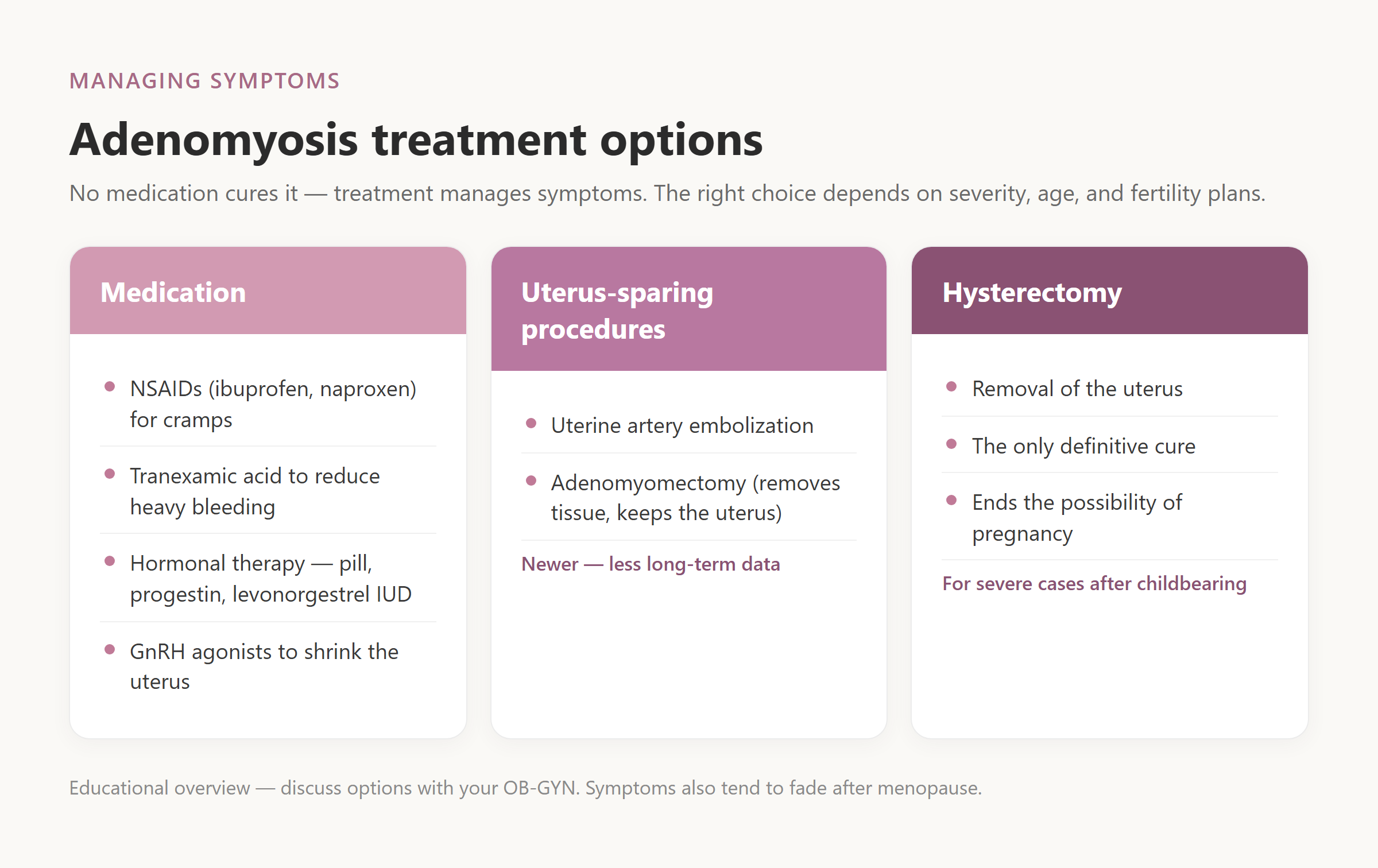
There’s no medication that cures adenomyosis. What treatment does is manage symptoms, and the right choice depends on how severe things are, your age, and whether you want to preserve fertility (Cleveland Clinic, Mayo Clinic, AAFP).
Medications for symptom relief
- NSAIDs like ibuprofen or naproxen for cramps, started just before or as the period begins.
- Tranexamic acid to reduce heavy bleeding.
- Hormonal therapies, including combined birth control pills, progestin-only options, a levonorgestrel-releasing IUD such as Mirena, injectable progestin, and dienogest.
- GnRH agonists, which temporarily shrink the uterus and stop periods by lowering estrogen. Because they cause menopause-like side effects, “add-back” therapy is sometimes used alongside them.
Procedures and surgery
For selected patients, uterine artery embolization and adenomyomectomy (removing the adenomyosis while keeping the uterus) are uterus-conserving options. They’re newer, and they have less long-term outcome data than the alternative, so they’re worth discussing carefully.
Hysterectomy, removal of the uterus, is the only definitive cure. It also ends the possibility of pregnancy, so it’s generally reserved for people who have finished having children and have severe symptoms.
There’s one more option that requires no procedure at all: time. Because adenomyosis is estrogen-driven, symptoms typically fade or disappear after menopause, even without surgery. For someone close to menopause, that fact often shapes the whole treatment conversation.
A Note on Fertility
Adenomyosis can make conception harder, and it’s associated with higher risks of miscarriage and preterm labor, since the altered uterine muscle and lining can interfere with implantation.
Here’s where the sources genuinely disagree, and I think it’s worth being upfront about it.
Some fertility specialists use GnRH-agonist pretreatment before IVF or embryo transfer, believing it improves pregnancy rates. But recent meta-analyses report it does not clearly improve reproductive outcomes. The evidence is honestly mixed, and this is exactly the kind of thing to weigh with a fertility specialist rather than a blog post.
When to See an OB-GYN
The reassuring news is that adenomyosis itself is benign. It is not cancer, and it is not life-threatening. But its symptoms overlap with fibroids, endometriosis, polyps, and, rarely, uterine cancer, so they do deserve a proper look.
See an OB-GYN promptly if you notice:
- Extremely heavy periods, soaking through pads or tampons hourly, or passing large clots.
- Severe cramps or pelvic pain that disrupts daily life.
- Bleeding between periods or unusually long periods.
- Painful intercourse.
- A persistent feeling of abdominal fullness, or a visibly enlarged abdomen.
- Signs of anemia such as fatigue, dizziness, shortness of breath, or looking pale.
- Trouble getting pregnant.
Please don’t try to self-diagnose from a list like this. The point of knowing the symptoms isn’t to reach a verdict on your own. It’s to walk into that appointment able to describe what’s happening clearly.
[Internal link: Related – Heavy periods: when is it too much?]
For years, a lot of people were quietly told that painful, heavy periods were just their lot. Adenomyosis is part of why that advice was wrong. It’s common, it’s real, and for the first time it can be identified without surgery and managed in more ways than one.
If your periods are running your life, that’s worth saying out loud to a doctor. Not because every heavy period means adenomyosis, but because the ones that do finally have somewhere to go.
References
- Cleveland Clinic — Adenomyosis: Causes, Symptoms, Diagnosis & Treatment
- Mayo Clinic — Adenomyosis: Symptoms, Causes, Diagnosis & Treatment
- Merck Manual (Professional Edition) — Uterine Adenomyosis
- AAFP — Adenomyosis: Diagnosis and Management
- Springer / Reproductive Biology and Endocrinology (2025) — Global prevalence of adenomyosis and endometriosis
- NIH / PMC — Adenomyosis: an underacknowledged cause of abnormal uterine bleeding and pelvic pain