

Iron Deficiency in Women: Why You’re Still So Tired
I’ll be honest with you. For a long stretch of my thirties, I assumed being tired was just my personality. I slept a full night and still woke up feeling like I’d been hit by a truck. Two flights of stairs left me weirdly out of breath. Now and then the room would tilt for a second when I stood up too fast, and I’d blame skipped lunches.
It never occurred to me that all of it might be one thing.
If you’re always exhausted despite enough sleep, short of breath on the stairs, and occasionally dizzy, please don’t file it under “just tired.” For a lot of women, this pattern points to something specific and very fixable: iron deficiency. I’m not going to promise a miracle here, and I’ll be upfront about what needs a doctor rather than a blog. But the fix, once you know it, is refreshingly ordinary.

Photo: www.kaboompics.com / Pexels
A quick, important note before we go further. This is general information, not medical advice. Constant fatigue has many causes, and some of them need testing. I’ll flag those along the way.
Why does low iron leave you so exhausted?
Here’s the part I wish someone had explained to me sooner.
Iron is the core of hemoglobin — the molecule in your red blood cells that carries oxygen through your blood. That’s according to the Cleveland Clinic, and it’s the whole story in one sentence. When your iron runs low, your bone marrow can’t make enough hemoglobin, so less oxygen reaches your muscles and brain.
Less oxygen delivered means exactly what it sounds like.
That’s the fatigue. That’s the breathlessness on the stairs. That’s the dizziness. Your body isn’t being dramatic — it’s running low on the thing that moves oxygen around.
The symptoms tend to travel in a pack. Mayo Clinic, Cleveland Clinic, and Harvard’s Nutrition Source list the usual suspects:
- Extreme fatigue and weakness that rest doesn’t fix
- Shortness of breath, a fast or pounding heartbeat
- Headache, dizziness, or lightheadedness
- Pale skin, cold hands and feet
- Brittle or spoon-shaped nails, a sore tongue, thinning hair
- Trouble concentrating — that “brain fog” feeling
- Odd cravings for ice, or even dirt or clay (this one has a name: pica)
One honest caveat: early on, iron deficiency can be so mild it goes completely unnoticed, as Mayo Clinic points out. The signs sharpen as it worsens. So you don’t need every symptom on that list to take it seriously.
Why women get hit so much harder than men
This is the part that reframed everything for me.
Blood carries iron, so any blood loss is iron loss. And women lose blood every month. According to ACOG, roughly 0.4 to 0.5 mg of iron leaves your body with every 1 mL of menstrual blood. Month after month, year after year, that adds up in a way it simply doesn’t for men.
The numbers make the gap hard to ignore.
In the US, the CDC’s most recent data (2021–2023) put anemia at 14.0% in women aged 20–59, versus just 3.9% in men the same age. Globally, for ages 15–49, one large analysis found anemia in 33.7% of women versus 11.3% of men — and iron deficiency is the leading cause. This isn’t a rare condition. It’s one of the most common ones women quietly live with.
Heavy periods push the risk higher still. Heavy menstrual bleeding affects up to about half of reproductive-age women, and as many as 63% of women with heavy menstrual bleeding have iron deficiency or iron-deficiency anemia, per a review from the American Society of Hematology.
But — and this matters — menstruation isn’t the only cause.
Mayo Clinic is clear that slow, hidden bleeding elsewhere can also drain your iron: a stomach ulcer, a colon polyp, even regular use of some over-the-counter pain relievers like aspirin. Pregnancy raises your iron needs. A diet low in iron can do it over time. That’s exactly why the smart move isn’t to start swallowing iron pills. It’s to get checked.
The “should I check?” list — then get a blood test
So here’s a simple self-check. Read it as a nudge to get tested, not as a diagnosis.

If several of those sound like you — especially the fatigue plus heavy periods combination — the next step is a blood test, not a supplement aisle.
I want to be firm about this, because I got it wrong myself for a while.
A proper check looks at more than one number. Providers use a complete blood count along with iron studies — especially serum ferritin, which reflects your iron stores, and hemoglobin. ACOG notes that iron deficiency is generally flagged by a ferritin below 15 micrograms per liter. The useful thing about ferritin is that it can catch depleted iron stores before your hemoglobin even drops — deficiency before full-blown anemia.
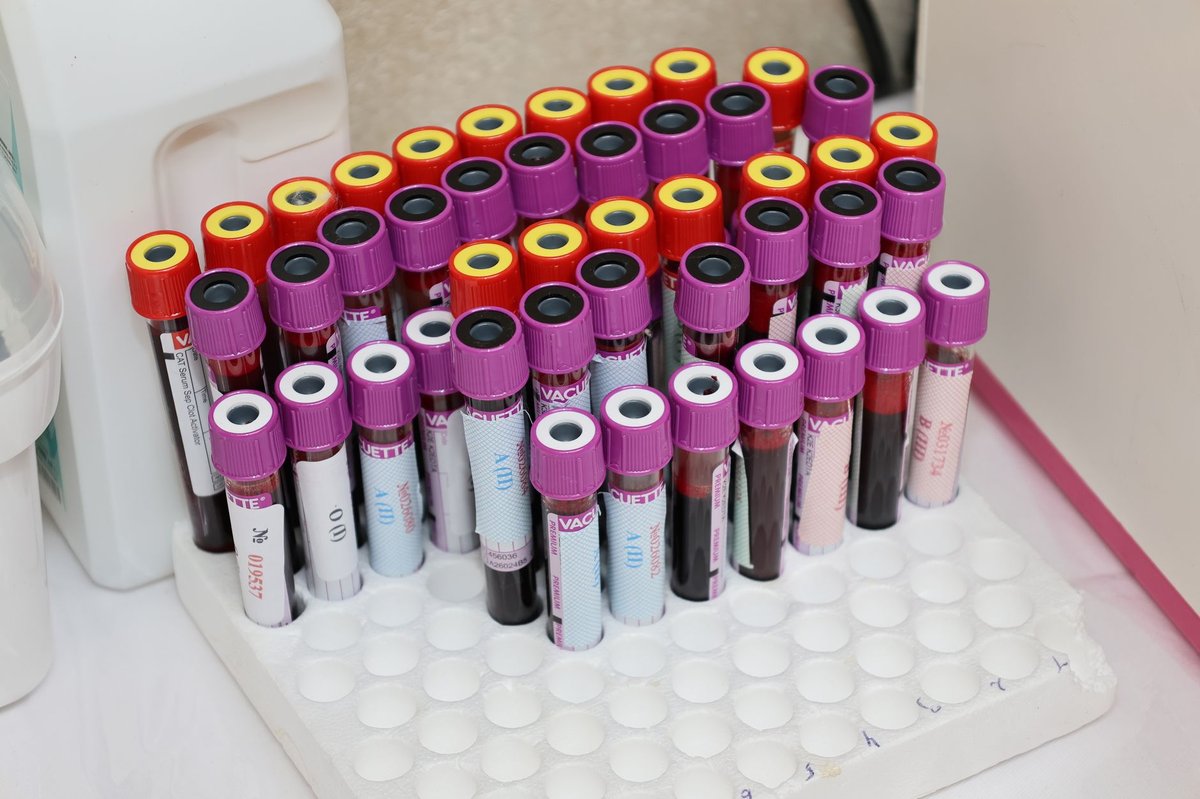
Photo: Tahir Xelfequliyev / Pexels
And a blood test does something a bottle of pills can’t: it points your doctor toward the cause. As Cleveland Clinic puts it plainly, supplements alone won’t fix an underlying problem. If something is quietly bleeding, that needs to be found. A twenty-dollar blood draw is worth more than months of guessing.
Fixing it, part one: food
Once you know you’re low, the food side is genuinely pleasant. No powders, no misery — just eating with a little intention.
First, a sense of scale. The recommended daily iron for women (from the NIH Office of Dietary Supplements and Harvard) is:
- 18 mg a day for women aged 19–50
- 8 mg a day after 50, once periods have stopped
- 27 mg a day during pregnancy
Notice how much more premenopausal women need than men, who sit at 8 mg. That’s the menstruation math, right there in the guidelines.
Now, the one distinction worth learning: heme versus non-heme iron.
Heme iron comes from animal foods — red meat, poultry, seafood like oysters, clams, mussels, sardines. Your body absorbs it well. Non-heme iron comes from plants — spinach and leafy greens, beans, lentils, tofu, nuts, seeds, fortified cereals. It’s absorbed less efficiently, which is the classic catch with the “just eat spinach” advice. Spinach has iron; your body just doesn’t grab it as easily.

Photo: Alari Tammsalu / Pexels
The good news is you can tilt the odds. Two rules do most of the work:
- Pair non-heme iron with vitamin C. Harvard notes that vitamin C at the same meal boosts non-heme iron absorption. In testing, about 80 mg of vitamin C — roughly a medium orange or a small glass of orange juice — raised absorption by around 30%. So squeeze lemon over the spinach, add bell peppers to the lentils, have citrus with the meal.
- Keep the absorption blockers separate. Large amounts of calcium (dairy and supplements), and the tannins in coffee and black tea, both drag iron absorption down. Calcium is the sneaky one — it blocks iron from both plants and meat.
None of this requires a special diet. It’s mostly about what you put next to what.
Fixing it, part two: how to actually take iron
If your doctor says you need a supplement, technique matters more than you’d think — because most of the iron you swallow never gets absorbed. Doing it right is the difference between feeling better and just feeling nauseated.

Photo: Polina Tankilevitch / Pexels
Here’s what the evidence supports:
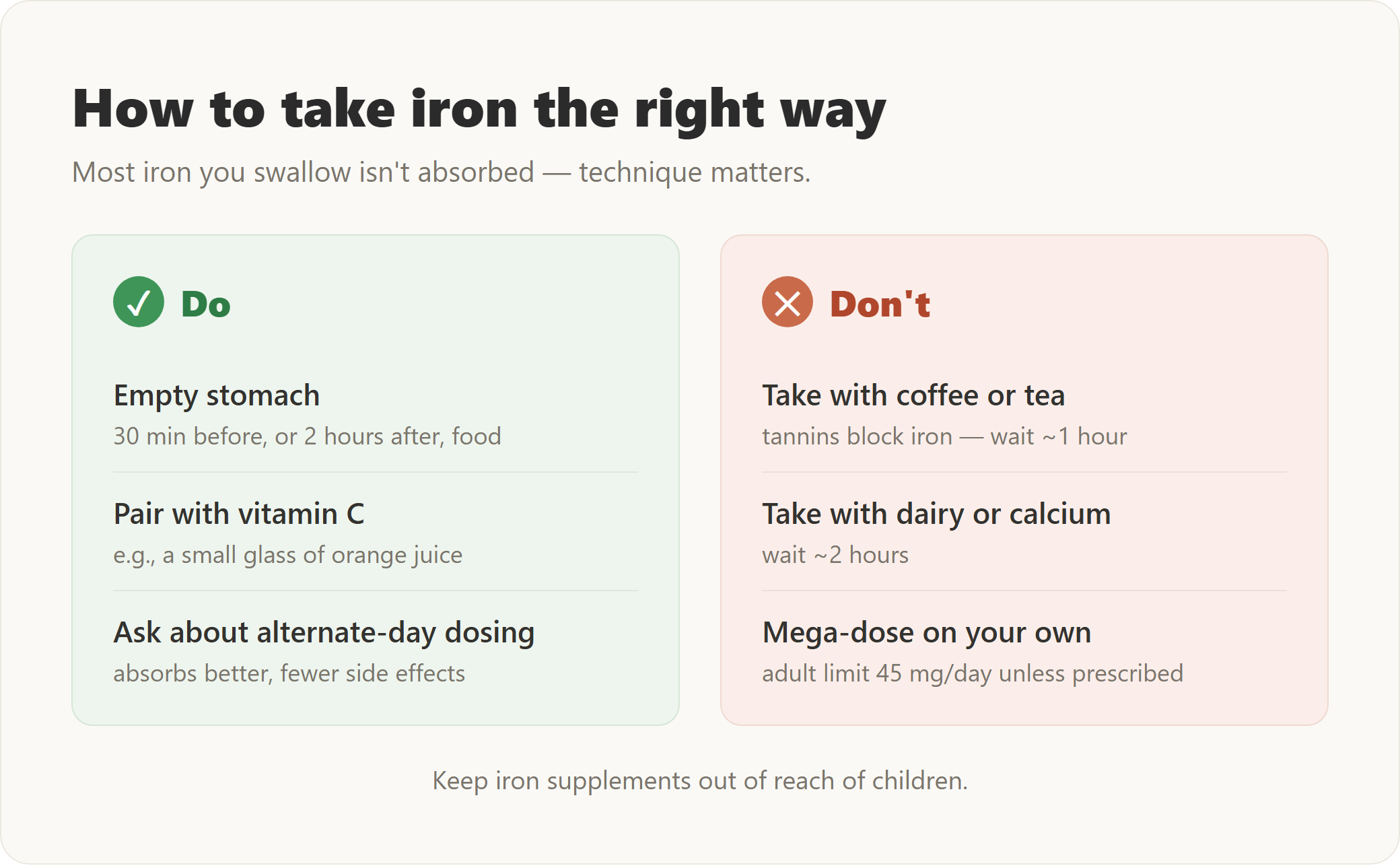
- Take it on an empty stomach if you can tolerate it — ideally at least 30 minutes before a meal or two hours after. Morning may be slightly better, since hepcidin, the hormone that limits iron absorption, tends to be lower then.
- Pair it with vitamin C. Same trick as with food: a small glass of orange juice helps your gut take up the iron.
- Push coffee, tea, dairy, and calcium away from the dose. Wait about an hour before coffee or tea, and at least two hours after dairy or a calcium supplement or antacid.
- Ask about alternate-day dosing. This one surprised me. Research in iron-deficient women found that taking iron every other day actually absorbs better than daily — fractional absorption was 40–50% higher — and it caused fewer stomach side effects while still improving iron levels over six months. More is not always better with iron. Talk to your provider about the right dose and schedule.
A word on side effects, since nobody warns you: oral iron is famous for causing constipation, nausea, cramps, and dark stools, because the iron your body doesn’t absorb irritates your gut. Alternate-day dosing, plenty of water, and enough fiber all help. And be patient — rebuilding your iron stores takes weeks to months, and ACOG recommends a follow-up ferritin test to confirm you’ve actually refilled the tank, not just topped up your hemoglobin.
Please don’t skip the safety part
I know it’s tempting to buy the biggest iron bottle you can find and call it done. Here’s why I’d ask you not to.
- More iron is not better. The tolerable upper limit for adults is 45 mg a day unless a doctor prescribes more for a diagnosed deficiency (NIH Office of Dietary Supplements). Routinely blowing past that on your own can hurt your gut and, in extreme cases, cause serious harm.
- Some people should not supplement iron at all. Those with a condition called hemochromatosis store too much iron already, and extra iron is dangerous for them. That’s another reason a blood test comes first.
- Keep iron supplements far from children. Iron is one of the leading causes of accidental poisoning in young kids. Child-resistant caps, high shelf, no exceptions.
- See a clinician sooner rather than later if your breathlessness or heart-pounding is severe, you faint, your periods are very heavy (soaking through protection hourly, large clots), you notice black or tarry stools, or you’re pregnant. Supplements can’t fix a bleeding source that needs a real evaluation.
Self-checks are for pointing you in a direction. They aren’t a substitute for a proper look when something feels off.
I spent years treating my exhaustion as a character flaw — something to push through with more coffee and more willpower. What actually changed things wasn’t willpower. It was a single blood test that put a name to the tiredness, and a few unglamorous habits: an orange with my lunch, spinach with a squeeze of lemon, and a small pill taken the right way, away from my morning coffee.
Your fatigue isn’t laziness, and it probably isn’t just “how you are.” Sometimes it’s your body telling you it’s running low on the thing that carries your breath from your lungs to the rest of you. The kindest thing you can do is listen, get the test, and let a doctor help you refill — because some kinds of tired are worth taking seriously.
References
– ACOG — Heavy Menstrual Bleeding and Iron Deficiency; Bleeding Disorders in Adolescents
– Mayo Clinic — Iron deficiency anemia: Symptoms & causes
– Cleveland Clinic — Iron-Deficiency Anemia
– NIH Office of Dietary Supplements — Iron Fact Sheet
– Harvard T.H. Chan School of Public Health, The Nutrition Source — Iron
– American Society of Hematology — Iron Deficiency Anemia in Women
– CDC/NCHS Data Brief No. 519 (2024) — Anemia Prevalence, United States
– Stoffel et al., Haematologica — Alternate-day vs consecutive-day oral iron dosing


