Pelvic Inflammatory Disease: Symptoms & Prevention
I want to start with the uncomfortable part, because it’s the reason this condition is so often missed. Pelvic inflammatory disease — PID — frequently feels like nothing much at first. A dull ache low in the pelvis. Cramps that seem a little off but not alarming. Many women, understandably, chalk it up to their period and move on. And that quiet beginning is exactly what makes PID dangerous, because when it’s left to progress it can quietly scar the very organs that matter most for fertility.
Before we go further: this is background information to help you recognize a pattern, not a diagnosis. PID is time-sensitive, and delayed treatment raises the risk of permanent damage. If any of this sounds familiar, the right next step is a prompt visit to an OB-GYN — not a search bar.
What PID actually is
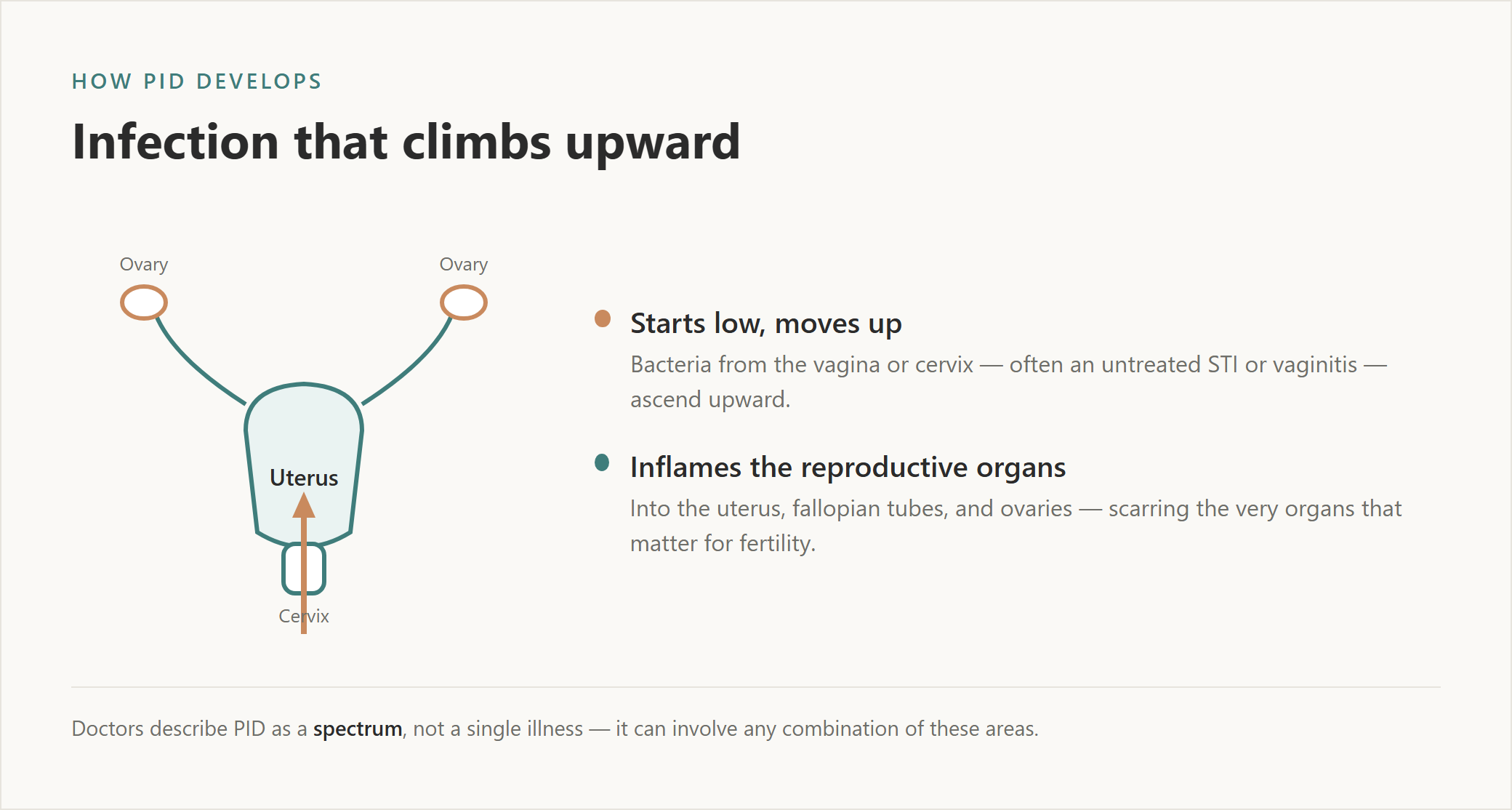
Pelvic inflammatory disease is an infection of the upper female reproductive organs — the uterus (endometritis), the fallopian tubes (salpingitis), and sometimes the ovaries, occasionally with pelvic peritonitis or a tubo-ovarian abscess.
It usually develops the same way: bacteria from the vagina or cervix — often an untreated vaginitis, cervicitis, or sexually transmitted infection — ascend upward into the uterus, tubes, and surrounding structures, inflaming them along the way. Doctors describe PID as a spectrum rather than a single illness, because it can involve any combination of those areas.
What causes it
The most common causes are the STIs chlamydia and gonorrhea — specifically Chlamydia trachomatis and Neisseria gonorrhoeae.
But here’s an important nuance to hold onto: not all PID is sexually transmitted. Normal vaginal bacteria — anaerobes, Gardnerella, enteric gram-negatives, streptococci, and organisms like Mycoplasma genitalium — can also ascend and cause it, especially once the cervical barrier is disturbed. So while most PID is STI-related, it’s a mistake to assume PID always equals an STI. Both can be true.
Certain factors raise the risk:
- Being a sexually active woman, especially under about 25
- Multiple or new sex partners, or a partner with an STI
- Unprotected sex (no condom)
- A prior episode of PID or an STI
- Douching
- Recent IUD insertion — though this carries only a small risk, mostly in the first three weeks or so
That IUD point is worth stating carefully. The risk is small and mainly early, and modern guidance does not treat IUDs as a major driver of PID. It’s real, but easy to overstate.
The symptoms to recognize
PID’s symptoms range widely — from none at all to genuinely severe. The common ones:
- Lower-abdominal or pelvic pain — the most common symptom, often dull and sometimes on both sides. Early and mild, it is easily confused with menstrual cramps
- Abnormal or increased vaginal discharge, sometimes with an unpleasant odor
- Fever and chills — which suggest more serious disease
- Pain or bleeding during or after sex
- Painful or difficult urination
- Irregular bleeding — between periods or after sex
- Nausea or vomiting in severe cases

The “silent” problem
Here is the fact that reframes everything about PID. Many women have minimal or no symptoms at all — what clinicians call subclinical or “silent” PID.
The numbers make the point. In studies using endometrial biopsy, subclinical PID was found in about 26% of women with gonorrhea and about 27% of women with chlamydia. That means a large share of cases go entirely undetected. Combine that with early symptoms that mimic ordinary period pain, and you can see why PID is so frequently underdiagnosed.
The takeaway isn’t to panic over every cramp. It’s simpler than that: don’t dismiss new or worsening pelvic pain, unusual discharge, or bleeding as automatically normal. Get it checked.
How it’s diagnosed
PID is a clinical diagnosis — there’s no single definitive test, and clinicians are specifically told to keep a low threshold to diagnose and treat. That approach exists precisely because waiting for certainty can mean waiting until damage is already done.
Under the CDC’s minimum criteria, presumptive treatment should begin in a sexually active young woman (or another woman at STI risk) who has pelvic or lower-abdominal pain with no other identified cause, plus one or more of the following on pelvic exam:
- Cervical motion tenderness
- Uterine tenderness
- Adnexal tenderness
Additional findings that make the diagnosis more specific include an oral temperature above 101°F (38.3°C), abnormal mucopurulent cervical or vaginal discharge, abundant white blood cells in vaginal secretions, elevated inflammatory markers (ESR/CRP), and lab confirmation of gonorrhea or chlamydia. Further workup may add a pregnancy test to rule out an ectopic pregnancy, STI testing, urinalysis, and a pelvic ultrasound if an abscess is suspected.
A note on treatment
I’ll keep this general, because the specific regimen is a medical decision — not something to attempt on your own.
Because delay risks permanent damage, clinicians start empiric, broad-spectrum antibiotics promptly when PID is suspected, rather than waiting for full confirmation. The treatment has to cover gonorrhea, chlamydia, and anaerobes. The CDC’s 2021 STI Treatment Guidelines added metronidazole to the recommended outpatient regimen; a commonly cited combination is ceftriaxone (a single injection) plus doxycycline and metronidazole for 14 days.
Hospitalization and IV therapy come into play for severe illness, pregnancy, a tubo-ovarian abscess, an inability to keep oral medication down, no response to oral treatment, or when a surgical emergency like appendicitis can’t be ruled out.
Two points matter here as much as the antibiotics themselves. First, partner management: sex partners from the 60 days before symptoms began should be evaluated, tested, and treated, and you should avoid sex until both partners finish treatment — otherwise reinfection is likely. Second, finish all the medication, even if you feel better before it’s gone. And to be clear, the U.S. guidance above follows the CDC 2021 STI Treatment Guidelines, still the operative CDC guideline as of 2026 — but specific doses are always a clinician’s call.
Why it matters: the complications
This is the heart of why PID isn’t something to wait out. Untreated or repeatedly delayed PID causes scarring and adhesions of the fallopian tubes and pelvic organs, and that scarring drives the serious, often irreversible harms.
- Infertility. Tubal scarring can block the tubes. The CDC frames it this way: about 1 in 8 women with a history of PID has difficulty getting pregnant. Other reviews cite tubal-factor infertility in roughly 10 to 20% of women after PID — the range reflects different ways of counting (per-episode versus cumulative). Either way, the risk rises with each recurrence.
- Ectopic (tubal) pregnancy. Damaged tubes can trap a fertilized egg. A PID history raises this risk substantially — sources cite ectopic pregnancy in around 9% of affected women. An ectopic pregnancy is a life-threatening emergency.
- Chronic pelvic pain. This develops in up to about 30% of women with a PID history, though the long-term PEACH study reported a higher figure — around 42.7% at 84 months. I’ll give you both, because they genuinely differ.
- Tubo-ovarian abscess. A pocket of pus in the tube or ovary, reported in roughly 15% of PID patients in some sources and 15 to 35% in others, depending on population and severity. It can progress to peritonitis and Fitz-Hugh-Curtis syndrome (inflammation around the liver).
Red-flag signs that call for emergency care: severe lower-abdominal pain, high fever with chills, vomiting or an inability to keep food down, fainting, or the signs of a possible ectopic pregnancy — sharp one-sided pelvic pain with abnormal bleeding.

How to prevent it
Here’s the genuinely hopeful part: if PID is caught and treated early, its complications can largely be prevented. And prevention is mostly about a handful of concrete habits.
- STI screening and prompt treatment is the single most effective step. Screening and treating sexually active women for chlamydia and gonorrhea lowers PID risk, and the CDC and USPSTF recommend annual chlamydia (and gonorrhea) screening for sexually active women under 25, plus older women with risk factors. One sobering gap: nearly half of eligible women aren’t screened to national standards — which quietly raises both acute and silent PID risk.
- Use condoms and reduce risky exposures — limit the number of partners and know a partner’s STI status.
- Treat partners, and make sure you both complete therapy before resuming sex, to prevent reinfection.
- Don’t douche — it disrupts the protective vaginal flora.
- Don’t ignore the symptoms of vaginitis or cervicitis. Unusual discharge, odor, bleeding, or pelvic pain deserve early treatment, because treating a lower-tract infection is what stops it from ascending into full PID in the first place.
If there’s one idea I’d want to stay with you, it’s that PID rewards attention and punishes delay. So much of the harm — the scarring, the fertility trouble, the chronic pain — comes not from the infection being untreatable, but from it being unnoticed. The cramps that seemed like “just my period.” The discharge that didn’t seem worth mentioning.
You don’t have to become anxious about every twinge. You just have to take the new, the unusual, and the worsening seriously enough to get screened and get seen. An OB-GYN can start treatment quickly, and with PID, quick is what protects your future. That’s a conversation worth having early, because the tubes you protect today are the ones you may be very glad to have later.
References
This article draws on information compiled from the CDC (About PID, the PID STI treatment page, and the 2021 STI Treatment Guidelines/MMWR), Mayo Clinic, Cleveland Clinic, the AAFP 2019 review, NIH/StatPearls, the MSD Manual, and PMC/NIH studies including subclinical PID data and the PEACH cohort.
[Internal link: Related article – Chlamydia and gonorrhea: symptoms every woman should know]