Early Menopause Warning Signs in Your 30s and 40s
Let me be honest: for a long time, “menopause” felt like a word that belonged to my mother’s generation, or to some distant version of me decades from now.
Then I started reading, and my assumptions shifted.
Early menopause — more precisely, primary (or premature) ovarian insufficiency, POI — can begin before age 40. And if you’re a woman in your 30s or 40s, knowing the warning signs is worth your time.
This isn’t a diagnosis. It’s a calm walk through the signals your body might send, and when it’s time to see a specialist.
What POI (Early Menopause) Actually Is
Let’s start with the words.
POI is the partial or total loss of the ovaries’ reproductive and hormonal function before age 40 — driven by follicular dysfunction or early loss of eggs. Menopause before 40 is called premature; between 40 and 45, it’s often called “early.” Average natural menopause is around 51.
Here’s the part that surprised me most. POI is not only a “middle-aged mom” issue. It affects roughly 1 in 100 women under 40, about 1 in 1,000 under 30, and 1 in 10,000 under 20.

And unlike true menopause, ovarian function in POI can fluctuate. Spontaneous ovulation — and even pregnancy — occasionally still happens. That’s why the older term “premature ovarian failure” is giving way to “insufficiency.”
The Warning Signs Your Body Sends

Photo: Fvno Fotografía / Pexels
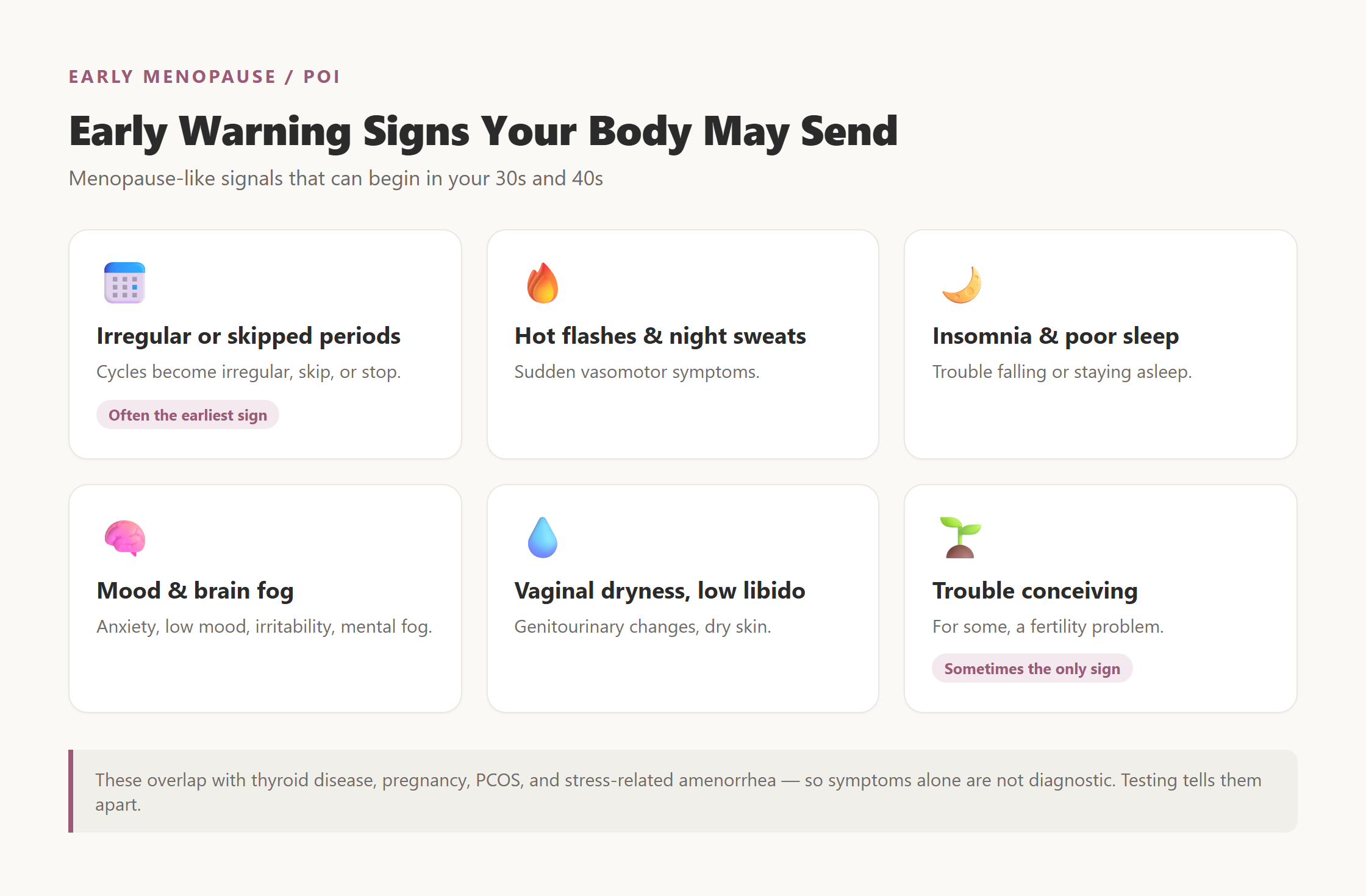
Before things fully progress, periods often become irregular and menopause-like symptoms creep in. The signs most consistently flagged by ASRM, ISUOG, and the Cleveland Clinic are:
- Menstrual changes — the most common, earliest sign: periods become irregular, skip, or stop.
- Vasomotor symptoms: sudden hot flashes and night sweats.
- Sleep disturbance: insomnia, poor sleep.
- Mood and cognition: anxiety, depression, irritability, “brain fog.”
- Genitourinary: vaginal dryness, dry skin, low libido.
- Fertility: for some women, trouble conceiving is the earliest — sometimes only — sign.
There’s one thing I want to be clear about, though.
These symptoms overlap heavily with thyroid disease, pregnancy, PCOS, and stress-related amenorrhea. So symptoms alone are not diagnostic. Testing is what tells them apart.
POI vs. PCOS — Opposite Directions
Here’s where a lot of confusion lives.
Both POI and PCOS (polycystic ovary syndrome) can cause irregular periods in younger women. But the underlying hormones point in opposite directions.

| Feature | PCOS | POI |
|---|---|---|
| Core problem | Ovulatory dysfunction + androgen excess | Ovarian insufficiency → low estrogen |
| Ovarian reserve | Often high; many small follicles | Depleted; low reserve |
| FSH | Normal to low | Elevated (>25 IU/mL per ESHRE; historically >40) |
| AMH | High | Low |
| Estrogen | Not deficient | Deficient |
| Typical symptoms | Acne, hirsutism, weight gain, insulin resistance | Hot flashes, night sweats, menopausal symptoms |
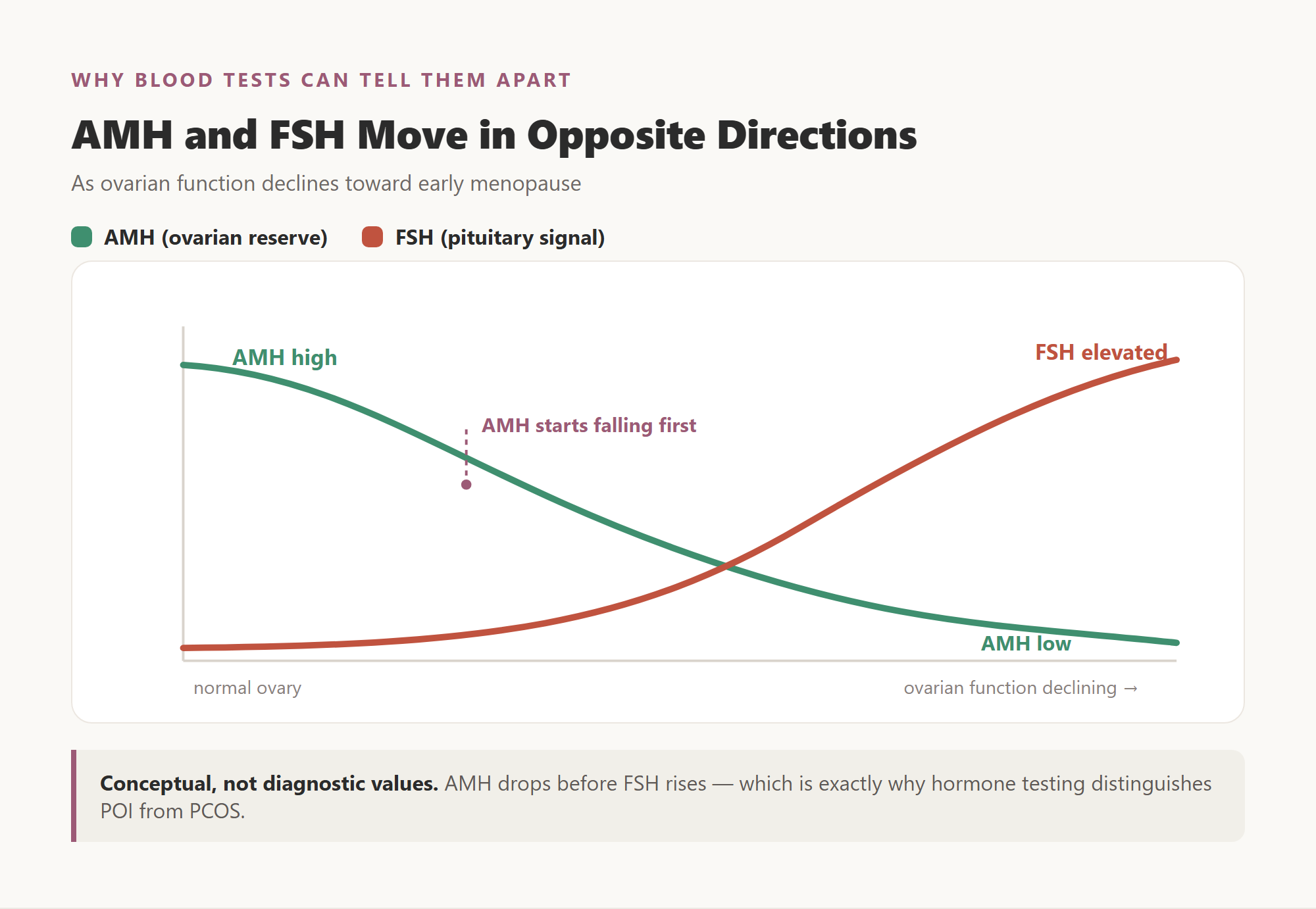
The bottom line: PCOS is “not ovulating despite adequate or high estrogen,” while POI is “estrogen deficiency from a failing ovary.” AMH and FSH move in opposite directions — which is exactly why blood tests can tell them apart.
So irregular periods alone won’t settle the question.
Do Soy and Pomegranate Help? The Evidence, Honestly
If you search around, you’ll find a lot of claims about soy and pomegranate. Here’s the honest version: the evidence is mixed and limited.
Photo: Polina Tankilevitch / Pexels
Soy isoflavones (phytoestrogens) are structurally similar to estradiol and bind estrogen receptors with SERM-like activity. Some reviews find they help menopausal symptoms; others don’t — the North American Menopause Society called the results mixed. Part of the reason effects vary: the benefit may depend on gut bacteria that convert daidzein into the active metabolite equol, and not everyone can. The bone-health signal is comparatively stronger, and soy isoflavones aren’t shown to raise breast or endometrial cancer risk (though anyone with hormone-sensitive conditions should ask a clinician).

Pomegranate and other “estrogen-boosting” foods are heavily marketed, but rigorous evidence that they meaningfully change estrogen levels or symptoms is weak. Treat the marketing with caution.
Stress management supports general well-being, but there’s no established evidence that diet or stress reduction prevents or reverses POI itself. Frame all of this as quality-of-life support — not a substitute for evaluation.
Diagnosis and Hormone Therapy Belong to a Specialist
I’ve saved the most important part for last.
Both diagnosis and treatment are a clinician’s job.
Diagnosis relies on repeated elevated FSH (ESHRE: >25 IU/mL on two occasions at least 4 weeks apart; older criteria used >40), low estradiol, low AMH, and ultrasound. You can’t self-diagnose this.
Treatment: hormone therapy (HRT) is standard. ACOG and NICE recommend offering systemic HRT — or a combined hormonal contraceptive — to women with POI unless it’s contraindicated (for example, a hormone-sensitive cancer). It treats symptoms and, critically, reduces the long-term risks of osteoporosis and cardiovascular disease. Treatment generally continues at least until the average age of natural menopause (~50–51), and younger women may need higher estrogen doses for adequate bone protection.

One last thing.
The point of this piece isn’t to frighten you — it’s to help you notice.
If your periods have been off for months, or hot flashes and insomnia keep showing up without explanation, that can be your body signaling something, regardless of your age.
You don’t need to panic. But please don’t ignore the signal, either. Talk it through with a specialist.
Because the most accurate answer isn’t in a search bar — it’s in the exam room.
Sources: ASRM/ReproductiveFacts, ISUOG, ACOG Committee Opinion, NICE QS143, Cleveland Clinic Journal of Medicine, NIH/PMC reviews, Frontiers in Endocrinology, Linus Pauling Institute.
[Internal link: Related – Understanding PCOS in your 20s and 30s]
[Internal link: Related – Hormone therapy (HRT): what to expect]