
Does Dieting Stop Your Period? Amenorrhea Risks & Recovery
Does Dieting Stop Your Period? What Amenorrhea Is Really Telling You
I’ll be honest — for a long time I treated a late period as a rounding error.
“You lose weight, things shift, no big deal,” I figured. Reading the research changed how I see it.
Because dieting-related amenorrhea isn’t just a skipped period. It’s your brain deciding that survival comes first and switching reproduction off. In this piece I want to walk through why aggressive dieting can stop your period, why letting it run past three months is genuinely risky, and what a recovery routine actually looks like.
One thing first: this is educational information, not a diagnosis. Diagnosis and treatment belong to a qualified clinician — an OB-GYN or endocrinologist.

Why can dieting stop your period?
The key idea is energy availability (EA) — the energy left over for normal body functions after you subtract exercise from what you eat.
When aggressive dieting or heavy training leaves too little usable energy, the hypothalamus reads it as an emergency. Here’s the chain:
- Intake stops covering the body’s needs, and the system shifts into “survival mode.”
- The hypothalamus slows or stops releasing GnRH, the hormone that drives the menstrual cycle.
- Lower GnRH means lower pituitary FSH and LH, which suppresses ovarian estrogen and ovulation — so no period.
This is functional hypothalamic amenorrhea (FHA). It affects roughly 1.62 million U.S. women ages 18–44 (about 17.4 million worldwide). Low leptin from reduced body fat, plus elevated cortisol and ghrelin and low IGF-1, all reinforce the shutdown. Brain glucose availability itself matters for LH pulses.
In athletes this shows up as RED-S (Relative Energy Deficiency in Sport) and the Female Athlete Triad, which links energy availability, menstrual function, and bone mineral density. But the mechanism is the same for everyday dieting.
Why is 3+ months of amenorrhea a warning?
Secondary amenorrhea means periods stopping for three months or longer in someone who previously menstruated normally. It warrants evaluation — not a wait-and-see.
The biggest concern is your bones.

- Bone loss / osteoporosis: Estrogen maintains bone. When it’s deficient, resorption outpaces formation, driving rapid loss — especially from the spine. Secondary amenorrhea can lower bone density to postmenopausal levels, and that loss may be irreversible.
- Adolescents are especially vulnerable: FHA during the skeletal-development window impairs peak bone accrual, raising future fracture risk.
- Stress fractures: These are more common in amenorrheic athletes, and bone density correlates negatively with the number of missed cycles since menarche.
- Cardiovascular and mental health: FHA is linked to endothelial dysfunction and an adverse lipid profile, and estrogen deficiency contributes to depression and anxiety. Because ovulation stops, FHA also causes infertility.
Worth stressing: amenorrhea has many causes — PCOS, primary ovarian insufficiency, thyroid or prolactin disorders, pregnancy. Don’t self-diagnose it as “just from dieting.” A clinician needs to identify the cause.
The recovery routine — restore energy balance
The primary goal isn’t medication. It’s correcting the energy imbalance to restore hypothalamic–pituitary–ovarian (HPO) function, which usually means behavior change.
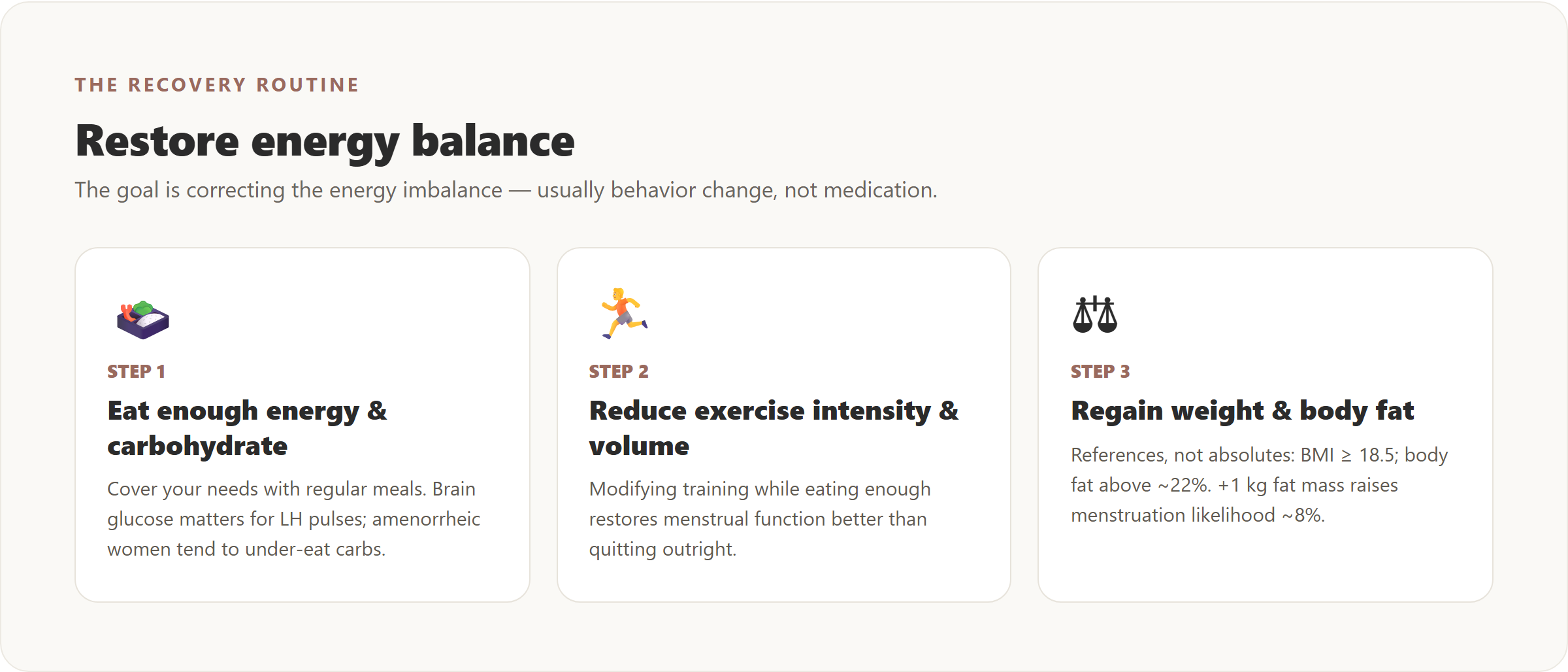
1. Eat enough energy and carbohydrate
EA thresholds are a useful frame: below 30 kcal/kg fat-free mass (FFM)/day is low EA and disrupts menses; 45 kcal/kg FFM/day or more restores energy balance.
How many calories it takes to recover varies by source, and it’s worth stating all sides:
- A modest surplus of ~300–350 kcal/day was enough to restore menses in some studies.
- The IOC has cited 300–600 kcal/day increases.
- The ACSM targets a minimum of ~2,000 kcal/day in amenorrheic athletes.
The reason these differ is that body size, activity, and current intake all vary — no single number fits everyone.
Carbohydrate matters in particular. Brain glucose availability is crucial for LH pulses and for regulating T3 and cortisol, and amenorrheic women tend to under-eat carbs. Regular meals spread through the day prevent prolonged glucose deficits.

Photo: Marina Leonova / Pexels
2. Modify exercise — don’t necessarily quit
Rather than stopping entirely, reducing exercise intensity and volume while eating enough is more effective for restoring menstrual function.

Photo: MART PRODUCTION / Pexels
3. Regain weight and body fat
Reference points: BMI ≥ 18.5 for adults (90% of standard weight for adolescents). Getting body-fat percentage above ~22% may be needed, and even +1 kg of body-fat mass raises the likelihood of menstruation by ~8%. These are references, though — not universal absolutes.
Timeline and mental-health support
Recovery is highly individual. A ~350 kcal/day increase can restore menses in 1 to 12 months; reviews often cite 9–12 months; Cleveland Clinic notes recovery “typically requires three to six months of consistent treatment.” The wide range is the point — people differ.
Because disordered eating, perfectionism, and stress often sit underneath low EA, pairing nutrition with CBT and mental-health care improves long-term success.

One last thing worth saying
There’s a common misunderstanding about recovery.
Hormone therapy — oral contraceptives, for instance — can produce withdrawal bleeds, but it doesn’t fix the underlying energy deficit or reliably normalize bone. Guidelines frame the real goal as the return of spontaneous menses through nutrition, training changes, and a reasonable body weight. Which treatment to use is the clinician’s call.
Ruling out causes, hormone testing, bone-density (DXA) assessment, any decision about hormone therapy — those belong to your OB-GYN or endocrinologist. The routine here is for understanding, not self-treatment.
Whatever number the scale shows this month fades. Your bones and your body’s rhythm are the part that stays.
Sources: Endocrine Society Clinical Practice Guideline on FHA (JCEM 2017), Cleveland Clinic (Hypothalamic Amenorrhea), NCBI StatPearls (Female Athlete Triad), Nutrients/MDPI review on FHA dietary and lifestyle management, PMC reviews on long-term consequences and adolescent bone accrual. Figures come from the sources compiled in research.md; where sources disagree, both are presented.