Leftover Soup Can Make You Sick: Cool Fast, Reheat to 165°F
For years I had one rule about soup, and I followed it faithfully.
Make a big pot on Sunday. Leave it on the stove with the lid on so it can “cool down first.” Put it in the fridge before bed. Eat it all week, boiling each bowl hard, because boiling makes it safe.
Almost every part of that turned out to be wrong.
Here is the honest answer up front. Yes, leftover soup from the fridge can still give you food poisoning — but the fridge is rarely the reason. The risk comes from how slowly the pot cooled and how long it was kept. And reheating, even to a hard boil, cannot rescue leftovers that were mishandled, because some bacteria leave behind toxins that heat does not destroy.
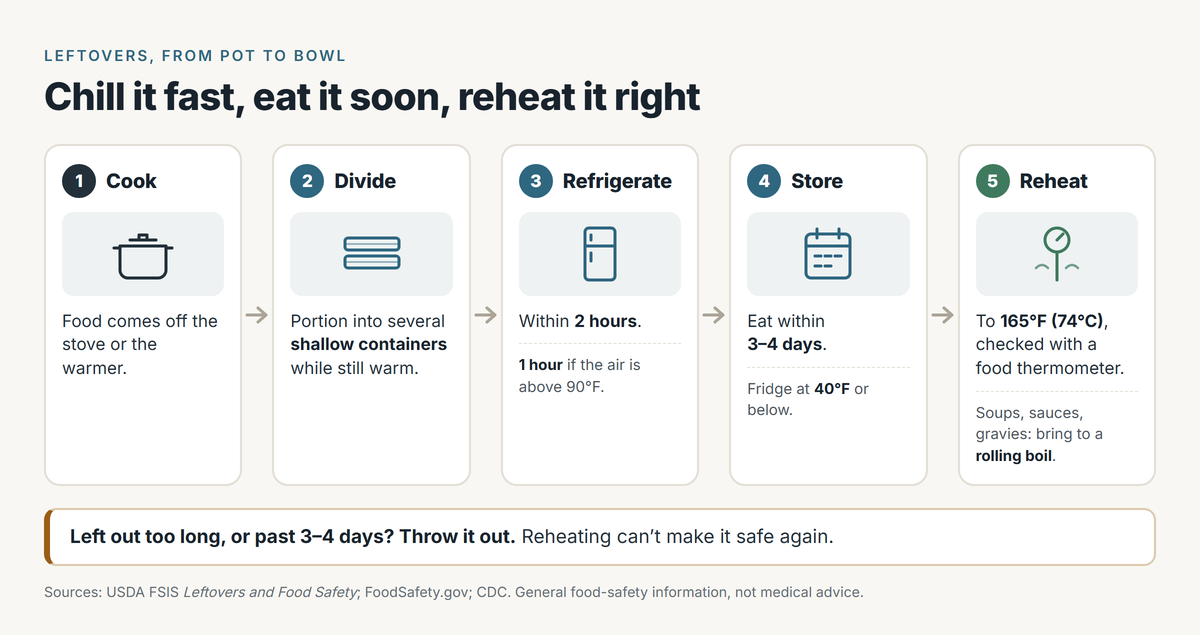
The fix is mostly at the other end of the process. Cool it fast. Eat it within 3–4 days. Then reheat it to 165°F (74°C), checked with a thermometer.
This article is general food-safety information based on USDA, FDA and CDC guidance. It is not medical advice and cannot diagnose illness. If you or someone you care for has symptoms of food poisoning — especially a young child, an older adult, someone who is pregnant, or someone with a weakened immune system — contact a healthcare provider.
Can leftover soup in the fridge still give you food poisoning?
It can. Soups, stews and gravies really are classic leftover risks — just not for the reason most of us were taught.
The usual culprit has a long name: Clostridium perfringens. The CDC says it is most often linked to foods cooked in large batches and held at unsafe temperatures, between 40°F and 140°F — poultry, beef, pork and gravy come up again and again.
What makes it tricky is that its spores survive cooking. So the pot comes off the stove “clean,” and then, while it sits warm, those spores wake up and multiply.
That is why the cooling step matters more than the reheating step.
The scale is not small, and I want to give you the numbers carefully, because they are easy to misuse:
- CDC’s long-standing estimate is 48 million foodborne illnesses, 128,000 hospitalizations and 3,000 deaths a year in the US. That figure comes from CDC’s 2011 estimates and covers all causes, known and unknown.
- CDC’s newest study (2019 data, published in 2025) looked at only seven major pathogens. In it, C. perfringens caused about 889,000 illnesses a year, the fourth-largest cause among the germs estimated.
These two numbers measure different things with different methods, and CDC itself says they cannot be compared. So neither one is a trend.
One more detail surprised me. We tend to call this “summer food poisoning,” and heat does matter — but CDC notes that most C. perfringens outbreaks happen in November and December, tied to big-batch holiday food like turkey, roast beef and gravy.
It is a volume problem more than a season problem.
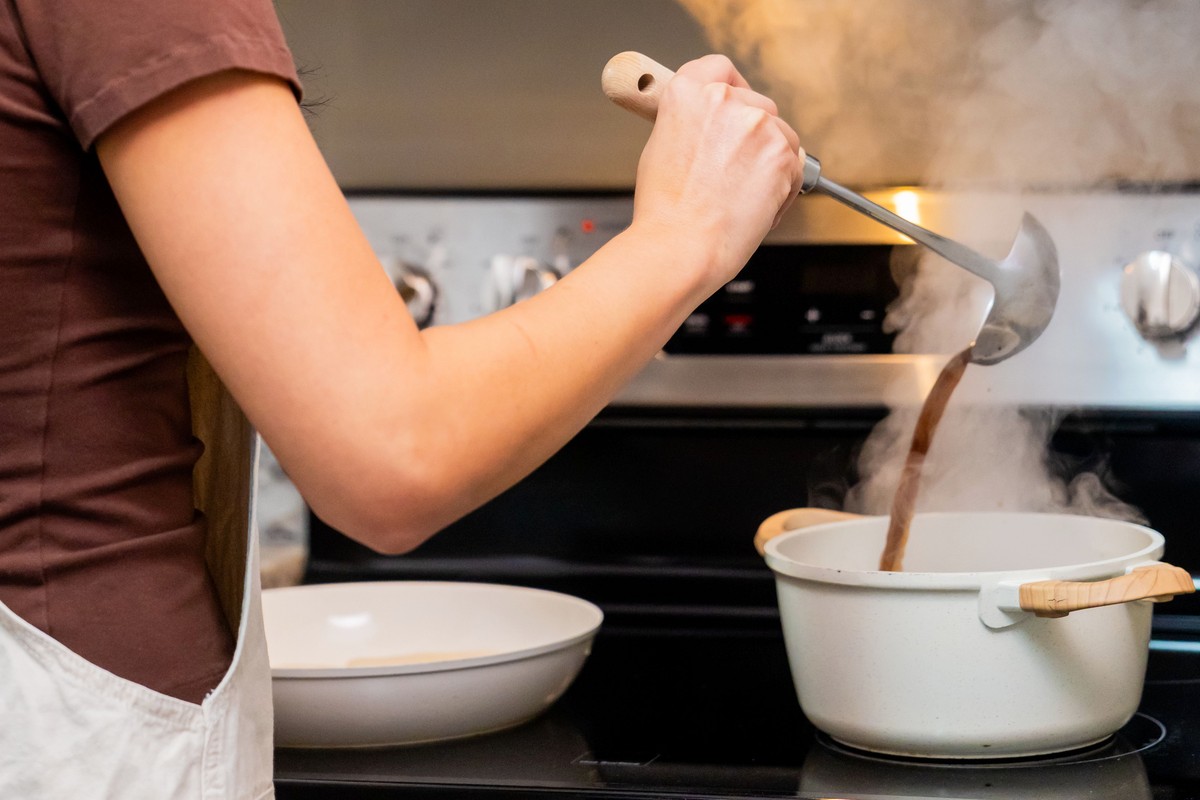
Photo: Caleb Oquendo / Pexels
Should you let hot food cool before you refrigerate it?
This is the habit I had, and I suspect a lot of us share it: leave the pot out until it stops steaming, because putting hot food in the fridge will “warm the whole fridge up” and let germs grow.
USDA’s Food Safety and Inspection Service (FSIS) says the opposite, in plain words:
“Hot food can be placed directly in the refrigerator or be rapidly chilled in an ice or cold water bath before refrigerating.”
The CDC adds the practical version: pack warm or hot food into several clean, shallow containers and then refrigerate — “it is okay to put small portions of hot food in the refrigerator since they will chill faster.”
I looked for a US government source saying a hot container dangerously raises a home fridge’s temperature. I could not find one. What the agencies do say is that waiting is the problem.
The rule is simple:
- Refrigerate cooked leftovers within 2 hours of cooking, or of taking them off a warming appliance.
- Within 1 hour if the air is above 90°F — a picnic, a cookout, a hot car.
- Perishable food left out longer than that should be thrown away, not reheated.
Every minute the pot spends “cooling down first” on the stove is a minute taken out of that 2-hour window.
That was the part I had backwards.
Why a big pot is the real problem
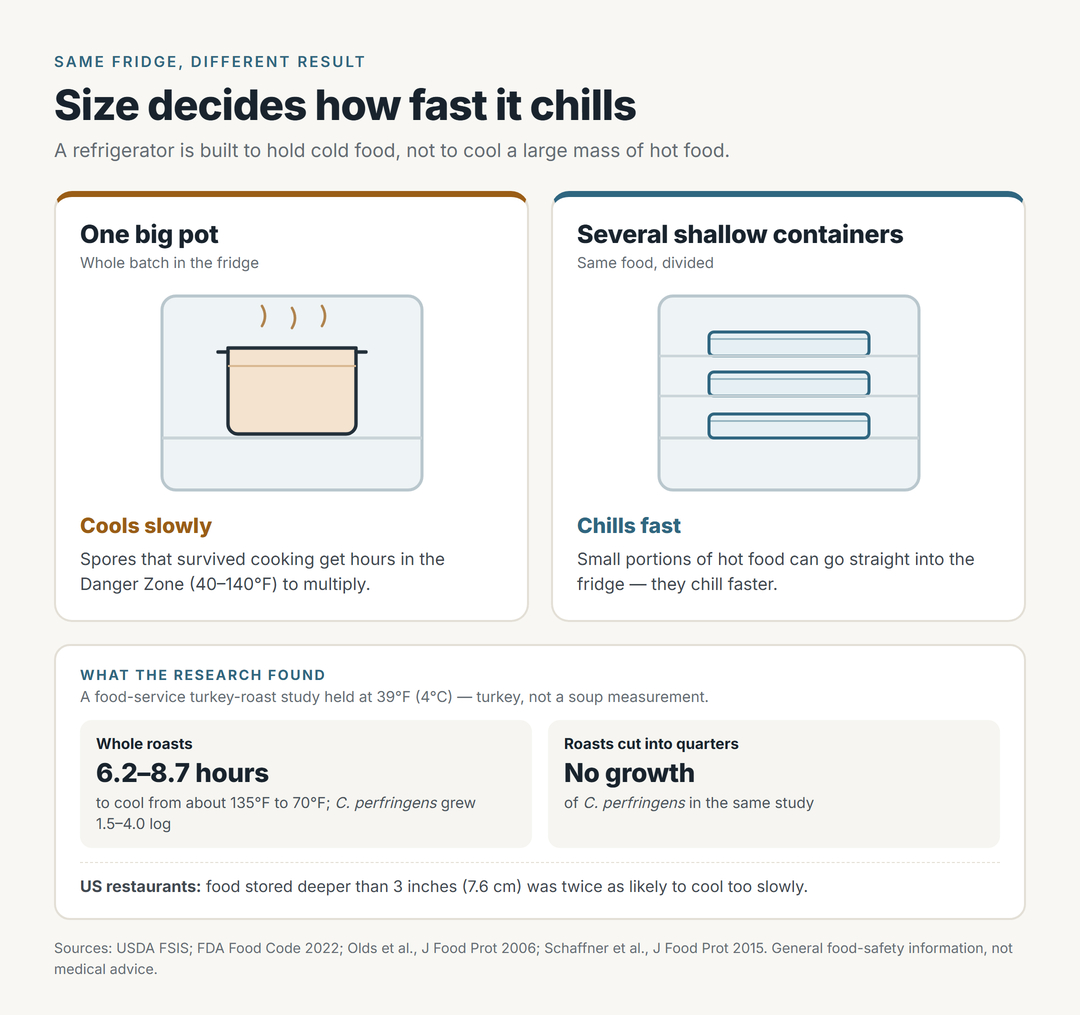
Here is the uncomfortable twist. Even putting the whole pot straight into the fridge is not enough.
FSIS singles out exactly my Sunday habit: “A big pot of soup, for example, will take a long time to cool, inviting bacteria to multiply.” The FDA’s Food Code makes the same point from the equipment side — refrigerators are designed to hold cold food, not to cool large masses of food.
A study of retail turkey roasts shows how much mass matters. Whole roasts held at 39°F (4°C) took 6.2 to 8.7 hours to cool from about 135°F to 70°F (57°C to 21°C), and C. perfringens grew by 1.5 to 4.0 log — roughly 30-fold to 10,000-fold, if you convert the logs. Roasts cut into quarters showed no growth at all.
That was turkey, not soup, and it was a food-service study. But the lesson carries over. Same fridge, same meat — the only difference was size.
Restaurant data from a CDC-supported network points the same way:
- Improper cooling contributed to more than 500 US restaurant and deli outbreaks between 1998 and 2008.
- Food stored deeper than 3 inches (7.6 cm) was twice as likely to cool too slowly.
- Stews and large cuts of meat cooled the slowest.
Those are restaurant kitchens, not homes. But a stew is a stew.
How to cool leftovers fast at home
This is the part worth building into your kitchen routine.
- Don’t wait for it to cool. Portion it out while it is still warm.
- Divide big batches into several shallow containers. USDA doesn’t give an exact depth — “shallow” is the instruction. For reference, the restaurant study above found food deeper than 3 inches was twice as likely to cool too slowly.
- For a big pot, use an ice-water bath. Set the pot in a sink or larger bowl of ice water and stir. FSIS lists rapid chilling in an ice or cold-water bath as an option before refrigerating.
- Cut large roasts or a whole turkey into smaller pieces before refrigerating.
- Leave a little air around the containers. In the restaurant data, cooling food without ventilation was almost twice as likely to cool too slowly.
- Cover loosely while it cools, then seal once it’s cold. This is my own synthesis, not an agency quote: the Food Code notes a tightly covered container transfers heat more slowly, while FSIS says to cover leftovers for storage.
I now write the date on the lid. It is a small thing, but it answers the next question for me.
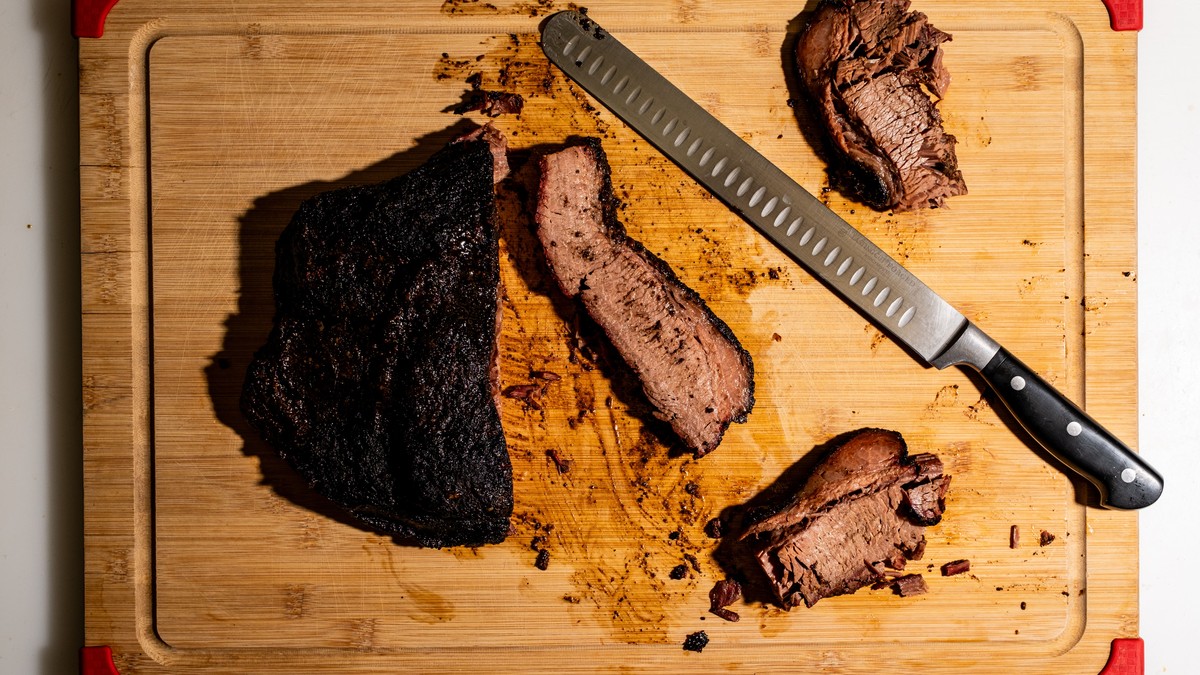
Photo: Alex Gonzo / Pexels
Does the refrigerator stop bacteria from growing?
Mostly — if it is cold enough.
FSIS: “A refrigerator set at 40°F or below will protect most foods.” The FDA’s Food Code explains why: refrigeration works by significantly slowing the growth of most microbes.
But there is a named exception. Listeria monocytogenes is slowed but not stopped by refrigeration. If it is present, it can keep multiplying slowly in the cold over time.
So the idea that “summer bacteria keep growing in the fridge” is not accurate as a general rule. Cold slows most germs to a crawl. A few, like Listeria, can still creep up.
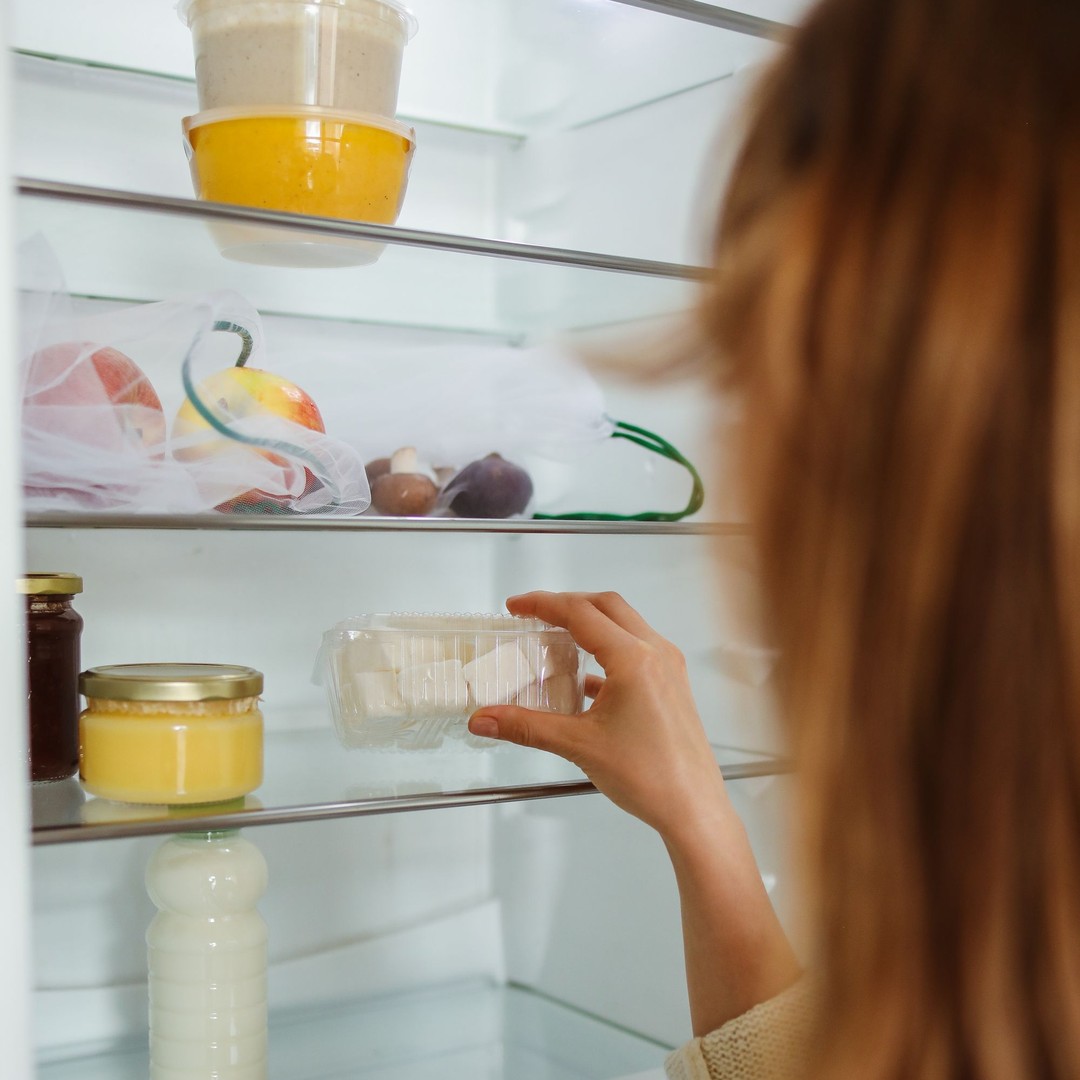
Photo: Polina Tankilevitch / Pexels
That is exactly why leftovers get a time limit.
Two practical notes:
- Check the fridge with an appliance thermometer. The dial setting is not a temperature. A 2017 international review of household refrigerators found that many are running warmer than recommended.
- Your nose can’t tell you. Spoilage bacteria make food smell and look bad, but FSIS says food-poisoning bacteria “do not generally affect the taste, smell, or appearance of a food.” A sniff test catches spoilage, not danger. And please don’t taste to test.
How long do leftovers last in the fridge?
The home rule is 3–4 days. It applies to most of what we actually keep.
| Leftover | In the fridge (40°F or below) | In the freezer (0°F) |
|---|---|---|
| Soups and stews | 3–4 days | Safe indefinitely; best quality 2–3 months (FoodSafety.gov) |
| Cooked meat and poultry | 3–4 days | Safe indefinitely; best quality 2–6 months (FoodSafety.gov) |
| Gravy and broth | 3–4 days | Safe indefinitely; quality declines over time |
| Leftovers in general | 3–4 days | Safe indefinitely; FSIS suggests 3–4 months for quality |
The two agencies give slightly different freezer times, and that is fine. Both say those limits are about quality, not safety. Frozen at 0°F, food stays safe.
So the real decision point is day three or four. If you won’t finish the soup by then, freeze a few containers early instead of hoping.
You may see “7 days” quoted online. That comes from the FDA Food Code’s date-marking rule for restaurants and retail at 41°F — it is not the home guideline.
This kind of “how long does it keep once it’s open” question turns out to have surprisingly precise answers in other corners of the house, too — I went through the same exercise for medicine expiration after opening.
What temperature should you reheat leftovers to?
The US answer is 165°F (74°C).
FSIS: “When reheating leftovers, be sure they reach 165°F as measured with a food thermometer. Reheat sauces, soups and gravies by bringing them to a rolling boil.” FoodSafety.gov’s chart and the CDC give the same number for leftovers of any type.
For soup specifically, that means two things. Bring it to a rolling boil, and if you want to check a thicker stew, use a food thermometer rather than guessing.
In the microwave, the weak point is cold spots:
- Cover the dish.
- Stir or rotate it partway through.
- Check the temperature in several spots, not just the edge.
- Let it stand for a moment before eating.
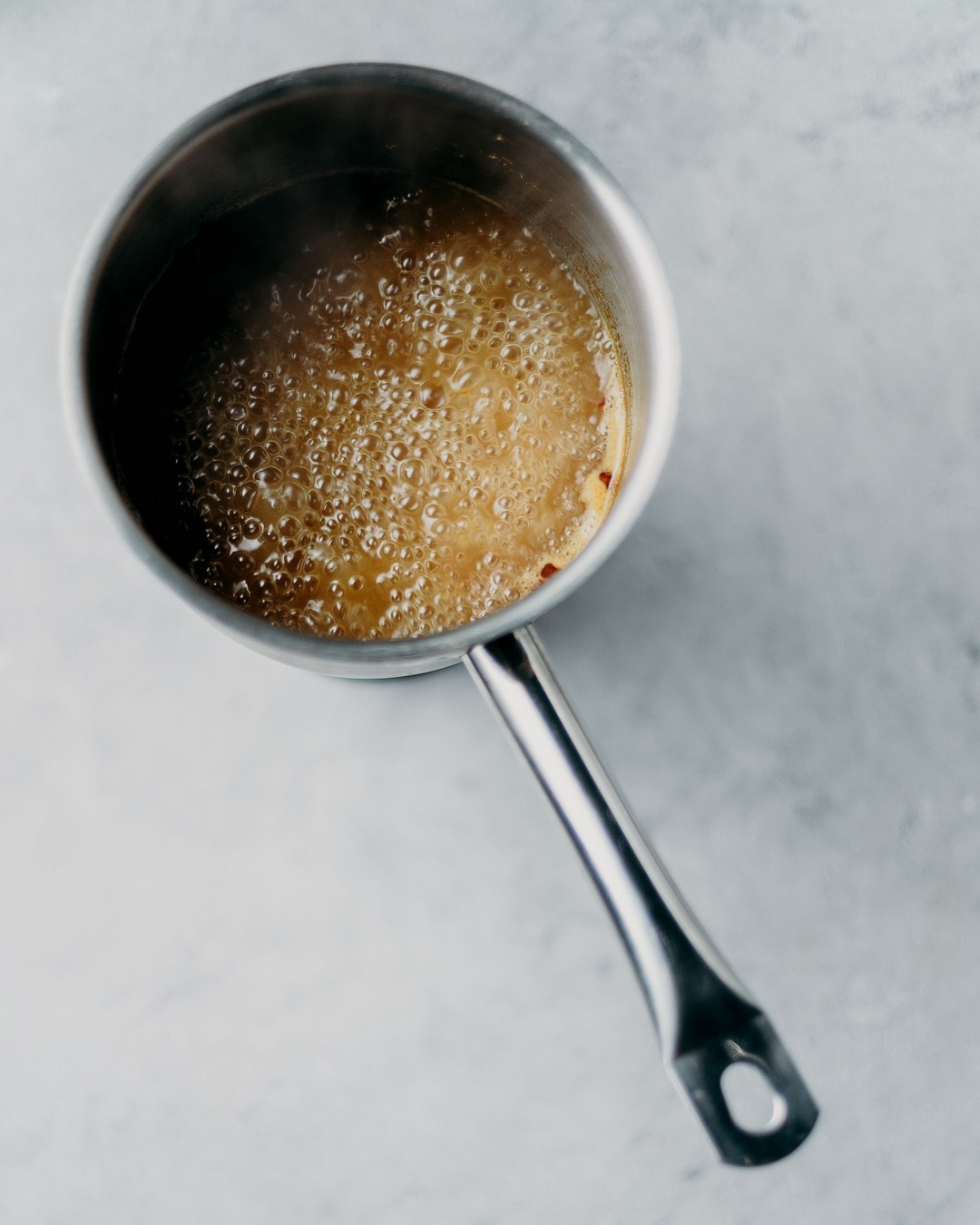
Photo: cottonbro studio / Pexels
Where the “75°C for 1 minute” rule comes from
You may have seen advice to heat leftovers to 75°C (167°F) for at least one minute. That number is real, but it is not American.
It comes from Japan’s Ministry of Health, Labour and Welfare manual for large-scale institutional cooking facilities — a standard for cooked food’s center temperature in big kitchens. It is not a US home rule.
To be fair to it: 75°C is slightly above 74°C, so following it isn’t unsafe. The problem is presenting it as the US standard, and especially attaching the promise that it destroys toxins.
The same caution applies to a number you might see from restaurant training. The FDA Food Code requires restaurants reheating food for hot holding to bring all parts to 165°F for 15 seconds, within 2 hours. That is a food-service provision. At home, USDA’s guidance is simply to reach 165°F.
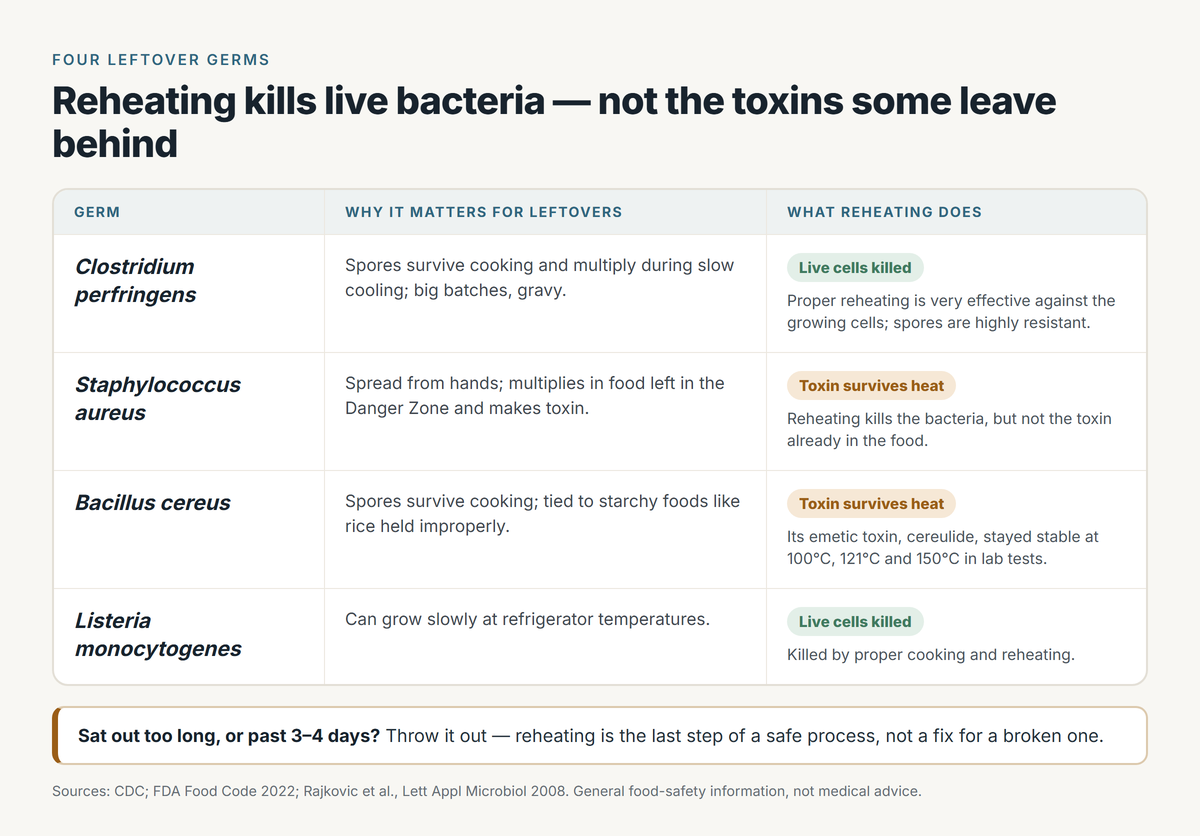
Why reheating can’t rescue mishandled leftovers
This is the part I most wish I had known, because it quietly undid my whole “just boil it” approach.
Reheating does kill live bacteria. The FDA’s Food Code says proper reheating is “especially effective in reducing the numbers of Clostridium perfringens” that may grow in meat, poultry or gravy that was cooled improperly. That matters, because C. perfringens illness comes from large numbers of live cells.
But some bacteria make toxins before you ever reheat, and those toxins shrug off heat.
- CDC, on staph food poisoning: “Even though cooking can kill Staph, it does not destroy the toxin in the food.”
- FDA Food Code: the toxin made by Staphylococcus aureus “cannot be inactivated through reheating of the food.”
- Bacillus cereus, often linked to starchy foods like rice held improperly, makes an emetic toxin called cereulide. In lab tests it stayed stable at 100°C, 121°C and 150°C — the researchers concluded that no heat treatment used in the food industry could inactivate it, and that safety has to rely on prevention and keeping food cold.
To be precise, these toxins are not indestructible under every condition. In one lab study, a staph toxin was largely broken down only by autoclaving at about 121°C for 5 to 15 minutes. That is far beyond a pot on a home stove, which boils at 100°C.
So here is the rule I follow now.
If it sat out too long, or it’s past 3–4 days, throw it out. Don’t boil it.
Reheating is the last step of a safe process. It is not a safety net for a broken one.
| Germ | Why it matters for leftovers | What reheating does | Typical onset (CDC) |
|---|---|---|---|
| Clostridium perfringens | Spores survive cooking and multiply during slow cooling; big batches, gravy | Proper reheating is very effective against the growing cells; spores are highly resistant | 6–24 hours; diarrhea and cramps, usually under 24 hours; vomiting and fever uncommon |
| Staphylococcus aureus | Spread from hands; multiplies in food left in the Danger Zone and makes toxin | Kills the bacteria, but the toxin survives heat | 30 minutes–8 hours; nausea, vomiting, cramps, diarrhea |
| Bacillus cereus | Spores survive cooking; tied to starchy foods like rice held improperly | Emetic toxin (cereulide) survives heat | Not listed in the CDC source used here |
| Listeria monocytogenes | Can grow slowly at refrigerator temperatures | Killed by proper cooking and reheating | Invasive illness around 2 weeks; fever, flu-like symptoms |
Who should be strictest about leftovers?
The time and temperature rules matter more, not less, for some households. The CDC names these groups as higher risk for food poisoning:
- Adults 65 and older
- Children under 5
- People who are pregnant — CDC says they are about 10 times more likely to get Listeria, the germ that tolerates the fridge
- People with weakened immune systems, such as those with diabetes, liver or kidney disease, HIV, or undergoing chemotherapy
If someone like that eats from your fridge, treat day three as the limit and use the thermometer every time.
If a young child does get sick, the main danger is usually fluid loss rather than the stomach bug itself. I wrote separately about infant diarrhea, dehydration signs and the right fluids.
When should you see a doctor after eating leftovers?
Most leftover food poisoning is short and miserable rather than dangerous. But some signs change that. Whatever else is going on, keep drinking fluids — the CDC says this helps prevent dehydration with diarrhea or vomiting.
Tier 1 — call 911 or go to the ER now
- Difficulty swallowing, muscle weakness, double or blurred vision, drooping eyelids, slurred speech, or trouble moving the eyes — symptoms that start in the head and move down.
- Fever with a stiff neck, confusion, loss of balance, or seizures.
- Signs of severe dehydration: unable to keep any liquids down, together with fainting, confusion, or very little or no urine.
- Trouble breathing, or rapid worsening in a young child, an older adult, or someone with a weakened immune system.
Tier 2 — see a doctor (same day to within a few days)
- Bloody diarrhea
- Diarrhea lasting more than 3 days
- Fever over 102°F
- Vomiting so often you cannot keep liquids down
- Signs of dehydration: urinating very little, dry mouth and throat, feeling dizzy when standing up
- Pregnant with fever and flu-like symptoms
- Any symptoms in a child under 5, an adult 65 or older, or someone with a weakened immune system — a lower threshold to call is reasonable
Tier 3 — watch at home
- Short-lived diarrhea and cramps starting 6–24 hours after a meal, with no fever and no blood, and you can drink — typical of C. perfringens, which usually passes within 24 hours.
- Sudden nausea and vomiting 30 minutes to 8 hours after eating that eases within about a day — typical of staph toxin — while you keep up fluids.
- Move up to Tier 2 if anything lasts longer, gets worse, or a red flag appears.
These are general thresholds, not a diagnosis. A clinician is the right person to say what caused it.
I still make a big pot of soup on Sundays. That part didn’t change.
What changed is the ten minutes after the stove goes off. The pot doesn’t sit there anymore. It goes into a sink of ice water, then into four shallow containers, then into a fridge I have actually checked with a thermometer. Two go in the freezer, because I know I won’t finish them by Thursday.
And when I reheat a bowl, I bring it to a rolling boil — not because boiling fixes everything, but because it’s the last step of a process that was done right from the start.
If I had to compress it into one line, it would be this.
“Chill it fast, eat it in 3–4 days, reheat to 165°F — and if it sat out too long, no amount of boiling makes it safe.”
The temperature at the end matters. It just matters less than what happened in the first two hours.
A note on what this article is and is not
This article is general food-safety information based on guidance from USDA FSIS, FoodSafety.gov, the FDA and the CDC. It is not medical advice and cannot diagnose illness. Restaurant and retail rules from the FDA Food Code are mentioned for context only; they are not home instructions. If you have symptoms of food poisoning — especially in a young child, an older adult, someone who is pregnant, or someone with a weakened immune system — contact a healthcare provider. In an emergency, call 911.
References
- USDA FSIS — Leftovers and Food Safety (last updated Jul 31, 2020)
- USDA FSIS — Refrigeration and Food Safety (last updated Mar 23, 2015)
- USDA FSIS — Danger Zone (40°F – 140°F) (last updated Jun 28, 2023)
- FoodSafety.gov — Safe Minimum Internal Temperature Chart (reviewed Nov 21, 2024); Cold Food Storage Chart
- FDA — Food Code 2022 (§3-403.11, §3-501.14, §3-501.15; Annex 3 and 4)
- CDC — Preventing Food Poisoning (Nov 24, 2025); Symptoms of Food Poisoning (Nov 24, 2025); Facts About Food Poisoning (Nov 24, 2025)
- CDC — About C. perfringens Food Poisoning (Apr 3, 2024); Preventing C. perfringens Food Poisoning (Apr 29, 2024)
- CDC — About Staph Food Poisoning (Apr 16, 2024); About Listeria Infection (Aug 2, 2024)
- CDC — People at Increased Risk for Food Poisoning (Jan 31, 2025); Estimates: Burden of Foodborne Illness (Mar 19, 2025)
- Scallan Walter EJ, et al. Emerg Infect Dis 2025;31(4) — Foodborne illness acquired in the United States, major pathogens, 2019
- Scallan E, et al. Emerg Infect Dis 2011 — Foodborne illness acquired in the United States (major pathogens; unspecified agents)
- Olds DA, et al. J Food Prot 2006 — Retail cooling methods and C. perfringens in turkey roasts
- Schaffner DW, et al. J Food Prot 2015 — Best food cooling practices in US restaurants
- Rajkovic A, et al. Lett Appl Microbiol 2008 — Heat resistance of Bacillus cereus emetic toxin, cereulide
- Akhtar M, et al. Appl Environ Microbiol 1996 — Staphylococcal enterotoxin A in heat-processed foods
- James C, et al. Compr Rev Food Sci Food Saf 2017 — Use and performance of household refrigerators: a review
- Japan MHLW — Large-Scale Cooking Facility Hygiene Management Manual (rev. 2017), context for the 75°C figure only