Dust Mites in Bedding Don’t Bite: How to Wash and Dry Right
Waking up itchy, skin breaking out, and blaming the thing living in your bed
For a while I was sure something in my bed was eating me alive.
I would wake up scratching. My skin looked worse than it had in years. And every article I opened pointed at the same villain — dust mites in bedding — with photos of a magnified monster and instructions to boil everything and burn it out.
So I went and read what US allergists and federal agencies actually say.
It turned out I had the villain wrong, and most of the cleanup plan wrong too.
Here is the short version up front. Dust mites in bedding don’t bite, and they don’t cause acne. They are a real allergy trigger for people who are sensitized to them — mostly a nose, eyes and airway problem. The fix is not “sterilizing” your bed. It is washing bedding once a week, finishing with a hot dryer cycle, and keeping the room dry. And if the itch is on your skin rather than in your nose, it is worth looking for something else.
This is general health information, not medical advice. There is a fuller note near the end, plus a three-tier guide on when to call someone.
Do dust mites bite? No — and that changes the whole plan
This is the part I had to unlearn first.
The American Lung Association puts it plainly: dust mites “are not parasites that bite, sting or burrow into our bodies.” Cleveland Clinic says the same thing even more bluntly — “They can’t bite.”
What they do is eat. Their food is the skin scales we shed every day, along with the fungi and bacteria that grow on them. That is why they end up in mattresses, pillows, comforters, carpets and stuffed toys.
The problem is not the mite touching you. It is an allergy to proteins in their droppings and bodies.
And that allergy only affects people who are sensitized — whose immune system has learned to overreact to those proteins. Everyone else can share a bed with dust mites and never notice.
When it does flare, the classic symptoms are up top:
- Runny or stuffy nose, sneezing
- Itchy nose, eyes or ears
- Red, watery eyes
- Cough or wheeze
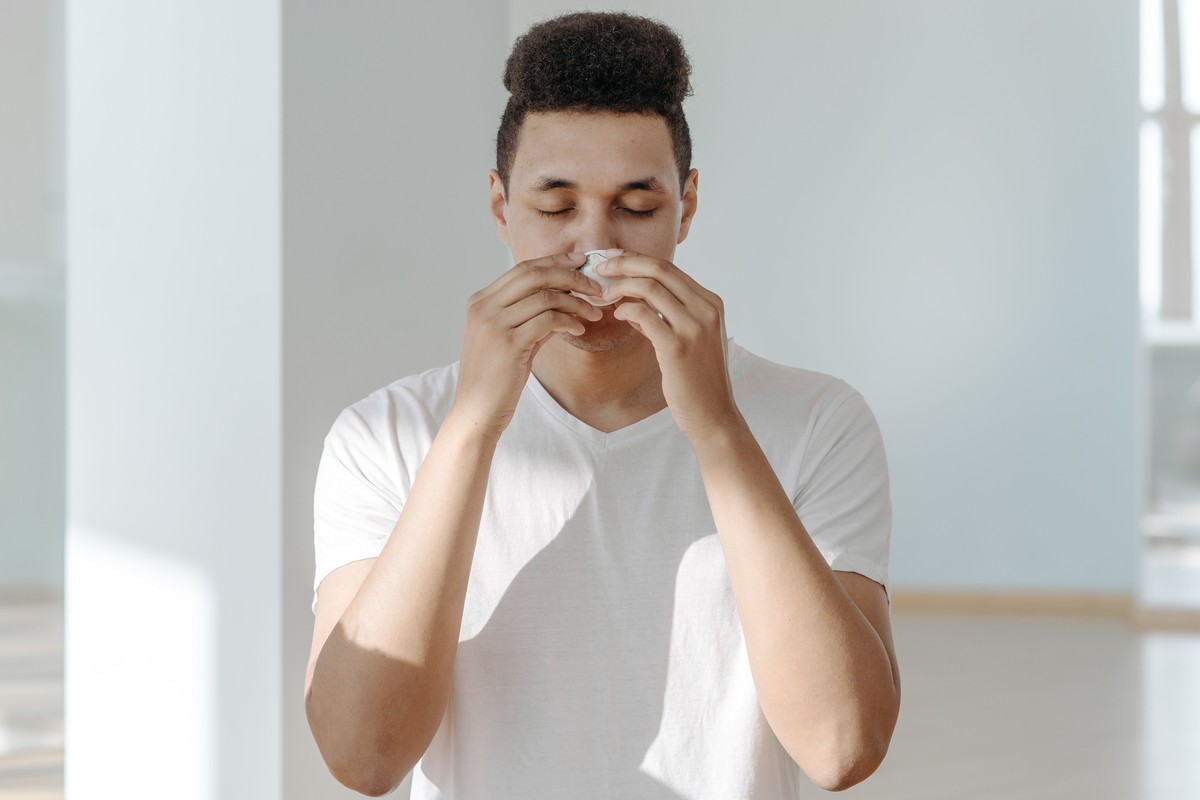
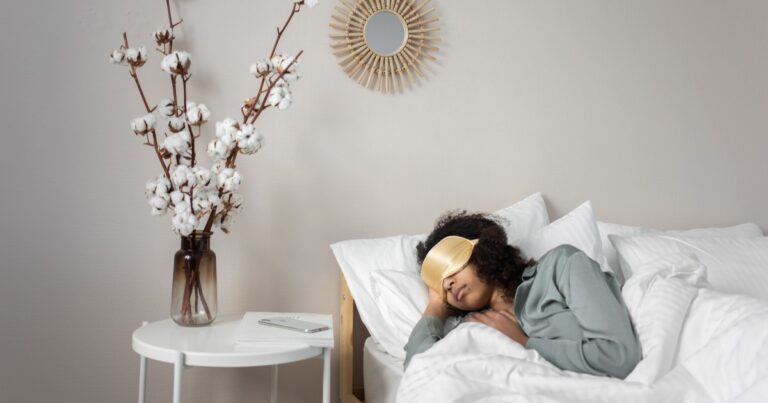
Photo: Pavel Danilyuk / Pexels
Skin is the exception, and a narrow one. The 2013 AAAAI/ACAAI practice parameter — the governing US allergy-society document on mite exposure — notes that “atopic dermatitis can be triggered by exposure to dust mites in sensitized individuals.” A Cochrane review found that as many as a third of people with eczema who test positive for dust-mite allergy report their eczema or breathing getting worse around dust.
So mites can make existing eczema worse in some people. They don’t leave bite marks.
And the breakouts?
No source I found links house dust mites to acne.
The NIH’s arthritis and skin institute (NIAMS) describes acne as excess oil, dead-skin buildup and bacteria inside a pore, with hormones, family history and some medications in the mix. The American Academy of Dermatology is shorter still: “Acne develops when pores become clogged.”
Neither mentions bedding. Neither mentions mites.
That was a slightly deflating thing to read, honestly. It meant my laundry plan was never going to fix my skin.
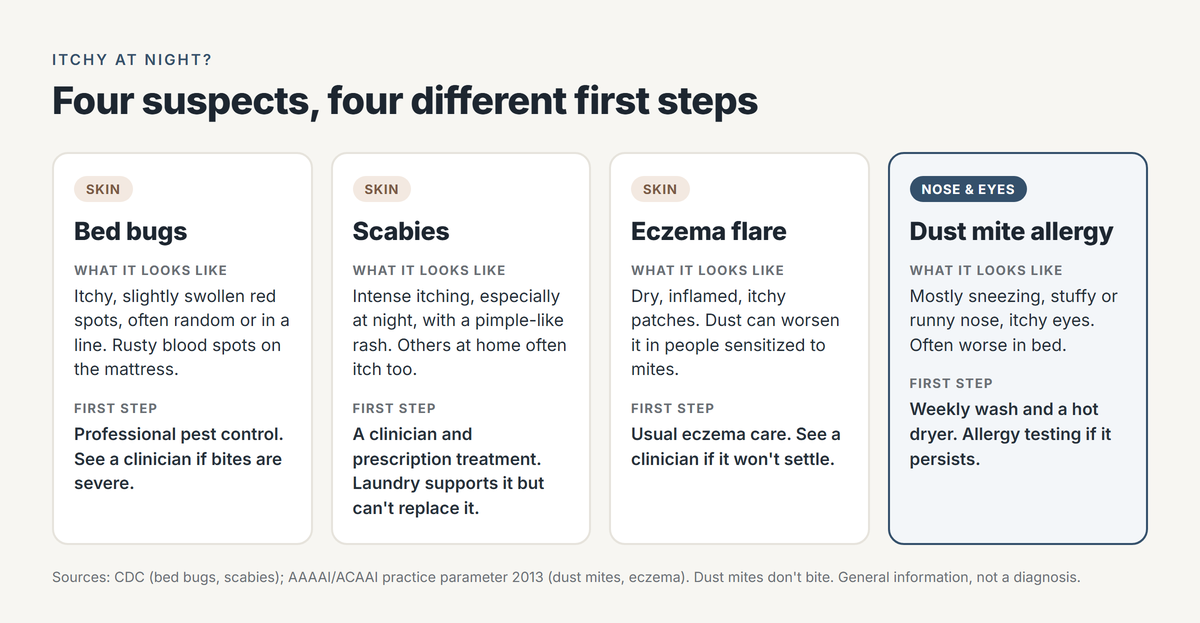
If your skin itches all over at night, check these first
If you are waking up with itchy bumps on your skin, the likelier suspects are ones that actually live on or feed on people.
| Suspect | What it tends to look like | What actually helps |
|---|---|---|
| Bed bugs | Itchy, slightly swollen red spots, often random or in a straight line; rusty-colored blood spots on the mattress (CDC) | Address the infestation with professional pest control; see a clinician if bites are severe |
| Scabies | A different mite that lives in the skin; “intense itching, especially at night, and a pimple-like skin rash” (CDC); others in the home often itch too | Diagnosis and prescription treatment from a clinician; laundering supports it but can’t replace it |
| Eczema flare | Dry, inflamed, itchy patches; can worsen with dust exposure in people sensitized to mites | Usual eczema care; see a clinician if it won’t settle or wrecks your sleep |
| Dust mite allergy | Mostly sneezing, stuffy or runny nose, itchy eyes — often worse in bed or when making the bed | Weekly washing, hot dryer, dry room, encasings; allergy testing if it persists |
Scabies is worth a special mention, because it is the one case where laundry really is part of the treatment.
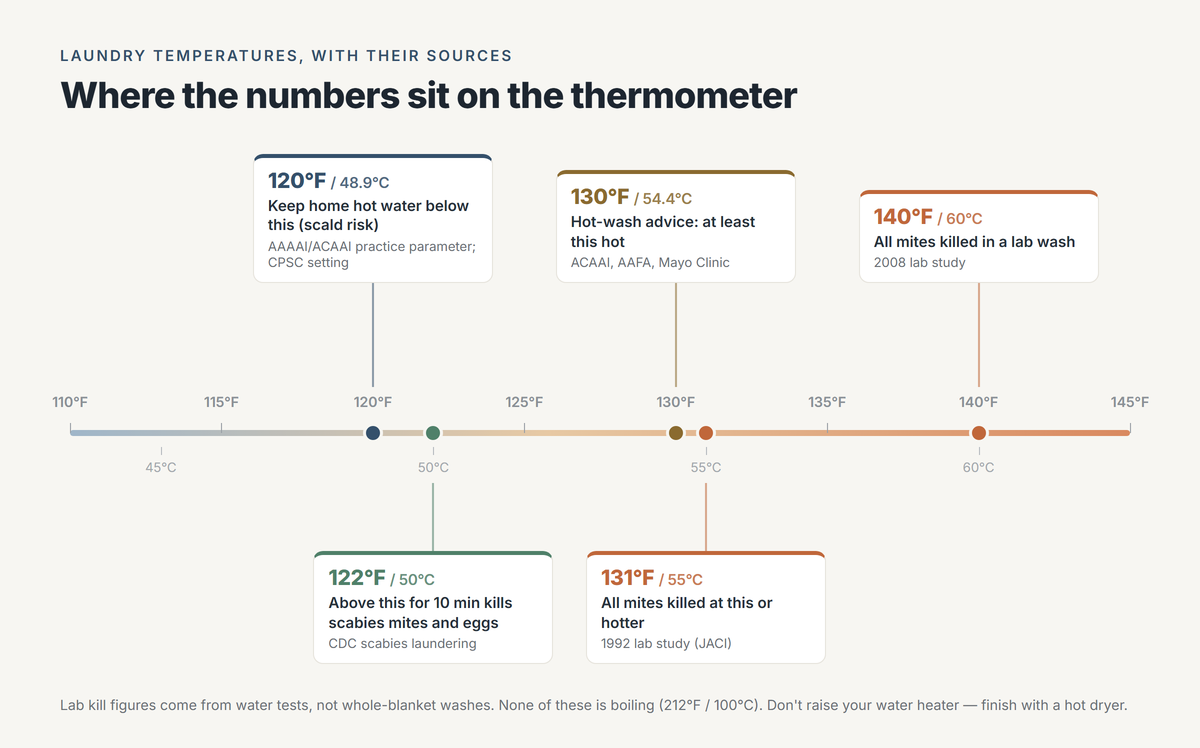
The CDC advises washing bedding, clothes and towels in hot water and drying them hot — above 50 °C (122 °F) for 10 minutes kills scabies mites and eggs — and bagging anything unwashable for 72 hours to a week. But that goes alongside prescribed treatment, not in place of it.
How often should you wash bedding for dust mites?
Once a week.
I had seen “every two weeks” repeated as a baseline, and for US readers it simply doesn’t match the guidance. Every US source I read says weekly — the EPA, ACAAI, the Asthma and Allergy Foundation of America (AAFA), Mayo Clinic, the American Lung Association, and the AAAAI/ACAAI practice parameter.
The reason is practical.
The practice parameter notes that allergen washed out of blankets “generally reappears within 1 month.” Clean bedding doesn’t stay clean for long, so the wash has to be a routine, not an event.
That covers sheets, pillowcases and blanket covers. The EPA adds washable stuffed toys to the list — wash them hot and dry them completely before a child plays with them.
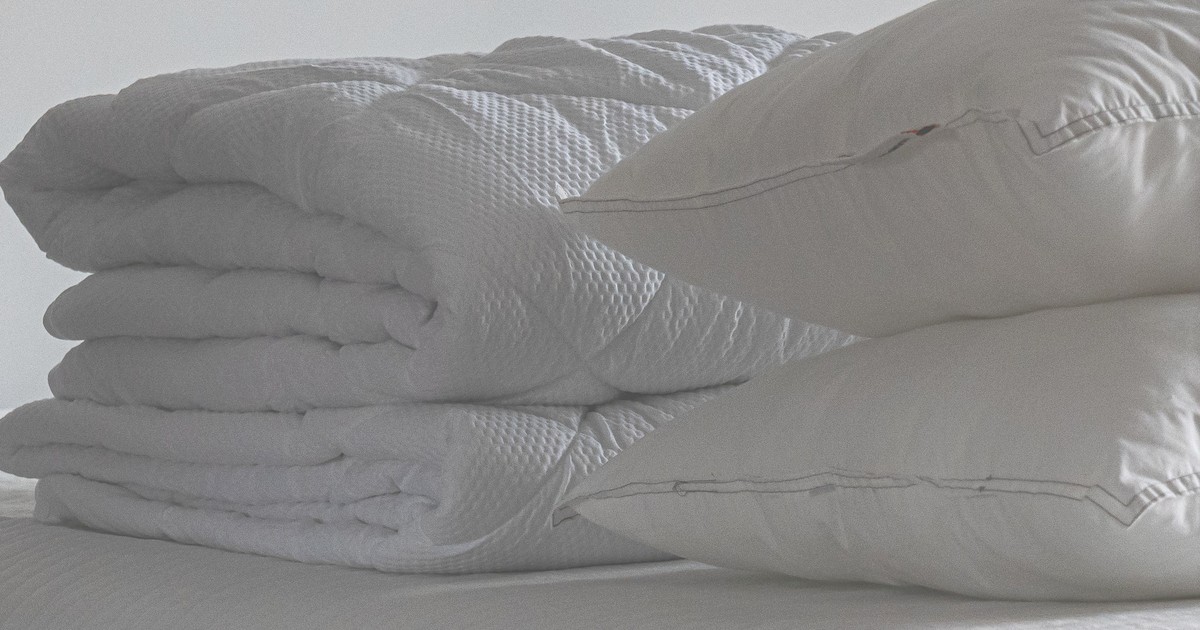
Photo: cottonbro studio / Pexels
What water temperature kills dust mites — and why US sources disagree
This is where I expected one clean number, and instead found a genuine disagreement.
Both sides are credible, so here are both.
The 130 °F camp. ACAAI’s allergy-avoidance page says to wash bedding in hot water “at least 130 degrees Fahrenheit.” AAFA and Mayo Clinic say the same — 130 °F, or 54.4 °C.
The “no high temperature needed” camp. The AAAAI/ACAAI practice parameter, as a strong recommendation, tells allergists to advise patients “that bedding should be washed weekly to decrease dust mite numbers and mite allergen levels, and that high temperature is not necessary. Home hot water should be kept below the temperature (120°F) that causes a scalding risk to occupants.” ACAAI’s own dust-allergy page also says hot water “no more than 120°F.”
The parameter goes further. It points out that the popular 130 °F advice comes from studies that dropped mites in permeable capsules into hot water — not from washing real blankets. Its suggestion is “to wash bedding weekly in warm water, without aiming for a specific and potentially dangerous temperature.”
What the lab studies actually found
The kill numbers are real, but they come with conditions:
- In a 1992 JACI study, all mites were killed at water temperatures of 55 °C (131 °F) or higher.
- A 2008 study in Annals of Allergy, Asthma & Immunology found all mites killed at 60 °C (140 °F) and by steam — but only 6.5% at 30 °C (86 °F) and 9.6% at 40 °C (104 °F).
- Species matter. In 50 °C (122 °F) water, one common species died within 10 minutes, but another needed 53 °C for 12 minutes before all were killed.
Notice that 130 °F is 54.4 °C — just under the 55 °C mark in that 1992 study. So I would not claim that 130 °F wipes out every mite. It kills most of them. The dryer, which we’ll get to, finishes the job.
And no, you don’t need boiling water. The 60 °C figure that circulates online is a lab threshold, not boiling — water boils at 100 °C (212 °F). No US source I read recommends boiling bedding.
The scald problem nobody mentions
This is the part that made the “no high temperature” side click for me.
To get 130–140 °F out of a regular top-loader, a lot of people would have to turn up the home water heater. And that same water comes out of the bathtub tap.
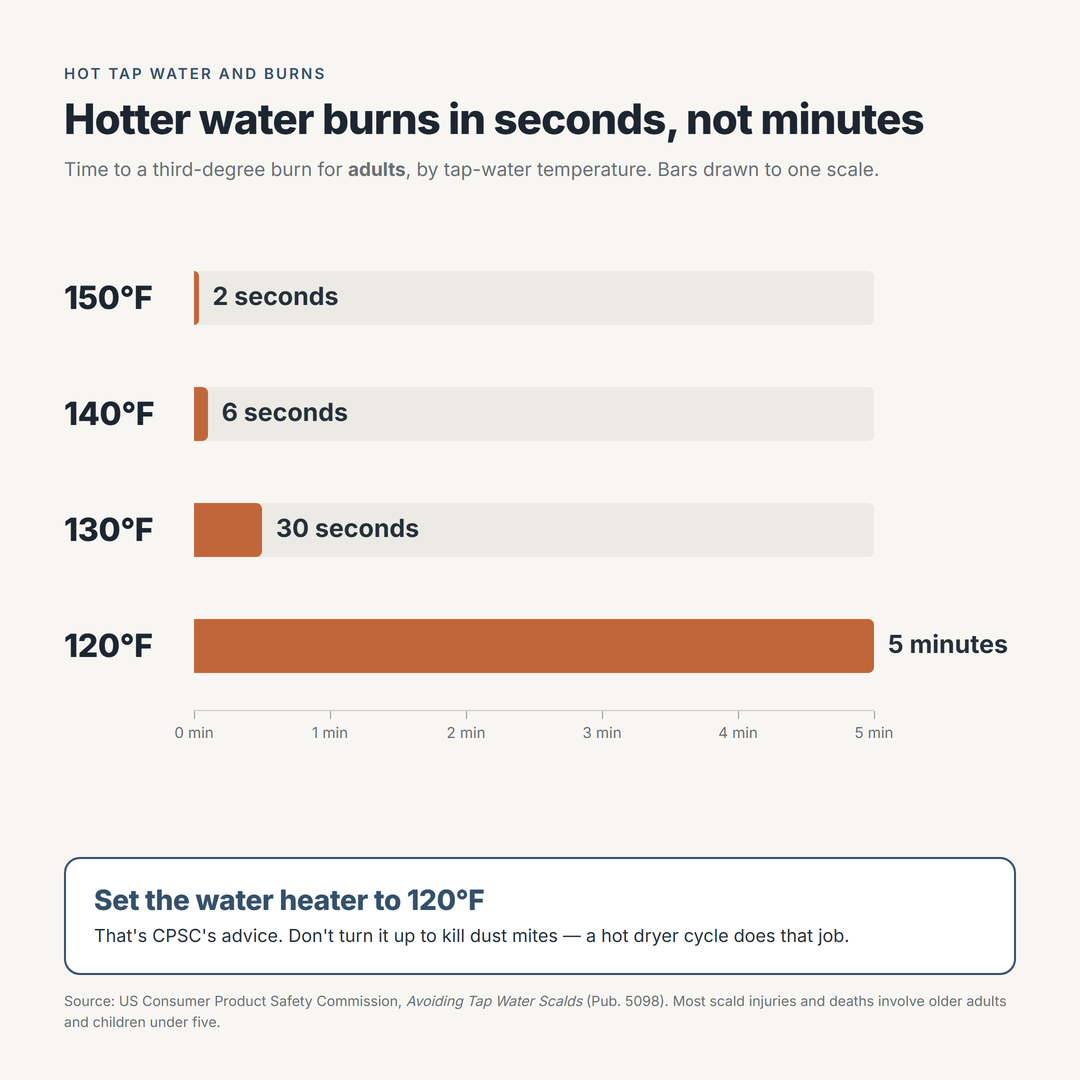
The US Consumer Product Safety Commission gives these burn times for adults:
| Tap water temperature | Time to a third-degree burn (adults, CPSC) |
|---|---|
| 150 °F | 2 seconds |
| 140 °F | 6 seconds |
| 130 °F | 30 seconds |
| 120 °F | 5 minutes |
The CPSC urges everyone to set water heaters to 120 °F, and notes that most scald injuries and deaths involve older adults and children under five.
So please don’t raise your water heater to kill dust mites.
If you want hotter water, some washing machines heat their own water internally. The practice parameter mentions machines certified under NSF Protocol P351 for allergen reduction, which boost water to at least 131 °F for 3 minutes. Otherwise, lean on the dryer.
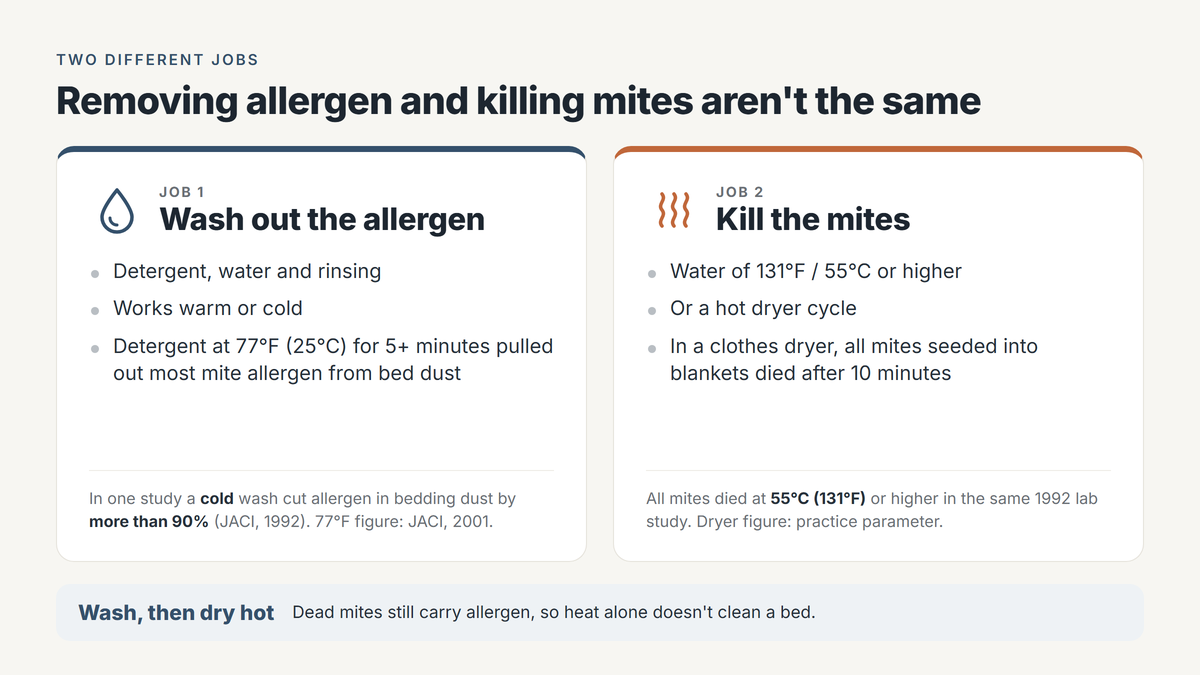
Killing mites and removing allergen are two different jobs
This was the most useful thing I learned, and it reframed everything else.
Removing allergen is mostly about detergent, water and rinsing. It works at almost any temperature.
Killing mites is about heat.
The studies line up like this:
- A cold wash cut the allergen concentration in bedding dust by more than 90% — but did not remove most of the live mites (JACI, 1992).
- In home machines on warm or cold settings, washing removed 84% of one major mite allergen, 98% with detergent plus bleach, and 60–83% of live mites (JACI, 2003).
- Detergent at 25 °C (77 °F) for at least 5 minutes pulled most mite allergen out of bed dust (JACI, 2001).
I should be honest that the studies don’t agree on how many live mites a non-hot wash gets rid of. The practice parameter cites lab data where most mites drowned even in cold water. What every source agrees on is that ordinary washing removes most of the allergen — and that heat is what reliably kills the mites.
Dead mites are still allergenic
This is the part the “burn them out” framing gets backwards.
A dead mite, and its droppings, still carry the proteins that set off the allergy. The practice parameter says freezing “kills them but does not get rid of the allergen.” One of the main mite allergens only breaks down after 30 minutes at 120 °C — far hotter than any laundry cycle.
So heat alone doesn’t clean a bed. Washing rinses the allergen out. That’s why the order is wash, then dry hot — not one or the other.
Dry cleaning is the cautionary example. In the 1992 study it killed most mites but did not reduce allergen.
One more practical detail from the 2003 study: live mites transferred from infested items to clean ones in the same load. Wash bedding on its own.
The hot dryer is the step that does the heavy lifting
If there is one habit I would keep, it is this one.
The evidence on drying is cleaner than the evidence on washing:
- Mayo Clinic: if something can’t be washed hot, put it in the dryer above 130 °F (54.4 °C) for at least 15 minutes to kill mites, then wash and dry it to remove allergen.
- Blankets: all mites seeded into blankets died after 10 minutes in a clothes dryer (practice parameter).
- Comforters and duvets: 99% of the mites naturally living in used duvets died after 1 hour in a dryer (practice parameter).
- Cleveland Clinic suggests the hottest setting for at least 30 minutes.
The practice parameter also notes that dry heat to 60 °C kills mites and their eggs. Eggs are tougher than adult mites, so that matters.
The takeaway for me: sheets and blankets on a normal hot cycle, thick comforters on the longest one.
Two caveats. Check the care label first — not every comforter can take high heat, and if yours can’t, ask about professional cleaning. And dry things completely. The EPA says to “dry completely,” and damp bedding is exactly the humid environment mites like.
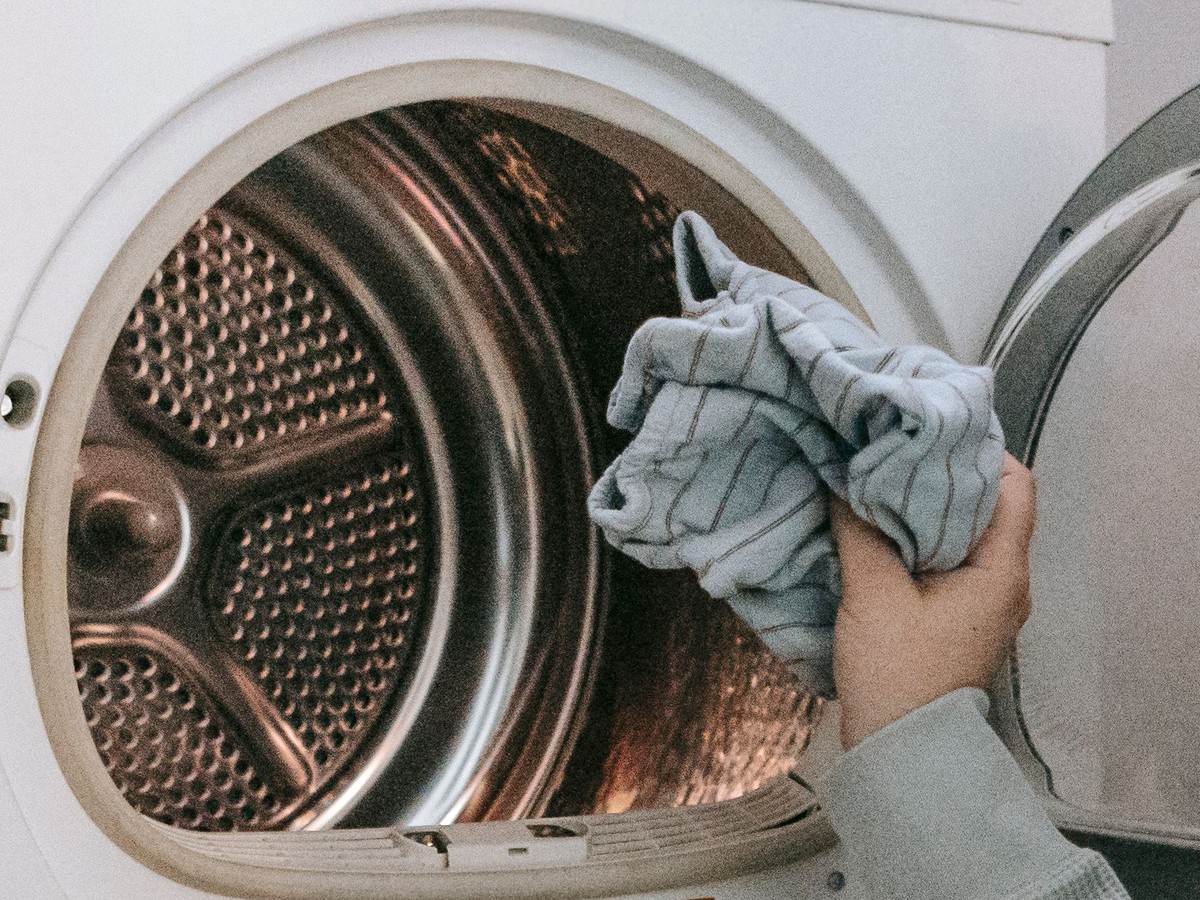
Photo: Sarah Chai / Pexels
What about sun-drying and beating the duvet outside?
This is the advice I had grown up with, so I wanted it to be true.
Mostly, it isn’t supported.
Sunlight. The only sunlight data I found was a 2011 study where direct sun killed mite eggs sitting on glass lab slides after about 3 hours. Eggs exposed on a slide are not mites buried inside a thick duvet. I couldn’t find any study showing sun-drying kills mites inside real bedding — so I wouldn’t count on it. The hot dryer has the evidence; the clothesline doesn’t.
Beating or shaking bedding. This one is actively counterproductive if you’re the allergic person doing it. The practice parameter notes that mite allergen becomes airborne when disturbed, and lists symptoms that flare while “making the bed, or shaking out blankets” as a classic sign of mite allergy. A Japanese study measured the allergen thrown into the air by beating futons. I found no study showing beating removes a meaningful share of mites.
Drying outdoors. ACAAI advises allergy patients not to hang laundry outside, because pollen can cling to sheets and towels.
The good news hidden in all this: the fur and dander part takes care of itself. In the 2008 study, only 0.3–1.3% of dog allergen remained after washing — at every temperature tested.
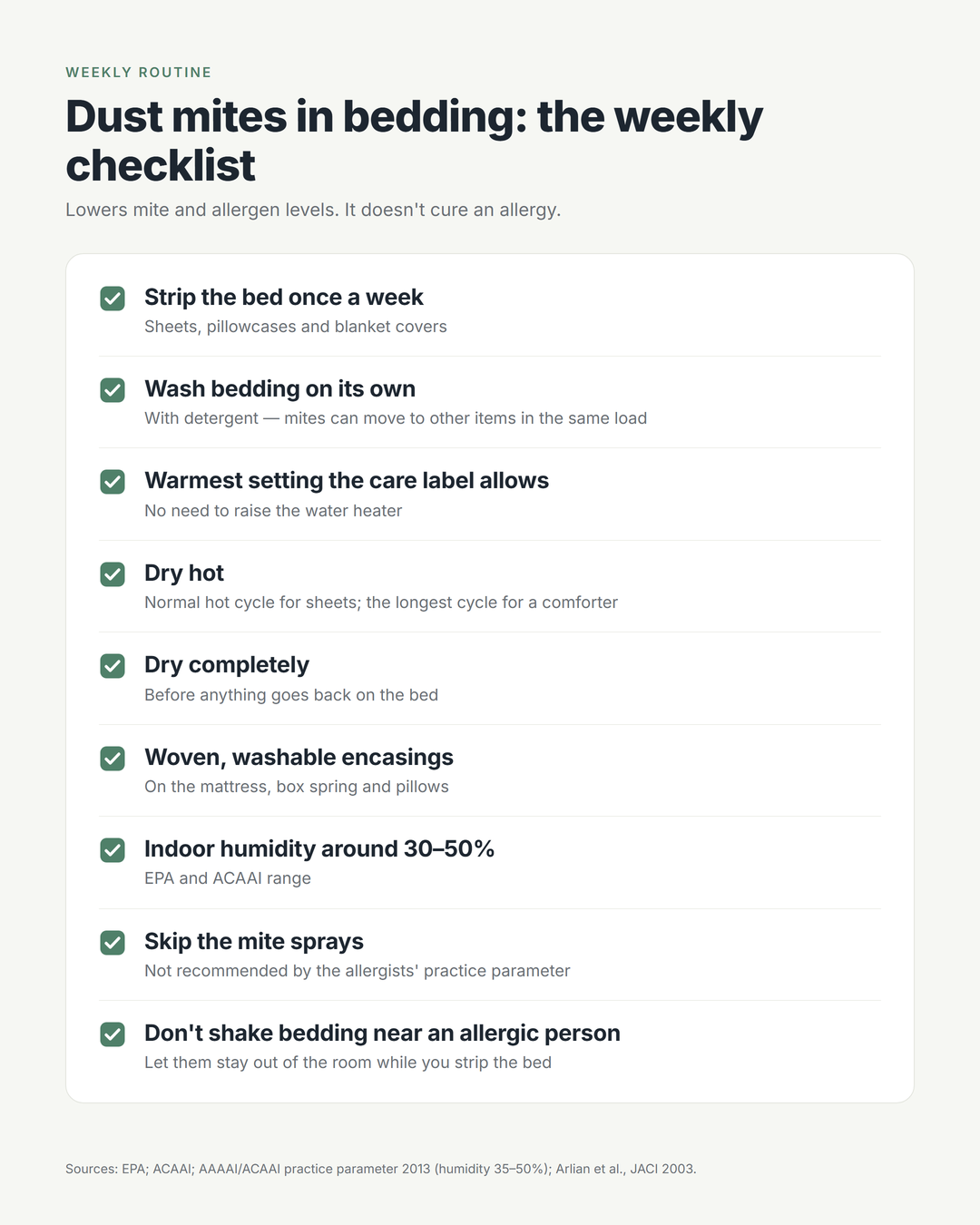
A weekly routine for dust mites in bedding
Here is what I actually do now. None of it is fancy.
- Once a week, strip the bed — sheets, pillowcases, blanket covers.
- Wash bedding on its own, with detergent, on the warmest setting the care label allows. No need to raise the water heater.
- Dry hot — a normal hot cycle for sheets and blankets, the longest cycle for a comforter.
- Dry completely before it goes back on the bed.
- Use woven, washable encasings on the mattress, box spring and pillows. The practice parameter recommends mite-proof encasings, and advises against nonwoven ones because they trap allergen and can’t be washed.
- Keep indoor humidity around 30–50% (EPA, ACAAI; the practice parameter says 35–50%). Mites need humid air — they take up water when relative humidity is around 65% or more, and very few grow below 45%. ACAAI advises allergy patients not to run humidifiers.
- Skip the mite sprays. The practice parameter doesn’t recommend chemical acaricides.
- Don’t shake bedding near the allergic person, and let them stay out of the room while you strip the bed. The allergen settles within minutes.
If you want the bigger picture of the bedroom itself — humidity, windows, and whether your trigger is mites or pollen — I wrote that up separately: allergic rhinitis and your bedroom setup.
Will clean bedding fix my allergies? The honest ceiling
I want to be straight about this, because a lot of bedding advice quietly promises more than it can deliver.
Washing and encasing reliably lower mite and allergen levels. Whether that makes people feel better is a much weaker story.
- A Cochrane review of mite-control measures for asthma — 54 trials, 3,002 patients — found no effect on peak flow, symptoms or medication use. Two caveats: Cochrane now flags that review as outdated and not for clinical decision-making, and the practice parameter argues that two-thirds of its trials used measures that didn’t actually lower allergen.
- Two 2003 NEJM trials of mattress encasings: in 232 people with allergic rhinitis who completed a one-year trial, allergen fell but symptoms didn’t change. In 1,122 adults with asthma, the covers “seem clinically ineffective” as a single intervention.
- A 2025 meta-analysis of 17 trials found dust and allergen levels dropped, but not enough to improve asthma, allergic rhinitis, or quality of life.
What the practice parameter recommends instead — backed by A-grade evidence — is a combined approach: humidity at 35–50%, regular washing of bedding, vacuuming with a high-efficiency vacuum, mattress and pillow encasings, and HEPA filtration if needed.
So here is how I think of it now. Clean bedding lowers your exposure. It doesn’t prevent allergies, and it doesn’t cure them. If symptoms keep going despite a good routine, that’s a reason to get tested, not to wash harder.
If you have a child with eczema or asthma, those have their own playbooks: child eczema and nighttime itch and childhood asthma symptoms and triggers.
When to see a doctor for itching or allergy symptoms
This article is general health information, not medical advice. It doesn’t diagnose any condition and isn’t a substitute for evaluation by a licensed clinician. Itching, rashes and breakouts have many causes — including bed bugs, scabies, eczema and acne — that need different treatments. If you’re not sure what’s causing your symptoms, get checked rather than relying on laundry alone.
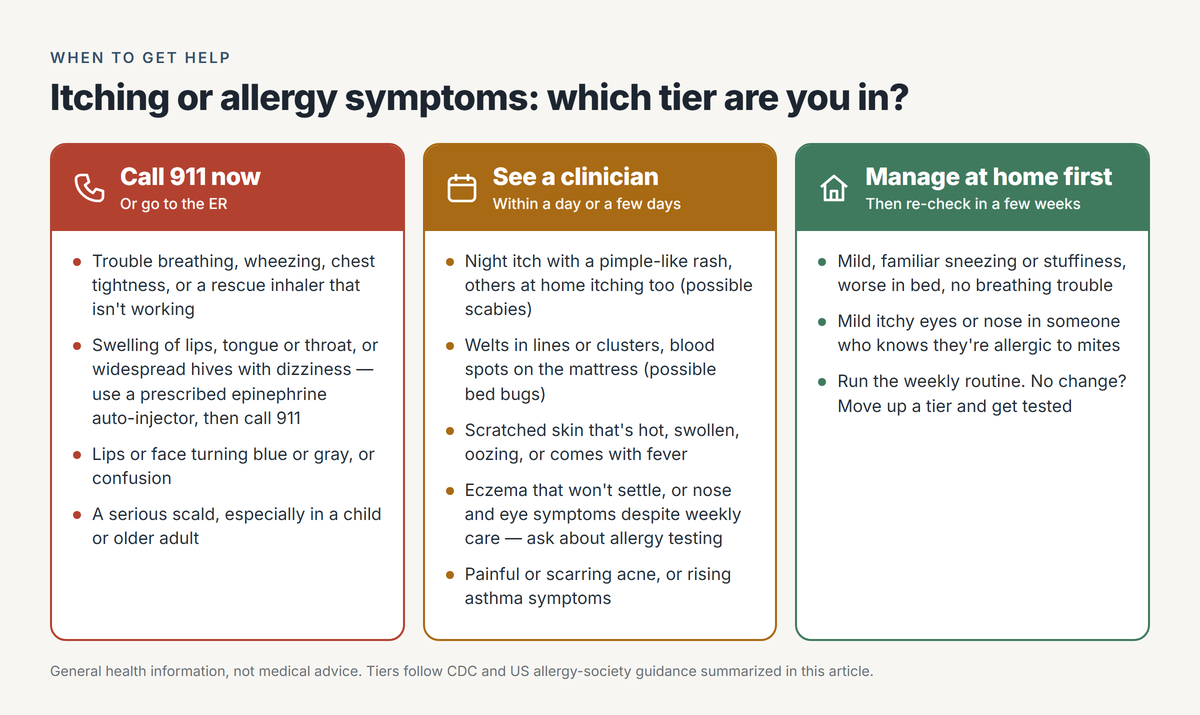
Call 911 or go to the ER now
- Trouble breathing, wheezing, chest tightness, or a rescue inhaler that isn’t working or is needed again and again
- Swelling of the lips, tongue or throat, trouble swallowing, or widespread hives with dizziness or fainting — use an epinephrine auto-injector if you have one prescribed, then call 911
- Lips or face turning blue or gray, or confusion; in a child, ribs pulling in with each breath or not being able to speak in full sentences
- A serious scald from hot water, especially in a child or older adult, or a large or blistering burn
See a clinician within a day or a few days
- Itching that’s worst at night with a pimple-like rash — between fingers, in skin folds — especially if others at home itch too (possible scabies)
- Itchy welts in lines or clusters, blood spots or insects on the mattress (possible bed bugs)
- Scratched skin that turns painful, hot, swollen, oozing or crusted, or comes with a fever
- An eczema flare that won’t settle with your usual care or keeps you up at night
- Nose or eye symptoms that persist despite weekly bedding care, disrupt sleep or work, or are new in a child — ask about allergy testing (skin or blood) and treatment options
- Acne that’s painful, cystic, scarring or not improving with over-the-counter care — that’s a dermatologist question, not a laundry one
- Anyone with asthma whose cough, chest tightness or reliever use is increasing — and keep following your asthma action plan; bedding care doesn’t replace it
Reasonable to manage at home first
- Mild, familiar sneezing or stuffiness that’s worse in bed or when making the bed, with no breathing trouble
- Mild itchy eyes or nose in someone who already knows they’re allergic to dust mites
- In this tier, run the weekly routine above and re-check in a few weeks. If nothing has changed, move up a tier and get tested.
The one thing I’d keep
I still wash my sheets every week. I just stopped thinking of it as a battle.
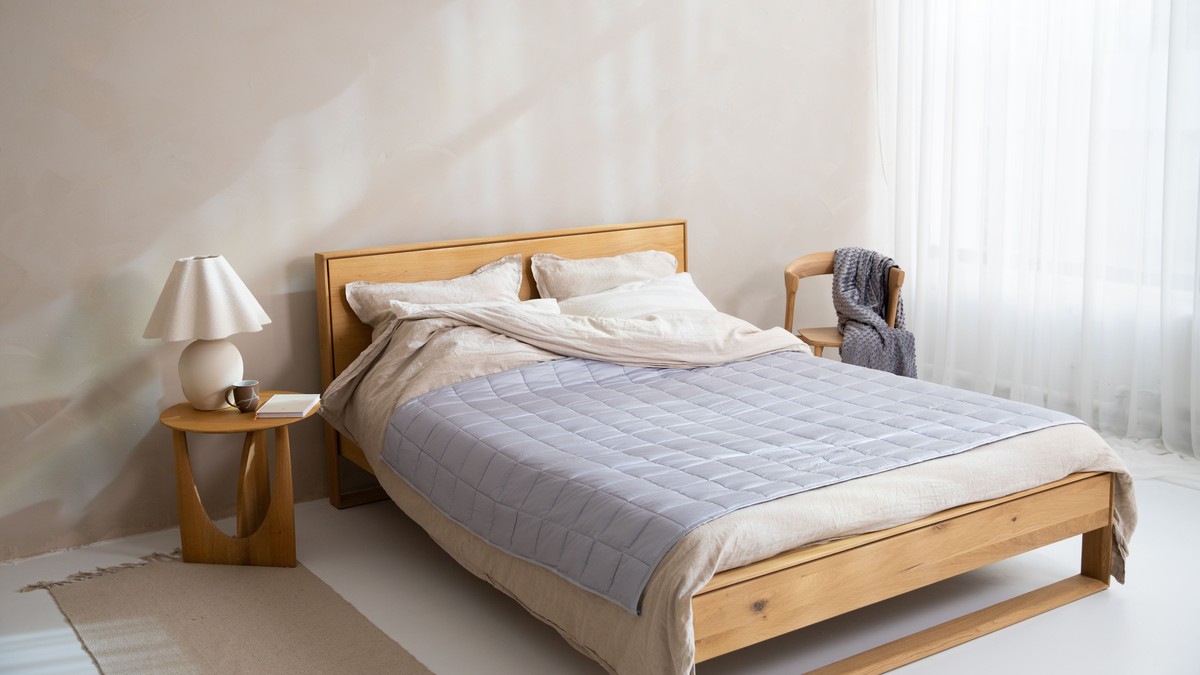
Photo: Niels from Slaapwijsheid.nl / Pexels
There is no version of a bed that’s free of dust mites — ACAAI says outright that it’s impossible to completely get rid of them. What you can do is keep their numbers and their allergen low, week after week, without scalding anyone or beating a duvet in the yard.
And the itch that sent me down this road?
It was never going to be solved in the laundry room. That’s the part I wish someone had told me first.
Weekly wash, hot dry, dry air — and if the itch is on your skin rather than in your nose, look for something other than dust mites.
Because the thing in your bed usually isn’t the thing keeping you up at night.
References
- AAAAI/ACAAI Joint Task Force — Portnoy J, et al. Environmental assessment and exposure control of dust mites: a practice parameter, Ann Allergy Asthma Immunol, 2013
- US EPA — Asthma Triggers: Gain Control
- US CPSC — Avoiding Tap Water Scalds, Publication 5098
- CDC — About Scabies, Scabies Treatment, and About Bed Bugs
- NIAMS (NIH) — Acne; American Academy of Dermatology — Acne: Who gets and causes
- ACAAI — Environmental Allergy Avoidance and Dust Allergy
- AAFA — Dust Mite Allergy
- American Lung Association — Dust Mites
- Mayo Clinic — Dust mite allergy: Diagnosis & treatment; Cleveland Clinic — Dust Mite Allergy
- McDonald LG, Tovey E. The role of water temperature and laundry procedures in reducing house dust mite populations and allergen content of bedding, JACI, 1992
- Arlian LG, et al. Mite and mite allergen removal during machine washing of laundry, JACI, 2003
- Choi SY, et al. Optimal conditions for the removal of house dust mite, dog dander, and pollen allergens using mechanical laundry, Ann Allergy Asthma Immunol, 2008
- Gøtzsche PC, Johansen HK. House dust mite control measures for asthma, Cochrane, 2008; Terreehorst I, et al. NEJM 2003; Woodcock A, et al. NEJM 2003; Sobczak M, et al. Int Forum Allergy Rhinol 2025