Child Eczema at Night: The 3-Minute Moisturizing Rule
I’ll be honest about the part nobody warns you about.
It isn’t the rash. It’s 2 a.m., and the sound of small fingernails going at the backs of the knees, over and over, until the sheets have little rust-colored spots on them in the morning.
If that’s your house right now, here’s the one thing I’d want you to know before anything else. Child eczema really does get worse at night — it isn’t your imagination, and it isn’t a discipline problem. There are measurable physiological reasons for it. And the single habit with the strongest agreement behind it is small enough to fit in three minutes.
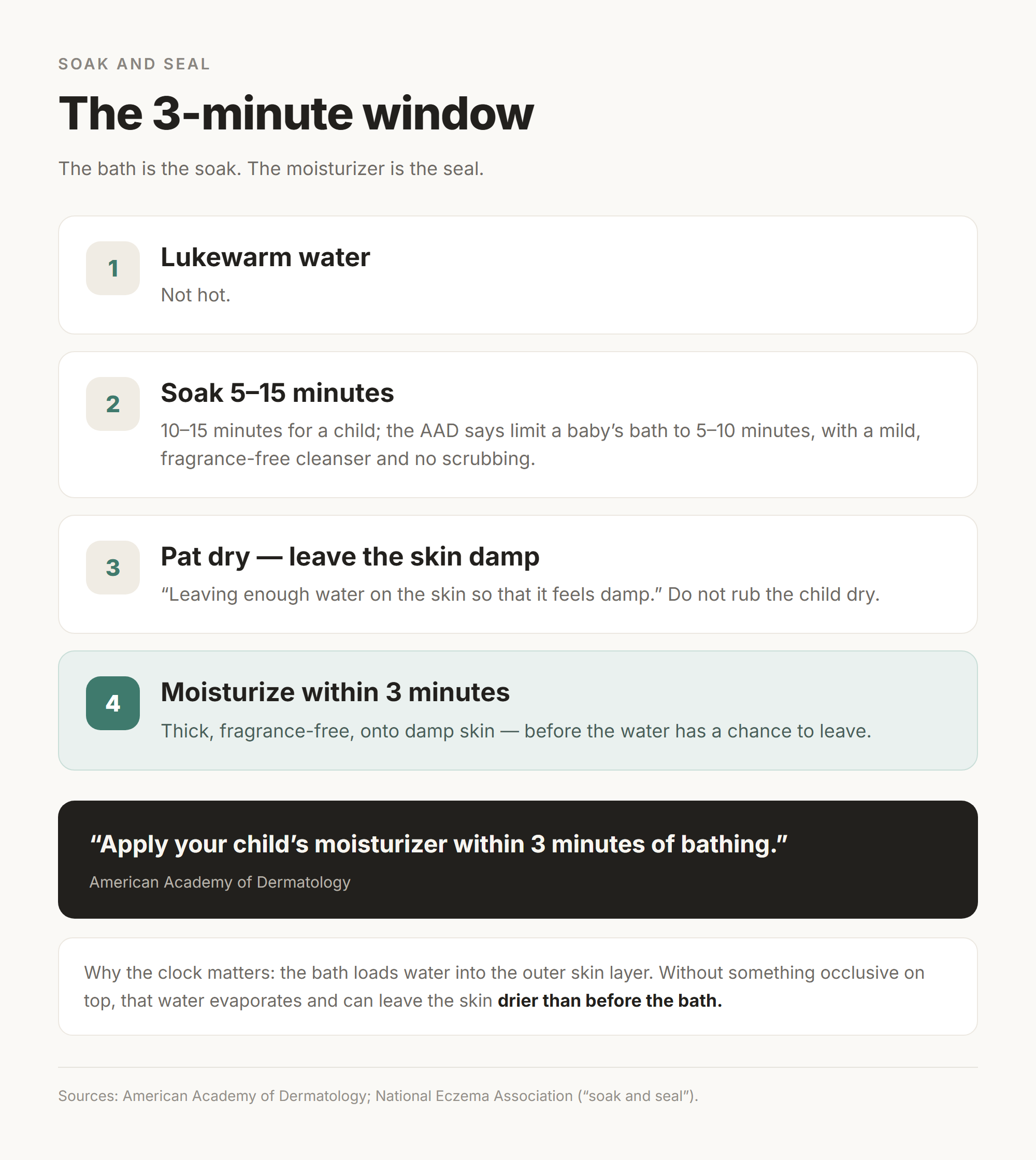
The American Academy of Dermatology’s own instruction to parents is exactly this: “Apply your child’s moisturizer within 3 minutes of bathing.”
That sentence is the spine of this article. Around it, I want to walk through why the skin fails in the first place, what to do about the bedroom, where the honest disagreements are, and the signs that mean stop reading and call someone.
Photo: Nataliya Vaitkevich / Pexels
A note before we start: this is general information, not medical advice. Diagnosis, prescriptions, and anything involving your specific child belong with your pediatrician, a board-certified dermatologist, or an allergist.
How common is child eczema, really?
Two very different numbers circulate, and both are correct. They just measure different things.
- 12.7% of US children aged 0–17 had diagnosed eczema in 2024, according to the CDC’s National Health Interview Survey. Ages 0–5 were highest at 14.0%, 6–11 at 12.7%, 12–17 at 11.6%.
- Up to 20–25% of children is the figure the AAP and AAD cite — a cumulative childhood estimate that sweeps in mild and short-lived cases.
So “1 in 4 kids has eczema right now” overstates it. “As many as 1 in 4 children will experience eczema at some point in childhood, and about 1 in 8 US children had a diagnosis in 2024” is fair to both.
The onset is early, too. The AAD estimates 60% of people with eczema develop it in their first year of life.
One more thing worth saying plainly: atopic dermatitis is chronic, relapsing, and not contagious, and there is no cure — but it is highly controllable. Those two facts have to sit next to each other.
Why the itch gets worse after dark
This part surprised me more than anything else in the research. The nighttime spike isn’t behavioral. It’s several body clocks lining up badly at the same hour.
Reviews of nocturnal eczema and circadian rhythm in pediatric AD point to a stack of overlapping causes:
- Cortisol hits its low point. Your child’s own anti-inflammatory hormone is at its minimum in the evening and overnight. The natural brake on inflammation is weakest exactly at bedtime.
- Skin temperature rises. Peripheral blood vessels dilate before and during sleep, and warmer skin has a lower itch threshold.
- Water loss peaks. Transepidermal water loss follows a circadian pattern that peaks overnight. In skin already short on lipids and ceramides, that spike dries things out further.
- Itch cytokines shift. Circadian variation in IL-2, IL-8, IL-31 and IFN-γ — IL-31 is the well-characterized “itch cytokine.”
- Melatonin secretion gets disrupted, which both reflects and worsens the sleep problem.
- Nothing else is competing for attention. With no other sensory input, itch perception is simply louder. That’s a real contributor, not a folk explanation.
What it actually costs a family
The numbers here are the reason I think this topic deserves more than a skincare listicle.
- 50–80% of children with AD have sleep disturbance, and rates go higher during flares.
- Falling asleep takes about 40 minutes on average.
- 2.7–3.5 nighttime awakenings during flares.
- Time awake after falling asleep ranged from 15 minutes to more than 2 hours.
- About 60% have trouble waking in the morning, and roughly 30% of parents end up co-sleeping.
And it doesn’t stop at the child. The AAP’s burden-of-disease resource notes that depression rates are twice as high in mothers of affected children, with caregiver health tracking the child’s severity. If you’re exhausted and short-tempered right now, that is a documented part of this disease, not a character flaw.

Why the skin barrier fails — and what sets it off
NIAMS describes two problems that feed each other.
The first is barrier failure. Changes in the protective outer layer let the skin lose moisture, including genetic differences in skin-barrier proteins — the filaggrin pathway is the best-known example. The second is immune dysfunction driving inflammation, amplified by things in the environment.
That’s why the standard framing is a triad, not a single fix. The AAP’s 2025 clinical report puts it as maintenance skin care + topical anti-inflammatory medication + trigger avoidance.
Common triggers, compiled across AAD, AAP and NIAMS sources:
| Category | Triggers |
|---|---|
| Body / behavioral | Sweat, saliva and drool, scratching, overheating at night |
| Environmental | House dust mites, pet dander, pollen, cockroach, dry air, tobacco smoke, air pollutants |
| Irritants | Harsh soaps and detergents, fragrances, dyes, essential oils, wool and synthetic fabrics |
| Infection | Staph and strep colonization, herpes simplex |
Two small, specific tactics from the AAD worth stealing: petroleum jelly around the mouth before feeding to block saliva irritation in babies, and rinsing or wiping down after play rather than letting sweat dry on the skin.
How the rash presents also changes with age — oozing red patches on the face and scalp in infants, moving to elbow creases, behind the knees, the neck and ankles in older children. And on darker skin, “redness” often reads as violet, gray, or dark brown rather than pink, which is one reason AD is under-recognized in Black and Hispanic children, in whom severity also runs higher.
The 3-minute window: bathe, pat, seal
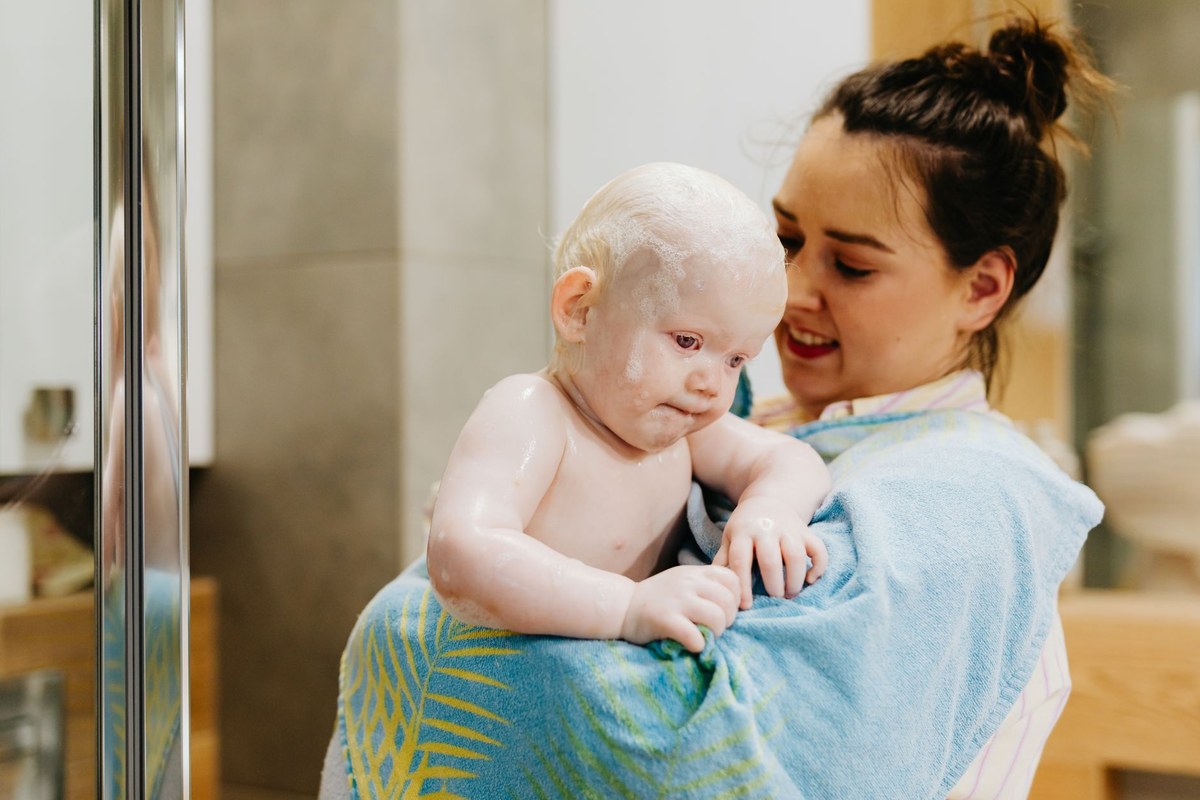
Photo: kaboompics.com / Pexels
Here’s the protocol itself, in the AAD’s own terms for a child with eczema.
- Lukewarm water. Not hot.
- Soak 10 to 15 minutes for a child. For babies, the AAD says limit the bath to five to 10 minutes, washing only the dirty or smelly parts with a mild, fragrance-free cleanser, no scrubbing. Call it roughly 5–15 minutes for routine care — longer only if a dermatologist directs it.
- Gently dry, “leaving enough water on the skin so that it feels damp.” Do not rub the child dry.
- “Apply your child’s moisturizer within 3 minutes of bathing.”
The National Eczema Association frames this as “soak and seal,” and the 3-minute rule is generally credited to them. The mechanism is simple enough to hold in your head at 7 p.m. with a wet toddler: the bath loads water into the outer skin layer, and without something occlusive on top, that water evaporates and can leave the skin drier than before the bath.
The bath is the soak. The moisturizer is the seal. A soak without a seal is a net loss.
How often should you bathe? Honestly — nobody has settled it
I went looking for a clean answer here and there isn’t one. So I’ll give you the disagreement straight.
- The AAP’s 2025 clinical report leans toward daily or frequent short lukewarm baths followed by immediate moisturizing, describing daily to every-other-day.
- The AAD’s April 2026 pediatric guidelines give bathing-followed-by-moisturizer only a conditional recommendation — reasonable, but the evidence isn’t strong.
- The Eczema Bathing Study, an online randomized trial in the British Journal of Dermatology with 438 participants, found no important difference in symptom scores between weekly and daily bathing over four weeks. An earlier RCT and a 2021 meta-analysis likewise found no significant difference between bathing seven or more times a week and fewer.
This argument is over 100 years old, and it splits by specialty — primary care physicians more often recommend infrequent bathing, allergists and pediatric dermatologists more often frequent. Which is why parents get told opposite things by two reasonable people.
The part everyone agrees on is what happens in the three minutes after. So that’s where I’d put the effort.
Choosing and using the moisturizer
The guidelines are less brand-specific than the internet is.
AAD’s 2026 pediatric guidelines give moisturizers a strong recommendation to reduce dry, itchy skin — the strongest endorsement any skincare step gets. They also carry a conditional recommendation in children aged 6 months to 3 years to help prevent eczema onset, which is the only prevention intervention with any recommendation at all.
The AAP calls daily application of thick, fragrance-free emollients the “cornerstone of care,” with creams and ointments preferred over lotions, applied liberally to the whole body at least daily, especially after bathing. If a cream stings, an ointment such as plain petroleum jelly can be substituted — inexpensive and, per the AAD, effective for many children. Avoid added fragrance, dyes, or essential oils, which are potential irritants and contact allergens.
The rule of thumb: the more oil and less water, the better it seals. Ointment > cream > lotion — with whatever your child will actually tolerate winning in real life.
On ceramides, a note against overselling. A randomized double-blind trial comparing 1% ceramide, 10% lanolin, and 10% urea creams against a petrolatum control in children with mild AD found a significant drop in water loss in the ceramide group over 14 days, while lanolin and urea were not different from control. But the STOP-AD prevention trial in high-risk infants found AD at 12 months in 13.2% of the ceramide group vs 25.0% of controls — not statistically significant. So: a physiologically sensible choice with small-trial support, not a proven preventive. What the guidelines actually require is “thick and fragrance-free.”
How much? US guidelines say “liberally” without publishing gram targets. The quantitative benchmark comes from UK NHS guidance, not the AAD or AAP: roughly 250–500 g of emollient per week for a child with eczema, depending on size. UK dermatology education also uses the fingertip unit — the amount squeezed along an adult fingertip, about 2 FTUs ≈ 1 gram — mainly for dosing topical steroids by body region. Take it as a directional sanity check: if one tub lasts a month, that’s likely underuse.
One conflict to hand back to your prescriber: sources disagree on sequencing. The AAD’s baby page says apply the prescribed steroid right after the bath, before the moisturizer. The AAD’s “soak and smear” technique says smear the medicine onto still-wet skin. NHS patient guidance suggests a ~30-minute gap between emollient and steroid. They agree the medicine goes on the patches and the moisturizer goes everywhere — they disagree on order. Follow the order your own prescriber gives you.
The bedroom: humidity, temperature, and what to wear
This is where a lot of well-meaning advice goes slightly wrong.
The number US federal agencies publish is a range, not “50%.” The EPA states that indoor relative humidity “should be kept below 60 percent — ideally between 30 percent and 50 percent, if possible,” and recommends 30–50% in its asthma guidance, measurable with an inexpensive hygrometer from any hardware store.
Read that as a ceiling, not a target. Dust mites and mold thrive above roughly 50–55% RH, and per the AAP, about 70% of children with AD are sensitized to dust mites. Pushing a bedroom to 50% parks you right at the line where the mite problem starts. Aim around 40–50%, and measure rather than guess.
There’s counter-evidence on humidifiers worth knowing, too. In a study of 3,302 Southern California children aged 5–7, those who had used a home humidifier were 44% more likely to have eczema than those who never had. That’s observational and very plausibly reverse causation — families buy humidifiers because a child has eczema — but it’s a real published signal, and it argues for a hygrometer rather than running a humidifier blind.
The rest of the AAP’s sleep guidance is refreshingly low-tech:
- Keep the bedroom at a steady, cool temperature. A cool-mist humidifier can help keep air moist and cool — within the ceiling above.
- Sleepwear cool, loose, and irritant-free. Remove tags, cover seams. For kids who sweat, wicking fabrics and cooling sheets may help. Research on clothing found synthetics significantly more irritating and cotton tolerated best.
- A consistent bedtime routine — bathe, brush teeth, read — leaving the room while the child is still awake, with regular bed, nap, and wake times. Reserve the bed for sleep only.
- Keep fingernails clean and cut short. Simple, and it limits the damage the scratching does.
Some children are given a bedtime oral allergy medicine because scratching blocks sleep onset. Two caveats: that’s a sedation strategy rather than an eczema treatment, and antihistamines are not among the AAD’s 2026 recommended treatments. It needs a prescriber’s direction, not a drugstore decision.

Photo: Andrea Piacquadio / Pexels
Treatment basics — and the steroid conversation
In April 2026 the AAD published its first-ever pediatric atopic dermatitis guidelines in JAAD, developed by a 14-member working group (11 board-certified dermatologists plus a pediatric allergist) and containing 26 treatment recommendations.
| Strength | Interventions |
|---|---|
| Strong | Moisturizers; topical corticosteroids; topical calcineurin inhibitors; PDE-4 inhibitors; topical JAK inhibitor; topical AhR agonist; biologics; oral JAK inhibitors |
| Conditional | Bathing followed by moisturizer; wet wrap therapy; phototherapy; moisturizers for prevention, ages 6 months–3 years |
| Against | Systemic corticosteroids (except short-term for severe flares); topical antimicrobials; PUVA |
| Insufficient / no benefit | Early food introduction, human milk consumption, probiotics, vitamin D, water softening, dust mite avoidance for prevention, special diets |
Topical corticosteroids remain first-line, with a strong recommendation, and the AAD cites their affordability and accessibility. The AAP goes further, describing appropriate supervision and appropriate use to control chronic disease — including a maintenance regimen for recurring cases. Proactive maintenance dosing is a legitimate strategy, not overuse.
Which brings us to the thing most parents feel and few say out loud.
Steroid phobia is common, measurable, and it backfires. A cross-sectional survey found steroid phobia in about 12% of adolescents and 37% of caregivers. Another found 72.5% of respondents worried about using topical corticosteroids on their own or their child’s skin, and 24% admitted they weren’t following the plan because of it. The fear is fed largely by friends, relatives, the internet, and social media — and notably, caregivers who got their information from a dermatologist, and whose children flared less, worried less.
The consequence is a loop: fear, underuse, uncontrolled inflammation, more flares, more infection risk, more lost sleep. In the real world, undertreatment is the more common error, not overtreatment.
If the face or another sensitive area is the worry, ask about topical calcineurin inhibitors — the AAP endorses them as effective steroid-sparing agents, particularly there. Several non-steroidal topicals now exist as well, though approved pediatric age ranges differ by product, so that’s a question for your clinician rather than a comparison chart.
Two more techniques you may read about: wet wrap therapy (a conditional AAD recommendation, explicitly “under the guidance of a healthcare professional skilled in eczema management,” and parents should be trained before doing it at home, since prolonged skin moisture raises infection risk), and dilute bleach baths for infection-prone eczema. The AAD publishes detailed bleach-bath measurements, but its 2026 guideline summary didn’t include them and recommends against topical antimicrobials — so treat that one as dermatologist-directed, not a routine home step.
The food question: why cutting foods usually backfires
If your child’s skin is bad and someone has suggested dropping dairy, eggs, or wheat, please read this section twice.
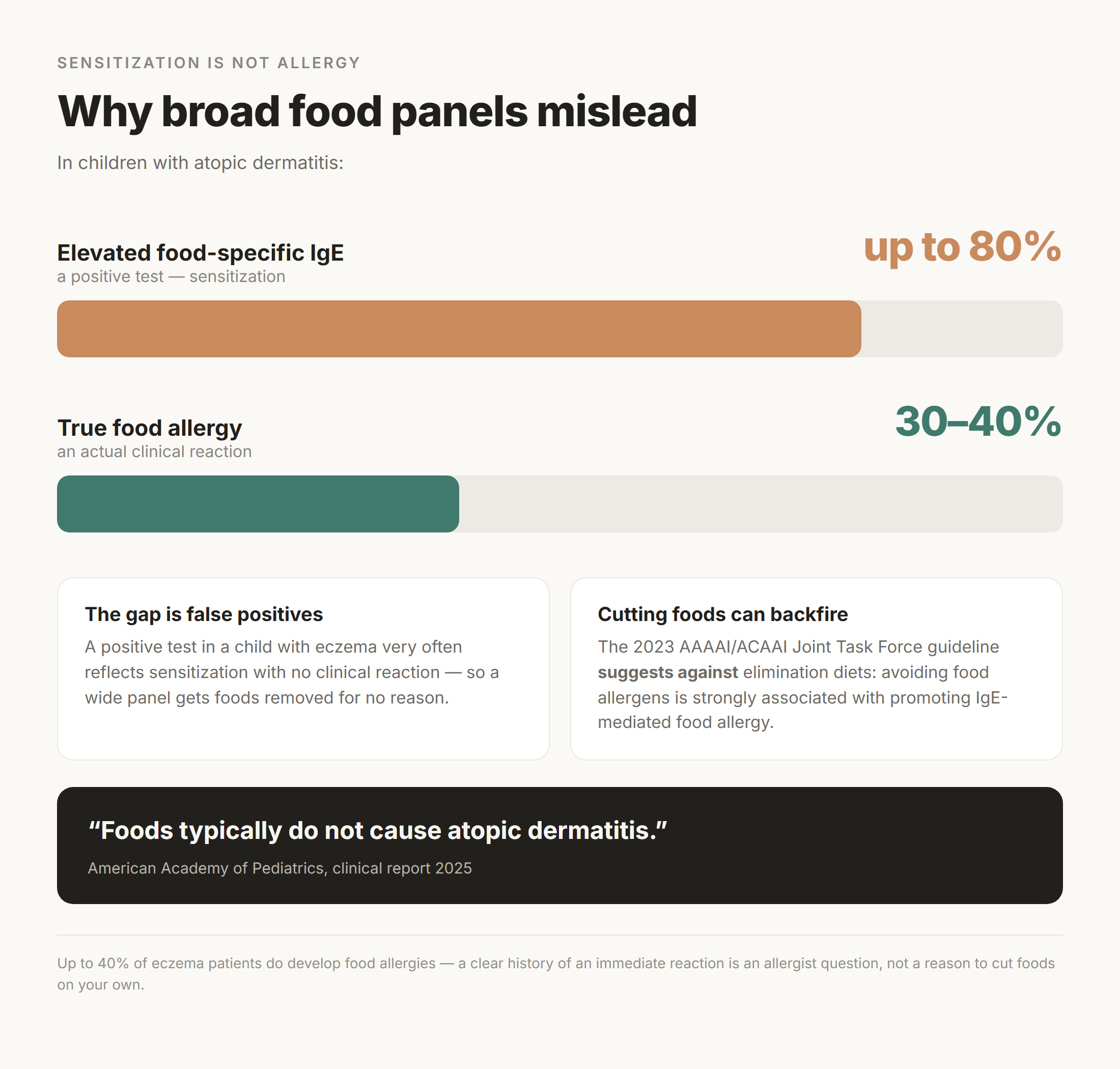
Foods generally do not cause atopic dermatitis. The AAP’s 2025 report states that while up to 40% of eczema patients develop food allergies, “foods typically do not cause atopic dermatitis,” and it cautions against unnecessary elimination diets.
Sensitization is not allergy, which is why broad panel testing misleads. Up to 80% of children with AD show elevated food-specific IgE, while true food allergy runs 30–40%. A positive test in a child with eczema very often reflects sensitization without any clinical reaction — so a wide panel manufactures false positives that lead to foods being removed for no reason.
The 2023 AAAAI/ACAAI Joint Task Force guideline suggests against elimination diets, on the grounds that avoiding food allergens is strongly associated with promoting the development of IgE-mediated food allergy.
The mechanism, from the AAAAI work group report, is the dual-exposure hypothesis: oral tolerance is built by high-dose exposure through the mouth, while sensitization happens through low-dose exposure across inflamed skin. Strict elimination removes the tolerance-building side while the leaky skin keeps sensitizing. Harms also scale with how many foods are cut and how long it lasts.
But — and this matters — food never mattering isn’t the message either. A minority of children, typically infants with moderate-to-severe AD, do have food-triggered flares. The AAAAI position is shared decision-making with an allergist, driven by a clear history of an immediate reaction, not by a rash that won’t settle. If your child gets hives, vomiting, or breathing trouble right after eating, that’s an allergist question — and if breathing is involved, an emergency.
Red flags: when to stop managing and call
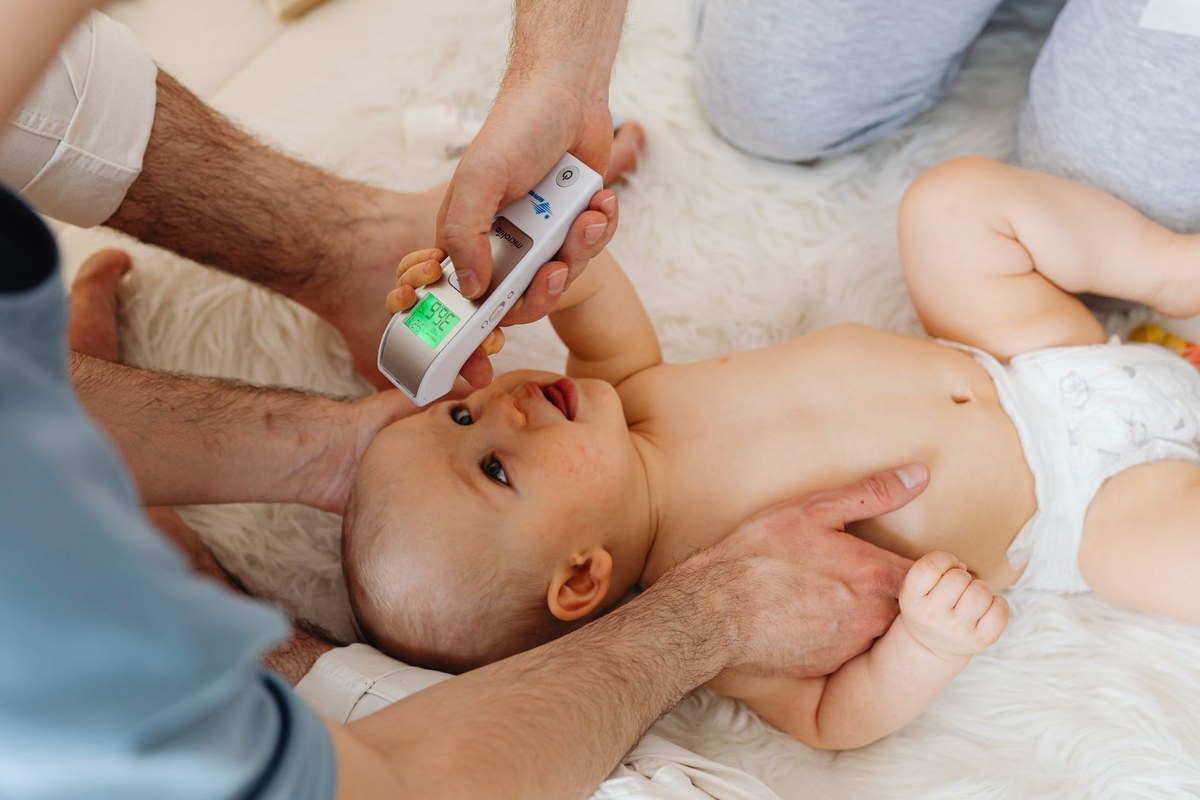
Photo: kaboompics.com / Pexels
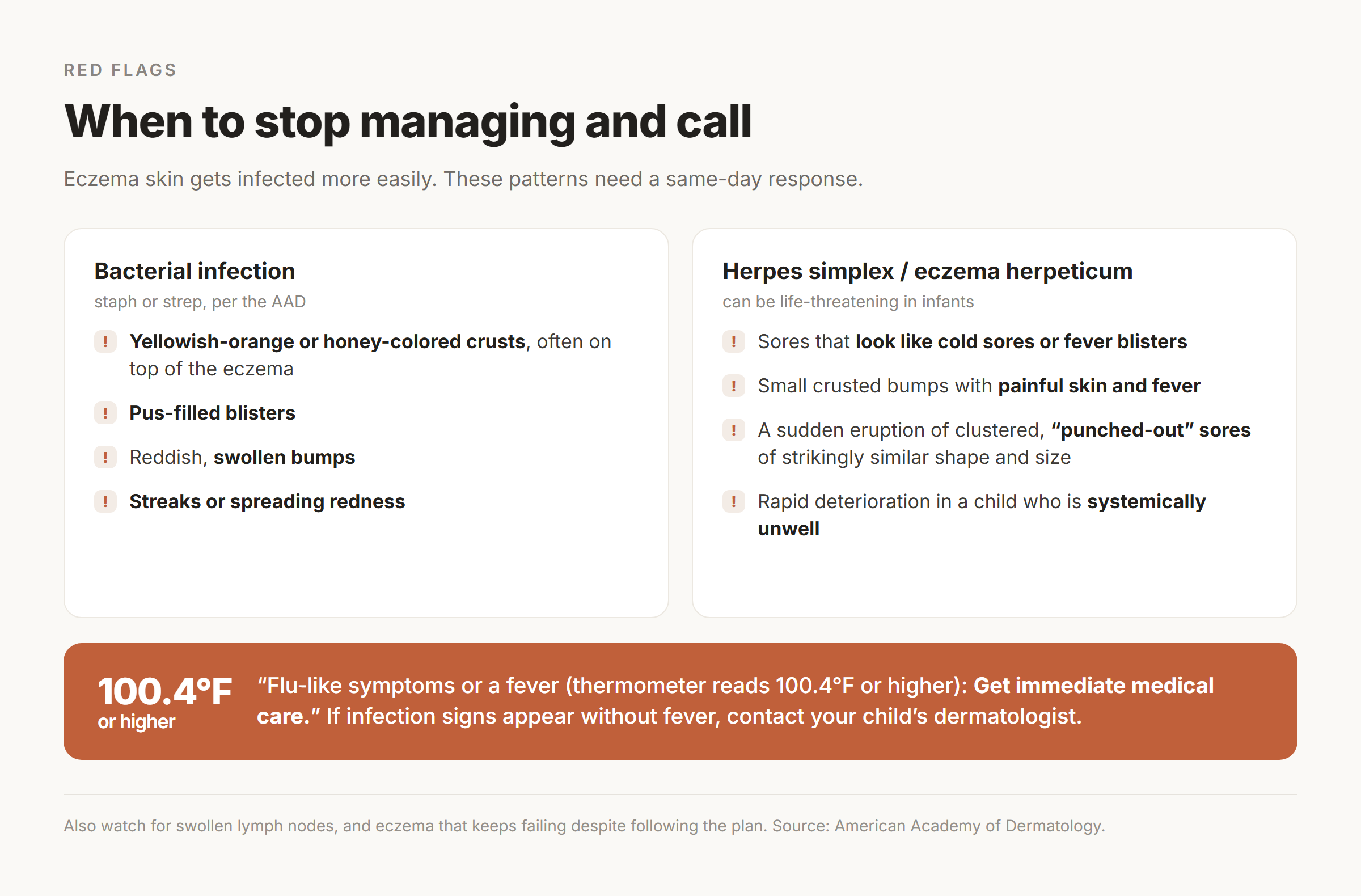
Eczema skin gets infected more easily, and a few patterns need a same-day response rather than another night of cream.
Signs of bacterial infection (staph or strep), per the AAD:
- Yellowish-orange or honey-colored crusts, often on top of the eczema
- Pus-filled blisters
- Reddish, swollen bumps
- Streaks or spreading redness
Signs pointing to herpes simplex / eczema herpeticum:
- Sores that look like cold sores or fever blisters
- Small crusted bumps with painful skin and fever
- A sudden eruption of clustered, “punched-out” sores — many lesions of strikingly similar shape and size — over eczematous skin, often with fever, swollen glands, or malaise
The urgency thresholds, in the AAD’s own words: “Flu-like symptoms or a fever (thermometer reads 100.4°F or higher): Get immediate medical care.” If infection signs appear without fever, contact your child’s dermatologist. Also watch for swollen lymph nodes, and for eczema that keeps failing despite following the plan.
Eczema herpeticum deserves its own line. As the clinical literature puts it, “a rapid deterioration in eczema in a child who is systemically unwell should prompt consideration of eczema herpeticum.” It can be life-threatening in infants and young children, and anyone who might have it needs immediate medical care. Practical corollary from the AAD: keep a child with eczema away from anyone with an active cold sore.
Other reasons to book a visit: eczema that isn’t controlled despite consistent moisturizing and prescribed treatment, sleep disruption bad enough to affect school or daytime function, and eczema on the eyelids or near the eyes. The AAP advises referral to a pediatric dermatologist or allergist for severe, complicated, or chronic disease.
Related reading: Baby heat rash vs. viral rash: how to tell them apart
If I had to compress all of this into one line, it would be this:
“You can’t win the argument about how often to bathe. You can win the three minutes afterward.”
That’s genuinely where the evidence is strongest and where a parent has the most control. Thick, fragrance-free, onto damp skin, before the water has a chance to leave. Every night, boring, unglamorous, done.
The rest — the humidity reading, the cotton pajamas, the short fingernails, the steroid your dermatologist actually wants you to use — stacks on top of that.

Photo: Tatiana Syrikova / Pexels
And on the nights it still doesn’t work, which there will be, it helps to remember that this is a relapsing disease with an established treatment path, not a verdict on how well you’re doing. The 2 a.m. scratching is a symptom with a mechanism behind it. Mechanisms can be worked on.
This article is general information and does not replace individualized medical care. Talk to your child’s pediatrician, a board-certified dermatologist, or an allergist about diagnosis and treatment. Prescription medications, bleach baths, wet wraps, and bedtime antihistamines should only be used under a clinician’s direction.
Sources: American Academy of Dermatology (pediatric atopic dermatitis guidelines, April 2026; patient education pages), American Academy of Pediatrics (clinical report Pediatrics, June 2025; HealthyChildren; Burden of Atopic Dermatitis), CDC/NCHS National Health Interview Survey 2024, NIH/NIAMS, AAAAI/ACAAI Joint Task Force 2023, Journal of Allergy and Clinical Immunology, British Journal of Dermatology (Eczema Bathing Study), US EPA, NHS (emollient quantity guidance). Compiled August 2026.