
Infant Colic: Causes, Soothing Methods, and Red Flags
Let me start with the part nobody puts in the baby books.
Around six in the evening, a perfectly healthy newborn can start screaming and not stop. Fed. Dry. Held. Still screaming. And somewhere around the ninety-minute mark, a parent stops asking “what’s wrong with the baby” and starts asking “what’s wrong with me.”
If that’s where you are tonight, here’s the short version. Infant colic is excessive, inconsolable crying in an otherwise healthy, well-fed, growing baby — and the honest answer about its cause is that nobody knows. What we do know is which soothing methods have real support, which popular ones don’t, and how to keep yourself safe when the crying wins.
I’ll go through all of it, including the evidence quality behind each claim — because a lot of what gets repeated confidently about colic turns out to be a theory wearing a lab coat.
Photo: Adventure Studio / Pexels
A note first: this is general information, not medical advice, and nothing here is a diagnosis or a treatment plan. Persistent crying in an infant belongs in a conversation with your pediatrician.
What Infant Colic Actually Is
Colic is not a disease. It’s a pattern: a baby who is growing normally, has no fever or illness, and cries in long, unexplained stretches that no one can prevent or resolve.
The American Academy of Pediatrics frames it as a baby who is “unusually sensitive to stimulation” and cannot yet self-regulate their own nervous system. Not a parenting failure. Not something the baby is doing wrong either.
The timeline is the most reassuring thing on this page.
| Milestone | What the sources say |
|---|---|
| Onset | 2–4 weeks of age (AAP) |
| Peak | About 3 hours of crying a day by 6 weeks (AAP); Cleveland Clinic puts the peak at 4–6 weeks |
| Resolution | Stops by 3–4 months, sometimes stretching to 6 (AAP) |
| Outgrowing it | About 90% of infants are past it by 3–4 months (StatPearls) |
Crying declines on its own in all healthy babies — from an average of 117–133 minutes a day in the first six weeks down to about 68 minutes a day by 8–9 weeks (StatPearls). And one dataset tracks colic itself dropping from 17%–25% under 6 weeks, to 11% at 8–9 weeks, to 0.6% at 10–12 weeks. That last figure is worth taping to the fridge.
Rome IV vs. Wessel’s “Rule of Threes”
There are two definitions in circulation, and they don’t agree.
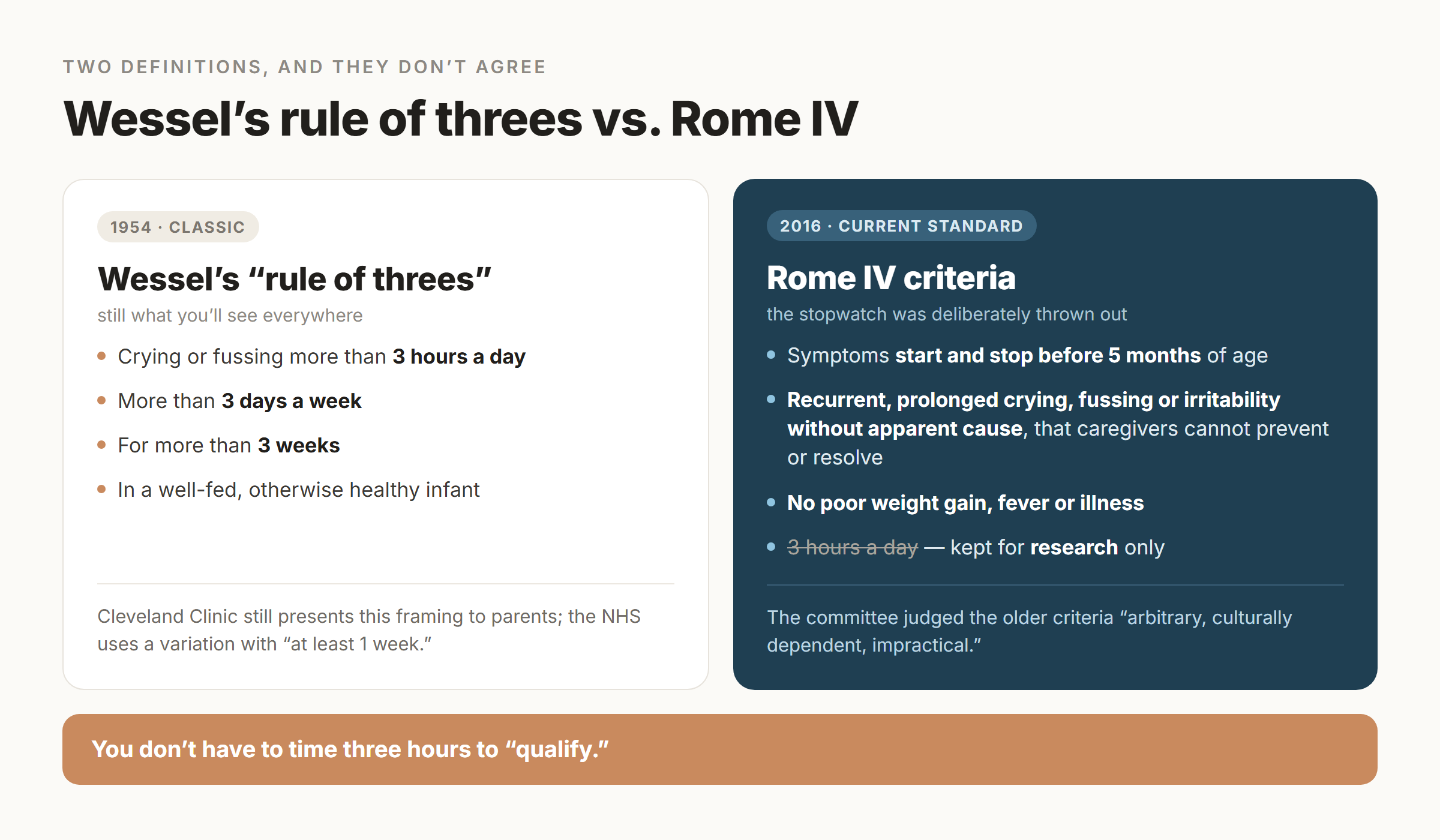
Wessel’s rule of threes (1954) is the classic one you’ll still see everywhere: crying or fussing more than 3 hours a day, more than 3 days a week, for more than 3 weeks, in a well-fed, otherwise healthy infant. Cleveland Clinic still presents this framing to parents; the NHS uses a variation with “at least 1 week.”
Rome IV (2016) is the current clinical standard, and it deliberately threw the stopwatch out — the committee judged the older criteria “arbitrary, culturally dependent, impractical.” For clinical diagnosis it requires all of:
- Symptoms start and stop before 5 months of age
- Recurrent, prolonged crying, fussing, or irritability without apparent cause, that caregivers cannot prevent or resolve
- No evidence of poor weight gain, fever, or illness
The “3 hours a day” threshold survives in Rome IV only for research purposes. So the practical takeaway is this: you don’t have to time three hours to “qualify.”

Photo: Emma Bauso / Pexels
How common is it? The sources genuinely disagree — about 1 in 5 babies (AAP), 3% to 28% worldwide with some reports as high as 40% (StatPearls), or 10%–15% in a Rome IV narrative review. That spread is a definitional artifact, not a real population difference.
One more thing worth knowing: StatPearls found no proven association with sex, feeding method (breast vs. formula), prematurity, socioeconomic status, or birth order. Nothing you chose caused this.
Why Does Colic Happen? Strong Evidence vs. Weak
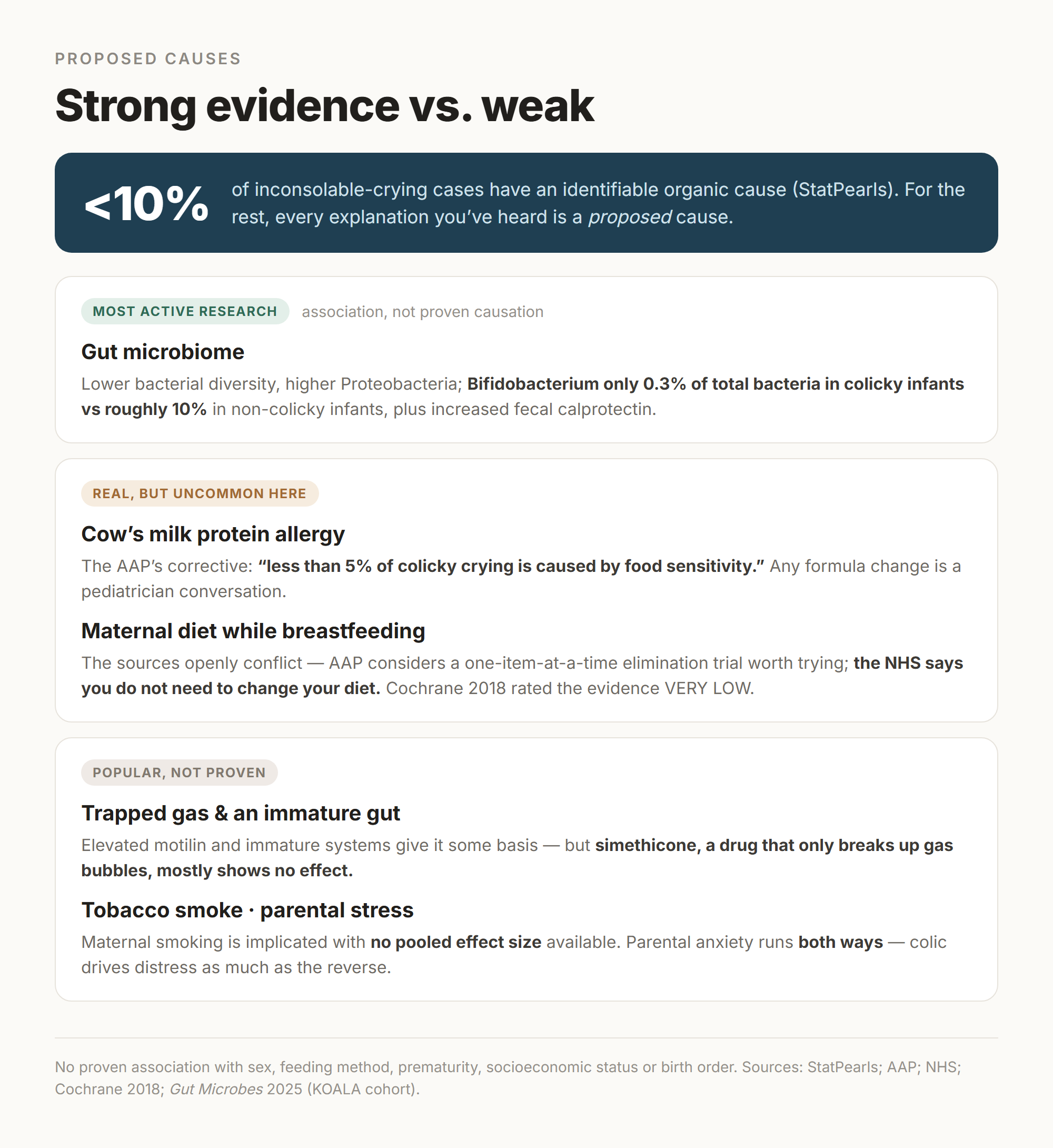
Fewer than 10% of inconsolable-crying cases have an identifiable organic cause (StatPearls). For the rest, every explanation you’ve heard is a proposed cause, and the evidence behind each is uneven.
Trapped Gas and an Immature Gut — the Popular Theory, Not a Proven Cause
This is the explanation almost every parent gets handed, so it deserves a careful look.
There’s something behind it. StatPearls documents elevated motilin levels, suggesting gut hypermotility and autonomic imbalance, plus generally immature nervous and gastrointestinal systems. Cleveland Clinic lists swallowed air, reflux, and an underdeveloped digestive system among potential factors.
But here’s the counterweight, and it’s heavy. Simethicone — a drug that does exactly one thing, break up gas bubbles — mostly shows no effect on colic (StatPearls). If trapped gas were the mechanism, de-gassing should work reliably. It doesn’t.
So gas remains a plausible, widely repeated theory. It is not the confirmed cause, and I’d rather say that than sell you a mechanism the drug trials don’t back up.
The Gut Microbiome — the Most Active Research Area
Colicky infants show lower bacterial diversity and higher Proteobacteria (E. coli, Klebsiella), with reduced Lactobacillus, Bifidobacterium, Bacteroides, and Enterococcus. One striking finding: Bifidobacterium made up only 0.3% of total bacteria in colicky infants versus roughly 10% in non-colicky infants, with levels inversely related to how much the babies cried. StatPearls also notes increased fecal calprotectin, a gut inflammation marker.
The caveat matters. These are associations, not proven causation — and a 2025 Dutch KOALA birth-cohort analysis in Gut Microbes explicitly reopens the question of how much infant crying the microbiome really explains.
Cow’s Milk Protein Allergy — Real, but Uncommon Here
The most useful corrective in this whole topic comes from the AAP: “less than 5% of colicky crying is caused by food sensitivity.” Most colic is simply not a milk allergy.
Where a clinician does suspect it, StatPearls describes a trial of hydrolyzed formula — symptoms sometimes improve within 48 hours, and if there’s no improvement after 2 weeks, the guidance is to return to standard formula. Soy-based formula is not recommended under 6 months, and lactose-free formula sits on the list of approaches that don’t hold up.
The broadest review is sobering: Cochrane’s 2018 analysis of dietary modifications rated the evidence VERY LOW and concluded it was “unable to recommend any intervention.” Any formula change for an infant is a pediatrician conversation, not a self-experiment.
Maternal Diet While Breastfeeding — the Sources Openly Conflict
Two respected bodies say different things here, so you should see both.
- AAP considers an elimination trial worth trying: remove milk products, caffeine, onions, or cabbage one item at a time, allowing about 2 weeks to see a change.
- The NHS takes the opposite line: “keep feeding your baby as usual – you do not need to make any changes to your diet if you’re breastfeeding.”
- Cochrane 2018 sits behind both. One 90-infant study found 35 of 47 infants (74%) responded to a low-allergen maternal diet versus 16 of 43 (37%) otherwise — inside a review graded very low quality with high risk of bias.
The safety note I’d underline: unsupervised elimination diets carry real risk of maternal undernutrition and early breastfeeding cessation. If you try one, do it with a clinician guiding it.
Tobacco Smoke and Parental Stress
StatPearls lists maternal smoking and nicotine replacement therapy among implicated environmental factors. But only one of the six studies examining it used Wessel’s definition, and no pooled effect size was available. Linked, yes. Proven to cause colic, no. (Keeping infants away from smoke is independently supported for SIDS and respiratory risk anyway.)
Parental anxiety also appears on the list — but the relationship runs both ways: colic can drive maternal depression, and maternal distress may in turn affect infant behavior. Your anxiety did not cause your baby’s colic. The AAP framing is the right one: colic is not the parent’s fault, and it does not harm the baby.
Soothing Methods: What Actually Holds Up
Framing first, because it changes how these feel to use. None of these shorten the colic phase. They help a baby through a single crying episode by calming their nervous system. Coping tools, not cures — and knowing that spares you the feeling of failing when the crying comes back tomorrow.

Photo: Helena Lopes / Pexels
The 5 S’s, Swaddling, and White Noise
The 5 S’s are Swaddling, Side/Stomach position (for holding), Shushing, Swinging, and Sucking — built on the idea of a “calming reflex” active in the first 3–4 months. The supporting research is genuinely positive, but I’d call it promising rather than settled: much of it comes from small studies, often with author involvement. The individual components — swaddling, sound, motion — each have support and appear to work about equally well.
🚨 One caveat cannot be skipped. The “side/stomach” S refers to how you hold an awake, supervised baby. It is not a sleep position. The AAP’s 2022 safe-sleep policy is unambiguous: back to sleep, every sleep, for the first year.
Swaddling works because, as the AAP puts it, “a thin blanket wrapped snugly around your baby’s body can resemble the womb.” The rules that come with it:
- Swaddled babies go on their back only, and need monitoring so they don’t roll.
- “Stop swaddling as soon as your baby shows any signs of trying to roll over. Some babies start working on rolling as early as 2 months.”
- Hip-healthy technique: legs must bend up and out. Tight straight-leg wrapping can cause hip dislocation.
- Watch for overheating: sweating, damp hair, flushed cheeks, heat rash, rapid breathing.
- Never a loose blanket that can unwrap over the face.
The AAP includes its own honest footnote: swaddling may decrease a baby’s arousal, making them harder to wake — and reduced arousal “may be one of the main reasons that babies die of SIDS.”

Photo: Laura Garcia / Pexels
White noise shows up on both the AAP and Cleveland Clinic lists. The part most people don’t know: a study of 14 infant white-noise devices found 9 of them (64.3%) exceeded 85 dBA at 10 cm from the speaker — but none exceeded that threshold at 30 cm or 100 cm. Distance does the safety work. AAP guidance is to place the machine as far from the infant as possible, keep the volume as low as possible, and limit how long it runs. A commonly cited practical rule is roughly 50 dB, at least about 7 feet from the crib.
Tummy Massage and Bicycle Legs — Modest Evidence, Probably Not About Gas
This is where I have to push back on the folklore a little.
A 2025 scoping review of manual interventions looked at 7 RCTs from 2012–2024 across abdominal massage, pediatric Tuina, craniosacral therapy, chiropractic manipulation, osteopathic light touch, reflexology, and acupressure.
- 5 of 7 trials reported significant reductions in daily crying, ranging 0.6 to 6.6 hours. 2 found no meaningful difference.
- 4 trials reported sleep gains of 1.1 to 2.8 hours a day.
- Limitations were substantial: inadequate blinding in most trials, small samples, mixed diagnostic criteria, reliance on caregiver diaries, and heterogeneity so large it made meta-analysis impossible.
The authors concluded these therapies “may offer modest short-term relief,” but “methodological variability and small sample sizes limit certainty.” Note the tension too: StatPearls lists full-body massage among approaches lacking support.
So where does that leave gentle clockwise tummy rubs and slow bicycle legs? They’re a safe, low-risk comfort routine with some signal in the trials. What I wouldn’t claim is that they “release trapped gas and stop colic” — the skin contact, your attention, and the rhythm may well be doing the work.
Burping — Universal Advice, Surprisingly Weak Evidence
Everyone recommends it. But the one randomized trial is negative. Kaur et al. (2015), 71 mother–baby dyads: burping produced no significant reduction in colic episodes (adjusted RR 0.64; 95% CI 0.22–1.86; p=0.41) and a statistically significant increase in regurgitation (adjusted RR 2.05; 95% CI 1.92–2.18; p<0.0001).
Burping is harmless and comforts some babies. It just isn’t a proven colic treatment. If you’ve ever patted a back for fifteen minutes and never got the burp — you didn’t fail a test.
Feeding, Holding, and a Quieter Room
The least glamorous items here have the steadiest support.
- Keep the baby upright during feeding to reduce swallowed air (NHS).
- Paced bottle feeding, taught by WIC programs nationally: baby upright rather than flat, head and neck supported, bottle horizontal so the nipple is only half full, and lower the bottle every few sucks to let the baby pause.
- AAP on overfeeding: allow at least 2 to 2½ hours from the start of one feeding to the start of the next.
- Walk the baby in a carrier, rock, sway, take a stroller walk or a car ride.
- Skin-to-skin contact, gentle stroking, singing, humming, a pacifier, a warm bath.
- Lay the baby tummy-down across your knees and rub their back — awake and supervised only.
- Dim the lights, cut the noise and the screens. Overstimulation is often the thing you can actually remove.
Related reading: Newborn sleep basics: safe sleep rules every parent should know
What Doesn’t Have Good Evidence
Saying this plainly saves money and, in a couple of cases, saves harm.
| Approach | Evidence status |
|---|---|
| Simethicone (gas drops) | Most studies show no effect (StatPearls). Regulated and considered safe, but not shown to reduce colic. |
| Gripe water | Not FDA-approved as safe or effective for any condition; sold as a dietary supplement, so it skips drug-level safety testing. FDA lab testing once confirmed Cryptosporidium contamination in unopened bottles of a commercial product. Some formulations have historically contained alcohol or sugar. |
| Lactose-free formula, sucrose, chamomile tea, homeopathic and herbal remedies | Lack supporting evidence (StatPearls). The NHS says anti-colic drops, herbal supplements and probiotic remedies are “not recommended… no evidence they help colic.” |
| Chiropractic / spinal manipulation, cranial osteopathy | Lack supporting evidence. The NHS explicitly advises against them: “there is little evidence this works, and it may hurt your baby.” |
| Acupuncture | Lacks supporting evidence (StatPearls). |
| Dicyclomine | Not for infants. Approved only at 6 months and older because of serious adverse effects, including respiratory depression and seizures. |
| Omeprazole and other PPIs | Ineffective versus placebo (StatPearls). |
No medication should ever be given to an infant without a pediatrician’s direction — including the ones sitting on the drugstore shelf.
Probiotics: Narrow Support, and a Genuine Disagreement
This is the one supplement with real data behind it, and also a live dispute, so you deserve both halves.
The strongest evidence is Sung et al., Pediatrics, January 2018 — an individual participant data meta-analysis of 4 double-blind RCTs, 345 infants, studying Limosilactobacillus (Lactobacillus) reuteri DSM 17938.
- At day 21, the probiotic group cried and fussed 25.4 minutes a day less than placebo (95% CI −47.3 to −3.5).
- Treatment success incidence ratio 1.7 (95% CI 1.4–2.2).
- In breastfed infants, the number needed to treat was 2.6 (95% CI 2.0–3.6) — a strong effect.
- In formula-fed infants, effects were not significant.
Earlier meta-analyses found the same strain reduced crying time at 2 and 3 weeks, with no effect on growth and no serious adverse events.
Now the other side. The NHS flatly disagrees — probiotic remedies are “not recommended… no evidence they help colic.” And the AAP’s parent-facing colic page does not recommend probiotics either; it recommends holding, motion, sound, swaddling, environment, and a conversation with your pediatrician. So if anyone tells you “the AAP recommends probiotics,” that isn’t what their guidance says. Add the regulatory reality: probiotics are supplements, so the FDA does not evaluate them for efficacy, and cost is prohibitive for many families.
My honest read: a reasonable thing to ask your pediatrician about, especially if you’re breastfeeding. Not a first step, not a cure, and never a substitute for evaluation if a red flag is present.
The Part About You: Burnout and Preventing Abusive Head Trauma
If you read only one section here, make it this one.
Abusive head trauma is the leading cause of fatal head injuries in children younger than 2. It most often happens when a parent or caregiver becomes angry or frustrated because of a child’s crying, and its incidence curve tracks the normal infant crying curve — which tells you who is at risk. Ordinary, loving, catastrophically tired people.
Documented consequences, per the AAP: brain damage, bleeding around the brain, blindness, hearing loss, speech and learning disabilities, seizures, intellectual disability, cerebral palsy, death.
Cleveland Clinic says it directly: “No matter how impatient or angry you become, don’t shake your baby.” The AAP puts it in five words: “A baby should never be shaken.”
The Period of PURPLE Crying
Developed by the National Center on Shaken Baby Syndrome, PURPLE has been an evidence-based prevention program since 2007. The word “Period” is the whole point — this phase has a beginning (around 2 weeks) and an end (around 4–5 months).
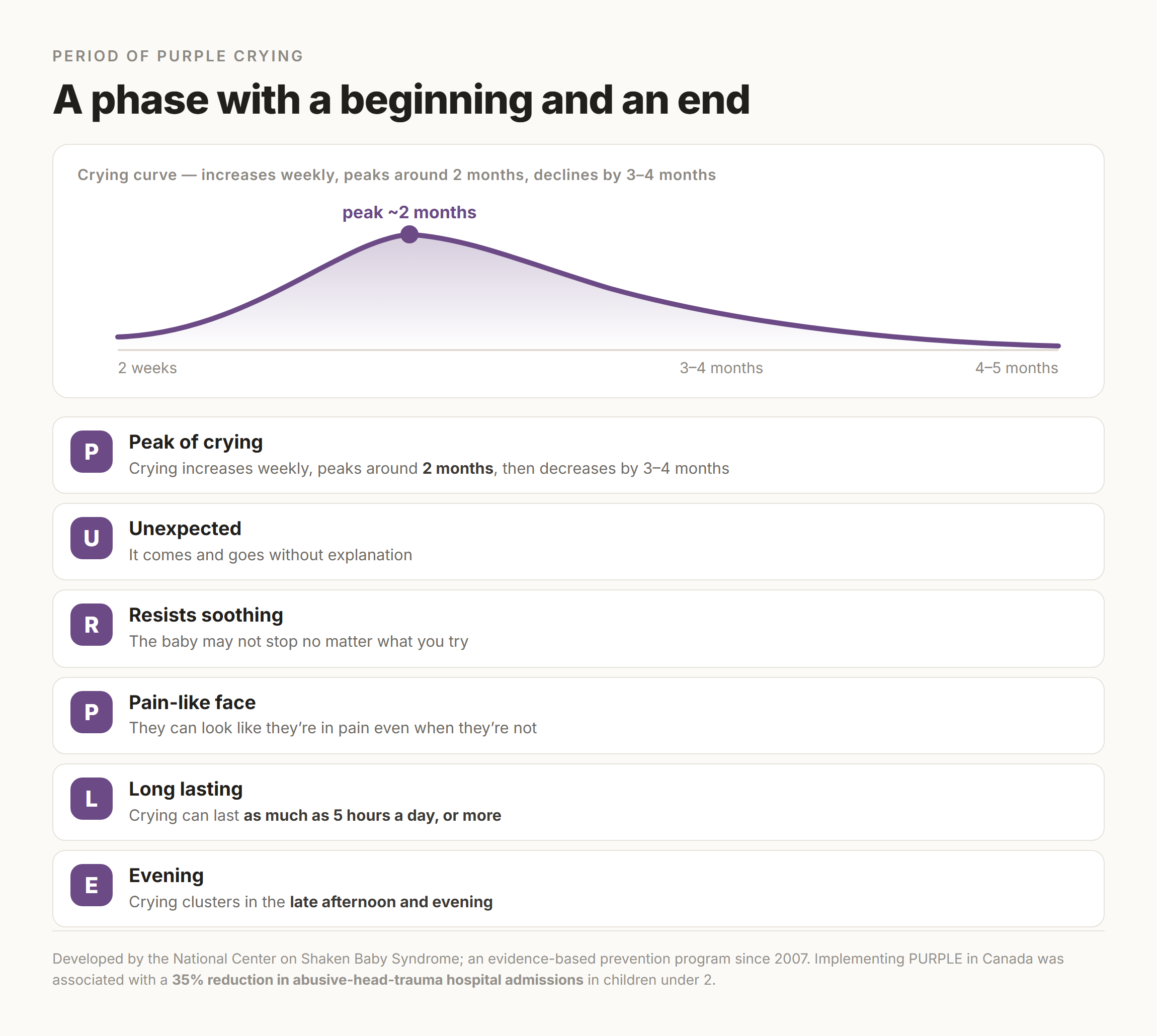
| Letter | Stands for | What it means |
|---|---|---|
| P | Peak of crying | Crying increases weekly, peaks around 2 months, then decreases by 3–4 months |
| U | Unexpected | It comes and goes without explanation |
| R | Resists soothing | The baby may not stop no matter what you try |
| P | Pain-like face | They can look like they’re in pain even when they’re not |
| L | Long lasting | Crying can last as much as 5 hours a day, or more |
| E | Evening | Crying clusters in the late afternoon and evening |
That last letter is the answer to the question this article opened with. The evening screaming isn’t a mystery you failed to solve. It’s the documented shape of the thing.
Implementing PURPLE in Canada was associated with a 35% reduction in abusive-head-trauma hospital admissions in children under 2.
The Protocol: Put the Baby Down and Step Away
This is the AAP’s guidance for the moment you feel you’re losing control. It is not a last resort. It’s the plan.
- Take a deep breath and count to 10.
- “Place your baby in a safe place, such as a crib or playpen without blankets and stuffed animals; leave the room and let your baby cry alone for about 10 to 15 minutes.”
- During the break, listen to music, call a support person, or do a household task.
- After 10–15 minutes, check on your baby — “but do not pick them up until you feel you have calmed down.”
- Call your pediatrician if the crying persists.
The AAP’s colic guidance repeats it: arrange childcare and leave temporarily if you can, and if you can’t, “it’s OK to lay the baby on their back in the crib… and leave the room for a few minutes.” Cleveland Clinic gives identical advice.
I want to state the thing too many parents never hear:
A baby left safely on their back in an empty crib for a few minutes is not being harmed.
Not neglected. Not damaged. Many parents genuinely don’t know this is permitted, and that gap is exactly what the guidance exists to close.
Your Own Mental Health Counts as Infant Safety

Photo: kaboompics.com / Pexels
Postpartum depression affects roughly 15–20% of women after childbirth, and colic affects roughly 20% of infants — the overlap is common by simple arithmetic. One study of a colic clinic population found 44% of the women presenting there were depressed; that figure comes from a single clinic reported secondhand, so treat it as “one study found,” not a general statistic.
StatPearls lists among colic’s complications: disrupted parent–infant bonding, early breastfeeding cessation, maternal depression, family stress, and risk of shaken baby syndrome. Notice that four of those five happen to the adults.
The AAP’s instruction is simple: tell your doctor if you are feeling depressed. If you are in crisis, a national crisis line and postpartum-specific support organizations exist for exactly this, and reaching one at 3 a.m. is a reasonable thing to do.
And the sentence worth carrying: colic is not your fault, and it does not harm your baby.
Red Flags: When It Isn’t Colic
Colic is a diagnosis of exclusion in a healthy, growing baby. Fewer than 10% of inconsolable-crying cases turn out to be organic — but that 10% matters enormously.
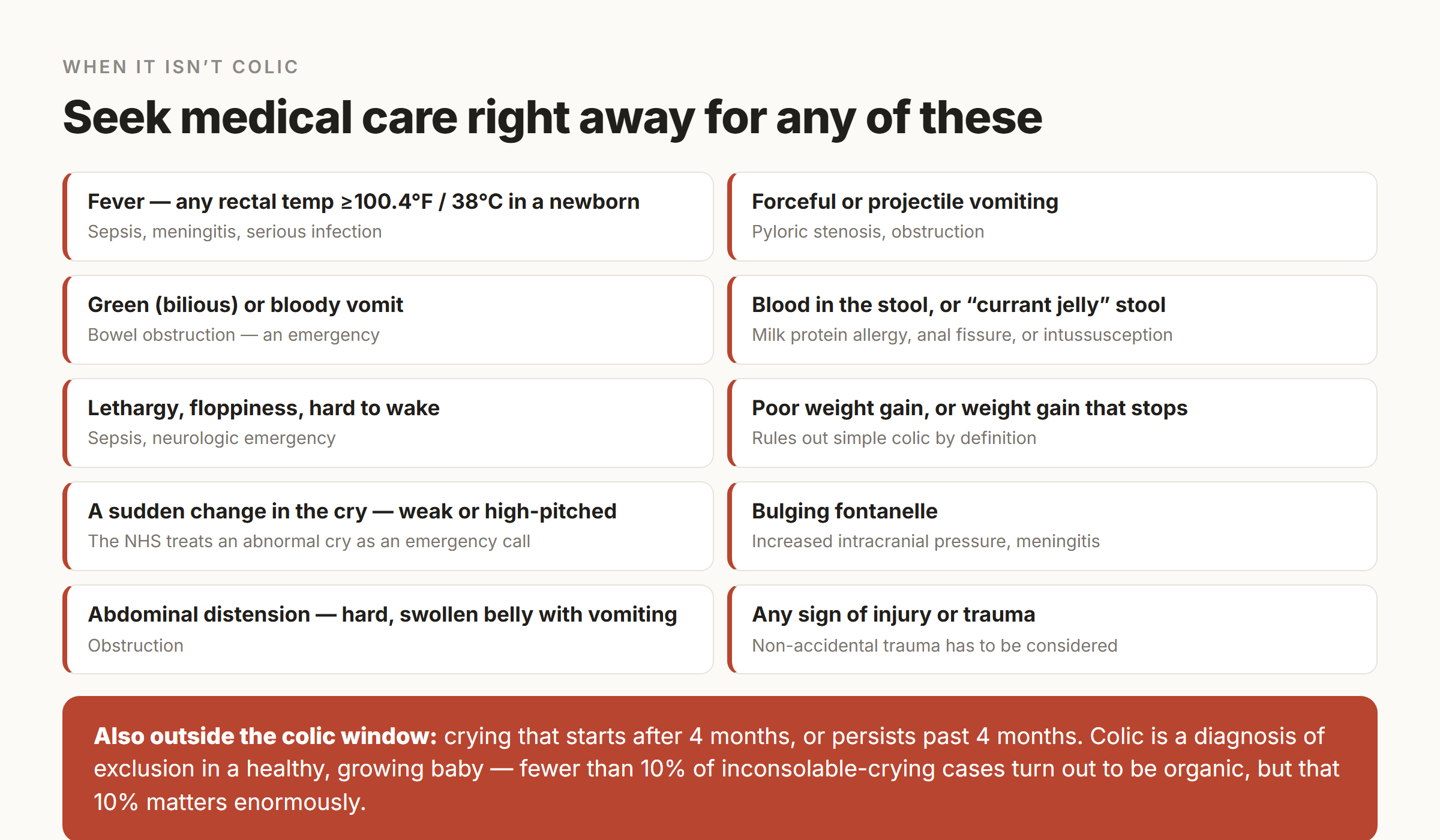
Seek medical care right away for any of these:
| Red flag | Why it matters |
|---|---|
| Fever — in a newborn, any rectal temp ≥100.4°F / 38°C | Sepsis, meningitis, serious infection |
| Forceful or projectile vomiting | Pyloric stenosis, obstruction |
| Green (bilious) or bloody vomit | Bowel obstruction — an emergency |
| Blood in the stool, or “currant jelly” stool (blood + mucus) | Milk protein allergy, anal fissure, or intussusception |
| Lethargy, floppiness, hard to wake | Sepsis, neurologic emergency |
| Poor weight gain, or weight gain that stops | Rules out simple colic by definition |
| A sudden change in the cry — weak, high-pitched, or a new pattern | The NHS treats an abnormal cry as an emergency call |
| Bulging fontanelle | Increased intracranial pressure, meningitis |
| Abdominal distension — a hard, swollen belly with vomiting | Obstruction |
| Any sign of injury or trauma | Non-accidental trauma has to be considered |
| Crying that starts after 4 months, or persists past 4 months | Outside the expected colic window |
Intussusception Deserves Its Own Paragraph
This is the one that hides inside a colic story.
It occurs in about 35–40 of every 100,000 babies under age 1, and it’s the most common cause of intestinal obstruction in babies and young children, with roughly 90% of cases before age 3 (NIDDK/NIH).
The signature pattern: severe crampy abdominal pain that comes and goes — initially every 15–20 minutes, then longer and more frequent — with crying that cannot be comforted, knees drawn up to the chest, lethargy, vomiting, and currant jelly stool.
Here’s the trap: knees-to-chest and inconsolable crying also describe ordinary colic. What separates them is the episodic on/off pattern, the lethargy between episodes, vomiting, and bloody or mucousy stool. Untreated, it can lead to tissue death, perforation, peritonitis, sepsis and shock — anyone with signs of it needs medical help right away.
One Small Thing Worth Checking at Home
Clinicians also rule out otitis media, reflux, a foreign body in the eye or throat, testicular torsion, inguinal hernia, cardiac arrhythmia, neonatal abstinence syndrome — and a hair tourniquet, a strand of hair wrapped tightly around a finger, toe, or the genitals.
That last one is genuinely checkable by a parent. Undress the baby and look at every finger and toe. It takes a minute, it occasionally solves the whole mystery, and it costs nothing.
Otherwise, diagnosis is clinical — history and physical exam. Lab tests and imaging are typically unnecessary for straightforward colic.
One last thing, and then I’ll stop.
Almost everything written about colic is aimed at the baby’s gut. After going through the evidence, I think that’s the wrong end of the problem. The gut theories are unproven, the gas remedies mostly don’t work, and the phase ends on its own schedule regardless. What actually changes outcomes is what happens to the adult holding the baby at 7 p.m. on the fourteenth consecutive evening.
So if tonight is one of those nights: the crying peaks around 2 months, about 90% of babies are through it by 3 to 4 months, and putting your baby down safely in an empty crib and walking out of the room for ten minutes is not a failure. It’s the recommended move.
The colic will end whether or not you solve it. You just have to still be standing when it does.
Medical disclaimer: This article is general information and is not a substitute for professional medical advice, diagnosis, or treatment. Nothing here is a treatment plan, and no remedy described is a cure for colic. Talk to your pediatrician about persistent crying in your baby, and seek emergency care for any red flag listed above.
Sources: American Academy of Pediatrics / HealthyChildren.org (colic, abusive head trauma, swaddling); AAP 2022 safe-sleep policy in Pediatrics; StatPearls — Infantile Colic; NIDDK — Intussusception; Cleveland Clinic — Colic; NHS — Colic; Sung et al., Pediatrics, 2018; Cochrane 2018 — Dietary modifications for infantile colic; Kaur et al., Child: Care, Health and Development, 2015; 2025 scoping review of manual interventions; National Center on Shaken Baby Syndrome — Period of PURPLE Crying. Compiled August 2026.