Baby Constipation After Starting Solids: Foods That Help
I still remember the first time I worried about this.
We had just started solids. A few spoons of cereal, some purees, the whole exciting mess. And then, a couple of days later, nothing. No dirty diaper. My baby grunted, went red in the face, and I sat there quietly panicking.
So if that is where you are right now, I want to say the calm thing first.
Baby constipation after starting solids is very common, and usually normal. Around six months, the gut is adapting to new textures and fiber while the amount of fluid from breastmilk or formula drops. Stools get harder. It happens to a lot of babies.
The good news is that a few simple foods really do help. Prunes, pears, peaches, peas, oatmeal. And a few foods quietly make it worse, which nobody tells you at first.
I want to walk through all of it here. But please read this as one parent sharing what the research says — not as medical advice. Some signs mean you skip the home remedies and call your pediatrician. I will get to those too.
Photo: Helena Lopes / Pexels
Why does starting solids cause constipation?
Three things tend to happen at once. Once I understood them, the whole thing felt less scary.
One — the fluid shift. Babies take in less breastmilk or formula when solids start. That is mostly water. So the stool loses water and hardens.
Two — a new job for a young gut. The digestive system is still maturing. Suddenly it has to handle textures and solids it has never seen. The rhythm gets disrupted for a while.
Three — low fiber at the start. First foods like rice cereal and plain purees are often low in fiber. There is little to bulk up or soften the stool.
Here is a detail that helped me relax. Nationwide Children’s notes that most of the time the baby “is not really constipated.” The usual causes are benign — a switch between breastmilk and formula, starting solids, drinking less formula. Truly rare causes exist, like a birth defect such as Hirschsprung disease, but those are uncommon.
One more honest note. Some straining, grunting, and a red face during a bowel movement can be completely normal for infants. Judge by the hardness of the stool, whether there is pain, and how your baby is behaving overall — not by effort alone.
Which foods actually help?
This is the part I wish someone had handed me on day one.
The “P” fruits
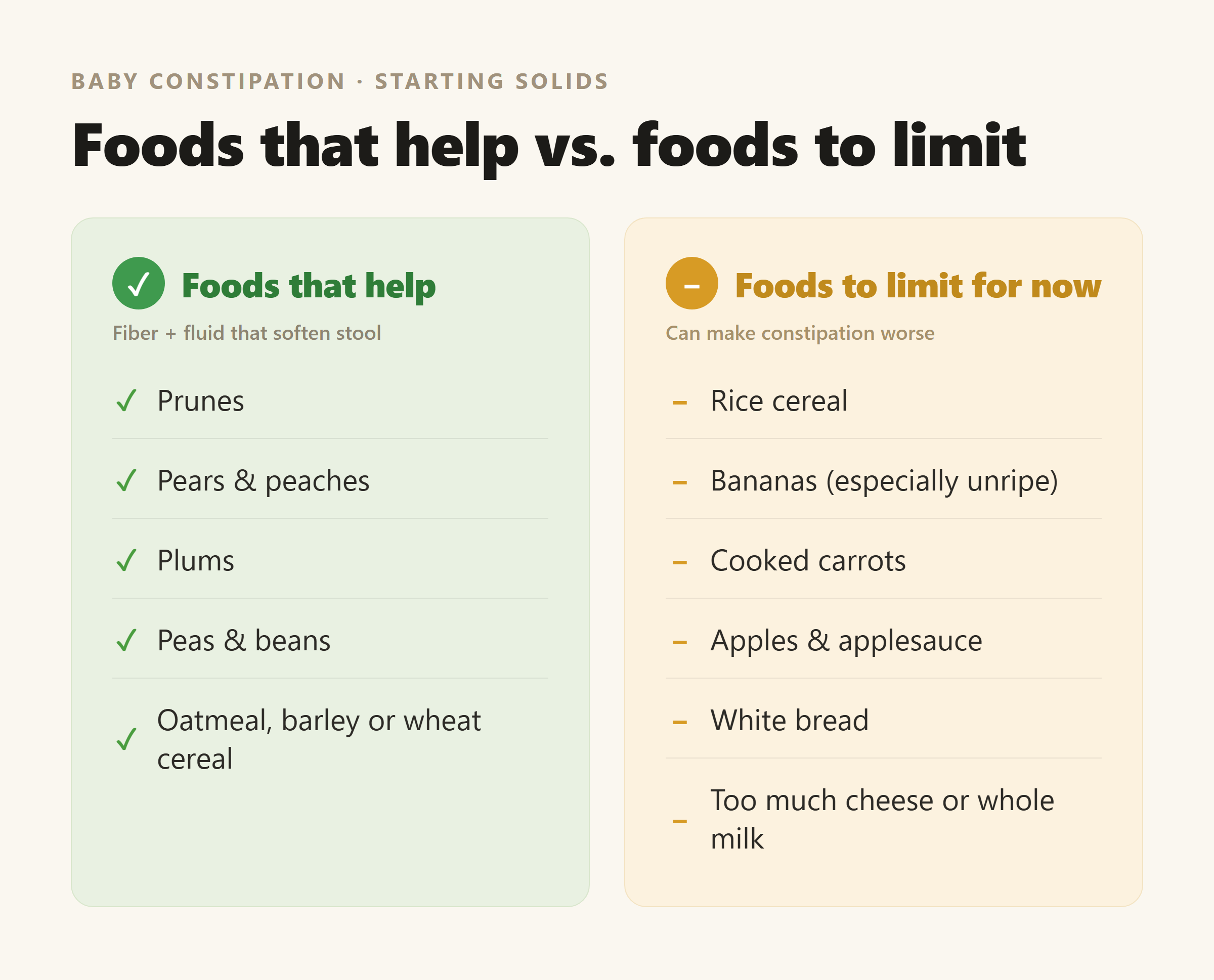
Prunes, pears, plums, and peaches help babies go. Prunes — dried plums — are the strongest, because they are high in both fiber and sorbitol. Sorbitol pulls water into the intestine, which softens things.
For a baby eating solids, offer them pureed. Pureed prunes, pears, or peaches.
Swap the cereal
If you are using rice cereal, that is worth a second look. Rice cereal can be constipating for some infants. Oatmeal, wheat, or barley cereal is a gentler choice.
Add a little more fiber
Age-appropriate fiber helps — beans, peas, prunes, pears. Both Alberta Health Services and CHOP frame fiber plus fluids as the first thing to try.
Foods to limit for now
And here is the flip side, which is just as useful. A few common baby foods can make constipation worse:
- Rice cereal
- Bananas, especially unripe ones
- Cooked carrots
- Apples and applesauce
- White bread
- Too much cheese or whole milk
I am not saying these are bad foods. They are fine foods. It is just that when your baby is backed up, easing off them for a bit can help.
What about fruit juice? (please read this part carefully)
Juice comes up a lot, and I want to be honest — this is where the sources do not fully agree.
So I will give you both, and then the one rule they share.
- HealthyChildren.org (AAP) suggests apple or pear juice with the guideline of “1 ounce per day for each month of life, up to about 4 months of age.” So a three-month-old would get up to about 3 ounces.
- Nationwide Children’s suggests “1 to 2 ounces of 100% fruit juice — pear, prune, cherry, or apple — once a day.”
- Mayo Clinic-style guidance points to a small daily amount of prune, pear, or apple juice, with total juice generally kept under about 4 ounces (120 mL) a day.
You can see the amounts do not line up neatly. And there is a bigger-picture tension too — the AAP has historically allowed small amounts of juice for constipation, while its broader nutrition guidance discourages routine juice for infants.
So here is the shared rule, and the one I would hold onto.
Juice is a short-term aid, not a daily habit. For young infants, only with a pediatrician’s approval. Confirm the exact amount with your pediatrician before you start.

Photo: Paloma Gil / Pexels
The physical tricks: massage, bicycle legs, a warm bath
Food is not the only tool. Some of the most reliable help is hands-on, and it costs nothing.
- Tummy massage. Gently massage the belly in a circular motion.
- Bicycle legs. Move the legs like pedaling a bike. Or hold the knees to the chest to mimic a squat, then release. This helps push the stool along.
- A warm bath. It simply relaxes the baby, which can be enough.
For fluids, make sure intake is adequate — continued breastmilk or formula, plus small amounts of water once age and solids allow.
One thing to be careful with. A glycerin suppository is only for occasional use, after several days without a bowel movement, and Nationwide Children’s frames it that way for a reason. Do not use laxatives, mineral oil, or enemas without talking to your provider first.

Photo: Nataliya Vaitkevich / Pexels
When should you stop the home remedies and call the doctor?
This is the section I would read twice.
Most of the time, the food and the leg exercises are enough. But some signs are not a “try prunes” situation. They are a “call your pediatrician” situation. Do not home-treat these:
- Blood in the stool. It can come from a small tear when stool is hard, but it can also mean infection, a milk-protein allergy, or something else. Do not self-diagnose.
- Black, white, or red stool, or persistent mucus.
- Vomiting, especially green vomit, with a bloated belly. Or a baby who cries with belly pain and pulls the legs up.
- Fever, lethargy, or poor weight gain, or a sharp drop in feeding.
- No bowel movement for three or more days with discomfort — or constipation that lasts more than a few days or keeps coming back despite the diet changes.
- A hard, swollen belly with severe pain.
- Diarrhea lasting more than a day or two alongside other symptoms.
I want to be clear about why I am spelling these out. Everything else in this article is general guidance. This list is the line where general guidance stops. If you see these, the safe move is a pediatrician’s evaluation, not another spoon of prunes.

A quick age-by-stage guide
Where your baby is in the journey changes what makes sense.
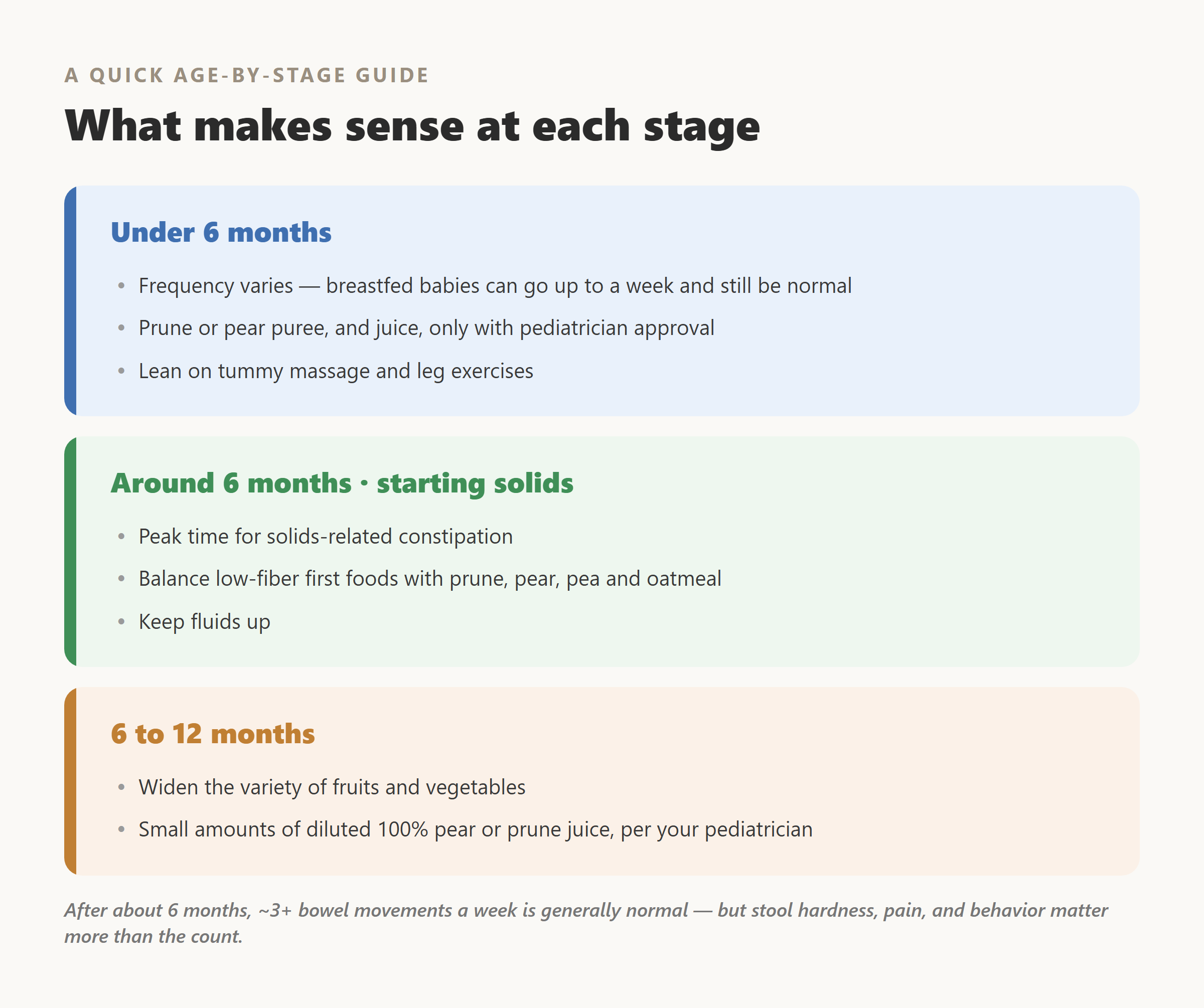
- Under 6 months. Frequency varies a lot. Breastfed babies can go several days — even up to a week — between stools and still be normal. At this age, prune or pear puree and juice only with pediatrician approval. Lean on massage and leg exercises.
- Around 6 months (starting solids). This is the peak time for solids-related constipation. Balance those low-fiber first foods with prune, pear, pea, and oatmeal, and keep fluids up.
- 6 to 12 months. Widen the variety of fruits and vegetables. Small amounts of diluted 100% pear or prune juice can be tried, per your pediatrician.
As a rough reference, after about six months, around three or more bowel movements a week is generally within the normal range. But honestly, stool hardness, pain, and your baby’s behavior matter more than the count.
Let me add just one last thing.
I know how it feels to stand over the changing table doing the math on when the last diaper was. The worry is real, and it does not make you dramatic.
But most of the time, this is a small, passing thing. A few pureed prunes, a cereal swap, some bicycle legs, a little patience. The gut catches up.
And on the days it does not — when something on that red-flag list shows up — you already know what to do. You call someone who can actually examine your baby.
Because the goal was never to handle everything at home. It was just to know which part is yours, and which part is the doctor’s.
This article is for general information only and does not replace medical evaluation. Always talk to your pediatrician about your own baby, especially before giving juice to a young infant or if any red-flag symptom appears.
Sources: HealthyChildren.org (American Academy of Pediatrics), Mayo Clinic, Nationwide Children’s Hospital, Children’s Hospital of Philadelphia (CHOP), Akron Children’s, Alberta Health Services, Medical News Today.
Related reading: [internal link: introducing first solids — a simple starter guide] · [internal link: normal baby poop, what’s normal and what’s not]