
How to Confirm Pregnancy: Tests, Timing, and Early Signs
Let me be honest about the part nobody really tells you.
The hardest thing about trying to confirm a pregnancy is not the test itself. It is the waiting, and the quiet arithmetic you do in your head — “Was it too early? Should I test again? Did I read that faint line right?”
So if you are here trying to figure out how to confirm pregnancy — which test to use, when to take it, and what those early signs actually mean — you are asking exactly the right questions. This is a plain, careful walk through what the medical sources actually say.
One thing first, though.
I am not your doctor, and this is not medical advice. It is general information. A positive or negative result — and anything that worries you — belongs in a conversation with a licensed provider, whether that is an OB-GYN, a midwife, or your physician.

Photo: RDNE Stock project / Pexels
What actually confirms a pregnancy?
It helps to start with the one thing every test is really looking for.
It is a hormone called hCG — human chorionic gonadotropin. Your body only makes it after a fertilized egg implants in the uterus, which happens roughly 6 to 10 days after conception. Once that implantation happens, hCG builds up fast, roughly doubling every 2 to 3 days in early pregnancy.
That single fact explains almost everything else on this page.
Every home test, every clinic urine test, and the qualitative blood test are all hunting for the same hormone. It is just a question of how sensitive the method is, and how early there is enough hCG to find.
So the honest summary is this: a test confirms pregnancy — not symptoms. We will get to the symptoms, but keep that line in your mind.
How a home pregnancy test works
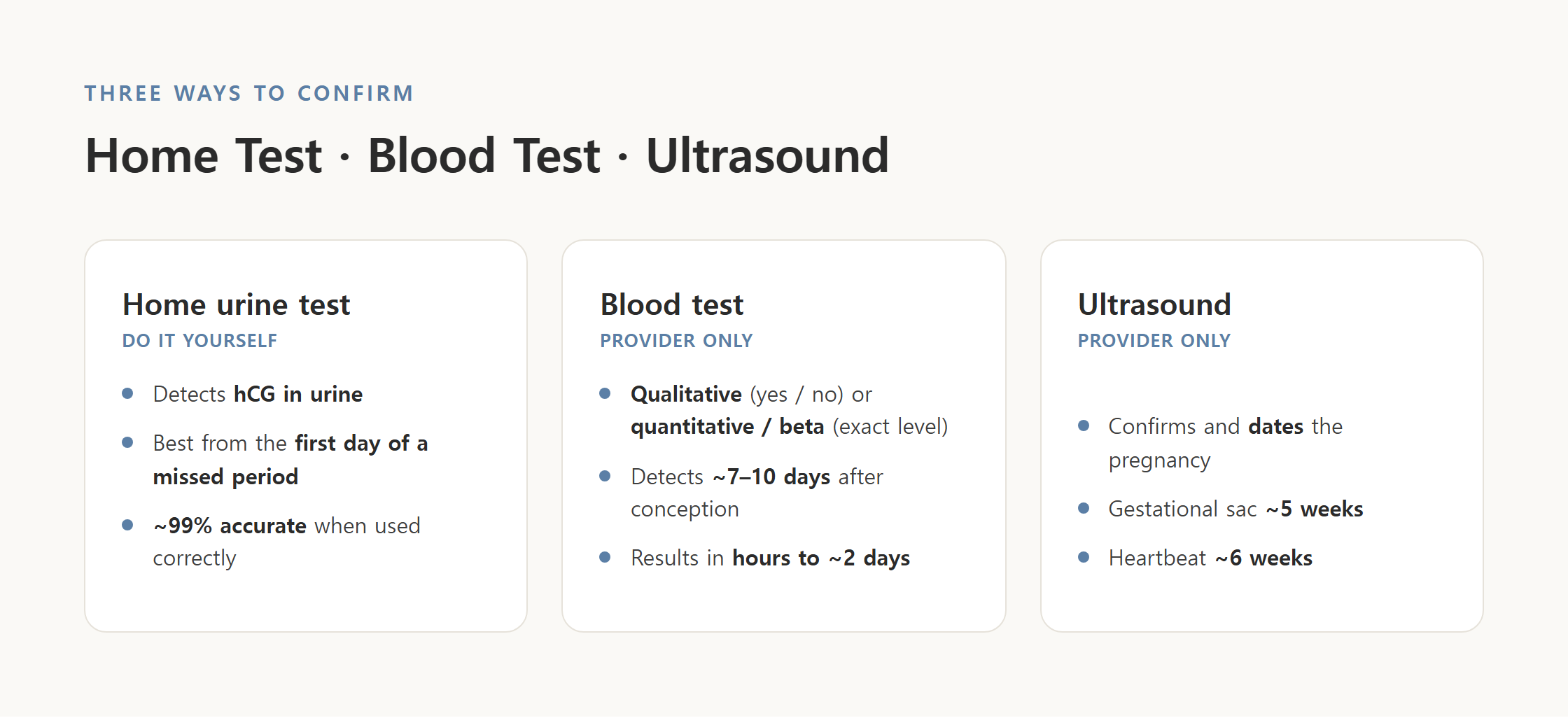
A home pregnancy test checks for hCG in your urine. Depending on the brand, you either hold the test in your urine stream, dip a strip into collected urine, or place a few drops onto the test.
Simple enough. The details are where people trip up.
Follow the kit exactly
This sounds obvious, but it is the quiet source of a lot of wrong results.
- Check the expiration date first.
- Wait the full time before reading — for many kits that is about 10 minutes.
- Do not read the result too early, and do not read it too late. Both reduce reliability.
That last point matters more than people think. A line that shows up outside the kit’s time window — an evaporation line — can mislead you. Read it inside the instructed window, and trust that window.
The best time to test
Here is the single most useful thing I can tell you.
For the most accurate result, take the test after the first day of a missed period.
Testing too early is the number one cause of a false negative. The hCG is there, but there is not yet enough of it for the test to catch. So the calendar, not your patience, is what does the work here.
First-morning urine is best, because it is the most concentrated, which makes hCG easier to find. If you cannot test in the morning, some guidance suggests waiting at least around 3 hours since you last went, and not drinking a lot of fluid beforehand — because dilute urine hides the hormone.
And if you genuinely do not know when your period is due? The NHS suggests testing at least 21 days after unprotected sex.

How early can you really test?
You will see bold claims here, and the honest answer is that the sources do not fully agree.
Some sensitive tests claim they can detect a pregnancy as early as about 10 days after conception, or 4 to 5 days before your expected period. That is technically possible. But the earlier you test, the harder hCG is to find, and the higher the chance of a false negative.
The NHS puts it plainly: tests are most reliable from the first day of a missed period, and earlier tests are simply less reliable.
Both things are true at once. Early testing is possible — but it is a gamble on accuracy.
About that “99% accurate” number
You have seen it on every box. Home tests are commonly described as around 99% accurate when used correctly, and manufacturers claim somewhere in the 98 to 99% range.
Read that phrase carefully: when used correctly.
Those numbers assume perfect timing and perfect use. Real-world accuracy is lower when you test too early or use the kit wrong. And here is a detail worth knowing — up to around 10% of people may not have implantation until after their first missed period, which can genuinely delay a positive result even when everything else is fine.
So the number is reassuring. It is just not a promise.
Digital or line test — does it matter?
Not for accuracy. Both detect the same hormone.
A line test shows one or two lines, and a faint second line can still mean positive. A digital test spells it out in a word — “Pregnant” or “Not Pregnant” — which takes the guesswork out of squinting at a faint line. Some digital tests even estimate the weeks since conception.
Pick whichever one you will read calmly. The hormone underneath is identical.
When the test says something you did not expect
False negatives
A false negative means the test says not pregnant, but you are. The usual reasons:
- Testing too early — hCG is not high enough yet. This is the most common cause by far.
- Ovulation or implantation happened later than you thought, delaying the hCG rise.
- Diluted urine, from testing late in the day or after drinking a lot.
- Using the test incorrectly — too much or too little urine, or reading it at the wrong time.
What to do: if the test is negative but your period has not come, wait a few days and retest. Remember hCG roughly doubles every 48 hours, so a few days can change the result. If it is still negative and your period still has not arrived, contact a provider.
False positives
These are rare, but they happen. A false positive says pregnant when you are not. Possible causes include:
- A chemical pregnancy — a very early miscarriage, where implantation happened and was then lost.
- Fertility medications that contain hCG, or a recent pregnancy loss leaving residual hormone behind.
- Certain ovarian conditions, or hormone changes around menopause.
This is one more reason a positive home test is a starting point, not a final answer.
Clinical tests: what a provider can do that you cannot
At some point the confirmation moves from your bathroom to a clinic. Here is what changes.

Photo: Lucas Guimarães Bueno / Pexels
Clinical urine test
Mostly it does not change. A urine test done at a clinic uses the same hCG-detection method as the one you did at home. Same hormone, same idea.
Blood tests
Blood tests are the part only a provider can do — and they detect pregnancy earliest. There are two kinds:
- Qualitative hCG blood test — a yes or no on whether hCG is present. It is about as accurate as a urine test.
- Quantitative, or beta, hCG blood test — this measures the exact amount of hCG in your blood. That number can help estimate gestational age and track how the pregnancy is progressing.
Blood tests are slightly more sensitive than urine tests. Cleveland Clinic describes detection roughly 7 to 10 days after conception; the U.S. Office on Women’s Health says around 10 days. Other lab sources cite windows like 6 to 8 days, or 8 to 11 days. They do not perfectly agree on the earliest day — but they all agree blood detects earlier than urine.
Results usually take anywhere from a few hours to about two days. And because quantitative hCG doubles about every 48 to 72 hours in the first weeks, a provider may repeat the test to check that the level is rising the way it should.
Ultrasound
Ultrasound is where a pregnancy stops being a hormone reading and becomes something you can see. It confirms the pregnancy is in the uterus, dates it, and later checks the heartbeat.
- A gestational sac is usually visible by about 5 weeks on a transvaginal scan.
- A fetal heartbeat is usually detectable by about 6 weeks, when the sac is roughly 10 to 15 mm, and most reliably around 6 to 7 weeks. Early on the heart rate may be under 100 bpm, rising to about 120 to 180 bpm by around 7 weeks.
- A transvaginal ultrasound generally shows these findings earlier than an abdominal one. It typically shows an intrauterine pregnancy once beta-hCG reaches roughly 1,000 to 1,500 IU/L.
One gentle note on timing. Because pregnancies develop at slightly different rates, a scan at around 5 weeks may show very little — and a scan a week later usually shows much more detail. An early “we do not see much yet” is not the same as bad news.
Early signs — and why they confirm nothing on their own
I want to be careful here, because this is where hope and worry both live.
The early signs of pregnancy are real. But they vary enormously — some people have many, some have almost none. A test confirms pregnancy. Symptoms only suggest it.
With that said, here is what the sources describe, and roughly when.
- Missed period — the most recognizable early sign. Pregnancy hormones stop ovulation and menstruation. Though stress and other things can also cause a missed period.
- Implantation spotting — light spotting or brownish discharge when the fertilized egg attaches to the uterine lining, about 10 to 14 days after conception.
- Nausea, or “morning sickness” — it can hit any time of day, and often begins about 1 to 2 months after conception. Some feel it earlier, some never do.
- Breast tenderness or changes — breasts may feel tender or swollen, and the areolas may darken or enlarge, all in response to rising hormones.
- Fatigue — driven by rising progesterone and a body working harder to support the pregnancy.
- Frequent urination — blood volume rises in pregnancy, so the kidneys process more fluid, which ends up in the bladder.
There are quieter ones too: food cravings or aversions, a metallic taste, headaches, dizziness, mild cramping, mood swings, bloating, nasal congestion, and skin changes.
On timing overall: a few signs — light spotting, fatigue, mild cramping — can appear as early as around a week after conception. But most begin a few weeks later, commonly around the 4 to 6 week mark, which is 1 to 2 weeks after the first missed period.
As for when to test, you can generally get a reliable home result about a week after a missed period, or as soon as you miss it.

When to see a provider
So the line turned positive — or your period is missing and the test keeps saying no. What now?
After a positive home test, schedule an appointment. A provider may confirm it with a blood test or an ultrasound.

Photo: Ivan S / Pexels
If the test is negative but your period has not arrived, retest in about a week. If your periods stay absent, or a second test is negative and your period still has not come, speak to a provider.
For prenatal care, the guidance points the same direction from two angles. Cleveland Clinic notes the first prenatal visit is typically scheduled between the 6th and 8th week of pregnancy. ACOG’s 2025 guidance says it is best to begin prenatal care in the first trimester — ideally an initial assessment before 10 weeks of gestation, counted from your last menstrual period, or whenever you first come in for care.
Either way, the message is the same: sooner is better, and there is no prize for waiting.
One thing that is not routine — the sign to act on
Most of this article is about patience. This part is not.
Seek prompt medical care for severe abdominal pain, heavy bleeding, or a positive test paired with sharp pain on one side — which can be a sign of an ectopic pregnancy. This is one where you stop weighing options and call someone.
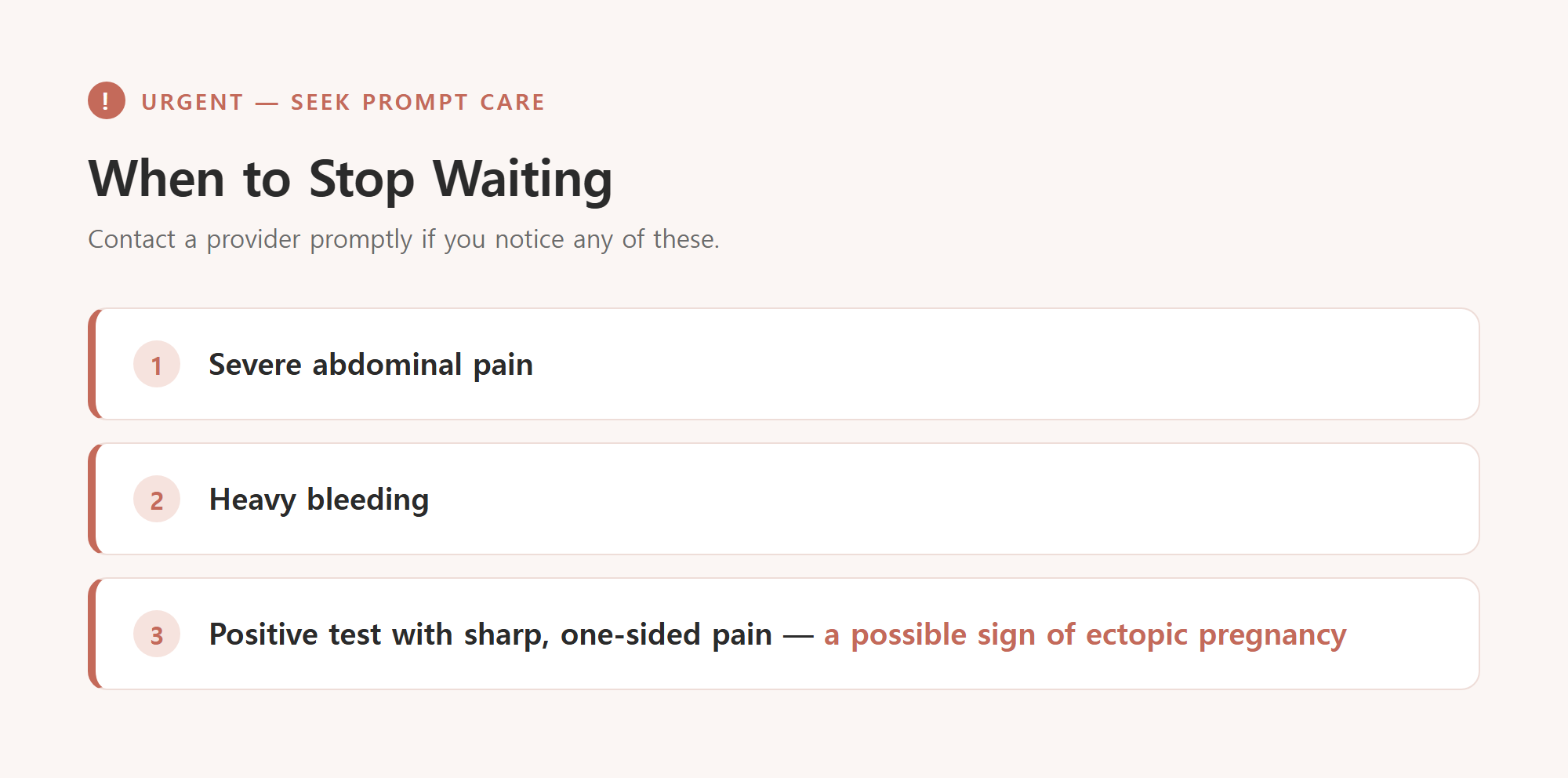
I am not saying this to frighten anyone. Ectopic pregnancy is uncommon. But it is the one situation on this page where knowing the warning signs, and taking that specific pain seriously, genuinely matters.
The short version
If I had to compress all of this into a few lines, it would be this.
Every test is looking for one hormone, hCG. A home test is at its most accurate from the first day of a missed period, using first-morning urine, and testing too early is the main reason a real pregnancy shows up negative. Blood tests and ultrasound, done at a clinic, confirm and date things more precisely. And early symptoms can hint at pregnancy, but they never confirm it — a test does.
Keep one line bright in your mind, though: a positive result is a beginning, not a conclusion.
The hormone level, the dating, and anything that looks off — very low or slow-rising hCG, no sac when one is expected, pain or bleeding — all need a real provider to interpret. Not a box, and not an article, including this one.
Everything here is general information, not a substitute for medical advice. The person who examines you knows your history. A short message to them, once you have that result in your hand, is worth more than any page you can read at 2 a.m.
Because this is the one thing you would not want to guess at.
References
- American College of Obstetricians and Gynecologists (ACOG) — “Prenatal Care” FAQ and 2025 “Tailored Prenatal Care Delivery” guidance
- Cleveland Clinic — “Pregnancy Test: When To Take, Types & Accuracy” and “Am I Pregnant? Early Pregnancy Symptoms & When To Test”
- Mayo Clinic — “Home pregnancy tests: Can you trust the results?”
- U.S. Office on Women’s Health (womenshealth.gov) — “Pregnancy tests”
- NHS (UK) — “Doing a pregnancy test”
- Ultrasoundpaedia — “1st trimester normal” (gestational sac and fetal heartbeat timing on ultrasound)