US Pregnancy Benefits and Government Support, Week by Week
Let me be honest about something first.
The week I started looking into pregnancy benefits in the US, I expected one tidy government program. A single form. A single answer.
That is not how it works here.
What you actually get is a patchwork. Some help comes from the federal government, some from your state, and a lot of it depends on your income and your zip code. If that sounds messy, it is. But once you can see the whole map, it stops feeling impossible.
So this is a plain, honest walk through the main pregnancy benefits and government support you can look into, roughly in the order they matter across the weeks.
One thing before we start. I am not a lawyer, a tax advisor, or your doctor. This is general information, not advice. Every number here changes over time, and almost everything depends on your state, so treat this as a starting map and confirm the details with the official sources I point you to.

Photo: Matilda Wormwood / Pexels
Federal or state? The one distinction that makes it all click
Here is the mental model that finally made this make sense to me.
Support in the US comes in two layers.
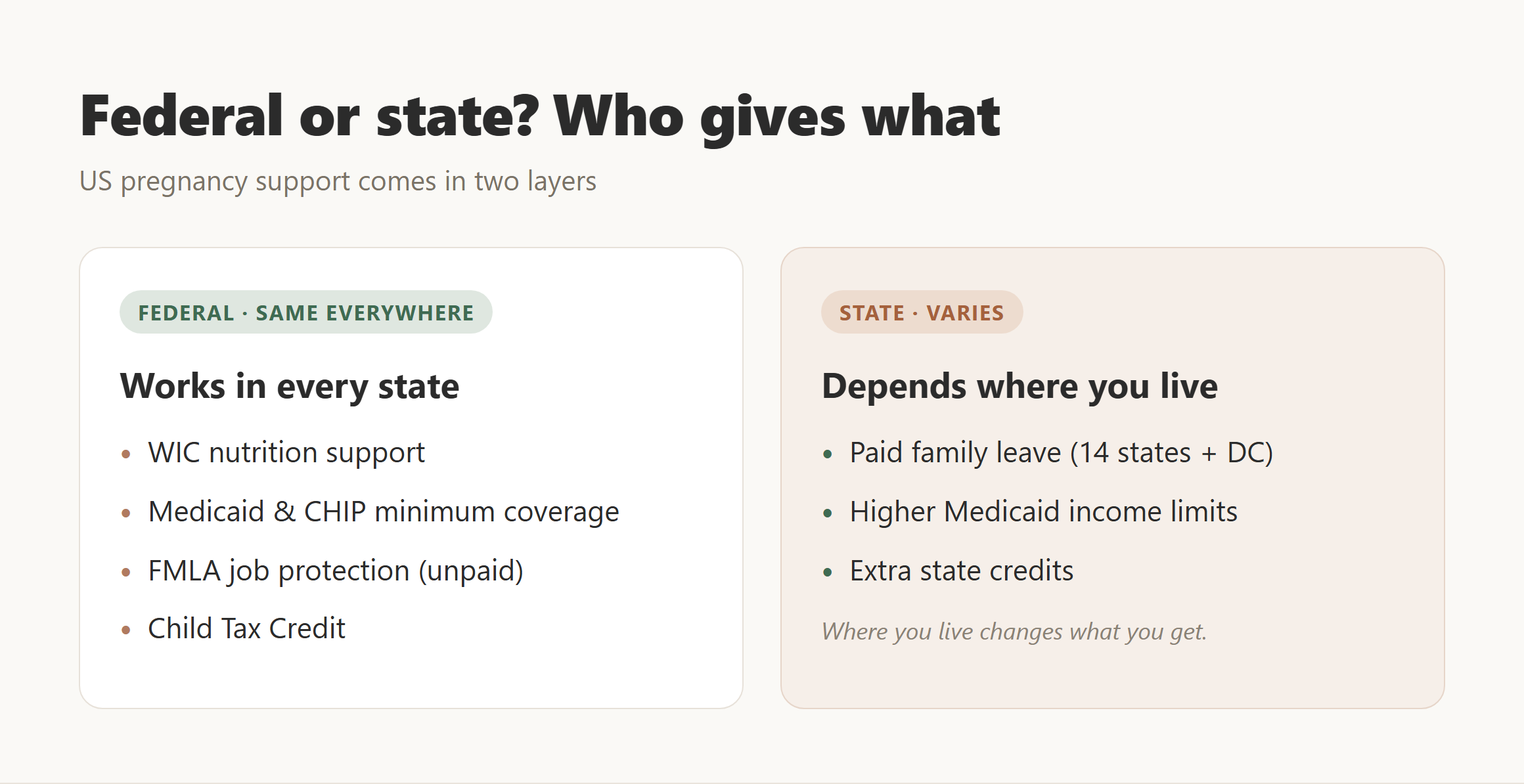
- Federal programs work more or less the same everywhere: WIC nutrition, the minimum Medicaid coverage for pregnancy, FMLA job protection, and the Child Tax Credit.
- State programs vary enormously. Paid family leave only exists in some states. Medicaid income limits are higher in some states than others. A few states add their own credits.
The single most important sentence in this whole article is this one.
Where you live changes what you get.
As of 2026, only 14 states plus Washington, DC have a statewide paid family and medical leave program. That means most of the country has no paid leave law at all. So as we go, keep asking “is this federal, or does it depend on my state?”
WIC: nutrition help during the pregnancy itself
WIC is one of the earliest supports worth checking, because it is built for exactly this stage of life.
WIC stands for Women, Infants, and Children. It helps low-income pregnant, postpartum, and breastfeeding women, plus infants and children up to age 5, when there is a nutritional risk. It provides supplemental healthy foods, nutrition education, breastfeeding support, and referrals to health care.
Who qualifies during pregnancy? You can apply if you are currently pregnant, up to six months postpartum, or breastfeeding up to the baby’s first birthday.
A small but genuinely useful detail: count your unborn baby in your family size when you apply. A bigger household means a higher income limit.
- The income limit is generally 185% of the Federal Poverty Level.
- For 2025 to 2026, a family of four earning up to roughly $61,050 a year may qualify.
- If you already receive SNAP, Medicaid, or TANF, you automatically meet WIC’s income test.
You also need to meet a state residency requirement and be found to be at nutritional risk by a health professional. You can find your local WIC office through benefits.gov or your state’s WIC agency.

Photo: www.kaboompics.com / Pexels
Medicaid and CHIP: coverage for the pregnancy and birth
If WIC is about food, Medicaid is about the medical care itself, prenatal visits, the delivery, and postpartum care.
Here is something reassuring. Federal law requires every state to cover pregnant women under Medicaid as a mandatory group. So there is a floor everywhere.
- States cannot set their pregnancy Medicaid income limit below the federal minimum, which lands somewhere around 133% to 185% of the Federal Poverty Level depending on the state.
- Most states go higher. 38 states set the upper limit at or above 200% of the Federal Poverty Level.
- As with WIC, the unborn child counts as a household member, which quietly raises the income limit for you.
For a sense of scale, the 2026 Federal Poverty Level in the 48 contiguous states is about $15,960 a year for one person and about $33,000 for a family of four.
CHIP, the Children’s Health Insurance Program, can also cover pregnant women and children, generally at the higher of 200% of the Federal Poverty Level or 50 points above the state’s Medicaid level.
The practical takeaway is about timing. Coverage can start once you are found eligible, so applying early in pregnancy is what gets your prenatal care covered. Apply through your state Medicaid agency or medicaid.gov.
FMLA: your job is protected, but the leave is unpaid
This is the one that surprises people most, so I want to be straight about it.
The Family and Medical Leave Act, or FMLA, gives eligible employees up to 12 weeks of unpaid, job-protected leave, and keeps your group health benefits in place while you are out. It covers the birth and care of a newborn, adoption or foster placement, and pregnancy complications.
The important word is unpaid.
FMLA protects your job. It does not pay you. You can choose, or your employer can require, to use accrued paid vacation or sick time during that leave, but FMLA itself is not a paycheck.
And not everyone is even eligible. You generally need all three of these.
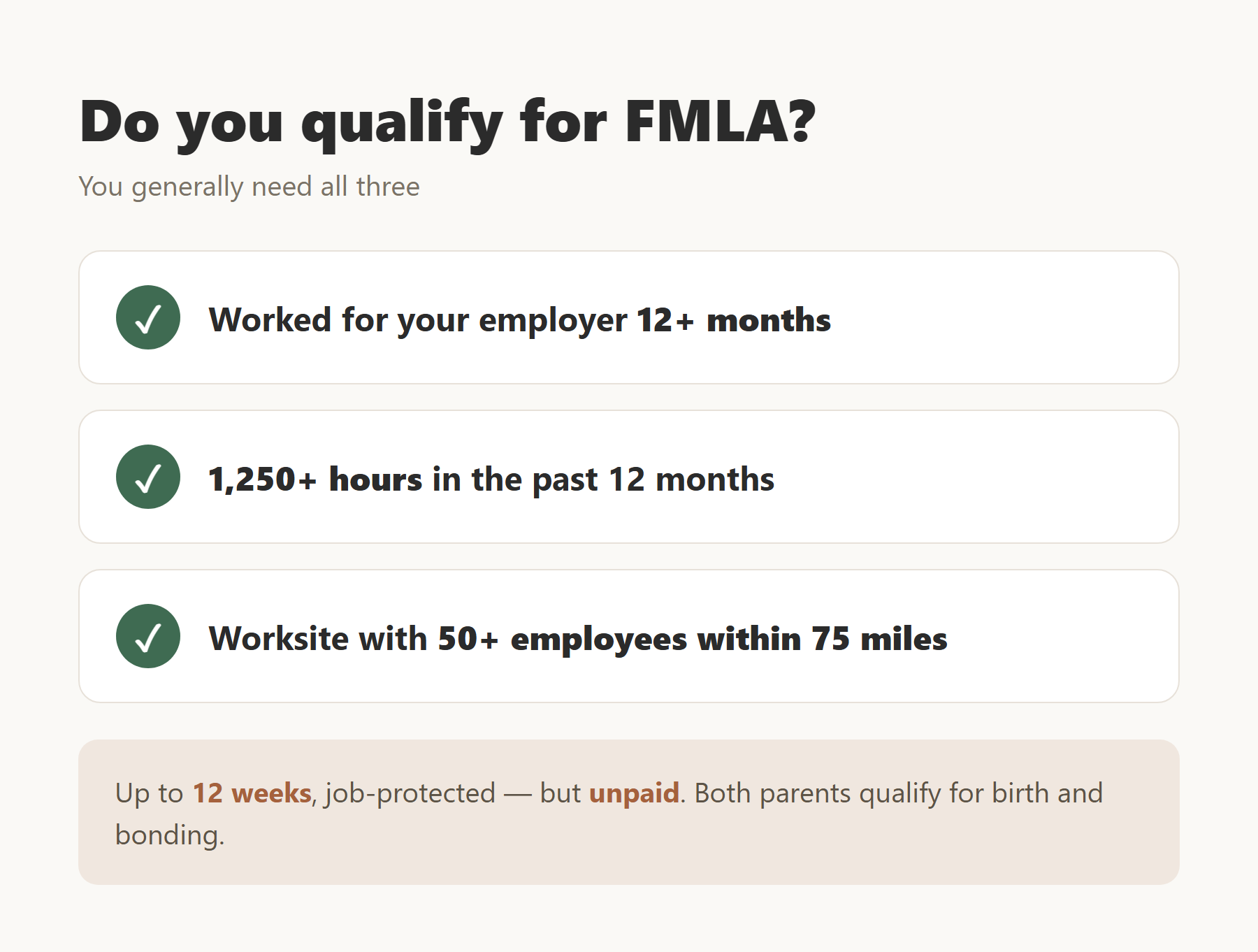
Both parents, birthing and non-birthing, are each entitled to their own 12 weeks for birth and bonding. But FMLA only applies to employers with 50 or more employees (plus public agencies and schools). So if you work part-time, you are newly hired, or your company is small, you may not qualify at all. That gap is real, and it is worth checking your own situation early.
State paid family leave: where you live changes everything
This is where the map splits hardest.
Some states have built their own paid family leave on top of FMLA’s unpaid protection. As of 2026, that list is California, Colorado, Connecticut, Delaware, DC, Maine, Massachusetts, Minnesota, New Jersey, New York, Oregon, Rhode Island, and Washington (Maryland and Virginia are on the way in later years).
If your state is not on that list, there is no state paid leave, and you fall back on FMLA, employer benefits, or short-term disability.
For the states that do have it, the duration and pay differ a lot. A few examples:
| State | Bonding leave | Wage replacement |
|---|---|---|
| New York | Up to 12 weeks | About 67% of average weekly wage |
| Minnesota | 12 weeks (up to 20 combined) | 55–90%, sliding scale by income |
| Massachusetts | Up to 12 weeks family | ~80% up to a threshold, then 50% |
| Oregon | Up to 12 weeks | Up to 100% for lower earners |
| Rhode Island | Up to 6 weeks bonding | ~60–70% |
These programs are funded by small payroll deductions, no more than 1.3% in any state in 2026, and usually 1% or less. The key move here is simple: look up your own state’s paid-leave agency and read its rules, because a number from a neighboring state tells you nothing about your own.
The Child Tax Credit, once your baby arrives
Not all support comes during pregnancy. One of the bigger ones shows up later, at tax time.
The federal Child Tax Credit is worth up to $2,200 per qualifying child for 2025 taxes filed in 2026, and it stays at $2,200 for 2026. Up to $1,700 per child can be refundable, which matters if you owe little or no federal tax.
Here is the part new parents ask about: a newborn qualifies for the year they are born. The main condition is that the child has a Social Security number valid for employment, issued before your tax return’s due date. A baby born during the year is treated as having lived with you all year.

Photo: Sarah Chai / Pexels
You get the full credit if your income is no more than $200,000, or $400,000 if married filing jointly, and it phases down above that. So getting your baby’s Social Security number sorted early is a small task with a real payoff.

A week-by-week way to hold it all
If the list feels like a lot, this rough timeline is how I would order it.
- Early pregnancy: apply for Medicaid or CHIP so prenatal care is covered, apply for WIC and count the unborn baby, and check whether you qualify for FMLA and whether your state has paid leave.
- Mid to late pregnancy: work out the paperwork with your HR department, understand your state’s wage-replacement rate and any waiting period, and keep your WIC appointments.
- After birth: use your bonding leave, get the baby a Social Security number, keep WIC going through the postpartum and breastfeeding months, and claim the Child Tax Credit when you file.
None of this is one form or one office. But taken one step at a time, across the weeks, it is manageable.
The short version
If I had to compress all of it into a few lines, it would be this.
There is no single US pregnancy benefit. There is WIC for food, Medicaid for care, FMLA for job protection, sometimes state paid leave for a paycheck, and the Child Tax Credit at the end. Which ones you actually get depends on your income and, more than anything, your state.
So do the boring, powerful thing. Check the official sources for your own situation: benefits.gov, medicaid.gov, dol.gov, irs.gov, and your state’s paid-leave agency. A benefits counselor or a hospital social worker can also walk you through it for free.
Because the help is real. It is just scattered, and it mostly goes to the people who take the time to go looking.
References
- USDA Food and Nutrition Service — WIC Eligibility and Income Guidelines (2025–26)
- Medicaid.gov / CMS — CHIP and Medicaid Eligibility Levels
- KFF — Medicaid and CHIP Income Eligibility for Pregnant Women (% of FPL)
- US Department of Labor — Family and Medical Leave Act (FMLA)
- IRS — Child Tax Credit
- New America; Bipartisan Policy Center — State Paid Family Leave overview; New York State Paid Family Leave (2026)