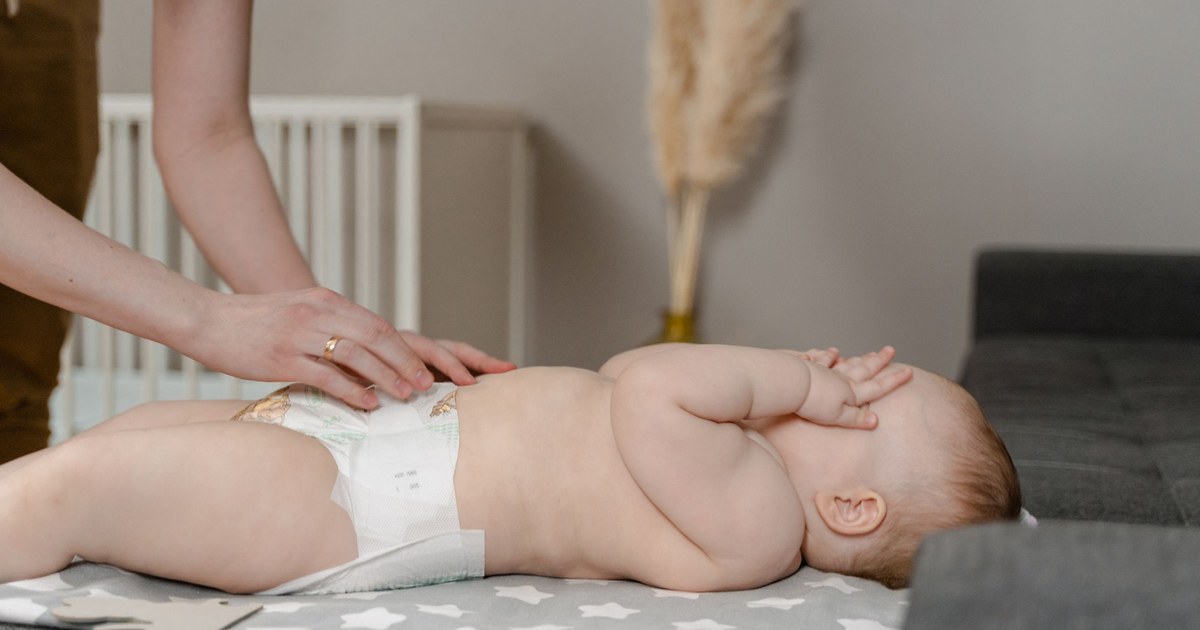
Infant Diarrhea: Dehydration Signs and the Right Fluids
The fourth diaper was the one that made me stop and count.
Not because it was worse than the others. Because I realized I had no idea what number I was supposed to be worried about. Somewhere on the internet I had absorbed a rule — fewer than five wet diapers means dehydration, go to the ER — and when I went looking for where that number came from, I couldn’t find it. Not in the AAP’s guidance. Not in the CDC’s. Not in the NHS’s.
So here’s the honest version up front. Infant diarrhea is dangerous because of dehydration, not because of the diarrhea itself — and the actual thresholds pediatric guidance uses are “fewer than six wet diapers a day” for mild-to-moderate dehydration and “only one to two urinations a day” for severe. Those are two different tiers with two different responses, and collapsing them into one scary number helps nobody.
The other half of this article is about what you put in the baby. That part is where well-meaning parents cause real harm, because the obvious answer — water — is the wrong one.
Photo: MART PRODUCTION / Pexels
A note before anything else: this is general information, not medical advice. None of the numbers below are a prescription for your child. Any baby you suspect is dehydrated belongs in a phone call with your pediatrician, and some of the signs further down belong in an ER.
What’s Actually Causing the Diarrhea
WHO defines diarrhea as “the passage of 3 or more loose or liquid stools per day (or more frequent passage than is normal for the individual).” That last clause matters — a breastfed newborn’s baseline is not a toddler’s baseline.
In US infants and toddlers, acute gastroenteritis is overwhelmingly viral. Three viruses do most of the work.
- Norovirus — sudden vomiting plus non-bloody diarrhea, incubation 12 to 48 hours. It’s now the dominant pediatric cause in the US, and in one post-vaccine-era comparison it was significantly more associated with severe dehydration than rotavirus. It’s also shed for significantly longer than rotavirus or adenovirus.
- Rotavirus — per the CDC, “vomiting and watery diarrhea can last 3 to 8 days,” often with fever, belly pain, and loss of appetite.
- Enteric adenovirus — usually a longer incubation and a more drawn-out, milder course, though it does put children in the hospital.
Rotavirus used to be the headline. It isn’t anymore, and that’s a vaccination story: US surveillance found the median annual percentage of positive rotavirus tests fell from 25.6% before vaccination (2000–2006) to 6.1% after (2007–2018), with a herd effect reaching older children and adults who were never vaccinated. The CDC puts vaccine protection against severe rotavirus illness and hospitalization at 85%–98% during an infant’s first year.
The catch is coverage. Rotavirus vaccination has consistently run lower than other infant vaccines — the dosing windows are narrow (first dose before 15 weeks, whole series done before 8 months) — and CDC survey reporting in 2026 described coverage slipping in recent birth cohorts rather than climbing. I’m deliberately not printing a current coverage percentage here, because it’s the fastest-moving figure in this whole topic and I’d rather you get it from your pediatrician than from a blog post.
The AAP also lists non-viral causes: bacteria, parasites, digestive problems, certain medications, and “changes in diet (such as drinking too much fruit juice).”
Hold onto that juice line. It comes back.
Why Babies Dehydrate So Much Faster Than You Do
This part of the folk wisdom is completely right, and the physiology is worth understanding because it explains everything that follows.
Total body water runs about 70% of body weight in infants, roughly 65% in children, and about 60% in adults. A baby is, proportionally, a wetter object — and paradoxically that means less reserve, not more, because the turnover is so much faster.
- Infants take in roughly three times more water per unit of body weight than adults do.
- Insensible losses — plain evaporation from skin and airway — account for about one third of total maintenance water, and proportionally more in a baby because of the surface-area-to-mass ratio.
- The kidneys don’t reach adult concentrating and diluting capacity until around age 2. A baby literally cannot conserve water the way you can.
- Higher metabolic rate means higher fluid and solute turnover.
And then the non-physiological one, which is the one that actually gets missed: infants “cannot independently communicate their thirst to caregivers or access fluids.” A thirsty adult goes to the sink. A thirsty eight-month-old cries the same way she cries about everything else.
That’s why this is a counting-and-watching problem rather than a wait-and-see problem.
How Dehydration Is Actually Graded: Mild-to-Moderate vs. Severe
Here’s the correction I went looking for. No major guideline uses a “fewer than 5 wet diapers” threshold. What they use is this.

Photo: kaboompics.com / Pexels
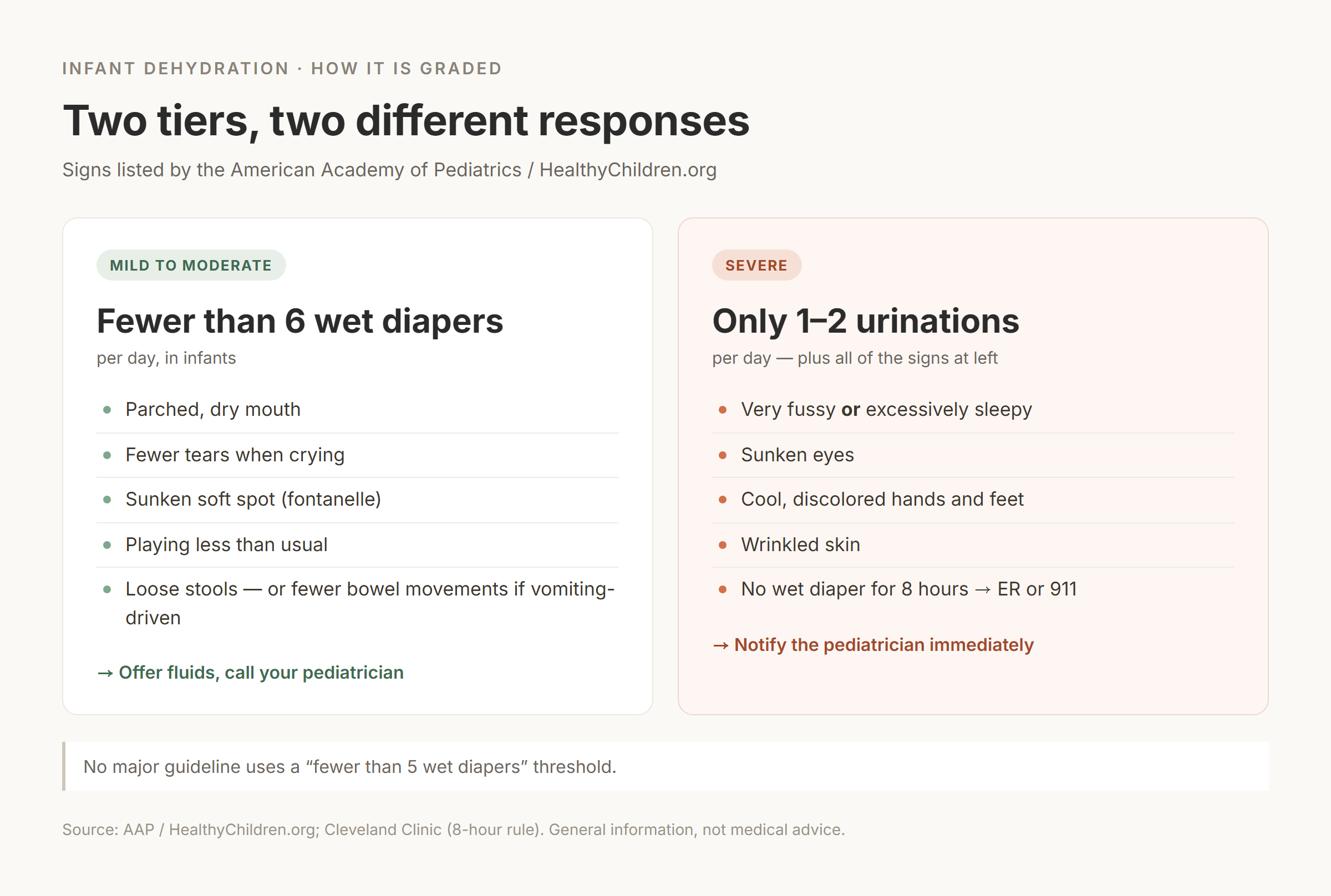
| Tier | Signs (AAP / HealthyChildren) |
|---|---|
| Mild to moderate | Urinating less often — for infants, fewer than six wet diapers per day; “parched, dry mouth”; fewer tears when crying; sunken soft spot (fontanelle); playing less than usual; loose stools, or fewer bowel movements if it’s vomiting-driven |
| Severe | All of the above, plus: very fussy or excessively sleepy; sunken eyes; cool, discolored hands and feet; wrinkled skin; urinates only one to two times per day |
Two things fall out of that table that the popular version gets wrong.
First, “no tears when crying” is a mild-to-moderate sign, not a severe one. It’s an early warning that you should be counting diapers and offering fluids, not a five-alarm bell on its own.
Second, “sunken eyes” is in the severe column. So is cool or mottled hands and feet, and so is a baby who’s suddenly hard to keep awake. Those belong to a different tier and a different response.
The AAP’s instruction on the severe list is to notify the pediatrician immediately. Cleveland Clinic adds the clock-based version that most parents find easier to use at 2 a.m.: no wet diaper or no urination for eight hours is an emergency — call 911 or go to the ER.
WHO’s field version, if you want the simplest mental model: severe is lethargy or unconsciousness, sunken eyes, unable to drink or drinking poorly, and a skin pinch that takes 2 seconds or more to spring back; some dehydration is restlessness or irritability, sunken eyes, and drinking eagerly because they’re thirsty.
Clinicians score this more formally with a validated 4-item Clinical Dehydration Scale (general appearance, eyes, mucous membranes, tears): 0 points is under 3% dehydration, 1–4 points is mild at 3%–6%, and 5–8 points is moderate to severe at over 6%. The individual signs family physicians find most useful are prolonged capillary refill, abnormal skin turgor, and an abnormal breathing pattern.
And the sign you want to see going the other way — recovery looks like increased activity, better appetite, more frequent urination, and the dehydration signs disappearing.
Why Plain Water Is the Wrong Fix
This is the section I’d tape to the fridge.
Water and diluted formula can cause seizures
Giving a dehydrated infant plain water feels like the most obviously correct thing in the world. It isn’t, and the mechanism is simple: water supplies free water with no sodium. Enough of it dilutes serum sodium below 135 mEq/L — hyponatremia — which causes cerebral edema.
This is not theoretical. A documented case series in Pediatrics described eight infants aged 2 to 5 months who presented with somnolence or irritability, seizures, and hypothermia after ingesting dilute formula. The usual culprit was tap or bottled water given as supplemental feedings, or formula mixed too thin, “in excessive amounts over relatively short periods of time.”
And the clinical literature is blunt about who’s most exposed: “Young infants with vomiting and diarrhea are especially prone to developing hyponatremia if fed fluids lacking sufficient sodium.” The sick baby is the high-risk baby. For infants under six months with an otherwise normal exam, hyponatremia is the leading cause of new-onset non-febrile seizure.
So the practical rule, and I’d state it harder than most articles do: never water down formula — not to stretch a can, not to “add fluids,” not for any reason. Mix it exactly to label directions.
Photo: Towfiqu barbhuiya / Pexels
Juice, soda, and sports drinks make it worse
Different mechanism, same wrong answer. These have too little sodium and too much sugar, and the excess carbohydrate pulls more fluid into the gut osmotically.
Merck Manual Professional is direct that “sports drinks, sodas, juices, and similar drinks do not meet these criteria.” The IDSA’s 2017 infectious diarrhea guidelines say popular beverages including Gatorade and commercial sports drinks should not be used for rehydration, because they lack the sodium-to-glucose ratio needed to activate intestinal sodium-glucose cotransport — the exact mechanism ORS is engineered around. The NHS puts it in one line: “Do not have fruit juice or fizzy drinks – they can make diarrhoea worse.”
What ORS is, and why the numbers matter
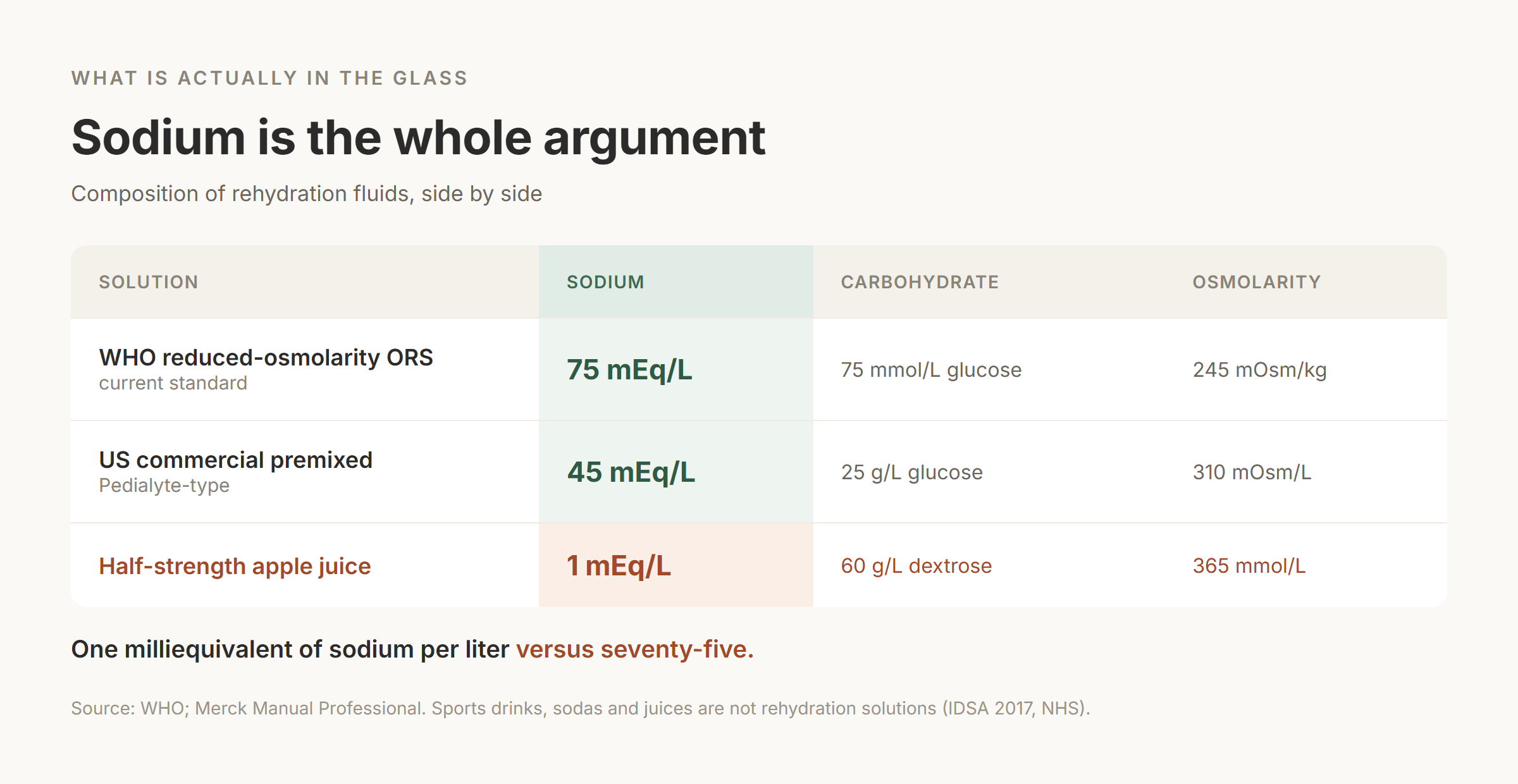
| Solution | Sodium | Carbohydrate | Osmolarity |
|---|---|---|---|
| WHO reduced-osmolarity ORS (current standard) | 75 mEq/L | 75 mmol/L glucose | 245 mOsm/kg |
| US commercial premixed (Pedialyte-type) | 45 mEq/L | 25 g/L glucose | 310 mOsm/L |
| Half-strength apple juice | 1 mEq/L | 60 g/L dextrose | 365 mmol/L |
One milliequivalent of sodium per liter versus seventy-five. That row is the whole argument.
US commercial premixed solutions are, per Merck, “effective despite having a sodium:glucose ratio of approximately 1:3,” even though the theoretical optimum is 1:1. They work, and they’re in every drugstore.
There is a homemade WHO fallback — ½ teaspoon salt and 6 teaspoons sugar in 1 liter of water — but I’d only mention it as a no-access-to-ORS emergency measure. Mis-measuring salt for an infant is dangerous in exactly the direction we’ve just spent three paragraphs on. In the US, buy the premixed one.
The apple juice study, and why it doesn’t cancel the above
Now the honest complication, because pretending it doesn’t exist would be the easy thing.
The DRINK trial (JAMA, 2016) randomized 647 children aged 6 to 60 months with gastroenteritis and minimal dehydration at a single Toronto emergency department. Half-strength apple juice plus preferred fluids beat electrolyte maintenance solution: 16.7% treatment failure versus 25%. The authors concluded routine electrolyte solution “may not be as beneficial… in areas where significant dehydration is uncommon.”
That’s a real result in a major journal, and it deserves to be stated plainly. So do the limits: it excluded infants under 6 months, it enrolled only minimally dehydrated children, and it was single-center. Meanwhile IDSA still gives a strong recommendation that reduced-osmolarity ORS is first-line for mild-to-moderate dehydration in children, and Merck and the NHS both advise against juice.
Where that leaves a parent: for a young infant, or for anything past minimal dehydration, use ORS. The apple-juice finding applies to older, barely-dehydrated toddlers who flatly refuse ORS — and it’s a conversation with your pediatrician, not a green light to hand a sick baby a juice box.
There’s a second genuine disagreement worth naming. The NHS tells parents to give babies on formula or solid foods “small sips of water between feeds.” US pediatric practice and the hyponatremia literature point the other way for young infants. Different guidance systems, different populations, and for a US audience I’d follow the US position: breast milk, standard-strength formula, or ORS — decided with your pediatrician.
How ORS Is Actually Given
Technique matters more than volume here, and it’s the part that gets skipped.
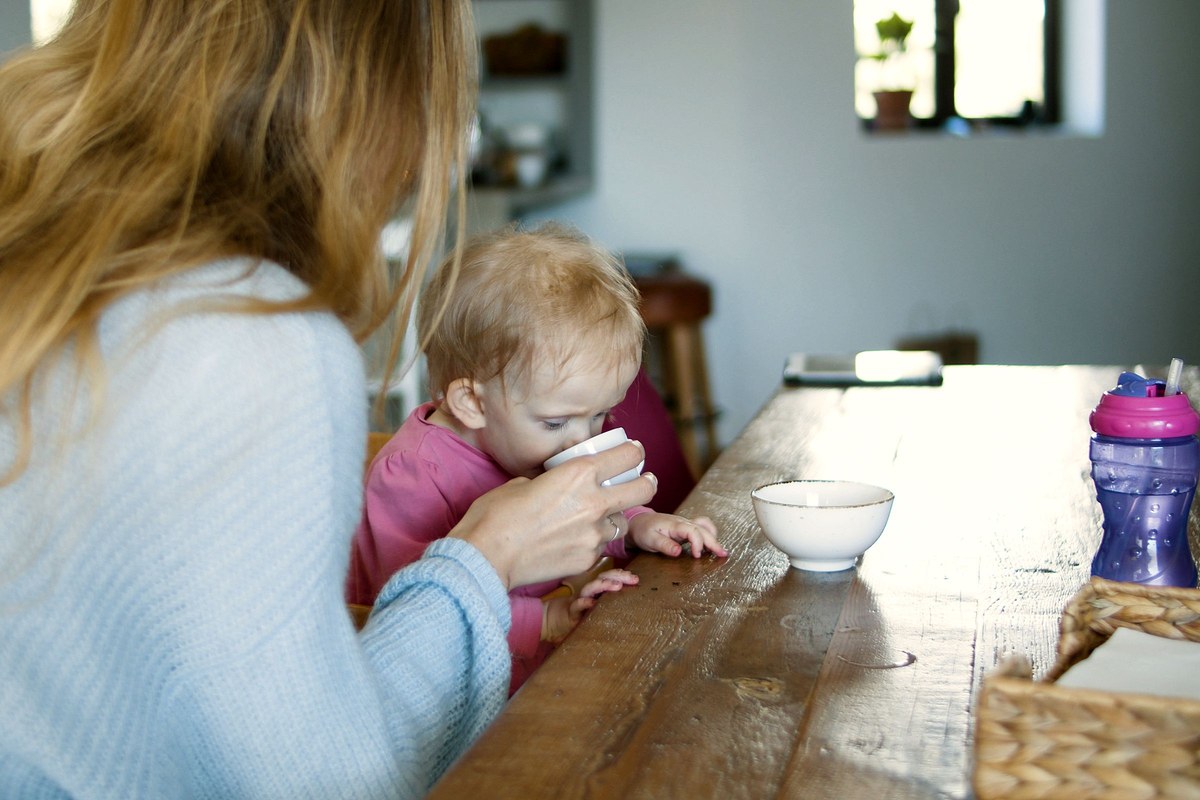
Photo: Kampus Production / Pexels
Start with 5 mL every 5 minutes, by spoon or oral syringe, and build up as it’s tolerated. Small, frequent, boring. A syringe lets you deliver a volume too small to trigger another round of vomiting, which is the entire trick.
Vomiting is not a reason to stop. Merck notes vomiting “typically should not prevent” oral rehydration because it usually abates over time with small frequent dosing. The AAFP’s instruction is specific: if the child vomits, wait five to 10 minutes, then start offering the ORS again more slowly, every two to three minutes.
Done this way, oral rehydration therapy has a failure rate under 5% in children who will take oral fluids.
The volume targets clinicians work from — and I want to be clear these are what clinicians calculate, not a home dosing schedule:
| Situation | Volume (Merck Manual Professional) |
|---|---|
| Mild dehydration | 50 mL/kg over 4 hours |
| Moderate dehydration | 100 mL/kg over 4 hours |
| Ongoing losses | 10 mL/kg (up to 240 mL) per diarrheal stool, on top of the above |
The AAP publishes a parallel table in ounces per 24 hours by body weight (16 oz at 6–7 lbs, 23 oz at 11 lbs, 40 oz at 22 lbs, and so on) — and frames it explicitly as something to use “according to your pediatrician’s directions.” I’d read both tables as context for the phone call, not a substitute for it.
Breastfed infants get a simpler answer. The AAP: “If a breastfed infant does develop diarrhea, generally you can continue breastfeeding, giving additional electrolyte solution only if your doctor feels this is necessary.” The NHS agrees and adds the useful modification — “if they’re being sick, try giving small feeds more often than usual.”
Oral rehydration isn’t right for everyone. It’s contraindicated in bowel obstruction, a surgical abdomen, or anything else preventing oral intake. And severe dehydration — signs of shock, or more than 10% dehydration — needs hospitalization and IV fluids, as does a child who fails oral rehydration even with an anti-nausea medication. That medication, ondansetron, is something an ER or clinic gives; it’s not something parents source.
Feeding a Sick Baby: The Case Against “Resting the Gut”
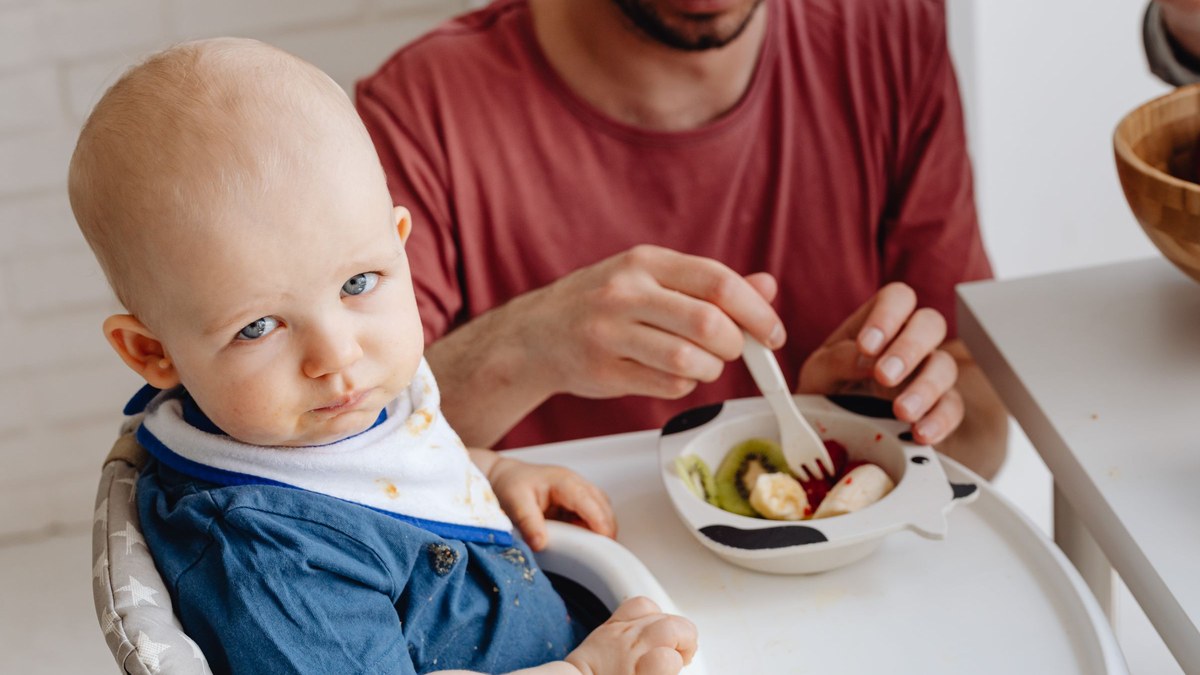
Photo: kaboompics.com / Pexels
The single most persistent piece of folk advice in this space is also the one the AAP rejects most directly.
“Fasting is not a treatment for diarrhea.” That’s the AAP, verbatim.
And on the diet everyone’s mother recommends: “The bananas, rice, applesauce, toast (BRAT) diet, once recommended while recovering from diarrhea, is no longer considered useful.” Also verbatim. It’s not a nuance or a soft revision — it’s off the list.
What replaces it:
- Keep breastfeeding throughout. Diarrhea and vomiting are not a reason to stop.
- For mild cases without vomiting, the AAP says “you can keep giving human (breast) milk, formula, or cow’s milk.”
- Resume an age-appropriate diet right after initial rehydration — and per AAFP, “it is not necessary to avoid milk-based products.”
- Do not dilute formula. Standard strength, every time. (See every paragraph above.)
The honest caveat: the AAP separately notes that in some children “drinking milk worsens diarrhea,” and that during active vomiting a temporary focus on fluids makes sense. So the balanced line is — don’t fast the child, resume normal food after rehydration, don’t routinely cut dairy, but follow your pediatrician if your child clearly gets worse on milk.
Related reading: Baby constipation after starting solids: what changed and what helps
What Not to Reach For
Anti-diarrheal medicine
Loperamide (Imodium) is FDA-contraindicated under age 2 — the label cites risks of respiratory depression and serious adverse cardiac reactions, with rare reports of paralytic ileus with abdominal distention. The AAP says over-the-counter antidiarrheals are “not recommended for children younger than 2 years” and “can also be harmful in older children.”
Pooled pediatric trial data found serious adverse events (ileus, lethargy, death) in 0.9% of children given loperamide — and every serious event occurred in a child under 3. It sits on the KIDs List of potentially inappropriate pediatric drugs for exactly that reason. The AAFP’s summary is one sentence: “Evidence-based guidelines agree that antidiarrheal medications should not be used.”
Antibiotics — and especially not for bloody diarrhea
Viral gastroenteritis doesn’t respond to antibiotics. But the specific danger zone is bloody stool, where the instinct to reach for a leftover prescription is most likely to appear and most likely to hurt.
In children infected with E. coli O157:H7, antibiotics are associated with hemolytic uremic syndrome. The landmark prospective cohort (NEJM, 2000) found antibiotic administration was a risk factor for HUS with a relative risk of 17.3 (95% CI, 2.2–137); a later multivariable analysis reported roughly 1 in 4 antibiotic-treated infected children developing HUS.
Bloody diarrhea needs a clinician who decides on testing — and who may deliberately avoid antibiotics.
Probiotics — where the evidence actually turned
This one changed, and a lot of published advice hasn’t caught up.
The PECARN trial (NEJM, 2018) randomized over 900 children aged 3 months to 4 years across 10 US pediatric emergency departments to a 5-day course of Lactobacillus rhamnosus GG (1×10¹⁰ CFU twice daily) or placebo. No benefit. The parallel Canadian PERC trial, published in the same issue, also found no benefit.
The AGA’s 2020 guideline followed: “In children with acute infectious gastroenteritis, the AGA suggests against the use of probiotics” — specifically in the United States and Canada, on the reasoning that host genetics, diet, sanitation and endemic pathogens differ enough that studies elsewhere don’t generalize, and “two high quality studies performed in the United States and Canada did not show any benefit.”
Older reviews did report a slight reduction in illness duration and stool frequency. Those are the superseded position now, not a competing one.
Zinc — a global intervention, not a US home remedy
WHO recommends a 10–14 day course of dispersible zinc during acute diarrhea, reducing episode duration by 25% and stool volume by 30%. That’s real, and it saves children’s lives.
It also probably doesn’t apply to your child. A Cochrane review found insufficient data to determine whether zinc improves outcomes, and a 2024 systematic review and meta-analysis of high-income-country studies concluded zinc did not reduce diarrhea duration there, recommending the WHO/UNICEF regimen “should not include high-income countries.” The effect depends on pre-existing zinc deficiency, which is uncommon in the US.
Don’t dose zinc at home. Ask, if you want to.
Red Flags: When to Call, and When to Go
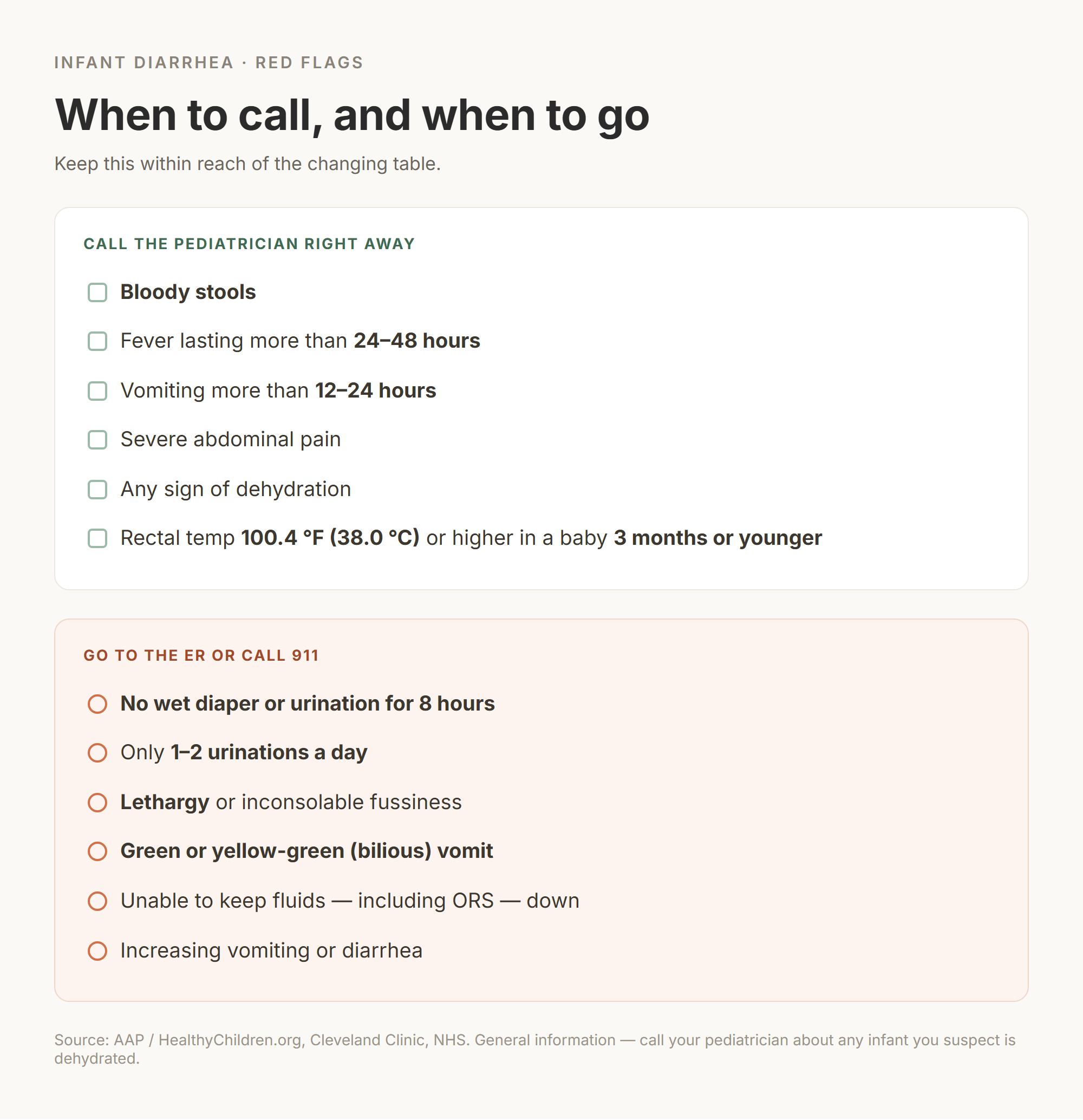
Call the pediatrician right away if diarrhea comes with (AAP):
- Bloody stools
- Fever lasting more than 24–48 hours
- Vomiting more than 12–24 hours
- Severe abdominal pain
- Any sign of dehydration
The age rule that overrides everything else: a baby 3 months old or younger with a rectal temperature of 100.4 °F (38.0 °C) or higher needs the pediatrician called immediately, even with no other symptoms — at that age fever may be the only sign of serious infection. Rectal is the reliable measurement method under 3 months.
Go to the ER or call 911 (Cleveland Clinic):
- No wet diapers or urination within 8 hours
- Any dehydration signs in a baby
- Increasing vomiting or diarrhea
- Lethargy
Emergency-level signs from the NHS: green or yellow-green vomit (bilious vomiting — a possible bowel obstruction sign), severe difficulty breathing, confusion, or severe pain that prevents sleep or normal activity. The NHS also flags diarrhea beyond 7 days, vomiting beyond 2 days, or being unable to keep fluid down — which in practice means unable to keep ORS down.
The compact version, all in one place: bloody stool · green or bilious vomit · rectal temp ≥100.4 °F in a baby 3 months or under · fever past 24–48 hours · vomiting past 12–24 hours · no urine for 8 hours · only 1–2 urinations a day · lethargy or inconsolable fussiness · sunken eyes or fontanelle · cool, discolored, mottled hands and feet · wrinkled skin · can’t keep ORS down · diarrhea past 7 days.
One last thing.
I went into this looking for a number, and what I came out with was a distinction. The early signs — fewer wet diapers, fewer tears, a drier mouth, a baby playing less than usual — are the ones that tell you to start offering ORS by the spoonful and to make a phone call in the morning. The severe signs — sunken eyes, one or two urinations in a day, cool mottled hands, a baby who won’t stay awake — are the ones that end the debate and put you in a car.
Knowing which list you’re looking at is most of the job. The rest is a syringe, five milliliters, and the patience to do it again in five minutes.
And if the honest answer tonight is that you don’t know which list you’re on — that’s what pediatric advice lines exist for, at any hour, with no apology required.
Medical disclaimer: This article is general information and is not a substitute for professional medical advice, diagnosis, or treatment. The volumes, doses, and thresholds described are what clinicians use — they are not self-treatment instructions for your child. Call your pediatrician about any infant with diarrhea and suspected dehydration, and seek emergency care immediately for any red flag listed above.
Sources: American Academy of Pediatrics / HealthyChildren.org (Dehydration, Diarrhea, Treating Dehydration with Electrolyte Solution, Fever and Your Baby); CDC — About Rotavirus and rotavirus vaccine recommendations; CDC MMWR — sustained decrease in rotavirus detection; WHO — Diarrhoeal disease; Merck Manual Professional — Oral Rehydration Therapy and Neonatal Hyponatremia; AAFP — Gastroenteritis in Children (2019); Cleveland Clinic — Dehydration; NHS — Diarrhoea and vomiting; Keating et al., Pediatrics, 1997; Freedman et al., JAMA, 2016 (DRINK trial); Schnadower et al., NEJM, 2018 (PECARN); AGA 2020 probiotics guideline; Wong et al., NEJM, 2000; FDA IMODIUM label; StatPearls — Pediatric Fluid Management; CADTH review — ORS vs drink of choice (IDSA 2017 position); zinc in high-income countries, 2024 meta-analysis. Compiled August 2026.