Hand, Foot and Mouth Disease: Mouth Pain and Daycare Rules
The part nobody warns you about is the drooling.
Not the rash on the palms, not the fever. The moment you realize your child is letting saliva run down their chin onto their shirt because swallowing it hurts more than sitting there wet. That’s when hand, foot and mouth disease stops being a nuisance rash and becomes something you actually have to manage.
So here’s the short version before anything else. In hand, foot and mouth disease the mouth sores are the medical problem, because a child who won’t swallow won’t drink — and dehydration, not the virus, is what sends kids to the ER. Everything useful you can do at home aims at one target: making the mouth hurt less so fluids go in.
The second thing I want to say up front, because I got it wrong myself: the rule I’d always heard — keep them home until the sores heal — is not what the American Academy of Pediatrics says. It’s not even consistently what the CDC says. I’ll show you both pages later and let you see the disagreement for yourself, because I’d rather you have the real picture than a clean one.
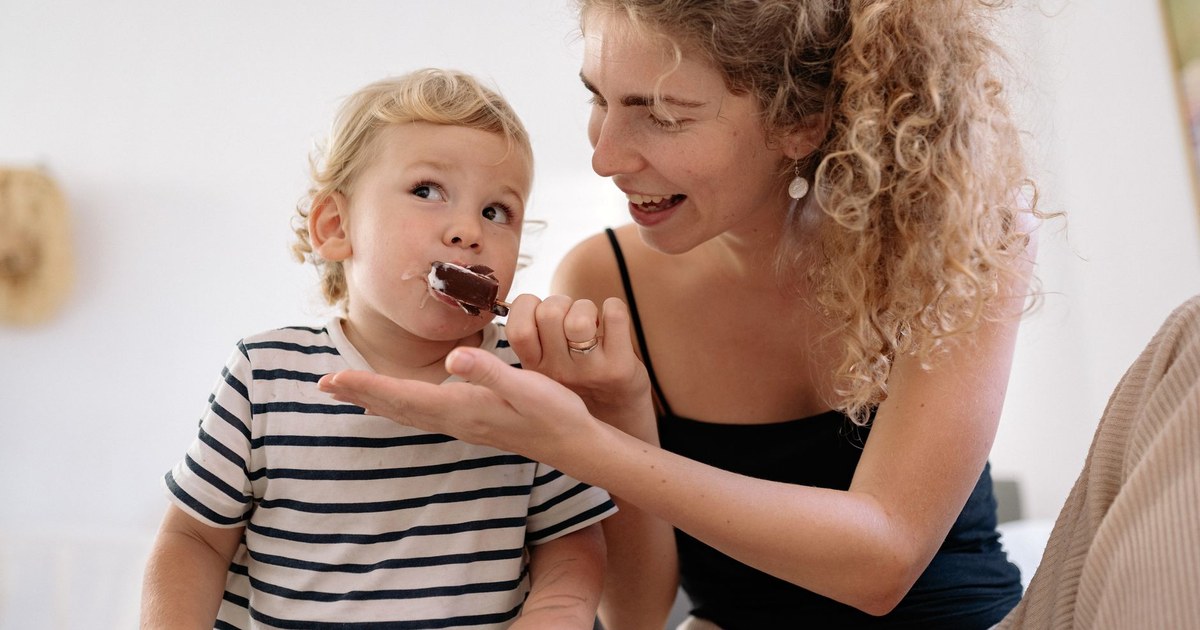
Photo: Yan Krukau / Pexels
A note before we start: this is general information, not a diagnosis and not medical advice for your child. Doses need to be confirmed with your pediatrician or pharmacist, and several of the signs near the end of this article need a phone call rather than a search bar.
What Hand, Foot and Mouth Disease Actually Is
It’s a viral infection caused by enteroviruses — a family, not a single bug, which is why a child can get it more than once.
- Coxsackievirus A16 is typically the most common cause in the United States, per the CDC.
- Coxsackievirus A6 has emerged more recently as another cause here and worldwide. Cases tend to run higher fever, longer duration, and a more widespread rash than the classic version — and Cleveland Clinic notes CV-A6 circulates year-round, including winter.
- Coxsackievirus A10 shows up as well.
- Enterovirus A71 (EV-A71) is the rare one that carries the neurologic risk. CDC associates it mainly with outbreaks in East and Southeast Asia, and notes that although rare, it has been associated with more severe disease such as encephalitis.
More than 90% of cases occur in children under 5. Incubation runs 3 to 6 days, and the illness is self-limited — most children are through it in 7 to 10 days.
The AAP is explicit that reinfection is possible: a child can be infected again with the same virus or with a different one that causes the same illness. So “she already had it” is not immunity.
One more number that explains a lot of what follows: about 1 in 8 infected children have no symptoms at all (Cleveland Clinic). Hold onto that — it’s the reason the daycare exclusion argument goes the way it does.
What the week usually looks like
| Stage | What you see | Timing |
|---|---|---|
| Incubation | Nothing | 3–6 days after exposure |
| Prodrome | Fever, sore throat, runny nose, no appetite — “mimics a common cold” | 1–2 days |
| Mouth sores | Painful ulcers on inner cheeks, gums, tongue, palate; drooling; refusing food and drink | Peak days 2–4; usually resolve by day 7 |
| Rash | Bumps and blisters on palms, soles, often the buttocks and diaper area | Hand and foot rash about 10 days, then may peel |
| Recovery | Back to normal | 7–10 days |
Fever typically lasts 2 to 3 days. Rash appears in roughly 75% of cases — which means some children get mouth sores and nothing else, and those are the ones that get misread as teething or a random sore throat.
On current US numbers: I’m deliberately not printing a national case count for 2026. I couldn’t verify one, and the most recent US surveillance narrative I could find was Virginia’s health department reporting significant increases in emergency department and urgent care visits for HFMD in 2025, with outbreaks centered on K-12 schools and childcare centers and peaking in autumn. That’s one state, and I’d rather label it as one state than dress it up as a national trend.
Is It Hand, Foot and Mouth — or Something Else?
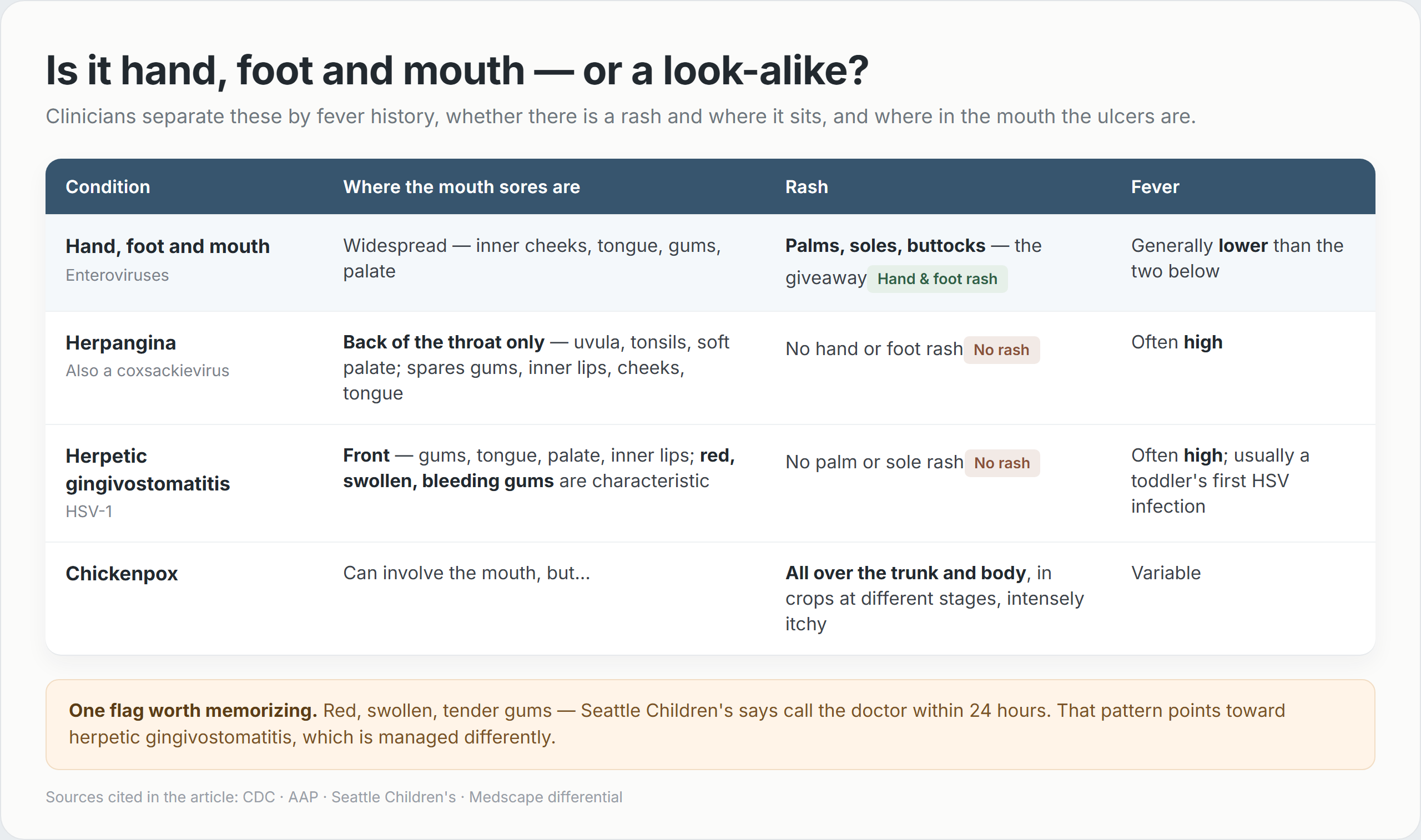
This matters more than it sounds, because two of the look-alikes behave differently and one of them is a reason to call the doctor sooner.
| Condition | Where the mouth sores are | Rash | Fever |
|---|---|---|---|
| Hand, foot and mouth | Widespread — inner cheeks, tongue, gums, palate | Palms, soles, buttocks — the giveaway | Generally lower than the two below |
| Herpangina (also a coxsackievirus) | Back of the throat only — uvula, tonsils, soft palate; spares gums, inner lips, cheeks, tongue | No hand or foot rash | Often high |
| Herpetic gingivostomatitis (HSV-1) | Front — gums, tongue, palate, inner lips; red, swollen, bleeding gums are characteristic | No palm or sole rash | Often high; usually a toddler’s first HSV infection |
| Chickenpox | Can involve the mouth, but | All over the trunk and body, in crops at different stages, intensely itchy | Variable |
The practical rule clinicians use: it comes down to fever history, whether there’s a rash and where it sits, and where in the mouth the ulcers are.
One flag worth memorizing. Seattle Children’s lists red, swollen, tender gums as a reason to call the doctor within 24 hours — that pattern points toward herpetic gingivostomatitis rather than hand, foot and mouth, and it’s managed differently.
Related reading: Baby heat rash vs. viral rash: how to tell the difference
Why the Mouth Pain Is the Whole Ballgame
There’s no antiviral for this. Nothing you give shortens the illness. The AAP puts it bluntly: there isn’t any medicine to treat or cure hand, foot and mouth disease, and what parents can do is ease the fever and pain.
Which sounds passive until you understand what the pain does.
A toddler with ulcers on the tongue and cheeks stops drinking. Not slows — stops. Seattle Children’s makes the priority explicit: fluid intake matters more than solid food intake. Nobody’s child starved during a seven-day virus. Plenty of children have needed IV fluids.
So the mental model I’d suggest is simple: pain control is not comfort care here, it’s hydration strategy. You are treating the mouth so the cup gets emptied.
Photo: Engin Akyurt / Pexels
And inability to swallow saliva — that uncontrolled drooling — is a signal in two directions at once. It tells you the pain has crossed a threshold, and per CDC and state health departments it’s also the specific thing that keeps a child out of childcare.
Pain Relief: What’s Safe, What the FDA Warns Against
This is the section I’d ask you to read twice, because the instinct almost every parent has — reach for the drugstore numbing gel — is the one product with an FDA contraindication attached.
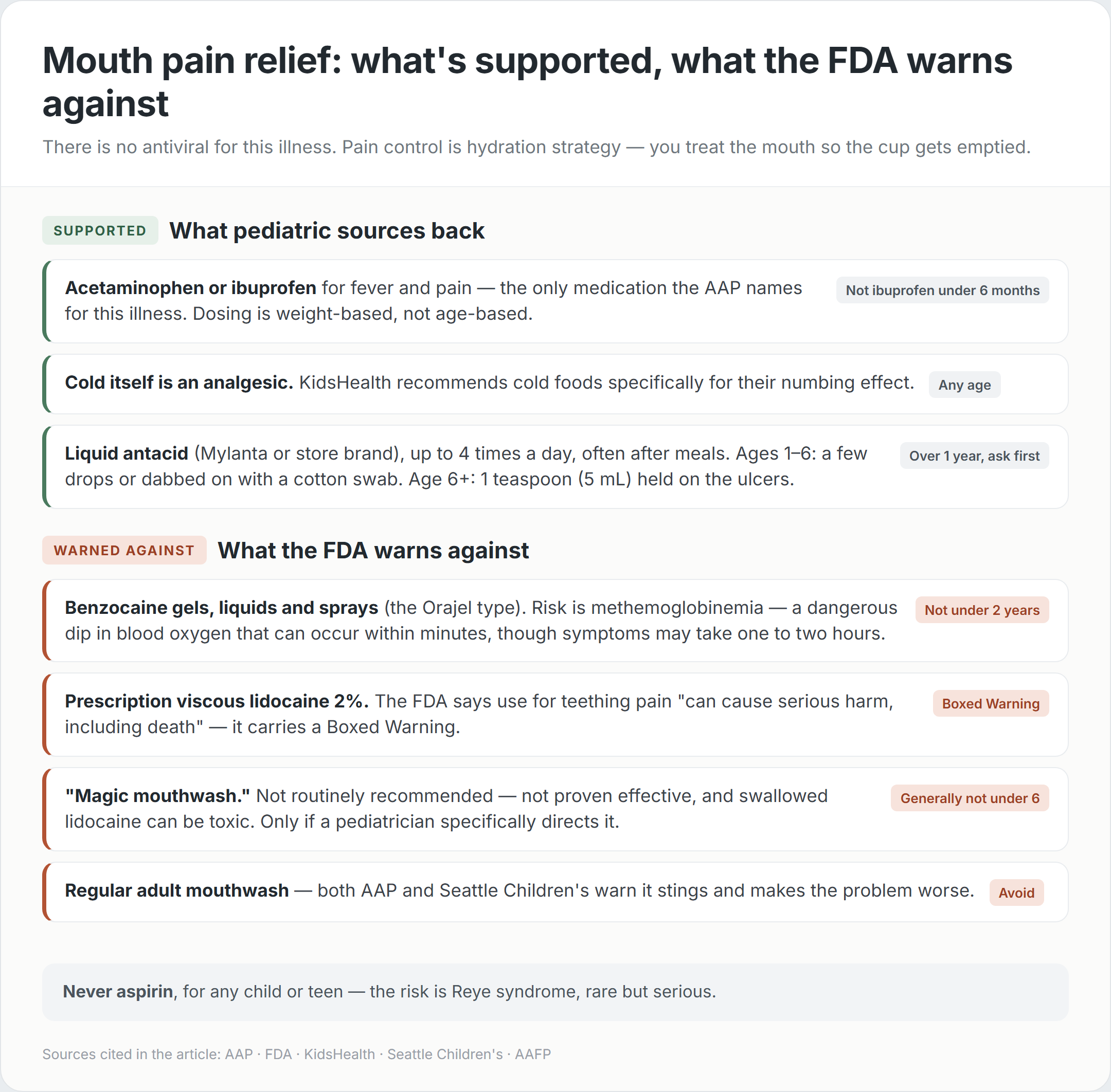
What’s supported
- Acetaminophen or ibuprofen for fever and pain. This is the only medication the AAP names for this illness.
- Ibuprofen is not recommended under 6 months. Dosing is weight-based, not age-based — confirm the number with your pediatrician or pharmacist rather than eyeballing the box.
- Never aspirin, for any child or teen — the risk is Reye syndrome, rare but serious.
- Cold itself is an analgesic. KidsHealth recommends cold foods specifically for their numbing effect, which is the single most useful thing in this entire article.
- Liquid antacid (Mylanta or a store brand) is described by both the AAP and Seattle Children’s, up to 4 times a day, often after meals. Ages 1 to 6: a few drops in the mouth, or dabbed onto the sores with a cotton swab. Age 6 and up: 1 teaspoon (5 mL) held on the ulcers as long as possible, then spit or swallowed. The AAP frames these mouth-soothing liquids as for children over 1 year, and after checking with your pediatrician — not as a free-for-all.
What the FDA warns against
- Benzocaine gels, liquids and sprays (the Orajel-type teething products): the FDA says over-the-counter oral products containing benzocaine should not be used in infants and children younger than 2 years, and other oral benzocaine products carry a contraindication for under-2s and for teething. The risk is methemoglobinemia — which the FDA describes as “a potentially life-threatening condition marked by a dangerous dip of oxygen levels in the blood.” It can occur within minutes of application, though symptoms may not appear for one or two hours.
- Prescription viscous lidocaine 2%: the FDA states it should not be used for teething pain in infants and young children, warning that use “can cause serious harm, including death.” It carries a Boxed Warning, the agency’s strongest.
- “Magic mouthwash” (typically diphenhydramine plus an antacid, sometimes with viscous lidocaine): not routinely recommended for this, because it hasn’t been proven effective and swallowed lidocaine can be toxic. It’s generally not used in children under 6, and recipes vary widely between pharmacies. Only if a pediatrician specifically directs it.
- Regular adult mouthwash — both AAP and Seattle Children’s warn it stings. It makes the problem worse.
There’s a genuine gray area on when to medicate. Seattle Children’s suggests saving fever medicine for fevers above 102°F (39°C), on the reasoning that lower fevers help fight infection. The AAP frames acetaminophen and ibuprofen as being for fever and pain generally. For this illness the practical goal is pain control so the child will drink, which can justify dosing at lower temperatures — but that’s a conversation with your pediatrician, not a rule I’d hand you.
What to Actually Offer a Child Who Won’t Swallow
Here the folk wisdom and the guidance agree completely, which is a nice change.

Photo: Marcia Salido / Pexels
Cold and soft is the entire principle. Cold numbs, soft doesn’t require chewing.
Offer:
– Cool fluids — the NHS says exactly this, while avoiding acidic options like fruit juice
– Cold foods: ice cream, smoothies, popsicles — KidsHealth recommends these specifically for numbing relief
– Milkshakes, slushes, sherbet, cold milk (Seattle Children’s)
– Soft foods: yogurt, mac and cheese, mashed potatoes, cereal with milk
– Small amounts, often. The target is total volume across the day, not any one successful feed.
Avoid:
– Hot, salty and spicy foods (NHS)
– Acidic everything — citrus juice, tomato sauce, soda (KidsHealth). This is the one parents miss. Orange juice feels like the healthy choice and it’s essentially lemon juice on an open sore.
– Foods requiring a lot of chewing (Seattle Children’s)
Two cautions specific to babies
Don’t give plain water instead of oral rehydration solution to an infant — it doesn’t have the right nutrients. Keep offering breast milk or formula, more often and in smaller amounts. Oral rehydration solution (Pedialyte, Enfalyte, or a store brand) is the standard for infants and young children because it replaces both fluids and electrolytes.
No honey before 12 months. The CDC is direct: honey given to children younger than 12 months may cause botulism, a severe food poisoning — don’t add it to food, water, formula, or a pacifier. This one matters here because “honey for a sore throat” is exactly the advice a well-meaning relative offers when a baby won’t swallow. It’s safe from age one, not before.
Contagion, and When They Can Go Back to Daycare
Now the part I got wrong.
How long the virus actually sticks around
- CDC: people are most contagious during the first week of illness, but can still spread the virus for days or weeks after symptoms go away.
- AAP is more specific: children may shed respiratory virus for 1 to 3 weeks and fecal virus for weeks to months.
- Cleveland Clinic: it can still spread through stool for weeks after symptoms end.
Read those numbers again and the isolation math falls apart. If a child sheds virus in stool for a month, and roughly one in eight infected children never had symptoms to begin with, then keeping the visibly sick child home a few extra days isn’t accomplishing what it feels like it’s accomplishing.
So is “isolate until the sores heal” right?
Not as stated — and the sources genuinely disagree with each other. Here’s the disagreement, in their own words.
- AAP: “Exclusion does not reduce disease transmission because some children may shed the virus without symptoms, and those who are ill can shed the virus in their stool for weeks. Additionally, sores do not need to be healed for the child to return to childcare.” It adds that most children with this illness don’t need to stay home from child care.
- CDC’s “About HFMD” page: children can continue to go to child care and school as long as they have no fever, feel well enough to participate, and have no uncontrolled drooling with mouth sores.
- CDC’s prevention page: “Keep children home until their fever goes away and their sores have healed.“
- NHS: children can return as soon as they’re feeling better, without waiting for blisters to heal.
- Seattle Children’s: return after the fever is gone, usually 2 to 3 days — but keep home about 7 days if blisters are extensive.
Yes, the two CDC pages read differently. I’m not going to pretend one of them doesn’t exist.
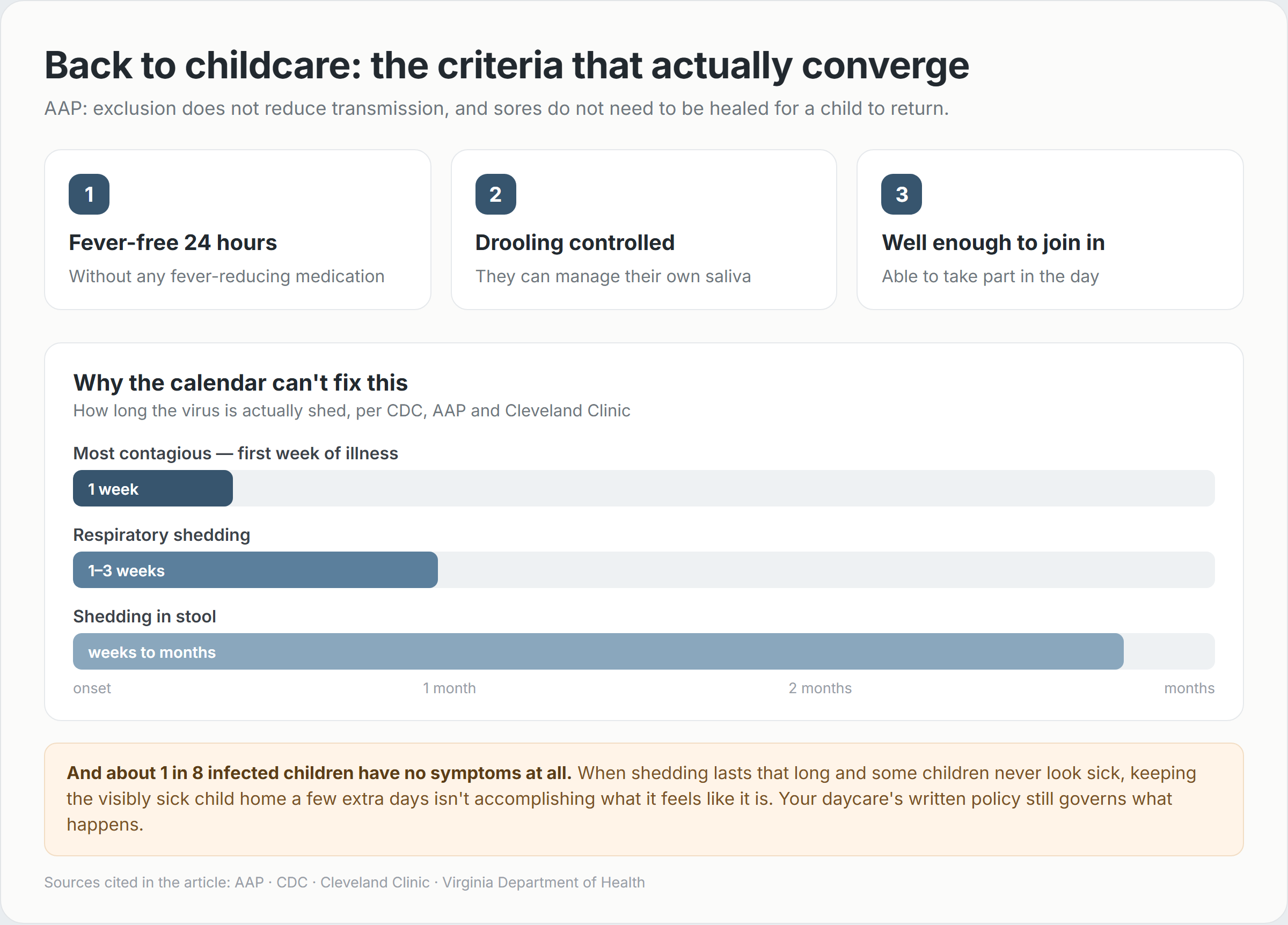
The working rule that the functional criteria converge on:
- Fever-free for at least 24 hours without fever-reducing medication
- Drooling controlled — they can manage their own saliva
- Well enough to participate in the day
That’s the operational version Virginia’s health department publishes, and it lines up with CDC’s About page and with AAP’s position.
The AAP’s own exclusion checklist keeps a few exceptions: the child isn’t well enough to take part, has a fever, the provider can’t care for them without shortchanging other children, there are many open blisters (roughly 7 days to dry), or the local health department requires exclusion during an outbreak.
And the practical caveat that overrides all of the above: your daycare’s written policy, or your state’s, governs what actually happens. Some are stricter than the guidance. Tell them your child is sick either way — the AAP asks parents to notify the school or provider — and then follow their rule, even where the evidence is thinner than the rule implies.
Handwashing, and the Hand Sanitizer Question
Since exclusion isn’t the lever, hygiene is.
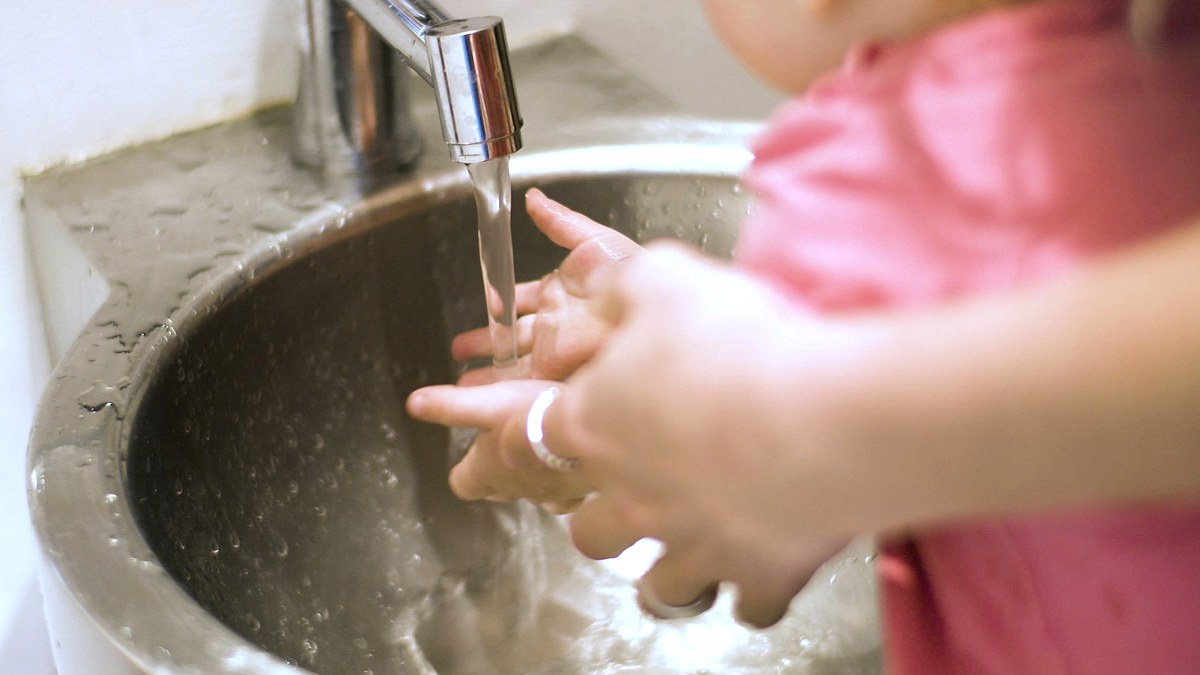
Photo: Kampus Production / Pexels
- CDC: wash hands often with soap and water for at least 20 seconds, especially after changing diapers, using the toilet, and coughing, sneezing or nose-blowing.
- Handwashing has been shown to be an effective strategy for preventing transmission of this illness (StatPearls). KidsHealth: “Hand washing is the best protection.”
- Clean and disinfect frequently touched surfaces and shared items, including toys and doorknobs (CDC). The AAP adds: clean, rinse and sanitize toys; don’t share food, drinks, utensils, toothbrushes or towels; cough into a tissue or your elbow; and keep some distance between the sick child and siblings, since kissing, hugging and sharing cups move this virus fast.
- Fecal–oral spread is the most common route per Cleveland Clinic — a child touches a contaminated surface, then a mouth. That’s why the diaper-change handwashing is the one that counts most.
On sanitizer, let me be precise about what is and isn’t established. The enteroviruses behind this illness are non-enveloped viruses. Alcohol works by disrupting a lipid envelope, and these don’t have one — alcohol can’t penetrate the protein capsid, which is why non-enveloped viruses are markedly more resistant to alcohol-based sanitizers. It’s the same virology behind CDC’s statement that alcohol-based hand sanitizers are ineffective against norovirus, another non-enveloped virus.
What I could not find is an explicit CDC statement saying “sanitizer doesn’t work for hand, foot and mouth disease.” CDC’s pages on this illness simply say to wash with soap and water. So the honest framing is: soap and water is what’s recommended, and here’s why alcohol is weaker against this family of viruses — not “the CDC says sanitizer fails here.” Sanitizer with at least 60% alcohol is still better than nothing when you’re out and there’s no sink. It just isn’t the substitute it is for a cold.
For surfaces, chlorine bleach is the effective choice against non-enveloped enteroviruses, applied after cleaning with soap and water first. Dilutions published by different health departments vary, so follow the product label or use an EPA-registered disinfectant listed as effective against non-enveloped viruses rather than trusting one recipe you found online.
The Strange Part of Recovery: Peeling Skin and Shedding Nails
Nobody prepares parents for this, and it produces a lot of unnecessary panic weeks after everyone had moved on.
- Skin peeling on fingers and toes may show up 1 to 2 weeks later (AAP).
- Nail loss occasionally occurs, often weeks after symptom onset (CDC). Cleveland Clinic describes ridges across the nail or nail loss appearing one to two months later, with nails regrowing within one to two months.
Both are temporary, and neither means the infection came back. A fingernail lifting off a toddler’s hand a month after a virus nobody remembers anymore is alarming to look at and, by every account here, uneventful.
Red Flags: When to Call, and When to Go
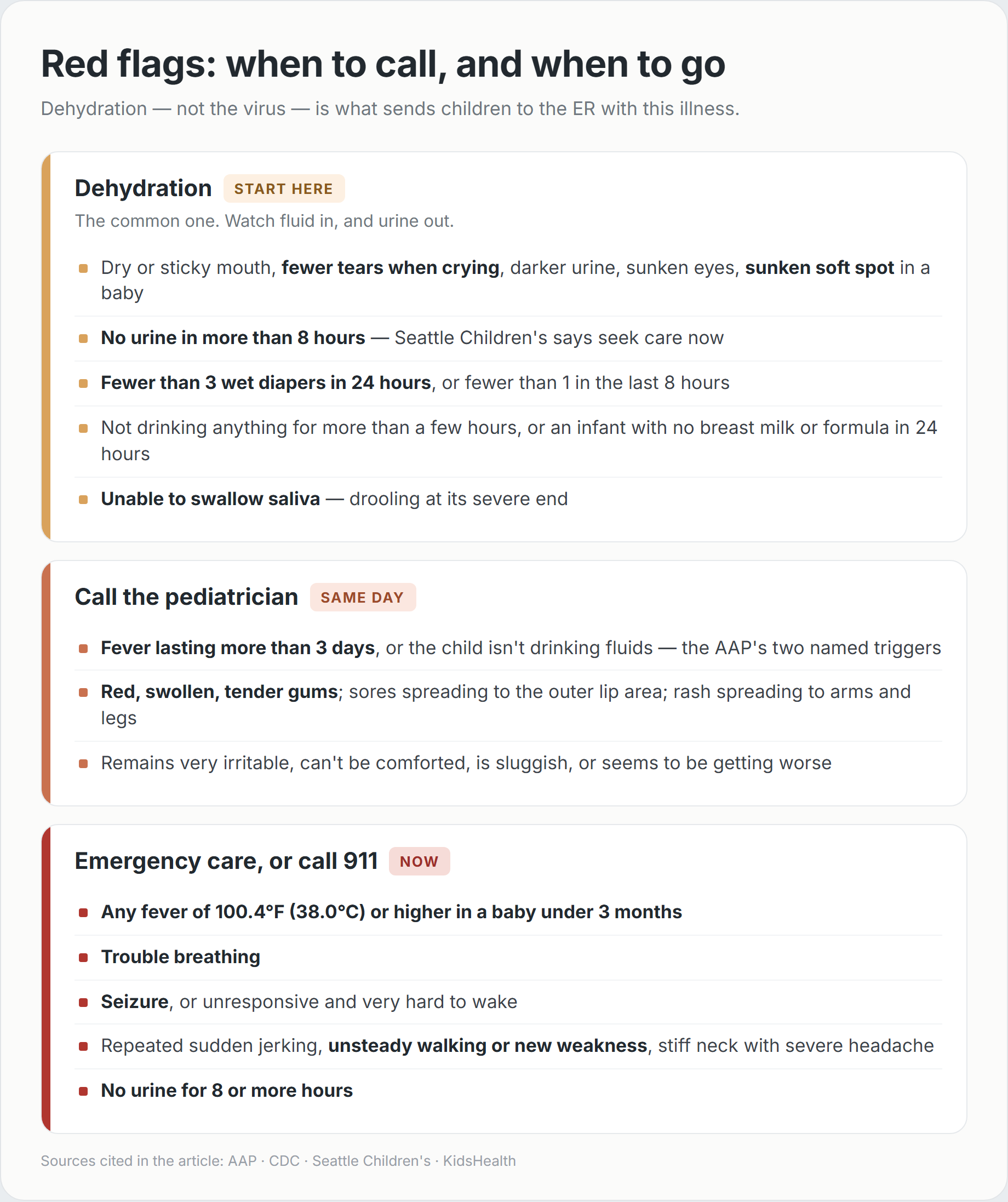
Signs of dehydration — start here, because this is the common one:
– Dry or sticky mouth, fewer tears when crying, darker urine, fewer wet diapers, sunken eyes, sunken soft spot in a baby
– No urine in more than 8 hours, dark urine, very dry mouth — Seattle Children’s says seek care now
– Fewer than 3 wet diapers in 24 hours, or fewer than 1 in the last 8 hours
– Not drinking anything for more than a few hours, or an infant who hasn’t taken breast milk or formula in 24 hours
– Unable to swallow saliva — the drooling that started this article, at its severe end
Call the pediatrician:
– Fever lasting more than 3 days, or the child isn’t drinking fluids — the AAP’s two named triggers
– Red, swollen, tender gums; sores spreading to the outer lip area; rash spreading to arms and legs (Seattle Children’s, within 24 hours)
– The child remains very irritable, can’t be comforted, is sluggish, or seems to be getting worse (KidsHealth)
Emergency care, or call 911:
– Any fever of 100.4°F (38.0°C) or higher in a baby under 3 months — this is a standing pediatric rule regardless of what’s causing it, and it means calling immediately, not waiting
– Trouble breathing
– Seizure, or unresponsive and very hard to wake
– Repeated sudden jerking (myoclonus, often as the child falls asleep), unsteady walking or new weakness, stiff neck with severe headache
– No urine for 8 or more hours
Those neurologic signs are the EV-A71 list. I want to frame the risk carefully. EV-A71 is rare in the US, and in the largest EV-A71 neurologic outbreak reported in the Americas — 43 children in Colorado, March to November 2018, published in The Lancet Infectious Diseases — 39 of the 42 children who could be followed up (93%) showed complete recovery by 1 to 2 months. There is a case-fatality figure in the broader literature, but it comes largely from Asian outbreak data and I don’t think it belongs in a US parent’s head as a personal risk number.
So: know the signs, don’t carry the statistic. The signs are what get you to a doctor in time; the statistic just costs you sleep.
Related reading: Alternating acetaminophen and ibuprofen in kids: what’s actually recommended
One last thing, and it’s the thing I’d say to a friend at 11 p.m.
Almost everything about this illness resolves on its own inside a week and a half. There’s no cure to chase, no antiviral to argue for, and the rash — the part that looks the worst — is the part that matters least. What you’re really doing for those seven days is running a very small, very unglamorous operation: numbing a mouth enough that a cup of cold milk goes down, counting wet diapers, and not reaching for the tube in the medicine cabinet that has an FDA contraindication printed on it.
The daycare question will probably stay messy. Two CDC pages, an AAP position, and your provider’s laminated policy are not going to agree, and I’d stop trying to make them. Go with fever-free for 24 hours, drooling under control, well enough to join in — then do what your daycare’s paperwork says, and wash everyone’s hands like the whole thing depends on it.
Because when the shedding lasts a month and one child in eight never looked sick at all, the sink is doing more work than the calendar ever was.
Medical disclaimer: This article is general information and is not a substitute for professional medical advice, diagnosis, or treatment. Nothing here is a diagnosis of your child, and medication doses must be confirmed with a pediatrician or pharmacist. Contact your pediatrician for any infant under 3 months with a fever, a child who won’t drink or has no urine for 8 or more hours, fever lasting more than 3 days, or any neurologic sign — jerking, unsteadiness, weakness, trouble breathing, or extreme sleepiness. Seek emergency care immediately for the red flags listed above.
Sources: CDC — About Hand, Foot, and Mouth Disease, Symptoms, Causes and How It Spreads, Foods and Drinks to Avoid or Limit (honey under 12 months), About Handwashing; AAP / HealthyChildren.org — Hand, Foot & Mouth Disease and AAP Pediatric Patient Education — Child Care and Schools; NIH/StatPearls — Hand, Foot, and Mouth Disease; NHS — Hand, foot and mouth disease; Cleveland Clinic; Nemours KidsHealth — HFMD and Dehydration; Seattle Children’s — Hand-Foot-and-Mouth Disease; FDA — Benzocaine safety information and viscous lidocaine Boxed Warning; AAFP — OTC benzocaine teething products; Virginia Department of Health — Higher Rates of HFMD in 2025; The Lancet Infectious Diseases (2020) — EV-A71 neurological disease, Colorado 2018; Medscape — HFMD and herpangina differential diagnoses; alcohol sanitizer efficacy against non-enveloped viruses (NIH/PMC). Compiled August 2026.