Cradle Cap: Why Not to Pick It, and Which Oil to Use
Let me start with the thing I got wrong for a long time.
I used to think the advice for cradle cap was “rub in a natural oil.” It sounds gentle. It sounds like the kind of thing you would want on a newborn’s scalp. But the American Academy of Dermatology says the opposite in plain words — use a non-food-based oil, like baby oil — and the NHS puts olive oil and peanut oil on an explicit “do not” list.
So the oil step is real. The word “natural” is the part that needs fixing.
The other half of this article is the crusts themselves. Those yellow, waxy plates on the crown of a baby’s head look exactly like something that wants to be lifted off. Every major source — the AAD, the AAP, the NHS, Cleveland Clinic, the National Eczema Society — says don’t.
Photo: Cup of Couple / Pexels
Before anything else: this is general information, not medical advice. Any medicated product — an antifungal shampoo, a steroid cream — belongs in a conversation with your pediatrician or a board-certified dermatologist, not in a decision you make alone at the drugstore.
What cradle cap actually is
Cradle cap is infantile seborrheic dermatitis of the scalp. Seborrheic dermatitis is the umbrella term, and cradle cap is the baby-scalp version of it.
What you see are greasy, non-inflammatory plaques with a yellowish scale on top, mostly on the crown and front of the scalp. It can look white or yellow, crusty or flaky, sometimes with color change in the skin around it.
It is also extremely common. Roughly 10% of infants have it in the first three months, and prevalence peaks around 3 months at about 70%, according to StatPearls and the AAP. By the second year it is down to about 7%. Onset is usually early — the AAP says between three weeks and two months, Seattle Children’s says the first 2 to 6 weeks.
And it goes away. The AAD says it tends to improve by six to 12 months of age. Nationwide Children’s says 8 to 12 months. The National Eczema Society says usually within the first six months, at the latest by the first birthday, and that it does not come back later in childhood.
A few things it is not, because parents blame themselves for all of them: it is not contagious, not an allergy, not an infection you caught, and not caused by poor hygiene.
It also does not usually bother the baby. Seattle Children’s: “not itchy or painful.” The AAP: rarely itchy or uncomfortable. Cleveland Clinic: no pain or discomfort. That detail matters more than it looks, and I will come back to it.

It is not only a scalp thing, either. Infantile seborrheic dermatitis can show up on the forehead, eyebrows, nasolabial folds, behind the ears, eyelids, neck creases, armpits and the diaper area. In body folds it looks bright red and shiny rather than scaly. The National Eczema Society notes the diaper-area form can spread quite rapidly and widely — alarming to look at, still the same benign condition.
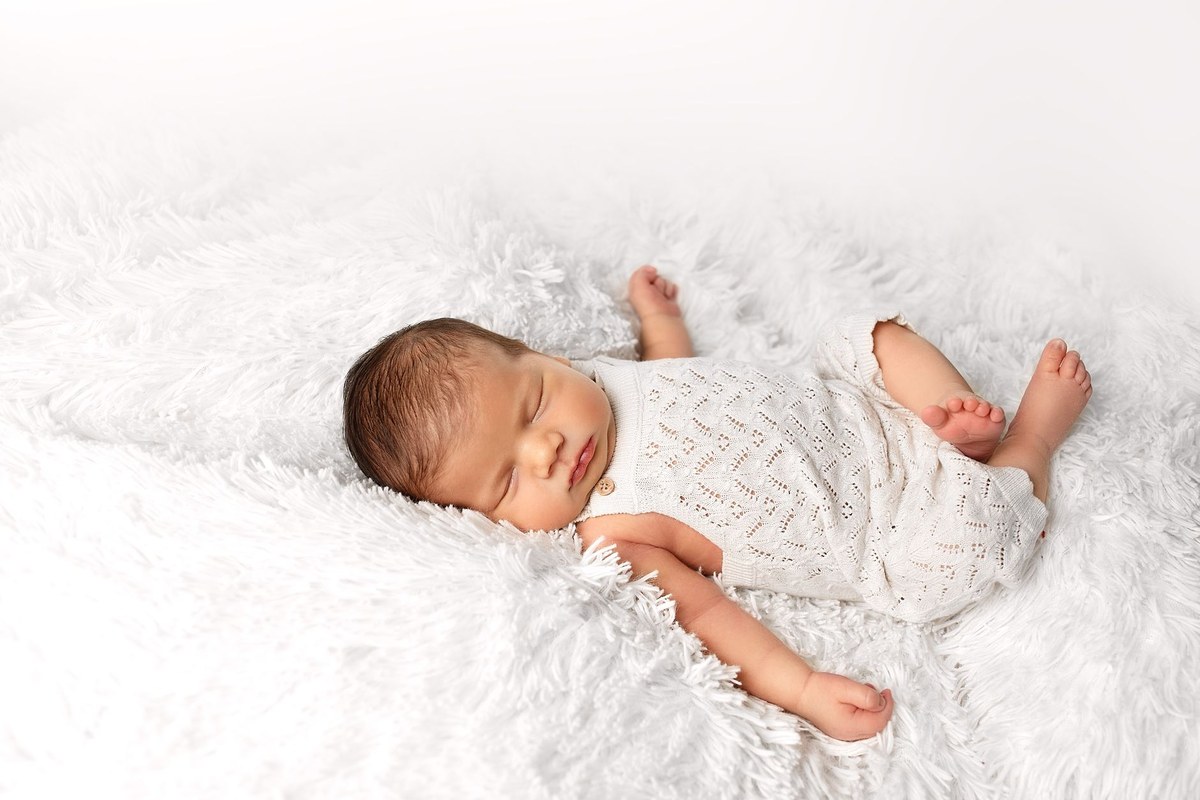
Photo: br prch / Pexels
What causes cradle cap — honestly, nobody has proven it
Here is where most articles overstate their hand, and where I want to be careful.
The maternal hormone story
You have probably read that hormones passing from mother to baby overstimulate the oil glands. That is the most commonly given explanation, and it is a reasonable one — but the sources disagree sharply on how confidently to say it.
| Source | How it frames the hormone explanation |
|---|---|
| Seattle Children’s | States it as the cause |
| Mayo Clinic patient content | “One factor may be hormones that pass from the mother to the baby” |
| AAP / HealthyChildren | Presents it as one of two theories |
| StatPearls | “One hypothesis” — supported indirectly by the fact that seborrheic dermatitis peaks in infancy and again in adolescence, the two hormonally active periods |
| DermNet | A potential factor; etiology “remains unclear” |
| NHS | Cause not known — does not mention hormones at all |
So: it fits the age pattern neatly, and that pattern is genuinely suggestive. But it is inferred from the pattern, not demonstrated. The right phrasing is “most likely,” not “because.”
The yeast story
The second proposed factor is Malassezia, a yeast that lives on skin. StatPearls reports M. globosa and M. restricta in over 80% of seborrheic dermatitis cases across all ages.
The catch is right there in the same sentence: those same organisms live on healthy people too. Which points toward differences in host susceptibility rather than a simple infection. DermNet says its exact role “is not clear.” The AAP frames it as “a reaction to some common yeast that everyone has on their skin.”
One indirect argument for the yeast: Mayo’s patient content notes that antifungal treatments often help control symptoms. That is suggestive — though as you will see below, the trial evidence behind antifungals in infants is very thin.
The proposed mechanism ties the two together. Overproduced sebum makes the scale stick, and Malassezia — which is lipid-dependent and cannot make its own long-chain fatty acids — consumes the saturated fatty acids in that sebum and leaves behind unsaturated ones that can irritate skin.

The honest summary: cradle cap most likely comes from a combination of temporarily overactive oil glands and a normal skin yeast that feeds on that oil. The exact chain of events has not been proven, and major bodies including the NHS still list the cause as unknown.
Why picking the crusts off backfires
This is the most unanimous point in the entire topic.
- AAD: “Never scratch or pick at cradle cap, as this could cause an infection.”
- Cleveland Clinic: picking can irritate or injure the healthy skin beneath the crusts, and may lead to infection, inflammation or scarring.
- NHS: don’t pick at the crusts — it increases infection risk.
- National Eczema Society: broken skin can let in bacterial or Candida infection.
Cleveland Clinic’s Dr. Turell adds the practical version for the ones that are half-lifted already: “Don’t scrape hard. You don’t want to cause redness or bleeding.” And stop if the scales don’t come off easily.
Photo: William Fortunato / Pexels
I want to be precise about the risk, though, because precision is what makes a warning believable.
No source gives a number for how often secondary infection actually follows picking. None of them frames it as common. So the accurate statement is: forcing the crusts off breaks the skin underneath, and broken skin can get infected. Not: picking causes infection. It is a real risk worth avoiding, not a likely outcome.
The point of the oil, then, is not to make removal faster. It is to make removal unnecessary — to soften the scale until it lets go on its own.
The oil routine, and the oil most people get wrong
Which oil
This is the correction worth carrying away from this article.
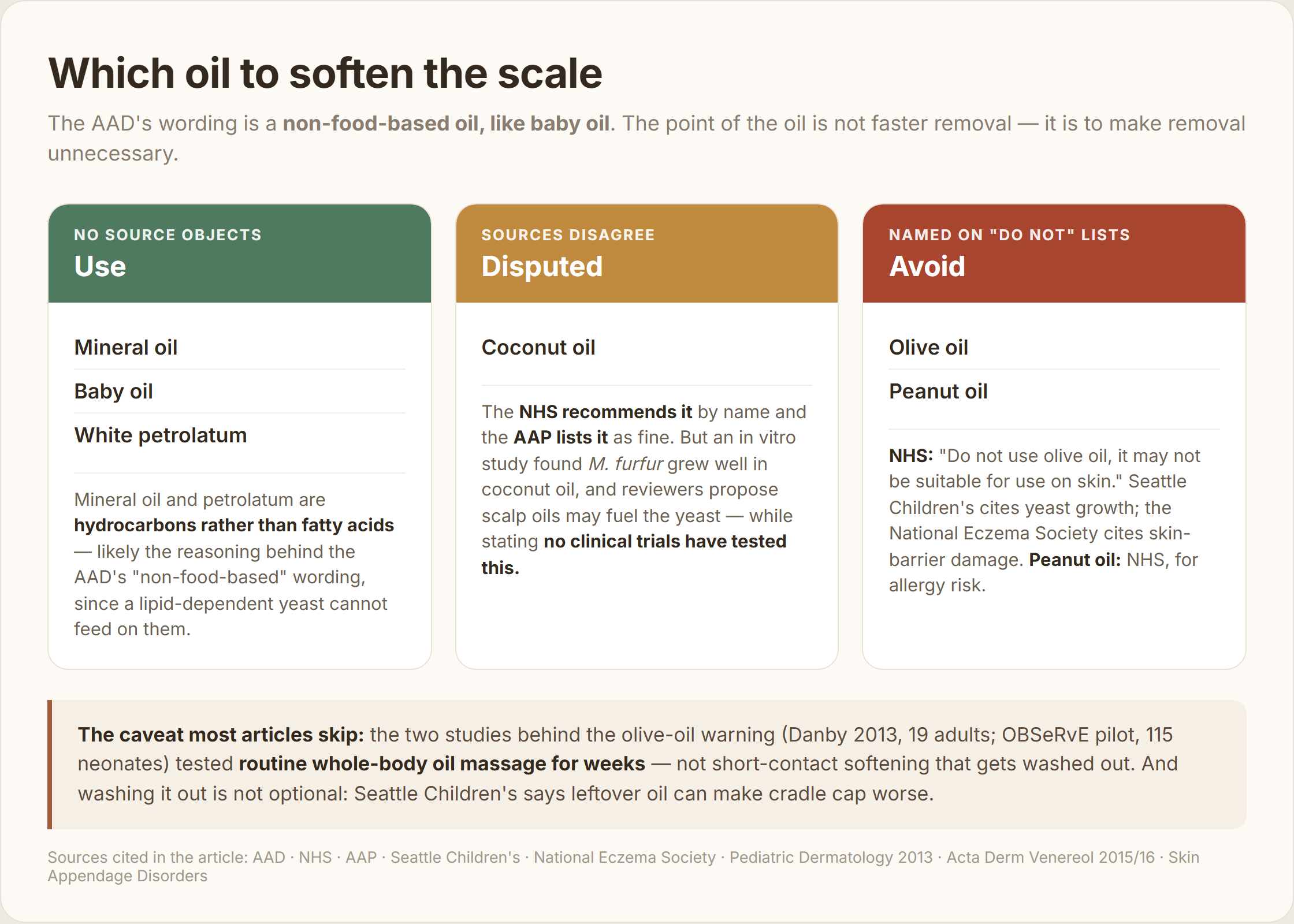
Use a mineral-oil-based product. Baby oil, plain mineral oil, or white petrolatum. The AAD’s wording is a non-food-based oil like baby oil, and mineral oil and petrolatum are hydrocarbons rather than fatty acids — which is likely the reasoning behind that wording, since a lipid-dependent yeast cannot feed on them. Present that as reasoning, not as a claim the patient pages spell out.
Do not use olive oil. The NHS says so outright: “Do not use olive oil, it may not be suitable for use on skin.” Seattle Children’s says avoid it because it may increase yeast growth. The National Eczema Society says it is no longer recommended because it damages the skin barrier.
Do not use peanut oil. NHS, for allergy risk.
The olive-oil warning rests on two real studies, and both deserve their caveats stated:
- Danby et al., 2013 (Pediatric Dermatology) — a forearm-controlled trial in 19 adult volunteers, 6 drops twice daily for 4–5 weeks. Olive oil significantly reduced stratum corneum integrity and produced mild erythema; sunflower seed oil preserved integrity and improved hydration. The authors discouraged olive oil for dry skin and infant massage. Adults, and a very small sample.
- OBSeRvE pilot RCT, 2015/2016 (Acta Dermato-Venereologica) — 115 healthy full-term neonates randomized to olive oil, sunflower oil, or no oil, twice daily for 4 weeks. Both oil groups improved hydration, but both showed significantly less improvement in lipid lamellae structure than the no-oil group — the oils appeared to impede the natural development of the skin barrier. The authors call it a pilot, not powered for clinical significance.
And the caveat that most articles skip: both studies tested routine whole-body oil massage for weeks, not short-contact softening that gets washed out. That is a meaningful difference. The studies are why olive oil is off the list, but they do not directly test the cradle-cap technique.
The coconut oil disagreement
I have to report this one honestly rather than pick a winner.
The NHS recommends coconut oil by name for loosening the scales. The AAP lists it as fine, alongside mineral oil and petroleum jelly.
But an in vitro study cited in a Skin Appendage Disorders review found M. furfur grew well in butter, then corn oil, olive oil, coconut oil, oleic acid and castor oil, versus poor growth without lipids. The review’s authors propose that scalp oils may worsen seborrheic dermatitis by fueling the yeast — while stating plainly that no clinical trials have tested this hypothesis. And AAD’s “non-food-based” wording would exclude coconut oil anyway.
So the tidy answer: mineral oil, baby oil and white petrolatum are the choices no source objects to. Coconut oil has real endorsements and a real theoretical objection. Olive oil and peanut oil are the ones to skip.
How long to leave it on
The “30 minutes before the bath” figure is real — Cleveland Clinic’s Health Essentials states it, with a nickel-sized amount. But it is one point in a wide range:
| Source | Dwell time before washing |
|---|---|
| Seattle Children’s | 15 minutes |
| Cleveland Clinic (Health Essentials) | About 30 minutes before bathing |
| Mayo patient content | Minutes to hours |
| Cleveland Clinic (disease page) | Several hours, or even overnight |
| AAP / HealthyChildren | Overnight, for tough scales |
| StatPearls | Overnight |
| AAD | “Before bathing” — no duration given |
Every one of these comes from a credible source, and not one of them presents its number as evidence-based. So treat 15 to 30 minutes as a common, convenient option, and several hours or overnight as the version for stubborn scale. Neither is a rule.
Then wash it out — this part is not optional
Apply a small amount and massage it in gently with your fingertips, so it works underneath the scale rather than sitting on top.
Then rinse it out thoroughly. Mayo says rinse thoroughly. Seattle Children’s says wash all the oil off, because leftover oil can make cradle cap worse.

Photo: Sasha Kim / Pexels
Which is exactly why the whole thing is framed as “before the bath.” The bath is not a nice pairing. It is the removal step.
Shampoo and brushing
Shampoo frequency is the other place sources disagree mildly, and it is not a safety conflict.
- AAD, AAP, Cleveland Clinic: every other day, with a mild fragrance-free baby shampoo.
- StatPearls: daily gentle shampooing as first-line.
- Mayo content: daily while scales are present, then down to 2–3 times weekly once they clear.
So: roughly every day to every other day while the scale is there, then back off. The AAP adds that after the scales clear, keeping up regular washing helps prevent recurrence. One exception from the AAD — if your baby has eczema, follow your dermatologist’s guidance instead of the every-other-day rule.
For the brushing, do it while the hair is lathered. Fingertips, a soft washcloth, a soft baby brush, a baby comb or a soft toothbrush all appear across AAD, AAP, StatPearls, Cleveland Clinic and Nationwide Children’s. Seattle Children’s suggests massaging for about 5 minutes while lathered.
Never fingernails, never a rough implement, never hard scraping. And if the scale isn’t lifting easily today, it will lift easily another day.

Photo: RDNE Stock project / Pexels
Two more product rules from the “don’t” column: no adult shampoos or fragranced products (NHS), and no salicylic acid dandruff shampoos — Mayo’s patient content lists them as contraindicated in infants because of skin absorption risks. StatPearls also notes that for selenium sulfide and zinc pyrithione, efficacy and safety in infants are simply not known.
What a doctor might add
Everything below is clinician territory. Mayo’s content warns specifically against reaching for over-the-counter treatments without asking, since some ingredients are too strong for infant skin.
Ketoconazole 2% shampoo or cream. DermNet and StatPearls list it for resistant disease, typically 1–2 weeks; StatPearls notes the 2% cream is preferred in fold areas. On safety, ketoconazole shampoo used for 10–30 days did not produce measurable serum levels or raise liver enzymes in infants — reassuring, though that comes from case series and consensus rather than large trials. Keep medicated shampoo out of the eyes.
Low-potency topical steroid — hydrocortisone 1%. DermNet and StatPearls list it for resistant or inflamed cases, 1–2 weeks. Seattle Children’s gives a concrete protocol only when the rash looks red and irritated: 1% hydrocortisone cream once daily, washed off after 1 hour, for 7 days or less. I am including that detail so you recognize it if a clinician gives it to you — not as something to start on your own.
Anti-dandruff shampoo. Seattle Children’s permits one such as Head & Shoulders twice a week, with baby shampoo on other days, and notes explicitly that daily use is not approved under age 2.
And the honest efficacy note: ketoconazole 2% shampoo and 1% hydrocortisone cream appear roughly equally effective — and possibly no better than placebo. Adequately sized trials in this age group are essentially absent.
How thin is the evidence, really
Thin. It’s worth saying plainly.
The 2019 Cochrane review on interventions for infantile seborrheic dermatitis found only 6 randomized trials covering 310 children. Oral biotin showed no statistically significant difference. Proprietary products showed a modest benefit — 96% versus 92% success in one trial. Corticosteroid comparisons showed no significant difference between hydrocortisone and licochalcone. The certainty rating for all comparisons and all outcomes was “very low-quality evidence,” with unclear risk of bias, small samples and poor reporting. The authors called for large, well-conducted trials.
Since then, essentially nothing has moved. I found no major new RCT or updated guideline for infantile seborrheic dermatitis for 2020 through 2026. The strongest evidence base remains Cochrane 2019, OBSeRvE 2015/2016 and Danby 2013.
So gentle washing, oil softening and gentle brushing are recommended on the strength of consensus and the condition’s benign, self-limiting nature — not on the strength of trial data.
Which is, in a strange way, the reassuring version. The main reason nothing has been proven superior is that the condition resolves by itself.
Cradle cap or eczema? The one clue that separates them
| Feature | Cradle cap | Atopic dermatitis (eczema) |
|---|---|---|
| Itch | Absent or minimal — baby feeds and sleeps normally | Moderate to severe; irritability, scratching, poor sleep |
| Onset | Very early, first 2–8 weeks; peaks around 3 months | Both can start early, but eczema commonly follows later |
| Where | Scalp crown and front, eyebrows, behind ears, skin folds and diaper area | Face and extensor arms and legs in infancy; tends to spare the diaper area |
| Appearance | Greasy yellow scale, non-inflammatory, fairly well defined | Poorly demarcated, red, oozing, crusted, excoriated |
| Baby’s behavior | Unbothered | Distressed |
| Course | Resolves by 6–12 months, does not recur | Chronic and relapsing |
The single most useful discriminator is the itch. Cradle cap generally does not bother the baby.
The diaper area is a second clue. Infantile seborrheic dermatitis can involve the diaper region including the folds — while plain irritant diaper rash spares the folds, and eczema usually leaves the diaper area alone.
One nuance to hold onto: the National Eczema Society advises seeing a clinician if itching develops, because that may mean the picture is actually atopic eczema. Some infants have overlapping features, and that call is a clinical judgment, not a home one.
Other things a clinician may need to rule out — psoriasis, tinea capitis, impetigo, scabies, contact dermatitis — are on the differential precisely because they can look similar. That is the argument for a visit, not for a longer internet search.
When to call the doctor
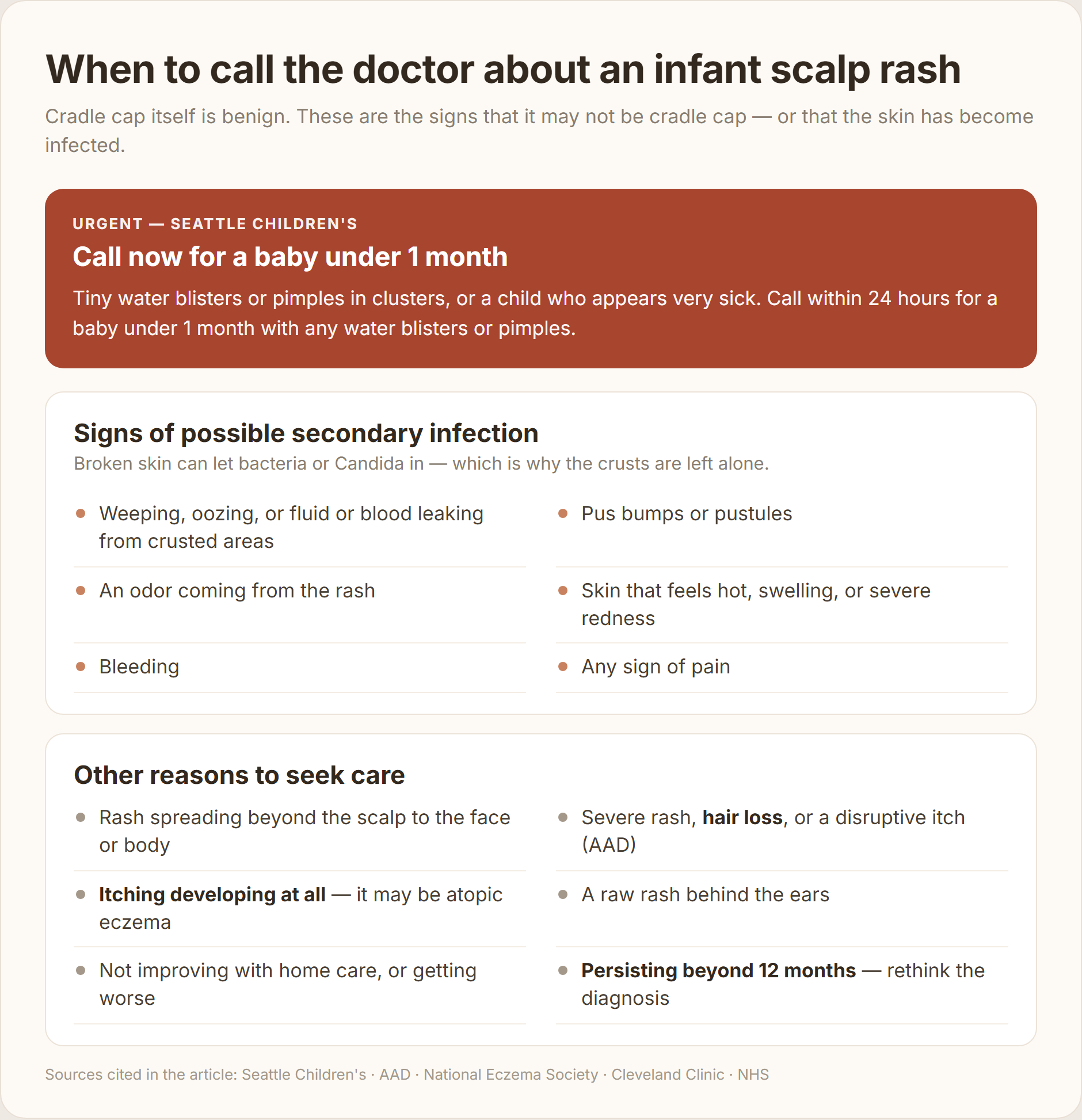
Signs of possible secondary infection:
- Weeping, oozing, or fluid or blood leaking from the crusted areas
- Pus bumps or pustules
- An odor coming from the rash
- Skin that feels hot, swelling, or severe redness
- Bleeding
- Any sign of pain
Urgent, per Seattle Children’s: call now if a baby under 1 month has tiny water blisters or pimples in clusters, or if the child appears very sick. Call within 24 hours if a baby under 1 month has any water blisters or pimples.
Other reasons to seek care:
- Rash spreading beyond the scalp to the face or body
- Severe rash, hair loss, or a disruptive itch (all named explicitly by the AAD)
- Itching developing at all
- A raw rash behind the ears
- Not improving with home care, or getting worse
- Persisting beyond 12 months — at that point the diagnosis itself should be reconsidered
The rare one, mentioned briefly
Very occasionally, a rash that looks like stubborn cradle cap is something else. Langerhans cell histiocytosis can mimic seborrheic dermatitis in infants — scaly papules on the scalp, trunk and fold areas that coalesce into a weeping or crusted eruption.
The distinguishing skin clue described in the literature is a petechial or purpuric component — tiny blood-spot marks — inside the seborrheic-looking rash. Systemic red flags include failure to thrive, an enlarged liver or spleen, liver dysfunction, ear discharge and fever. The clinical rule of thumb is that unresponsive, repeated episodes of “seborrheic dermatitis” with a petechial rash warrant ruling it out, by biopsy.
I include that not to worry you about flakes. I include it so the reason a doctor takes a persistent or atypical rash seriously makes sense.
Related reading: Childhood eczema and atopic dermatitis: what to know
If I had to compress all of this into one line, it would be this.
“Soften it, wash it, and leave it alone otherwise.”
The crusts will come off. They will come off on their own timeline, usually somewhere between six and twelve months, whether or not you help. What the baby oil and the shampoo really do is make that timeline more comfortable to look at.
And I keep thinking about the two words that changed in this article. “Natural oil” became “baby oil.” One word, and it flips the advice from something a skin-barrier study warned against to something the AAD actually recommends.
That’s usually how it goes with baby care. The instruction that sounds gentlest isn’t always the gentlest one.
Medical disclaimer: This article is general information, not medical advice, and does not replace evaluation by a clinician. Cradle cap is common and benign, but any rash that weeps, smells, spreads, comes with fever, itches noticeably, or persists past 12 months should be seen. Medicated products — antifungal shampoo, hydrocortisone cream — should be used only on a pediatrician’s or dermatologist’s direction.
Sources: American Academy of Dermatology; American Academy of Pediatrics / HealthyChildren.org; NHS; Cleveland Clinic; Seattle Children’s Hospital; Nationwide Children’s Hospital; Mayo Clinic patient education content (verified via a licensed hospital mirror; mayoclinic.org returned HTTP 403 to automated retrieval); NCBI/StatPearls; DermNet NZ; National Eczema Society (UK); Cochrane Library (Victoire et al., 2019); Pediatric Dermatology (Danby et al., 2013); Acta Dermato-Venereologica (OBSeRvE pilot RCT, 2015/2016); Skin Appendage Disorders (hair oils and Malassezia review). Compiled August 2026.