
Toddler Constipation: The Withholding Cycle Explained
I’ll be honest about where this article started. It started with a piece of advice I had heard repeated so often that I assumed it was settled: if your child is constipated, double the water and load up on fiber.
It turns out that advice is not what pediatric guidelines say. And for the toddler who is genuinely afraid to poop — the one who hides behind the couch, goes stiff, and then passes a few hard little pellets — it can quietly delay the treatment that actually works.
So this is a piece about toddler constipation as clinicians actually frame it. What functional constipation looks like, why the withholding cycle is the real engine behind it, what diet can and cannot do, and the red flags that mean this is not ordinary constipation at all.
None of this replaces your own pediatrician. It is meant to help you have a better conversation with one.
What functional constipation actually looks like
About 95% of childhood constipation is functional, meaning there is no underlying disease driving it (AAFP, 2022). It is a clinical diagnosis. Uncomplicated cases do not routinely need blood tests, imaging, or an abdominal X-ray.
The part that surprises most parents is that the diagnosis is not mainly about counting.
Under the Rome IV criteria, a child under 4 needs at least two of the following for at least a month: two or fewer bowel movements a week, a history of stool withholding, a history of painful or hard bowel movements, a history of large-diameter stools, or a large mass of stool in the rectum. For children 4 and older, the list adds fecal incontinence at least once a week and retentive posturing, occurring at least weekly for a month.
Notice how much of that is about pain, size, and holding rather than frequency. A child can go most days and still be constipated. On the pediatric Bristol scale, the target is type 3–4 — soft and formed. Hard pellets are type 1.
Rome IV also shortened the required duration from two months to one, precisely because waiting two months delayed diagnosis and treatment.
Some context on how common this is: constipation accounts for roughly 3% of general pediatric outpatient visits and about 25% of pediatric gastroenterology visits. Among children referred to specialists, about half recover within 6 to 12 months, while around 40% remain symptomatic despite laxatives. That prognosis is exactly why the timing and the length of treatment matter so much.
The withholding cycle — why “he’s straining” usually means “he’s holding it in”
This is the part I would most want a parent to read.
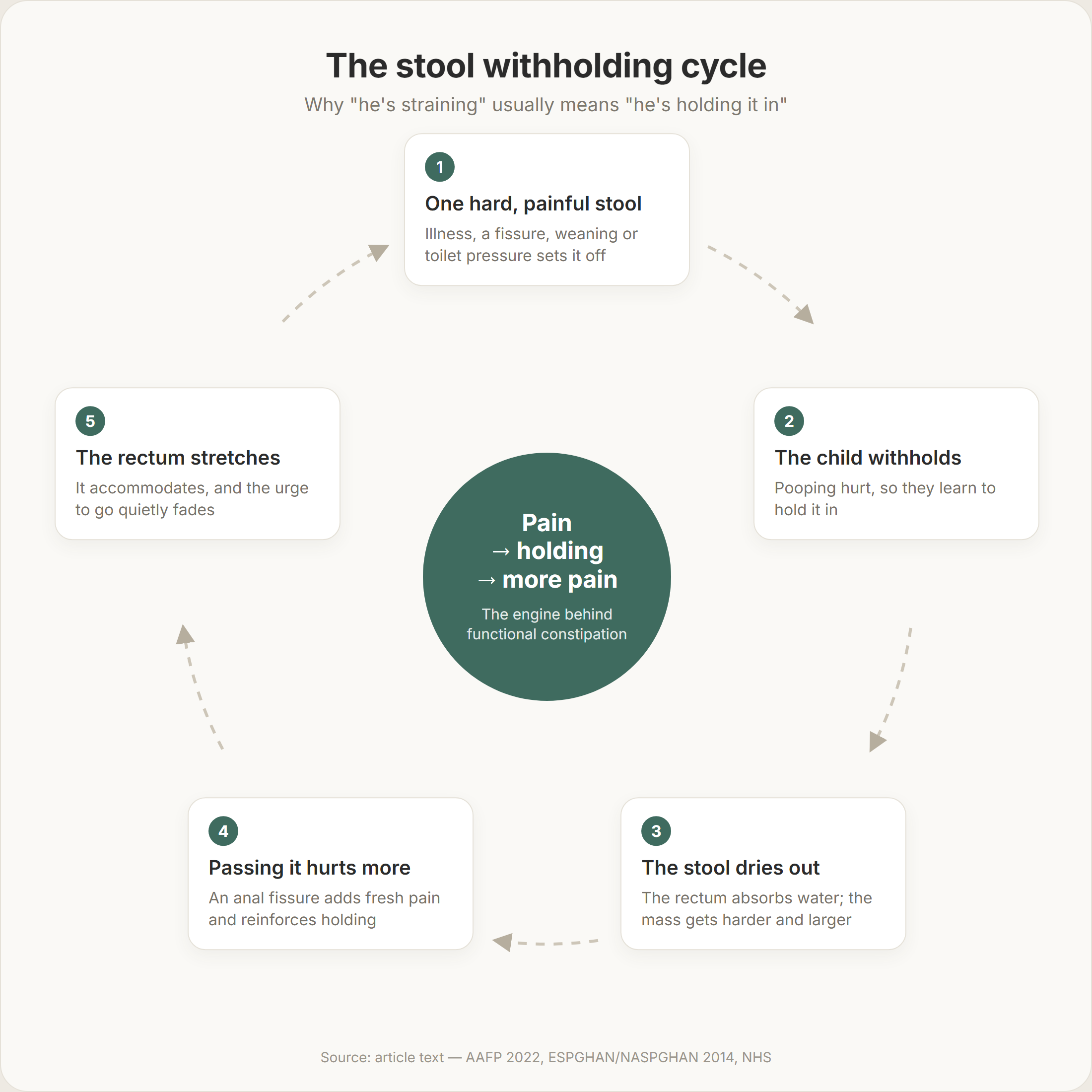
The mechanism runs like this:
- One hard, painful stool happens. Common trigger points include weaning and starting solids, an anal fissure, a febrile illness or stomach bug, dehydration, potty training pressure, or a child who refuses to use the toilet at nursery or school.
- The child learns that pooping hurts, and starts to withhold. Constipation typically becomes chronic when a child begins to associate pain with defecation and holds stool to avoid the discomfort.
- The retained stool dries out. The rectal lining absorbs water from the mass, which becomes harder and larger the longer it sits — which makes the next passage worse, not better.
- Passing it can tear the skin. An anal fissure adds fresh pain and reinforces the withholding. Bright red streaks on the surface of a hard stool or on the wipe are a familiar sign of this.
- The rectum stretches and stops signaling. With continued withholding, the rectum gradually accommodates and the normal urge to go fades. Children with a stretched rectum have a high sensory threshold — over-distension reduces both contractility and sensitivity.
The posture parents misread
Standing stiff-legged. Rocking up on tiptoes. Crossing the legs, squeezing the buttocks, going red in the face, hiding behind furniture.
Most of us read that as a child straining to push.
It is usually the opposite — that is retentive posturing, the child working hard to hold it in. Reading it correctly changes what you do next, because encouragement to “push harder” is aimed at the wrong problem entirely.
And the soiling is not defiance
When stool impacts, looser stool leaks around the mass. Parents then see what looks like diarrhea, or skid marks in the underwear, in a child who is severely constipated. The NHS describes this plainly as overflow soiling around impacted feces.
It is a sign the constipation got worse. It is not laziness, and it is not a discipline issue.
That stretched, desensitized rectum is also the reason treatment takes so long. Softening stool alone is not enough once there is an impaction. The blockage has to be cleared first, and then the rectum needs months of consistently soft, painless stools to shrink back and regain sensation.

Photo: Tatiana Syrikova / Pexels
What diet can and cannot do for toddler constipation
Here is the correction I mentioned at the top, and it is worth stating bluntly because most of us believe the opposite.
“Double the fluids” is not supported
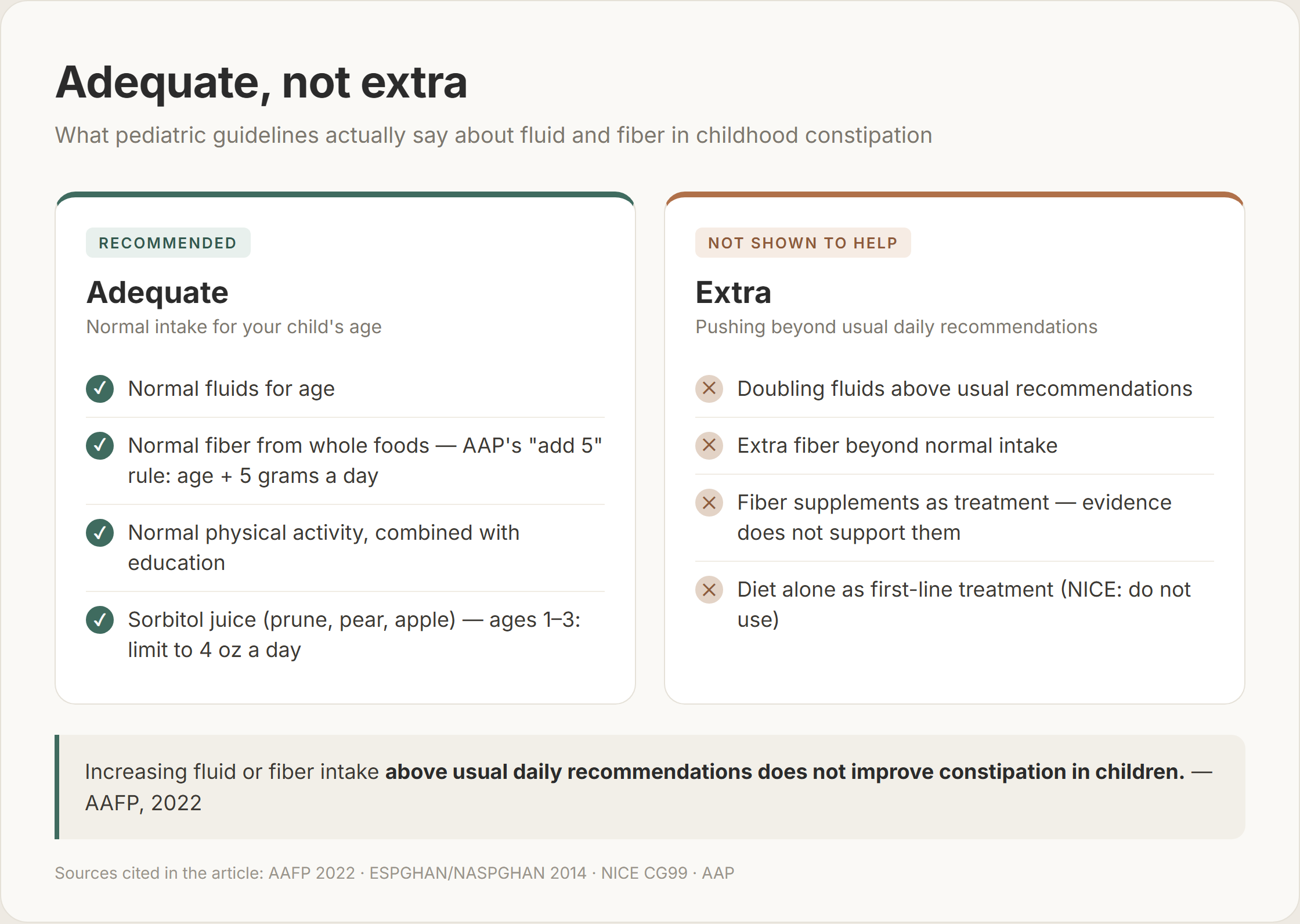
AAFP states it directly: increasing fluid or fiber intake above usual daily recommendations does not improve constipation in children. The 2014 ESPGHAN/NASPGHAN international guideline says much the same — no evidence supports extra fluid or extra fiber beyond normal intake, and it recommends normal fiber, normal fluids, and normal physical activity combined with education. NICE goes furthest: do not use dietary interventions alone as first-line treatment.
Please read that as adequate, not extra. Normal hydration for your child’s age still matters, and fiber taken without enough water can make things worse. What has not been shown is that pushing far beyond normal intake fixes constipation — and it should never replace or delay proper treatment.
I should also be fair about how entrenched this advice is. In one survey, 86% of pediatric gastroenterologists recommended water and 81% recommended fiber for functional constipation. Parents hear it constantly because clinicians say it constantly. The distinction that gets lost is adequate versus extra.
I have deliberately not printed daily fluid targets here. I could not find US numeric targets by age from an authoritative source, and inventing them would be worse than leaving them out. Ask your pediatrician what adequate looks like for your child.
For fiber, AAP offers the “add 5” rule of thumb: daily grams roughly equal to the child’s age plus 5, so about 10 grams for a five-year-old — from whole foods, with fruits, vegetables, beans and whole grains preferred over supplements.
Fiber supplements: unproven
ESPGHAN/NASPGHAN put it plainly — the available evidence does not support the use of fiber supplements in the treatment of functional constipation in children.
To be balanced, a 2018 review of 13 pediatric trials covering 723 children did find scattered positive signals: corn fiber reduced pain episodes versus placebo, psyllium reduced pain episodes, glucomannan helped in two of three small trials, and partially hydrolyzed guar gum performed comparably to lactulose. But one glucomannan trial found no difference against placebo, fiber mixtures were not superior to standard laxatives, and the authors concluded that the studies were too heterogeneous and too small to make a definitive recommendation.
So: adequate dietary fiber, yes. Fiber supplements as a treatment, unproven. Ask before you buy.
Where diet genuinely does work: sorbitol

Photo: Hanna Pad / Pexels
Prune, pear and apple juices contain non-digestible sorbitol, and prunes also carry pectin and polyphenols. Non-absorbable carbohydrates draw water into the colon, increasing stool water content — the same osmotic principle behind the medications below. This is a real mechanism, not folklore.
The limits matter, though, and AAP’s juice policy is specific:
- No fruit juice at all before 12 months of age — unless clinically indicated, and the named clinical indication is management of constipation. Which is exactly why this is a conversation with your pediatrician rather than a decision to make on your own.
- Ages 1 to 3: limit to 4 oz (120 mL) per day.
- Whole fruit is preferred over juice, for the fiber.
Pediatric sources commonly suggest around 1 to 2 oz of 100% prune, pear or apple juice per day until symptoms resolve for an infant, with a rule of thumb of 1 oz per month of age up to about 4 oz — confirm the amount with your own pediatrician. Large amounts of juice can cause diarrhea in infants, and more is not better. For babies already on solids, puréed prunes, pears and peaches are the standard sorbitol-containing options.
One thing I will not claim: there is no pediatric constipation evidence for individual vegetables like broccoli. Vegetables belong in a balanced diet. They are not a treatment.
And about formula
The idea that switching formula causes constipation is not an established cause. Formula-fed infants normally have firmer, less frequent stools than exclusively breastfed infants — that is a difference in baseline, not proof that a change caused a problem.
The one well-documented formula-related cause is cow’s milk protein allergy: early-onset infant constipation that resists conventional treatment, remits when milk proteins are withheld, returns when they are reintroduced, and resolves again on an extensively hydrolyzed or amino acid-based formula. Estimates put it at 1.8–17% of formula-fed infants versus about 0.5% of breastfed infants, and stool improvement after a change can take two to four weeks.
That is a doctor-supervised trial for a specific presentation, not a reason to swap formulas on your own. Notably, the same case series reported cow’s milk protein allergy presenting with delayed meconium passage — which is a red flag that needs evaluation regardless.
The treatments that actually work
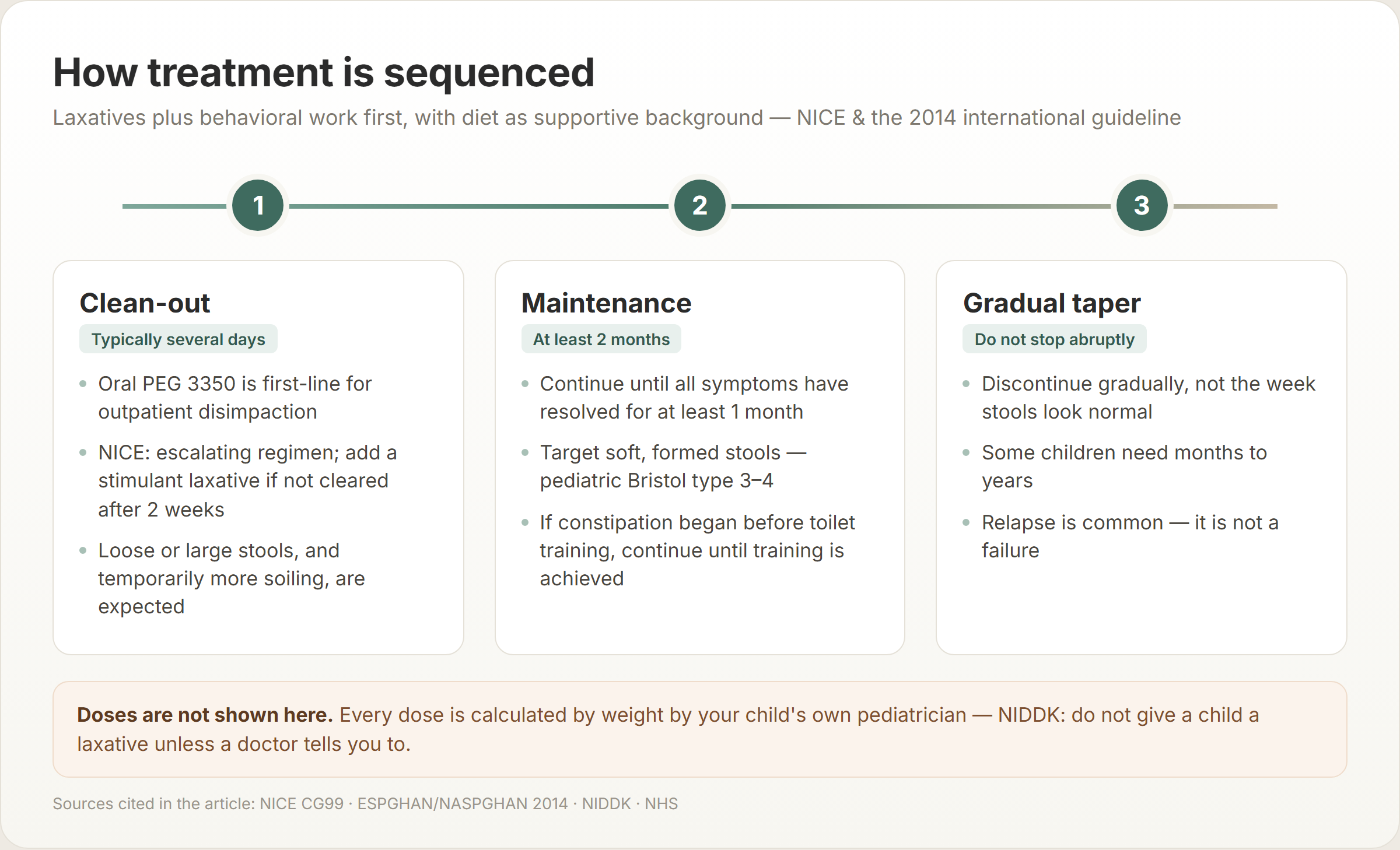
Both NICE and the 2014 international guideline put laxatives plus behavioral work first, with diet as supportive background. The reason is mechanical: an impacted, stretched rectum will not clear on fiber alone.
Step one is disimpaction. Oral polyethylene glycol (PEG 3350) is first-line for outpatient clean-out, typically over several days. NICE specifies PEG 3350 with electrolytes in an escalating regimen, adding a stimulant laxative if the impaction has not cleared after two weeks. Enemas are a fallback — NICE advises them only if all oral medications have failed, and states that enemas are not recommended for maintenance.
Expect the clean-out to look alarming. Loose or large stools, and sometimes temporarily more soiling, are expected during this phase. This is where many families stop, and stopping restarts the cycle.
Step two is maintenance, and this is the part almost everyone under-does. The 2014 guideline recommends continuing maintenance for at least two months, and until all symptoms have been resolved for at least one month, before gradually discontinuing. Taper, do not stop abruptly. If constipation began before toilet training, maintenance continues until toilet training is achieved. Some children need months to years, and the NHS likewise says treatment may take several months.
The rectum stretched over months. It needs months of soft, painless stools to recover. Stopping treatment the week stools normalize is the single most common cause of relapse — and relapse is common, not a failure.
I have deliberately given no doses here. Every dose is calculated by weight, by your child’s own pediatrician.
What not to do on your own
NIDDK is unambiguous: you should not give a child a laxative unless told to do so by a doctor.
And one warning deserves its own paragraph. Sodium phosphate (Fleet-type) enemas are a genuine pediatric danger. The FDA identified 54 serious adverse events with over-the-counter oral or rectal sodium phosphate products, 29 of them in children, driven by severe electrolyte disturbances — hyperphosphatemia, hypocalcemia, hypernatremia. Reported pediatric harms include metabolic acidosis, seizures, kidney failure, cardiac arrest and death. The rectal form should never be given to a child under 2 years, and oral products should not be given to children 5 and under without first talking to a health professional. Most serious harms followed a single larger-than-recommended dose, or more than one dose in a day.
Stimulant laxatives like senna and bisacodyl are recognized add-ons under medical direction when PEG alone is not enough — not a starting point, and not parent-initiated. Mineral oil is listed by NIDDK for children age 2 and older, again clinician-directed.
On PEG 3350 itself, I want to be straight with you rather than reassuring. It is recommended first-line and widely used, but its pediatric use is off-label — it is not FDA-approved for children under 17 or for use beyond 7 days. Parent reports and adverse-event data since 2009 raised neuropsychiatric concerns such as tremors, tics and mood changes, and trace ethylene glycol and diethylene glycol found in some samples prompted an NIH-funded study. The FDA’s current position is that its reviews of adverse event reports and the medical literature indicate the approved labeling accurately conveys the risks, and that additional warnings about neuropsychiatric issues in children are not warranted at this time. Both of those things are true at once. That decision belongs with your pediatrician, with the full picture in front of them.
Toileting habits that support the treatment

Photo: Vie Studio / Pexels
Behavior does not replace medication. It supports it, and it is the half of treatment you can start today.
- Sit after meals. Eating triggers colonic contractions, so a 5 to 10 minute sit at the same time each day, after the same meal, is the highest-yield window.
- Support the feet. A footstool that puts the knees at or above hip level creates a squat-like posture and relaxes the pelvic floor. Dangling legs make effective pushing hard. Treat this as a comfort and positioning measure rather than a proven intervention.
- Keep it non-punitive. NICE specifies negotiated, non-punitive behavioral interventions suited to the child’s stage of development. Reward the sitting, not the stool.
- Keep a stool diary using the pediatric Bristol scale. It is how you and your clinician tell whether the maintenance dose is right — the target is soft and formed, type 3–4.
- Ease off potty training pressure while your child is constipated. NIDDK suggests temporarily pausing potty training during constipation episodes. Resume when stools are soft and painless.
There is a good reason not to read toilet refusal as defiance. Among children with both stool toileting refusal and hard bowel movements, 93.4% had constipation before the refusal began. The refusal is usually a symptom of pain.
Whether early toilet training itself raises constipation risk is genuinely unsettled — one prospective study found no association, another reported early trainers were about three times more likely to complain of constipation, and a large cohort found no association between age at starting and constipation or soiling at school age. I would not assert a cause either way.
And one honest caveat on behavior work: a trial summarized in NICE’s evidence update found no significant difference in success rate between behavioral therapy with a child psychologist and conventional treatment. AAFP still suggests considering psychology referral after about three months without improvement.
Red flags — when this is not functional constipation
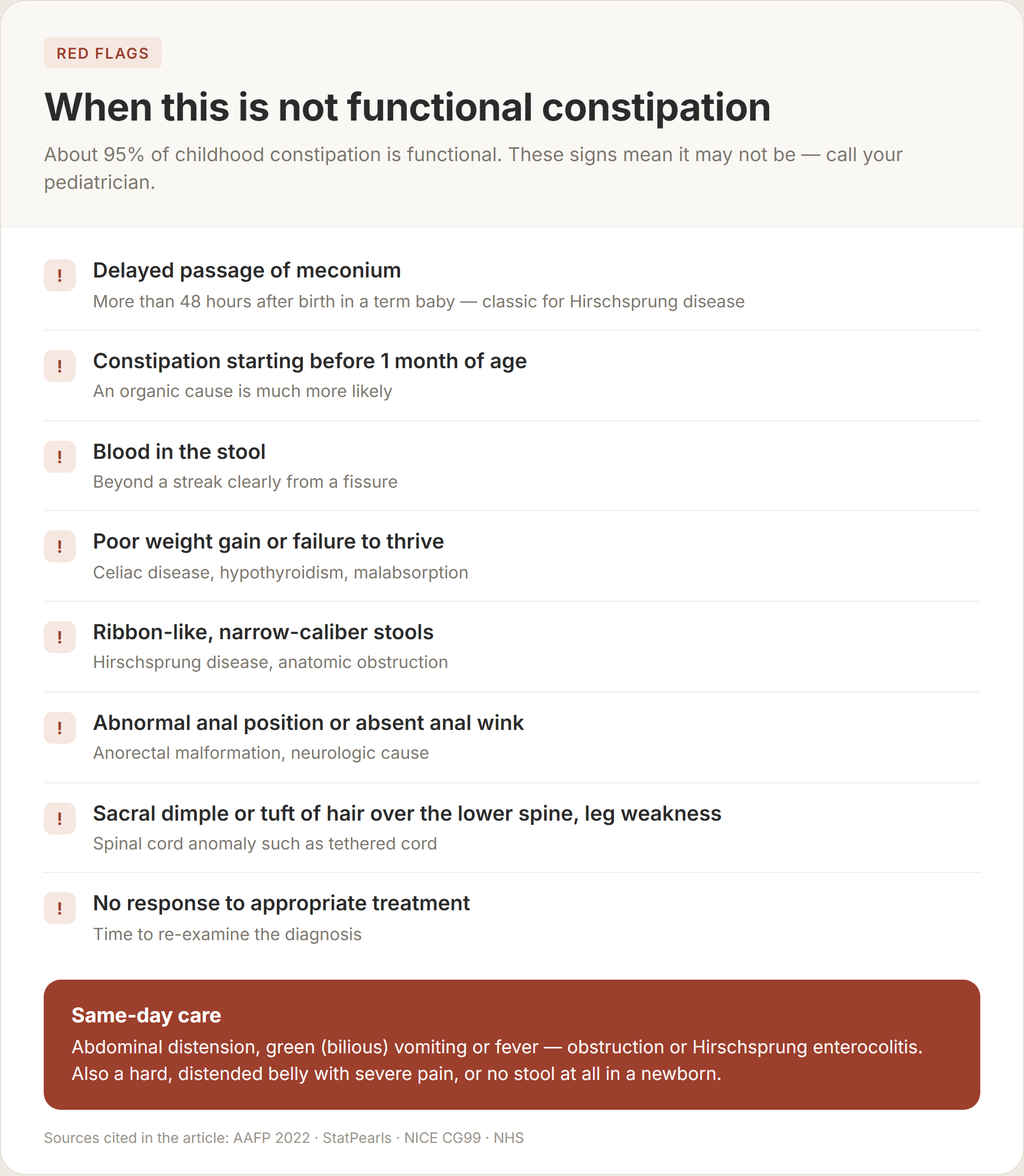
Call your pediatrician — and for the emergency-level signs, seek same-day care.
| Red flag | Why it matters |
|---|---|
| Delayed passage of meconium (more than 48 hours after birth in a term baby) | Classic for Hirschsprung disease; 99% of normal newborns pass stool within 48 hours |
| Constipation starting before 1 month of age | An organic cause is much more likely |
| Blood in the stool beyond a streak clearly from a fissure | Needs evaluation |
| Poor weight gain or failure to thrive | Celiac disease, hypothyroidism, malabsorption |
| Abdominal distension, green (bilious) vomiting, fever | Obstruction or Hirschsprung enterocolitis — potentially emergent |
| Ribbon-like, narrow-caliber stools | Hirschsprung disease, anatomic obstruction |
| Abnormal anal position or absent anal wink | Anorectal malformation, neurologic cause |
| Sacral dimple or tuft of hair over the lower spine, leg weakness | Spinal cord anomaly such as tethered cord |
| No response to appropriate treatment | Time to re-examine the diagnosis |
Hirschsprung disease occurs in roughly 1 in 5,000 live births. The classic newborn triad is abdominal distension, bilious vomiting and delayed passage of meconium; older children present with chronic constipation. A rectal suction biopsy showing absent ganglion cells is the diagnostic gold standard.
Also on the list of organic causes: hypothyroidism, celiac disease, cow’s milk protein allergy, anorectal malformations, spinal cord anomalies, and constipating medications. Organic causes are relatively more likely in infants and very young children, which is why a new-onset constipation in a young baby deserves a lower threshold for evaluation.
Severe abdominal pain with a hard, distended belly, green vomiting, fever, or no stool at all in a newborn means same-day medical care — not a home remedy.
Related reading: infant feeding transitions and digestive changes · when to call the pediatrician: newborn warning signs
What I would take away from all of this
If your toddler is passing hard pellets and clearly afraid to go, the problem is probably not that they are drinking too little.
The problem is a cycle — pain, then holding, then a harder stool, then more pain — running in a rectum that has quietly stretched and stopped signaling. You do not break that with a water bottle. You break it by clearing the blockage, keeping stools soft for long enough that the rectum recovers, and taking the pressure off the toilet while that happens.
The two things you can safely do today are small. A daily 5 to 10 minute sit after the same meal, with feet supported and no pressure. And a stool diary using the Bristol scale.
Then call your pediatrician, and bring the diary. Because the mistake that costs families the most is not choosing the wrong food — it is stopping the treatment the week things finally look normal.
Medical disclaimer. This article is general health information, not medical advice. Constipation in infants and young children can look identical to serious conditions including Hirschsprung disease, hypothyroidism, celiac disease, cow’s milk protein allergy and spinal cord anomalies. Any dose of PEG 3350, and any decision to use a laxative, suppository or enema, must come from your child’s own pediatrician. Never give a child a laxative or enema unless a doctor has told you to, and never give a rectal sodium phosphate enema to a child under 2 years. Seek same-day care for delayed meconium in a newborn, blood in the stool, poor weight gain, a hard distended abdomen, green vomiting, fever, or leg weakness.
References
- American Academy of Family Physicians — Constipation in Children and Adolescents: Evaluation and Treatment (2022)
- StatPearls / NCBI Bookshelf — Pediatric Functional Constipation (Rome IV criteria)
- ESPGHAN / NASPGHAN — Evaluation and Treatment of Functional Constipation in Infants and Children (2014; a 0–18 update has since been published, and its specific recommendations are not cited here)
- NICE CG99 — Constipation in children and young people: diagnosis and management (2010, surveillance 2012/2017)
- American Academy of Pediatrics / HealthyChildren.org — Constipation in Children; Fruit Juice in Infants, Children, and Adolescents (Pediatrics, 2017)
- NIH / NIDDK — Treatment of Constipation in Children
- NHS — Constipation in children
- FDA safety communication on over-the-counter sodium phosphate products
- PMC3042216 — Constipation in Children: Novel Insight into Epidemiology, Pathophysiology and Management
- PMC6267171 — The Role of Fiber in the Treatment of Functional Gastrointestinal Disorders in Children
- PMC9051367 — Cow’s Milk Protein Allergy Presenting as Delayed Meconium Passage With Early Onset Infant Constipation
- PMC10968950 — The Risks of Phosphate Enemas in Toddlers: A Life-Threatening Unawareness