
Baby Drool Rash: How to Clean It and What to Apply
I want to start with something a little unglamorous.
The single best-evidenced thing you can do about a baby drool rash is not a product. It is plain petroleum jelly, applied around the mouth before feedings and naps — that is the American Academy of Dermatology’s own wording — plus blotting the saliva off gently instead of wiping it away.
That is genuinely most of the answer. The red, chapped ring around a drooling baby’s chin usually comes from saliva sitting on the skin over and over, and from the friction of everything we do to clean it off.
And here is the honest part, up front. There is no dedicated clinical guideline on drool rash from the AAP, the AAD, the NHS or the CDC. It is a parent-facing term, not a formal diagnosis with its own protocol. Almost everything below is transferred from adjacent, well-evidenced guidance — diaper dermatitis, baby eczema, lip licker’s dermatitis, teething. So I will be confident about the care steps, which several sources agree on, and modest about the biology, which is thinly sourced.
Photo: Nikita Nikitin / Pexels
A note before anything else: this is general information, not medical advice. Any rash that is severe, painful, spreading, infected-looking, or coming with a fever belongs in front of a pediatrician.
What a drool rash actually is
The best description clinical sources support is irritant contact dermatitis. Not an allergy. Not an infection. Just skin that has been damaged by something sitting on it repeatedly.
What does the damage, according to DermNet NZ, is the wet–dry cycle of saliva — the skin gets wet, dries, gets wet again — and that repetition disrupts normal skin barrier function and causes inflammation. DermNet describes this for lip licker’s dermatitis, the closest well-described clinical cousin, and the picture is familiar: chronic redness, dryness and scaling around the lips, often crossing the lip border.
Seattle Children’s adds a second, more concrete irritant. On its teething page it notes that “the drool contains little bits of food that are irritating to the skin.” Milk and solids residue, riding along in the saliva.
Then there is friction. Every pass with a towel, a gauze square or a wipe is mechanical trauma on skin that is already compromised. Scripps Health’s pediatrician guidance puts it plainly: avoid rubbing, and avoid a rough or abrasive towel. The AAD’s general baby-skin rule is the same — do not scrub your baby’s skin.
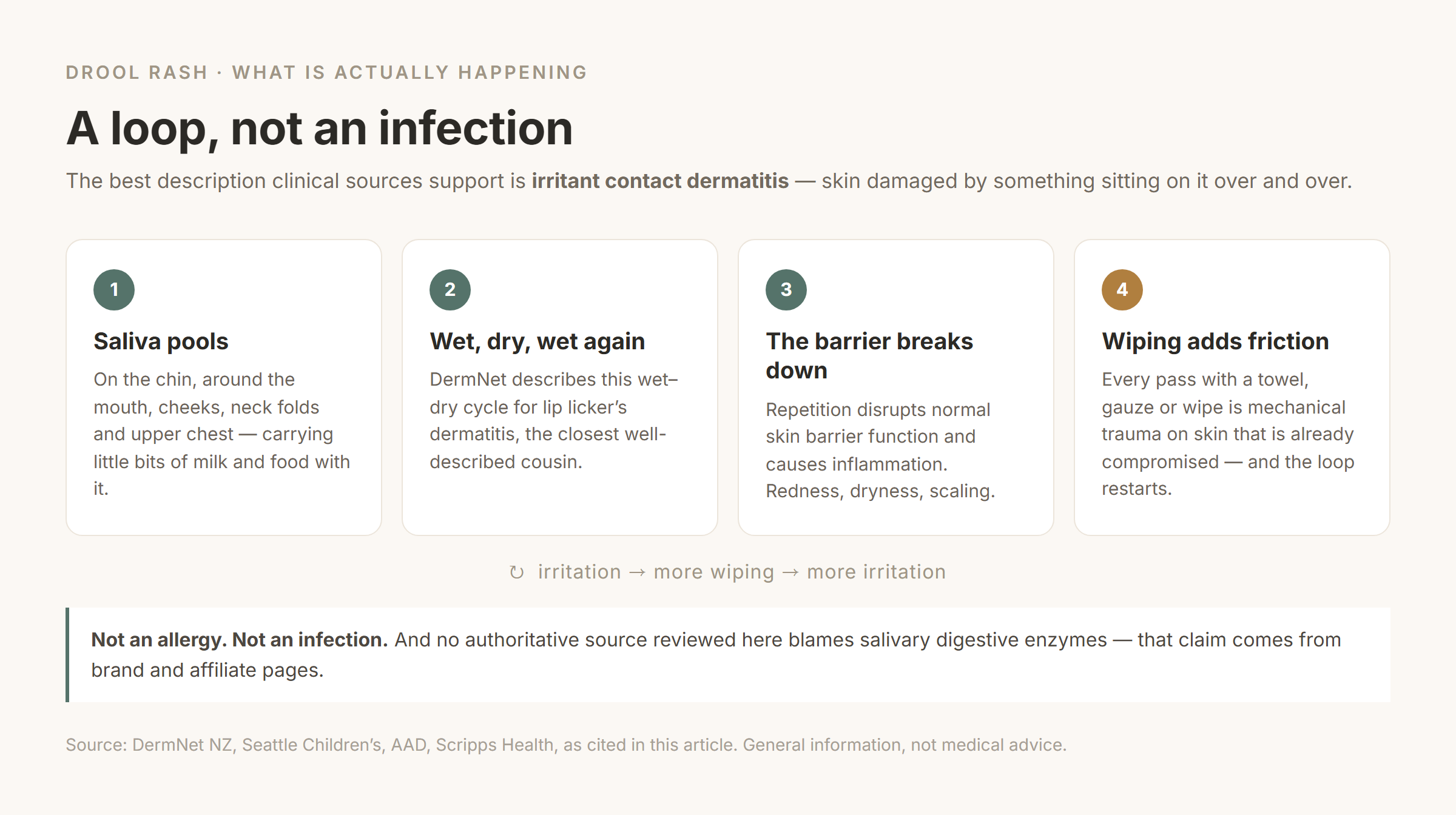
There is also a self-perpetuating loop in here. DermNet describes it for lip-licking: inflammation drives more licking, which drives more inflammation. The infant version is drool, then irritation, then more wiping, then more irritation.
About the “digestive enzymes” explanation
You will read almost everywhere that the enzymes in saliva digest the skin. I looked for that in authoritative guidance and could not find it.
Across AAP/HealthyChildren, the AAD, the NHS, Seattle Children’s, Nemours KidsHealth and DermNet, not one attributes drool rash to salivary digestive enzymes. The sources making that claim are brand and affiliate pages. It is mechanically plausible — it mirrors the well-established enzyme model in diaper dermatitis — but plausible is not the same as established.
So the framing I would use is the simple one. Repeated wetting and drying by saliva, plus friction from wiping, breaks down the skin’s protective barrier. Some clinicians also point to substances in saliva and food residue as contributors. That is as far as the evidence goes.
Why it happens at this age
Drooling is a normal developmental stage, and it starts on its own schedule.
Salivary output rises around 2–3 months, while lip seal and swallowing coordination are still immature. The saliva has to go somewhere, so it escapes. Drooling is heaviest roughly 3–9 months. Scripps notes babies typically drool heavily from 3–6 months, with salivary glands developing as early as 2–3 months. In the broader picture, infant drooling usually settles by around 18 months.

Photo: Polesie Toys / Pexels
Teething often overlaps with that window, which is why the two get fused together.
| Source | Teething timing |
|---|---|
| AAP / HealthyChildren.org | Babies typically start teething by about 4–7 months |
| Nemours KidsHealth | Can begin as early as 3 months, first tooth usually 4–7 months |
| Seattle Children’s | Baby teeth come in between 6 and 24 months |
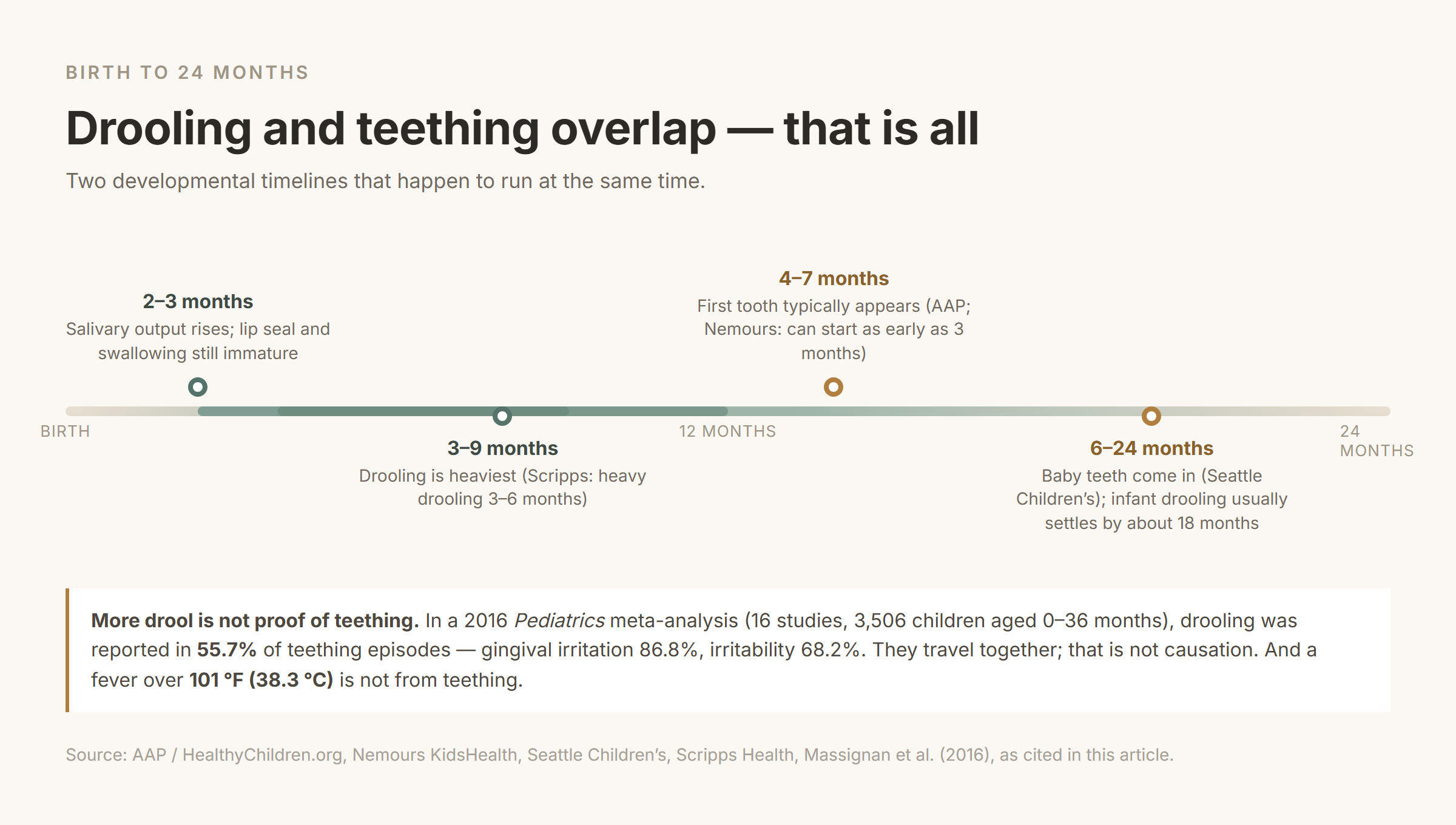
More drool is not proof of teething
This is the nuance worth carrying, because it changes what you do when something else shows up.
The AAP describes teething as causing mild irritability, a slight rise in temperature (but not over 101 °F / 38.3 °C), excessive drooling, and a desire to chew on something hard. And then the important line: if a child has a fever higher than 101 °F, it is probably not from teething.
Seattle Children’s is blunter still. “Teething does not cause fever, diarrhea, diaper rash or runny nose. It does not cause a lot of crying.” Nemours agrees that teething does not usually cause high fever or diarrhea, and that if fever develops you should contact the doctor.
The research is consistent with that caution. A 2016 systematic review and meta-analysis in Pediatrics (Massignan et al.) pooled 16 studies covering 3,506 children aged 0–36 months. Signs and symptoms around primary tooth eruption had a 70.5% overall prevalence, most commonly gingival irritation (86.8%), irritability (68.2%) and drooling (55.7%). Risk of bias was moderate.
Read that carefully. Drooling was reported in a little over half of teething episodes — which means roughly 44% had no reported drooling at all. It shows the two travel together often. It does not show one causes the other.
So a drooly, red-chinned four-month-old with no tooth in sight is completely ordinary. And a fever is never to be written off as “just teething.”
The cleaning routine
This is the part people get wrong, usually by doing too much rather than too little.
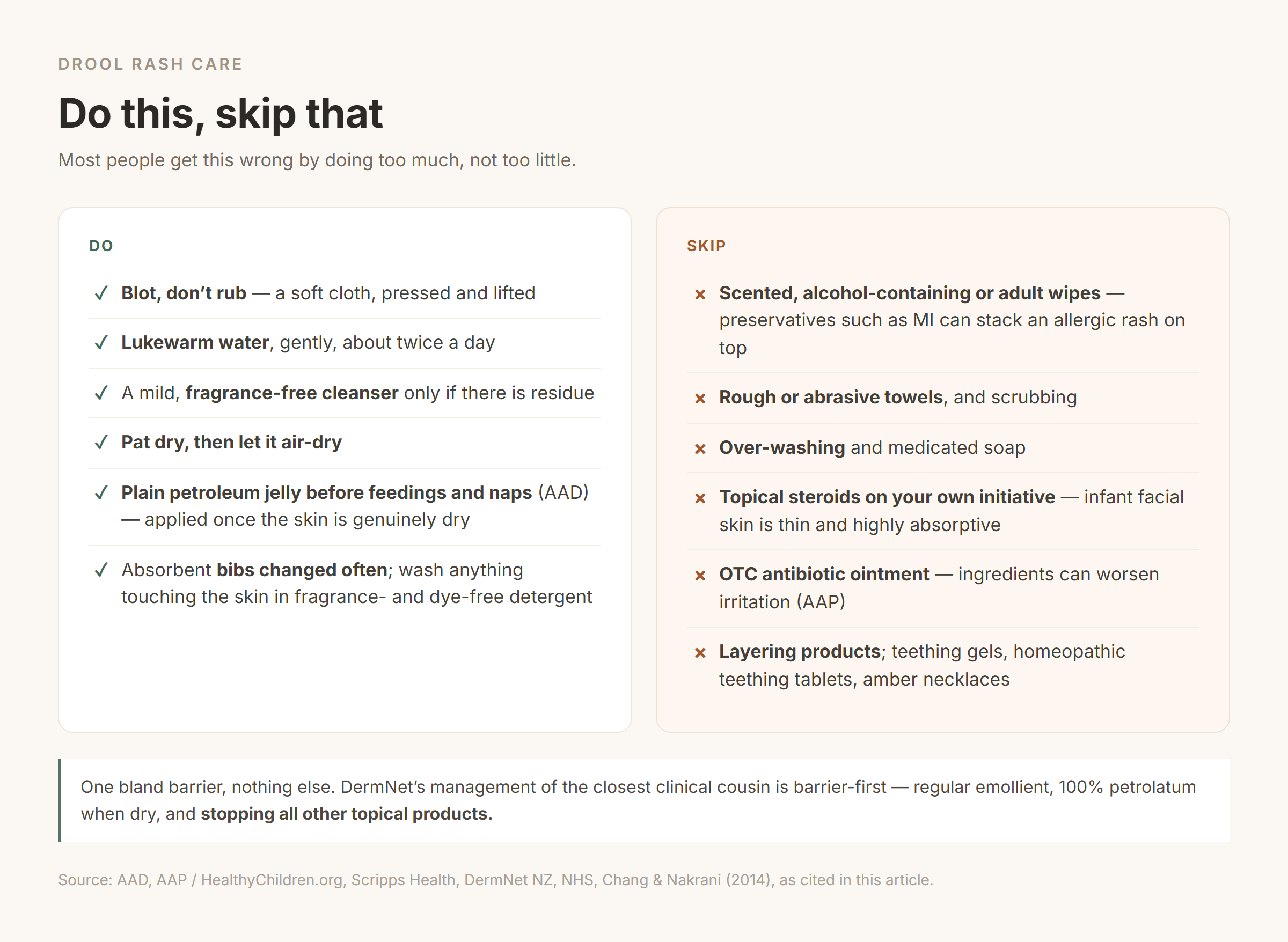
- Blot, don’t rub. A soft cloth, pressed and lifted. The AAD says avoid scrubbing; Scripps says avoid rubbing or an abrasive towel.
- Lukewarm water is the cleaner. Scripps suggests washing the affected area gently with warm water twice daily. The AAD recommends lukewarm water for baby skin generally.
- Cleanser only if you need it. The AAD’s rule is to wash only the dirty or smelly parts, using a mild, fragrance-free cleanser. The AAP’s phrasing is water and a non-soap or gentle cleanser.
- Pat dry, then let it air-dry. The AAP’s wording: “pat gently and allow skin to air-dry.”
- Don’t over-wash. Scripps says it directly — don’t wash the area too frequently, and don’t use medicated soap. Twice daily, plus blotting after drool episodes. Not a full clean after every dribble.
- For a really raw chin, rinse without touching. The AAP suggests a squirt or spray bottle of water for severe rashes, to rinse without rubbing. It is a diaper-rash tip, and it transfers neatly here.
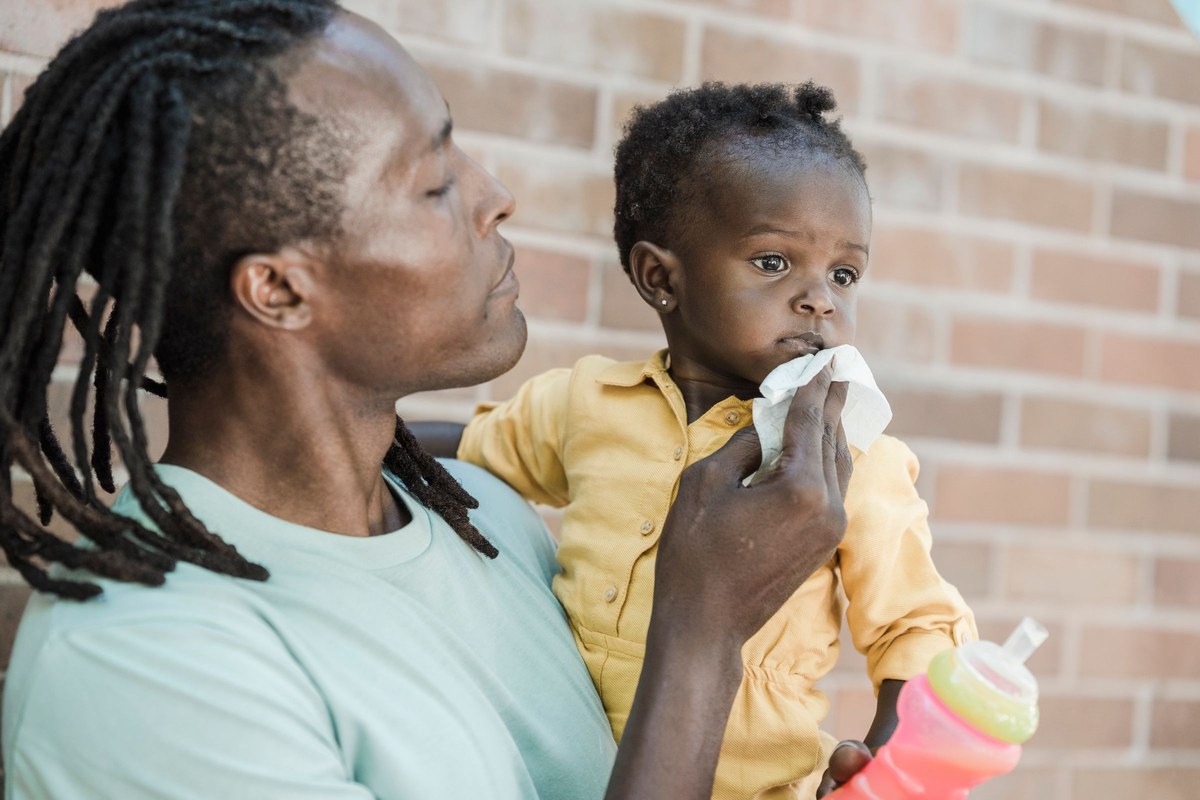
Photo: Sasha Kim / Pexels
Alongside that, reduce how much saliva sits on skin in the first place. The NHS says gently wiping the face may help prevent a rash when a teething baby is dribbling more than usual — and notably, gentle wiping is the only intervention that page mentions. Nemours suggests gently wiping the face often with a cloth. Absorbent bibs, changed frequently, keep the chest and neck folds dry, and so does changing damp clothing.
One detail that is easy to miss: the bib sits on the rash all day. The AAD advises washing anything that touches your baby’s skin with hypoallergenic, fragrance- and dye-free detergent. Scripps says the same about scented detergents, perfume and essential oils.
Barrier ointment: what, and when
The strongest single line in this entire topic comes from the American Academy of Dermatology, in its guidance on treating eczema in babies:
Apply plain petroleum jelly around your baby’s mouth before feedings and naps.
Notice what that timing implies. The ointment goes on preventively, before the skin gets soaked — not only after the damage is done.
On what to use, the sources converge on unremarkable products:
- The AAD notes thick creams and ointments are generally more effective than lotions or oils. Plain white petroleum jelly is inexpensive, fragrance-free, and contains no contact allergens.
- The AAP’s diaper-rash guidance — the same irritant-barrier principle — says zinc oxide and petrolatum are both good choices, and fragrance-free products are best.
- DermNet’s management of lip licker’s dermatitis is barrier-first: a bland emollient used regularly, 100% petrolatum whenever the area is dry, and stopping all other topical products.
- Pigatto et al. (2010) recommend perfume- and preservative-free products, plus a barrier such as zinc oxide to isolate the skin from irritants.
No premium product is required. Plain is explicitly good enough.
Photo: Towfiqu barbhuiya / Pexels
Apply to dry skin — and yes, sources disagree
Here is the point where I have to show my work, because there is a real conflict.
The familiar after-bath eczema rule is to moisturize while the skin is still damp, to seal water in. Applied to drool rash, that becomes “put the ointment on before the skin dries.” Scripps’s pediatrician guidance says the opposite — apply petroleum jelly or a healing ointment after the area is completely dry, to soothe the irritation and protect the skin from drool.
Both logics are defensible, and they are aiming at different things. The eczema rule is trying to trap water in the skin. The drool-rash rule is trying to avoid sealing saliva against the skin.
For a drooling chin, I would follow Scripps. Pat dry, wait until it is genuinely dry, then apply. Sealing residual saliva under an occlusive ointment is the exact exposure you are trying to end.
How much
No verified source specifies a thickness for the face. The AAP’s memorable “thick layer, like icing on a cupcake” is diaper-area guidance, and I would not transfer it to a baby’s mouth.
A thin, even film is enough on the face. The goal is a seal, not a mask.
I should also say plainly what does not exist: there is no evidence-based statement on how many times a day to reapply, and no trial comparing petrolatum against zinc oxide or dimethicone specifically for drool rash. Before feedings and naps is the anchor. Beyond that, you are using judgment, not a protocol.
Wipes and other things to skip
Wipes are the strongest “don’t” in this article, and the reasoning is more interesting than “they’re harsh.”
The AAP’s position: cleansing with water and a non-soap or gentle cleanser “may be less painful than wiping if the skin is irritated or has open sores.” And if you do use wipes, “choose a product that is free of alcohol and fragrance.”
The deeper problem is preservatives. In Pediatrics (2014), Chang and Nakrani reported six children with chronic eczematous dermatitis — perianal, buttock and facial — that had resisted multiple topical and oral antibiotics and corticosteroids. All had used wet wipes containing methylisothiazolinone (MI) on the affected areas. One case was an eight-year-old girl with chronic crusted, fissured patches around the mouth, a picture that looks exactly like a severe drool or lick rash. Patch testing confirmed allergic contact dermatitis, and discontinuing the wipes produced rapid and complete resolution. The authors note this reaction is frequently misdiagnosed as eczema, impetigo or psoriasis.
A companion 2014 paper (Schlichte and Katta) found MI is a moderate-to-strong sensitizer and an emerging pediatric allergen — and that among baby and children’s products surveyed, facial and body wipes were among the categories containing the most MI.
To be precise, because the distinction matters: MI causes an allergic reaction, which is a different mechanism from the irritant dermatitis of drool rash. Wipes do not cause drool rash. What they can do is make it worse, and stack a second, harder-to-treat rash on top of it. If a chin rash will not clear despite careful care, it is fair to ask what is being wiped on it.
A workable hierarchy:
Water and a soft cloth (best) → water plus a mild fragrance-free cleanser if there is residue → an alcohol-free, fragrance-free wipe when you are out of the house → never a scented, alcohol-containing or adult wipe.
A few more things to leave alone:
- Topical steroids, on your own initiative. Corticosteroid exposure is documented in 58–72% of pediatric periorificial dermatitis cases, a rash steroids can trigger or worsen; Children’s Mercy reports over 70% had a history of topical, inhaled or oral steroid exposure. Infant facial skin is thin and highly absorptive. If a steroid is appropriate, a clinician chooses the potency and the duration.
- Over-the-counter antibiotic ointment. The AAP warns that ingredients in these products can sometimes worsen skin irritation.
- Layering products. DermNet’s advice is to stop the use of any other topicals. One bland barrier, nothing else.
- Teething gels, homeopathic teething tablets and amber teething necklaces. The AAP warns all three carry safety risks.
What it might be instead
Distribution is the most useful clue. A simple drool rash stays where saliva pools — chin, around the mouth, cheeks, neck folds, upper chest — and it waxes and wanes with the drooling. No fever, no pus, no crusting.

Photo: Helena Lopes / Pexels
| Condition | What sets it apart |
|---|---|
| Atopic dermatitis (eczema) | Red, scaly, sometimes crusted, poorly demarcated patches on cheeks and scalp; itchy enough to disturb sleeping and feeding. Extends well beyond the drool zone. Saliva is a recognized trigger, so the two genuinely overlap. |
| Seborrheic dermatitis (cradle cap) | Onset 2 weeks–12 months, peaking around 3 months. Greasy plaques with yellowish scale, classically on the scalp, sometimes eyebrows, neck folds, behind the ears. Usually neither painful nor itchy. Resolves on its own. |
| Periorificial dermatitis | Small papules, papulopustules or vesicles around mouth, nose and eyes — bumps, not just redness and scale. Extends beyond the reach of the tongue and drool. Strongly linked to prior steroid use. |
| Impetigo | Honey-colored crusts, classically around the nose and mouth. Bullous impetigo is more common in infants — over 90% of cases are in children under 2 — and presents as blisters without the honey crust. Contagious. |
| Candida / thrush | Creamy white curd-like patches on the tongue and inside the cheeks that do not wipe away easily; can crack the corners of the mouth (angular cheilitis). Pacifier use is a risk factor. |
| Herpes simplex (HSV) | Small blisters around the lips, sometimes chin, cheeks and nose, which ooze and crust. A first infection can bring fever, swollen glands, sore throat, irritability — and drooling, which is exactly how it gets mistaken for teething. |
| Allergic contact dermatitis (e.g. MI in wipes) | Chronic, crusted, fissured patches that fail to respond to antibiotics and steroids, with a history of wipe use. Diagnosed by patch testing. |
Broken skin can also get secondarily infected — usually Staphylococcus aureus or Candida albicans — which needs prompt medical attention.
Red flags: when to call
Some of these are “call this week.” One is “call now.”
- Honey-colored or yellowish-orange crusting, or pus-filled blisters or sores.
- Weeping, oozing, or open sores.
- Grouped blisters, vesicles or ulcers around the lips — think HSV.
- Fever. The AAP is clear that a fever over 101 °F (38.3 °C) is not from teething; Seattle Children’s says teething does not cause fever at all.
- Rash spreading well beyond where drool lands — eyes, nasolabial folds, scalp, body.
- Bumps and pustules rather than flat redness and scale, especially if a steroid cream has been used.
- White patches inside the mouth, or cracked corners of the mouth.
- Cracked, painful or bleeding skin, or lethargy, or difficulty breathing or swallowing.
- No improvement after about a week of consistent, correct home care.
Urgent. A newborn or a baby under 6 months with blisters or sores, especially alongside fever, needs a clinician urgently. HSV is dangerous to babies under 6 months, and above all to newborns in the first few months of life. The same urgency applies to sores near the eyes, or to headache with confusion, seizure or fever.
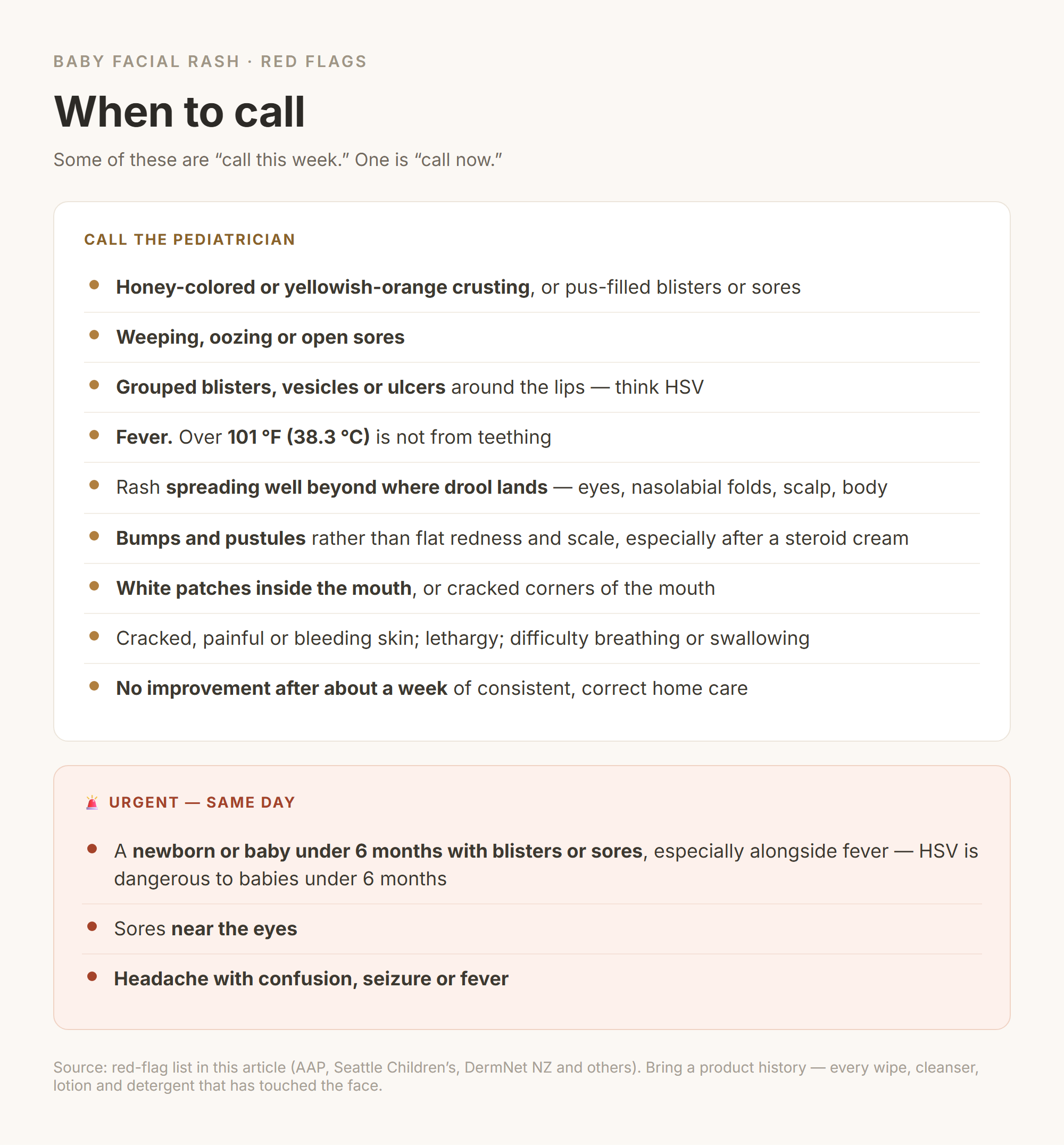
If you do end up in the office, one thing that helps enormously is bringing a product history — every wipe, cleanser, lotion, laundry detergent and topical that has touched the face. A refractory rash plus a wipe habit is what prompts a clinician to think about MI allergy and patch testing.
Related reading: Baby heat rash vs. viral rash: how to tell them apart
I keep coming back to how thin the ground is here.
For something this common — a red chin on a drooling baby — the strongest direct statement I could find in the entire body of authoritative guidance is a single sentence from the AAD about petroleum jelly before feedings and naps. There is no prevalence figure worth quoting. No comparison trial between barrier products. No evidence-based reapplication schedule. The confident, detailed articles you find online are mostly written by companies selling something.
Which is oddly reassuring, in a way. It means the real answer is small: blot gently, dry properly, seal with something plain, and stop putting other things on it.
And it means the part that actually requires attention is not the routine, but the watching. Knowing which chin rash is just a chin rash, and which one has stopped being one.
Because the routine is something you can settle into. The judgment is the part nobody can hand you in a jar.
Medical disclaimer: This article is general information, not medical advice, and does not replace evaluation by a clinician. Talk to your pediatrician about any rash that is severe, painful, spreading, looks infected, comes with fever, or is not improving — and seek care urgently for a baby under 6 months with blisters and fever.
Sources: American Academy of Dermatology; American Academy of Pediatrics / HealthyChildren.org; NHS; Seattle Children’s Hospital; Nemours KidsHealth; Scripps Health; Children’s Mercy Kansas City; Johns Hopkins Medicine; Nationwide Children’s Hospital; Mayo Clinic; DermNet NZ; Pediatrics (Chang & Nakrani, 2014; Massignan et al., 2016); Dermatology Research and Practice (Schlichte & Katta, 2014); Italian Journal of Pediatrics (Pigatto et al., 2010). Compiled August 2026.