Nasal Irrigation the Safe Way: Avoid Side Effects
I’ll admit something first.
For years, I rinsed my sinuses with whatever water came out of the tap.
Nobody ever told me not to, and honestly, it never occurred to me to ask.
Nasal irrigation — using a neti pot or squeeze bottle to flush out mucus, allergens, and dust — is one of those home remedies that gets recommended constantly, especially during allergy season.
It works.
But the way most of us do it has a real, if rare, safety gap: the water itself.
I started digging into this after reading about a death linked to tap water in a nasal rinsing device, and what I found changed how I do this completely.
Here’s what I wish someone had told me from the start — the water rules, the technique, and the warning signs worth knowing before you ever pick up a neti pot again.
Photo: Peter Vang / Pexels
Why Plain Tap Water Is the One Mistake That Matters Most
This is the part I got wrong for years, so let me start here.
Tap water is treated to be safe to drink.
That’s a different standard than safe to put up your nose.
When you swallow tap water, stomach acid kills off whatever low-level bacteria or organisms might be in it.
Your nasal passages don’t have that defense.
Water — and anything living in it — can just sit there instead of being neutralized.
Most of the time, nothing happens.
That’s exactly why the habit feels harmless — until it isn’t.
The Infection Risk, Named Plainly
I don’t want to be alarmist about this, because serious infection from nasal rinsing is rare.
But it’s real enough that the FDA and CDC both put out specific warnings about it, so I think it’s worth naming directly rather than dancing around it.
Tap water can carry bacteria and amoebae that survive in nasal passages.
One of them is Naegleria fowleri — sometimes called the “brain-eating amoeba.”
In extremely rare cases, when it’s sniffed up the nose, it can travel to the brain and cause primary amebic meningoencephalitis (PAM), a condition that’s almost always fatal.
Another is Acanthamoeba.
A CDC report described a fatal case of Acanthamoeba encephalitis in a New Mexico patient in 2023, tied to regular use of tap water in an electronic nasal irrigation device.
By one analysis, this kind of infection affects roughly 3 to 12 people a year in the US — a tiny number nationally, but with a fatality rate around 82%.
That combination — very rare, very severe — is exactly why the water rule isn’t optional.

Photo: Pavel Danilyuk / Pexels
What “Safe Water” Actually Means
So if tap water straight from the faucet is out, what’s in?
According to the FDA and CDC, you have a few solid options — you only need one of them.
- Distilled or sterile water — the store-bought kind labeled “distilled” or “sterile.”
- Boiled and cooled water — bring tap water to a rolling boil for 1 minute (3 minutes if you’re above roughly 6,500 feet / 1,980 meters), then let it cool to lukewarm before use.
- Filtered water — through a filter specifically labeled “NSF 53” or “NSF 58,” or one stating an absolute pore size of 1 micron or smaller.
Any one of these removes the amoebae and organisms that plain tap water can carry.
None of them are complicated.
The boiling method, in particular, costs nothing and takes one minute — which makes the “I didn’t have time” excuse hard to justify, and I say that as someone who used it for years.

Don’t Forget the Salt
Safe water solves the infection risk. It doesn’t solve the sting.
The solution also needs to be isotonic — roughly 0.9% salt, close to the concentration of your own body fluids — and lukewarm.
Plain water, or a solution that’s too weak, can sting and make the mucosa swell through simple osmosis.
Pre-measured saline packets sold with most neti pots and squeeze bottles are built for exactly this ratio, so I just follow the packet rather than guessing.

Photo: Towfiqu barbhuiya / Pexels
The “Ahh” Sound That Actually Does Something
This part felt a little silly to me the first time I read it. It isn’t.
While you rinse, keeping your mouth open and making a sustained sound — “ahh,” or holding an “ng”/”k” as in “hung” — raises and closes the soft palate at the back of your throat.
That keeps the solution from running down your throat, and it also helps keep it away from the Eustachian tubes that connect your nose to your middle ear.
That second part matters more than it sounds.
It’s the main thing standing between a normal rinse and fluid ending up somewhere it shouldn’t — your middle ear.
Interestingly, sources don’t fully agree on which exact sound works best.
Some say “ahh,” others say “k” or “ng,” others say “eee.”
The goal is the same regardless — raise and close that soft palate — so whichever sound does that for you is the right one.
Technique, Step by Step

During the rinse
- Lean forward over a sink and tilt your head slightly to one side. Don’t tip your head far back — that’s what lets solution run toward your ears instead of out your nose.
- Gently place the spout in your upper nostril. Don’t insert it deeply or force a seal; that can irritate or injure the mucosa.
- Keep your mouth open, make your “ahh” sound, and let the solution flow slowly, at low pressure. It should run out the lower nostril within a few seconds.
- Repeat on the other side.
Finishing up
- Lean forward and gently blow your nose — one nostril at a time, softly — to clear the remaining solution. Blowing hard can push fluid toward your ears instead of out.
- Move your head side to side and forward to let any trapped solution drain out naturally.
- Wash the device after every use, following the manufacturer’s instructions, and let it air-dry completely before you put it away. A device that’s still damp when you store it is exactly the environment bacteria and mold like.

Photo: cottonbro studio / Pexels
I used to skip that last step more often than I’d like to admit. I don’t anymore.
Side Effects and Who Should Be Careful
Even done correctly, nasal irrigation isn’t entirely risk-free — just low-risk.
The honest list of what can go wrong:
- Middle-ear irritation or otitis — usually from high pressure, forceful nose-blowing, tipping the head too far back, or too much solution too fast.
- Mucosal irritation, dryness, nosebleeds, or stinging — usually from non-isotonic solution, rinsing too often, or inserting the spout too deep.
- Infection — from unsafe water or a device that wasn’t cleaned and dried properly.
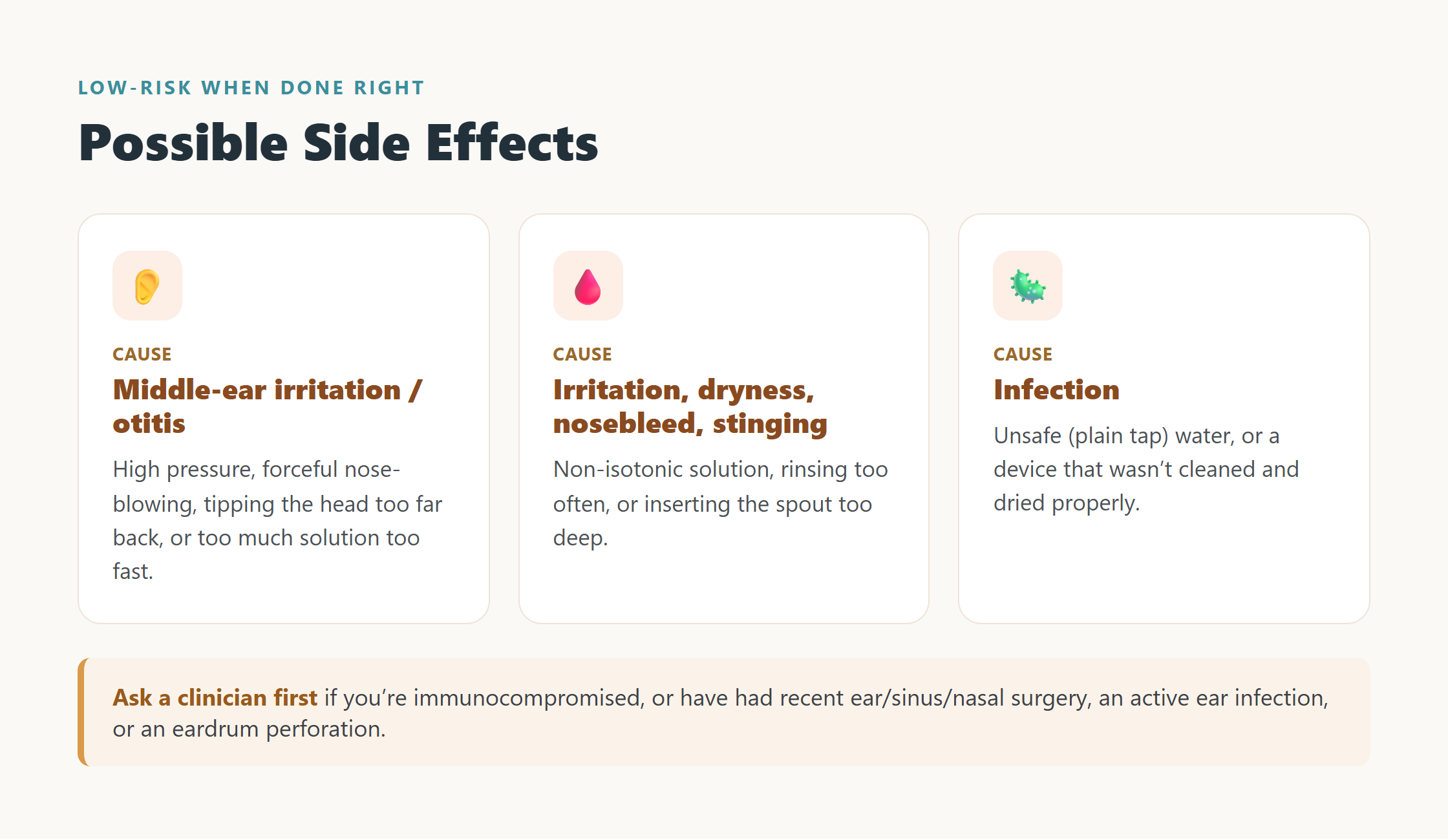
A few groups should check with a clinician before starting, or before continuing:
- Anyone who is immunocompromised — the safe-water rules matter even more here.
- Anyone with a recent ear, sinus, or nasal surgery, an active ear infection, or an eardrum perforation.
- Anyone who notices repeated ear pain after rinsing — that’s a sign to stop and ask, not push through.
On frequency: most guidance suggests once or twice a day, but this varies by symptoms and by clinician advice. More isn’t automatically better — over-rinsing can strip the protective mucus your nose actually needs.
When to Get Care Right Away
Two different urgency levels are worth knowing.
Go to the ER immediately if, after rinsing, you develop a headache, fever, confusion, vomiting, seizures, or a stiff neck. These are extremely rare, but they’re the warning signs associated with amoebic infection, and this is not a “wait and see” situation.
See a clinician for severe or persistent ear pain, a high fever, foul-smelling ear drainage, sudden hearing loss, or dizziness that doesn’t go away. These point toward middle-ear involvement or an infection that needs to be checked.
Where This Leaves Me
I still use a neti pot most mornings during allergy season. That part hasn’t changed.
What changed is the water — always distilled, boiled-and-cooled, or properly filtered, never straight from the tap — and the fact that I actually rinse the device out and let it dry now instead of leaving it damp in a drawer.
None of this is medical advice, and it isn’t meant to replace a conversation with your doctor, especially if you’re in one of the higher-risk groups above.
It’s meant to close the gap I didn’t know I had: the assumption that any water is fine, as long as it’s clean enough to drink.
It isn’t.
And that one fact is worth remembering every single time you reach for the bottle.