Medicine Expiration After Opening: There Is No US Rule
That eye-drop bottle you opened months ago and used again last night — what is actually in it now?
I asked myself that at the sink, holding a bottle with no memory of when I first twisted the cap. Somewhere online I had absorbed a rule that felt authoritative: liquids last a month after opening, ointments six months, eye drops a month. So I went looking for the agency that says so.
I could not find one.
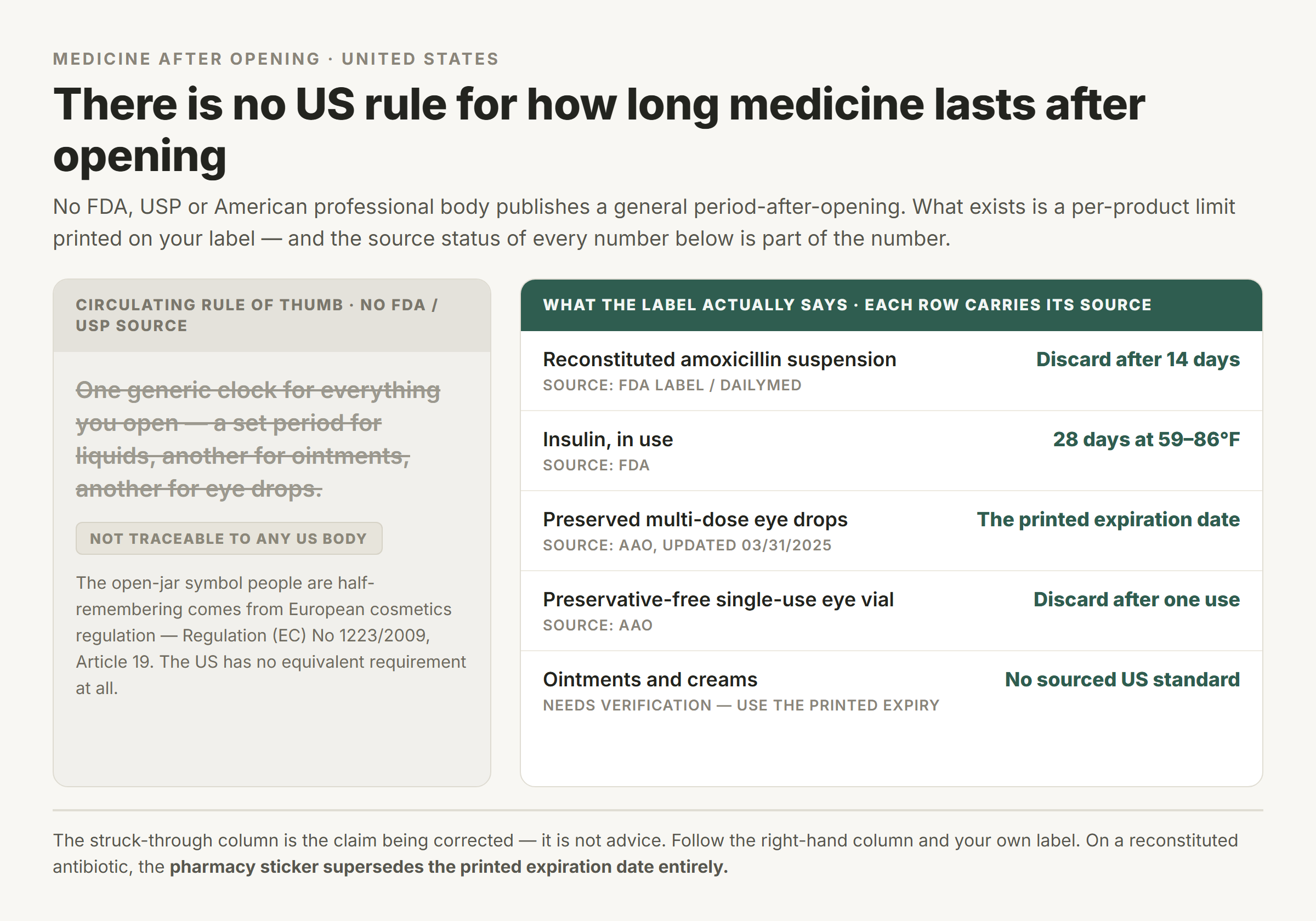
Here is the honest answer up front. There is no US period-after-opening rule for medicine. No FDA, USP or American professional body publishes “one month for liquids, six months for ointments, one month for eye drops.” The open-jar symbol with “6M” printed inside it, the thing most people are half-remembering, comes from European cosmetics regulation — Regulation (EC) No 1223/2009, Article 19 — and the US has no equivalent requirement at all.
What does exist is narrower, stricter and more useful: per-product after-opening limits printed on your label or package insert, and some of them are far shorter than a month. Reconstituted amoxicillin goes in 14 days. Augmentin suspension in 10. A preservative-free eye vial gets thrown away after a single use.
I am not a pharmacist or a doctor, and this is general information rather than medical advice. The label on your specific medicine always outranks anything in this article, and the person who can read that label for you is free to talk to. A fuller note is at the bottom.
What the printed expiration date actually promises
FDA frames the date as a conditional promise, not an unconditional one. It applies to the product in its unopened, intact container, stored the way the label says. Once that date passes, FDA’s position is that there is no guarantee the medicine will be safe and effective.
The agency is blunt about the mechanism. Expired medical products “can be less effective or risky due to a change in chemical composition or a decrease in strength,” and sub-potent antibiotics “can fail to treat infections, leading to more serious illnesses and antibiotic resistance.”
FDA is equally blunt about the other half of the sentence, the half people skip. “Improper storage — such as a damp bathroom cabinet — can contribute to decreased effectiveness.” The date assumes conditions your medicine cabinet may not have provided.
So the date is real. It is just answering a different question than “how long since I opened this.”
How long is medicine good after opening? The limits that are actually sourced
This is the table I wish I had found first. Every row carries where it comes from, because the difference between an FDA-approved label and a number someone typed into a listicle is the whole point of this article.
| Dosage form | After-opening limit in the US | Source status |
|---|---|---|
| Tablets and capsules, manufactured, original container | No general after-opening limit; the printed expiration date applies if stored properly | FDA; Poison Control |
| Nitroglycerin, sublingual | Keep in the original tightly closed container; potency falls after opening. A real-life-conditions study found tablets held potency from roughly 12 months after opening up to the labeled expiry, depending on handling | Am J Cardiol 2018 |
| Reconstituted amoxicillin suspension | Discard after 14 days. Refrigeration preferable, not required | FDA label / DailyMed |
| Amoxicillin-clavulanate (Augmentin) suspension | 10 days, refrigeration required | FDA labeling |
| Azithromycin oral suspension | 10 days; store 5–30°C (41–86°F) | FDA labeling |
| Insulin, in use | 28 days at 59–86°F (15–30°C); unopened refrigerated 36–46°F until the printed expiry; diluted or repackaged 14 days; never use if frozen | FDA |
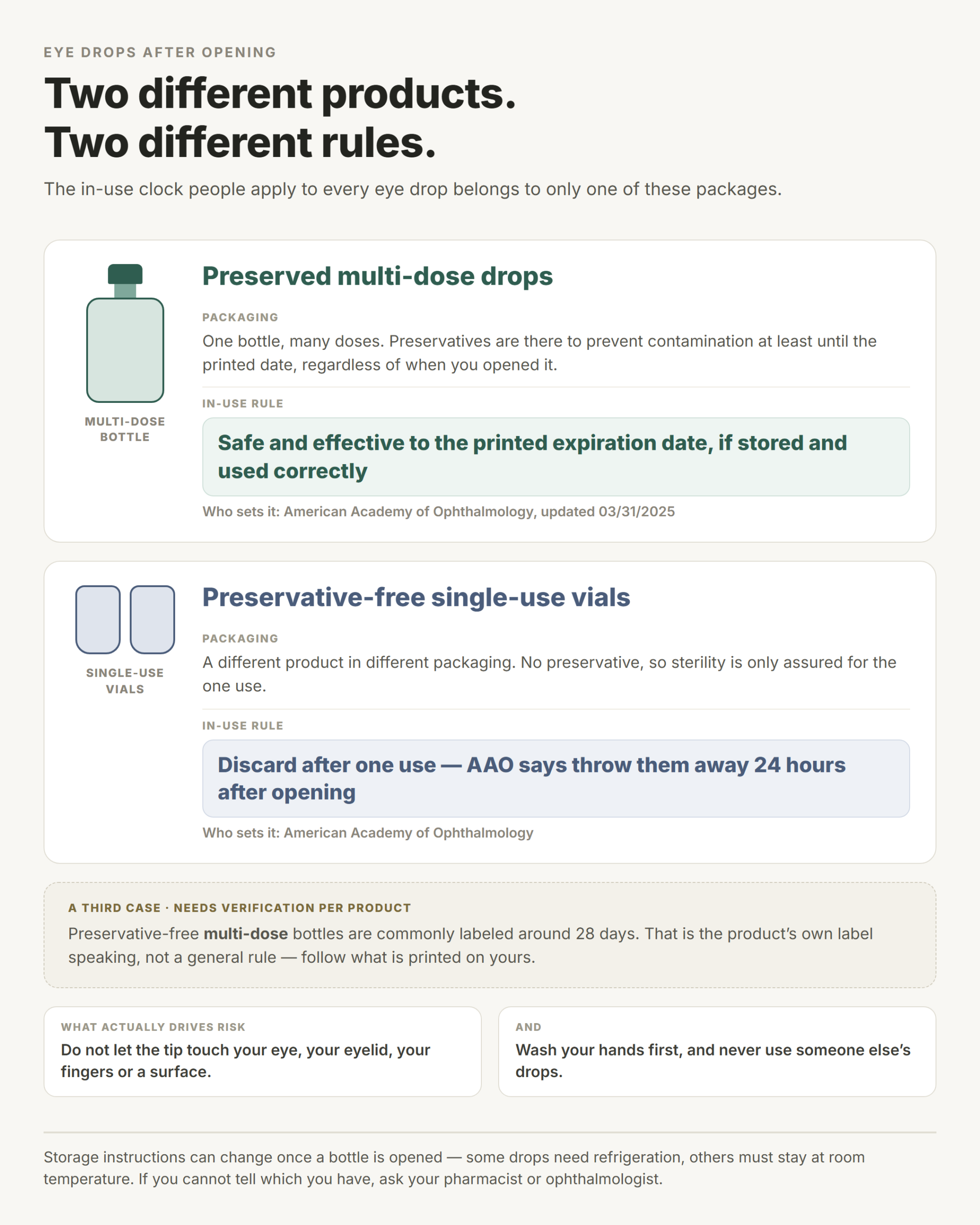
| Preserved multi-dose eye drops | The printed expiration date, if stored and used correctly — not 30 days | AAO, updated 03/31/2025 |
| Preservative-free single-use eye vials | Discard after one use. AAO states these should be thrown away 24 hours after opening | AAO |
| Preservative-free multi-dose eye bottles | Commonly labeled around 28 days — follow that product’s own label | Needs verification per product |
| Opened multi-dose injectable vial, clinical setting | 28-day default beyond-use date after first entry, never beyond the unopened expiry | CDC / USP <797> |
| Ointments and creams | No sourced US after-opening standard. Use the printed expiry; discard earlier if it changes | Needs verification |
| Inhalers, suppositories, hydrogen peroxide | No sourced US after-opening standard — read the label | Needs verification |
Two rows deserve a warning label of their own.
The 28-day multi-dose vial rule is a clinical sterile-compounding standard for opened injectable vials in healthcare settings. It is not a household rule, and it should not be stretched into one for the cough syrup in your kitchen cabinet.
And the six-month figure for ointments — the one I had been most confident about — could not be traced to FDA, USP or any US professional body in the research behind this article. I am not going to state it as fact. What is defensible: follow the printed date, and discard early if the product separates, changes color, changes smell, or was used on broken or infected skin.
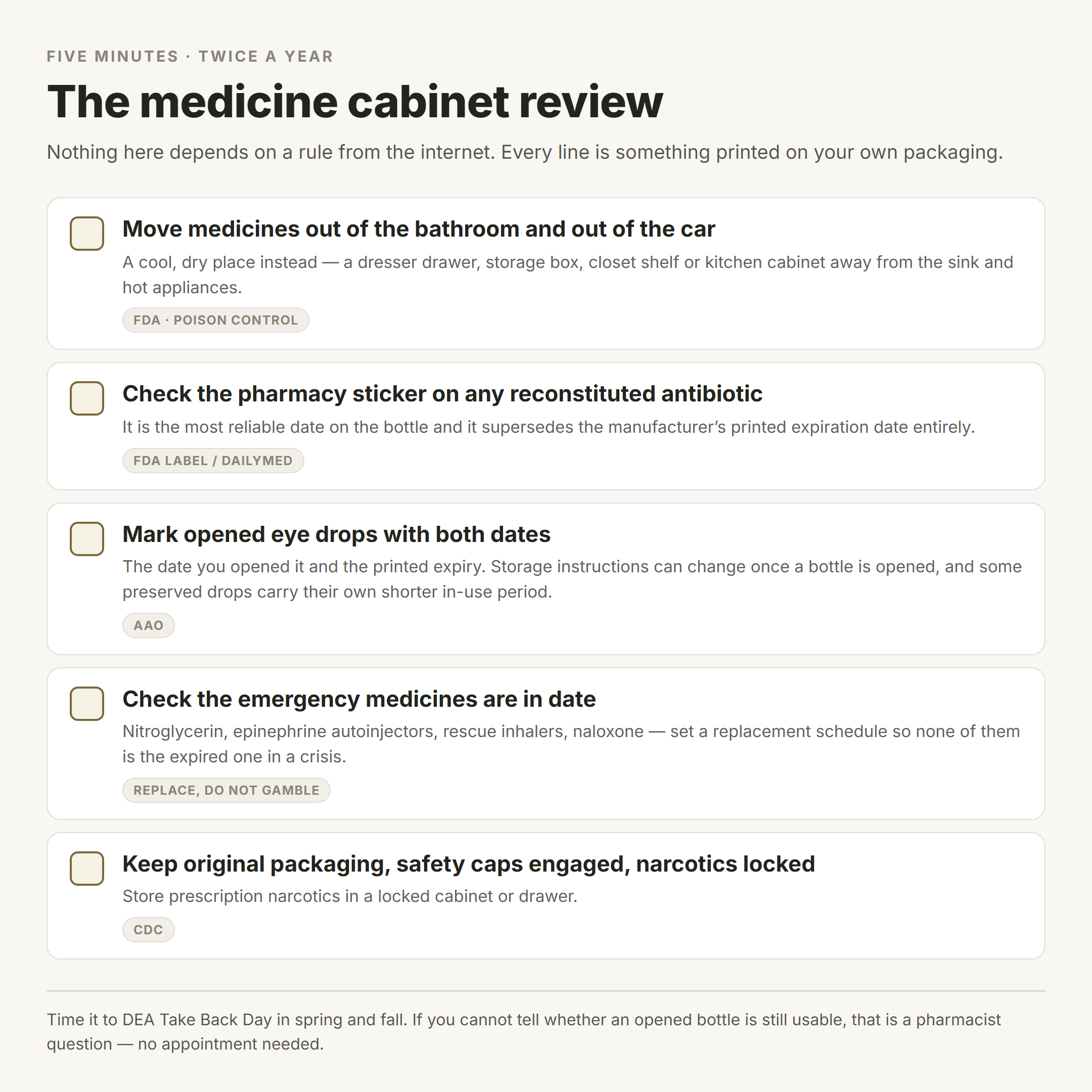
The most reliable date on any reconstituted antibiotic is the pharmacy sticker. It supersedes the manufacturer’s printed expiration date entirely.

Photo: Picas Joe / Pexels
Eye drops after opening: the premise is backwards
This is where the folk rule gets it most wrong, and where the relevant professional body says so out loud.
The American Academy of Ophthalmology’s position is that preserved multi-dose drops should stay safe and effective until the printed expiration date if they are used and stored correctly. The preservatives are there to prevent contamination at least until that date, regardless of when the bottle was opened. The 24-hour and single-use rules belong to preservative-free vials, which are a different product in different packaging.
AAO has gone further and campaigned against premature discarding. Research from New York Eye and Ear Infirmary of Mount Sinai, covered in an AAO release in October 2024, collected 297 bottles across three surgical sites over six weeks. Clinics were throwing multiuse bottles away 14 to 28 days after opening — roughly a year and a half before the FDA expiration date — with an average of 72% of the medication still in the bottle. The estimated waste at those sites was about $80,997 a year.
So the instruction to bin preserved drops at 30 days is not a safety standard. At those clinics it was mostly throwing away medicine.
One caveat AAO also gives: storage instructions can change once a bottle is opened, some drops need refrigeration and others must stay at room temperature, and some preserved drops do carry their own shorter in-use period. If yours does, mark both dates on the bottle. If you cannot tell, ask your pharmacist or your ophthalmologist — AAO gives exactly that advice.
The real contamination risk is the dropper tip, not the air
The version of this warning I had in my head involved bacteria drifting in through an open bottle. That is not how it works.
Contamination of in-use eye drop bottles is driven by the tip touching your eye, your eyelid, your fingers or a surface — and it rises with how long the bottle has been in use.
- A study of 194 in-use antiglaucoma bottles found 28% (55/194) grew bacteria. Split by bottle age: 19% in bottles under 8 weeks old, 40% in bottles used more than 8 weeks. Gram-positive organisms accounted for 91% of the contaminated bottles.
- A 2015 comparison found 24.4% of drops used at home were contaminated versus 19.5% on the ward, and located the problem precisely: the tip was contaminated 20.2% of the time, the drops themselves only 8.4%.
- A 2025 systematic review and meta-analysis pooled the rate at roughly 10% across studies.
Now the part that keeps this honest. A bottle growing something is not the same as an eye infection. Those studies measured culture positivity, not clinical illness. AAO notes that infections from FDA-regulated dropper bottles used in clinical settings have not been reported when proper storage and administration precautions were followed.
Which means the useful takeaway is not a discard date. It is: do not let the tip touch anything, never use someone else’s drops, and wash your hands first.
Does old medicine become toxic? Usually not — it loses potency
The National Capital Poison Center’s position is that expired medications are generally not poisonous. The dominant risk is reduced effectiveness — blood pressure that goes untreated, an infection that does not clear. Poison Control also notes that tablets are more stable than liquids or injectable products and may have a longer shelf life.
The scary story usually told here is tetracycline and Fanconi syndrome. Those case reports date from 1963 and 1965, involving degraded formulations, and Poison Control’s own note is that those products have since been taken off the market. It is medical history, not a live hazard in your cabinet.
The 2022–23 artificial tears outbreak was a manufacturing failure
I used that fear in the opening line, so let me correct it properly.
The catastrophic case is real and I am not going to soften it. In 2022–23, contaminated artificial tears sold as EzriCare and Delsam Pharma were linked by CDC to an outbreak of an extensively drug-resistant Pseudomonas aeruginosa strain never previously reported in the United States.
| Outcome (CDC, data as of 05/15/2023) | Number |
|---|---|
| Patients identified | 81 |
| States | 18 |
| Deaths within 30 days of clinical culture | 4 |
| Patients with vision loss | 14 |
| Enucleations (surgical removal of an eye) | 4 |
Now the part that changes what you should do about it. FDA’s findings on the manufacturer identified three failures: lack of appropriate microbial testing, a formulation failure — the company made and distributed ophthalmic drugs in multi-use bottles without an adequate preservative — and inadequate tamper-evident packaging controls. The company recalled all unexpired lots.
Read that again. The product was contaminated upstream, sold preservative-free in multi-dose bottles, and recalled while still in date. Nothing about the outbreak turns on a consumer keeping an opened bottle past an arbitrary 30 days.
So: severe harm, documented, and caused by a manufacturing failure — not by the calendar in your bathroom.
The live 2026 version of this risk is recalls
This is the part worth acting on. In April 2026, an FDA Enforcement Report citing a “lack of assurance of sterility” in OTC eye drops prompted a voluntary recall of more than 3 million bottles across brands sold through major retailers. A July 2026 update flagged 2.5 million bottles of prescription prednisolone acetate for a foreign substance.
The current eye-drop danger in the US is recalls and manufacturing defects, which you can actually check, rather than folk discard timetables, which you cannot verify at all. Check FDA recall notices, and if a product you own is on one, stop using it.
Photo: cottonbro studio / Pexels
So are expiration dates just conservative? The SLEP question
Every conversation about this ends up at the same study, and it deserves a straight presentation.
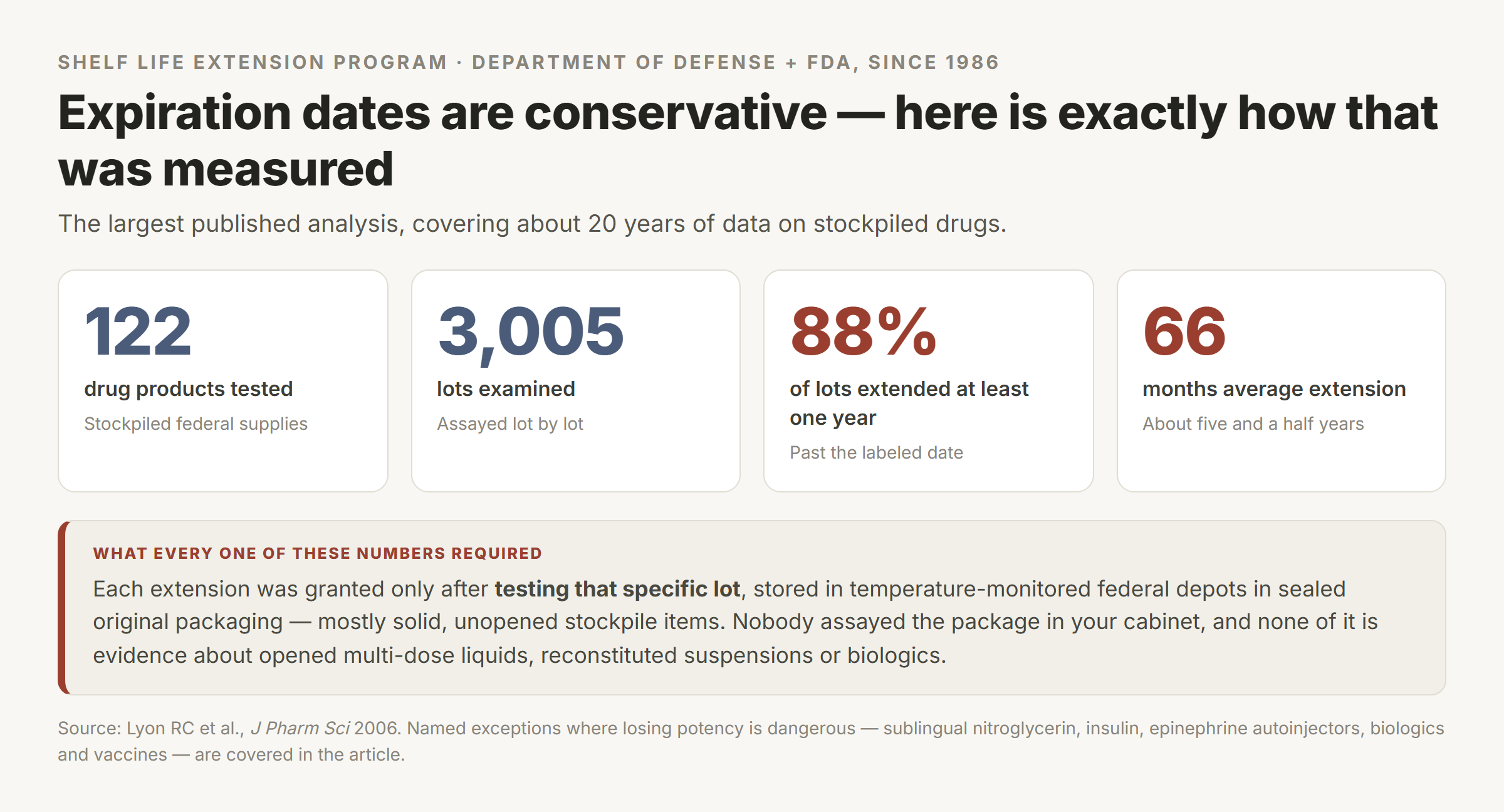
The Shelf Life Extension Program, run jointly by the Department of Defense and FDA since 1986, tests stockpiled drugs to see whether they remain within specification past their labeled dates. The largest published analysis, covering about 20 years of data, examined 122 drug products across 3,005 lots. It found that 88% of lots were extended at least one year, with an average extension of 66 months — about five and a half years.
Related work is even more striking. A 2025 systematic review on expired resuscitation medications found naloxone samples retaining more than 90% potency up to 27 years past expiration, albuterol at roughly 98% active drug at 20–30 years, and aspirin holding active drug up to 40 years.
That is the honest case. Here is the boundary around it.
- Storage. SLEP lots sat in temperature-monitored federal depots in sealed original packaging. The authors condition their findings on “properly stored.” A steamy bathroom is not a depot.
- It is lot-specific, not label-specific. Extensions were granted only after assaying that particular lot. Nobody assayed your bottle. An 88% aggregate says nothing about the package in your hand.
- It tested mostly solid, unopened stockpile items. It is not evidence about opened multi-dose liquids, reconstituted suspensions or biologics.
- Named exceptions where losing potency is dangerous. Sublingual nitroglycerin loses potency once the bottle is opened. Insulin’s in-use clock is days. Epinephrine autoinjectors are guaranteed by FDA to hold at least 90% of the dose only to the labeled date, and real-world results split sharply: one study found 80% of devices still at 90% content around two years past expiry, while another of more than 100 pens up to 11 years past expiry stored in EMS vehicles found only 13–31% of the labeled dose left. Biologics and vaccines: replace, do not gamble.
- Microbial risk is a separate axis. SLEP measured chemical potency. It says nothing about whether a dropper tip is colonized. A chemically perfect drop in a colonized bottle is still a bad idea.
- The emergency review is scoped to emergencies. An expired autoinjector beats nothing during anaphylaxis, with a 911 call either way. That is not a license for routine home use.
The expiration date is deliberately conservative and it is not a cliff edge. But “conservative” and “irrelevant” are different words — and the exceptions are precisely the drugs you would be reaching for when it matters most.
Where to store medicine, in actual numbers
USP <659> defines the storage terms your label is using.
| Term | Range |
|---|---|
| Controlled room temperature | 20–25°C (68–77°F), excursions permitted 15–30°C provided mean kinetic temperature stays at or below 25°C |
| Cool | 8–15°C (46–59°F) |
| Refrigerated / cold | 2–8°C (36–46°F) |
One caveat with a 2026 date on it: USP has proposed realigning controlled room temperature to 15–25°C for global harmonization, published in Pharmacopeial Forum 52(4) with comments open through 30 September 2026. That is a proposal, not the standard. Until it is adopted, 20–25°C is the definition in force.
FDA’s practical advice is a cool, dry place — a dresser drawer, storage box, closet shelf or kitchen cabinet away from the sink and hot appliances. Not a damp bathroom cabinet. Poison Control gives the same warning, noting that moisture and heat from the shower accelerate degradation.

Photo: adrian vieriu / Pexels
The glovebox deserves its own sentence. A parked car routinely blows past the 15–30°C excursion window, and the EpiPen finding above — 13–31% of the labeled dose in pens stored in vehicles — is the strongest practical argument against keeping medicine in your car that I know of.
CDC adds a dimension temperature talk misses: keep medicines in original packaging with safety caps engaged, and store prescription narcotics in a locked cabinet or drawer.
How to throw it away: the flush list is real, and so is the disagreement
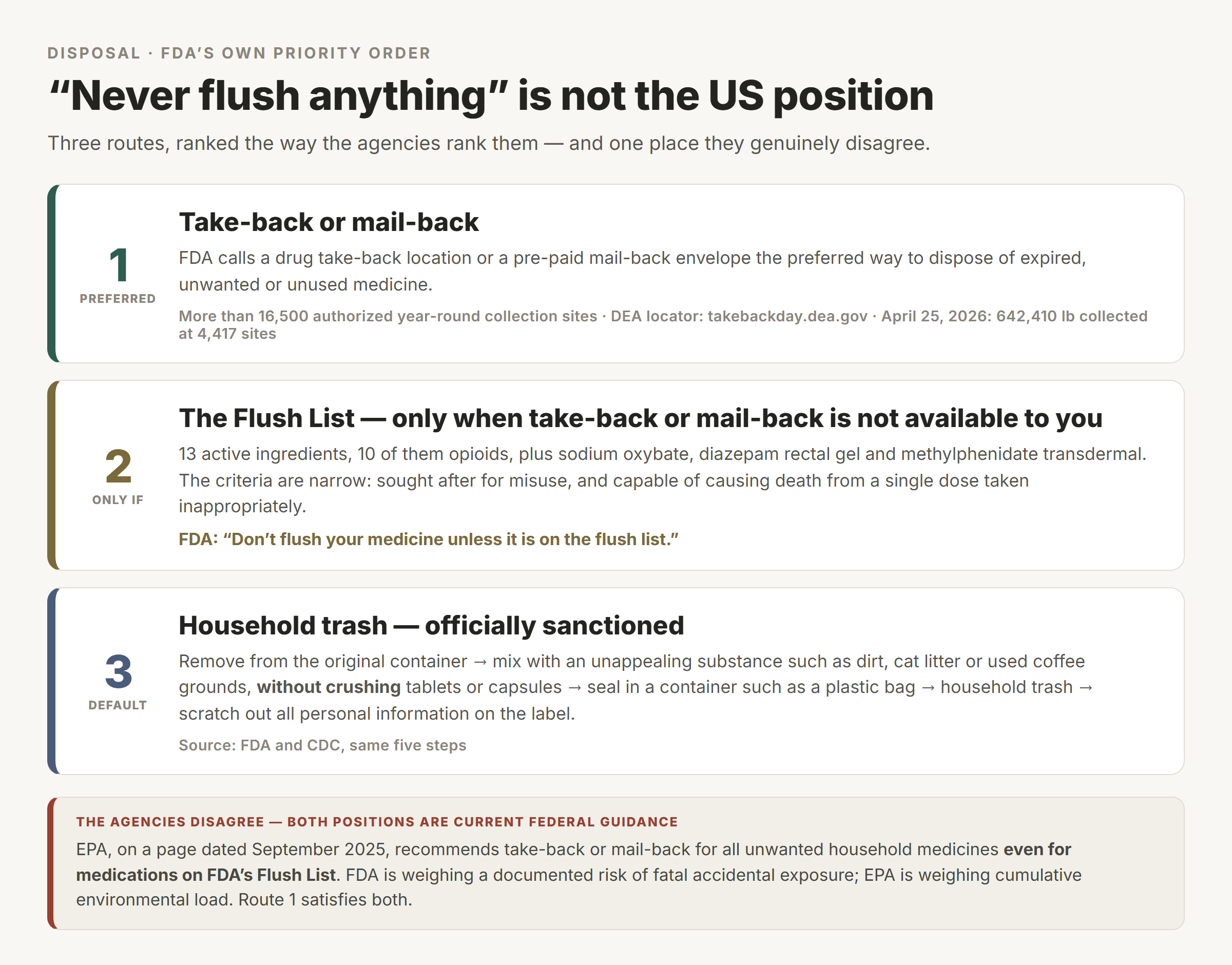
Here is where I found the confident internet advice most wrong. “Never flush anything” is not the US position.
Take-back first. FDA calls a drug take-back location or a pre-paid mail-back envelope the preferred way to dispose of expired, unwanted or unused medicine. The infrastructure is substantial: DEA’s spring 2026 Take Back Day, held April 25, 2026, collected 642,410 pounds at 4,417 sites, bringing the cumulative total since 2010 to 21,034,225 pounds — more than 10,500 tons. Year-round, more than 16,500 pharmacies, hospitals and businesses operate authorized collection sites, plus many police departments. DEA’s locator is takebackday.dea.gov.
The Flush List, second. FDA maintains a list of 13 active ingredients — 10 of them opioids, plus sodium oxybate, diazepam rectal gel and methylphenidate transdermal — that it tells consumers to flush when take-back or mail-back is not available to them. The criteria are narrow: medicines sought after for misuse, and capable of causing death from a single dose if taken inappropriately. FDA’s reasoning is that these present negligible environmental risk compared with the risk of a child, pet or visitor being killed by one dose. FDA’s own limit on this is equally clear: “Don’t flush your medicine unless it is on the flush list.”
Household trash, third, and officially sanctioned. For everything not on the Flush List, FDA and CDC give the same steps:
- Remove the drugs from their original containers.
- Mix them with an unappealing substance — dirt, cat litter, or used coffee grounds. Do not crush tablets or capsules.
- Seal the mixture in a container such as a plastic bag.
- Put it in the household trash.
- Scratch out all personal information on the prescription label before discarding or recycling the empty bottle.
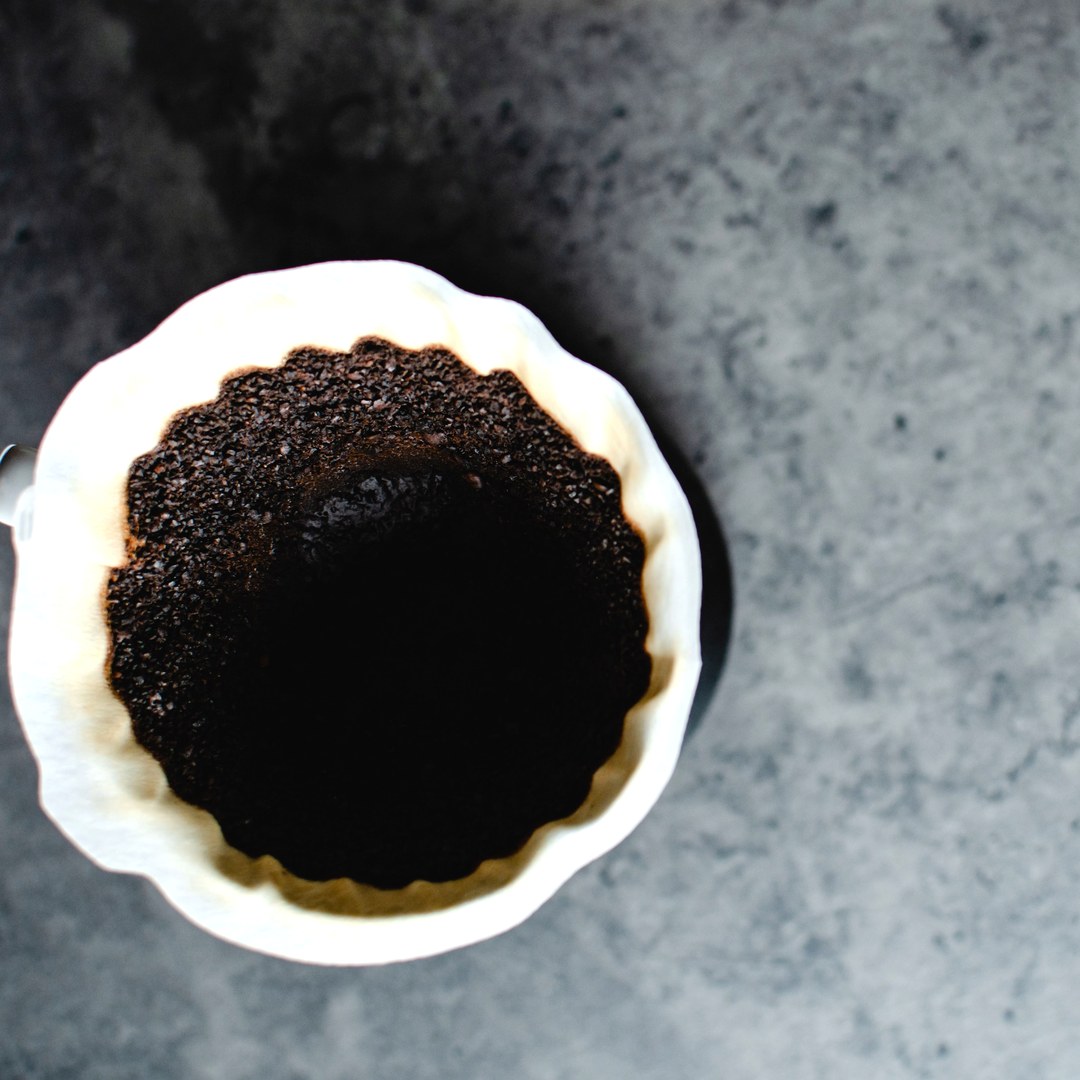
Photo: Eva Bronzini / Pexels
The agencies genuinely disagree, and I am not going to resolve it
EPA, on a page dated September 2025, recommends take-back or mail-back for all unwanted household medicines even for medications on FDA’s Flush List, and says it strongly discourages flushing waste pharmaceuticals from any source, with few exceptions such as sterile water and saline.
Both positions are current federal guidance. FDA is weighing a real, documented risk of fatal accidental exposure; EPA is weighing cumulative environmental load. Take-back satisfies both, which is the practical resolution even if the policy one is unsettled.
On the water question, the evidence is narrower than the headlines. A joint EPA/USGS study running from October 2007 to March 2012 sampled 25 drinking water treatment plants for 118 pharmaceuticals, before and after treatment. Substantially fewer pharmaceuticals were detected in treated water than in matching source water, with a median of two detections per treated sample and a maximum of four. A separate reconnaissance detected 63 of 100 targeted chemicals in at least one of 25 groundwater and 49 surface-water drinking-water sources.
So pharmaceuticals are detectable, treatment reduces but does not eliminate them, and household disposal is one contributor among several. None of the sources reviewed quantified how much of it comes from home flushing, so I am not giving you a percentage.
If you want the disposal steps on their own, with what to keep in a home first-aid kit while you are in the cabinet anyway, I wrote that up separately: how to dispose of expired medicines and stock a first-aid kit.
When to stop reading and get help
Tier 1 — urgent, same day, or call 911
- After using eye drops: blurred or decreased vision, severe eye pain, worsening redness, light sensitivity, discharge, or the sensation of something in the eye. Especially if the drops were preservative-free, shared, recalled, or the tip touched a surface. Same-day ophthalmology or emergency care.
- After any medicine: difficulty breathing, swelling of the face, lips, tongue or throat, rapidly spreading hives, chest pain, fainting, confusion, or a fast-worsening rash. Call 911.
- A medicine failed when it mattered: chest pain not relieved by nitroglycerin, anaphylaxis not controlled by an autoinjector, a severe asthma attack not relieved by a rescue inhaler, or unexplained very high blood glucose in someone using insulin. Emergency care immediately — and tell the clinician the medicine may have been expired or stored badly.
- Accidental swallowing by a child or a pet, expired or not: Poison Control, 1-800-222-1222, or 911. Do not wait for symptoms.
Tier 2 — ask your pharmacist within days, no appointment needed
- You found an opened bottle and cannot tell whether it is still usable, or there is no in-use date on the label.
- A liquid looks cloudy, separated or discolored, has crystals, or smells different.
- An ointment or cream has separated or changed color or smell.
- The pharmacy sticker on a reconstituted antibiotic is past its discard date.
- Insulin has been out longer than 28 days, or exposed to heat, a hot car or freezing.
- You are unsure whether a medicine must be refrigerated — or must not be.
- You want to know whether something you own is covered by a current recall, or where the nearest year-round collection kiosk is.
Tier 3 — routine, on your own schedule
- A twice-yearly cabinet review, timed to DEA Take Back Day in spring and fall.
- Moving medicines out of the bathroom and out of the car.
- Confirming with your prescriber that long-term medications are still needed before refilling.
- Setting a replacement schedule for nitroglycerin, epinephrine autoinjectors, rescue inhalers and naloxone, so none of them is the expired one in a crisis.
- Asking whether a preservative-free single-use formulation suits you, if you use drops long-term.
Two rules that apply regardless: never share prescription medicine, and never use someone else’s eye drops — sharing a dropper transfers organisms directly.
The same “what touched the tip” logic applies to anything else you put near a mucous membrane at home — if you rinse your sinuses, the safe way to do nasal irrigation is worth five minutes.
Compressed into a few lines, it comes out like this.
The date on the box is a promise about an unopened, properly stored container, and it is a conservative promise rather than a cliff edge. The after-opening clock is real, but it is not the generic month I had in my head — it is per product, it is printed, and it runs from “discard after one use” to no limit at all. The eye-drop bottle I was worried about was, if preserved and used carefully, probably fine until its printed date, and the thing I should have been checking was the recall list.
I threw out the mystery bottle anyway. Not because a folk rule told me to, but because I could not remember whether the tip had ever touched anything — and that, it turns out, was the right question all along.
The next time you are standing at the cabinet holding something you cannot date, you do not need a rule from the internet. You need thirty seconds with the person behind the pharmacy counter, who will read your specific label for free.
A note on what this article is and is not
This article is general health information, not medical advice. It does not replace the instructions on your medicine’s label or the judgment of a licensed healthcare professional. Storage and after-opening limits vary by product — always follow the label and package insert for your specific medicine. Do not start, stop, change or continue any medication based on this article. If you are unsure whether a medicine is still safe to use, ask your pharmacist before using it. In an emergency, call 911; for a suspected poisoning or accidental ingestion, call Poison Control at 1-800-222-1222.
References
- FDA — Don’t Be Tempted to Use Expired Medicines (updated 10/31/2024)
- FDA — Drug Disposal: FDA’s Flush List for Certain Medicines; Disposal of Unused Medicines: What You Should Know (updated 10/31/2024)
- FDA — Information Regarding Insulin Storage and Switching Between Products in an Emergency (09/19/2017)
- FDA — Consumer warning on EzriCare Artificial Tears and manufacturer findings (updated 08/25/2023)
- FDA / NIH DailyMed — Amoxicillin oral suspension label, storage and handling
- CDC — Outbreak of Extensively Drug-resistant Pseudomonas aeruginosa Associated with Artificial Tears (data as of 05/15/2023)
- CDC — Your Prescription Medicine: Tips for Safe Storage and Disposal (updated 06/24/2025)
- DEA — National Prescription Drug Take Back Day results, April 25, 2026 (press release 05/13/2026); takebackday.dea.gov
- EPA — The Limited Role of the Food and Drug Administration’s Flush List (09/18/2025)
- EPA / USGS — Nationwide reconnaissance of contaminants of emerging concern in source and treated drinking waters
- USP — <659> Packaging and Storage Requirements; proposed revision of controlled room temperature, Pharmacopeial Forum 52(4), comments to 30 September 2026
- American Academy of Ophthalmology — How long can you use prescription eye drops after opening them? (Omar R. Chaudhary, MD, updated 03/31/2025)
- American Academy of Ophthalmology — Improve Sustainability in Eye Clinics: Stop Throwing Away Eye Drops Before They Expire (10/17/2024; NYEE/Mount Sinai, 297 bottles)
- Lyon RC et al. — J Pharm Sci. 2006 (Shelf Life Extension Program: 122 products, 3,005 lots)
- Br J Ophthalmol. 1995;79(4) — Microbial contamination of medications used to treat glaucoma (194 bottles)
- Medicine (Baltimore) 2015 — Microbial contamination of glaucoma eyedrops used by patients compared with hospital ocular medications
- Systematic review and meta-analysis, 2025 — Microbial contamination of eye drops (pooled rate)
- Resuscitation Plus 2025 — Expired resuscitation medications for life-threatening first aid conditions
- Am J Cardiol. 2018 — Stability of sublingual nitroglycerin tablets in simulated real-life conditions
- National Capital Poison Center — Expired medicines: Should you take them?
- UC Davis Health — Eye drop recall 2026: FDA flags over 3 million bottles (April 2026, with July 2026 update)