Brushing Harder Won’t Fix Bleeding Gums: What to Change
You brush hard every day, twice a day, and still your teeth feel more sensitive and your gums bleed. So what are you supposed to change?
I asked that question for years without saying it out loud.
Every time I saw pink in the sink, I did one of two things. Some mornings I scrubbed harder, because clearly I was not getting things clean enough. Other mornings I went lighter near the gums, because clearly I was hurting them.
Both reactions felt reasonable. It turns out both were aimed at the wrong target.
Here is the short answer, up front. Bleeding gums are, first and foremost, a sign of gingivitis — plaque left at the gumline — not proof that you brush too hard. Hard brushing with a firm brush is a real factor in sensitivity and gum recession, but it is one factor among several. The “this” worth changing is not a secret technique. It is your pressure, your bristles, your stroke, and your aim — a soft brush, angled at the gumline, moved gently, for a full two minutes.
The rest of this article is about why, and about the three pieces of popular advice I had to partly un-learn along the way.
This article is general health information, not dental or medical advice. It can’t diagnose the cause of bleeding gums or sensitive teeth — both have several possible causes, including gum disease, cavities, cracked teeth, and some medical conditions and medications. If symptoms persist, see a dentist.

Photo: Miriam Alonso / Pexels
Why do gums bleed when you brush? Usually plaque, not pressure
This was the part I had backwards.
NIH MedlinePlus defines gingivitis simply as “inflammation of the gums,” and the first symptom it lists is “bleeding gums (when brushing or flossing).” The cause is plaque — a sticky film of bacteria — sitting at the gumline. The CDC describes the signs the same way: “red, swollen, or easily bleeding gums.”
So when people say “your gums bleed because you brush too hard,” that is mostly the wrong way around.
Brushing too hard is on MedlinePlus’s list of causes of bleeding gums. But it sits alongside pregnancy hormones, bleeding disorders, infections, leukemia, vitamin C or K deficiency, and blood thinners — while plaque at the gumline is the main one.
That matters for one very practical reason.
If your gums bleed and you respond by avoiding the gumline, the plaque stays exactly where the problem is.
The good news is that early gum disease is reversible. The National Institute of Dental and Craniofacial Research says early gum disease “can often be reversed by daily brushing and flossing.” MedlinePlus is more specific: bleeding and tenderness “should lessen within 1 or 2 weeks after professional cleaning and with good oral care at home.”
Gentler, yes. But also more thorough at the gumline — not less.
This is not a rare problem in the US
A few numbers helped me stop treating this as a personal failing:
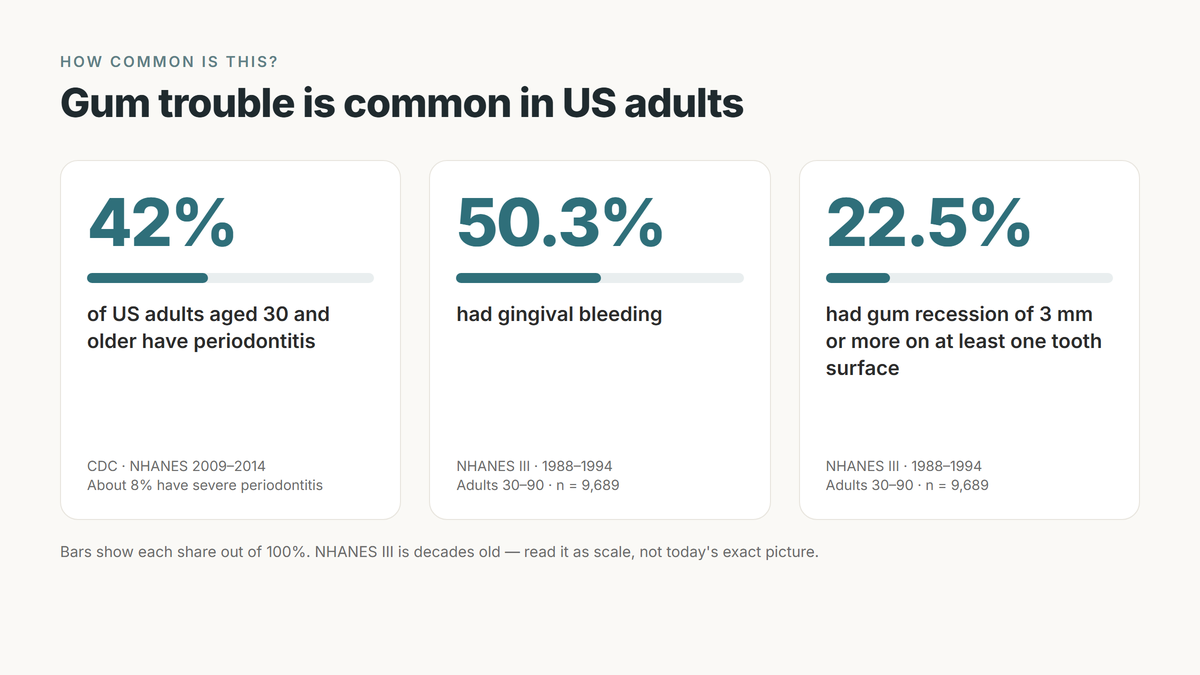
- 42% of US adults aged 30 and older have periodontitis, and about 8% have severe periodontitis (CDC, NHANES 2009–2014).
- In an older national survey (NHANES III, 1988–1994, 9,689 adults aged 30–90), 50.3% had gingival bleeding and 22.5% had at least one tooth surface with 3 mm or more of gum recession.
- In that same survey, recession increased with age, was more common in men, and was more common on the cheek-side surfaces of teeth.
That last survey is decades old, so treat it as scale rather than today’s exact picture. But the scale is the point.
Where brushing hard really fits: sensitive teeth and gum recession
Now the other half of the hook — and here, hard brushing does earn a place in the story.
The American Dental Association recommends a soft-bristled brush and gentle pressure because both “may help reduce the risk of gingival injury,” and because soft bristles “minimize the risk of gingival abrasion.” Cleveland Clinic lists brushing too hard among the causes of both sensitive teeth and gum recession.
The mechanism is straightforward. When gums recede, root surfaces are exposed. When enamel or the root covering is worn away, the dentin underneath lets heat, cold, and acidic foods reach the nerve.
So far, so good for the “you brush too hard” theory. But the research gets more careful from here.
“Associated with” is not the same as “caused by”
A 2015 systematic review in the Journal of Clinical Periodontology looked at 13 cross-sectional studies. The brushing factors most often associated with gum recession were brushing frequency, a horizontal or scrub method, bristle hardness, brushing duration, and how often people changed their brush.
Its conclusion, though, was that the data “remain largely inconclusive.” An earlier 2007 review reached the same word: “inconclusive.”
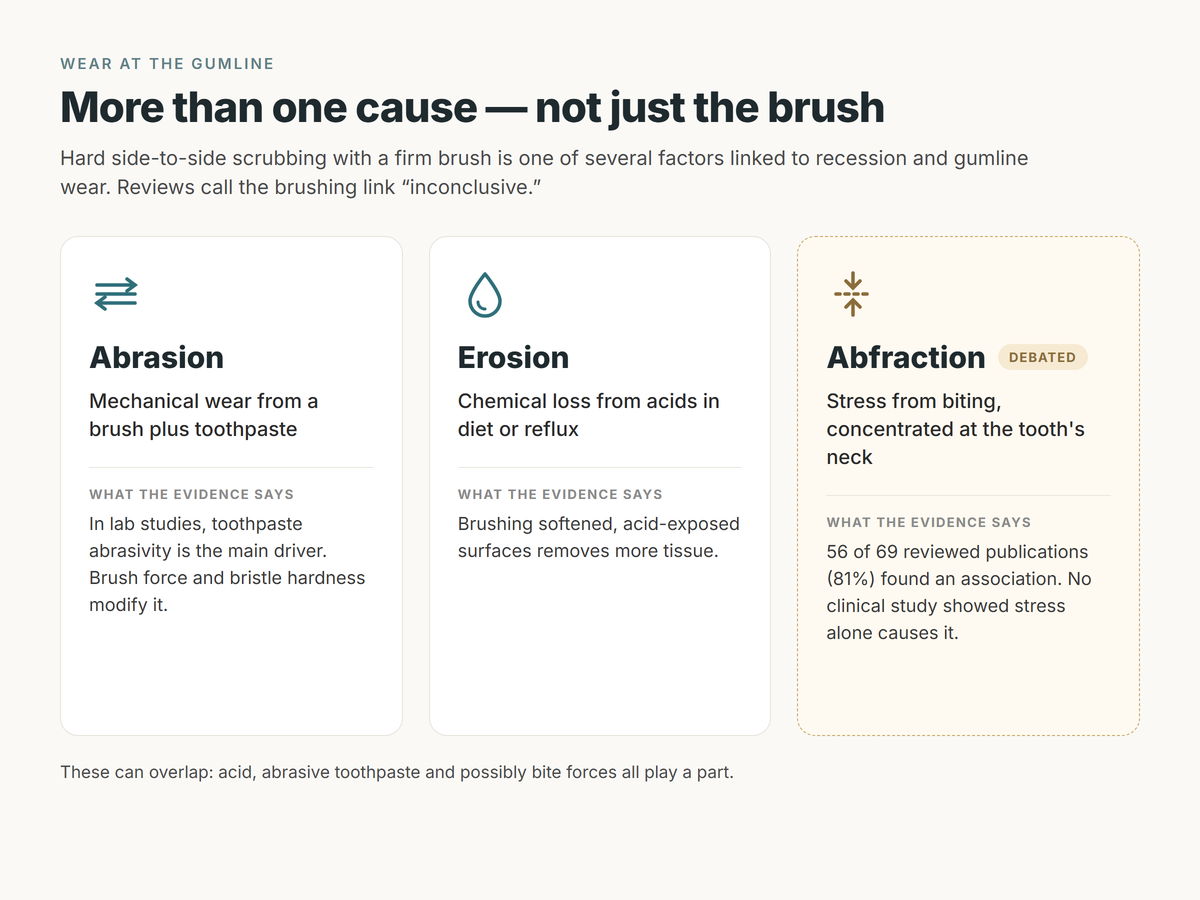
The wedge-shaped wear some people get at the gumline is also more complicated than a brush alone:
| Term | What it means | What the evidence says |
|---|---|---|
| Abrasion | Mechanical wear from brush plus toothpaste | In lab studies, toothpaste abrasivity is the main driver; brush force and hardness modify it |
| Erosion | Chemical loss from acids in diet or reflux | Brushing softened, acid-exposed surfaces removes more tissue |
| Abfraction | Stress from biting concentrated at the tooth’s neck | 56 of 69 reviewed publications (81%) found an association; no clinical study showed stress alone causes it — still debated |
So the fair sentence is this: hard, side-to-side scrubbing with a firm brush is one of several factors linked to recession and gumline wear. Acid, abrasive toothpaste, and possibly bite forces play a part too.
Sensitivity has more than one cause
The ADA’s consumer site lists tooth decay, fractured teeth, worn fillings, gum disease, worn enamel, and exposed roots as causes of sensitive teeth. Brushing technique can only touch some of those.
How common is it? A 2019 meta-analysis of 77 studies worldwide put the best overall estimate of dentin hypersensitivity at 11.5% — but individual studies ranged from 1.3% to 92.1%, and none of that is a US-specific figure.
Treatment depends on the cause: desensitizing toothpaste, in-office fluoride gel, bonding or a crown, a gum graft, or, in severe persistent cases, a root canal.
And one hard truth from Cleveland Clinic: receding gums can’t grow back. Gentler brushing can help stop further damage. Repairing what’s lost, often with a gum graft, is a dentist’s job.

Photo: Anna Shvets / Pexels
What the ADA actually says about toothbrushing technique
This is the section I wish someone had handed me first.
The ADA’s advice, from its MouthHealthy site and its professional pages:
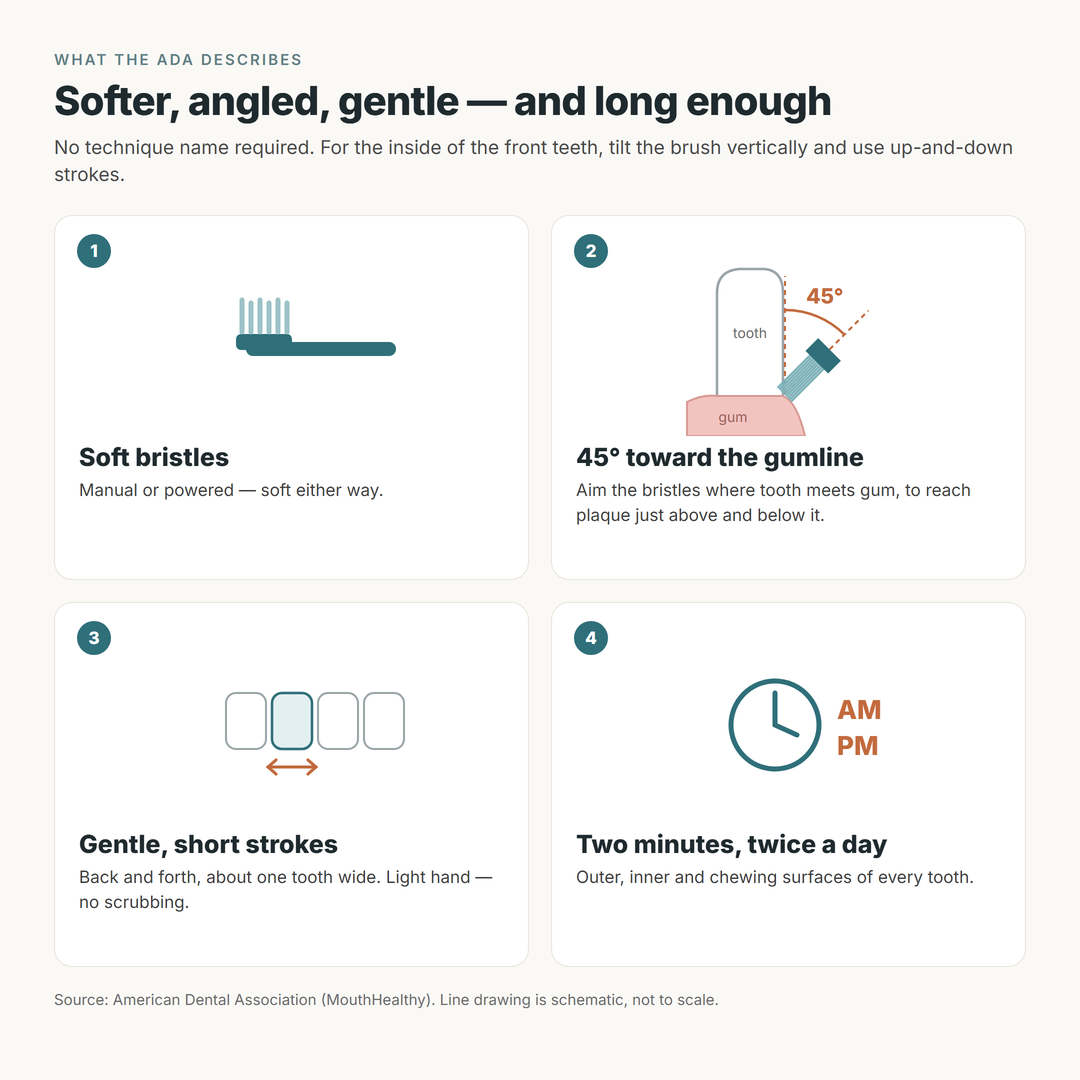
- Choose a soft-bristled brush — manual or powered.
- Place it at a 45-degree angle to the gums.
- “Gently move the brush back and forth in short (tooth-wide) strokes.”
- Clean the outer, inner, and chewing surfaces.
- For the inside of the front teeth, tilt the brush vertically and make several up-and-down strokes.
- Two minutes, twice a day.
The point of that 45-degree angle, in the ADA’s own words, is to remove plaque “from above and just below the gingival margin.” In other words: the brush is supposed to work right where gums bleed.
Notice what the ADA does not do. It doesn’t name a technique. No “Bass,” no “roll.” It simply describes the motion.
Two minutes is longer than you think
The authors of a 2009 study note that “the average brushing time in the general population is closer to 45 seconds.” In their own study of 47 people, brushing for 120 seconds removed 26% more plaque than brushing for 45. That study used one manufacturer’s brush and toothpaste, so I read it as supportive rather than definitive.
Still, it reframed the problem for me. Much of what I was trying to achieve with force, I could get with time.

Photo: kaboompics.com / Pexels
Why soft, if medium cleans more?
Honestly, this is a real trade-off.
In a small 2011 study of 25 people, a medium brush removed more plaque in a single brushing than a soft one — and also caused more abrasion at the gumline. The ADA chooses soft anyway.
So a soft brush asks you to make up the difference with aim and time, not pressure. As for how much pressure is “light enough,” I could not find a verified number, so I’m not going to invent one. Light is the instruction.
Is the roll technique the “right” way to brush?
You may have been taught the roll technique: bristles against the gum, then sweep toward the biting edge. It’s a real, defined method — and a reasonable one.
But it is not the correct technique, because no technique has earned that title.
- A 2020 systematic review of 13 studies found “insufficient evidence” that any one brushing method beats another for plaque or gingivitis.
- A 2024 network meta-analysis (15 studies; 10 in the main comparison, covering Fones, Bass, and scrub) concluded there is “limited evidence” on how techniques affect plaque or gingivitis.
- A 2014 survey of recommending bodies and textbooks found them all over the map — modified Bass recommended by 19, Bass by 11, Fones by 10, scrub by 5 — which the authors called an “unacceptably large diversity.”
The most direct comparison I found was a 2023 randomized trial of 180 people, followed for four weeks after instruction:
| Technique | Overall plaque removal | At the gumline | Easy to learn? |
|---|---|---|---|
| Roll | Same as the others | Less than modified Bass | Easiest to master |
| Modified Bass | Same as the others | Best of the three | Harder to master |
| People’s usual brushing (after basic instruction) | Same as the others | Less than modified Bass | — |
So my honest takeaway is this. The roll technique is one easy-to-learn option. Angling toward the gumline, as the ADA describes, may clean that margin better. The best technique is the one you’ll actually do gently, thoroughly, and every day.
When to replace your toothbrush — and what a frayed one really does
You’ve probably heard this one: “A frayed brush only hurts your gums and removes no plaque at all, so replace it every two to three months.”
The habit behind it is sound. The details aren’t quite right.
The ADA’s interval is every three to four months, or sooner if the bristles are frayed. I couldn’t find a US source for “two to three months” as the rule.
Does a worn brush stop working? Not entirely — it works less well.
- In a 2019 study of 172 people using three-month-old manual brushes, those whose brushes showed extreme wear had significantly higher plaque than those with little or no wear. The researchers suggested splaying is a better signal than the calendar: once the outer tufts splay beyond the edge of the brush head, it’s time.
- A 2023 meta-analysis of 8 trials and 344 adults found new and worn brushes broadly similar overall, with new brushes doing better only in trials where brushes were used over time. The certainty of that evidence was very low to low.
And the gum-injury claim? I couldn’t find any study that measured gum injury from splayed bristles, so I’m leaving that one alone.
The ADA’s own phrasing is the fairest version: “A worn toothbrush won’t do as good of a job cleaning your teeth.”
A few care basics from the ADA while you’re at it: rinse the brush after use, store it upright, let it air-dry, and don’t routinely cover it or keep it in a closed container.
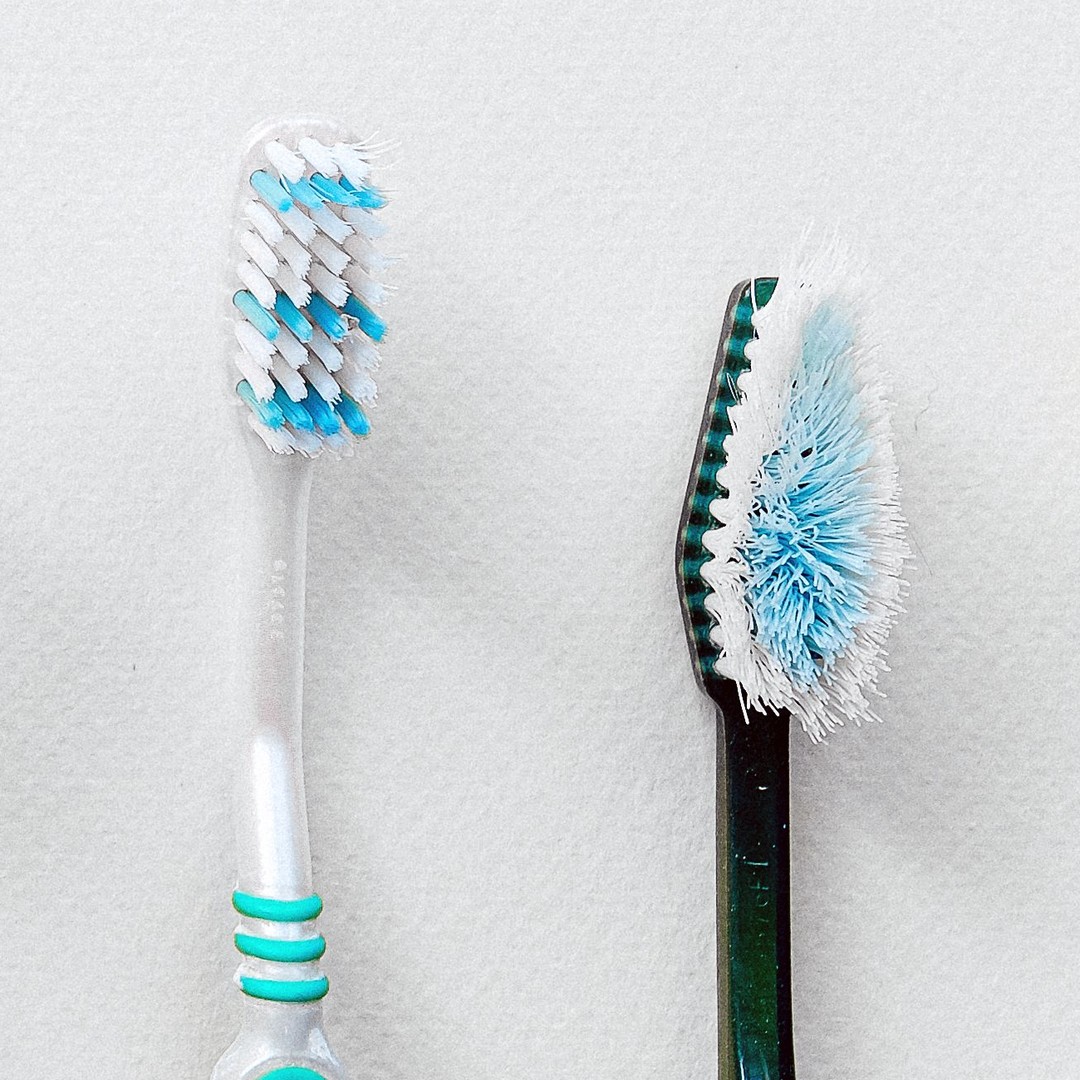
Photo: Anna Shvets / Pexels
Manual or electric?
Both work. The ADA says so plainly.
The largest review I found — a 2014 Cochrane review with data from 51 trials and 4,624 people — found powered brushes reduced plaque by 11% over one to three months and 21% beyond three months compared with manual, and gingivitis by 6% over one to three months and 11% beyond three months (on the Löe and Silness index). The authors noted that the clinical importance “remains unclear.”
On safety, a 2011 review found oscillating-rotating brushes “do not pose a clinically relevant concern” to teeth or gums. A small meta-analysis of 159 people even found more recession after 12 months in manual-brush users than in powered-brush users.
Whichever you choose, pick soft bristles, and look for the ADA Seal of Acceptance rather than a brand name.
A few people should talk to their dentist and doctor sooner
This is where I want to be most careful.
- If you take a blood thinner, bleeding gums can have added causes. Tell your dentist and your doctor. Do not stop a prescribed blood thinner on your own.
- If you’re pregnant, have diabetes, or have a bleeding disorder, bleeding gums may have more than one explanation. Mention them at your next visit rather than assuming it’s technique.
- Brushing right after acidic food or drink may wear softened enamel more. Ask your dentist about timing — I couldn’t verify a specific number of minutes.
- Desensitizing toothpaste eases symptoms; it doesn’t diagnose them. If sensitivity persists, find out why.
Related reading: I went through a similar “I’ve been cleaning this wrong for years” moment with cotton swab ear cleaning. If you brush a pet’s teeth too, what home brushing can and can’t do for pets makes a useful comparison. [내부링크: 관련 글 – how to floss correctly and daily interdental cleaning]
When to see a dentist — or go to the ER
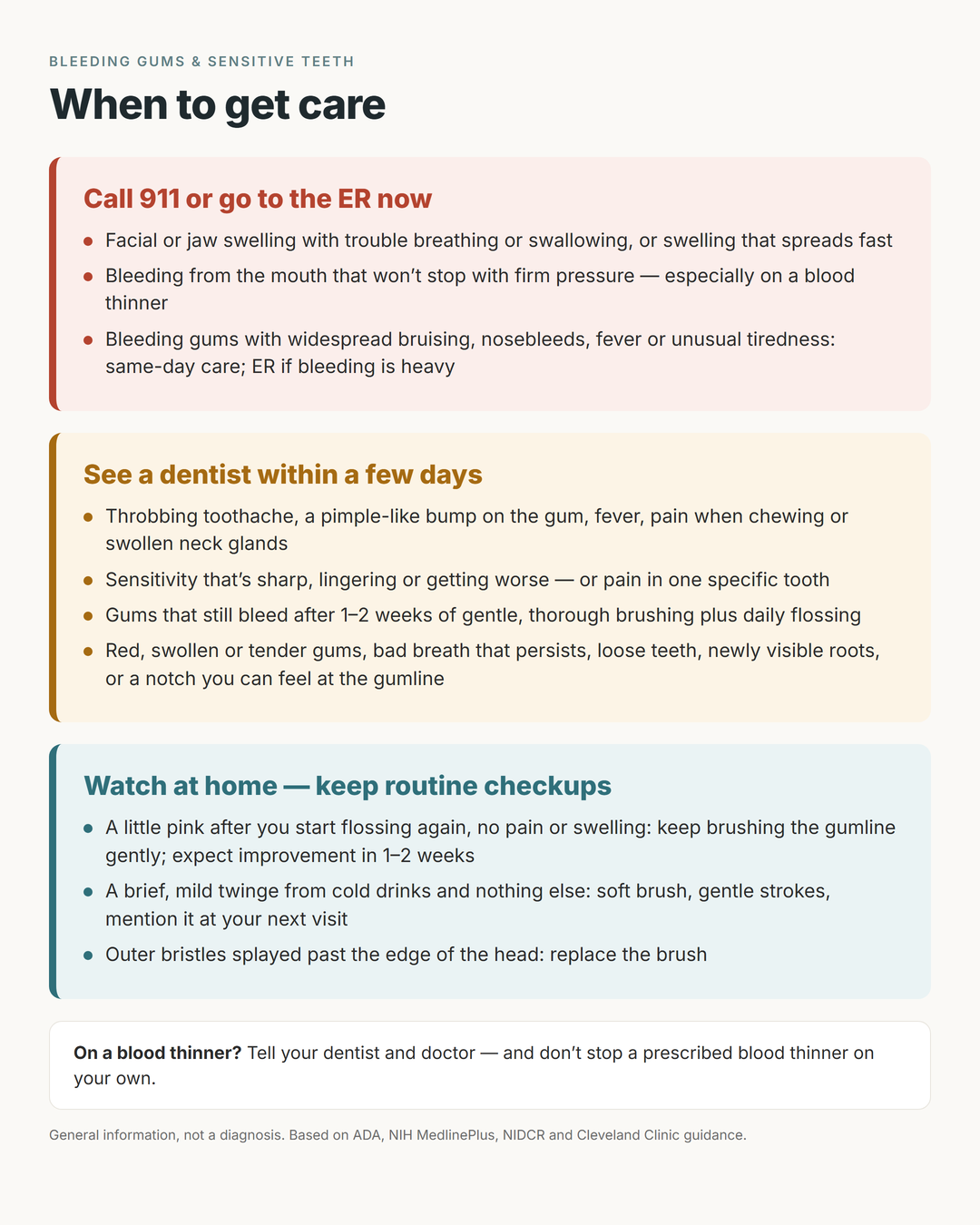
Call 911 or go to the ER now
- Facial or jaw swelling with trouble breathing or swallowing, or swelling that’s spreading quickly.
- Bleeding from the mouth that won’t stop with firm pressure — especially if you’re on a blood thinner.
- Bleeding gums along with widespread bruising, nosebleeds, fever, or unusual tiredness. Get same-day medical care, and go to the ER if the bleeding is heavy.
See a dentist within a few days
- A throbbing toothache that won’t go away, a pimple-like bump on the gum, fever, pain when chewing, or swollen neck glands.
- Sensitivity that’s sharp, lingering, or getting worse, or pain in one specific tooth.
- Gums that still bleed after 1–2 weeks of gentle, thorough brushing twice a day plus daily flossing.
- Red, swollen, or tender gums, persistent bad breath, loose teeth, or roots that are newly visible.
- A notch you can feel with a fingernail at the gumline.
Watch at home, and keep your routine checkups
- A little pink on the brush or floss after you start flossing again, with no pain or swelling. Keep brushing the gumline gently and expect improvement within 1–2 weeks.
- A brief, mild twinge from cold drinks and nothing else. Switch to a soft brush and gentle strokes, consider a desensitizing toothpaste, and mention it at your next visit.
- A brush whose outer bristles have splayed past the head — replace it.
What I’d actually change, if I could only change one thing
I still brush twice a day. I just stopped treating it like a scrubbing contest.
Softer brush. Lighter hand. Bristles angled toward the gumline. Two full minutes — which, I discovered, is a lot longer than whatever I’d been doing.
If I had to put it in one line, it would be this:
“Softer brush, lighter hand, angled at the gumline, two full minutes — and if your gums still bleed after two weeks of that, it’s a dentist’s problem, not a brushing-harder problem.”
For years I thought the answer was more effort.
It was better aim — and a little more patience with the part that bleeds, because that’s the part that needed the attention.
References
- ADA / MouthHealthy — Brushing Your Teeth, Toothbrushes, Sensitive Teeth
- ADA — Oral Health Topics: Toothbrushes (updated Aug 2026)
- NIDCR (NIH) — Periodontal (Gum) Disease
- CDC — Fast Facts: Gum Disease
- NIH MedlinePlus — Gingivitis, Gums – bleeding, Tooth abscess
- Cleveland Clinic — Gum Recession, Sensitive Teeth
- Albandar & Kingman, J Periodontol 1999 — gingival recession and bleeding in US adults, 1988–1994
- Heasman et al., J Clin Periodontol 2015 — toothbrushing, gingival recession and cervical lesions; Rajapakse et al., J Clin Periodontol 2007 — tooth brushing and gingival recession
- Rajwani et al., Oral Health Prev Dent 2020 — manual toothbrushing techniques review; Deinzer et al., PLoS One 2024 — network meta-analysis; Weng et al., J Dent 2023 — modified Bass vs rolling vs current technique
- Van Leeuwen et al., Int J Dent Hyg 2019 — toothbrush wear and plaque; Silva et al., Int J Dent Hyg 2023 — new vs worn toothbrushes meta-analysis
- Yaacob et al., Cochrane 2014 — powered versus manual toothbrushing
- Wiegand & Schlueter 2014; Duangthip et al. 2017; Favaro Zeola et al. 2019; Zanatta et al. 2011; Creeth et al. 2009; Van der Weijden et al. 2011; Wainwright & Sheiham 2014 — via PubMed