Luxating Patella in Dogs: Symptoms, Grades, and Prevention
I’ll be honest. The first time I saw a little dog do that quick “skip” — hind leg up for two or three steps, then back to walking like nothing happened — I assumed she’d just stepped on something.
That skip is easy to shrug off. It comes and goes. The dog isn’t crying, isn’t dragging the leg, and a minute later she’s chasing a ball again.
But that intermittent hop is often the first sign of a luxating patella — a kneecap that slips out of place. And it’s one of the most common orthopedic problems in dogs, diagnosed in about 7% of puppies. So if you own a small breed, this is worth understanding early.
Let me walk through what’s actually happening in that knee, how vets grade it, and what you can — and honestly cannot — do about it.

What a luxating patella actually is
The patella is the kneecap — a small bone sitting inside the thigh muscle’s tendon. Normally it glides smoothly up and down a channel at the end of the femur called the trochlear groove as the knee bends and straightens.
In patellar luxation, the kneecap rides outside that groove when the knee flexes. It’s really a misalignment problem: the whole extensor mechanism — the quadriceps, the patella, and the ligament below it — is pulling slightly off-center, and that off-center pull tugs the kneecap out.
Here’s the part that surprises people. It tends to get worse on its own.
During a puppy’s growth, the kneecap presses on the cartilage and helps carve the groove deep enough to hold it. When the alignment is off from the start, the groove develops too shallow. Then every time the kneecap pops out, it wears down the ridge a little more — so it slips more easily next time. A quiet, progressive cycle.
Medial vs. lateral — which way it slips
- Medial luxation (inward) is by far the most common form, especially in small and toy breeds. Severe cases can leave a puppy looking a bit “bow-legged.”
- Lateral luxation (outward) is less common and shows up more in medium, large, and giant breeds, often alongside hip dysplasia. Those puppies can look “knock-kneed.”
Which dogs are most at risk?
Most cases are developmental and genetic, not the result of a single injury. Signs often appear before one year of age — sometimes as early as eight weeks.
Small and toy breeds carry the strongest predisposition for the medial (inward) type:
- Pomeranian
- Yorkshire Terrier
- Chihuahua
- Toy and Miniature Poodle
- Maltese
- Bichon Frise
- Boston Terrier
It’s increasingly reported in bigger dogs too — Chinese Shar-Pei, Akita, Shiba Inu, Flat-Coated Retriever, Great Pyrenees, and giant breeds like Great Danes, Irish Wolfhounds, and St. Bernards, which lean toward the lateral (outward) form.
Because the hereditary link is so strong, veterinary surgeons advise that affected dogs should not be bred. That’s worth knowing if you’re choosing a breeder.
A smaller share of cases are traumatic — a fall or car accident tearing an otherwise normal knee. And certain lifestyle factors don’t cause the condition but clearly make an existing one worse: excess weight, slippery floors, and constant jumping on and off furniture.

Photo: alleksana / Pexels
The symptoms: that “skipping” gait
If you remember one sign, remember this one.
The classic presentation is intermittent lameness in a hind leg that fixes itself within a few steps. The dog suddenly lifts or holds up a back leg — a little hop, a skip — for several strides, then sets it down and walks normally.
That non-weight-bearing moment is the kneecap sitting out of place. The dog often gives the leg a little “kick” or stretch to pop it back in, and carries on.
Other things you might notice:
- Sudden limping in a small dog, often worse after activity
- A hind leg that turns inward or outward
- A rabbit-like hop on both back legs when running
- Reluctance to jump up, climb, or run
- Yelping when the leg is touched or during play
- If both knees luxate at once, the dog may briefly be unable to stand
And here’s the honest catch: mild cases can have no symptoms at all, and only turn up during a routine exam. So a normal-seeming dog isn’t automatically in the clear.

Photo: Mike Art / Pexels
How vets grade it: Grade 1 to 4
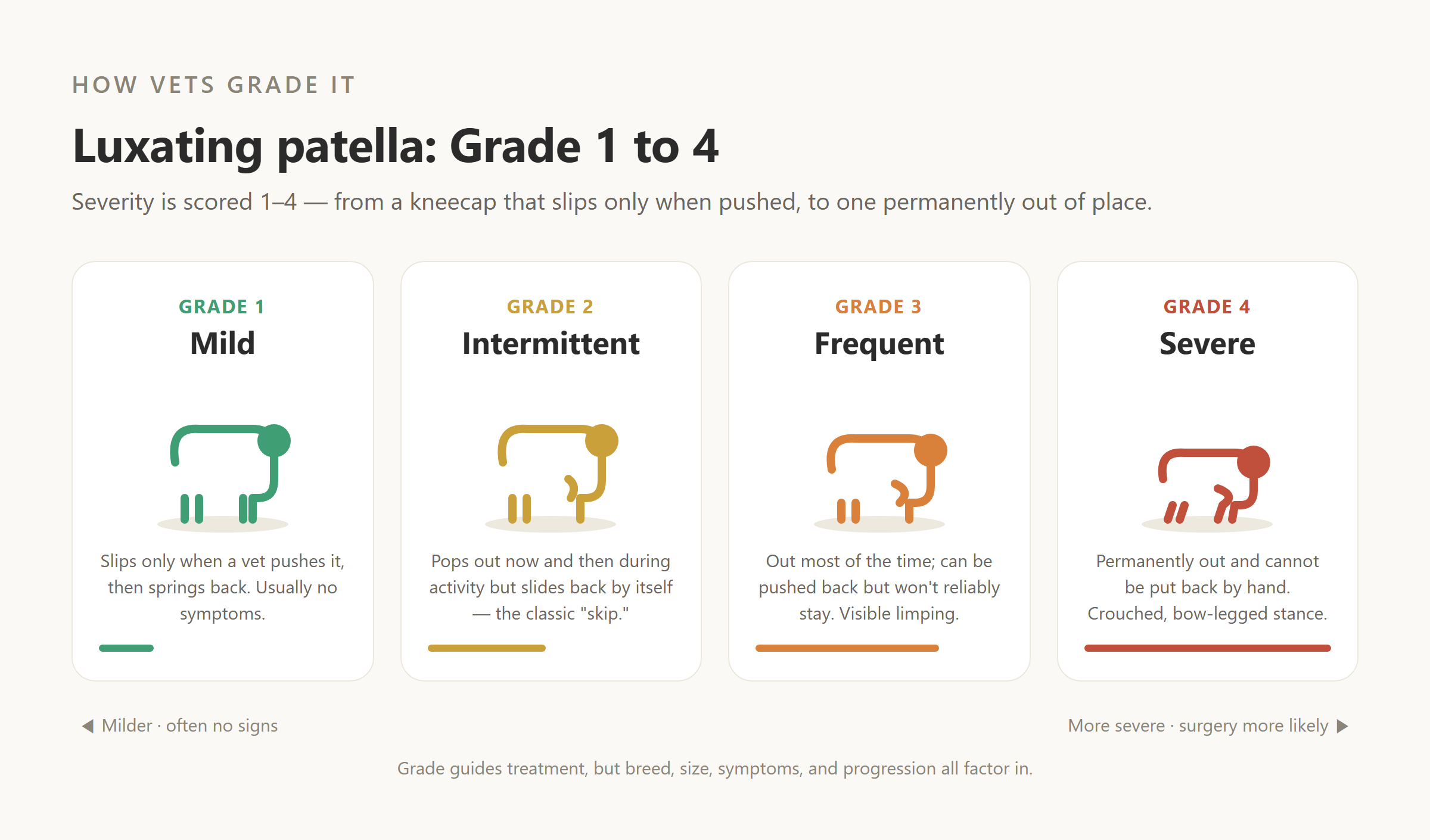
Veterinarians score severity on a 1 to 4 scale, and the grade heavily shapes what happens next.
| Grade | What’s happening | Typical picture |
|---|---|---|
| Grade 1 | Kneecap luxates only when the vet manually pushes it, then springs back on its own | Usually no symptoms; doesn’t slip during normal life |
| Grade 2 | Luxates occasionally during normal activity but returns readily by itself | Intermittent skipping — or none at all |
| Grade 3 | Luxated most of the time but can be pushed back by hand (doesn’t reliably stay) | Frequent skipping, reluctance to jump, visible deformity |
| Grade 4 | Permanently luxated and cannot be manually put back | Severe lameness, crouched or bow-legged posture |
Higher grades generally point toward earlier or surgical treatment. But grade is a guide, not the whole story — symptoms, progression, breed, and size all factor in.
Diagnosis itself is mostly hands-on. A vet feels the kneecap sliding in and out during flexion and extension, assigns a grade, and usually confirms with X-rays of the knee, tibia, and hip. Complex or large-breed cases may need a CT scan for surgical planning.
Treatment: managing it vs. fixing it
Broadly, there are two paths — and they do different jobs.
Conservative management
For mild cases (usually Grade 1–2), the goal is to reduce strain and slow arthritis. This includes weight loss, controlled exercise, vet-guided physical therapy and hydrotherapy, and anti-inflammatory pain control or joint support when needed. Newer osteoarthritis pain options, like the anti-NGF antibody therapy bedinvetmab (Librela), exist too.
One thing to be clear-eyed about: conservative care does not correct the underlying anatomy. It manages the problem. The knee can still progress.
Surgery
Surgery is generally recommended for Grade 2–4, marked lameness, or steady worsening — and it’s best done before arthritis sets in. The aim is to realign the extensor mechanism so the kneecap stays put. Common techniques, often combined:
- Trochleoplasty — deepening the too-shallow groove so the kneecap seats securely
- Tibial tuberosity transposition (TTT) — cutting and repositioning the ligament’s attachment point on the tibia and pinning it; it typically heals over about 8 weeks
- Soft-tissue balancing — loosening the tight side and tightening the stretched side of the joint
- Corrective osteotomy — reshaping a severely malformed bone in high-grade cases
The outlook is genuinely encouraging when surgery happens before arthritis takes hold — dogs usually regain full function, and more than 90% of owners report satisfaction with their dog’s progress afterward. Recurrence is uncommon.
It’s more guarded in large dogs with existing bone deformities or established arthritis. Which surgery — or combination — is right is a call only a veterinary surgeon can make for your specific dog.
Prevention and home care: what actually helps
Here’s where I have to be straight with you.
The inherited, developmental form cannot truly be prevented. No mat or supplement rewrites a dog’s skeleton. Anyone promising otherwise is overselling.
What home care can do is real and worth doing: reduce strain on the knee, slow arthritis, prevent injury-caused luxation, and support the joint. Think of it as risk reduction, not a cure.
- Non-slip flooring. Slick hard floors make the legs splay and torque the knee. Rugs, runners, and yoga-style mats give traction. This is one of the simplest, highest-value changes you can make.
- Ramps and steps. Let the dog get on and off the couch, the bed, and the car without high-impact jumping.
- Limit jumping and standing on hind legs. Discourage the repeated launch off furniture and the begging-on-two-legs routine.
- Weight control. Extra weight directly strains the knee and speeds up arthritis. Of everything on this list, this is the factor most under your control.
- Muscle strengthening — with vet guidance. Building the muscles around the knee helps stabilize it. Controlled sit-to-stands, gentle stair work on carpeted stairs, leash walks, and hydrotherapy all help. Start only under veterinary or rehab direction, especially after surgery, because the wrong exercise can make an unstable knee worse.
- Keep the dog leashed or fenced to avoid the traumatic kind of luxation.
- Nail and paw-hair trimming. Keeping nails short and the fur between the paw pads trimmed helps the foot land properly and grip. I’ll flag this plainly: this is footing and traction support, not a proven medical treatment. The top clinical references center on weight, footing, and exercise — trimming is a helpful supporting habit, not a fix for the knee itself.

Photo: @ Prestige by Nature / Pexels
Why not to just wait it out
It’s tempting to leave a mild, painless skip alone. But left unmanaged, patellar luxation tends to snowball.
Repeated slipping grinds the kneecap against the groove, wearing cartilage and driving osteoarthritis — and once arthritis is established, it’s irreversible. In dogs going in for medial luxation surgery, cartilage damage has been found on the patella in roughly 47.6% of cases and on the trochlea in about 54.4%.
There’s a second, more serious knock-on effect: cranial cruciate ligament (CCL) rupture. A luxating patella predisposes to it, and reported concurrent CCL rupture runs around 22–41% in small-breed dogs and about 13% in large breeds. The combined problem often has to be fixed surgically, together.
That’s the real argument for taking the early skip seriously. Catching it before arthritis and ligament trouble arrive is where the best outcomes live.
For clinical detail, veterinary references such as the ACVS patellar luxation page are a reliable external starting point.
If I could leave you with one thing, it wouldn’t be a product or a supplement.
It’s a mindset. That little skip isn’t nothing, and it isn’t a crisis either — it’s information. Your dog is telling you something about a knee, quietly, before it becomes loud.
So if you’ve been watching a hind leg pop up for a few steps and wondering whether it’s worth a visit, I’d gently say yes. Get it graded by a veterinarian. Everything else — the mats, the ramps, the weight, the timing of any surgery — is a decision you and your vet make together, with better information, before the harder problems have a chance to arrive.
Medical disclaimer: This article is an educational summary based on veterinary references and is not a substitute for professional veterinary care. Any dog showing a skipping gait, limping, or knee pain should be examined by a licensed veterinarian. Grading, imaging, and treatment decisions — especially surgery — must be made by a veterinary professional. Always consult your veterinarian before starting supplements, medications, or a rehabilitation program.
Sources: American College of Veterinary Surgeons (ACVS), Merck Veterinary Manual, Cornell Riney Canine Health Center, VCA Animal Hospitals, American Kennel Club (AKC), PetMD, and peer-reviewed veterinary literature.