

Lightweight Transport Chair: Fit the Trunk and Your Parent
I’ll be honest about where this started.
A friend asked me to help her pick a folding wheelchair for her mother. Her mom’s back had been bothering her for months, and the plan was simple — a few day trips, a doctor visit, maybe a family lunch. The post she’d saved promised “specs for an ultralight wheelchair that fits in your trunk,” with a hard rule: under 22 lb, aircraft-grade aluminum, and suspension to protect a sore back.
It sounded tidy. Then I went through what US coverage rules, WHO guidance and the injury research actually say.
Some of it held up. Some of it didn’t.
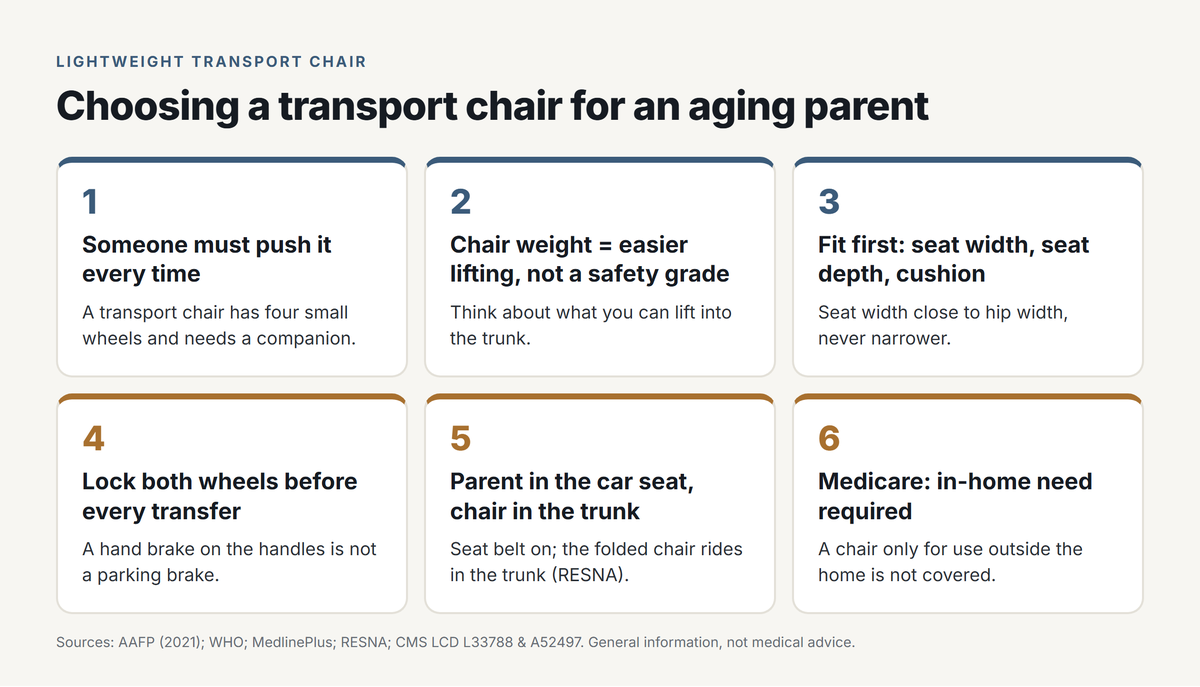
Here’s the short version. A lightweight transport chair — the kind a companion pushes, with four small wheels, that folds to fit into a car trunk — is real and genuinely useful for short, occasional outings on even ground. But there’s no official 22 lb rule, “ultralight” means something else in the US, no study shows suspension relieves an older passenger’s back pain, and the riskiest moments aren’t the ride. They’re tips, curbs and transfers.
This article is general information about choosing mobility equipment, not medical advice. The right wheelchair depends on your parent’s body size, strength, balance, skin, and how long they’ll sit — a physical or occupational therapist or a RESNA-certified assistive technology professional can assess this. Medicare coverage depends on individual eligibility and documentation; confirm with Medicare (1-800-MEDICARE) or your plan before buying. If your parent falls and hits their head, can’t get up, or has new severe pain, call 911.
Key takeaways
- Two different products. A transport chair needs someone to push it every time. If your parent can wheel themselves even a little, large rear wheels keep that ability.
- Chair weight is about lifting, not safety. Medicare’s weight classes for self-propelled chairs are 36, 34 and 30 lb cutoffs, and transport chairs are coded by the user’s weight capacity. No public standard sets a 22 lb line.
- Fit comes before pounds. Seat width close to hip width (never narrower), the right seat depth, a foam or gel cushion, and weight shifts every 15–20 minutes (MedlinePlus).
- Suspension evidence is mixed and comes from lab tests — not from older adults with back pain riding in transport chairs.
- In the car, your parent sits in the car seat with the seat belt on. The folded chair goes in the trunk (RESNA).
- Medicare doesn’t cover a chair used only outside the home. Coverage requires an in-home mobility need and a caregiver able to push it.
Transport chair vs. wheelchair: which one does your parent need?
This is the first fork in the road, and a lot of buying guides skip it.
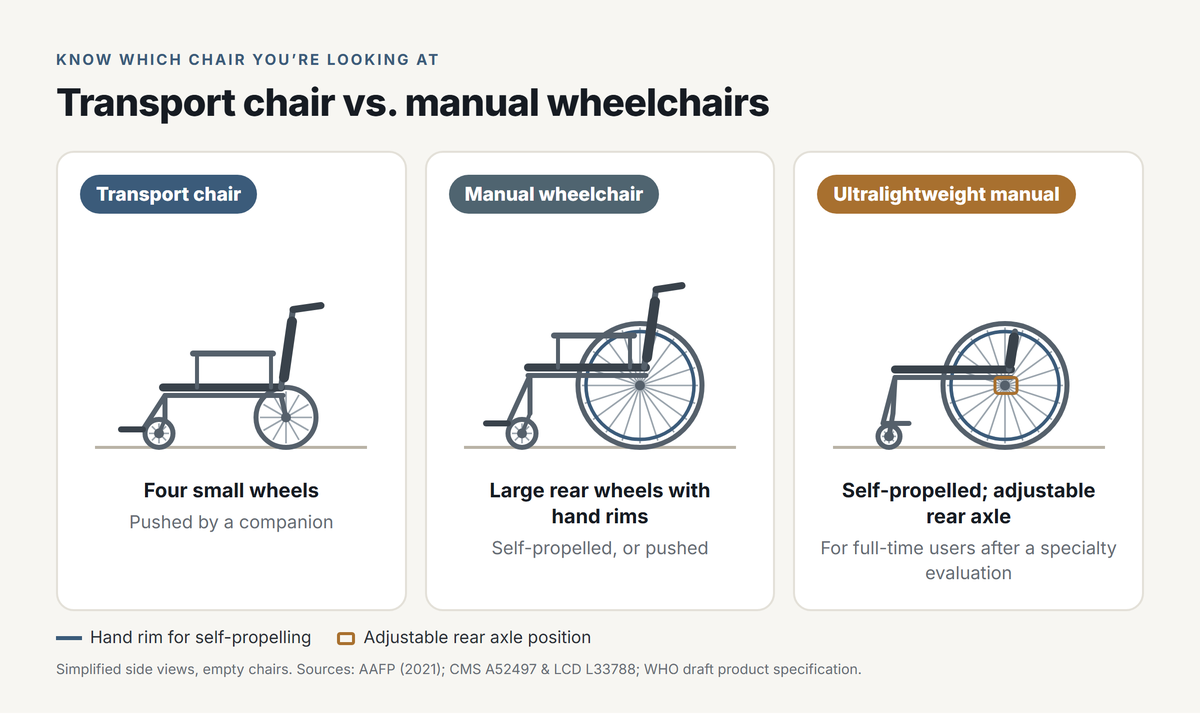
Under the word “portable wheelchair,” two different products are hiding. The American Academy of Family Physicians (AAFP, 2021) describes them this way:
- A transport (companion) chair “has four small wheels, is lighter, requires another person to push it, and folds to fit into the trunk of a car.”
- A manual wheelchair has “large back wheels with hand-rails for propelling the chair.”
So the real question isn’t “which one is lighter.” It’s whether your parent can move the chair themselves.
If they can’t, a transport chair — or a lightweight manual chair that a companion pushes — is the realistic choice. If they can self-propel even short distances, a chair without big rear wheels quietly takes that independence away.

Photo: Gustavo Fring / Pexels
WHO’s draft product specification for manual wheelchairs describes the transport chair’s intended use plainly. It’s “typically used intermittently for short duration or for short distance,” “primarily used indoors or on even surfaces outdoors,” and meant for users with “basic posture support needs.” Its rear wheels run from about 8 inches for attendant-pushed chairs up to 26 inches for self-propelled ones. (That WHO document is marked as a draft, so I treat it as guidance, not a final standard.)
That’s a good description of a doctor visit or a museum afternoon. It’s not a description of a whole day of sitting.
| Type | How it moves | Medicare code (for reference) | Suits | Limits |
|---|---|---|---|---|
| Transport (companion) chair | Pushed by a companion; four small wheels | E1037 / E1038 / E1039, sorted by user weight capacity | Short, occasional trips; parent can’t self-propel; companion always present | Best on indoor or even ground; basic posture support; fixed seat depth |
| Standard or lightweight manual wheelchair | Large rear wheels with hand rims; can also be pushed | K0001 (over 36 lb), K0003 (34–36 lb), K0004 (under 34 lb) | Parent can self-propel some; longer daily use | Heavier to lift into a trunk |
| Ultralightweight manual wheelchair | Self-propelled; adjustable rear axle | K0005 (under 30 lb) | Full-time users after a specialty evaluation | A different class of product, not a travel chair |
How much should a lightweight transport chair weigh?
Here’s where the viral rule and the evidence part ways.
The post said to choose a chair “under 22 lb (10 kg).” I couldn’t find that number in any public or clinical standard.
What does exist is Medicare’s set of weight classes for self-propelled manual wheelchairs, from CMS policy article A52497 (revised July 2024):
- Standard: more than 36 lb
- Lightweight: 34–36 lb
- High-strength lightweight: less than 34 lb
- Ultralightweight: less than 30 lb
Transport chairs aren’t sorted by chair weight at all. They’re coded by how much the person sitting in them can weigh. E1038, for example, is an adult transport chair with a patient weight capacity “up to and including 300 pounds,” and E1039 covers adults over 300 lb.
WHO’s draft specification, for comparison, suggests a maximum of 16 kg (about 35 lb) complete for an active-use manual wheelchair. Again, nothing at 10 kg.
So a lighter chair is a lifting preference. It isn’t a safety grade.
And lighter doesn’t automatically mean steadier. In a Nova Scotia survey of 577 manual-wheelchair users (Kirby, 1994 — Canadian, self-reported, and about people wheeling themselves), features linked to more tips and falls included “lightweight,” camber and adjustable rear axles. The same survey found that being pushed by an attendant was associated with lower risk. It’s not a transport-chair study, but it’s a useful reminder that low weight trades off against stability.
My practical version: stand at your own trunk and ask what you can lift comfortably, again and again. Then never trade away weight capacity or fit for a few pounds.
Photo: Luke Miller / Pexels

What the weight labels on a wheelchair actually mean
This part surprised me the most.
In US coverage language, “ultralightweight” (K0005) is a defined category. It means a chair under 30 lb with an adjustable rear axle position, and Medicare covers it only for full-time users who self-propel, after a specialty evaluation, supplied by a company with a RESNA-certified Assistive Technology Professional (LCD L33788).
That’s close to the opposite of a light, companion-pushed chair for day trips.
So when a listing calls a transport chair “ultralight,” read it as marketing. “Lightweight transport chair” or “lightweight folding wheelchair” is the more accurate description.
Frame material: what to check beyond the metal’s name
Partly true, partly not.
Aluminum really is the usual lightweight frame. According to the Model Systems Knowledge Translation Center (MSKTC), standard-weight chairs usually have steel frames, lightweight chairs are usually aluminum, and ultralight chairs are aluminum or titanium. MSKTC also notes that “folding frames are often easier to transport.”
“Duralumin” is an aluminum–copper alloy family historically used in aircraft. You’ll rarely see it in US listings, where the usual phrase is “aircraft-grade aluminum” — and that phrase is marketing, not a standard.
A material name isn’t a strength rating. What you can actually check:
- The rated user weight capacity. Don’t exceed it.
- Whether the maker states testing to ISO 7176 or ANSI/RESNA WC-1, the consensus standards FDA recognizes for mechanical wheelchairs.
One more label worth decoding. Mechanical wheelchairs, including transport chairs, are FDA-regulated Class I medical devices under general controls (21 CFR 890.3850, product code IOR). Class I isn’t an “approval” or a safety rating, so I’d be wary of any “FDA-approved” wording.
Recalls also happen. In 2014, a combination transport chair/rollator was recalled (Class 2, 129 units) because the “wheel assembly failing” damaged the wheels. If you’re buying used, it’s worth searching FDA’s recall database and the maker’s site first.
Seat fit and comfort for a parent with a sore back
This is the section I’d read twice.
The hook promised a back-friendly chair. What the evidence actually supports for comfort isn’t a single spec. It’s fit, cushioning and movement.

Photo: cottonbro studio / Pexels
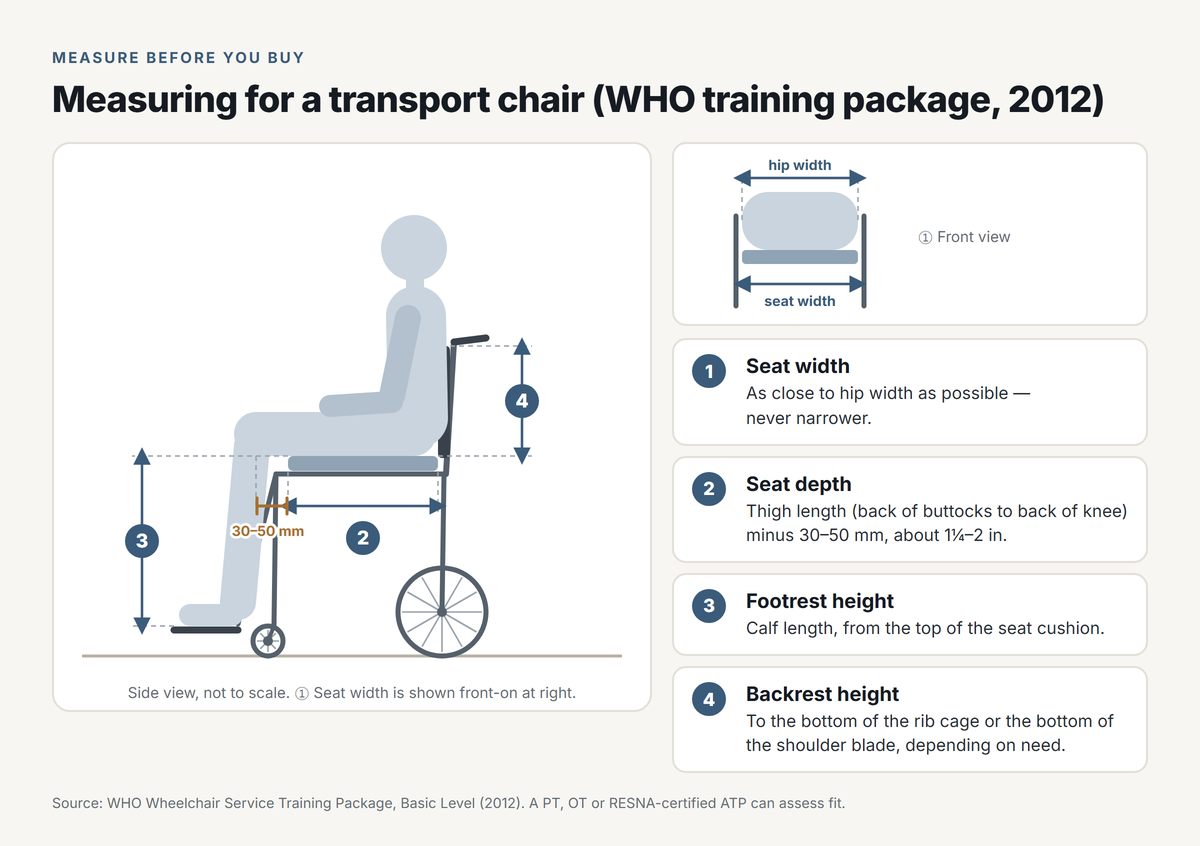
WHO’s Wheelchair Service Training Package (2012) gives measurements that apply even when someone is being pushed:
- Seat width: “as close to the user’s hip width as possible, but should never be smaller.”
- Seat depth: thigh length (back of the buttocks to the back of the knee) minus 30–50 mm, about 1¼–2 inches.
- Footrest height: calf length, measured from the top of the seat cushion.
- Backrest height: to the bottom of the rib cage or the bottom of the shoulder blade, depending on need.
MSKTC explains why it matters. Too tight “can cause pressure sores.” Too wide, and it may cause problems with “stability, posture and fitting through doorways.”
For skin and comfort on long outings, NIH MedlinePlus (reviewed April 2026) is specific:
- Shift weight — lean forward, left and right — every 15 to 20 minutes. A caregiver can help.
- Sit on a foam or gel cushion that fits the chair. Don’t use a donut-shaped cushion.
- Have a provider or physical therapist check the fit once or twice a year.
The National Institute on Aging, writing about late-stage dementia care, adds that a person who is sitting up should be repositioned at least every two hours. These aren’t competing numbers — they’re different actions. Small weight shifts often, and a full position change at least every couple of hours.
NIA also notes that an early pressure sore shows up as discolored or darker skin, especially on the heels, hips, lower back and back of the head. MedlinePlus adds that redness can be harder to see on darker skin tones.
If your parent’s back pain is part of a bigger picture, I wrote about lumbar spinal stenosis symptoms and which exercises help separately. A chair can make an outing possible. It won’t treat what’s behind the pain.
Wheelchair suspension and back comfort: what studies show
I wanted this one to be true. The evidence doesn’t back it up for this use.
The studies are almost all lab tests, and they don’t agree:
- Cooper, 2003 (6 manual wheelchairs, test dummies): suspension caster forks reduced shock and vibration, but rear-suspension systems were “not clearly superior” to traditional designs.
- Kwarciak, 2008 (16 wheelchairs, curb drops of 5–15 cm): suspension chairs had lower peak seat accelerations than folding chairs at the 5 cm drop, but with one model removed from the analysis, they were “not significantly different” from non-suspension chairs.
- Misch, 2022 (robotic tests on an ultralight chair): suspension caster forks increased seat vibration by 16–97%, though all readings stayed within health-guidance ranges.
- Hischke, 2018 (10 healthy adults pushed over a door threshold and 2-cm bumps in a tilt-in-space chair): an add-on rear suspension reduced peak jolts. That’s the closest to your situation — but the riders were healthy, the chair was a different class, and nobody measured pain.
- Neti, 2026: an in-wheel suspension wheel had 118% and 44% higher rolling resistance on linoleum and carpet. A smoother ride, but harder to push.
I found no study of suspension and back pain in older adults riding in transport chairs.
So my honest take: suspension may soften some bumps, but the evidence is mixed. For rough ground, WHO’s training material points to larger front castors and thicker rear wheels. For comfort, fit, a proper cushion and frequent weight shifts matter more.
Brakes and wheel locks: two different jobs
The post said to check that the brakes are “intuitive.” That’s a good instinct, with one clarification.
A wheelchair can have two kinds of stopping controls, and they do different things:
- Rear wheel locks “to park the wheelchair” belong on every manual wheelchair (WHO specification). They’re what keeps the chair still during a transfer, while you load the trunk, or at any stop. Brake performance is tested under ISO 7176-3.
- Attendant hand brakes on the push handles slow the chair while it’s moving, which helps on slopes. Some transport chairs have them, so check whether the one you’re considering does, but I found no US standard that requires them.

Photo: Jsme MILA / Pexels
A hand brake isn’t a parking brake. When your parent gets in or out, both wheel locks should be on.
Two more features worth looking for: an anti-tipping feature, which AAFP says keeps many wheelchairs from falling backward, and a tipping lever, which WHO lists as a transport-chair frame feature for getting over curbs. Check whether the chair you’re considering has them — not every model does.
The riskiest moments: tips, curbs and transfers
This is the part of the original hook I’d change the most. “Safely” doesn’t come from a spec sheet.
US emergency-department data (NEISS) tell a consistent story, though the most detailed figures are older:
- 2003: more than 100,000 wheelchair-related injuries were treated in US emergency departments, double the 1991 number. Tips and falls accounted for 65–80% (Xiang, 2006).
- 1986–1990: elderly women were the most likely to be injured, falls happened most often at home (50.8%), and 7.6% of the people injured weren’t wheelchair users — some were the helpers (Ummat & Kirby, 1994).
- Adults 65 and older, 2007–2017: an average of 3,924 emergency visits a year for fractures during wheelchair transfers. 61.8% happened while transferring out of the chair, 37.5% were hip fractures, and 60.2% of those patients were admitted (Tsai, 2020).
I didn’t find national figures specific to transport chairs, or more recent than those years.
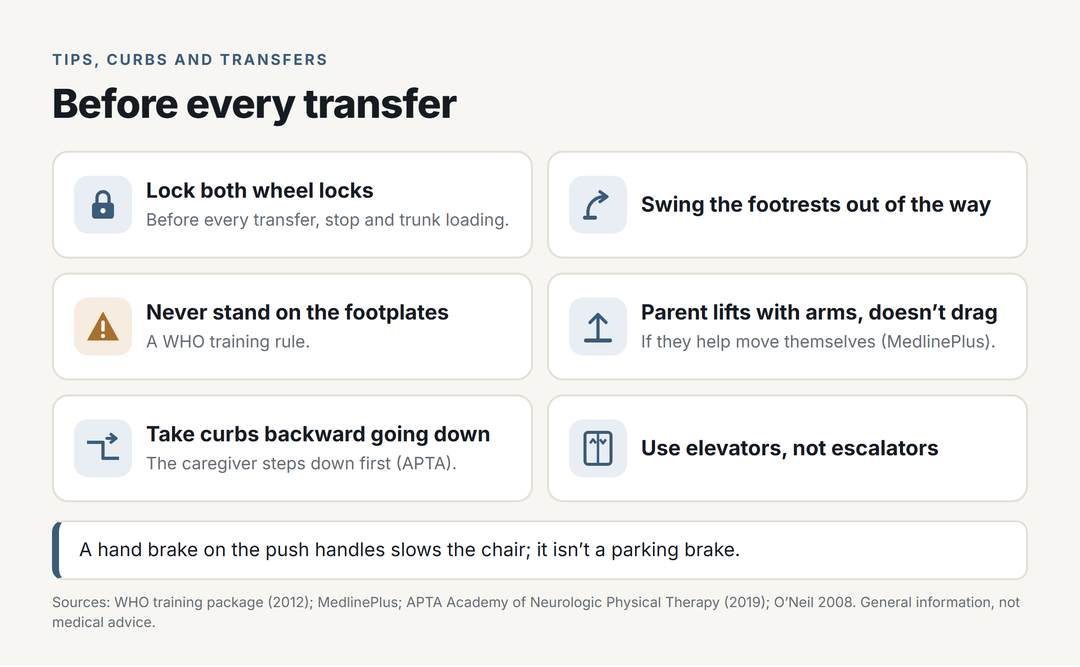
What the numbers point to is technique. Before every transfer:
- Lock both wheels.
- Swing the footrests out of the way.
- Never let your parent stand on the footplates (a WHO training rule).
- If they help move themselves, they should lift with their arms rather than drag (MedlinePlus).
Falls are a bigger topic than any single piece of equipment. I went through osteoporosis and fall prevention for aging parents in another post.
Curbs. The APTA Academy of Neurologic Physical Therapy (2019) warns that if curbs aren’t navigated properly, “the individual in the wheelchair and the caregiver could be injured.” Their technique:
- Going up, face forward. Press the tipping lever to tilt the chair back and lift the front casters onto the curb, roll forward until they rest well on top, then bring the rear wheels up using power from your legs.
- Going down, go backward. The caregiver steps down first, brings the rear wheels to the edge, lowers them slowly, then tips back and rolls back so the casters and footplates clear before lowering the front.
Ramps and escalators. ADA ramps have a maximum running slope of 1:12 — one inch of rise per 12 inches. A 2010 case report describes a wheelchair tip-over on a steeper, non-compliant hospital-garage ramp that ended in a femur fracture. And use elevators, not escalators. Among adults 65 and older, there were an estimated 39,850 escalator injuries from 1991 to 2005, and the escalator injury rate doubled over that period. The study’s authors said a wheelchair “should not have been on the moving stairs.”
For your own back: bend your knees and keep your back straight when lifting the chair or tilting it at a curb. If lifting is genuinely hard, that’s a real reason to choose a lighter chair.
Getting a transport chair into the car
This is the scene the hook imagined, so let me be clear about how it should look.
RESNA’s position is that “the ideal safety practice for people who use wheelchairs is to transfer into a manufacturer-installed vehicle seat and use the vehicle’s crash-tested occupant restraint system.” It also notes there are “no federal safety standards that apply to wheelchairs used as seats in vehicles.”
In practice:
- Your parent transfers into the car seat and buckles up.
- The transport chair folds and goes in the trunk. Your parent doesn’t ride in it.
- A wheelchair that has to serve as a vehicle seat should be crash-tested to WC19 — a 30 mph / 20 g frontal sled test with four-point strap tiedowns. That’s a different situation from a day trip in the family car.
The transfer into the car is one of the risk moments above. Lock the wheels, move the footrests aside, and take your time.

Photo: Andrea Piacquadio / Pexels
Does Medicare cover a transport chair for outings?
This is one of the most searched questions, and the answer isn’t what most people hope.
Under Original Medicare, a transport chair can be covered as an alternative to a standard manual wheelchair — but only when a set of in-home criteria are met (LCD L33788):
- A mobility limitation that significantly impairs daily activities like toileting, dressing, grooming and bathing in customary locations in the home
- A limitation that a properly fitted cane or walker can’t resolve
- A home with enough access and space for the chair
- Use that will significantly improve those daily activities
- A caregiver who is available, willing and able to push the chair
And the key sentence from CMS policy article A52497: if the wheelchair is “only for use outside the home, it will be denied as noncovered.”
So a chair bought only for day trips isn’t a Medicare benefit.
If your parent does qualify:
- 2026 Part B deductible: $283, then you pay 20% of the Medicare-approved amount.
- You’ll need an order from your doctor and a Medicare-enrolled supplier. A participating supplier must accept assignment.
- Medicare may have you rent rather than buy. For capped-rental items, the title transfers to you after 13 continuous months of rental payments. Ask the supplier which applies to the specific chair.
Medicare Advantage plans set their own rules, which I didn’t research — call your plan.

When a basic transport chair isn’t enough
Here’s the limit I’d want someone to tell me.
A transport chair suits short, occasional trips. When mobility is severely limited, WHO’s 2023 wheelchair provision guidelines are firm (strong recommendations): wheelchairs “must be provided using a process of individual assessment and selection,” “prepared and fitted for each person,” and training should be provided “for wheelchair users and those who assist them.”

Photo: Omar Ramadan / Pexels
AAFP adds that proper sizing and education are needed to avoid injury to bony areas and skin breakdown, and that patients may benefit from seeing a physiatrist or physical therapist.
I’d ask for a PT or OT seating assessment if your parent:
- will sit for hours at a time,
- slumps, leans or slides forward in the chair,
- has had a stroke,
- or already has skin or pressure-sore problems.
A transport chair has a fixed seat depth and basic posture support. For some parents, that isn’t enough.
If strength is what’s slowly slipping, this sarcopenia checklist for seniors is a good place to start the conversation with their doctor.
When to call 911 or see a doctor
A chair is equipment. These are the signs that mean it’s time for a person with training.
Call 911 now
- Your parent tips over or falls and hits their head — especially if they take blood thinners — or shows confusion, vomiting, drowsiness, a severe headache, or loss of consciousness.
- After a fall or transfer, they can’t bear weight, have severe hip or groin pain, a leg that looks shortened or turned outward, or can’t get up. (Hips were 37.5% of transfer fractures in adults 65+, and 60.2% were admitted — Tsai, 2020.)
- Heavy bleeding, obvious deformity, trouble breathing, or chest pain.
See a doctor the same day or within a few days
- Redness or darker skin over the tailbone, hips or lower back that doesn’t fade, or any sore that’s painful, warm or draining pus. MedlinePlus says to contact a provider right away.
- New or worsening back pain, numbness or tingling after outings or long sits.
- A fall without the red flags above but with new pain, bruising or reduced mobility. Any bump to the head in someone on blood thinners — same day.
- The chair doesn’t fit: your parent slides forward, leans to one side, or has pressure points. Ask for a PT or OT seating evaluation.
- Your parent now needs the chair for daily life at home. Talk to the doctor about an order and Medicare eligibility.
Watch and wait at home
- Brief redness that fades quickly once pressure is off, with no pain or warmth. Keep up weight shifts, the cushion and skin checks — and call a clinician if it lingers.
- Mild stiffness after a long outing that eases with rest and position changes.
- A minor bump or bruise with no head strike, full movement and no worsening pain. Recheck over the next day.
When I went back to my friend, I didn’t give her a number.
I gave her a tape measure, a question — “Can your mom push herself at all?” — and a short routine. Lock the wheels. Footrests out of the way. Mom into the car seat, chair into the trunk. Check her skin when you get home.
If I had to fit it on a sticky note, it would be this.
“Pick the chair that fits your parent, not the lightest number on the box.”
A lighter chair makes the trunk easier. What makes the day go well is everything you do around it — and that part was never going to be on the spec sheet.
A note on what this article is and is not
This article is general information about choosing mobility equipment, not medical advice. The right wheelchair depends on your parent’s body size, strength, balance, skin, and how long they’ll sit — a physical or occupational therapist or a RESNA-certified assistive technology professional can assess this. A transport chair needs a companion every time. Lock the wheels before every transfer, stop and trunk loading; don’t exceed the rated user weight capacity; and inspect wheels, brakes and frame joints before trips. Medicare coverage depends on individual eligibility and documentation; confirm with Medicare (1-800-MEDICARE) or your plan before buying. No brands or models are recommended here. If your parent falls and hits their head, can’t get up, or has new severe pain, call 911.
References
- CMS — LCD L33788, Manual Wheelchair Bases (revision effective 01/01/2020)
- CMS — Policy Article A52497, Manual Wheelchair Bases (rev. 07/01/2024)
- Medicare.gov — Wheelchairs & scooters; Durable medical equipment (DME) coverage
- CMS — 2026 Medicare Parts A & B Premiums and Deductibles (fact sheet, Nov 14, 2025)
- CGS DME MAC Jurisdiction B Supplier Manual, Ch. 5 (Summer 2026)
- 21 CFR 890.3850, Mechanical wheelchair; FDA Product Classification (IOR); FDA recall Z-0216-2015
- Sehgal M, Jacobs J, Biggs WS — Mobility Assistive Device Use in Older Adults, Am Fam Physician 2021
- NIH MedlinePlus — Preventing pressure ulcers (reviewed Apr 9, 2026)
- National Institute on Aging — Care in the Last Stages of Alzheimer’s Disease
- World Health Organization — Wheelchair provision guidelines (2023); Wheelchair Service Training Package, Basic Level (2012); Assistive Product Specification: Wheelchairs, manual (draft)
- RESNA — Position on Wheelchairs Used as Seats in Motor Vehicles
- MSKTC — The Manual Wheelchair: What the SCI Consumer Needs to Know
- APTA Academy of Neurologic Physical Therapy — Manual Wheelchair Skills: Navigating Curbs Dependently (2019)
- US Access Board — ADA Standards §405, Ramps
- Xiang H et al. — Inj Prev 2006; Ummat S, Kirby RL — Am J Phys Med Rehabil 1994; Tsai et al. — Public Health 2020
- Kirby RL et al. — Am J Phys Med Rehabil 1994
- Cooper RA et al. — Arch Phys Med Rehabil 2003; Kwarciak AM et al. — J Rehabil Res Dev 2008; Misch J et al. — IEEE TNSRE 2022; Hischke M, Reiser RF — PM&R 2018; Neti et al. — Assist Technol 2026
- O’Neil J et al. — Accid Anal Prev 2008


