
People-Pleasing Fatigue: Boundaries, Not a Cut-Off List
You have been smiling at things that were not funny. Answering the group chat at 11 p.m. because leaving it on read felt rude. Saying yes to the dinner, then sitting in the car afterward with the engine off, too flat to drive.
And somewhere in there the thought arrives, fully formed and very appealing: I should just clean house. Mute everything. Cut out the people who drain me.
I went looking for the evidence behind that plan, and I want to be straight with you about what came back. The exhaustion part holds up — there is a measured construct behind it, with a large meta-analysis and a two-year prospective cohort. The cut-off list does not. It is the one piece of this advice with a documented health cost attached to it, and almost nobody mentions that part.
So this is a correction piece. Not a scolding — a correction. The tiredness is real, and there is a version of this that works. It just is not the version where you delete people.
Is “people-pleasing burnout” an actual diagnosis?
No. And this matters more than it sounds.
Neither “people-pleasing” nor “social burnout” appears as a disorder in the DSM-5-TR or the ICD-11. A PubMed search for “people-pleasing” or “people pleasing” in the title or abstract returns 11 records in total, across the entire database, and none of them is a diagnostic-criteria paper. The popular adjacent term, the “fawn response,” is not indexed in PubMed at all — the phrase simply does not appear as a searchable clinical term.
Burn-out is in the ICD-11, but read the fine print. It is classified as an occupational phenomenon — explicitly not a medical condition — and the WHO states it “should not be applied to describe experiences in other areas of life.” So “social burnout” is a borrowed word, not a WHO category.
What does exist are four constructs that researchers can actually measure:
| Construct | Source | What it captures |
|---|---|---|
| Sociotropy | Beck; Sociotropy-Autonomy Scale (30 sociotropy items) | Excessive interpersonal dependency; strong need for affiliation, acceptance and support |
| Rejection sensitivity | Downey & Feldman 1996; RSQ | Anxiously expecting, readily perceiving and overreacting to rejection |
| Unmitigated communion | Helgeson & Fritz 1998 | “A focus on and involvement with others to the exclusion of the self” |
| Fear of negative evaluation | BFNE; Leary 1983 | The core feature of social anxiety disorder |
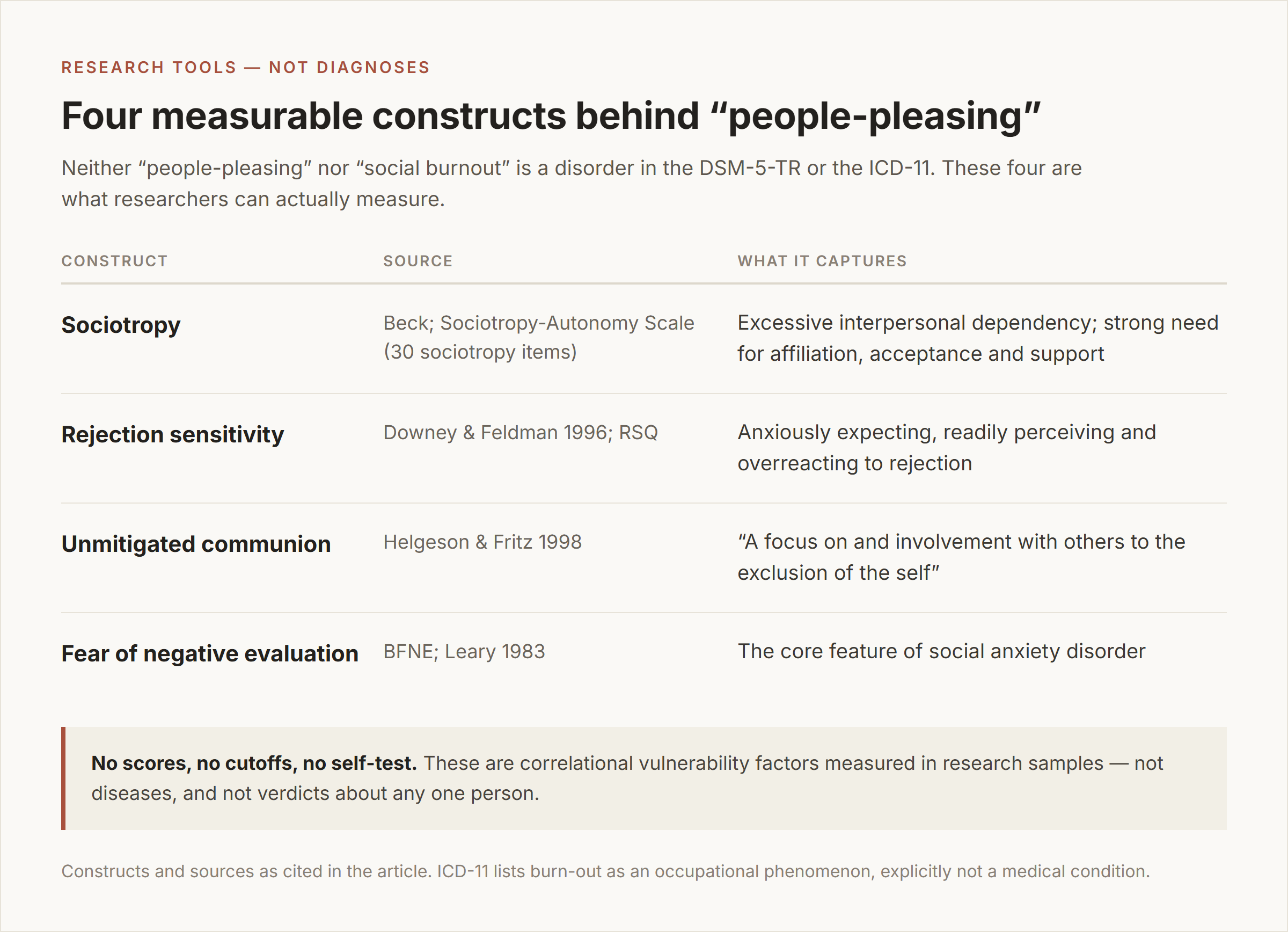
One caution I will repeat later: these are correlational vulnerability factors, not diseases and not verdicts. In Beck’s model, highly sociotropic people are more likely to become depressed after stressors they experience as a loss of social resources — a rejection, a friendship ending. Support for the sociotropy–depression link has been abundant; support for the parallel autonomy–depression link has been very thin, which is why you only see one half of that model quoted here.
Nobody should finish this section thinking “I have sociotropy.” That is not how any of this works.
The exhaustion is real — but the evidence comes from work, not your group chat
Here is the strongest part of what you already believe.
The sociologist Arlie Hochschild introduced emotional labor in 1983, along with the distinction that still organizes this field: surface acting (changing the outward display while the inner feeling is unchanged) versus deep acting (working on the felt emotion itself). That is a conceptual source, not evidence of harm. The evidence came later.
Hülsheger and Schewe’s 2011 meta-analysis pooled 494 individual correlations from 95 independent studies. Emotion-rule dissonance and surface acting correlated ρ = .39 to .48 with indicators of impaired well-being — emotional exhaustion, burnout, psychological strain — and ρ = −.24 to −.40 with job attitudes. Deep acting, by contrast, showed only weak relations with impaired well-being and positive relations with emotional performance and customer satisfaction (ρ .18 and .37).
Read that contrast slowly, because it is the useful part: the cost sits in the gap between what you feel and what you show. Not in being kind.

The emotional-labor evidence was built on paid work with display rules — service, healthcare, teaching, call centers — not on friendships.
Photo: Kampus Production / Pexels
There is prospective evidence too. Suh and Punnett (2021) followed 939 US skilled-nursing-facility employees who had no depression at baseline and re-surveyed them two years later. 15% developed depressive symptoms, and workers with intermediate and high surface-acting emotional labor had adjusted odds ratios of around 2. Onset was also predicted by high work-family conflict, younger age and low decision latitude at work. The authors themselves note that both the exposure and the outcome could have suffered some misclassification.
Now the limit, stated plainly, because most articles skip it:
Almost all of this evidence is occupational. It was built on paid work with display rules — service, healthcare, teaching, call centers. The 939 people in that cohort were doing job-required emotional suppression in nursing facilities. Nobody has run the equivalent study on brunch with friends or a family group chat. Extending the mechanism to your private life is a plausible extrapolation, not a proven finding, and I am not going to tell you that science has shown faking a smile with friends doubles your risk of depression. It has not shown that.
If your version of this is mostly happening at work, the self-test and recovery path for employee burnout sits closer to where the actual evidence lives.
The nearest experimental analogue for private interaction is expressive suppression. Butler and colleagues (2003) paired unacquainted people in a lab and randomly assigned one of each pair to suppress emotional behavior, respond naturally, or reappraise. Suppression disrupted communication, raised blood pressure in both the suppressor and their partner, reduced rapport and inhibited relationship formation. Useful as a mechanism illustration — but it is a short lab study with strangers, not a study of long-term friendship fatigue, and a cross-cultural replication has questioned whether those social costs are culture-general.
What I found when I went looking for the biochemistry
You may have read that fake smiles build up into some kind of substance that eats away at your self-esteem. I went looking for the source. There isn’t one.
Checked on September 20, 2026, in PubMed:
"fatigue substance"combined with smile, emotional labor or social interaction → 0 results. No biochemical metabolite of social smiling is described anywhere in the literature."surface acting"AND"self-esteem"→ 0 results."emotional labor"AND"self-esteem"→ 3 records total, two of which are one 2026 Frontiers in Psychology paper on marital intentions plus its correction. None supports “socializing erodes self-esteem.”
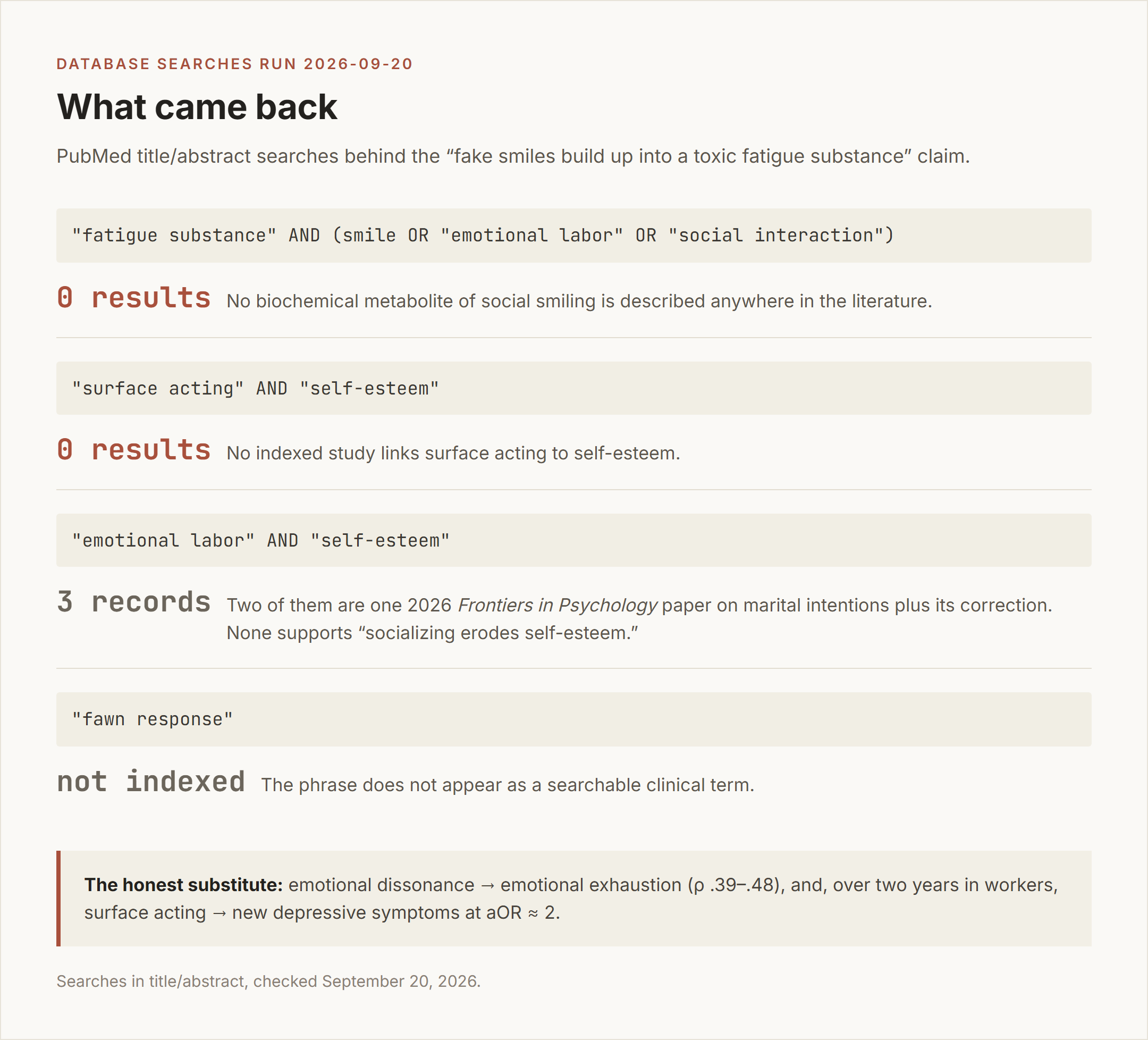
So the “toxins” framing is rhetoric, not physiology — and it is worth noticing that the classic version of this folk claim in exercise science, lactic acid as a fatigue “toxin,” is itself outdated. I am not going to dress it up as a metaphor either, because a biochemical-sounding metaphor is how a false biological claim gets into people’s heads.
The honest substitute is emotional dissonance → emotional exhaustion (ρ .39–.48), and, over two years in workers, surface acting → new depressive symptoms at aOR ≈ 2.
If you want a self-worth angle, the closest legitimate one is unmitigated communion. Helgeson and colleagues (2007) found it “predicted greater psychological distress and lower levels of competence cross-sectionally and longitudinally” — in 263 adolescents with and without diabetes, over one year. That is a self-perceived-competence finding in teenagers, not proof that parties damage adult self-esteem.
The part I have to push back on: the cut-off list
This is where the popular advice stops being merely unproven and starts carrying a cost.

Complex social integration — being embedded in multiple roles and relationships — is the measure that carried the strongest association in Holt-Lunstad 2010.
Photo: Brett Sayles / Pexels
Blanket disconnection is not health-neutral. The evidence here is large, consistent, and almost never quoted next to “protect your peace.”
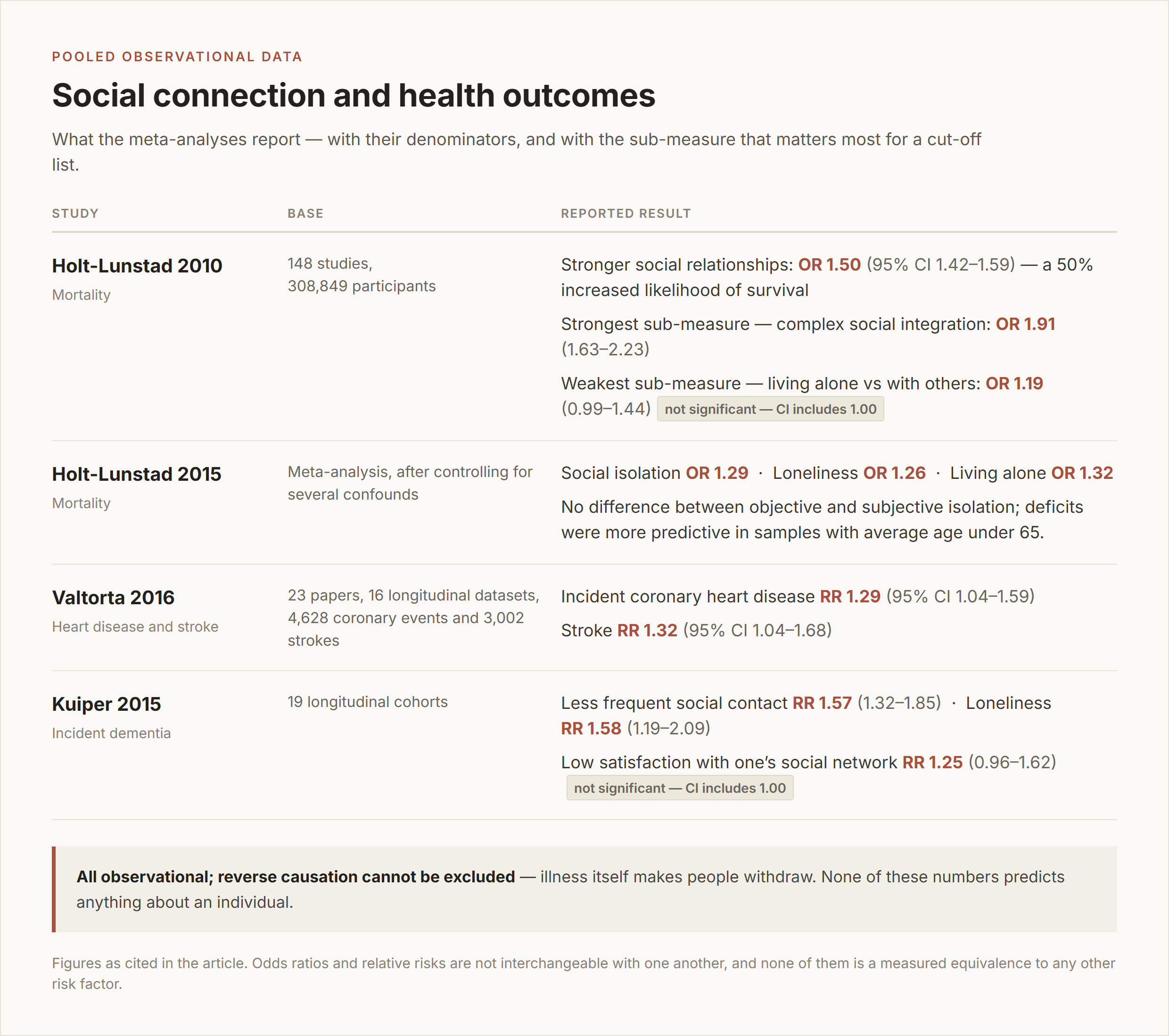
Holt-Lunstad and colleagues (2010) pooled 148 studies and 308,849 participants and found a random-effects weighted average of OR = 1.50 (95% CI 1.42 to 1.59) — a 50% increased likelihood of survival for participants with stronger social relationships. The finding held across age, sex, initial health status, cause of death and follow-up period.
And here is the line that matters most for your cleanout plan: the association was strongest for complex measures of social integration, OR 1.91 (95% CI 1.63 to 2.23) — and weakest for the crude binary of living alone versus with others, OR 1.19 (95% CI 0.99 to 1.44). Complex social integration means being embedded in multiple roles and relationships. That is precisely the thing a cut-off list shrinks.
Read the number correctly, though. OR 1.50 is the odds of survival for people with stronger relationships, pooled across observational studies. It is not “muting a friend raises your risk of death by 50%.” Nothing here predicts anything about you personally, and reverse causation is a live possibility — illness itself makes people withdraw.
Holt-Lunstad’s 2015 meta-analysis, after controlling for several confounds, found social isolation OR 1.29, loneliness OR 1.26 and living alone OR 1.32 — a 29%, 26% and 32% increased likelihood of mortality respectively. Two details from it are worth keeping:
- There was no difference between objective and subjective isolation. “But I chose this, so it doesn’t count” is not supported by the data.
- Social deficits were more predictive of death in samples with an average age under 65. This is not a retirement-age problem.
On specific diseases, Valtorta (2016) — 23 papers, 16 longitudinal datasets, 4,628 coronary events and 3,002 strokes, follow-up of 3 to 21 years in high-income countries — found poor social relationships associated with a 29% increase in incident coronary heart disease (RR 1.29, 95% CI 1.04–1.59) and a 32% increase in stroke (RR 1.32, 95% CI 1.04–1.68). Those authors closed by saying future studies are needed to find out whether interventions targeting loneliness and isolation can actually prevent these outcomes. The intervention question is still open.
Kuiper (2015), across 19 longitudinal cohorts, found less frequent social contact RR 1.57 (1.32–1.85) and loneliness RR 1.58 (1.19–2.09) for incident dementia — while finding no statistically significant association for low satisfaction with one’s social network (RR 1.25, 95% CI 0.96–1.62). Frequency of contact tracked with the outcome; how pleased you felt about your network did not, in that analysis.
Where the Surgeon General’s famous numbers come from
The 2023 US Surgeon General’s Advisory, “Our Epidemic of Loneliness and Isolation” (May 2023), is the version most people have met: a 29% increased risk of heart disease, a 32% increased risk of stroke, and a 50% increased risk of developing dementia for older adults. It also reports that about one in two US adults reported experiencing loneliness before the COVID-19 pandemic, and that social isolation among older adults is tied to an estimated $6.7 billion in excess Medicare spending annually.
Since we are using those figures, you should know exactly what sits underneath them:
- The 29% and 32% match Valtorta 2016 — the observational pooled relative risks for incident CHD and stroke quoted above.
- The dementia figure corresponds to the same body of cohort evidence as Kuiper 2015 (less frequent contact RR 1.57; loneliness RR 1.58).
- The “similar to smoking up to 15 cigarettes a day” line — the one that ends up on every infographic — derives from Holt-Lunstad 2010’s statement that the influence of social relationships on mortality risk “is comparable with well-established risk factors for mortality.” It is an effect-size analogy between observational estimates, not a measured equivalence. Nobody ran a trial comparing loneliness to a pack of cigarettes.
Globally, the WHO Commission on Social Connection (30 June 2025) reports that about 1 in 6 people worldwide (15.8%) report feeling lonely, highest among young people at roughly 21% (20.9% ages 13–17; 17.4% ages 18–29), 24.3% in low-income countries versus 11% in high-income countries, with new WHO estimates attributing 871,000 deaths per year to loneliness for the period 2014–2019. Those are global figures with heavy low- and middle-income weighting — do not read them as American numbers.
For the US, the federal anchor is the CDC’s MMWR 73(24), 20 June 2024, drawing on BRFSS 2022 across 26 states, n = 218,915 adults: 32.1% reported feeling lonely always, usually or sometimes, and 24.1% reported lacking social and emotional support. Depression and frequent mental distress were significantly more prevalent among those adults (adjusted prevalence ratios on the order of 2.38 for depression and 3.05 for frequent mental distress among adults reporting loneliness). That survey is cross-sectional, self-reported and covers 26 states — not a national estimate, and not causal.
One more honesty note, since your problem is specifically group chats: I could not find a single verified US statistic on group-chat volume, group-chat fatigue, or group chats and loneliness. I am not going to invent one. The closest legitimate anchor for “always-on contact load” is platform use — Pew Research Center’s Americans’ Social Media Use 2025 (published 20 November 2025; n = 5,022 US adults, fielded 5 February to 18 June 2025) found 84% of US adults ever use YouTube, 71% Facebook, 50% Instagram, 37% TikTok and 32% WhatsApp, with about half saying they visit Facebook and YouTube at least daily. That is platform use. It is not a measurement of your group chats.
Why you are not a reliable judge of who is “toxic” right now
This is the question the cleanout advice never asks, and the research has an uncomfortable answer.
Downey and Feldman’s 1996 paper in the Journal of Personality and Social Psychology established rejection sensitivity as a cognitive-affective processing disposition: people sensitive to social rejection tend to “anxiously expect, readily perceive, and overreact to it.” Study 2 was experimental, and it showed that people who anxiously expect rejection readily perceive intentional rejection in the ambiguous behavior of others.
Sit with that for a second. The state you are in right now — depleted, braced, scanning for who is taking too much — is precisely the state in which ambiguous behavior gets read as deliberate slight. Someone’s short reply. Someone’s late response. The friend who did not react to your message.
Which is why you will not find a “signs someone is toxic” checklist in this article. Handing that list to a reader who is already exhausted is handing a verdict to the least reliable available judge.

Photo: Engin Akyurt / Pexels
And there is a matching finding on the intervention side. Masi and colleagues (2011), meta-analyzing loneliness interventions, found that among randomized comparison studies, the most successful interventions were the ones that addressed maladaptive social cognition — not the ones that simply increased opportunities for social contact. The leverage point is interpretation, not attendance. That fits the rejection-sensitivity finding exactly.
If being easily overwhelmed by other people is a long-running trait for you rather than a recent state, the practical guide to being a highly sensitive person covers that territory without turning it into a diagnosis.
The legitimate half: when distance genuinely is the answer
I am not arguing that everyone deserves your time. Two verified counterweights sit on the other side of the scale.
Hostile close relationships carry their own measured risk. De Vogli, Chandola and Marmot (2007) followed 9,011 British civil servants in the Whitehall II cohort (6,114 men, 2,897 women) for an average of 12.2 years. Adjusting for sociodemographic characteristics, biological factors and other dimensions of social support, people reporting negative aspects of close relationships had a higher risk of incident coronary events, HR 1.34 (95% CI 1.10–1.63) — and it remained significant after further adjustment for negative affectivity and depression. That is British civil servants from the 1980s to the 2000s, so generalize with care. But it is real, and it means reducing exposure to a specifically harmful relationship is defensible.
And cutting off is not the clean relief it is sold as. In Pillemer’s national survey (reported in 2020, more than 1,300 respondents), 27% of Americans aged 18 and over had cut off contact with a family member — 10% from a parent or child, 8% from a sibling, 9% from extended family — and most reported being upset by the rift. That is a survey finding rather than a peer-reviewed meta-analysis, so hold it loosely. It still describes something the “just cut them off” genre never mentions: people who did it are frequently not at peace about it.
So the resolution is not quantity in either direction. It is specificity. Reducing exposure to one genuinely harmful relationship and adopting a general policy of pruning your network for energy management are two different actions with two different evidence bases.
And one hard line: if a relationship involves threats, coercion, intimidation or physical harm, that is a safety issue, not a boundary-setting exercise. It needs appropriate help — a domestic violence advocate, a lawyer, law enforcement, a clinician — not a blog tip.
What actually has trial evidence: assertiveness, not amputation
Here is the part I found genuinely encouraging.
Assertiveness has randomized evidence. Cutting people off has none.
Lindner and colleagues (2023) randomized 210 adults into three groups — therapist-guided self-help, unguided self-help, and a waitlist — for an eight-week internet-based CBT program aimed at increasing assertive behavior. Compared with the waitlist at post-treatment, between-group effect sizes on self-rated adaptive assertiveness ranged from ES 0.95 to 1.73, with reliable clinical recovery proportions of 19% to 36%, and the two active groups were statistically equivalent both at post-treatment and at one-year follow-up. Social anxiety symptoms improved at ES 0.67 to 0.93 (recovery 16–26%), well-being at ES 0.70 to 1.05. There was no effect on generalized anxiety. The trial was preregistered.
A separate RCT in 100 private-university students in Cairo (2024), using an adapted DBT skills curriculum of eight 90-minute group sessions, found small effects: stress d = 0.52, anxiety d = 0.30, depression d = 0.21, assertiveness d = 0.38.
Both caveats matter. Waitlist comparators inflate effect sizes relative to an active control, and the Cairo trial is small and single-site.
And the specific thing you came here for? “Setting boundaries” has not been validated as a stand-alone technique. A PubMed title search for “boundary setting” or “setting boundaries” returns 50 records in total, dominated by professional-ethics, nursing, parenting and qualitative papers — with no adult outcome RCT testing boundary-setting for social fatigue. The correct level of claim is this: the evidence sits at the level of assertiveness training and DBT-style interpersonal-effectiveness skills programs that include boundary-setting as one component.
So nobody can promise you that boundaries will make the exhaustion disappear. What can be said is that the skill of saying no, stating a limit and staying in contact has been tested, and the skill of deleting people has not.

Photo: Mary Taylor / Pexels
Reduce the load, renegotiate the terms — five swaps
Each of these replaces removing a person with changing a demand. I have marked how strong the backing is, because that is the honest way to hand over advice.
- Mute the thread instead of leaving it. You keep the tie; you drop the 11 p.m. obligation. Evidence level: reasoned application of the isolation data — no trial of this specific behavior.
- Say no to one specific request rather than to the person. This is the tested skill, the thing assertiveness training actually trains. Evidence level: RCT (N = 210, assertiveness ES 0.95–1.73 vs waitlist).
- Shorten the duration, keep the frequency. Forty minutes at the dinner and an honest early exit beats three months of silence. Evidence level: reasoned — reduces emotional-dissonance exposure without shrinking social integration (OR 1.91 in Holt-Lunstad 2010).
- Close the felt-shown gap where you safely can. The meta-analytic contrast is that surface acting tracks with strain while deep acting does not. Saying “I’m wiped, but I’m glad you’re here” is not a performance. Evidence level: correlational, occupational (ρ .39–.48 vs weak).
- Keep at least a small number of close contacts active while you cut load elsewhere. Every distance decision should come with a keep-list. Evidence level: observational, but consistent across four meta-analyses.
What I cannot offer you is the clean promise. Not “do this and the exhaustion lifts.” If any article tells you one month of no-contact will return you to yourself, that sentence has no study behind it — and believing it can delay care that would actually help.
When this stops being a social-energy problem
Two clinical pictures sit near this topic, and both get blurred in casual writing. Let me be precise about them, because the difference changes what you should do.
Depression. The DSM-5-TR requires five or more symptoms, nearly every day, for two weeks, with at least one being depressed mood or “markedly diminished interest or pleasure in all or almost all activities.” The remaining criteria cover appetite or weight change, sleep disturbance, psychomotor agitation or retardation, fatigue, worthlessness or excessive guilt, diminished concentration, and recurrent thoughts of death or suicide.
Here is the distinction that gets mangled constantly: social withdrawal is not a standalone diagnostic criterion. It is most often the behavioral expression of the loss-of-interest criterion — the “almost all activities” that stopped being interesting includes people.
Which turns the whole cleanout impulse into a different kind of question. A sudden, sweeping urge to cut everyone off — especially arriving alongside low mood, fatigue, sleep or appetite change, guilt or poor concentration for two weeks or more — is a reason to be evaluated, not a self-care plan to execute. If the smile you have been holding is starting to feel like the only thing still working, the self-check for smiling depression is the more useful read.
Social anxiety disorder. The DSM-5-TR pattern is a marked, persistent (≥ 6 months) fear or anxiety about one or more social situations involving possible scrutiny, with fear of negative evaluation, consistent triggering, active avoidance or endurance with intense distress, anxiety out of proportion to the actual threat, and clinically significant distress or functional impairment — not attributable to a substance or another medical condition. The Merck Manual puts prevalence at about 3 to 7% in a given year, with a lifetime prevalence of 5 to 13%. NIMH, drawing on the NCS-R surveys conducted in 2001–2003, estimates 7.1% of US adults in the past year (8.0% of women, 6.1% of men) and 12.1% lifetime; among past-year cases, 29.9% had serious impairment.
Tired after a party is not this. “I have avoided calls, declined events and dodged coworkers for six months and my work and relationships are suffering” is.
And when it is that, the treatment evidence is strong. Mayo-Wilson and colleagues’ NICE-funded network meta-analysis (2014) analyzed 101 trials and 13,164 participants with diagnosed social anxiety disorder: individual CBT had an SMD of −1.19 (95% CrI −1.56 to −0.81) versus waitlist, group CBT −0.92, and individual CBT beat psychological placebo at −0.56 (−1.00 to −0.11). SSRIs and SNRIs beat pill placebo at −0.44 (−0.67 to −0.22). The authors concluded individual CBT “should be regarded as the best intervention for the initial treatment of social anxiety disorder,” with SSRIs showing the most consistent benefit for people who decline psychological therapy. Medication decisions belong with a prescribing clinician, in a conversation about your specific situation.
Those numbers apply to diagnosed social anxiety disorder, not to ordinary social tiredness. Do not carry an SMD of −1.19 over to a draining Saturday. If the fear is centered on being watched and evaluated in specific performance moments, social anxiety and public speaking goes into that narrower situation.
Questions to bring to an appointment, not a score
These are reflection prompts to organize what you would say in a consulting room. They are not a screening instrument, there is no score, and no number of checkmarks means anything. Even validated instruments require clinical interpretation — the BFNE’s own standard scoring is contested in patients with social anxiety disorder.
- How long has this been going on — weeks, or more than six months?
- Is it about scrutiny and evaluation, or about depleted energy across the board?
- Has anything measurably slipped: work, school, sleep, appointments, income?
- Did the urge to withdraw arrive on its own, or together with low mood and loss of interest in nearly everything?
- Is alcohol or another substance becoming how you get through or avoid social contact?
- Am I already down to very few contacts and planning to reduce further?
Three tiers of care
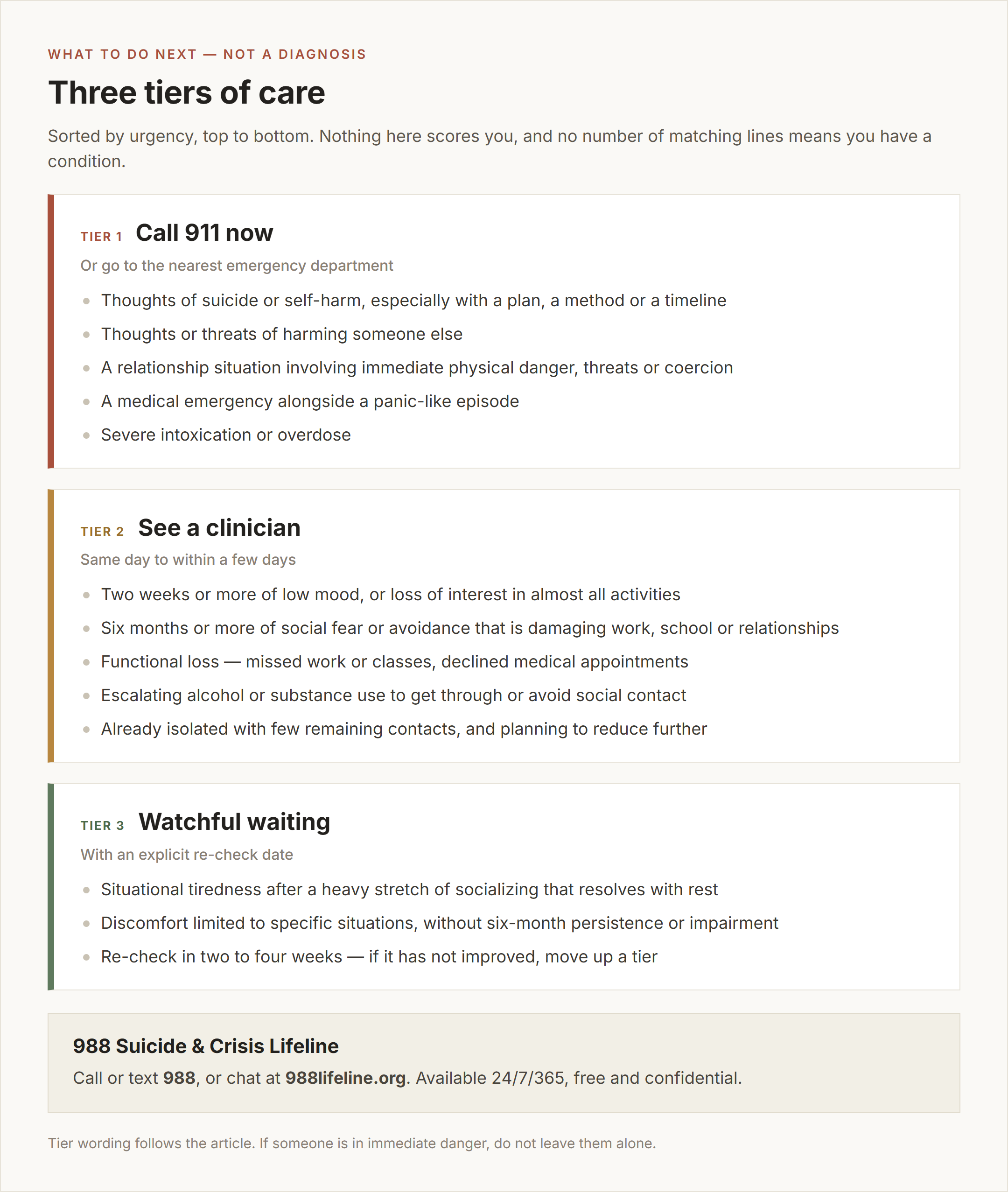
Tier 1 — call 911 now, or go to the nearest emergency department. Thoughts of suicide or self-harm, especially with a plan, a method, a timeline, or a recent attempt. Thoughts or threats of harming someone else. Any relationship situation involving immediate physical danger, threats or coercion. Altered consciousness, severe confusion, breathing difficulty, or any medical emergency occurring alongside a panic-like episode. Severe intoxication or overdose in the context of using alcohol or drugs to cope. If someone is in immediate danger, do not leave them alone.
988 Suicide & Crisis Lifeline. Call or text 988, or chat at 988lifeline.org. The 988 Lifeline is available 24/7/365, and it is free and confidential. Spanish: call 988 and press 2, or text AYUDA. Veterans and service members: call 988 and press 1, or text 838255. Support is available for Deaf and hard-of-hearing callers. (Verified on 988lifeline.org, September 20, 2026.)
Tier 2 — see a clinician within the same day to a few days. Two weeks or more of depressed mood and/or markedly diminished interest or pleasure in almost all activities, especially if it arrived together with the urge to cut people off, plus any of: sleep or appetite change, fatigue, worthlessness or guilt, poor concentration, psychomotor change. Six months or more of fear or avoidance of social situations because of possible scrutiny, out of proportion to the actual threat, damaging work, school, relationships or daily functioning. Functional loss — missing work, dropping classes, stopping responses to everyone, declining medical appointments. Escalating alcohol or substance use to get through or avoid social contact. Recurring panic-type episodes, or fear of the next one changing your behavior. New physical symptoms alongside the emotional ones: chest pain, palpitations, unexplained weight loss, persistent insomnia. And this one especially: already isolated with few or no remaining contacts, and actively planning to reduce further — the highest-risk profile in all the isolation evidence above, and the one that warrants a professional conversation before any further pruning.
Tier 3 — watchful waiting, with a re-check date. Situational tiredness after a heavy stretch of socializing that resolves with rest, does not persist daily, and is not accompanied by low mood or loss of interest. Discomfort limited to specific, identifiable situations — large parties, presentations — without six-month persistence or functional impairment. While you wait: renegotiate the specific demand rather than delete the relationship, practice assertive phrasing, protect sleep and recovery time, and keep at least a small number of close contacts active. Set an explicit re-check date of two to four weeks. If it has not improved, or it is getting worse, move up a tier. Any time thoughts of self-harm appear, skip straight to 911 or 988.
The bottom line
- “People-pleasing” and “social burnout” are not diagnoses in the DSM-5-TR or ICD-11. PubMed holds 11 records total for “people-pleasing,” and “fawn response” is not indexed there at all. What is measurable: sociotropy, rejection sensitivity, unmitigated communion, fear of negative evaluation.
- The exhaustion has real evidence behind it — in workplaces. Hülsheger & Schewe 2011: 95 studies, 494 correlations, surface acting and emotion-rule dissonance ρ = .39–.48 with impaired well-being. Suh & Punnett 2021: 939 nursing-facility employees, 15% developed depressive symptoms over two years, aOR ≈ 2. Transfer to friendships and group chats is an extrapolation, not a finding.
- The “toxic fatigue substance” has no source. PubMed returned 0 results, both for “fatigue substance” with smiling or emotional labor and for surface acting with self-esteem. Not a physiology claim, and not a safe metaphor either.
- The cut-off list carries a documented cost. Holt-Lunstad 2010 — 148 studies, 308,849 participants, OR 1.50 (95% CI 1.42–1.59) for survival with stronger relationships, strongest at OR 1.91 for complex social integration. These are observational studies; reverse causation cannot be excluded, and none of them predicts anything about an individual.
- The Surgeon General’s headline numbers are traceable. The 29% heart disease and 32% stroke figures are Valtorta 2016; the dementia figure sits on the same cohort evidence as Kuiper 2015 (RR 1.57–1.58); and “like smoking 15 cigarettes a day” is an effect-size analogy drawn from Holt-Lunstad 2010, not a measured equivalence.
- Keep the figures in their own lanes. WHO’s 1 in 6 and 871,000 deaths a year are global. The US number is 32.1% feeling lonely (BRFSS 2022, 26 states, n = 218,915) — cross-sectional and not causal. No verified US group-chat statistic exists, and this article did not invent one.
- You are not a reliable judge of who is toxic right now. Downey & Feldman 1996 showed experimentally that rejection-sensitive people readily perceive intentional rejection in ambiguous behavior.
- Distance is defensible when it is specific. De Vogli 2007, Whitehall II, n = 9,011 over 12.2 years: negative aspects of close relationships, incident coronary events HR 1.34 (95% CI 1.10–1.63). One harmful relationship, yes. A pruning policy, no.
- Assertiveness has been tested; boundary-setting as a stand-alone technique has not. N = 210 internet RCT, assertiveness ES 0.95–1.73 vs waitlist, recovery 19–36%; n = 100 student RCT, d = 0.21–0.52. A PubMed title search for boundary-setting returned 50 records with no adult outcome RCT for social fatigue — so nobody can promise you it works on its own.
- Withdrawal can be a symptom. Social withdrawal is not a standalone DSM-5-TR criterion; it is usually how the loss-of-interest criterion shows up in behavior. For diagnosed social anxiety disorder, individual CBT is the best-supported initial treatment (101 trials, 13,164 participants, SMD −1.19 vs waitlist).

Photo: Kampus Production / Pexels
The instinct underneath all this is sound. Something is costing you more than it should, and you are right to want it to stop.
It is just that the thing to remove is rarely the person. It is the 11 p.m. obligation, the three hours you did not have, the face you have been holding in place since Tuesday. Keep the tie, drop the demand — and if the urge to disappear arrived with two weeks of flatness rather than after one long weekend, let someone qualified look at it with you before you start deleting anyone.
This article is general health information. It does not replace diagnosis or treatment by a licensed professional, and nothing here can tell you whether you have social anxiety disorder, depression or any other condition — only a qualified clinician can. The reflection questions above are not a screening instrument and produce no score. If a relationship involves threats, coercion, intimidation or physical harm, that is a safety matter requiring appropriate help. If you are having thoughts of suicide or self-harm, call or text 988, or call 911 if there is immediate danger.
Sources: Hülsheger & Schewe, J Occup Health Psychol 2011 (PMID 21728441); Suh & Punnett, Int Arch Occup Environ Health 2021 (PMID 33074354); Butler et al., Emotion 2003; Hochschild, The Managed Heart 1983; Holt-Lunstad et al., PLoS Med 2010 (PMID 20668659); Holt-Lunstad et al., Perspect Psychol Sci 2015 (PMID 25910392); Valtorta et al., Heart 2016 (PMID 27091846); Kuiper et al., Ageing Res Rev 2015 (PMID 25956016); De Vogli et al., Arch Intern Med 2007 (PMID 17923594); Downey & Feldman, J Pers Soc Psychol 1996 (PMID 8667172); Helgeson & Fritz 1998; Helgeson et al., Pers Soc Psychol Bull 2007 (PMID 17400835); Weeks et al., Psychol Assess 2005 (PMID 16029105); Lindner et al., Internet Interv 2023 (PMID 37273933, NCT04240249); J Educ Health Promot 2024 (PMID 39268439); Mayo-Wilson et al., Lancet Psychiatry 2014 (PMID 26361000); Masi et al., Pers Soc Psychol Rev 2011 (PMID 20716644); US Surgeon General’s Advisory, May 2023; WHO Commission on Social Connection, 30 June 2025; CDC MMWR 73(24), 20 June 2024 (BRFSS 2022); NIMH social anxiety disorder statistics (NCS-R); Merck Manual Professional Edition (DSM-5-TR criteria); Pew Research Center, Americans’ Social Media Use 2025; Pillemer, Cornell Family Reconciliation Project survey (2020); 988 Suicide & Crisis Lifeline (988lifeline.org).