
Can’t Stop Scrolling at 3 A.M.? It’s Not Your Dopamine
I want to start with the part I got wrong.
For a long time I repeated the line you have probably read a hundred times: that swiping short-form video at 3 a.m. floods your brain with dopamine, “the pleasure hormone,” and that this is proof you are addicted. It sounds explanatory. It is also wrong in three separate places, and when I went looking for the study that supposedly proves it, there wasn’t one.
Here is the short version, before anything else. No human study has measured dopamine during short-form video use. Not TikTok, not Reels, not Shorts. “Short-form video addiction” is not a diagnosis in ICD-11 or DSM-5-TR. And the thing that is actually keeping you up has a duller, more useful name: bedtime procrastination.
The experience you had last night was real. The explanation you were handed for it was not.
This article is general health information. It is not a diagnosis and it does not replace evaluation by a qualified clinician. If you are in crisis, skip to the crisis and care section now.
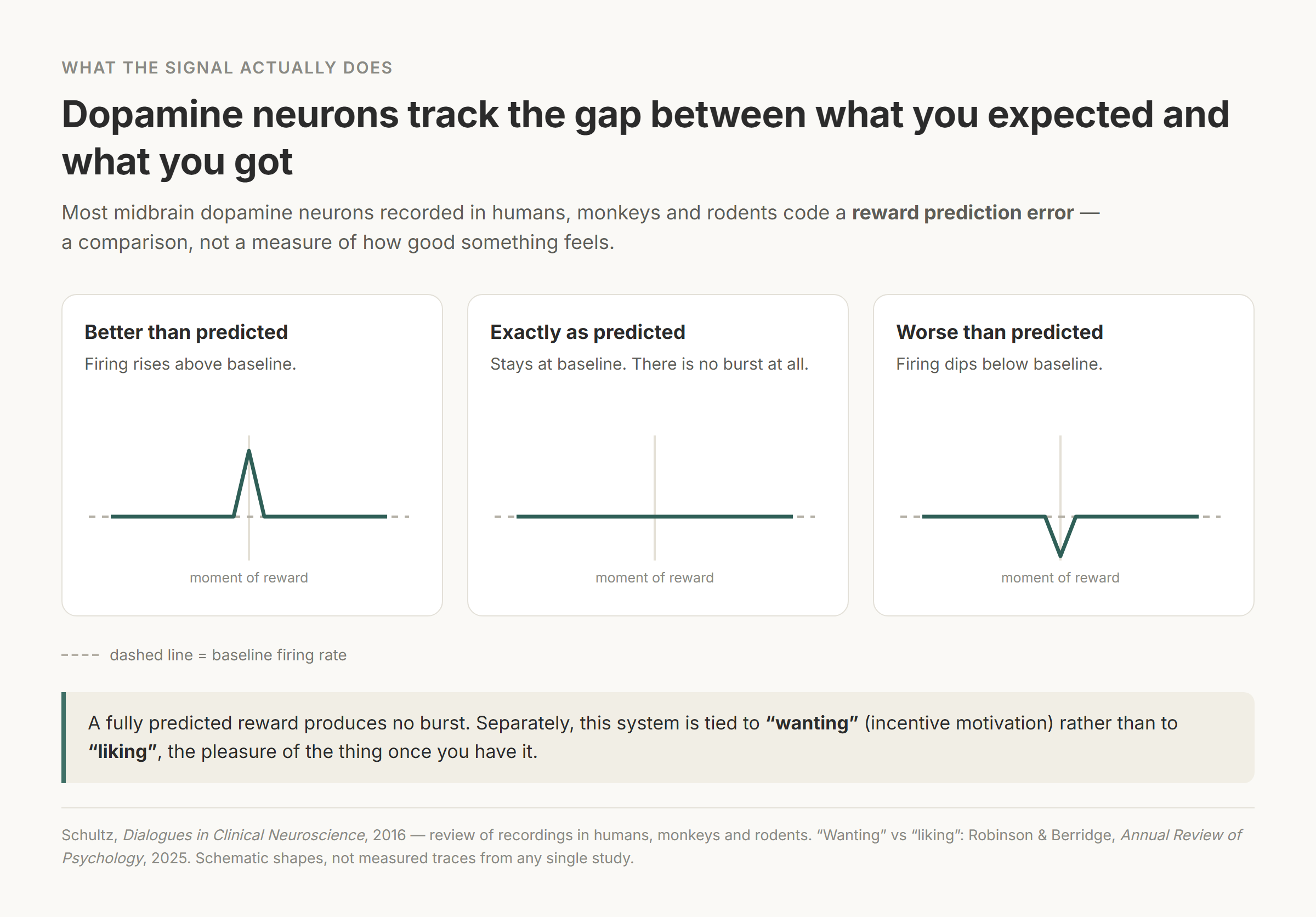
What dopamine actually signals, in about three sentences
Dopamine is a neurotransmitter, not principally a hormone, and its dominant job is not pleasure. Most midbrain dopamine neurons in humans, monkeys and rodents signal a reward prediction error: they fire above baseline when a reward is better than predicted, stay at baseline when a reward is fully predicted, and dip below when it is worse (Schultz, Dialogues in Clinical Neuroscience, 2016). There is a second finding that matters more for your 3 a.m. self: mesolimbic dopamine systems mediate incentive motivation — “wanting” — but not the hedonic impact, the “liking”, of the thing when you actually get it (Robinson & Berridge, Annual Review of Psychology, 2025).
Read those two together and the phrase “a constant gush of dopamine with every swipe” falls apart. A fully predicted reward produces no burst at all. And wanting to keep going while not enjoying it is not a paradox — it is the documented behavior of this system.
That is the sentence I would want someone to hand me at 3 a.m.: you are not broken, and you are not weak. You are experiencing a dissociation that has a name.
I am keeping this short on purpose, because the wider “you can’t drain or reset your dopamine” argument is covered in detail in our piece on mood swings and the dopamine detox myth. This post is about something else: the product, and the hour.
What about “my receptors are burned out”?
The receptor story is borrowed. In substance addiction it is well established — imaging studies show drug abusers have marked decreases in dopamine D2 receptors and in dopamine release, and reduced sensitivity to natural reinforcers (Volkow et al., Neuropharmacology, 2009).
For behavior, the evidence is thin enough to be worth stating precisely. The only comparable receptor study I could find in a digital behavioral domain used PET in 12 drug-naive adult males with internet gaming disorder versus 14 matched controls (European Journal of Nuclear Medicine and Molecular Imaging, 2014). It found striatal D2 dysregulation correlated with years of overuse. Twelve men. Cross-sectional, so it cannot say which came first. Gaming, not short-form video. And the tracer binds both D2 and 5-HT2A receptors.
No receptor study of short-form video use exists that this research could find. The structural MRI work that does exist on short-video addiction found gray-matter volume positively correlated with symptoms in a sample of 190 — which doesn’t fit the burned-out-brain picture either.
The feeling that ordinary quiet things no longer satisfy you is real. Its cause simply has not been measured.
“Addicted” isn’t a diagnosis here, and a quiz score isn’t one either
This is the part almost nobody says out loud. A 2026 scoping-review protocol in PLoS ONE puts it cleanly: Gaming Disorder is recognized in ICD-11, Internet Gaming Disorder remains a DSM-5-TR condition for further study, and problematic social media and smartphone use are research constructs rather than established diagnoses. The authors add the line this whole article rests on — these distinctions “avoid equating screening-positive use with clinical disorder.”
| Term | Where it actually stands |
|---|---|
| Gaming disorder (ICD-11, 6C51) | A recognized diagnosis. Requires impaired control, gaming prioritized over other activities, and continuation despite negative consequences — normally evident for at least 12 months — with significant distress or impairment |
| Internet gaming disorder (DSM-5-TR) | Section III, “Conditions for Further Study.” Not an official disorder |
| Problematic social media / smartphone use | Research constructs. Not diagnoses |
| “Short-form video addiction” | Research construct only, measured by study-specific scales, mostly in Chinese college samples |
| “Smartphone addiction,” “dopamine addiction” | Everyday language. Not diagnoses anywhere |
WHO notes that gaming disorder “affects only a small proportion of people who engage in digital- or video-gaming activities.” Heavy use is not the same thing as a disorder, even where a disorder exists.
And the online quizzes? The SAS-SV, the scale behind a lot of them, is 10 items developed in 540 Korean adolescents (343 boys, 197 girls, mean age 14.5) in April–May 2013, with cutoffs of 31 for boys and 33 for girls. The SABAS is 6 items validated in 240 English-speaking volunteers aged 18–69, and its own authors describe it as an “ultra-brief tool” for screening symptoms. A cutoff derived in Korean 14-year-olds in 2013 is what a lot of “are you addicted?” quizzes are quietly reusing on US adults in 2026.
So nothing in this article ends in a verdict. Use any of it to organize what you would say in an exam room, not to label yourself.
Then why can’t you stop? Because the feed has no ending
Here is the reframe, and I think it is the more useful one.
A 2023 review in Addictive Behaviors — and it is a theoretical review, not a measurement of anyone’s brain while scrolling — argues that reward variability and frequency are potential prerequisites of behavioral addiction, and names “infinite scrolls and personalized recommendations” as novel sources of reward variability. It identifies two moderators: how fast the uncertainty resolves, and the frequency of exposure, allowing temporal compression.
Those two describe short-form video almost exactly. A slot machine resolves its uncertainty in about three seconds. A 15-second clip resolves in about the same — and then a new uncertainty starts. At that length, an hour of scrolling is roughly 240 cycles of “is this one worth it?” Nothing before the smartphone delivered a schedule that dense.
It isn’t that any single clip is powerful. It is that the schedule is compressed.
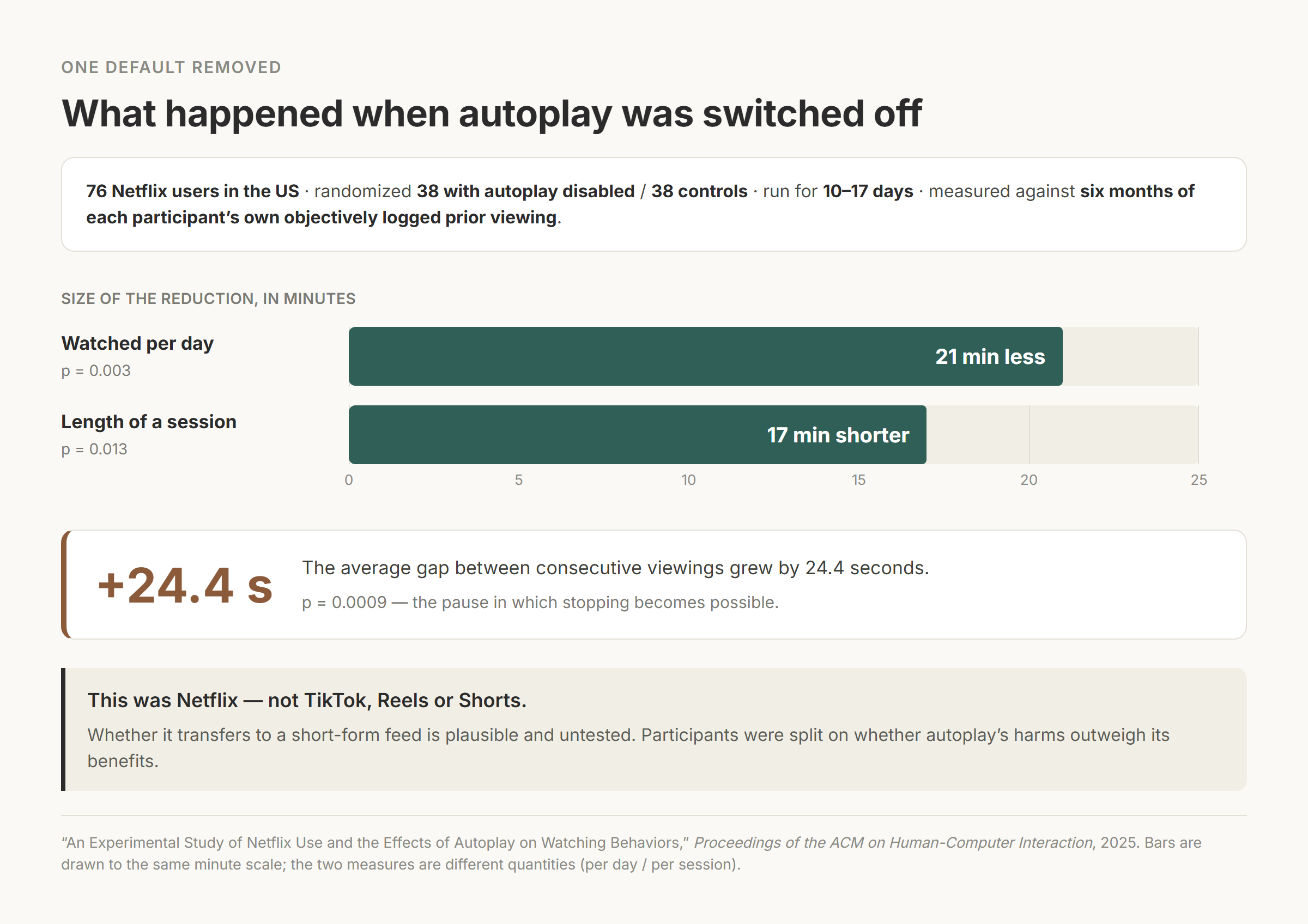
The one clean experiment on removing a default — and it’s Netflix
When people say “turn autoplay off,” this is the study underneath it, and it deserves its label. Researchers took 76 Netflix users in the US, randomized 38 to have autoplay disabled and 38 as controls, ran it for 10 to 17 days, and measured against six months of each participant’s own objectively logged prior viewing obtained through data access requests (Proceedings of the ACM on Human-Computer Interaction, 2025).
Disabling autoplay produced 21 fewer minutes watched per day (p = 0.003) and sessions 17 minutes shorter (p = 0.013).
This was Netflix, not TikTok, Reels or Shorts. The transfer to a short-form feed is plausible and untested. I would rather say that than pretend otherwise.
But the finding I keep thinking about is the small one: the average gap between consecutive viewings rose by 24.4 seconds (p = 0.0009). That gap is the missing decision. With autoplay on, continuing costs nothing. With it off, 24 seconds of nothing appears — and in that gap, some people stop.
The feed’s power isn’t that it’s irresistible. It’s that stopping was never given a moment to happen. The study’s authors also noted that participants were split on whether autoplay’s harms outweigh its benefits, which seems fair to report.
Friction beats good intentions — with an honest null attached
A pre-registered field experiment (N = 112, several weeks, objectively measured screen time, Cyberpsychology, Behavior, and Social Networking, 2023) compared switching the phone to grayscale — design friction — against setting your own time limits, against plain self-monitoring.
Grayscale produced an immediate, significant reduction. Goal-setting produced a smaller, more gradual one. And then the sentence that most articles leave out: “In contrast to the popular belief that reducing screen time has broad benefits, we found no immediate causal effect of reducing usage on subjective well-being and academic performance.”
Changing the environment changed the behavior. It did not automatically make people happier or better students. Hold on to that; we’ll come back to it.
One more, counter-intuitive and genuinely useful. In a 7-day study of 72 people scrolling social media (arXiv, 2025, exploratory), sleepiness lowered reactance toward interventions — the tired late-night self pushed back against a nudge less than the alert self did. A reminder placed at that hour meets less resistance, not more.

Photo: Jamaal Hutchinson / Pexels
The mechanism at 3 a.m. has a name, and it isn’t a chemical
Bedtime procrastination: “going to bed later than intended, without having external reasons for doing so.” That definition comes from a representative sample of 2,431 Dutch adults (published online 2014, Journal of Health Psychology), where the link between poor self-regulation and insufficient sleep ran through bedtime procrastination.
Notice what the definition excludes. A nurse on nights is not procrastinating bedtime. A parent up with a sick child is not procrastinating bedtime. It’s specifically the delay you can’t justify — which is exactly the 3 a.m. scroll.
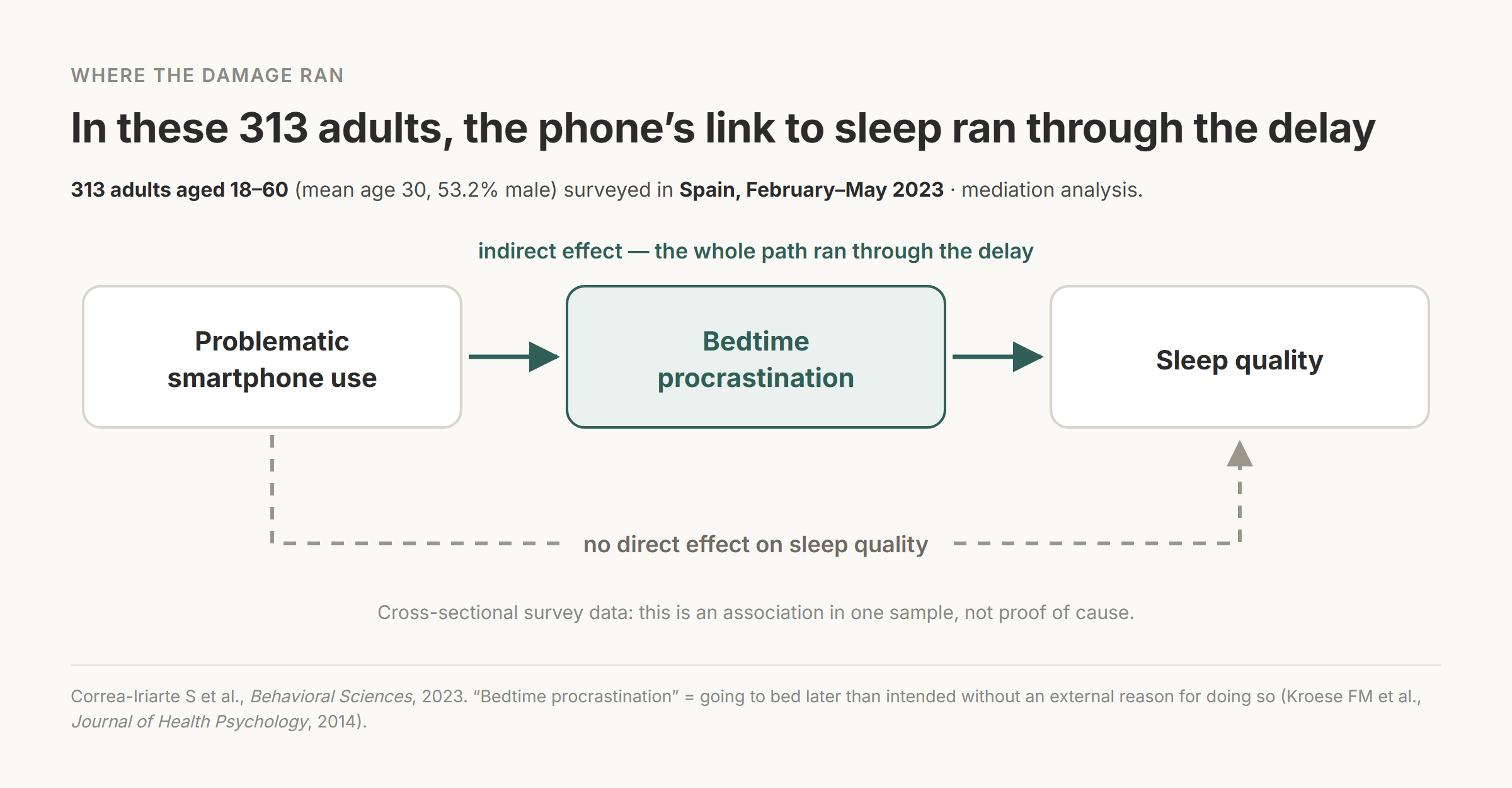
The phone’s damage ran entirely through the delay
In 313 adults aged 18–60 (mean age 30, 53.2% male) surveyed in Spain between February and May 2023, mediation analysis found that problematic smartphone use had indirect effects on sleep quality through bedtime procrastination, but no direct effects on sleep quality (Behavioral Sciences, 2023).
Read that twice. In that sample, the phone did not damage sleep by itself. It damaged sleep by making bedtime move.
That changes the target. The thing to fix isn’t “the phone.” It’s the boundary of the night.
The pattern has been replicated in adolescents — in 245 Turkish adolescents aged 13–18 in 2024, 46.9% screened positive for problematic smartphone use signs on the SAS-SV, average use was 2.8 hours a day, 90.6% used a smartphone in bed, on average 4.9 days a week for 2.3 hours a day, and bedtime procrastination again mediated the link to sleep quality. Those are screening-scale figures in Turkish teenagers, not US adults and not a diagnosis rate.
Why it happens in the evening, specifically
Among 218 adults (Frontiers in Psychology, 2018), people who reported resisting more desires during the previous day were more likely to procrastinate bedtime.
This is cross-sectional self-report, and the wider ego-depletion literature it sits in has had well-known replication problems — so take the correlation, not the theory. But the correlation alone is humane and worth saying plainly:
The harder your day was, the worse your midnight self is at stopping.
Which means any plan that depends on late-night willpower is designed to fail. The plan has to be made at 7 p.m. and executed by the environment. If your days have been running you down for months, the more relevant read may be our piece on burnout and how recovery actually works.
What’s actually at stake in hours
The CDC (page last reviewed May 15, 2024) puts the adult floor at 7 or more hours a night for ages 18–60, 7–9 hours for 61–64, and 7–8 hours for 65+, with insufficient sleep linked to higher risk of type 2 diabetes, heart disease, high blood pressure and stroke, plus crash risk and impaired attention and memory.
Do the arithmetic. If your alarm is fixed and bedtime slides 90 minutes, the 7-hour floor is gone — not occasionally, but every night the slide happens. The clip is 15 seconds. The debt is in hours.

Photo: Mathias Reding / Pexels
One caveat I owe you: the short-form-video sleep studies specifically — 553 Chinese college students with FoMO as a mediator, and 677 Chinese college students with social anxiety and low self-control as mediators — are all cross-sectional, self-report, and drawn from Chinese university samples. They cannot establish direction, and they may not transfer to a US adult. Most of this literature was built somewhere other than the US: Dutch, Polish, Spanish, Turkish, German, Danish samples.
What the US numbers do and don’t say
These are Pew usage figures. They describe behavior, not health.
- Teens: among 1,458 US teens aged 13–17 surveyed September 25 – October 9, 2025, daily use ran YouTube 75%, TikTok 61%, Instagram 55%. “Almost constantly” was about 20% for YouTube, 21% for TikTok (up from 16% in 2022) and 12% for Instagram. Pew’s own line: “Across these five platforms, 36% of teens use at least one of these sites almost constantly.”
- Adults: among 5,022 US adults surveyed February 5 – June 18, 2025, 84% use YouTube and 37% use TikTok (up from 21% in 2021); 33% visit YouTube several times a day; about half of 18–29-year-olds use TikTok daily, against 5% of adults 65+.
Pew does not break out YouTube Shorts as a separate metric, so there is no Shorts-specific US percentage to quote. If you see one, someone made it up.
Before the tips: it may be the symptom, not the cause
I want this ahead of the practical section, because getting the order wrong wastes months.
In a three-wave cross-lagged panel analysis of 321 medical students, depressive symptoms at Time 1 predicted problematic smartphone use at Time 3 through rumination at Time 2 (indirect effect 0.023, 95% CI 0.004–0.042) — and problematic use at Time 1 predicted depressive symptoms at Time 3 through rumination (0.015, 95% CI 0.001–0.029). Both directions were significant. Both effects were small (Addictive Behaviors, 2024).
Rumination is the hinge, and that matches the 3 a.m. experience precisely. You may not be scrolling instead of sleeping. You may be scrolling because you can’t stop thinking and the feed is the only thing loud enough to drown it out. If that’s what’s happening, a screen-time app is treating the wrong thing.
So here is the practical rule: if you put the phone away and still lie awake, the phone was not the problem. That’s a signal to be evaluated for insomnia disorder or depression, not a signal to try harder. If the racing mind is the main event, start with quieting a racing mind at night instead, and if the flatness follows you into the daytime while you keep functioning on the outside, smiling depression is worth reading.
About the scary statistics
A 2025 systematic review and meta-analysis in the Journal of Behavioral Addictions pooled observational studies of “digital addiction” in youth and reported these odds ratios versus youth without it: insomnia 1.46 (1.33–1.59), poor sleep quality 1.50 (1.37–1.64), depression symptoms 1.76 (1.68–1.83), anxiety 2.14 (1.99–2.28), stress 2.15 (1.79–2.52), suicidal tendencies 2.63 (2.36–2.90).
Every one of those is an association from observational studies in young people, pooled under one umbrella term. None of them is an effect of scrolling. The last figure in particular does not mean scrolling raises anyone’s suicide risk by that amount — the design cannot support that sentence, and writing it would be a serious error.
What the cluster does say is this: heavy problematic use tends to travel with serious difficulties. That is a reason to take it seriously enough to get evaluated. It is not a reason to panic.
(The one US longitudinal dose figure, from 6,595 US adolescents aged 12–15 followed 2013–2016, found adjusted relative risk ratios for internalizing problems of 1.60 at 3–6 hours a day and 1.78 above 6 hours — and the authors hedged with “may be.” That was social media generally, in adolescents, before short-form feeds dominated. It is not a rule for adults in 2026.)
What actually happens when people cut back
Now the part with real randomized evidence. And it starts by contradicting the advice you were probably about to follow.
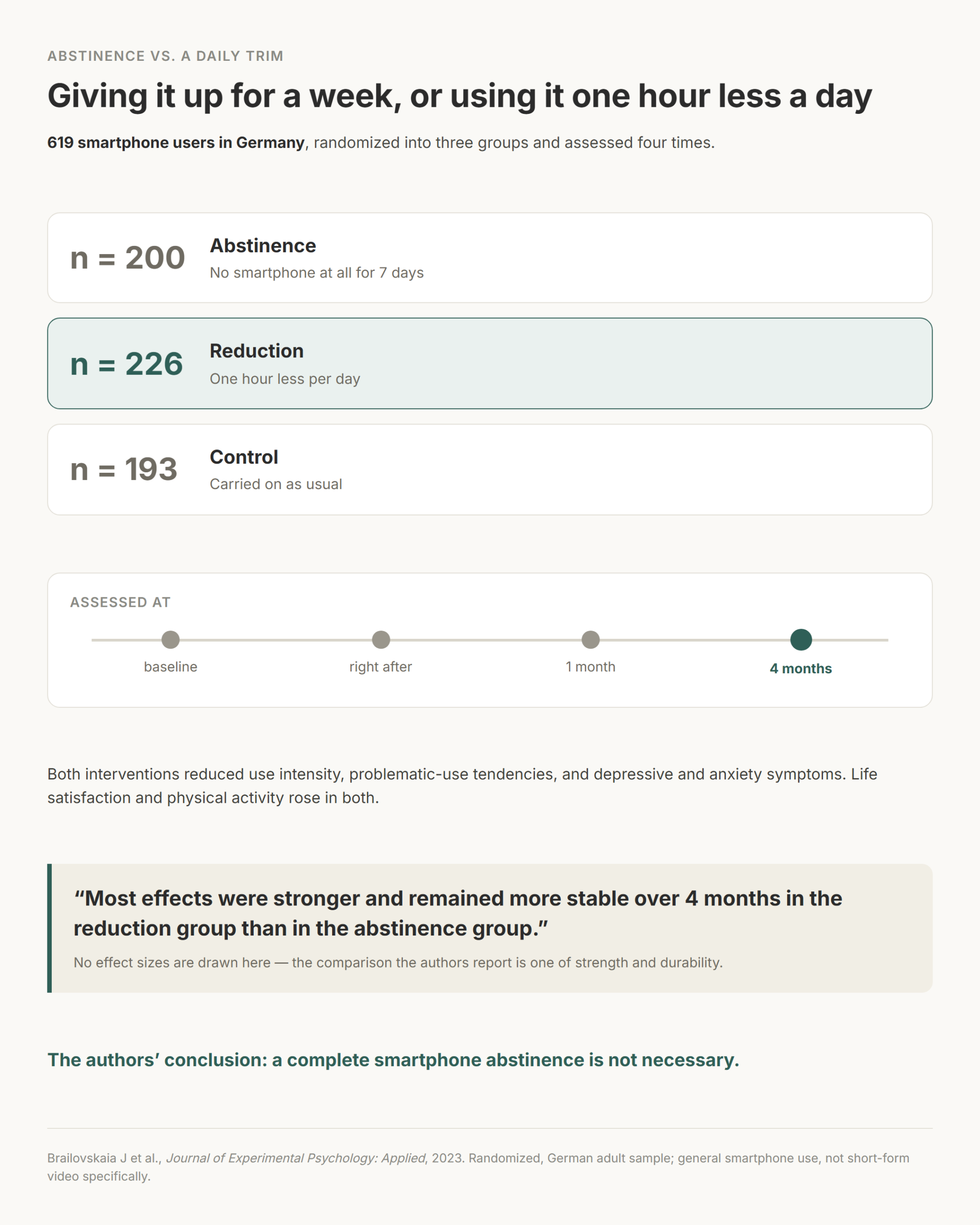
Total abstinence was tested against a modest daily cut. The daily cut held up better.
619 smartphone users in Germany were randomized into three groups: 200 gave up their smartphone entirely for 7 days, 226 reduced daily use by 1 hour, and 193 carried on as usual. They were assessed at baseline, right after, then 1 month and 4 months later (Journal of Experimental Psychology: Applied, 2023).
Both interventions reduced use intensity, problematic use tendencies, and depressive and anxiety symptoms. Life satisfaction and physical activity rose in both. But: “Most effects were stronger and remained more stable over 4 months in the reduction group than in the abstinence group.” The authors’ own conclusion is that a complete smartphone abstinence is not necessary.
That’s a direct, head-to-head rebuttal of the all-or-nothing instinct. The blackout worked. The modest daily trim worked better, four months out.
So what about the “digital sabbath”?
I went looking for it. A PubMed search for “digital sabbath” returned two records, neither relevant, and I could not find any study that directly tested powering everything down for half a weekend day.
That is not “it doesn’t work.” It is untested, and the distinction matters. What I can say is that the nearest tested relatives point elsewhere: 7-day total abstinence was less durable than a daily reduction, and a weekly blackout is the same abstinence logic in miniature. A day off on Saturday also does nothing about the 3 a.m. Tuesday, which is the actual complaint.
The instinct underneath it — replace, don’t just remove — is sound, and it’s how the successful trials were built. But the replacement with randomized support in this literature is physical activity (about 30 extra minutes a day). Paper books and houseplants may well be lovely. I could not find trial evidence for them as screen substitutes, so I’m not going to tell you they work.
The tactics, with honest strength labels
| What to do | Evidence behind it | How strong |
|---|---|---|
| Set a daily ceiling ~30–60 minutes below your current use, and hold it for weeks | 143 undergraduates, RCT; 619 German adults with 4-month follow-up; 503 German adults | Strongest. Randomized, replicated, durable |
| Turn autoplay off | Netflix experiment, 76 users, objectively logged, −21 min/day | Direct but off-platform. Netflix, not short-form. Transfer plausible, untested |
| Add friction (grayscale, app off the home screen, charger in another room) | Pre-registered field experiment, N = 112 | Good for cutting time. No measured benefit to well-being or grades |
| Use a limit tool that interrupts and makes you choose | RCT of 70 iPhone users, −29.35 min/day on the target app | Moderate. Moved time; did not move problematic-use scores or self-efficacy |
| Just track your use | Control group in the 143-student trial improved on anxiety and FOMO | Weak but real, and free |
| Add ~30 minutes of physical activity | 503 German adults; 278 German employees | Good. Combination outlasted activity alone |
| Make the rule at 7 p.m., not at midnight | Reasoned from the 218-adult depletion correlation | Indirect. Reasoning from a correlation, not a trial |
| “Digital sabbath,” half a weekend day off | No direct test found | Untested. Not disproven — unmeasured |
The two specifics worth repeating: in the 3-week trial of 143 undergraduates at the University of Pennsylvania, limiting Facebook, Instagram and Snapchat to 10 minutes per platform per day produced significant reductions in loneliness and depression versus controls — and both groups improved on anxiety and FOMO, which the authors read as a benefit of simply paying attention to your own use.
The promise I’m not going to make
Reducing screen time reliably reduces screen time. Whether it makes you happier is genuinely unsettled.
- The pre-registered grayscale study (N = 112) found no immediate causal effect of reduced usage on subjective well-being or academic performance.
- In the SCREENS trial (89 families including 164 adults, randomized, 2 weeks at under 3 hours of recreational screen use per week, compliance objectively monitored), self-reported well-being and mood improved significantly — but the researchers “observed no intervention effects for biomarkers of stress,” measured as salivary cortisol and cortisone.
- The app-based RCT of 70 iPhone users cut 29.35 minutes a day on the target app, yet found no significant reduction in problematic social media use and no increase in self-efficacy.
Other trials did find symptom improvements. Both sides are real, and you deserve to know that before you start.

Photo: Andres Idda Bianchi / Pexels
When to talk to someone
Three tiers. Nothing here diagnoses anyone.
Call 911 now, or go to the nearest emergency department
- Thoughts of suicide or self-harm with a plan, means, intent, or a timeline.
- Any attempt at self-harm, or immediate danger to yourself or someone else.
- New confusion, a seizure, chest pain, severe shortness of breath, an inability to be woken, or any loss of consciousness.
- Sudden severe agitation, or a break from reality — hearing or seeing things others do not.
- Falling asleep at the wheel or while operating machinery because of sleep loss. Pull over and stop driving. That is an acute danger, not a productivity problem.
988 Suicide & Crisis Lifeline — free, confidential, 24/7/365
- Call 988 · Text 988 · Chat at
chat.988lifeline.org - Español: call 988 and press 2, text AYUDA to 988, or chat in Spanish
- Deaf / Hard of Hearing: use your preferred relay service, or dial 711 then 988; ASL videophone at
988lifeline.org/deaf-hard-of-hearing-hearing-loss/ - Veterans & Service Members: call 988 and press 1, or text 838255
- Disaster Distress Helpline: 1-800-985-5990
You do not have to be suicidal to call. Distress, overwhelm, or not knowing who else to talk to is enough.
See a clinician within days
Primary care, a psychiatrist, a psychologist, a licensed therapist, or a sleep clinic.

Photo: Chris F / Pexels
- Trouble falling or staying asleep at least 3 nights a week for 3 months or more, with daytime consequences — the pattern that defines chronic insomnia, and the point to ask about CBT-I, the first-line treatment.
- You put the phone away and still can’t sleep, or still feel flat and unmotivated. That points past the phone.
- Low mood, loss of interest, hopelessness, or persistent anxiety lasting two weeks or longer.
- Sleep loss is affecting your driving, your work, or your caregiving.
- You have repeatedly tried to cut back and cannot, and use continues despite clear damage to work, school, relationships or health.
- Night scrolling has replaced eating, hygiene, or seeing people — not just sleep.
- Loud snoring with witnessed pauses in breathing, or waking unrefreshed no matter how long you were in bed. That may be sleep apnea, a medical cause no screen rule will fix.
- Any of this alongside an existing diagnosis of depression, anxiety, bipolar disorder, ADHD or a substance use disorder.
- Children and teens: talk to a pediatrician if night use is displacing sleep, school performance is slipping, or mood has changed.
Watchful waiting, then re-check in 2–4 weeks
- Occasional late nights you can stop on your own, without a consistent shortfall against the 7-hour adult floor.
- You lose track of time in the feed sometimes, but work, relationships and health are intact.
- What to try, in evidence order: a specific daily ceiling about 30–60 minutes below your current use; autoplay off; friction (grayscale, app off the home screen, charger in another room); make the rule in the early evening, because that decision only gets harder as the day goes on; add about 30 minutes of physical activity; and simply tracking your use, which is not nothing.
- Re-check in 2–4 weeks. If the ceiling never holds, or sleep and mood don’t improve, move up a tier. Repeatedly failing to keep a limit you set for yourself is information, not a character flaw.
The disclaimer, in full
This is general health information, not a diagnosis, and not a substitute for evaluation or treatment by a qualified clinician. Nothing here can tell you what is happening to you.
“Short-form video addiction,” “smartphone addiction” and “dopamine addiction” are not medical diagnoses. Gaming disorder is recognized in ICD-11; internet gaming disorder remains a DSM-5-TR condition for further study; problematic social media and smartphone use are research constructs. Screening positive on an online quiz is not a diagnosis, and scales like the SAS-SV were built as screeners in specific samples — 540 Korean adolescents in 2013, in that case — whose cutoffs do not diagnose anyone.
There is a real risk of delayed care here. Night scrolling can be a symptom of insomnia disorder, depression, anxiety or ADHD rather than their cause, and in longitudinal data the arrow runs both ways. Spending months optimizing a screen-time app while an untreated condition gets worse is its own harm. Nothing in this article should be used in place of care, and nothing here is a reason to stop or change a prescribed medication — that’s a conversation with your prescriber.
And please don’t read any of this as a willpower test. Evening self-regulation is thin by design and thinner after a hard day. If you can’t stop, that is not evidence of a weak character.
The bottom line
- “Pleasure hormone,” “addicted,” “proof” — all three are wrong. Dopamine mostly signals reward prediction error, a fully predicted reward produces no burst at all, and no human study has measured dopamine during short-form video use.
- Receptor downregulation is a substance-addiction finding. The only comparable behavioral study I could find was 12 men with internet gaming disorder. There is no short-form video receptor study.
- The better explanation is design plus the hour: uncertainty that resolves in seconds, repeated at a density nothing else matched, meeting a self-regulation system that is empty by midnight.
- Bedtime procrastination is the mechanism worth naming. In 313 Spanish adults, problematic phone use had no direct effect on sleep quality — the whole effect ran through the delay.
- A daily ceiling beats a blackout. In 619 German adults, 7 days of total abstinence and a one-hour daily reduction both helped, but the reduction group’s gains were stronger and more stable at 4 months.
- The “digital sabbath” was never directly tested in anything this research could find. Untested, not disproven.
- Cutting back reliably cuts time. It does not reliably lift mood — a pre-registered study found no effect on well-being or academics, and the SCREENS trial improved mood while cortisol didn’t move.
- The scrolling may be the symptom. If the phone goes away and sleep doesn’t come, that’s a reason to be evaluated.
The honest version of the 3 a.m. story is less dramatic than the one about your neurochemistry, and I think it’s more forgiving. Nothing was hijacked. You reached the end of a long day with an ordinary amount of self-control left, and you picked up a product that was built without an ending.
So don’t fight it at midnight. Give the night an edge at seven in the evening instead — and let the environment, not your exhausted self, do the stopping.
Sources
- Schultz W. “Dopamine reward prediction error coding.” Dialogues in Clinical Neuroscience, 2016.
- Robinson MJF, Berridge KC. “The Incentive-Sensitization Theory of Addiction 30 Years On.” Annual Review of Psychology, 2025.
- Volkow ND et al. “Imaging dopamine’s role in drug abuse and addiction.” Neuropharmacology, 2009. · Tian M et al. Eur J Nucl Med Mol Imaging, 2014.
- “Digital behavioral addictions in adolescents and young adults” (scoping review protocol). PLoS ONE, 2026. · WHO, “Addictive behaviours: Gaming disorder.” · American Psychiatric Association, “Internet Gaming.”
- Kwon M et al. PLoS ONE, 2013 (SAS-SV). · Foster J et al. Int J Ment Health Addict, 2018 (SABAS).
- Clark L et al. “Engineered highs.” Addictive Behaviors, 2023. · “An Experimental Study of Netflix Use and the Effects of Autoplay on Watching Behaviors.” Proc. ACM Hum.-Comput. Interact., 2025. · “Digital Strategies for Screen Time Reduction.” Cyberpsychology, Behavior, and Social Networking, 2023. · “Scrolling in the Deep.” arXiv, 2025.
- Kroese FM et al. Journal of Health Psychology, 2014. · Kadzikowska-Wrzosek R. Frontiers in Psychology, 2018. · Correa-Iriarte S et al. Behavioral Sciences, 2023. · Eurasian Journal of Medicine, 2024. · Frontiers in Public Health, 2026. · Behavioral Sciences, 2026.
- CDC, “About Sleep” (last reviewed May 15, 2024). · Watson NF et al., AASM/SRS joint consensus statement, SLEEP, 2015.
- Brailovskaia J et al. J Exp Psychol Appl, 2023; J Public Health, 2023; Acta Psychologica, 2024. · Hunt MG et al. J Soc Clin Psychol, 2018. · Pedersen J et al. (SCREENS), npj Mental Health Research. · “Wellspent” RCT, JMIR mHealth uHealth, 2026.
- Addictive Behaviors, 2024 (cross-lagged panel). · Journal of Behavioral Addictions, 2025 (meta-analysis). · Riehm KE et al. JAMA Psychiatry, 2019.
- Pew Research Center, “Teens, Social Media and AI Chatbots 2025” and “Americans’ Social Media Use 2025.” · 988 Suicide & Crisis Lifeline, “Talk to Someone Now” (verified September 20, 2026).