
Intrusive Memories: Why the Past Feels Like Right Now
You are loading the dishwasher, or waiting at a red light, and it arrives. A thing you said in 2019. Or something much worse than that. Not as a thought you decided to have — as something that drops into the room, fully formed, with the volume already up.
The usual explanation for this is that your brain has a timing error. That it cannot quite tell the past from the present, so it replays an old file as though it were live footage, and then floods your body with stress hormones all over again.
Part of that is a fair description of something real. Part of it is wrong in a way that matters, and I want to be straight about which part.
Before we go on, one thing I would rather say early than late.
A note on how to read this. You can stop at any point. Nothing in this article is an instruction to relive anything, and please do not deliberately call up a painful memory to “test” any of it, especially not alone. If reading gets heavy, close the tab and come back another day — or talk to someone instead.
If you are in crisis or thinking about suicide or self-harm, call or text 988 (988 Suicide & Crisis Lifeline) — free, confidential, 24/7/365; chat is available at 988lifeline.org, and Spanish text and chat are available. Veterans and service members: dial 988 then press 1, or text 838255. If someone’s life is in immediate danger, call 911.
This is general health information. It is not a diagnosis, not a treatment, and not a substitute for care from a licensed mental health professional. If you are struggling, talk to a clinician.
The memory showing up is not the problem
Here is the first correction, and it is the gentlest one.
Memories arriving uninvited is normal. A 2025 systematic review in Clinical Psychology Review, which gathered 79 empirical studies of involuntary autobiographical memories, describes them as “common and mostly positive in everyday life.” Most of the memories that ambush you are ordinary — a song, a smell, a kitchen in a house you no longer live in. Your autobiographical memory is supposed to do this.
So what separates an intrusive memory that is part of a disorder from one that is just Tuesday?
Not its presence. Not even how often it shows up.
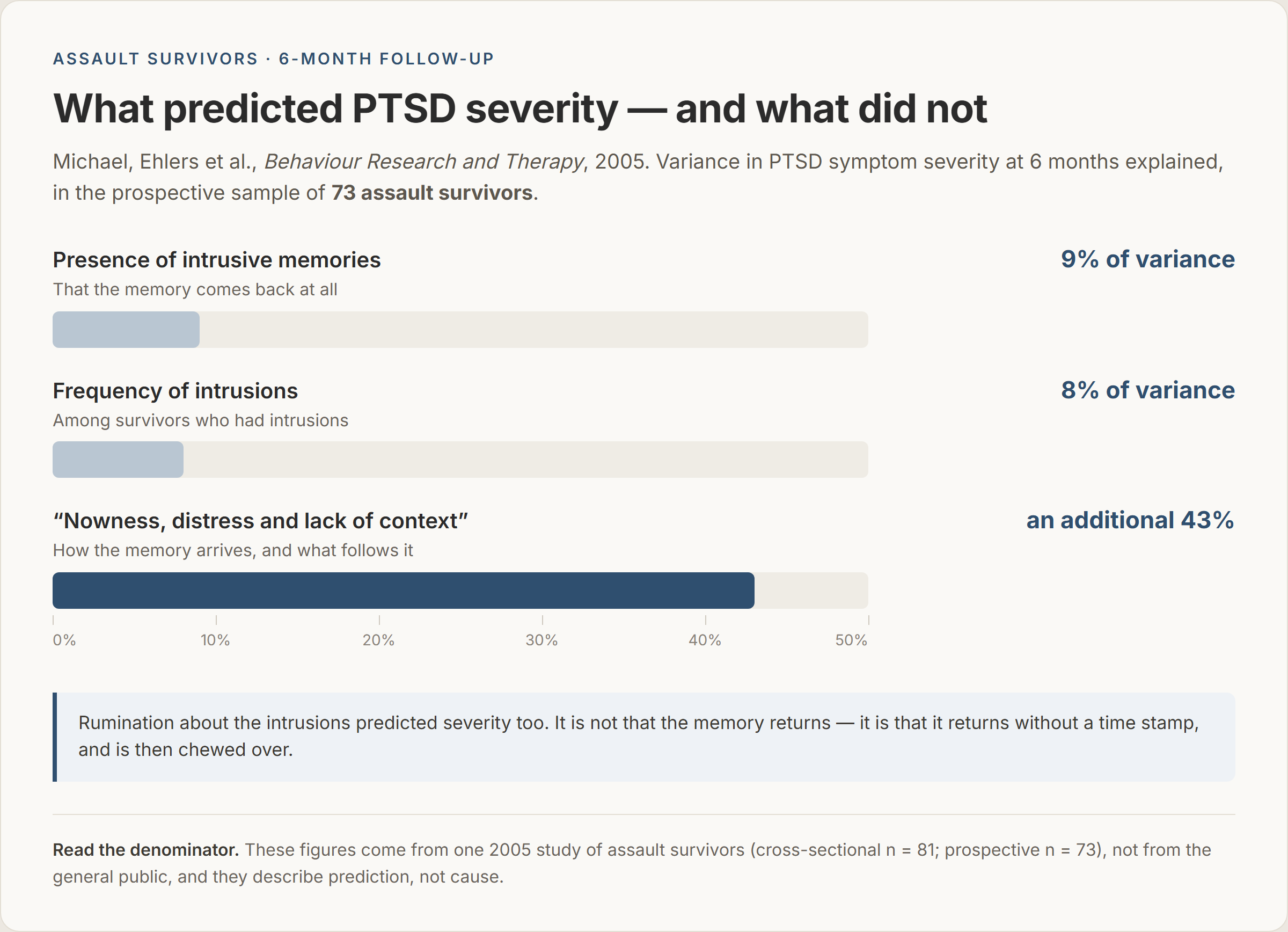
In a study of assault survivors by Michael, Ehlers and colleagues (Behaviour Research and Therapy, 2005 — a cross-sectional sample of 81 and a six-month prospective sample of 73), the presence of intrusive memories explained only 9% of the variance in PTSD severity at six months. Among people who had intrusions, the frequency explained only 8%.
What carried the weight was three other things: “nowness, distress and lack of context” explained an additional 43% of the variance. Rumination about the intrusions predicted severity too.
Read that again, because the whole article turns on it. It is not that the memory comes back. It is that it comes back without a time stamp — feeling current, stripped of context, and then chewed over afterward.
The 2025 review lands in the same place from a different direction: across disorders, what stands out is an increased frequency of involuntary memories, plus “heightened negativity, greater emotional impact, and the use of maladaptive emotion regulation strategies” in response to them — reported particularly in people with PTSD and depression. The response matters more than the arrival.
A cringe memory is not a flashback — and that distinction is not gatekeeping
This is the part people dislike, so let me be careful with it.
When something mortifying from years ago hits you in the chest at 11 p.m., the distress is real. I am not going to argue you out of it. But calling it trauma, or calling yourself a little bit PTSD, is not a harmless shorthand. It sends you looking for the wrong help.
In the DSM-5-TR (2022, which made no changes to the adult PTSD criteria carried over from DSM-5), Criterion A is a gate. The qualifying event has to be exposure to actual or threatened death, serious injury, or sexual violence, in one of four ways:
- directly experiencing it;
- witnessing it in person as it happened to someone else;
- learning it happened to a close family member or close friend (if the death was actual or threatened, it must have been violent or accidental);
- repeated or extreme exposure to aversive details of the events, usually in the course of professional duties — first responders, police, child-abuse caseworkers.
And the criterion carries an explicit exclusion, verbatim: “This does not include exposure through television, movies, electronic devices, or pictures.”
Embarrassment, regret, humiliation, a bad breakup, being shouted at by a manager, the thing you said in 2019 — none of these pass that gate. They can still hurt. They are simply a different clinical object, and a different conversation with a clinician.
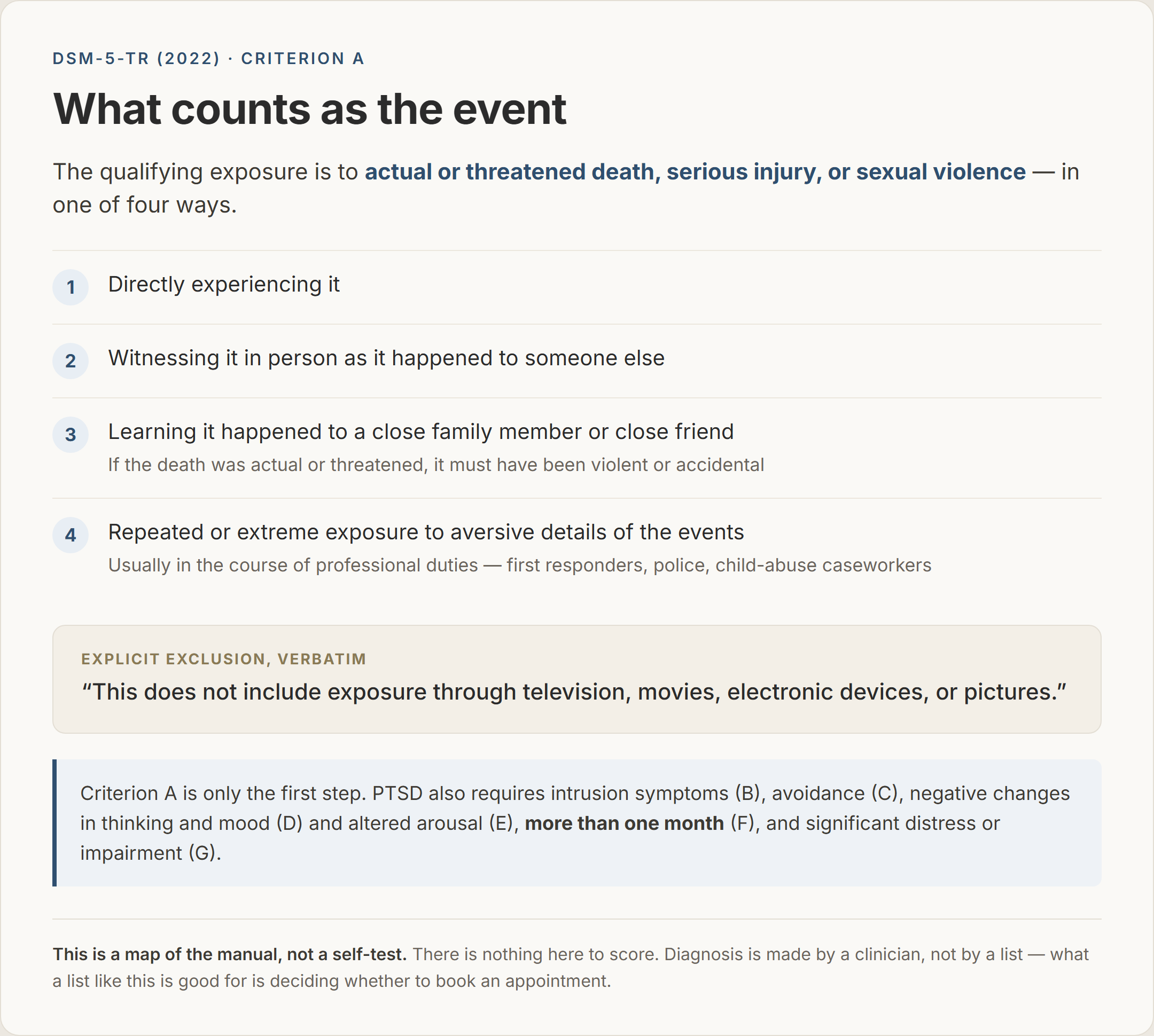
Criterion A is also only the first step. PTSD additionally requires at least one intrusion symptom from Criterion B — intrusive memories, distressing nightmares, “dissociative reactions, such as flashbacks,” intense distress on reminders, or marked physiological reactivity such as increased heart rate and blood pressure on reminders — plus avoidance (C), negative changes in thinking and mood (D), and altered arousal and reactivity (E). Then Criterion F: more than one month. Then Criterion G: significant distress or functional impairment.
That is a clinician’s assessment, not a checklist you can score at home. Nothing in this article lets you diagnose yourself or anyone else. What a list like this is good for is deciding whether to book an appointment.
The ICD-11 version says it even more plainly
The WHO’s ICD-11 (in effect since 2022) lists PTSD (6B40) and Complex PTSD (6B41) as siblings. Its PTSD definition has three core clusters: re-experiencing the trauma in the present — not merely remembering it — plus avoidance of reminders, plus a persistent sense of current threat.
Complex PTSD adds three “disturbances in self-organization”: problems with affect regulation; beliefs about oneself as diminished, defeated or worthless, with shame or guilt tied to the event; and difficulty sustaining relationships. Brewin and colleagues’ review (Clinical Psychology Review, 2017) found that CPTSD identifies a distinct group who “more often experienced multiple and sustained traumas and have greater functional impairment” than those with PTSD. (These cluster descriptions come from the peer-reviewed validation literature rather than from the WHO browser itself.)
“In the present” is the operative phrase. Thinking about something a lot is not the same as it happening again.
The timing-error metaphor: good model, not a measured mechanism
So why does it feel current?
The most-cited explanation is the cognitive model from Ehlers and Clark (Behaviour Research and Therapy, 2000). In their words, PTSD becomes persistent when people process the trauma in a way that produces “a sense of serious, current threat,” arising from two things: excessively negative appraisals of the trauma and its aftermath, and “a disturbance of autobiographical memory characterised by poor elaboration and contextualization, strong associative memory and strong perceptual priming.”
In plainer language: the memory got filed without a date and without the surrounding context, but with very strong sensory hooks. When a cue catches one of those hooks, what comes back is a raw fragment that has no “this was then” attached to it.
That is a reasonable version of the timing-error idea — and it is worth saying clearly that it is a model, a way of organizing the evidence, not a brain mechanism anyone measured directly.

What treatment aims at: putting the context and the date back around the memory.
Photo: RDNE Stock project / Pexels
The stress-hormone part is where the popular story breaks
Now the correction I care most about.
The familiar line is that an intrusion makes your brain dump cortisol through your whole body again. It is repeated everywhere. It is not what the research on PTSD and cortisol found.
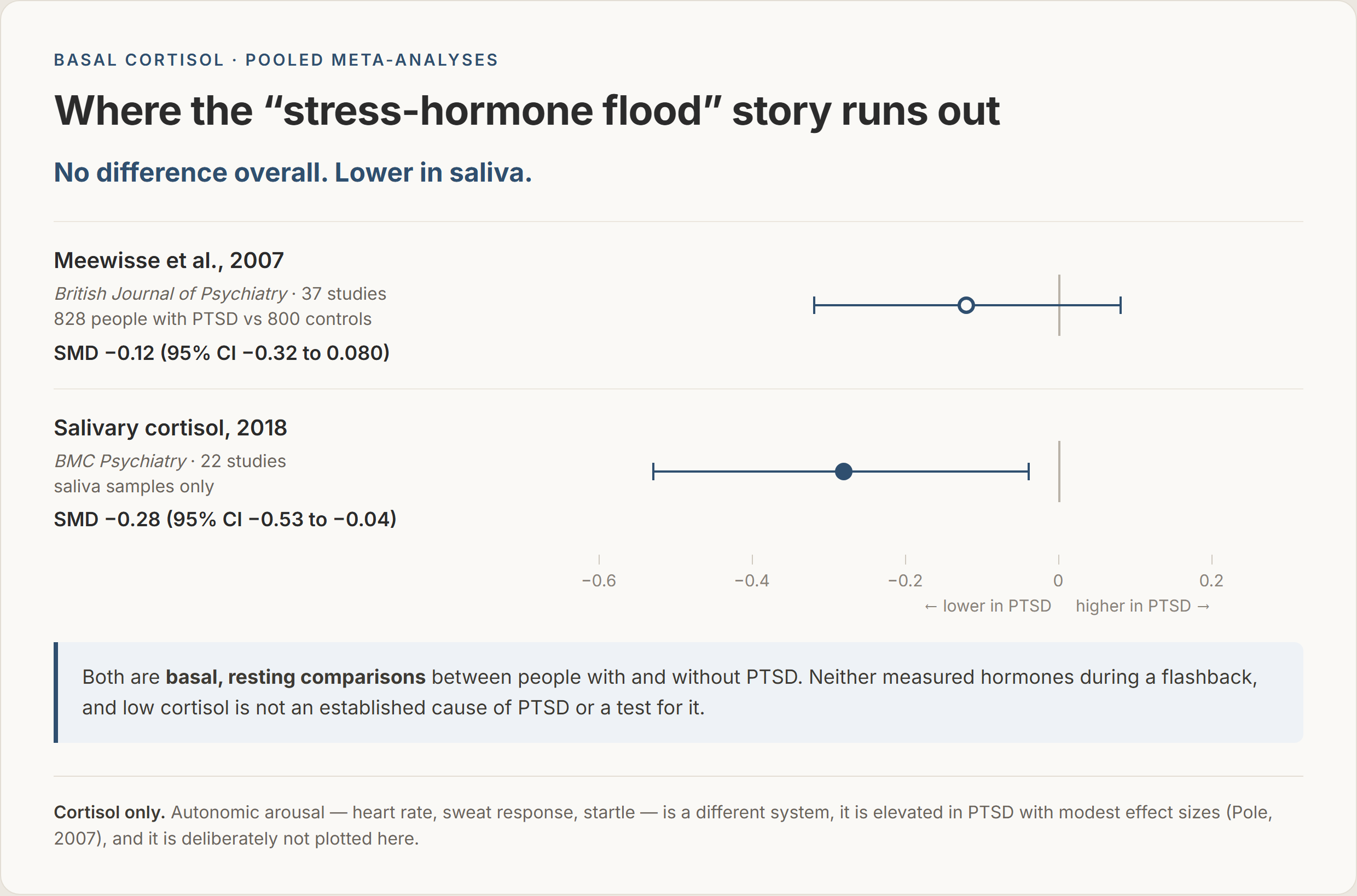
Meewisse and colleagues (British Journal of Psychiatry, 2007) pooled basal cortisol across 37 studies — 828 people with PTSD and 800 controls — and found no difference: SMD −0.12, 95% CI −0.32 to 0.080. Lower levels turned up only in subgroups: studies assessing plasma or serum, samples that included women, studies of physical or sexual abuse, and afternoon samples. The authors’ conclusion was that “low cortisol levels in PTSD are only found under certain conditions.”
A later meta-analysis of salivary cortisol (BMC Psychiatry, 2018, 22 studies) pointed the same direction: lower in people with PTSD, SMD −0.28, 95% CI −0.53 to −0.04, p = 0.022 — while noting that whether salivary cortisol could be used as a diagnostic tool needs further research.
Null overall, and trending lower in saliva. Not a flood.
Two more caveats before anyone flips this into a new myth. These are basal, resting comparisons between people with and without PTSD — nobody in this literature measured hormone levels during an actual flashback. And low cortisol is not an established cause of PTSD or a test for it.
What actually is elevated
Something does fire. It is the autonomic alarm system, not the cortisol story.
Pole’s meta-analysis (Psychological Bulletin, 2007 — 58 resting-baseline, 25 startle, 17 standardized trauma-cue and 22 idiographic trauma-cue studies) found adults with PTSD showed elevated psychophysiology compared with adults without it: heart rate r = .18 at rest, r = .27 to standardized trauma cues and r = .22 to personalized ones; corrugator (brow) muscle activity r = .34 to personalized cues; skin conductance r = .08 at rest.
Those are modest effects, and the authors flagged that the published literature has a “disproportionate focus on male veterans,” which limits how far the numbers generalize.
So the honest sentence is this: when a reminder lands, the body’s alarm system — heart rate, sweat response, startle — fires, and it fires as if the danger were current. That is a real finding. “Your brain floods you with cortisol” is not.
Nothing erases a memory — and the reason that matters
There is no established method, drug, or technique that erases a memory.
The science behind the claim is memory reconsolidation: retrieving a memory may briefly destabilize it, and a drug given in that window — usually propranolol, a beta-blocker — might weaken its emotional charge when it is re-stored. Most of that work is animal research, lab analogue studies in healthy volunteers, and small clinical trials.
The most relevant clinical meta-analysis in PTSD patients (Journal of Psychiatric Research, 2022) screened 3,224 publications and pooled seven studies on PTSD symptoms and three on physiological responses. The authors’ own conclusion: there is “a lack of evidence for the efficacy of propranolol on traumatic memory disruption, in PTSD patients, to recommend its routine clinical use,” with “a high level of heterogeneity, variation in propranolol dosage and inadequate sample sizes” meaning the findings need cautious interpretation. (I am quoting the conclusion rather than the effect sizes on purpose — the published abstract prints its point estimates in a way that is internally inconsistent.) A separate 2022 correction to an earlier, more positive meta-analysis moved in the same direction, toward null.
So “erasure” is a marketing word, not a clinical one. Nothing here is medical advice about any medication, and nothing here is a reason to start, stop, or ask for one — that belongs to a prescriber.
Here is what treatment does aim for, which is better than it sounds: the memory stops being experienced as happening now. It becomes a past event you can recall, with a date attached, without being hijacked. Ehlers and Clark name the targets as contextualizing the memory and updating the appraisals around it.
That goal is reachable. Deletion is not, and promising deletion sets people up to call a successful treatment a failure.
The genuinely dangerous advice: face it alone
If you take one practical thing from this article, take this one.
Deliberately “facing,” re-running, or writing out a traumatic memory by yourself is not prolonged exposure therapy. PE is manualized, paced and monitored, delivered by a trained clinician who is assessing risk in the room while it happens. The monitoring is not an accessory to the method. It is part of it.
van Minnen and colleagues (European Journal of Psychotraumatology, 2012) looked at whether PE is contraindicated for common comorbidities — dissociation, borderline personality disorder, psychosis, suicidal behavior and non-suicidal self-injury, substance use disorders, major depression — and concluded that PE “can be safely and effectively used with patients with these comorbidities,” adding that in cases of severe comorbidity it should be delivered “while providing integrated or concurrent treatment to monitor and address the comorbid problems.”
That is an argument for clinicians not to withhold therapy. It is not an argument for doing exposure to yourself. The same paper reports the PE manual’s own clinical contraindications: imminent threat of suicidal or homicidal behavior, serious self-injurious behavior in the past three months, and current psychosis.
The UK’s NICE guideline (NG116, 2018) draws the same boundary at guideline level. It allows supported — that is, therapist-guided — trauma-focused computerised CBT for adults more than three months after a trauma who prefer it, typically 8 to 10 sessions, and only for people without severe PTSD symptoms, in particular dissociative symptoms, and not at risk of harm to themselves or others [1.6.21–1.6.22].
Note also what “self-help” means in the research. A 2022 meta-analysis in Depression and Anxiety of trauma-focused guided self-help (17 trials, 610 intervention versus 570 control participants, controls mostly waiting list) found a moderate-to-large effect on PTSD symptoms, g = −0.81 (95% CI −1.24 to −0.39), with considerable heterogeneity — and the authors still wrote that guided self-help “(and unguided self-help) may not be appropriate for certain individuals at certain times.” Guided, against waiting lists. That is not evidence for unguided memory work at home.
So, plainly: do not deliberately go into a traumatic memory alone if any of these apply to you.
- Any suicidal or homicidal thoughts, a plan, or self-injury in the past three months. Call or text 988, and see the emergency section below.
- Severe dissociation — losing track of time or place, feeling detached from your body, feeling that things are not real, or “coming to” somewhere without knowing how you got there. Among people already diagnosed with PTSD, a dissociative presentation was found in 38.1% (95% CI 31.5–45.0%) across 49 studies and 8,214 participants (Psychological Medicine, 2022, with high heterogeneity). That denominator is people who already have the diagnosis — not the general public.
- Ongoing danger — current violence, abuse, stalking, or an unsafe home. Trauma-focused work assumes the threat is in the past. If it is not, safety comes first: National Domestic Violence Hotline 800-799-7233, 24/7; National Sexual Assault Hotline (RAINN) 800-656-4673, 24/7.
- Alcohol, substances, or medication used to blunt the memories. Not an automatic exclusion from treatment, but it needs a clinician managing both things at once.
- Current psychosis.

Reaching out to someone is the opposite of doing this alone.
Photo: MART PRODUCTION / Pexels
Where grounding fits — and where it does not
Grounding belongs here, briefly, and with an honest label on it.
In practice it means anchoring attention to the present: feet flat on the floor, naming the date and where you are, naming a few objects in the room, holding something cold or textured. It is what clinicians reach for in session — a 2026 critical review in Trauma, Violence, & Abuse notes grounding techniques are “frequently cited as a primary approach to attenuate dissociative episodes within treatment sessions.” But the same review, after screening 1,894 records down to 19 sources, states that grounding techniques “have not been subjected to efficacy studies due to a lack of consensus regarding a measurable operational definition.” No randomized trial of 5-4-3-2-1 grounding on its own turned up in this research — recorded as not found, which is not the same as proven ineffective.
One practical caution: if focusing on your breath makes you more anxious or lightheaded, that is a documented phenomenon called relaxation-induced anxiety (studied in GAD, n = 32, and depression, n = 34, against 30 healthy controls — Journal of Affective Disorders, 2019 — so in those populations, not PTSD), not a personal failure. Use non-breath anchors instead, and stop if distress escalates.

Feet flat on the floor is one of the non-breath anchors — a bridge across the next few minutes, not a treatment.
Photo: cottonbro studio / Pexels
If what hits you is a surge of physical panic rather than a returning memory, the anchoring toolkit and the breathing question are covered properly elsewhere — see [Internal link: panic attacks — what is actually happening in your body and how to ride one out] for the step-by-step version.
Grounding is a bridge across the next few minutes so you can get to treatment. Using it instead of treatment is the failure mode this whole article is trying to prevent.
What actually treats PTSD
The guidelines agree on the category, even where they disagree on the ranking.
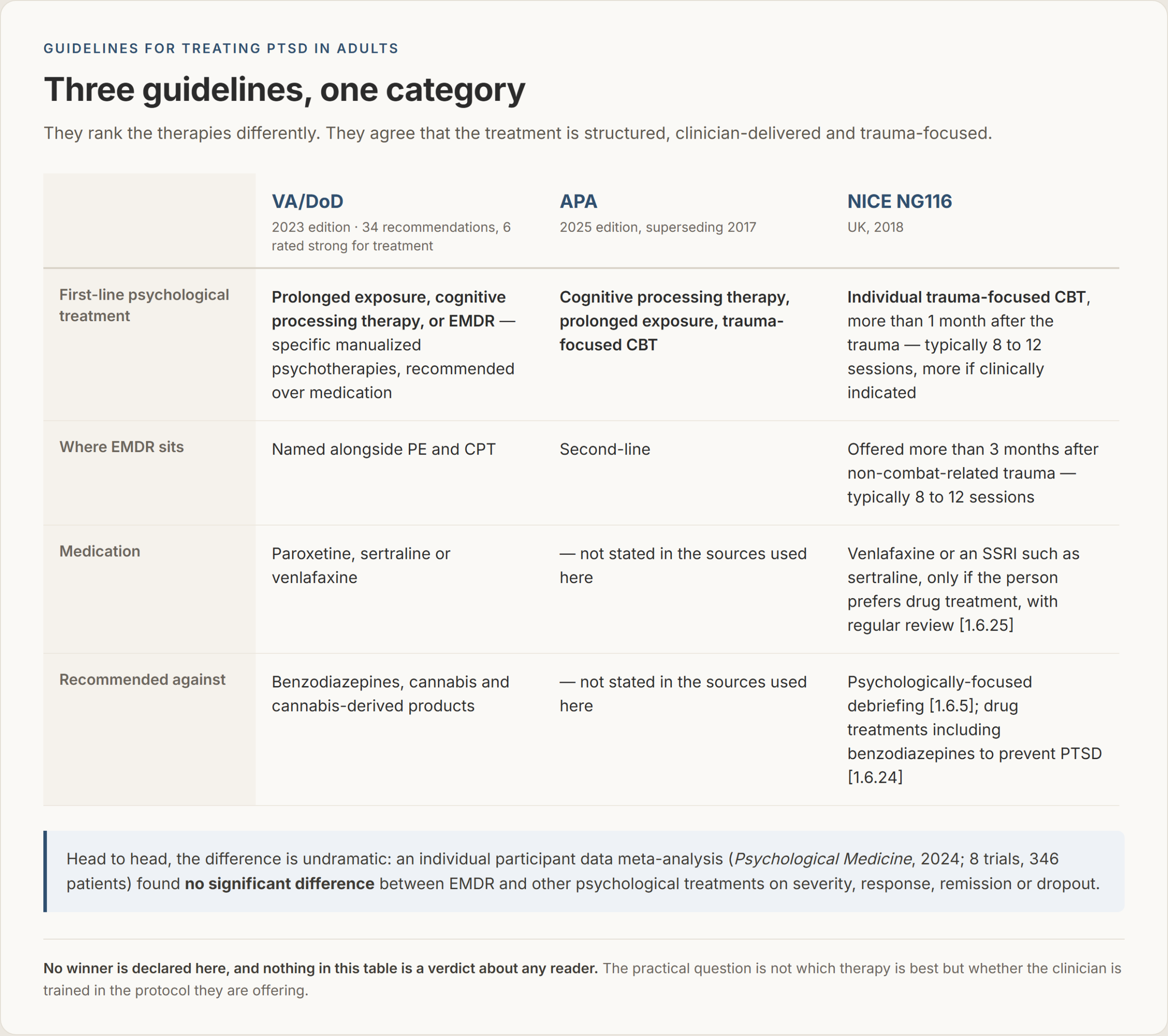
The VA/DoD Clinical Practice Guideline, 2023 edition — 34 recommendations, six of them rated strong for treatment (synopsis in Annals of Internal Medicine, 2024) — recommends the use of specific manualized psychotherapies over medication: prolonged exposure, cognitive processing therapy, or EMDR. It names paroxetine, sertraline or venlafaxine as medication options, supports secure video teleconferencing for delivering validated psychotherapy when other options are unavailable, and recommends against benzodiazepines, cannabis, and cannabis-derived products.
The APA Clinical Practice Guideline, 2025 edition, which supersedes the 2017 version, lists cognitive processing therapy, prolonged exposure and trauma-focused CBT as first-line psychological treatments, with EMDR as second-line. (That list is quoted from a 2025 peer-reviewed critique of the guideline and APA’s own Monitor coverage; the guideline text itself could not be retrieved directly for this article.)
NICE NG116 offers individual trauma-focused CBT to adults presenting more than a month after trauma — typically 8 to 12 sessions, more if clinically indicated, such as after multiple traumas — and offers EMDR to adults presenting more than three months after non-combat-related trauma, also typically 8 to 12 sessions. It says do not offer psychologically-focused debriefing for prevention or treatment [1.6.5], and do not offer drug treatments including benzodiazepines to prevent PTSD [1.6.24]; venlafaxine or an SSRI such as sertraline is a consideration only if the person prefers drug treatment, with regular review [1.6.25].
Where guidelines rank EMDR differently, the head-to-head evidence is undramatic: an individual participant data meta-analysis (Psychological Medicine, 2024; 8 trials, 346 patients) found no significant difference between EMDR and other psychological treatments on symptom severity, response, remission or dropout.
So the practical answer is not “which one is best.” It is: get assessed, and ask whether the clinician is trained in the specific protocol they are offering.
One number about delay, because it is the reason this section exists. In NESARC-III (36,309 US adults, 2012–2013, DSM-5 criteria), among people with lifetime PTSD, 59.4% sought treatment — an average of 4.5 years after onset. For context from a different survey and a different decade: the NCS-R (fielded February 2001 to April 2003, DSM-IV, PTSD assessed in a subsample of 5,692 adults) estimated past-year PTSD at 3.6% of US adults and lifetime at 6.8%. Those two surveys used different diagnostic systems in different decades, so they are not two readings of the same thing — do not average them.
Four and a half years is a long time to be handling this with browser tabs.
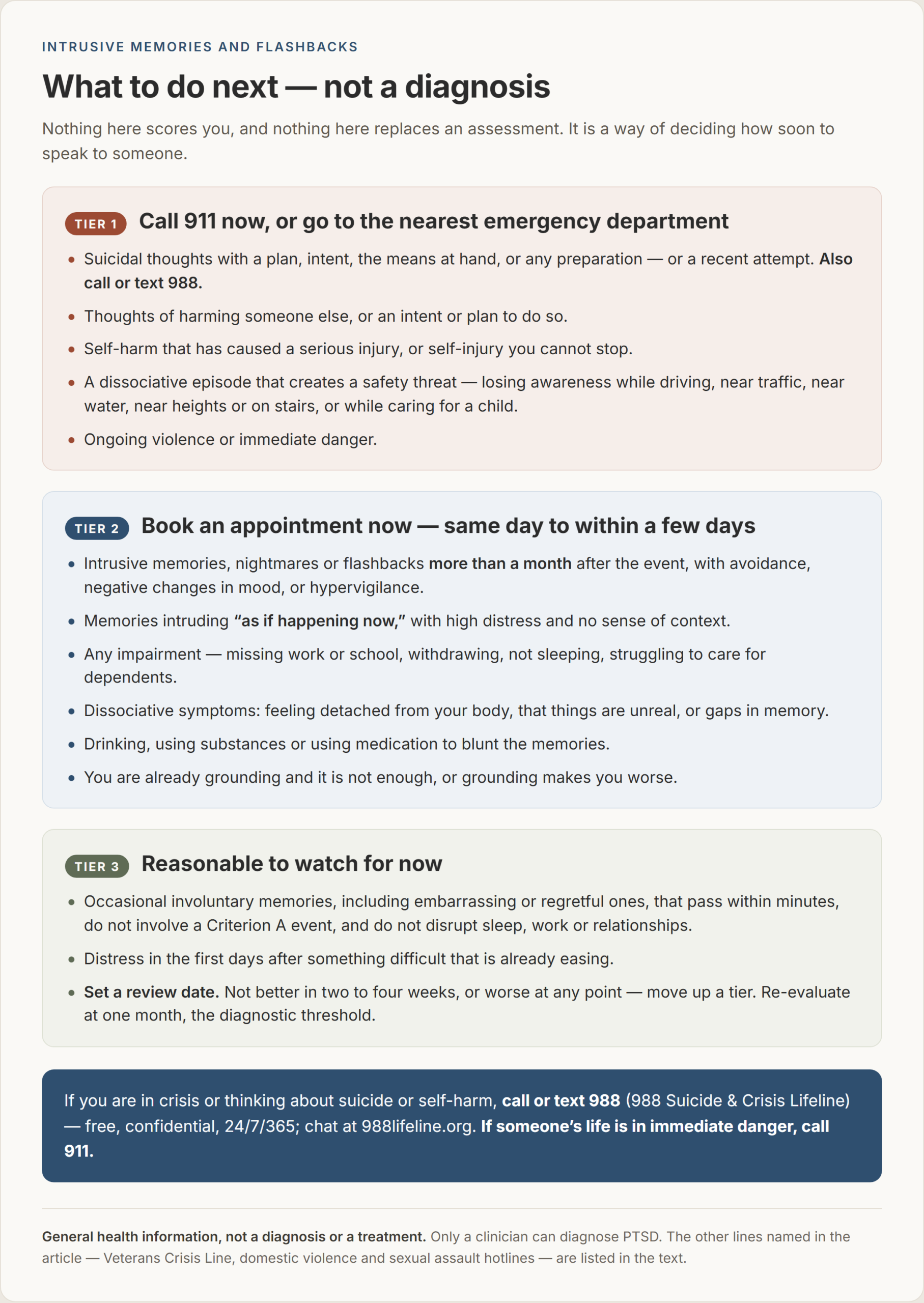
When to get help: three tiers
This is the part to screenshot.
Call 911 now, or go to the nearest emergency department
- Suicidal thoughts with a plan, intent, the means at hand, or any preparation — or a recent attempt. Also call or text 988.
- Thoughts of harming someone else, or an intent or plan to do so.
- Self-harm that has caused a serious injury, or self-injury you cannot stop.
- A dissociative episode that creates a safety threat — losing awareness of your surroundings while driving, near traffic or roadways, near water, near heights or on stairs, or while caring for a child; “coming to” somewhere without knowing how you got there; or a flashback so complete that the person is acting as though the event is happening now and cannot be oriented back to the present.
- Ongoing violence or immediate danger — an active assault, threats with a weapon, being followed or held, or a home that is unsafe right now. Also: National Domestic Violence Hotline 800-799-7233, 24/7; National Sexual Assault Hotline 800-656-4673, 24/7.
- Overdose, poisoning or dangerous intoxication; unresponsiveness, confusion, seizure, or difficulty breathing.
- New chest pain, fainting, or one-sided weakness, facial droop or slurred speech — do not assume it is anxiety. That is a medical emergency until a clinician says otherwise.
- Veterans and service members: dial 988 then press 1, or text 838255.
Book an appointment now — same day to within a few days
- Intrusive memories, nightmares or flashbacks that have persisted more than a month after the event, along with avoidance, negative changes in mood, or hypervigilance. That one-month mark is the DSM-5-TR duration threshold.
- Memories intruding “as if happening now,” with high distress and no sense of context — the features that predicted severity at six months in the assault-survivor study above.
- Any impairment — missing work or school, withdrawing from people, not sleeping, struggling to care for dependents.
- Passive thoughts of death or of not wanting to be here, without a plan. Still same-week care; call or text 988 if it intensifies.
- Dissociative symptoms — feeling detached from your body, that things are unreal, or gaps in memory.
- Drinking, using substances or using medication to blunt the memories.
- Persistent problems with emotion regulation, self-worth and relationships after childhood, prolonged or repeated trauma — the ICD-11 Complex PTSD picture, which usually needs a longer, specialist-led plan.
- A recent trauma within the past month with severe acute symptoms — NICE recommends early individual trauma-focused CBT here [1.6.15], and specifically says not to use psychologically-focused debriefing [1.6.5].
- You are already grounding and it is not enough, or grounding makes you worse. That is information for a clinician, not a reason to try harder alone.
Reasonable to watch for now
- Occasional involuntary memories, including embarrassing or regretful ones, that pass within minutes, do not involve a Criterion A event, and do not disrupt sleep, work or relationships. That is autobiographical memory doing its normal job.
- Distress in the first days after something difficult that is already easing. Most people recover without treatment. Keep sleep, food, routine and contact with people, and re-evaluate at one month, the diagnostic threshold.
- Using brief present-moment anchoring to get through a rough few minutes — reasonable as a coping skill, explicitly not a treatment, with efficacy not yet established in trials.
- Set a review date. If it is not better in two to four weeks, or if it gets worse at any point, move to the second tier. If anything in the first tier appears, act immediately.
The short version
If I compress all of it:
Involuntary memories are normal and happen to healthy people — a 2025 review of 79 studies calls them common and mostly positive in everyday life. What tracked with PTSD severity in assault survivors was not that intrusions occurred (9% of variance) or how often (8%), but their nowness, distress and lack of context (an additional 43%). A cringe or regret memory does not meet DSM-5-TR Criterion A, which gates trauma to actual or threatened death, serious injury or sexual violence — that is not a dismissal of the pain, just a different door to knock on. The “your brain floods you with cortisol” line is not what the cortisol research found: pooled basal cortisol showed no difference (SMD −0.12, 95% CI −0.32 to 0.080; 37 studies, 828 with PTSD versus 800 controls), and salivary cortisol trended lower. What does rise is autonomic arousal, with modest effect sizes, in a literature weighted toward male veterans. No method erases a memory; the clinical propranolol meta-analysis found insufficient evidence to recommend routine use. Grounding is clinical convention that, as of a 2026 critical review, has not been subjected to efficacy studies — a bridge across minutes, not a treatment. And doing exposure to yourself is the part to avoid outright.
What works is structured, clinician-delivered, trauma-focused psychotherapy, typically 8 to 12 or more sessions.
Here is the sentence I wish someone had put in front of me sooner.
The goal was never to make the memory disappear. It is to get the date back on it — so that when it arrives, uninvited, in the checkout line, it arrives as something that happened, not something that is happening.
That is a smaller promise than erasure. It is also the one that treatment can actually keep.
Related reading
- How to Quiet a Racing Mind at Night and Actually Fall Asleep
- Smiling Depression: A Self-Check and Path to Healing
- Highly Sensitive Person (HSP): A Survival Guide, Not a Diagnosis
- Social Anxiety and Public Speaking: Breathing to Calm Down
References
- DSM-5-TR criteria as transcribed in StatPearls, “Posttraumatic Stress Disorder” (NCBI Bookshelf NBK559129); VA National Center for PTSD, “PTSD and DSM-5”
- Brewin CR et al., “A review of current evidence regarding the ICD-11 proposals for diagnosing PTSD and complex PTSD,” Clinical Psychology Review, 2017
- Ehlers A, Clark DM, “A cognitive model of posttraumatic stress disorder,” Behaviour Research and Therapy, 2000
- Michael T, Ehlers A et al., “Unwanted memories of assault: what intrusion characteristics are associated with PTSD?”, Behaviour Research and Therapy, 2005
- “Involuntary autobiographical memories as a transdiagnostic factor in mental disorders,” Clinical Psychology Review, 2025
- Meewisse M-L et al., “Cortisol and post-traumatic stress disorder in adults,” British Journal of Psychiatry, 2007; “Salivary cortisol in post-traumatic stress disorder,” BMC Psychiatry, 2018
- Pole N, “The psychophysiology of posttraumatic stress disorder: a meta-analysis,” Psychological Bulletin, 2007
- “Effects of propranolol on the modification of trauma memory reconsolidation in PTSD patients,” Journal of Psychiatric Research, 2022
- “Building an Operational Definition of Grounding,” Trauma, Violence, & Abuse, 2026
- van Minnen A et al., “Examining potential contraindications for prolonged exposure therapy for PTSD,” European Journal of Psychotraumatology, 2012; “Trauma-focused guided self-help interventions for PTSD,” Depression and Anxiety, 2022
- “Prevalence of the dissociative subtype of post-traumatic stress disorder,” Psychological Medicine, 2022; “EMDR v. other psychological therapies for PTSD,” Psychological Medicine, 2024
- “The paradox of relaxation training: relaxation induced anxiety,” Journal of Affective Disorders, 2019
- VA/DoD Clinical Practice Guideline for PTSD, 2023 edition (synopsis, Annals of Internal Medicine, 2024); APA Clinical Practice Guideline for the Treatment of PTSD in Adults, 2025; NICE NG116 (2018)
- NIMH PTSD statistics (NCS-R, 2001–2003); Goldstein RB et al., NESARC-III, Social Psychiatry and Psychiatric Epidemiology, 2016
- 988 Suicide & Crisis Lifeline (988lifeline.org); Veterans Crisis Line (veteranscrisisline.net); HHS Office on Women’s Health, “Get help”
If you are in crisis or thinking about suicide or self-harm, call or text 988 (988 Suicide & Crisis Lifeline) — free, confidential, 24/7/365; chat is available at 988lifeline.org, and Spanish text and chat are available. Veterans and service members: dial 988 then press 1, or text 838255. If someone’s life is in immediate danger, call 911.
This article is general health information. It is not a diagnosis, not a treatment, and not a substitute for care from a licensed mental health professional. Only a clinician can diagnose PTSD. Nothing here is advice to start, stop or change any medication, and nothing here is an instruction to revisit a traumatic memory on your own. If you are struggling, talk to a clinician.