
IBS and the Gut-Brain Axis: A Low-FODMAP Diet Guide
Let me start with a scene you might recognize. Ten minutes before a big meeting, or an exam, or a flight, and suddenly your stomach turns on you — cramps, an urgent dash to the bathroom, gas, the whole unwelcome production. Nothing you ate explains it. Your gut just seems to know you’re nervous before you fully do.
If that sounds familiar, you’re not imagining the connection. For irritable bowel syndrome, or IBS, that link between the mind and the gut isn’t a side note. It’s the center of the story. IBS is now formally understood as a disorder of gut-brain interaction, and once you see it that way, both the symptoms and the treatments start to make a lot more sense.
What IBS actually is
The National Institute of Diabetes and Digestive and Kidney Diseases (NIDDK) defines IBS as “a group of symptoms that occur together, including repeated pain in your abdomen and changes in your bowel movements” — and crucially, without visible damage to the digestive tract. That last part is important. Your gut can hurt, misbehave, and disrupt your life while looking completely normal under examination.
It’s also common. About 12% of people in the United States have IBS. Women are up to twice as likely as men to have it, and it shows up more often in people under 50. Known risk factors include family history, childhood stress or abuse, and severe digestive-tract infections — the last of which can lead to what’s called post-infectious IBS.
Doctors sort IBS into subtypes: IBS-C (constipation-predominant), IBS-D (diarrhea-predominant), and IBS-M (mixed). Underneath them run a few shared mechanisms — altered gut motility, visceral hypersensitivity (the gut over-reacting to normal signals), increased intestinal permeability, immune activation, and a shifted gut microbiome.
The gut-brain axis: why stress pulls the trigger
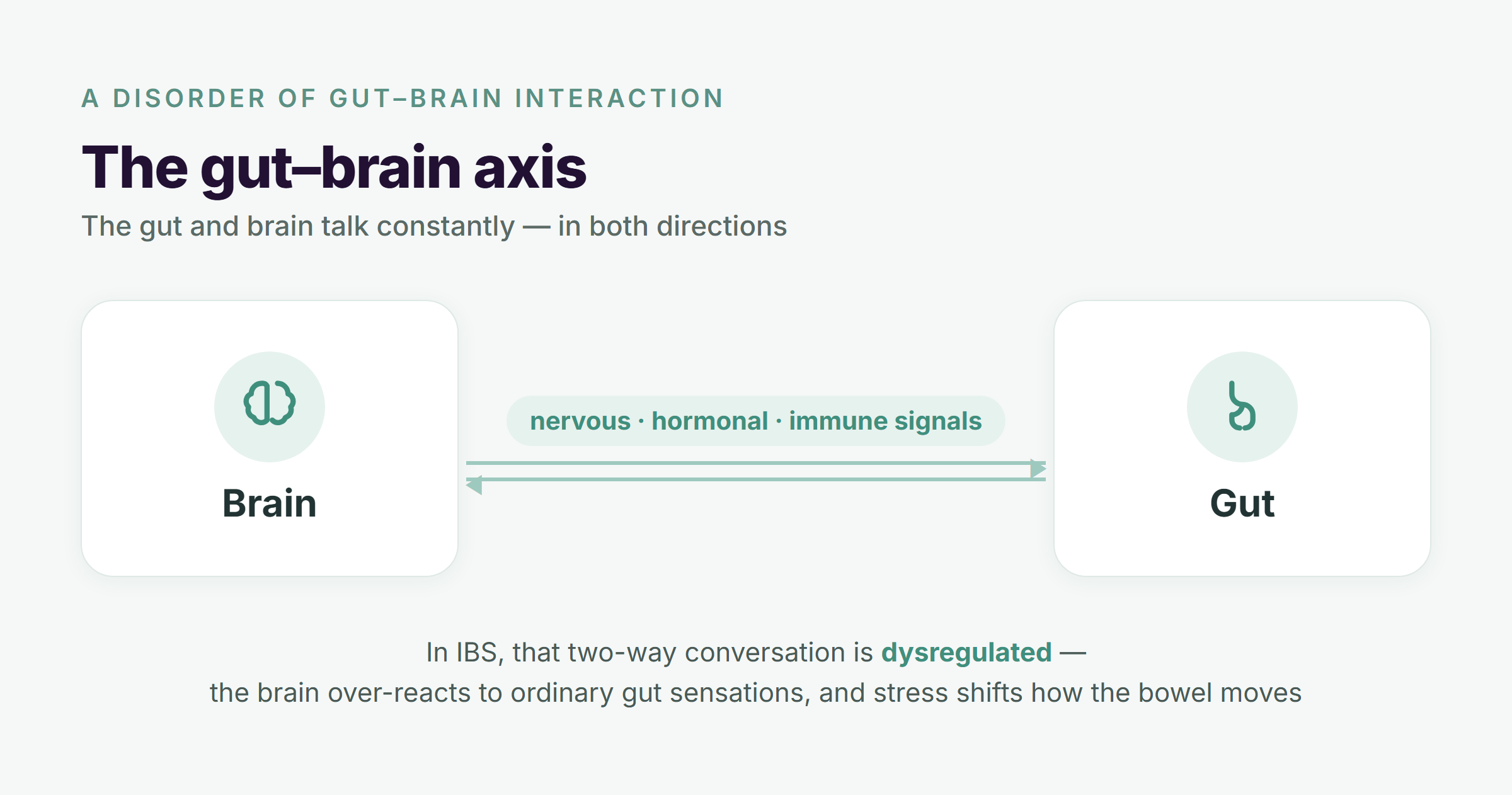
The gut and the brain talk constantly, in both directions, through nervous, hormonal, and immune signals. In IBS, that conversation is dysregulated. The brain over-reacts to ordinary gut sensations, and stress can speed up or slow down the muscle contractions that move things along.
That’s the mechanism behind the pre-meeting scramble. Acute stress modulates gut sensitivity and motility through the gut-brain axis, so an emotional spike can genuinely change how your bowel behaves in the moment.
There’s a heavier layer to this too, and it deserves saying plainly. Up to 40 to 60% of IBS patients also live with psychopathology — particularly anxiety and depression, but also panic, PTSD, and somatization. I want to be careful with that number. It reflects co-occurrence, not proof that psychological illness alone causes IBS. IBS is multifactorial. But it does explain why treating the gut without ever addressing the stress often leaves people stuck.

The low-FODMAP diet, explained honestly
If you’ve searched IBS and diet, you’ve met the acronym FODMAP. It stands for Fermentable Oligo-, Di-, Mono-saccharides and Polyols — a group of carbohydrates that are poorly absorbed, ferment in the gut, and can trigger gas, bloating, pain, and altered bowel habits. The approach was developed and validated at Monash University.
The NIDDK’s dietary guidance leans on it, alongside referral to a registered dietitian. Foods typically reduced on a low-FODMAP plan include certain fruits (apples, pears, mangoes), some vegetables (onions, garlic, mushrooms, beans), dairy, wheat and rye, honey, high-fructose corn syrup, and sugar alcohols like sorbitol, xylitol, and mannitol.
Here’s the part people miss, and it changes everything about how you should approach this. Low-FODMAP is not a permanent diet. It’s a structured, three-phase protocol:
- Elimination — reduce high-FODMAP foods, usually for about 2 to 6 weeks.
- Reintroduction — add foods back methodically to test what you actually tolerate.
- Personalization — settle into a long-term, far less restrictive diet built around your own triggers.
I’ll be blunt about why the phases matter. Several sources caution that a strict low-FODMAP diet can reduce beneficial gut bacteria and isn’t meant for long-term restriction. That’s exactly why the reintroduction and personalization phases — and dietitian oversight — aren’t optional extras. Treat it as a temporary elimination experiment, not a lifestyle.
Two more dietary notes from NIDDK worth keeping:
- Fiber for constipation: adults should aim for 22 to 34 grams a day, with soluble fiber (beans, fruit, oats) generally more helpful for IBS. Add it slowly — about 2 to 3 grams a day — to avoid gas and bloating. Note that insoluble fiber like wheat bran can worsen symptoms for some people.
- A gluten trial can be worth testing even without celiac disease, to see whether symptoms improve.
Does it work? Meta-analyses pooling thousands of patients show the low-FODMAP diet significantly reduces IBS symptom-severity scores and improves quality of life. One 12-week strict trial even reported reductions in fatigue, depression, anxiety, and inattention. Encouraging — as long as it’s done in phases and with guidance.
Treating the brain side too
Diet is only half of the gut-brain equation, and the guidelines say so directly. The ACG Clinical Guideline (2021) recommends gut-directed psychotherapy to treat overall IBS symptoms — including cognitive behavioral therapy adapted for the gut (CBT-GI) and gut-directed hypnotherapy.
Clinicians are advised to consider referral especially for moderate-to-severe or stubborn IBS, prominent anxiety or depression, marked disruption to work and social life, or heavy healthcare use.
Alongside those, the commonly recommended stress-reduction tools are the accessible ones: mindful breathing, meditation, yoga, regular walking or exercise, and consistent sleep habits. They aren’t a soft add-on. They target the gut-brain axis directly, which is the whole point.
So the current best-evidence strategy is a combination — a phased low-FODMAP diet plus stress reduction or behavioral therapy. And I’d underline “combination.” No single method cures IBS. Diet, behavioral therapy, medication, and stress management get layered and personalized, because what settles one person’s gut does little for another’s.

Photo: elena_ sher / Pexels
When to see a specialist
This article is educational and not a substitute for individualized medical advice. If you have persistent abdominal pain and changed bowel habits, see a doctor to confirm the diagnosis and rule out other conditions. IBS is best managed with a gastroenterologist, and low-FODMAP changes should be done with a registered dietitian to avoid over-restriction and nutrient gaps. A mental-health or psychiatry referral is appropriate when anxiety, depression, panic, or high stress are prominent.
And please don’t self-treat these. The following are alarm symptoms that are not typical of IBS and need prompt medical evaluation:
- Rectal bleeding or blood in your stool
- Unintentional weight loss
- Iron-deficiency anemia
- Symptoms that first begin after age 50
- Nighttime symptoms that wake you from sleep
- A family history of colorectal cancer, inflammatory bowel disease, or celiac disease
- Fever
Any of those warrant a workup, not a diet trial.
[Internal link: related post – Stress management and gut health]
What finally helped me make peace with IBS wasn’t a perfect food list. It was letting go of the idea that my gut had betrayed me. It hadn’t. It was just wired tightly to a nervous system that runs hot, and it was telling me the truth about my stress a beat before my mind caught up.
So if your stomach knots up before the big moments, maybe don’t scold it. Feed it thoughtfully, in phases, with help. Breathe. And when the warning signs are the serious kind, listen — because the gut, for all its noise, is usually trying to tell you something worth hearing.
References (research basis): NIDDK/NIH (IBS Definition & Facts; Eating, Diet & Nutrition for IBS); ACG Clinical Guideline: Management of IBS (2021); PMC (Gut-Brain Axis and Psychopathology; umbrella review of low-FODMAP meta-analyses; 12-week low-FODMAP trial; low-FODMAP and microbiome); Monash University (three-phase low-FODMAP protocol).