Lutein vs Astaxanthin: Does Either Help Tired Eyes?
I started this article intending to help you choose between two capsules.
The brief I was handed made three claims, and they are the same three you will meet in almost every eye-supplement aisle. That tired screen eyes and aging near vision are different problems calling for different supplements. That lutein holds macular pigment and prevents age-related macular degeneration, while astaxanthin relieves the strain of the ciliary muscle. And that if your eyes feel dry and tired after a day of screens, astaxanthin is the one to pick if you want to see results.
So the honest version of “lutein vs astaxanthin” turned out not to be a comparison at all. It was a correction.
I went looking for the American primary sources — the National Eye Institute, NCCIH, the FDA and FTC, the American Academy of Ophthalmology, the American Optometric Association, Cochrane, JAMA, NEJM. One claim partly survived. Two did not. And the most quoted number in this entire field, I discovered, is not comparing what almost everyone thinks it is comparing.
Before anything else. This is general health information, not medical advice. It does not diagnose, treat, cure or prevent any disease, and it cannot tell you which condition is causing your symptoms — only a comprehensive eye exam can do that. Nothing here is a reason to delay an appointment, skip a prescription, or treat a vision change as “just aging.” The National Eye Institute’s own phrasing is the one I would keep: consult your doctor or eye care professional about which supplement, if any, is right for you.

Photo: ANTONI SHKRABA production / Pexels
Lutein vs astaxanthin: the three claims, and what the sources did to them
Here are the verdicts first, because that is the useful part.
Claim 1 — “Screen fatigue and aging near vision are different problems, so they need different supplements.” Partly holds.
The first half is correct. The American Optometric Association defines computer vision syndrome, or digital eye strain, as “a group of eye- and vision-related problems that result from prolonged computer, tablet, e-reader and cell phone use,” with a symptom list of “Eyestrain. Headaches. Blurred vision. Dry eyes. Neck and shoulder pain.” Presbyopia is something else entirely — the National Eye Institute calls it “a refractive error” caused by a lens that “gets harder and less flexible” with age.
The second half is where it falls apart. Neither problem has a supplement answer in US primary sources. AAO, verbatim: “There is no way to stop or reverse the normal aging process that causes presbyopia.”
Claim 2 — “Lutein prevents macular degeneration; astaxanthin relieves ciliary-muscle fatigue.” Neither half holds.
NEI answers the first half in one sentence, which I will quote in full below. The second half fails on its own terms: the newest and largest astaxanthin eye-strain trial measured accommodation directly and found no difference from placebo.
Claim 3 — “If your eyes are dry and tired from screens, pick astaxanthin to see results.” Does not hold.
Dry eye’s first line in the US is artificial tears, environment, and an exam. No US authority has evaluated astaxanthin for eye use at all. And “you’ll see results” is not an overstatement in American advertising law — it is a substantiation problem, which is why the FTC expects randomized controlled human trials before a health benefit can be claimed.
“Nutritional supplements cannot prevent AMD” — the federal eye institute’s own sentence
That is a direct quote from the NEI’s own frequently-asked-questions page about the AREDS and AREDS2 trials. Not from a skeptic, not from a journalist. From the institute that funded the trials.
NEI immediately adds its own qualification, and it deserves equal weight: “However, the AREDS/AREDS2 supplements may delay progression of intermediate to advanced AMD and may help you keep your vision longer.”
Read those two sentences together and the whole shape of the evidence appears. There is something here — for a specific group of people who already have a diagnosis.
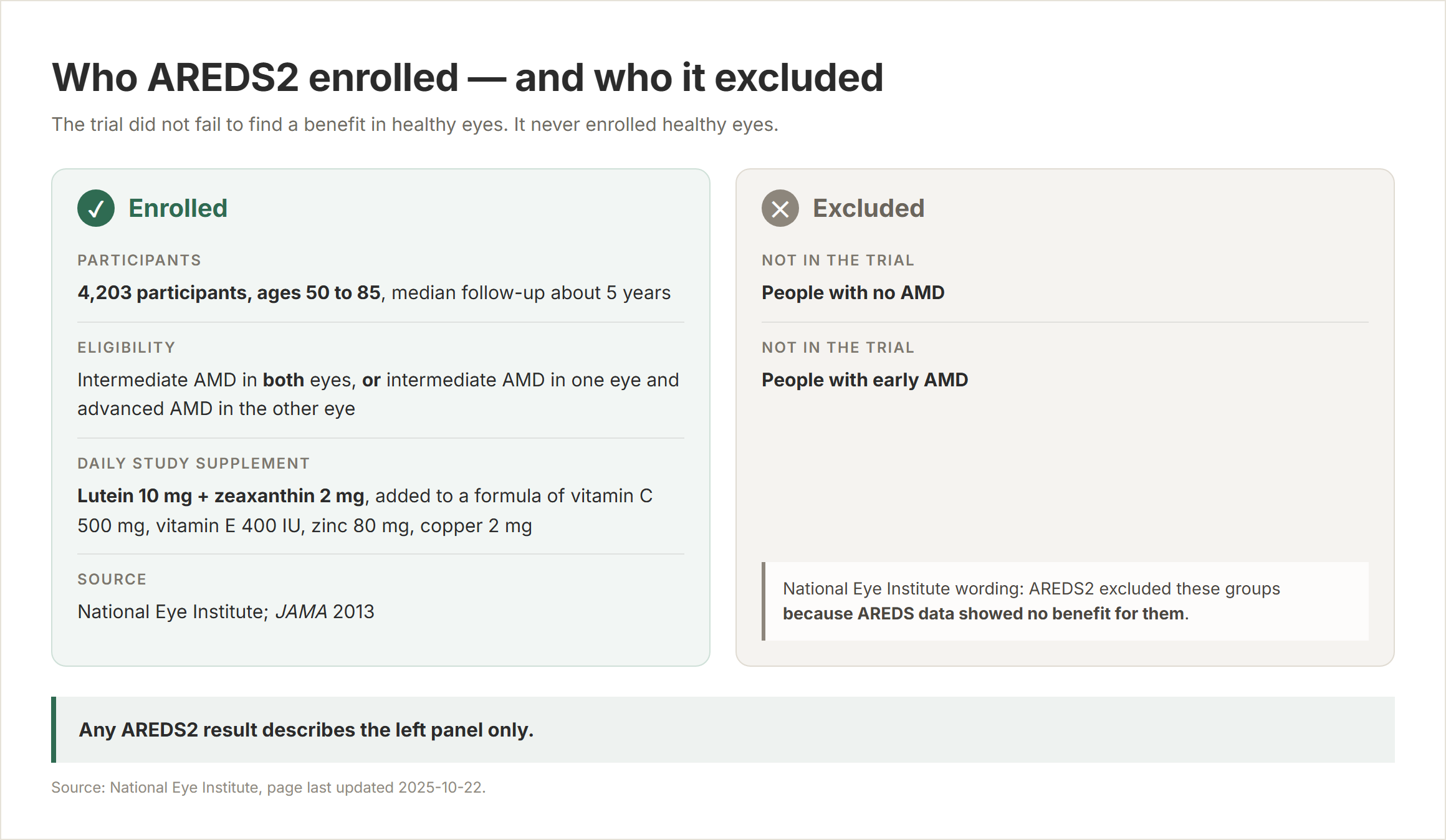
NEI is explicit about who that group is: “In clinical trials, the AREDS and AREDS2 formulas benefited people with intermediate or late AMD. There was no benefit for people with early AMD or for people who do not have AMD.”
And on the trial design itself: “AREDS2 included only people with intermediate AMD in both eyes or intermediate AMD in one eye and advanced AMD in the other eye. AREDS2 excluded people without AMD or with early AMD because AREDS data showed no benefit for these individuals.”
That last sentence is the one I would tape to the shelf. The trial did not fail to find a benefit in healthy eyes. It never enrolled healthy eyes, because the earlier trial had already looked.
The primary endpoint was null
The AREDS2 trial itself (JAMA 2013) enrolled 4,203 participants aged 50 to 85, all with intermediate AMD in both eyes or intermediate in one plus advanced in the other, and followed them for a median of about five years on lutein 10 mg plus zeaxanthin 2 mg daily.
Progression to advanced AMD: hazard ratio 0.90 (98.7% CI 0.76–1.07; P=.12). Not statistically significant. The omega-3 arm was HR 0.97 (0.82–1.16; P=.70), and both together HR 0.89 (0.75–1.06; P=.10).
The authors’ own conclusion, verbatim: “Addition of lutein + zeaxanthin, DHA + EPA, or both to the AREDS formulation in primary analyses did not further reduce risk of progression to advanced AMD.”
Cochrane, twice, with denominators
Cochrane has looked at this literature from both directions, and the distinction between the two reviews matters more than either result.
The 2012 review asked about preventing AMD — 4 randomized trials, 62,520 people. On lutein specifically, verbatim: “There is no evidence with respect to other antioxidant supplements, such as vitamin C, lutein and zeaxanthin, or any of the commonly marketed multivitamin combinations.” For vitamin E and beta-carotene, which had been studied in prevention, the pooled result was RR 0.98 (95% CI 0.89–1.08) for any AMD and RR 1.05 (0.80–1.39) for advanced AMD.
“No evidence” means the trials have not been done. It does not mean “proven useless,” and I want to be careful not to upgrade it.
The 2023 review asked about slowing progression — 26 studies, 11,952 people aged 65 to 75. Lutein and zeaxanthin versus placebo: progression to late AMD RR 0.94 (95% CI 0.87–1.01), neovascular AMD RR 0.92 (0.84–1.02), geographic atrophy RR 0.92 (0.80–1.05), loss of 15 letters or more RR 0.98 (0.91–1.05) — all rated low-certainty, from a single study of 4,176 participants.
The combination that did clear the bar in that review was the original AREDS antioxidant-plus-zinc formula versus placebo: late AMD OR 0.72 (95% CI 0.58–0.90), moderate-certainty, with an absolute effect of roughly 4 fewer cases per 1,000 in early AMD and 78 fewer per 1,000 in intermediate AMD.
Notice which ingredient that was, and which it was not.

Photo: Sóc Năng Động / Pexels
Four percentages, four different comparisons
This is the part I would rewrite the entire internet over, if I could.
Four numbers circulate from these trials, and they are quoted interchangeably, as though they were four measurements of the same thing. They are not. 25%, 18%, 26% and 32% each have a different comparison group and a different population — all of them people who already had AMD — and not one of them was measured against taking nothing. Two of the four are post hoc subgroups.
Here is each of them with its conditions attached.
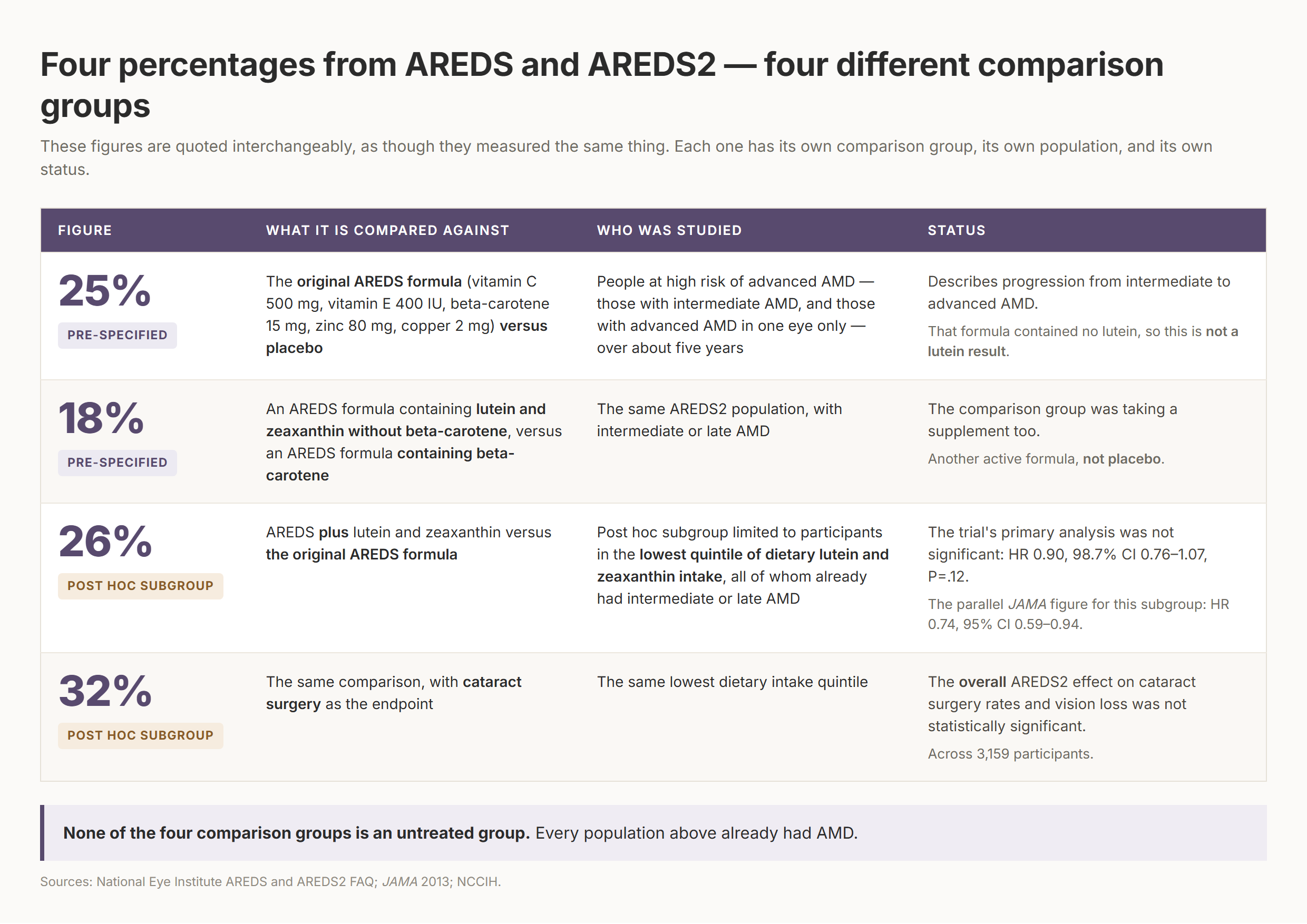
The 25% figure belongs to the original AREDS formula versus placebo — vitamin C 500 mg, vitamin E 400 IU, beta-carotene 15 mg, zinc 80 mg, copper 2 mg. NEI attaches it to reduced “progression from intermediate to advanced AMD” in “people at high risk for developing advanced AMD—those with intermediate AMD, and those with advanced AMD in one eye only,” over roughly five years.
That formula contained no lutein. The 25% is not a lutein number and not a prevention number, and it is the single most common misattribution in this field.
The 18% figure compares one active formula against another. NEI, verbatim: “participants who took an AREDS formulation containing lutein + zeaxanthin lacking beta-carotene had an 18% lower risk of progressing to advanced AMD compared with those who took AREDS containing beta-carotene.” The comparison group was taking a supplement too.
The 26% figure needs all four of its conditions in the same breath. It is a post hoc subgroup limited to participants in the lowest quintile of dietary lutein and zeaxanthin intake, who already had intermediate or late AMD, compared against the original AREDS formula rather than placebo — inside a trial whose primary analysis was not statistically significant (HR 0.90, 98.7% CI 0.76–1.07, P=.12). NEI’s own wording: “Among participants who had the lowest dietary intake of lutein and zeaxanthin, those who took AREDS with lutein + zeaxanthin had a 26% lower risk of progressing to advanced AMD compared to participants taking the original AREDS formula.” In JAMA the parallel lowest-quintile figure is HR 0.74 (95% CI 0.59–0.94).
The 32% figure is the same subgroup, with cataract surgery as the endpoint. Worth knowing alongside it: the overall AREDS2 effect on cataract surgery rates and vision loss was not statistically significant across 3,159 participants. And NEI answers the cataract question outright — “Will the AREDS/AREDS2 formulations help prevent cataract? No.“
Read the table one more time and the subgroup finding starts to say something different from what it is usually used to sell. The signal appeared in people eating the least of these nutrients. There was no signal in people already eating them.
What lutein’s verified job actually is
Here is the part that genuinely surprised me, because it is a real finding and almost nobody markets it.
Lutein’s documented role in the US evidence base is as beta-carotene’s safer stand-in inside a formula for people who already have AMD.
AREDS2 Report 28 (JAMA Ophthalmology 2022) followed 3,882 participants, mean age 72.0 ± 7.7, for 10 years. Lung cancer odds were OR 1.82 (95% CI 1.06–3.12; P=.02) for beta carotene, against OR 1.15 (95% CI 0.79–1.66; P=.46) for lutein and zeaxanthin. Late AMD progression for lutein/zeaxanthin versus none was HR 0.91 (95% CI 0.84–0.99; P=.02).
NEI puts the same signal in plain counts: lung cancers in 2% of participants taking an AREDS formulation with beta-carotene versus 0.9% without, and about 91% of those who developed lung cancer were former smokers. Its formula table carries the footnote “Not recommended for current or former smokers” on the beta-carotene version. NCCIH, by contrast: “Lutein and zeaxanthin appear to be safe regardless of smoking status.”
So lutein earned its place by being the less hazardous ingredient in a treatment for diagnosed disease. That is a safety upgrade, not a prevention story — and it is still a formula for people with intermediate or late AMD.
For anyone who is a current or former smoker, I would add the thing NEI puts at the very top of its own risk-lowering list: “Quit smoking — or don’t start.” Then physical activity, blood pressure and cholesterol, and leafy greens and fish. The capsule is not on that list at all.
Macular pigment density is a measurement, not an outcome
“Raises macular pigment optical density” appears constantly in marketing, and it is a real, measurable thing. It is also a surrogate.
A 2021 systematic review and meta-analysis in Eye pooled 22 studies in adults with healthy eyes and found correlations only: contrast sensitivity at 30 minutes of arc r 0.37 (95% CI 0.15–0.56), photostress recovery at 30′ r −0.57 (−0.78 to −0.24), glare disability at 30′ r 0.47 (0.32–0.59). Other visual functions had too little data to pool.
Correlation between a pigment reading and a visual test is not the same as a supplement improving sight. I would not let the pigment number carry a promise it never made.
Food first, and what that does and does not mean
The food part is easy to say and hard to oversell.
AAO lists lutein and zeaxanthin in “leafy green vegetables like kale, spinach, collard greens, and Swiss chard… Broccoli, asparagus, and colorful fruits like raspberries, papaya, peaches, and mangoes,” and omega-3 in “oily fish like salmon, trout and sardines.” AOA adds broccoli, corn, peas, persimmons and tangerines. Astaxanthin occurs naturally in salmon, shrimp, lobster and microalgae.
I am deliberately not printing milligrams per serving, because I could not verify per-food figures against a primary database and I would rather leave a gap than invent one.
On supplements versus food, the Institute of Medicine’s 2000 report set no Tolerable Upper Intake Level for carotenoids and proposed no dietary reference intake for them, concluded that beta-carotene supplements are “not advisable” other than as a provitamin A source for at-risk populations, and stated that “existing recommendations for increased consumption of carotenoid-rich fruits and vegetables are supported.” No UL cuts both ways: there is no established safe ceiling, and no evidence that exceeding trial doses adds anything.

Photo: Denys Gromov / Pexels
Astaxanthin: two trials, both manufacturer-linked, and no US assessment
I want to state this next part exactly, because it is easy to get wrong in either direction.
No independent US federal assessment of astaxanthin for eye fatigue was found. NCCIH’s professional clinical digest “Dietary Supplements for Eye Conditions: What the Science Says” (August 2024) works through AMD, cataract, dry eye and glaucoma in detail, naming vitamins C and E, beta-carotene, zinc, lutein and zeaxanthin, omega-3, Ginkgo biloba, Fructus lycii, vitamin B12, selenium and cannabinoids. Astaxanthin appears zero times. NCCIH has no astaxanthin topic page — the URL returned HTTP 404 when checked on 2026-09-21. No NIH Office of Dietary Supplements fact sheet for it was located. No Cochrane review of astaxanthin for eye fatigue exists. A PubMed search for astaxanthin AND asthenopia returns three records in total.
That is an absence of assessment. It is not a finding of no effect, and I am not going to convert it into one.
The newest trial was in 64 children, and its objective endpoint was null
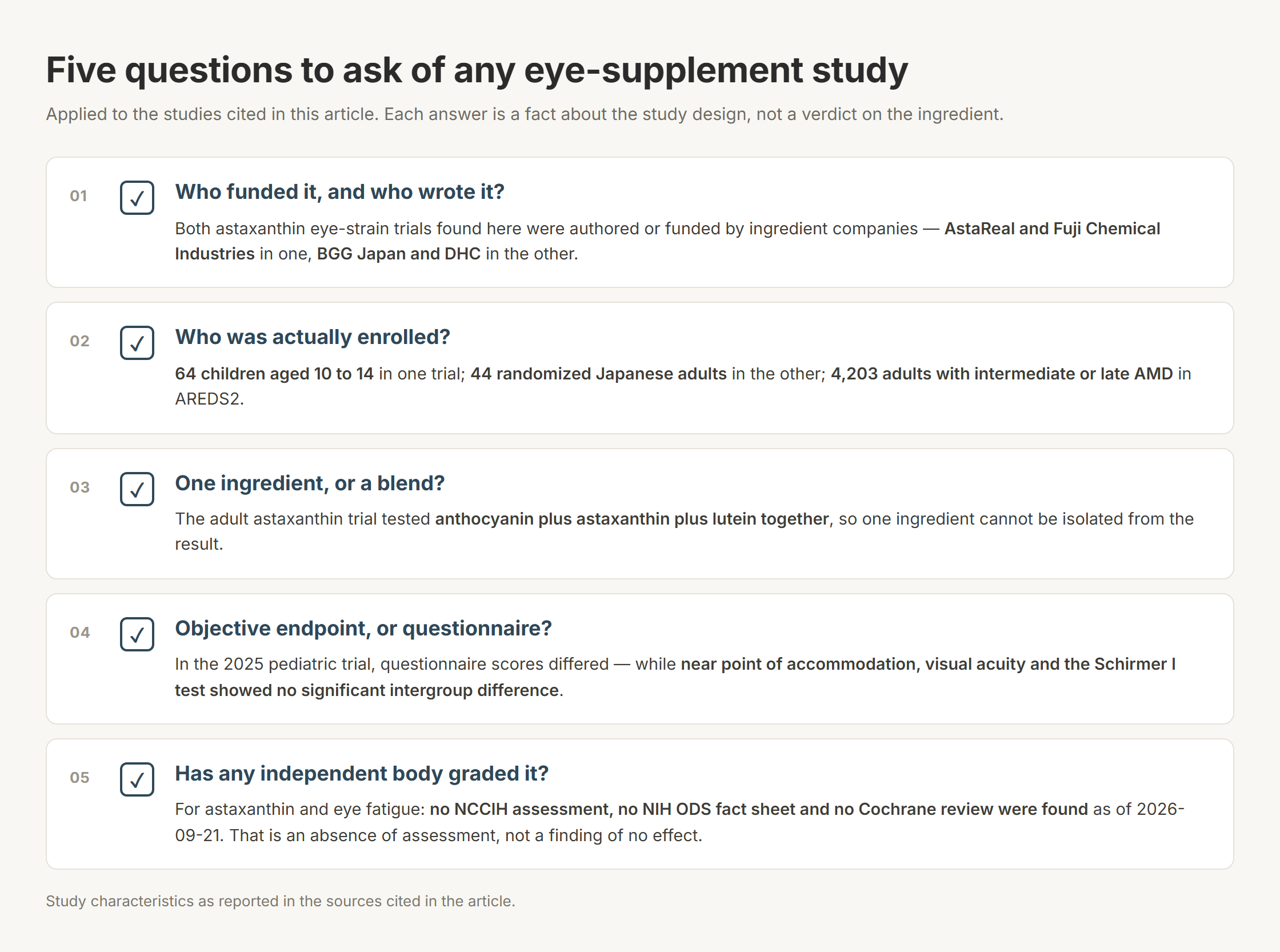
The most cited recent study is an RCT in Advances in Therapy (2025): 64 children aged 10 to 14, mean age about 11.5, all with at least four hours of daily screen time and a computer-vision-syndrome questionnaire score of 8 or higher and under 19, randomized double-blind to astaxanthin 4 mg/day for 84 days or placebo.
Subjective scores did move. CVS-Q change was −4.00 ± 4.05 versus −1.72 ± 3.61 on placebo, described by the authors as “a 20% between group difference,” and a visual fatigue Likert scale read 11.55 ± 5.78 versus 15.78 ± 7.12 (p=0.01). Stereopsis and pupillary light reflex also improved.
Then the sentence the marketing never quotes, verbatim: “with no significant intergroup difference in the Schirmer I test, visual acuity, spherical equivalence, near point of accommodation, near exphoria, immune markers, or safety variables.”
Near point of accommodation is the objective measure of focusing effort. It is precisely the endpoint the “ciliary muscle” story rests on, and it did not move.
Two more things travel with this trial every time it is cited. The authors are from AstaReal Inc., AstaReal India, AstaReal Pte Ltd and Fuji Chemical Industries — the astaxanthin manufacturer and distributor — with the contract research organization Vedic Lifesciences. And the participants were children aged 10 to 14, not the adult office worker most readers of this article actually are.
The adult study cannot isolate astaxanthin at all
The other frequently cited trial (Journal of Clinical Biochemistry and Nutrition, 2021) randomized 44 healthy Japanese adults, with an efficacy analysis of 20 per group, to capsules containing anthocyanin plus astaxanthin plus lutein twice daily for six weeks. It reported improvement in pupillary response ratio around visual display terminal work and in two subjective items. Funding and authorship trace to BGG Japan and DHC — the ingredient and product companies — with ORTHOMEDICO contracted.
It was a three-ingredient combination product. Whatever happened, astaxanthin’s own contribution cannot be separated out of it.
Reviewers describe the field the same way. A 2025 systematic review in Nutrients (9 RCTs, PROSPERO-registered, Cochrane risk-of-bias 2) found carotenoids including astaxanthin associated with modest benefits such as pigment density increases and reduced visual fatigue, with the verbatim caveat that “Trials were generally small, heterogeneous, and short in duration.” A 2020 narrative review in Marine Drugs concluded that “further long-term clinical trials are warranted in order to define appropriate dosage, route of administration and exact composition of the final product” — meaning the appropriate dose is not settled, so no milligram figure on a bottle can honestly be called a recommended amount.
“Relaxes the ciliary muscle” is a hypothesis wearing a mechanism’s clothes
Sustained ciliary contraction during close work is a genuine textbook explanation for near-work fatigue. Accommodative asthenopia is a real clinical concept.
But no human trial located shows astaxanthin acting on that muscle, and the one trial that measured accommodation directly found no difference from placebo. There is a regulatory echo here too: 21 CFR 101.93(f) permits a supplement statement to characterize the “documented mechanism” by which an ingredient works. A mechanism that fails its own objective endpoint is not documented.
The defensible sentence is the narrow one. Ciliary strain is one proposed explanation for near-work fatigue; whether astaxanthin acts on that muscle in humans has not been established.
Two places where US sources disagree with each other
Balanced reporting means showing the seams, and there are two.
Early AMD. NEI is flat: “There was no benefit for people with early AMD or for people who do not have AMD.” AAO’s patient page says the AREDS 2 vitamins “are often recommended for people with early to intermediate AMD who are at risk of developing advanced AMD.” Both are current US sources, and they do not agree.
I would resolve toward the trial fact — AREDS2 enrolled only intermediate and late disease — while noting that AAO’s framing reflects clinical judgment about drusen burden. AAO itself adds that the vitamins are “most likely to help people who have a lot of drusen.” Which is a reason to let an ophthalmologist look at your retina rather than let either sentence decide for you.
Geographic atrophy. AAO’s diet page quotes Dr. Emily Chew saying the latest research shows AREDS2 can help people with geographic atrophy slow loss of central vision “by as much as 35%.” An AAO news release dated October 20, 2025 then reports an analysis of more than 1,200 untreated eyes from the OAKS and DERBY trials finding no significant effect of AREDS or AREDS2 supplementation on geographic atrophy progression, “directly contradicting the Keenan analysis,” with the investigator quoted: “Until there’s more data like from a prospective randomized clinical study, we don’t know if antioxidants and macular pigments like lutein have beneficial effects on geographic atrophy.”
Both of those sit inside the same organization’s own content, eight months apart. So the honest status of the 35% figure is unsettled, and I would not quote it without the October 2025 analysis attached to it.
What the US actually recommends for dry, tired screen eyes
This is where the article stops being about capsules, because the American guidance simply is not about capsules.
Start with the reassurance, because it is the most useful thing AAO says. Verbatim: “You may have heard that looking at a computer, smartphone, or other digital screen for long periods of time will permanently damage your eyes. Thankfully, this is not true.“ And then, just as verbatim: “However, it is true that your eyes may feel uncomfortable if you stare at your screen too long.”
The mechanism AAO points to is unglamorous. “Humans normally blink about 15 times in one minute. However, studies show that we only blink about 5 to 7 times in a minute while using computers and other digital screen devices.”
AAO’s page then gives seven practical steps, and not one of them is a supplement: blink consciously; use artificial tears and a humidifier in dry warm rooms; look at a distant object periodically; consider computer eyeglasses for the intermediate working distance of “about 20-26 inches away from your face” — with AAO’s own caveat that these are “not the same as ‘blue light blocking’ glasses”; match screen brightness to the room and raise contrast; use a matte filter for glare; and sit about 25 inches from the screen with your gaze slightly downward.
AOA’s page on computer vision syndrome mentions no supplement or vitamin anywhere either. Its treatment list is an eye exam, corrective or computer-specific lenses, vision therapy where a focusing or eye-teaming problem exists, and changes to the workstation, lighting, breaks and blinking. For scale, AOA notes that “The average American worker spends seven hours a day on the computer either in the office or working from home,” and that greatest risk falls on people spending “two or more continuous hours“ daily at a screen — while also reassuring that many of these symptoms are “only temporary and will decline after stopping computer work.”
Yes, 20-20-20 is a real US recommendation — and the one trial of its numbers was null
I want to write both halves of this, because most articles pick one.
AOA recommends the rule in as many words: “To help alleviate digital eyestrain, follow the 20-20-20 rule; take a 20-second break to view something 20 feet away every 20 minutes.” AOA also advises “Resting the eyes for 15 minutes after two hours of continuous computer use,” and sets the workstation at 15 to 20 degrees below eye level and 20 to 28 inches from the eyes.
Then there is the experiment that tested the actual numbers. Optometry and Vision Science (2023), titled “20-20-20 Rule: Are These Numbers Justified?”, put 30 young participants through a 40-minute cognitively demanding tablet reading task with 20-second breaks scheduled every 5, 10, 20 or 40 minutes in a crossover design. Symptoms rose in all four conditions (P<.001), but verbatim: “there was no significant effect of scheduled breaks on reported symptoms (P = .70), reading speed (P = .93), or task accuracy (P = .55).” The authors concluded that “these results do not support the proposal of using 20-second scheduled breaks as a therapeutic intervention for digital eye strain.”
Two limits belong with that. It is one small study — 30 young adults, a single 40-minute task. And what it tested was the specific numbers, not the general idea of looking away and blinking.
So the fair synthesis is narrow and slightly deflating. The direction — look away from near work regularly, blink on purpose — is what every US body agrees on. The precise 20/20/20 figures are a memorable convention, not a validated dose.

Photo: Mikhail Nilov / Pexels
Dry eye’s first line is tears and environment, not a capsule
Nearly 16.4 million Americans have dry eye, per NEI, and NEI says plainly that it “can happen if you spend a lot of time looking at your computer, tablet, or smart phone.”
NEI’s treatment ladder runs: over-the-counter artificial tears first, then prescription cyclosporine (Restasis) or lifitegrast (Xiidra), alongside lifestyle changes — avoid smoke, wind and direct air conditioning, run a humidifier, “Limit screen time and take breaks from staring at screens,” wraparound sunglasses, water, seven to eight hours of sleep — then punctal plugs, and rarely eyelid surgery. Lutein and astaxanthin do not appear on that page. Nutrition appears only as risk factors for not getting enough vitamin A or omega-3 fatty acids.
Which brings us to the strongest American argument that supplements are not the first move here, and it is not about carotenoids at all.
DREAM (NEJM 2018) was the definitive US trial of omega-3 for dry eye: 535 randomized — 349 to active, 186 to placebo, with 329 and 170 in the primary analysis — taking 3,000 mg/day of fish-derived EPA and DHA versus an olive-oil placebo, in patients with moderate-to-severe dry eye. The primary outcome was the change in OSDI symptom score averaged at 6 and 12 months. Verbatim: “The mean change in the OSDI score was not significantly different between the active supplement group and the placebo group (−13.9 points and −12.5 points, respectively; mean difference in change after imputation of missing data, −1.9 points; 95% CI, −5.0 to 1.1; P=0.21).” It was funded by the National Eye Institute.
NCCIH adds the prevention half: a 2022 randomized trial of 23,523 adults without dry eye disease taking 1 g/day of marine omega-3 for a median of 5.3 years found no significant effect on the incidence of diagnosed dry eye or on reported symptoms.
Both groups in DREAM improved by roughly 13 points, which tells you something about symptom scores and about attention and about time. If the most-studied eye supplement in America came out null in the best-designed American trial for exactly the symptom readers want fixed, a carotenoid with two manufacturer-linked trials is not a shortcut. If you do use fish oil for other reasons, the practical quality questions are covered in Omega-3 Gone Rancid? How to Choose and Spot Bad Fish Oil.
Presbyopia: where US labeling law is more permissive than the evidence
This section exists because of a genuinely counterintuitive piece of American regulation, and because I think it gets weaponized.
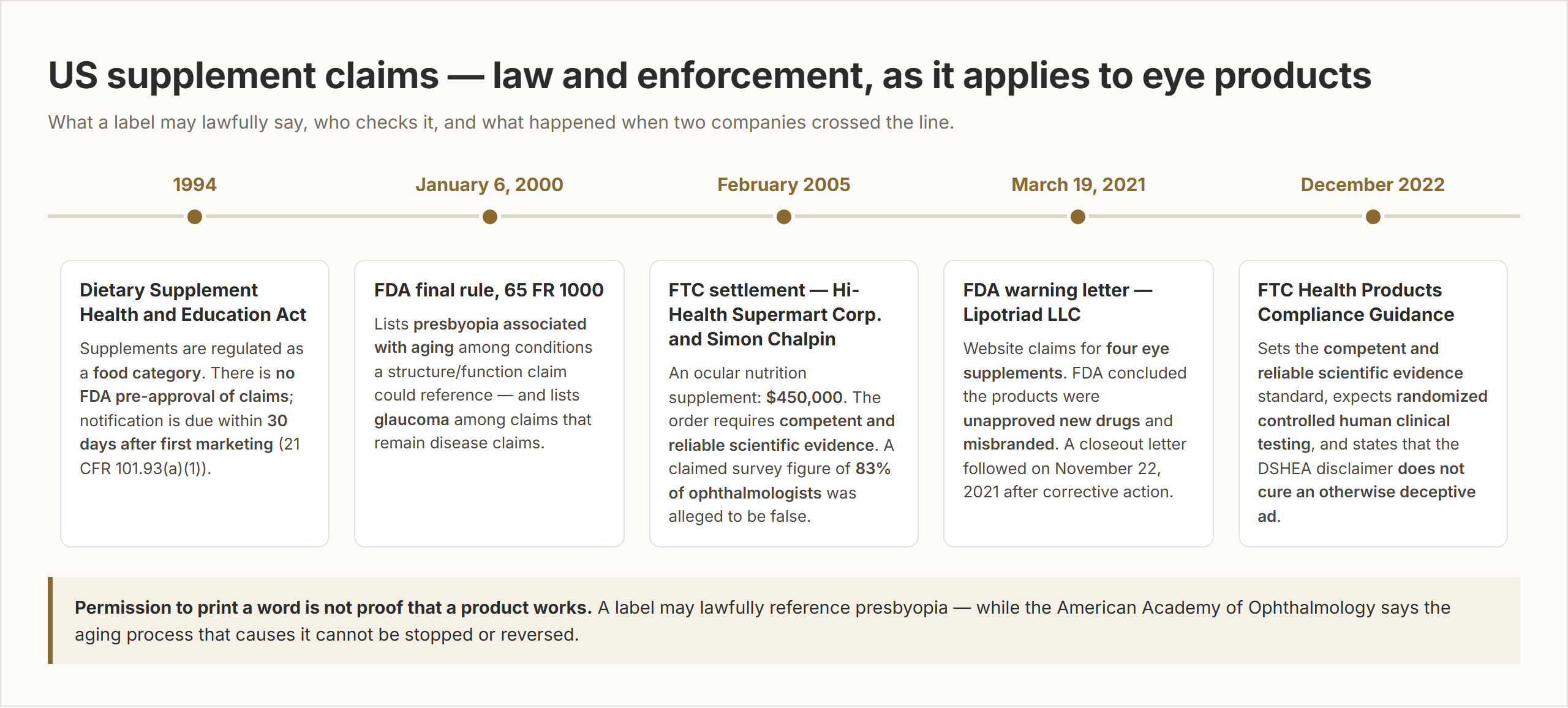
FDA’s final rule on structure/function claims (65 FR 1000, January 6, 2000) lists, among conditions about which such claims could be made: “(7) presbyopia (inability to change focus from near to far and vice versa) associated with aging.” The same rule lists “(6) glaucoma“ among claims that “would remain disease claims.”
So a US supplement label may lawfully reference presbyopia. It may not reference glaucoma, AMD or dry eye disease the same way.
And in the same breath, AAO: “There is no way to stop or reverse the normal aging process that causes presbyopia.”
Those two sentences belong together permanently. Permission to say a word is not proof that a product works. A perfectly compliant US label can gesture at aging near vision while the ophthalmologists’ own body says the process cannot be stopped or reversed.
What presbyopia actually is, per NEI: a refractive error, because “the lens in your eye gets harder and less flexible, and it stops focusing light correctly on the retina.” It arrives “usually after age 45,” worsens over time, and “usually stops getting worse after age 65.” NEI’s treatment section lists holding material farther away, large print, brighter reading light, and then glasses or contact lenses. No supplement, no nutrient.
AAO adds the newer options: “Prescription eye drop medications (pilocarpine hydrochloride or aceclidine ophthalmic solution) are now available to treat presbyopia. These drops work by reducing the size of your pupils… effective for up to six hours and you need to use them every day.” The FDA records: pilocarpine HCl 1.25% (VUITY), NDA 214028, approved 2021, and aceclidine 1.44% (VIZZ), NDA 218585, approved July 31, 2025.
The United States has drugs for presbyopia, optics for presbyopia, and surgery for presbyopia. It has no nutrient for presbyopia. Someone who buys a carotenoid because small print got blurry has skipped the refraction that could fix it in one visit — and, worse, may have filed early cataract or AMD under “just getting older.”
How US supplement claims actually work — and what happened when two companies crossed the line
I expected this to be the dry section. It turned out to be the most concrete one.
Under the Dietary Supplement Health and Education Act, FDA does not review or approve supplement claims before a product goes on sale. FDA’s own words: structure/function claims “are not pre-approved by FDA, but the manufacturer must have substantiation that the claim is truthful and not misleading.” Under 21 CFR 101.93(a)(1), the manufacturer notifies FDA “no later than 30 days after the first marketing” — after the bottle is already selling.
In exchange, every such label must carry this exact sentence, from 21 CFR 101.93(c)(1):
“This statement has not been evaluated by the Food and Drug Administration. This product is not intended to diagnose, treat, cure, or prevent any disease.”
It must be boldface and no smaller than one-sixteenth of an inch (101.93(e)), adjacent to or asterisk-linked to the claim (101.93(d)). That sentence is not boilerplate. It is the deal.
Cross the line and the category changes. 21 CFR 101.93(f), verbatim: if a supplement’s labeling bears a disease claim, “the product will be subject to regulation as a drug“ unless it qualifies as an authorized health claim. And “disease” is defined broadly in (g)(1) as “damage to an organ, part, structure, or system of the body such that it does not function properly… or a state of health leading to such dysfunctioning.” AMD, cataract, glaucoma and dry eye disease all sit inside that definition. Subsection (g)(2) then catches claims that a product has an effect on a specific disease or on its characteristic signs or symptoms, or that it substitutes for or augments a therapy.
Two enforcement cases, with names and dates
On March 19, 2021, FDA sent a warning letter to Lipotriad LLC covering four eye supplements — Lipotriad Visionary, Lipotriad Adult 50+, Lipotriad Dry Eye and Lipotriad Vision Support Plus. Among the website statements FDA quoted as drug claims were the assertion that the products prevent macular degeneration, an invitation to “start taking vitamins to help fight against eye diseases,” the line “reduces dry eye symptoms,” and lutein and zeaxanthin claims to “protect the macula and filter out harmful blue rays.” FDA’s conclusions, verbatim: the products “are not generally recognized as safe and effective for the above referenced uses and, therefore, the products are ‘new drugs‘” and are “misbranded.” FDA issued a closeout letter on November 22, 2021, after corrective action.
Notice which two phrases FDA pulled. They are two of the most common sentences in eye-supplement copy, and they are precisely the two claims this article has spent its length taking apart. That is not a coincidence — NEI’s flat “Nutritional supplements cannot prevent AMD” and FDA’s enforcement position are looking at the same evidence.
Earlier, in February 2005, the FTC settled with Hi-Health Supermart Corp. and Simon Chalpin for $450,000 over an ocular nutrition product. The FTC alleged unsubstantiated claims that it could “restore vision already lost from age-related macular degeneration and eliminate small specks moving in the field of vision (called ‘floaters’),” and that respondents “falsely claimed that a study shows that 83 percent of ophthalmologists recommend or prescribe” it for AMD and cataracts. The order bars those vision-restoration and floater claims absent competent and reliable scientific evidence.
The FTC’s bar is the other half of the frame. Its Health Products Compliance Guidance (December 2022) states, verbatim: “As a general matter, substantiation of health-related benefits will need to be in the form of randomized, controlled human clinical testing to meet the competent and reliable scientific standard.” And, pointedly: “the DSHEA disclaimer or similar statements won’t cure an otherwise deceptive ad.”
Which is why “pick astaxanthin and you’ll see results” is not merely enthusiastic. It is a promise with no US-recognized evidence behind it, and adding fine print does not fix it.
And if you are already taking something, the stacking is the real risk
The AREDS2 formula is not a gentle multivitamin. It contains zinc 80 mg and vitamin E 400 IU daily, against an RDA for vitamin E in adults over 14 of 22.4 IU. Copper 2 mg is in there specifically to reduce the risk of copper deficiency anemia from all that zinc.
NEI notes that AREDS and AREDS2 saw no adverse effects at 400 IU/day, but also that vitamin E “can interact with some medications, including blood thinners, chemotherapeutic agents, and lipid-lowering drugs,” and that NEI recommends consulting a health care provider before taking vitamin E or other nutritional supplements. NEI adds that high-dose supplements “can sometimes interfere with medications and compete with other vital nutrients for absorption.” NCCIH flags separately that the SELECT trial found 400 IU/day of vitamin E may increase prostate cancer risk in men in the general population — NEI quantifies that as a 17% increase, about 1 to 2 more prostate cancers per 1,000 patients taking high-dose vitamin E for a year — while AREDS and AREDS2 themselves found no such effect.
NEI permits multivitamins alongside AREDS2, noting that “In AREDS2, almost nine of ten participants took multivitamins.” AAO adds the caution, verbatim: “Research shows that it’s safe to take a multivitamin along with AREDS2, however any high-dose supplement may interfere with other medications.”
The quiet failure mode is arithmetic. A “macular” product, plus a separate lutein capsule, plus a fish oil, plus a multivitamin, is how people double a high-dose ingredient without ever choosing to. If you are sorting out what overlaps with what, How to Choose a Multivitamin and Avoid Side Effects and When to Take Supplements: Timing for Better Absorption cover the label-reading and the absorption-competition side of that.
One more, specific to astaxanthin: a 2019 case report in the Journal of Cardiology Cases describes a 69-year-old woman on warfarin who developed bruising the day after adding astaxanthin, with INR rising from 1.4 to 10.38. That is a single case report — a possible interaction, not an established one. If you take an anticoagulant or antiplatelet drug, that is a conversation with your clinician, not a risk to run quietly.
When to seek care
This is the section I would keep if everything else were cut, because two of the conditions on this list take vision you cannot get back, and two of them are silent until they are not.
Photo: Ksenia Chernaya / Pexels
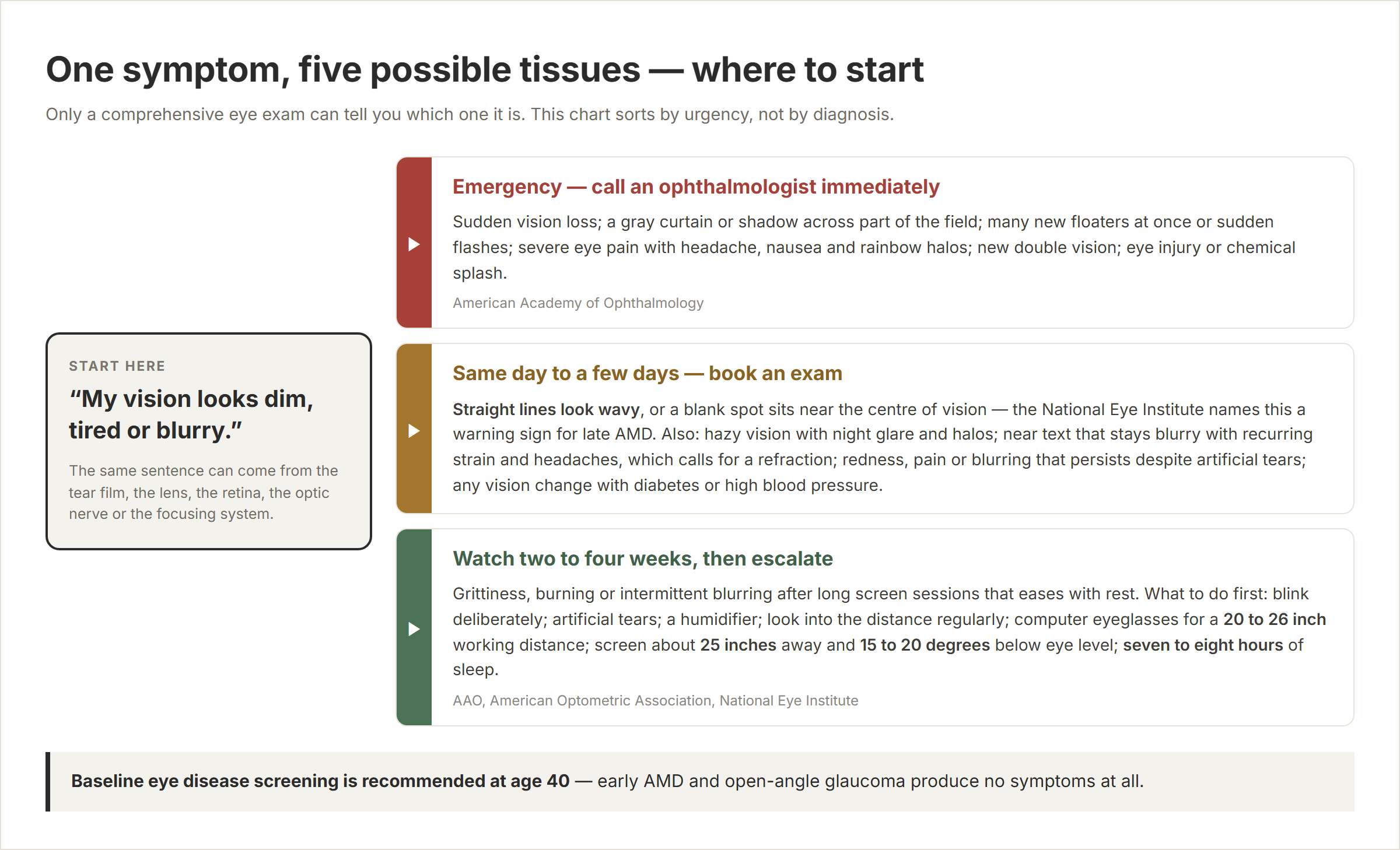
Emergency — call an ophthalmologist immediately or go to an emergency department
Do not wait on any of these:
- Sudden loss or sudden blurring of vision in one or both eyes. AAO: sudden loss of vision “should be checked right away.”
- A gray curtain or a shadow across part of your field of vision. AAO’s detached-retina triggers to “Call an ophthalmologist immediately” include “A shadow appearing in your peripheral (side) vision” and “A gray curtain covering part of your field of vision.”
- A sudden burst of new floaters, or sudden flashes of light. AAO, verbatim: “Seeing flashing lights all of a sudden” and “Noticing many new floaters at once.”
- Severe eye pain with headache, nausea, vomiting, redness and rainbow halos around lights — suspect an acute angle-closure attack. AAO: “It is a true eye emergency, and you should call your ophthalmologist right away or you might go blind.”
- Eye injury, chemical splash, or anything embedded in the eye.
- New double vision, which AAO notes can warn of a systemic or nerve problem.
Same day to a few days — book an exam promptly
These are not “wait and see” symptoms:
- Straight lines look wavy, bent or crooked; a blank or dark spot near the center of vision; letters with gaps; colors look less bright. NEI, verbatim: “Straight lines looking wavy is a warning sign for late AMD. If you notice this symptom, see your eye doctor right away.”
- Blurred vision, halos, mild headache or mild eye pain if you are at risk of angle-closure glaucoma. AAO: people with these early symptoms “should be checked by their ophthalmologist as soon as possible.”
- Covering one eye reveals a clear difference between the two.
- Hazy, foggy vision with night glare and halos around headlights — possibly cataract, which needs a dilated exam. And note NEI’s answer on supplements and cataract: no.
- Near text stays blurry with recurring eye strain and headaches — that is a refraction, not a capsule.
- Redness, pain, watering, light sensitivity or blurring that persists despite artificial tears and breaks, especially for contact lens wearers.
- Dry eye severe enough to interfere with daily activities, or increasing discharge or crusting. NEI: “If severe dry eye isn’t treated, it can sometimes damage your cornea.”
- Any vision change if you have diabetes or high blood pressure.
Watch and wait — try the basics for two to four weeks, then escalate
This is the ordinary picture, and it usually eases:
- Temporary grittiness, burning, tiredness or intermittent blurring after long screen sessions that improves with rest. AAO on permanent damage from screens: “Thankfully, this is not true.” AOA: many of these symptoms are “only temporary.”
- What to do first, all from AAO, AOA and NEI: blink deliberately; use artificial tears; run a humidifier in dry warm rooms; look at something distant regularly (AOA’s 20-20-20 rule, plus 15 minutes of rest after two continuous hours); consider computer eyeglasses for the 20 to 26 inch working distance; match screen brightness to the room and raise contrast; use a matte filter for glare; sit about 25 inches from the screen, screen 15 to 20 degrees below eye level; avoid smoke, wind and direct air conditioning; sleep seven to eight hours.
- If two to four weeks of that does not help, or symptoms worsen, move up to the list above and get examined. Persistent symptoms can be uncorrected refractive error, a focusing or eye-teaming problem, or dry eye disease needing prescription treatment.
- Keep routine exams regardless of symptoms. AAO recommends a baseline eye disease screening at age 40. Anyone 55 or older, with a family history of AMD, or who smokes should follow their doctor’s recommended interval — because early AMD and open-angle glaucoma produce no symptoms at all.
The short version
If I had to put this on one card, I would write it like this.
NEI’s sentence is the anchor: “Nutritional supplements cannot prevent AMD” — with NEI’s own qualification that the AREDS and AREDS2 formulas may delay progression from intermediate to advanced AMD in people who already have it. AREDS2 excluded people with no AMD and with early AMD because the earlier trial showed no benefit for them, and its primary endpoint for lutein and zeaxanthin was null (HR 0.90, 98.7% CI 0.76–1.07, P=.12). The percentages have four different comparison groups: 25% is the original AREDS formula against placebo in high-risk AMD patients; 18% is lutein-without-beta-carotene against AREDS-with-beta-carotene; 26% and 32% are a post hoc subgroup of participants in the lowest quintile of dietary lutein and zeaxanthin intake, all of whom already had intermediate or late AMD, measured against the original AREDS formula rather than placebo. None of the four is a prevention number, and none compares against taking nothing.
Lutein’s verified job is narrow and real: it let the formula drop beta-carotene, which showed lung cancer OR 1.82 (95% CI 1.06–3.12) against lutein and zeaxanthin’s OR 1.15 (0.79–1.66) over 10 years in 3,882 people with AMD.
For astaxanthin, the accurate statement is about what is missing: no independent US federal assessment of astaxanthin for eye fatigue was found — not in NCCIH’s August 2024 eye-supplement digest, which never names it; not in a Cochrane review, because none exists. That is an absence of assessment, not a finding that it does not work. The two trials that exist are manufacturer-linked, one in 64 children and one a three-ingredient blend in 44 randomized adults, and the objective accommodation measure showed no significant intergroup difference.
And for tired, dry eyes at a screen, the American answer is tears, blinking, distance, light, and an exam — with AOA recommending 20-20-20 while the single trial of those numbers found no significant effect on symptoms (P=.70), reading speed (P=.93) or accuracy (P=.55) in 30 young adults.
What changed while I was writing was not my opinion of either ingredient. It was noticing how a real, narrow finding gets promoted one grade at a time — a subgroup becomes a result, a pigment reading becomes better sight, a permission to print a word becomes proof.
The eye exam is the part nobody is selling. Which is probably why it keeps getting left out.

Photo: Sami Abdullah / Pexels
Disclaimer
This article is general health information and is not medical advice. It does not diagnose, treat, cure or prevent any disease, and it does not replace evaluation by an eye care professional. Only a comprehensive dilated eye exam — refraction, slit lamp, intraocular pressure, dilated retinal exam, tear-film testing, and imaging where indicated — can identify which condition is causing a symptom. NEI’s wording: “Consult your doctor or eye care professional about which supplement, if any, is right for you.”
Dietary supplements are not drugs, and their claims are not vetted by the government before sale. Every US supplement bearing a structure/function statement must carry, verbatim: “This statement has not been evaluated by the Food and Drug Administration. This product is not intended to diagnose, treat, cure, or prevent any disease.” FDA does not review these claims before marketing; notification is due only within 30 days after sales begin. There is no FDA-authorized health claim linking either lutein or astaxanthin to the eye.
Supplements do not replace eye exams or treatment. AAO recommends a baseline eye disease screening at age 40, and calls glaucoma the “silent thief of sight.” NEI notes that early AMD has no symptoms, “so don’t wait for your vision to change.” Wet AMD is treated with anti-VEGF injections or photodynamic therapy; dry eye with artificial tears and prescription drops; presbyopia with optics, FDA-approved drops, or surgery. Substituting a supplement for any of those risks permanent, preventable vision loss.
Talk to a clinician before starting anything, and especially if you take anticoagulants or antiplatelet drugs (a single case report describes an astaxanthin–warfarin interaction with INR rising from 1.4 to 10.38; NEI warns that vitamin E can interact with blood thinners), take chemotherapy or lipid-lowering drugs, are a current or former smoker (the beta-carotene-containing AREDS formula is “Not recommended for current or former smokers”), are pregnant or breastfeeding, are buying for a child, or already take other supplements. No US authority statement on astaxanthin in pregnancy, breastfeeding or childhood was located in either direction, so the only honest advice is to ask a clinician. NEI’s practical instruction: make a list of every medication and supplement you take and share it with your provider.
A vitamin is not automatically harmless. The Institute of Medicine set no Tolerable Upper Intake Level for carotenoids, which means there is no established safe ceiling and no evidence that exceeding trial doses helps. Long-term high carotenoid intake can cause carotenodermia, which NCCIH describes as “a harmless condition in which the skin becomes yellow-orange.” For a sharper example, AAO warns that high doses of nicotinamide for glaucoma — “3 grams or more per day” — “could harm your liver,” that it “is still being tested,” and that it “is not approved by the FDA.”
Before reaching for a bottle: quit smoking, which is the first item on NEI’s own AMD risk-lowering list; stay active; keep blood pressure and cholesterol in range; eat leafy greens and fish; blink deliberately at screens; use artificial tears; take breaks from near work; wear UV-blocking sunglasses; and get the exam.
Figures and quotations here reflect sources verified as of September 2026 — AAO pages re-reviewed 2025–2026, NEI’s AREDS page last updated 2025-10-22, NCCIH’s eye-supplement digest dated August 2024 — and may change as new research, guidance or regulations appear.
References
- National Eye Institute (NIH) — About AREDS and AREDS2 (formulations, enrollment and exclusion criteria, 25% figure, lung cancer in former smokers; last updated 2025-10-22)
- National Eye Institute — AREDS/AREDS2 Frequently Asked Questions (“Nutritional supplements cannot prevent AMD”; no benefit in early AMD or no AMD; 18%, 26% and 32% subgroup figures; vitamin E, zinc and copper; cataract answer)
- National Eye Institute — Age-Related Macular Degeneration (staging; wavy-lines warning; 11 million Americans; risk factors and risk-lowering list)
- National Eye Institute — Presbyopia and Dry Eye (refractive error; 16.4 million Americans; artificial tears first; Restasis and Xiidra; punctal plugs)
- NCCIH (NIH) — Dietary Supplements for Eye Conditions: What the Science Says, clinical digest, August 2024 (no mention of astaxanthin; lutein and zeaxanthin safe regardless of smoking status; carotenodermia; 2022 omega-3 trial in 23,523 adults)
- Institute of Medicine / NASEM — Dietary Reference Intakes for Vitamin C, Vitamin E, Selenium, and Carotenoids (2000), β-Carotene and Other Carotenoids chapter
- FDA — Structure/Function Claims
- 21 CFR § 101.93 — mandatory disclaimer (c)(1), placement (d), typesize (e), documented mechanism (f), disease definition and criteria (g)
- Federal Register 65 FR 1000, January 6, 2000 — FDA final rule on structure/function claims (presbyopia and glaucoma examples)
- FDA Warning Letter — Lipotriad LLC, 636306-era letter dated March 19, 2021; closeout letter November 22, 2021
- FTC — Seller of “Ocular Nutrition” Dietary Supplement That Purports to Treat Eye Diseases Settles FTC Charges and Pays $450,000, February 2005
- FTC — Health Products Compliance Guidance, December 2022
- FDA accessdata — NDA 214028 approval letter, pilocarpine HCl ophthalmic solution 1.25% (VUITY), 2021; FDA Drug Trials Snapshots — VIZZ, aceclidine ophthalmic solution 1.44%, NDA 218585, approved July 31, 2025
- American Academy of Ophthalmology — Vitamins for AMD (published 2026-08-19)
- American Academy of Ophthalmology — Diet, Nutrition, and Eye Health Supplements (published 2025-04-08)
- American Academy of Ophthalmology — Computers, Digital Devices, and Eye Strain (published 2024-06-27)
- American Academy of Ophthalmology — What Is Presbyopia? (published 2026-05-21), Detached Retina (2025-12-04), Understanding Glaucoma (2026-03-04), Sudden Vision Loss
- AAO Newsroom, October 20, 2025 — Vitamin Supplements May Not Slow Geographic Atrophy Growth in Advanced Macular Degeneration (>1,200 untreated eyes, OAKS and DERBY)
- American Optometric Association — Computer Vision Syndrome and Diet and Nutrition
- Age-Related Eye Disease Study 2 Research Group — Lutein + zeaxanthin and omega-3 fatty acids for age-related macular degeneration, JAMA 2013 (PMID 23644932)
- AREDS2 Report 28 — 10-year outcomes, JAMA Ophthalmol 2022 (PMID 35653117)
- Cochrane Database Syst Rev 2012, CD000253 — antioxidant vitamin and mineral supplements for preventing AMD (PMID 22696317)
- Cochrane Database Syst Rev 2023, CD000254.pub5 — antioxidant vitamin and mineral supplements for slowing progression of AMD (PMID 37702300)
- DREAM Study Research Group — n−3 Fatty Acid Supplementation for the Treatment of Dry Eye Disease, NEJM 2018 (PMID 29652551)
- Astaxanthin (AstaReal®) Improved Acute and Chronic Digital Eye Strain in Children: A Randomized Double-Blind Placebo-Controlled Trial, Adv Ther 2025 (PMID 40014233)
- Effects of anthocyanin, astaxanthin, and lutein on eye functions, J Clin Biochem Nutr 2021 (PMID 34376917)
- Clinical Applications of Astaxanthin in the Treatment of Ocular Diseases, Mar Drugs 2020 (PMID 32370045)
- Nutritional Supplementation for Myopia Prevention and Control: A Systematic Review of RCTs, Nutrients 2025 (PMID 41515122)
- Johnson S, Rosenfield M — 20-20-20 Rule: Are These Numbers Justified?, Optom Vis Sci 2023 (PMID 36473088)
- Association between macular pigment optical density and visual function outcomes: a systematic review and meta-analysis, Eye (Lond) 2021 (PMID 32792595)
- Interaction between warfarin and astaxanthin: a case report, Journal of Cardiology Cases 2019