
When to Take Supplements: Timing for Better Absorption
Let me be honest about something first.
For years I took whatever supplement I had, whenever I remembered — usually a fistful before bed, on an empty stomach, because that was the moment I finally sat down. Then I would lie there wide awake, or wake up with a sour, heartburn-y stomach, and quietly blame the product.
The product was rarely the problem, though. The timing was.
So if a supplement is giving you heartburn or keeping you up at night, this is worth reading. Knowing when to take supplements is one of the few things that genuinely changes how well they work — and how they make you feel. The short version: fat-soluble vitamins want a meal, some vitamins want an empty stomach, and a couple of them have a “golden hour” that makes all the difference.
One thing before we start, though.
I am not your doctor, and none of this is medical advice. It is general information drawn from sources like the NIH Office of Dietary Supplements, Cleveland Clinic, and Mayo Clinic. Supplements are meant to complement a balanced diet — they are not treatments. If you suspect a deficiency, the honest first step is a blood test and a conversation with your doctor, pharmacist, or a registered dietitian, not a new bottle.

Photo: Thesis / Pexels
Why timing can turn a “good” supplement bad
Here is the part most labels do not tell you.
The same pill can sit fine or wreck your afternoon depending on when it lands. Iron is the classic example. Taken in a high dose on an empty stomach, it can cause an upset stomach, nausea, constipation, even vomiting — that is well documented by the NIH Office of Dietary Supplements. The iron did nothing wrong. Your empty stomach did.
Sleep works the same way. Vitamin B12 “can be energizing,” which is why Cleveland Clinic suggests taking it in the morning — later in the day it can disrupt sleep. So that “why am I wired at 11 p.m.” feeling might just be a B-complex you took at dinner.
That is the whole idea here.
Most supplement “side effects” are really timing problems in disguise. Fix the timing, and a lot of the heartburn and restlessness quietly goes away.
The golden rule: with food, or with water?
If you remember only one thing, make it this distinction.
Vitamins come in two families, and they behave very differently:
- Fat-soluble vitamins (A, D, E, K) need fat to dissolve. Cleveland Clinic puts it plainly — your body “needs fat and oil” to absorb them, so take them with a meal that contains some fat. Even small amounts of low- or whole-fat milk or yogurt, or food cooked in oil, are enough.
- Water-soluble vitamins (B and C) need water. You can take these on an empty stomach with a glass of water.

That is genuinely most of the puzzle solved. Match the fat-soluble ones to a meal. Match the water-soluble ones to a glass of water. When in doubt, ask which family your supplement belongs to.
Vitamin D: the clearest “take it with food” case
Vitamin D is fat-soluble, so it is the poster child for this rule.
Cleveland Clinic recommends taking it with a meal or snack that has healthy fats — olives, walnuts, dairy, or food cooked in oil. There is no single perfect time of day, but morning with your largest, fattiest meal is a nice practical default, because it is easy to remember and usually has fat in it.
How much does the meal matter? In small studies, taking vitamin D with the largest meal of the day was linked to roughly a 50% rise in blood levels over a couple of months, and a high-fat meal raised levels about 32% at twelve hours compared to a fat-free one. I want to be careful here — these are small studies, so treat the numbers as a direction, not a promise. But the direction is clear: naked vitamin D on an empty stomach is a waste.

Photo: Adela Cristea / Pexels
One caveat worth knowing. A 2021 review suggested that taking vitamin D in the evening may lower melatonin, the hormone that helps you fall asleep. The evidence is mixed — some studies point the other way — but if vitamin D at night seems to mess with your sleep, that is a reason to move it to the morning.
Empty-stomach types vs with-food types
Beyond the fat-and-water rule, it helps to sort your supplements into two piles.

The empty-stomach pile — take away from meals:
- Iron. Best absorbed on an empty stomach — about 30 minutes before eating or two hours after a meal. Pair it with vitamin C (a glass of orange juice works) to boost absorption. If it makes you queasy, take it with a little food instead. And keep iron away from calcium, which blocks it.
- Probiotics. Many can go with or without food; some strains actually survive better taken during a meal or about 30 minutes before. Read the label — they vary.
- Water-soluble B and C, as above, are fine on an empty stomach with water.
The with-food pile — take with a meal:
- Fat-soluble A, D, E, and K, so there is fat to carry them.
- Multivitamins and prenatals. Taking them with breakfast or lunch lowers the chance of an upset stomach and acid reflux. (There is a small trade-off — food helps the fat-soluble parts absorb but slightly hampers the water-soluble ones — and honestly, “with food and no nausea” wins for most people.)
- Calcium carbonate, which needs stomach acid, so take it with meals. Calcium citrate is more forgiving and can go with or without food.
Magnesium and the evening “golden hour”
This is the one people ask about most, so let me be specific.
Magnesium — especially magnesium glycinate — is commonly taken in the evening because it may support relaxation and sleep. The glycine part has mild calming properties, and Mayo Clinic notes that glycinate tends to be gentler on the gut than other forms.
There is some real evidence here. A 2025 randomized, placebo-controlled trial in 155 adults with poor sleep found that 250 mg of magnesium bisglycinate, taken 30 to 60 minutes before bed, improved their insomnia scores over eight weeks.

Photo: cottonbro studio / Pexels
I want to stay honest, though. Magnesium is a supportive habit, not a sleeping pill, and one modest trial is not the final word. Two guardrails matter more than the timing:
- Most adults should stay at or under 350 mg a day of supplemental magnesium unless a clinician says otherwise. Too much commonly causes diarrhea.
- Consistency beats the clock. Taking it at the same time each day matters more than hitting an exact minute.
A few conflicts worth spacing out
Some supplements simply do not get along, and taking them together means you absorb less of both.
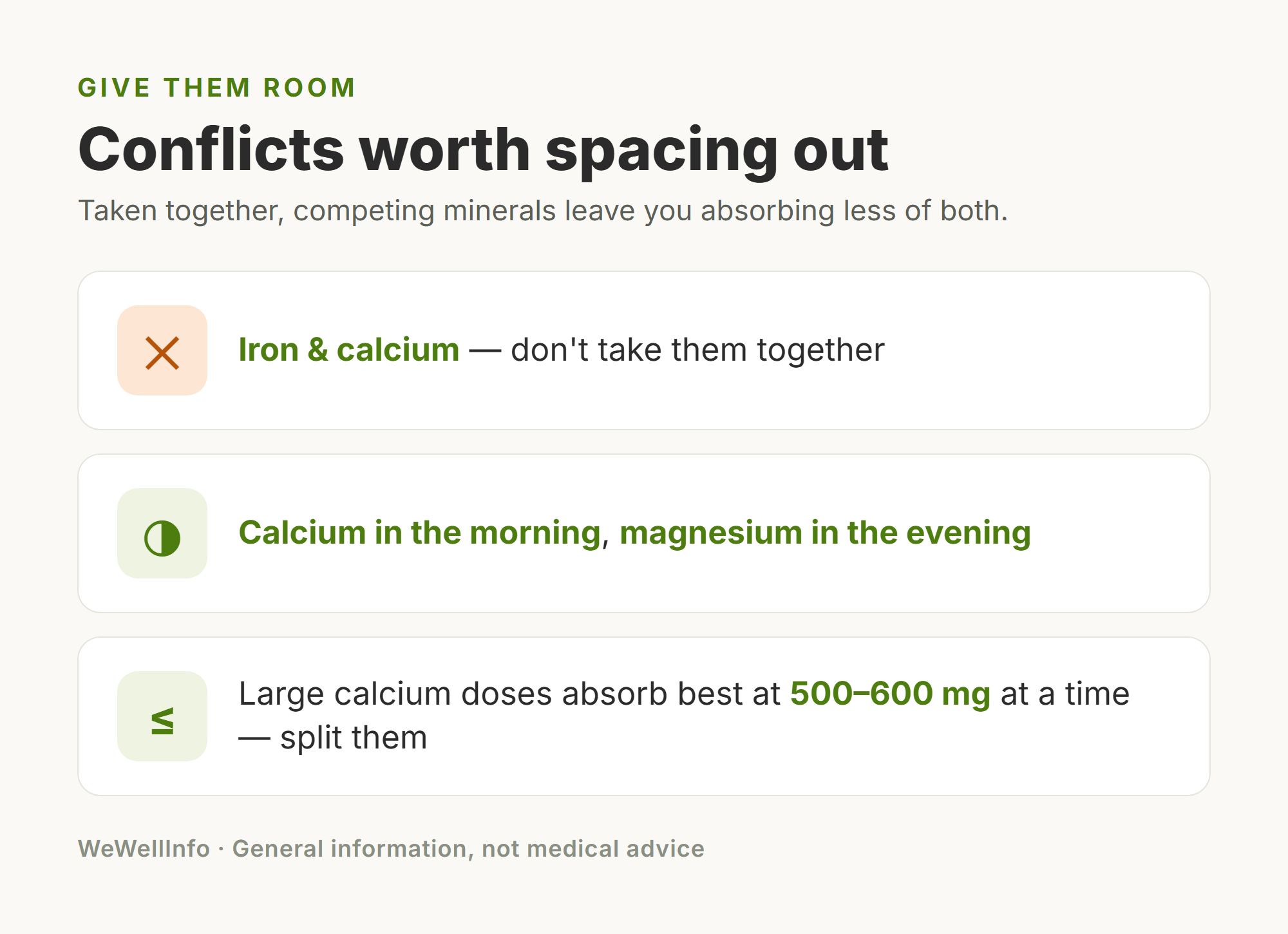
- Iron and calcium compete — do not take them together.
- Calcium and magnesium also compete for absorption, which is one more reason the common pattern is calcium in the morning, magnesium in the evening.
- Large calcium doses absorb best in amounts of about 500 to 600 mg at a time, so split a big daily total rather than taking it all at once.
Nothing here is complicated. It is mostly about giving competing minerals a few hours of space.
The safety part — please don’t skip this
Most of this article is about getting more out of your supplements. This part is about not getting hurt by them.
Supplements complement a balanced diet; they do not replace food, and they do not treat or cure disease. If you feel run down and suspect a deficiency, resist the urge to guess with a bottle. A blood test tells you what is actually low, and a doctor, pharmacist, or registered dietitian can tell you what to do about it.
Interactions are the other quiet risk:
- Vitamin K can work against warfarin and other blood thinners — if you take an anticoagulant, keep your vitamin K intake steady and talk to your doctor before adding any.
- Iron, calcium, and magnesium can block the absorption of some medications — including certain thyroid drugs and antibiotics — so space them apart and ask a pharmacist.
- St. John’s Wort interacts with a long list of prescription drugs.
- Pregnant, managing a chronic illness, or on any prescription? Check with a clinician before starting something new.
I know it is less fun than a timing hack. But a two-minute question to your pharmacist is the cheapest insurance you will ever buy.
The short version
If I had to compress all of this onto a sticky note, it would read like this.
Fat-soluble vitamins (A, D, E, K) go with a meal that has some fat. Water-soluble B and C can go on an empty stomach with water. Iron likes an empty stomach and a splash of vitamin C, but away from calcium. Multivitamins go with food to spare your stomach. And magnesium glycinate, if you use it, fits the evening — at or under 350 mg, at a consistent time.
None of this makes a supplement do more than it can. What it does is stop you from wasting the good ones, and stop the good ones from keeping you up or turning your stomach.
Because the bottle was probably never the problem. The clock was.
And that, at least, is something you can actually fix tonight.
References
- NIH Office of Dietary Supplements — Iron, Consumer Fact Sheet
- Cleveland Clinic — “The Best Time To Take Vitamins” and “The Best Time of Day To Take Vitamin D”
- Cleveland Clinic — “Why You Should Take Iron With Vitamin C”
- Mayo Clinic Press — “Magnesium for Sleep: What You Need to Know”
- Magnesium Bisglycinate Supplementation in Adults With Poor Sleep — randomized, placebo-controlled trial (2025)
- MedlinePlus — “Taking iron supplements”