Weight-Loss Plateau: Why the Scale Stalls and What Works
For a long time I believed a stalled scale meant my body had turned on me.
Nothing had changed. Same food, same walks — and the number just sat there for two weeks. Every forum said my metabolism had clamped down to defend my weight. It felt true, and it let me off the hook, which is usually a sign a story is doing emotional work rather than factual work.
So here is the honest version up front. A weight-loss plateau is real and it arrives for everyone — but the mechanism most people name for it is the wrong one. The deficit closes mostly from the food side, driven by an appetite that climbs with every pound you lose. And a large share of “plateaus” aren’t plateaus at all — they’re a real signal buried under the noise of a bathroom scale.
This is general health information, not medical advice, and doesn’t replace care from a licensed clinician or dietitian. A fuller note is at the end, plus a section for anyone whose relationship with food has started to feel distressing.
Most “plateaus” are the scale being noisy
Start with the arithmetic, because it dissolves a lot of panic.
NHLBI describes a healthy pace as “losing 5% to 10% of your initial weight over the course of about 6 months.” NIDDK is more conservative still — 5% in six months, illustrated as 10 lb for a 200-lb person. Spread across 26 weeks, real progress looks like this.
| Starting weight | 5–10% target | Real weekly progress |
|---|---|---|
| 150 lb (68 kg) | 7.5–15 lb | about 0.3–0.6 lb/week |
| 200 lb (91 kg) | 10–20 lb | about 0.4–0.8 lb/week |
| 250 lb (113 kg) | 12.5–25 lb | about 0.5–1.0 lb/week |
Now set half a pound a week against what a scale measures on a given morning: food and fluid in transit, sodium and carbohydrate-driven water shifts, glycogen, bowel contents, hydration, and for menstruating readers, cyclical fluid retention. A single day’s swing routinely covers an entire week of genuine progress.
A flat scale for one or two weeks is not a plateau. It’s the signal being buried in the noise.
People quit over that, or worse, slash their food over it. A measurement problem calls for a better measurement:
- Weigh daily under the same conditions — on waking, after the bathroom, before eating or drinking — and read the 7-day rolling average, never a single morning. Among National Weight Control Registry maintainers, daily self-weighing was associated with less weight gain (Olson 2021, p = 0.03), and falling self-weighing frequency predicted regain.
- Judge a genuine stall only after roughly 3–4 weeks of a flat rolling average.
- Track waist circumference too. A 2026 Front Physiol analysis found interval training “significantly lowered BMI and BF% but not overall weight.”
What actually stops the scale: appetite, not a broken metabolism
If the rolling average really has been flat for a month, the next question is why. Here the popular answer and the evidence part ways.
The decisive study is Thomas and colleagues, American Journal of Clinical Nutrition, 2014. They noticed a gap that shouldn’t exist: clinical weight loss typically stabilizes at 6 months, yet validated energy-balance models predict plateaus at 1 to 2 years. If a slowing metabolism governed the plateau, loss should continue for another six to eighteen months. It doesn’t.
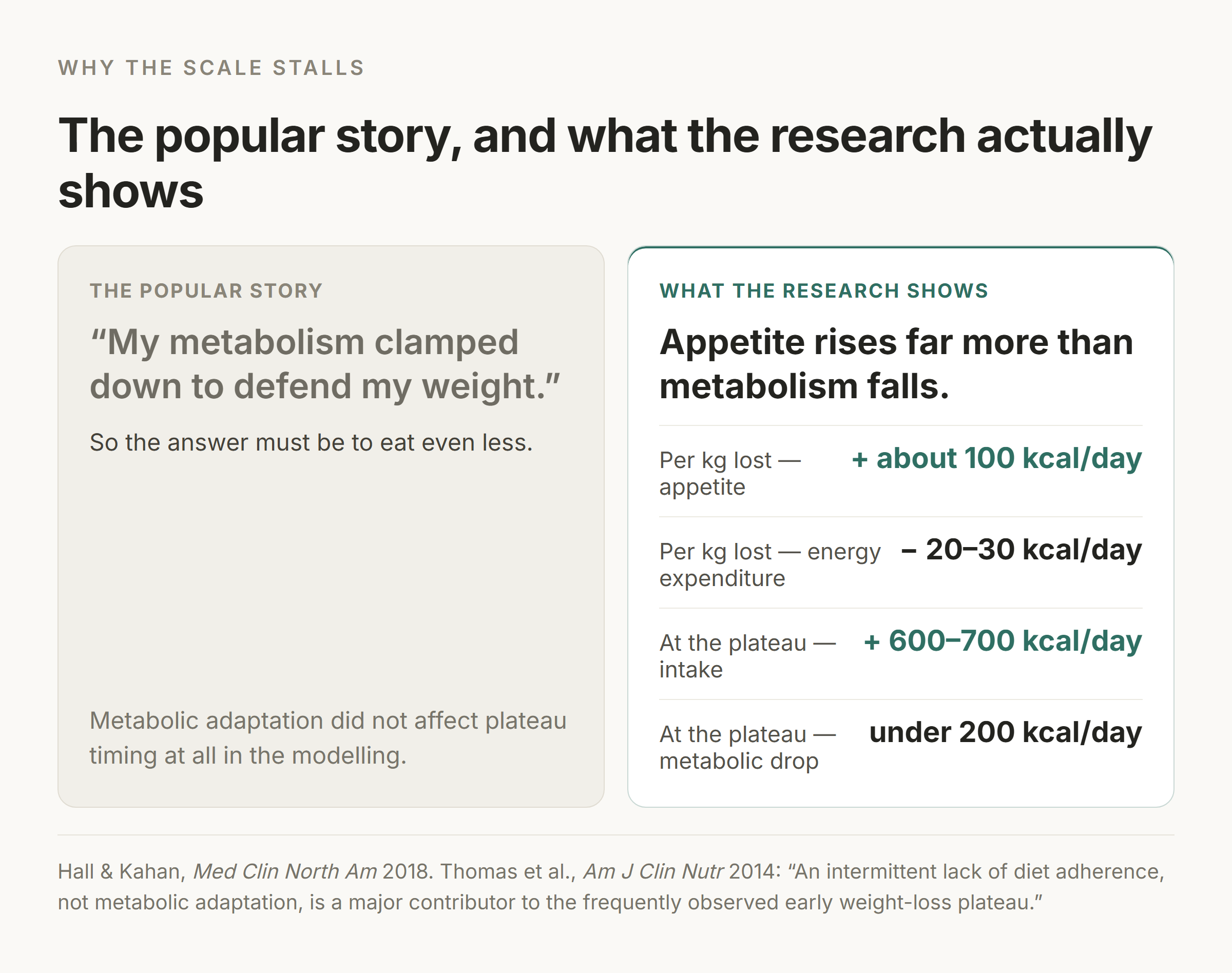
So they built two competing models — one driven by energy-expenditure adaptation, one by intermittent lapses in intake — and tested both against four independent datasets. Only the second reproduced reality, generating “oscillating weight graphs that have been frequently observed in weight-loss studies.” Metabolic adaptation did not affect plateau timing at all. Their conclusion, verbatim:
“An intermittent lack of diet adherence, not metabolic adaptation, is a major contributor to the frequently observed early weight-loss plateau.”
Read that clause carefully, because it’s the easiest sentence in this field to read cruelly — and reading it that way gets the physiology wrong, not just the tone.
“Lack of adherence” is a modeling term, not a moral verdict. Kevin Hall’s work at NIDDK explains the mechanism, and it isn’t willpower. Weight loss activates a feedback circuit that raises appetite in proportion to what you’ve lost. Hall and Kahan put the two arms side by side in 2018: per kilogram lost, energy expenditure decreases by about 20–30 kcal/day while appetite increases by about 100 kcal/day. At the plateau, appetite has risen 400–600 kcal/day and intake 600–700, against a metabolic drop of less than 200.
Roughly a three- to fivefold difference, and the larger arm is the one nobody talks about.

Photo: kaboompics.com / Pexels
Hall describes how that feels from the inside: “the same amount of effort to cut calories was met with increasing resistance as ongoing weight loss increasingly activated the feedback control circuit stimulating appetite.”
Nobody in those studies decided to eat more. The drift is unconscious: a heavier pour, a bigger handful, a looser weekend. It’s portion creep driven by physiology, not a lapse of discipline.

“But nothing changed”
Almost always, something did — invisibly.
Lichtman and colleagues, New England Journal of Medicine, 1992 studied adults who described themselves as diet-resistant, using doubly labeled water. Their expenditure and resting metabolic rate came back “within 5 percent of the predicted values” for their body composition, and low expenditure was explicitly excluded as the mechanism. What they found instead: those subjects under-reported food intake by 47 ± 16% and over-reported physical activity by 51 ± 75%.
Please don’t read that as evidence dieters lie. Misreporting is unconscious and close to universal — an equation built from 6,497 doubly labeled water measurements found misreporting above 50% across two national surveys (Bajunaid, 2025). It’s a measurement problem, not a character problem, which is good news: measurement problems are fixable.
Photo: RDNE Stock project / Pexels
A plateau always arrives — but the timing moves
The premise gets one thing exactly right. Hall’s 2024 review in Obesity: “Every obesity intervention eventually results in a body weight plateau after which no further weight loss occurs.”
Look at when it arrives, though, because that’s where the mechanism gives itself away. In Hall’s calibrated model, calorie restriction alone plateaus at around 12 months. Semaglutide, tirzepatide, and Roux-en-Y gastric bypass all push it to around 24 months.
And none of them changed energy expenditure. The metabolic-adaptation term stayed in the same narrow band — 19 to 24 kcal/day per kilogram — across every one. What moved was the appetite gain, from 82–101 kcal/day per kg down to roughly 30–60. In Hall’s words, they “weakened the feedback control of appetite by ~40–70%.”
If a defending metabolism caused the plateau, treatments that leave metabolism untouched could not delay it. They do. So appetite is the mechanism.
Given how widely GLP-1 receptor agonists are prescribed here, that matters practically. A plateau on prescribed medication is expected physiology on roughly a two-year arc — not a cue to self-adjust a dose or cut food further. It’s a conversation for the prescribing clinician. The lean-mass guidance attached to that era of weight loss is consistent: protein above 1.2 g/kg/day with structured resistance training, as a package rather than two separate levers (Noronha 2025).
None of this means the plateau is out of your hands. It arrives on a predictable schedule, for a knowable reason.
Metabolic adaptation, sized honestly
Adaptive thermogenesis — expenditure falling more than body-composition change predicts — is real, and wildly inflated.
The number everyone quotes is −499 ± 207 kcal/day, from Fothergill’s six-year follow-up of 14 Biggest Loser contestants who lost an average of 129 lb (58.3 kg) under television conditions. Hall revisited that cohort in 2022 and read it as a genuine compensatory response to extreme, sustained exercise — not a measurement artifact, but not a general rule either. Adaptation was “largest in contestants with the greatest increases in sustained physical activity.”
The figure for an ordinary dieter looks nothing like it. Martins and colleagues, AJCN 2020, measured 171 women and found −54 ± 105 kcal/day, which did not predict regain at one or two years. Their title is blunt: “Metabolic adaptation is not a major barrier to weight-loss maintenance.” The argument is still live, though — Ravussin and Redman published a counterpoint arguing adaptation is a genuine physiological phenomenon, not an illusion.
So the translation isn’t “your metabolism collapsed.” Your metabolism works normally, it has genuinely dropped a little, and a deficit calculated for your heavier body is smaller now. Recalculating for the lighter body is legitimate. Panic-cutting hundreds more calories is not.
What the evidence supports — and what it doesn’t

Carb cycling. A structured literature search for carbohydrate cycling and fat loss or body composition returned no human randomized controlled trials of the practice. It’s popular. It hasn’t been tested as a plateau-breaker, and I won’t recommend something on that basis.
Refeeds and diet breaks. Weak evidence, usually oversold. MATADOR (Byrne 2018) looks impressive — 14.1 kg lost versus 9.1 kg — but the caveats swallow much of it: men only, all food provided and delivered weekly, the intermittent arm ran 14 more calendar weeks, and the authors call it “preliminary support.” Pooled against everything else, Schroor’s 2024 meta-analysis found no superiority for body weight (−0.42 kg, not significant) and slightly more fat-free mass loss. The defensible benefit is psychological — reduced disinhibition (Siedler 2023), less hunger and irritability (Peos 2021). A planned break is an adherence tool, not a metabolic reset switch; no source supports that language.
HIIT. Intervals don’t “reactivate” a metabolism, because nothing shut off. They add an energy deficit and improve fitness. Viana’s 2019 meta-analysis found interval training cut body fat percentage by −1.50 percentage points and moderate continuous training by −1.44 — essentially the same. Intervals gave 28.5% greater reduction in absolute fat mass, but that’s 28.5% of a small number; absolute effects here run roughly 2–3.5 lb (1–1.6 kg).
The 2026 Cochrane review (58 RCTs, 2,075 participants) is more cautious still. Against no exercise, HIIT clearly wins — waist circumference −3.56 cm (−1.4 in), high certainty. Against moderate exercise, the only edge was +1.39 mL/min/kg of VO₂max, rated low certainty, with no clear differences in waist, blood pressure, or triglycerides. And one line deserves quoting rather than paraphrasing: “There were no reports of adverse events, and we are unsure if the studies actively monitored for them.” That’s an absence of data, not evidence of safety.
Sustainability splits too. A 2026 meta-analysis found HIIT more enjoyable short-term (Hedges’ g = 0.44), but Ekkekakis and Biddle reviewed eight trials of 12 months or longer and reported that “while unsupervised, individuals initially assigned to HIIT tend to exercise at lower-than-prescribed intensities and HIIT groups demonstrate no advantage in long-term adherence.” Pick the one you’ll keep doing.
Before you start high-intensity work
The AHA’s 2020 scientific statement is explicit that “vigorous physical activity, particularly when performed by unfit individuals, can acutely increase the risk of sudden cardiac death and acute myocardial infarction in susceptible people,” and recommends preparticipation screening and gradual progression rather than abrupt jumps.
For scale: across 175,820 supervised cardiac-rehab exercise hours, Rognmo’s group recorded one fatal cardiac arrest per 129,456 moderate-intensity hours and one nonfatal arrest per 23,182 high-intensity hours. Roughly 5.6 times the per-hour rate, on a very small absolute base, with medical staff present — and their own conclusion was that “the risk of a cardiovascular event is low after both.”
Two practical notes. Low-impact modalities — cycling, rowing, incline walking, pool work — give the intensity without the joint loading. And if you take a beta-blocker or another rate-controlling medication, heart-rate zones won’t reflect your real effort. Use perceived exertion or the talk test, and ask your clinician.
The federal Physical Activity Guidelines for Americans are a gentler starting point anyway: 150 to 300 minutes of moderate aerobic activity weekly, muscle-strengthening at least 2 days a week, and the principle that “any amount of physical activity has some health benefits.”

Photo: Vidal Balielo Jr. / Pexels
Why cutting harder backfires
The intuitive move at a plateau is to eat even less. The case against it isn’t that your metabolism will collapse — it won’t.
A 2022 British Journal of Nutrition analysis found popular weight-loss meal plans deviated from healthy-eating guidance with “low intakes of multiple food groups, low intakes of essential micronutrients and a distorted macronutrient distribution”; Healthy Eating Index scores across popular diets run anywhere from 26.7 to 89.1 out of 100 (Phelan 2023). Restriction takes lean mass too, and protein above 1.2 g/kg/day with resistance training is what protects it. Most importantly, monotony erodes adherence — the plateau’s actual engine. A boring diet accelerates the exact process you’re trying to stop.
What long-term maintainers do instead is strikingly dull. More than 87% of National Weight Control Registry members kept at least a 10% loss at both years 5 and 10, and the predictors of regain were less physical activity, less dietary restraint, less frequent self-weighing, and more disinhibition. One caveat: NWCR is a self-selected registry, predominantly white, female, and middle-aged. It describes what maintainers do; it doesn’t prove those behaviors caused it.
For scale-setting, intensive year-long behavioral programs produce about 5.3 lb (2.39 kg) more loss than control at 12–18 months (USPSTF 2018) — and a loss of just 3% to 5% already lowers triglycerides, blood glucose, and type 2 diabetes risk (NHLBI).
When to talk with a health care professional
See a clinician if:
- Weight loss stalls and you have symptoms suggesting an underlying cause — persistent fatigue, cold intolerance, hair loss, constipation, menstrual changes, or unexplained swelling. That warrants testing, not more dieting.
- You take a medication known to affect weight, or you’re on a GLP-1 receptor agonist and your loss has stalled.
- Lifestyle changes alone aren’t enough. NIDDK advises working with a professional to set the goal and time frame.
- You have diabetes, high blood pressure, heart disease, or kidney disease, or are pregnant or breastfeeding, and are considering calorie restriction.
Before starting high-intensity interval training, talk with a clinician if you have known or suspected cardiovascular disease; experience chest pain or pressure, unexplained shortness of breath, dizziness, fainting, or palpitations; have uncontrolled high blood pressure or diabetes; are over roughly 40 and long sedentary; or have joint problems that vigorous impact would aggravate.
If a stalled scale is pushing you toward eating less and less
Please reach out. This article reaches people at the exact moment restriction is most tempting to escalate.
Seek help right away — do not wait — if you notice in yourself or someone else: escalating restriction, skipping meals, or fear of eating after a plateau; compulsive weighing or calorie counting that feels impossible to stop; exercising to “compensate” for food; purging, laxative or diuretic use, or binge episodes; or thoughts of self-harm.
| Resource | Contact | Hours |
|---|---|---|
| National Alliance for Eating Disorders | 1-866-662-1235 | Mon–Fri, 9 am–7 pm ET. Free, staffed by licensed eating-disorder therapists. Not a 24/7 crisis line. |
| ANAD Helpline | 1-888-375-7767 | Mon–Fri, 9 am–9 pm CT. Free peer support and referrals. |
| 988 Suicide & Crisis Lifeline | Call or text 988 | 24/7, free and confidential |
| Crisis Text Line | Text HOME to 741741 | 24/7 |
The short version
A plateau is not your metabolism breaking. It’s energy balance arriving back at zero — mostly because appetite quietly won back the calories you cut, while your metabolism moved a fraction of that.
So before treating it as a plateau, check whether it is one. Half a pound a week is smaller than what a scale does on its own, so two flat weeks is data, not failure. Then re-measure what you’re eating for a week or two, recalculate for the body you have now, track something besides the number, and keep the activity you’ll actually keep. The most effective plateau tool in the research isn’t dramatic. It’s measuring again.
Your body did exactly what bodies do. It got lighter, and then it got hungrier, and nobody told you the second part was coming.
A note on who should be careful
- This article is general health information, not medical advice. It is not a diagnosis or treatment plan and does not replace care from a licensed clinician, registered dietitian, or your own physician.
- Weight, metabolism, and nutritional needs vary substantially between individuals and are affected by medications, thyroid and hormonal conditions, sleep, pregnancy and postpartum status, age, and medical history.
- Do not start, stop, or change a diet, an exercise program, or any medication based on this article.
- If you are pregnant or breastfeeding, under 18, over 65, managing a chronic condition, taking prescription medication (including GLP-1 receptor agonists), or have any history of disordered eating, talk with a health care professional before making changes.
- The studies here involved specific populations — several men-only, several small, one a self-selected registry — that may not resemble you.
- No product, brand, supplement, or program is recommended here.
- The 2013 AHA/ACC/TOS obesity guideline has been retired and superseded by the 2026 AHA/ACC/ADA/ASN guideline on cardiovascular-kidney-metabolic syndrome.
References
- Thomas DM, Martin CK, Redman LM, et al. — “Effect of dietary adherence on the body weight plateau,” Am J Clin Nutr. 2014;100(3):787–795
- Hall KD — “Physiology of the weight-loss plateau in response to diet restriction, GLP-1 receptor agonism, and bariatric surgery,” Obesity. 2024;32(6)
- Hall KD, Kahan S — “Maintenance of Lost Weight and Long-Term Management of Obesity,” Med Clin North Am. 2018;102(1):183–197
- Lichtman SW, et al. — “Discrepancy between self-reported and actual caloric intake and exercise in obese subjects,” N Engl J Med. 1992;327(27):1893–1898
- Bajunaid R, et al. — predictive equation from 6,497 doubly labelled water measurements, Nature Food. 2025
- Martins C, Gower BA, Hill JO, Hunter GR — “Metabolic adaptation is not a major barrier to weight-loss maintenance,” Am J Clin Nutr. 2020;112(3):558–565 (n = 171 women)
- Ravussin E, Redman LM — “Metabolic adaptation: is it really an illusion?” Am J Clin Nutr. 2020;112(6):1653–1654
- Fothergill E, et al. — “Persistent metabolic adaptation 6 years after ‘The Biggest Loser’ competition,” Obesity. 2016;24(8):1612–1619 (n = 14)
- Hall KD — “‘The Biggest Loser’ study reinterpreted,” Obesity. 2022;30(1):11–13
- Byrne NM, et al. — MATADOR study, Int J Obes. 2018;42(2):129–138 (men only)
- Schroor MM, Joris PJ, Plat J, Mensink RP — intermittent vs continuous energy restriction, Adv Nutr. 2024
- Siedler MR, et al. — J Hum Kinet. 2023; Peos JJ, et al. — ICECAP secondary analysis, PLoS One. 2021
- Viana RB, et al. — “Is interval training the magic bullet for fat loss?” Br J Sports Med. 2019;53(10):655–664
- Strauss JA, Kirwan R, Ranasinghe C, et al. — HIIT for reducing cardiometabolic syndrome in sedentary populations, Cochrane Database Syst Rev. 2026 (58 RCTs, 2,075 participants)
- Ekkekakis P, Biddle SJH — HIIT and long-term exercise adherence, Psychol Sport Exerc. 2023 (8 trials ≥12 months); Lu Q, et al. — HIIT and enjoyment, Psychol Sport Exerc. 2026
- Zhong J, et al. — isolated HIIT modalities and body composition, Front Physiol. 2026
- Franklin BA, Thompson PD, et al. — AHA Scientific Statement on exercise-related acute cardiovascular events, Circulation. 2020;141(13):e705–e736
- Rognmo Ø, et al. — high- vs moderate-intensity exercise in coronary heart disease patients, Circulation. 2012;126(12):1436–1440
- Bracci EL, Keogh JB, Milte R, Murphy KJ — Br J Nutr. 2022;128(7):1357–1370; Phelan S, et al. — Nutrients. 2023;15(21):4526
- Noronha JC, et al. — Obesity Pillars. 2025; Corsetti G, Pasini E — Nutrients. 2026
- Thomas JG, Bond DS, Phelan S, Hill JO, Wing RR — 10-year maintenance in the National Weight Control Registry, Am J Prev Med. 2014;46(1):17–23
- Olson K, et al. — Obes Sci Pract. 2021 (daily self-weighing, p = 0.03)
- US Preventive Services Task Force (2018) — behavioral weight-loss interventions in adults with obesity, Grade B
- NIDDK (NIH) — “Treatment for Overweight & Obesity”; NHLBI (NIH) — “Aim for a Healthy Weight”
- HHS / ODPHP — Physical Activity Guidelines for Americans, 2nd Edition (2018)