
Yo-Yo Dieting and Metabolic Adaptation: Why Weight Returns
Let me start with the part I got wrong for years.
I believed every abandoned diet had left a mark — that the metabolism I was walking around with was a worn-down version of the one I started with. It explained everything, and it let me off the hook, which is usually a sign that a story is doing emotional work rather than factual.
So, the honest version up front. Yo-yo dieting and metabolic adaptation are both real — but the slowdown is far smaller than the internet claims, and in the single most-cited study on the subject it did not predict who regained the weight. Energy expenditure does fall somewhat more than your smaller body alone accounts for, on the order of a few dozen to about 500 calories a day. A real headwind. Not a broken engine.
General educational information, not medical advice — there is a fuller note at the bottom, and a section for anyone whose relationship with food has started to feel distressing.
What metabolic adaptation is, and how big it actually gets
Adaptive thermogenesis — metabolic adaptation, in plainer language — is the drop in energy expenditure that is larger than the loss of body mass and fat-free mass predicts. Shrink a body by 20% and you expect it to burn less. Adaptation is the extra slowdown on top.
Nobody can pin the number down. Müller and Bosy-Westphal, reviewing the field in Obesity in 2013, noted that adaptation “is not unequivocally defined” and that its very existence is contested, because labs use different prediction equations and measurement windows.
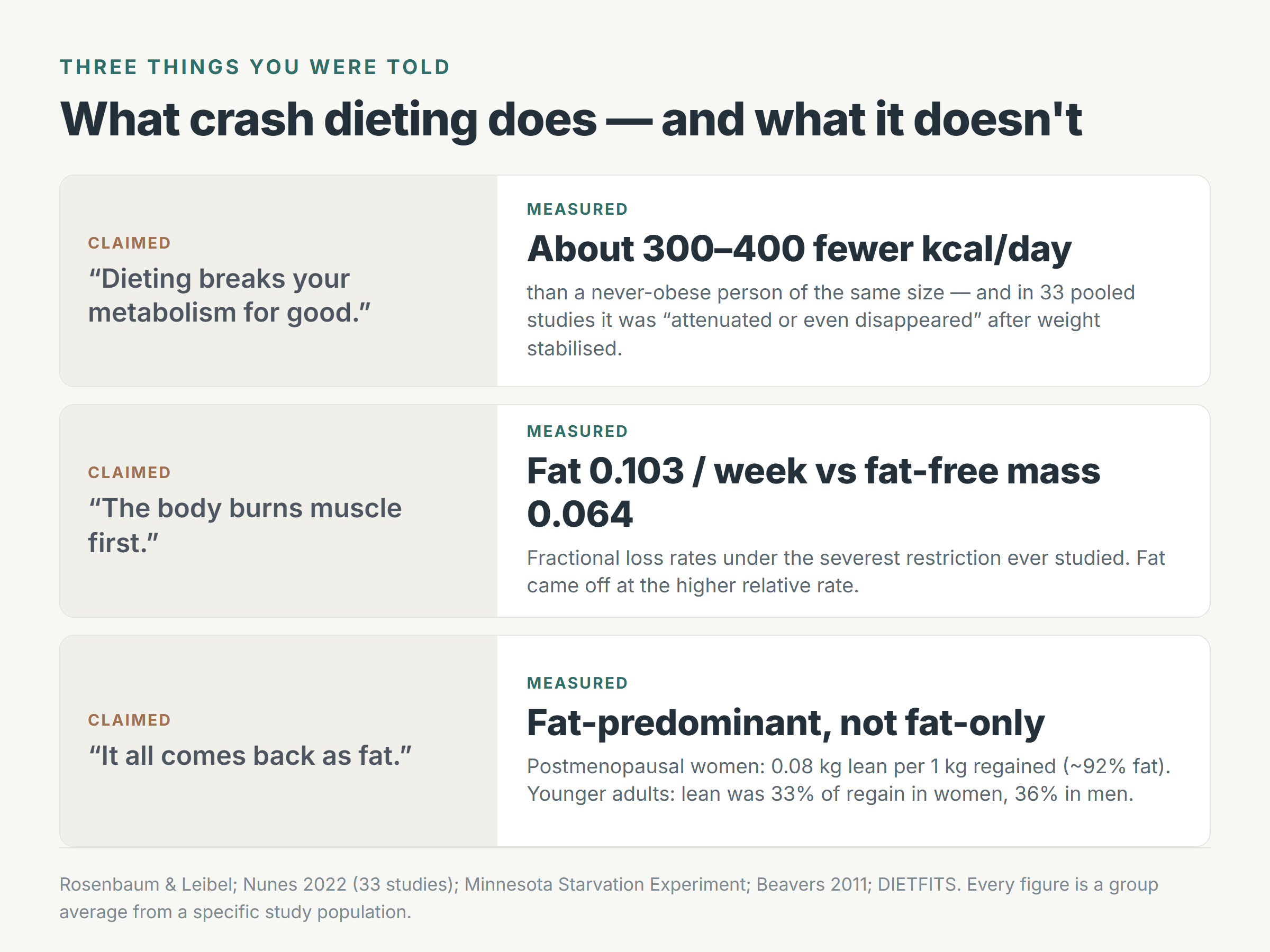
So there is a range, not a number, and every figure in it belongs to a specific population. Rosenbaum and Leibel found that after a 10% or greater reduction, 24-hour energy expenditure falls by roughly 20–25%, exceeding what body composition predicts by 10–15% of total expenditure — something like 300–400 fewer calories a day than a never-obese person of identical size.
Roughly a large snack. Not a metabolism that runs on air — and not exclusive to crash dieting, since CALERIE 2 found the same effect in 220 healthy non-obese adults on a moderate 25% restriction.

Photo: Luna Lovegood / Pexels
The Biggest Loser study says the opposite of what you were told
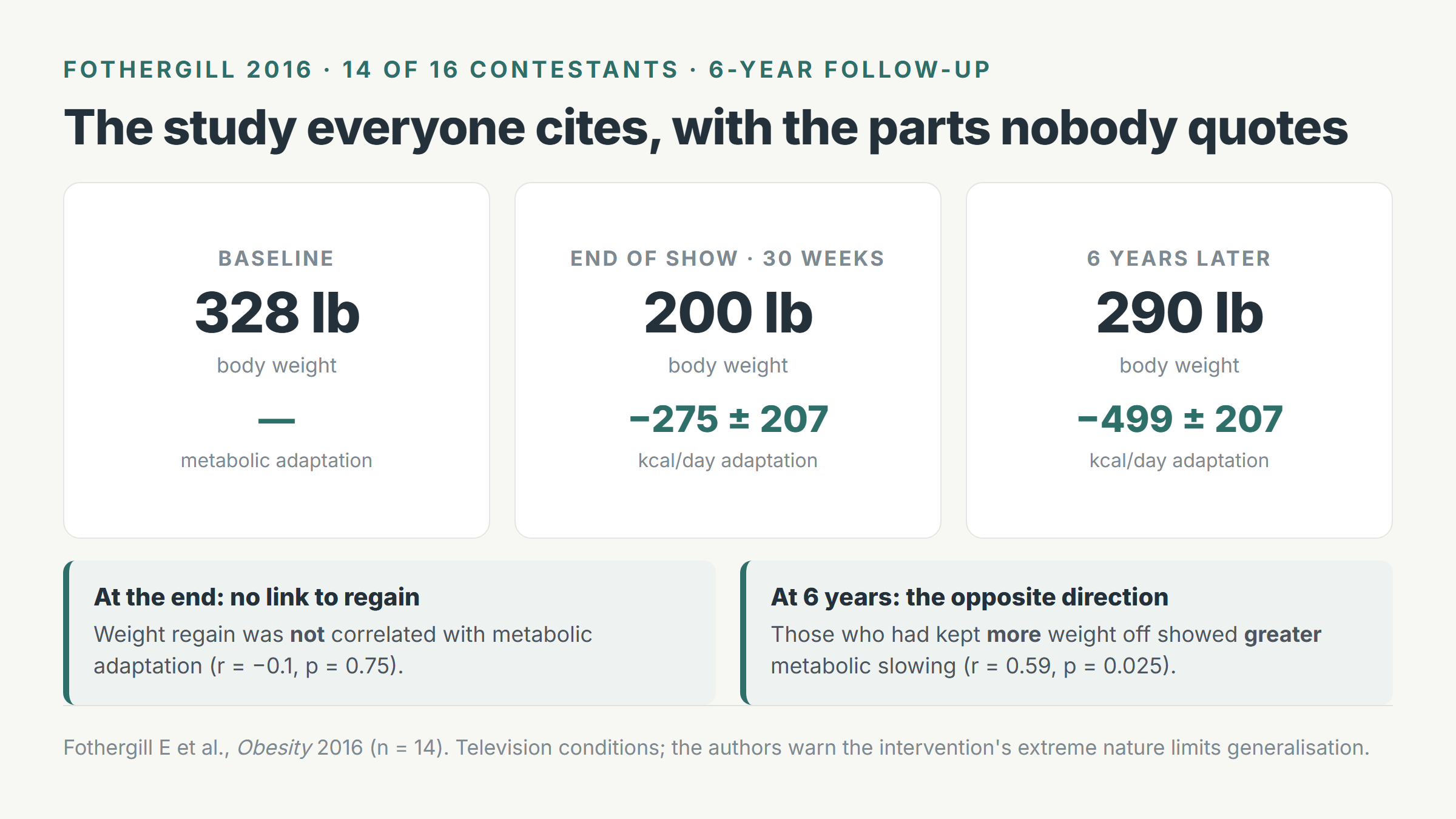
You have read about this study — usually as proof that crash dieting breaks your metabolism and that is why the weight returns. The paper says close to the reverse. Fothergill and colleagues, in Obesity in 2016, tracked 14 of the 16 original contestants for six years.
| Baseline | End of show (30 weeks) | 6 years | |
|---|---|---|---|
| Body weight | 328 lb | 200 lb | 290 lb |
| Metabolic adaptation | — | −275 ± 207 kcal/day | −499 ± 207 kcal/day |
They lost an average of 129 lb (58.3 kg) in 30 weeks, regained about 90 lb, and still held a net 11.9% of their starting weight. The −499 kcal/day figure is the one the internet quotes, always without the context: fourteen people, television conditions, and the authors’ own warning that the intervention’s extreme, public nature limits how far it generalizes.
The two findings that never make the headlines
First: at the end of the competition, metabolic adaptation had no relationship to who regained. The paper’s words are that “weight regain was not significantly correlated with metabolic adaptation at the competition’s end (r = −0.1, p = 0.75).”
Second, and stranger: at six years, “those with greater weight loss at 6 years also experienced greater concurrent metabolic slowing (r = 0.59, p = 0.025).”
Read that slowly, because the direction is easy to flip. Metabolic adaptation is written as a negative number — −499 kcal/day means more suppression, −100 means less. So a positive correlation between weight kept off and metabolic slowing means the people who had kept the most weight off were the ones running the most suppressed metabolisms. The people who had regained the most were the ones whose expenditure had drifted back toward where it started.
The authors’ own summary sidesteps the arithmetic entirely. They describe metabolic adaptation as “likely a proportional, but incomplete, response to contemporaneous efforts to reduce body weight.”
In plain English: your metabolism runs lower because you are successfully carrying less weight than you used to. The suppression is a consequence of the loss you are maintaining, not the cause of the loss you are not. A low measured rate after weight loss is not evidence that you failed or that something broke — in this dataset, it marked the people who were still succeeding.
The other side: the slowdown mostly fades when you stop dieting
An article that stops at The Biggest Loser is not being straight with you. The argument in the literature is live and unresolved.
Martins and colleagues, AJCN 2020 — 71 adults with obesity on an 8-week very-low-energy protocol. Adaptation was measurable at the end of active weight loss, then shrank by more than half after four weeks of eating at maintenance, and did not predict regain at one year. Their title: “Metabolic adaptation is an illusion, only present when participants are in negative energy balance.”
A separate Martins cohort, also 2020 — 171 women with overweight. Adaptation measured a few tens of calories a day, shrank toward zero by one and two years, was no longer statistically significant at follow-up, and was unrelated to regain. Its standard deviations run ±105 to ±166 kcal/day against averages of −18 to −64, so quoting any single figure would be dishonest. The title again carries the conclusion: “Metabolic adaptation is not a major barrier to weight-loss maintenance.”
Nunes and colleagues, British Journal of Nutrition 2022 reviewed 33 studies: adaptive thermogenesis appeared in 27 of them, so it is real and reproducible, but it was “attenuated or even disappeared after a period of weight stabilisation.”
A rebuttal followed in the same journal, so nobody has won this. But both camps agree on the part that matters: adaptation did not predict who regained.
If the slowdown is not the cause, what is?
Appetite. Overwhelmingly, appetite.
Sumithran and colleagues, NEJM 2011, put 50 adults with overweight or obesity on a 10-week very-low-energy diet, mean loss 13.5 kg. Leptin, peptide YY, cholecystokinin, insulin and amylin fell; ghrelin rose; subjective appetite climbed. At 62 weeks — a full year after the diet ended — those hormones and subjective hunger were still significantly different from baseline. The authors concluded that “the circulating mediators of appetite that encourage weight regain… do not revert to the levels recorded before weight loss.”
Modeling from Kevin Hall’s group at NIDDK points the same way: the estimated rise in appetite pressure per unit of weight lost is several times larger than the fall in expenditure.
So the fight is with hunger that outlasts the diet by more than a year. Not with a metabolism that quit.
“I gain weight from drinking water”
The claim is physiologically impossible — water has zero calories and cannot be stored as body fat — and yet the experience behind it is real. Three things are happening.
Your food diary is not lying to you. It is just human.
Lichtman and colleagues, NEJM 1992 studied a diet-resistant subgroup of 224 adults with obesity using doubly labeled water — the gold standard for real energy expenditure — over 14 days. They under-reported food intake by 47 ± 16% and over-reported physical activity by 51 ± 75%, reporting about 1,028 calories a day against a measured 2,081. The authors’ conclusion is the important part: the failure to lose weight “is due to an energy intake substantially higher than reported and an overestimation of physical activity, not to an abnormality in thermogenesis.“
Please do not read that as an accusation. These were not people cheating and covering it up. Under-reporting is unconscious and close to universal — the oil in the pan, the handful standing at the counter, the second pour. Human memory is a poor measuring instrument, and that is true of researchers and dietitians as much as anyone else. Nobody is exempt, and nobody is at fault.

Photo: Katya Wolf / Pexels
Second, water moves without fat moving. Glycogen is stored wet — roughly three grams of water for every gram of glycogen. Cut carbs sharply and it depletes, taking its water with it; that is the dramatic first week, and it is not fat loss. Resume normal eating and it refills. Sodium, cycle phase, hard exercise and constipation shift the scale by pounds within 24 to 48 hours too.
Third, you genuinely do burn less — a few hundred calories a day less than someone never at your higher weight, so old portions now create a small surplus.
Which turns “my body is broken” into “my measurement is off and my appetite is elevated.” One of those is fixable.
Does the body burn muscle first? No.
In the Minnesota Starvation Experiment — 36 healthy young men, 24 weeks of semi-starvation in the 1940s — the fractional rate of fat loss was 0.103 per week against 0.064 for fat-free mass. Fat came off at a substantially higher relative rate than lean tissue, under about the most severe restriction ever ethically studied. (Explanatory, not a template.)
How much of weight loss is lean tissue? The rule of thumb says a quarter. Heymsfield and colleagues examined that rule in Obesity Reviews in 2014 and found it shakier than its popularity suggests: roughly 25–27% in people carrying more body fat, rising toward 40% in leaner people, since “greater relative FFM loss is experienced by the leaner men.” Their own verdict is that the quarter rule is “at best an approximation that has a limited mechanistic basis.” The leaner you already are, the bigger the share taken from lean tissue.
Your scan says you lost muscle. It probably didn’t.
Adipose tissue is not pure fat. Roughly 85% of it is fat; the rest is a fat-free component of mostly water and protein. Lose fat and you lose that component too — and a DXA scan reports it as lean mass loss. Heymsfield’s group revisited this in Obesity in 2025 and found that once it is accounted for, “the original loss of lean mass is no longer observed or is markedly reduced.”
What does drive real muscle loss is narrower and mostly modifiable: severity of the deficit, no resistance training, too little protein, older age, already-low body fat.
Does it all come back as fat? Also no.
Regain is fat-predominant, not exclusively fat, and the split varies by population.
| Population | Finding |
|---|---|
| Postmenopausal women (Beavers, AJCN 2011) | 0.32 kg lean per 1 kg lost, but only 0.08 kg lean per 1 kg regained — regain roughly 92% fat |
| Younger adults (DIETFITS) | Lean gains were 33% of weight regained in women, 36% in men |
In young adults, Bosy-Westphal found loss and regain composition approximately equal, both mainly fat. So the worry worth keeping is not “it all comes back as fat” but that in older populations lean tissue returns more slowly than fat does — the argument for protecting it on the way down.
One version of the fear does hold up. The larger, better-powered finding is Heymsfield’s above: leaner people lose a bigger share of their weight as fat-free mass. Converging with it is Dulloo’s collateral fattening work, in which a fat-free mass deficit drives intake upward to restore it, so more fat is deposited by the time lean mass is whole again. In US Army Rangers after a roughly 12% weight loss, Dulloo reports fat overshoots of 4–5 kg on average. Separately, and from a different sample, the finding that overshoot rises exponentially as initial body fat falls comes from measured data on the 12 men who completed every phase of the Minnesota experiment — so treat that curve as hypothesis, not settled fact.
The rebuild — what the evidence supports
Now the useful part. None of it is exciting, which is generally a good sign.
Lift at least two days a week
The federal Physical Activity Guidelines for Americans, 2nd Edition, are specific: “Adults also need muscle-strengthening activity, like lifting weights or doing push-ups, at least 2 days each week,” covering all major muscle groups.
You will see “three times a week or more” attributed to official guidance all over the internet. The federal number is two — a far less intimidating place to start. What it buys you:
- Sardeli, Nutrients 2018, meta-analysis of randomized trials in adults with obesity aged 60 and over: resistance training prevented 93.5% of the lean body mass loss caused by caloric restriction (0.819 kg preserved), with comparable fat and total weight loss.
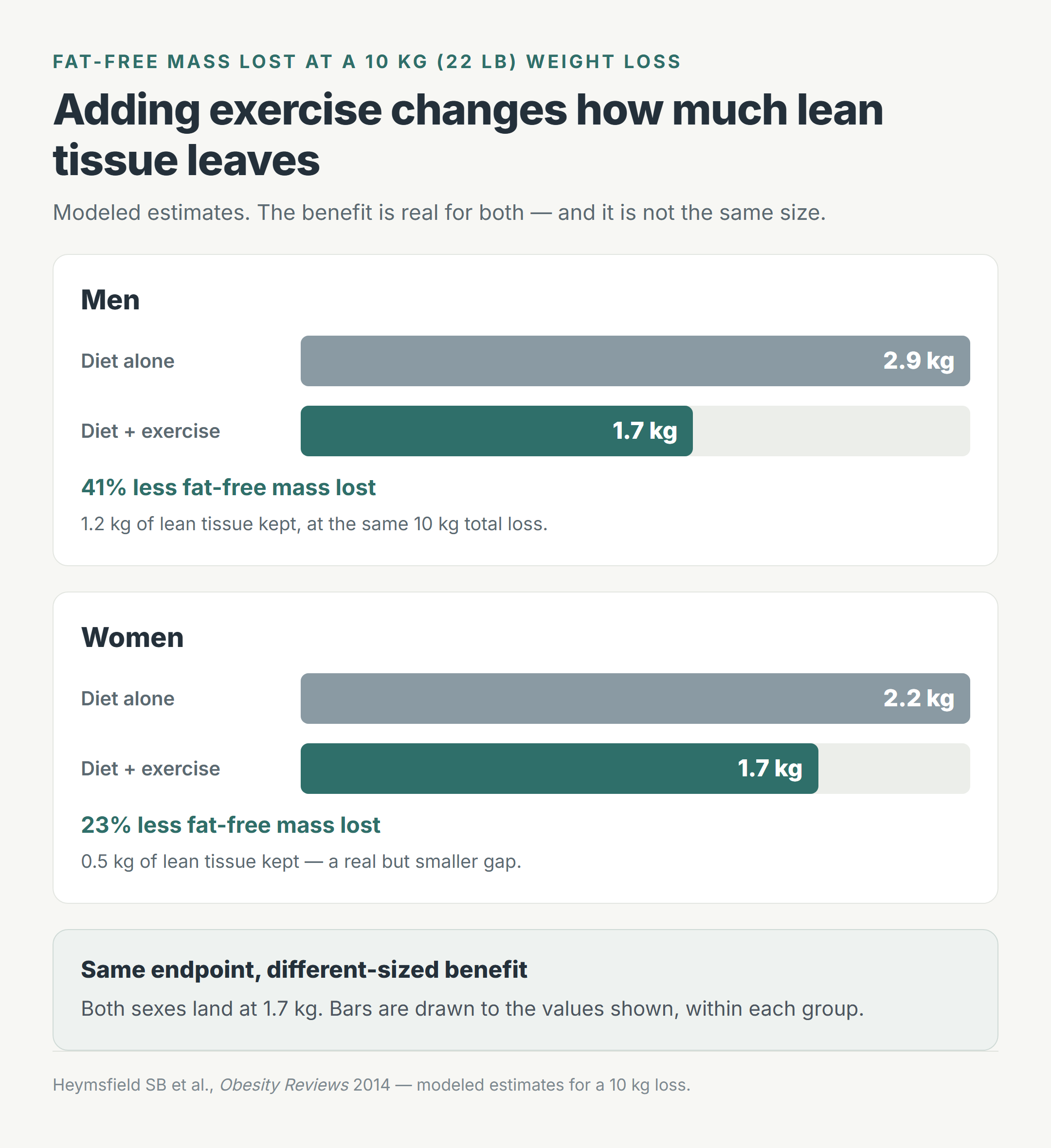
- Heymsfield 2014’s modeled estimates for a 10 kg (22 lb) loss: fat-free mass lost falls from 2.9 kg to 1.7 kg in men and 2.2 kg to 1.7 kg in women when exercise is added — 41% for men, 23% for women. Same endpoint, different-sized benefit, worth saying that way rather than rounding into one tidy claim.
- A separate pooled analysis: the lean share of loss fell from 0.27 with diet alone to 0.13 with aerobic exercise and 0.17 with resistance training. Aerobic edged out resistance there, with a wide standard deviation — so this is not the paper to argue lifting beats cardio.
- Rosenbaum, Obesity 2018: resistance training reduces the increased skeletal muscle work efficiency seen in weight-reduced people, countering one measured mechanism of adaptation.

Photo: Gustavo Fring / Pexels
Why lifting works — and why it is not what you were told
You have heard that a pound of muscle burns 50 calories a day. It does not. Elia’s tissue-specific coefficients, confirmed in Wang and colleagues’ 2010 AJCN analysis:
| Tissue | Resting metabolic rate |
|---|---|
| Skeletal muscle | 13 kcal/kg/day |
| Adipose tissue | 4.5 kcal/kg/day |
| Heart and kidneys | 440 kcal/kg/day |
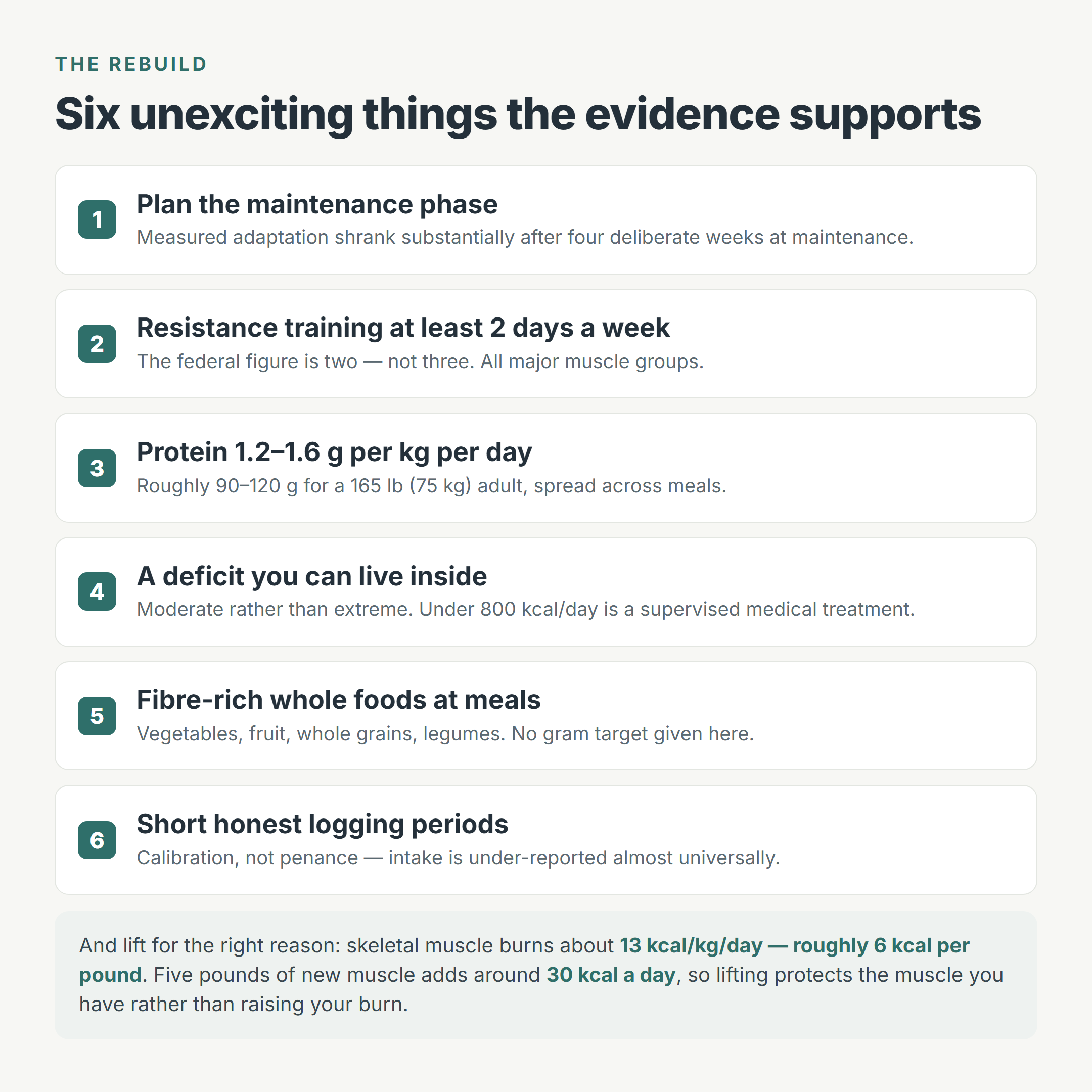
Skeletal muscle burns about 1/35 the rate of the heart and kidneys — one pound of it, roughly 6 calories a day. The popular claim is off by around eightfold. Gain an impressive 5 lb of muscle and you have added something like 30 calories a day. About one bite of a banana.
So lift for the real reasons: it protects the muscle you already have during a deficit, blunts one measured mechanism of adaptation, and means more of what you lose is fat.
Protein, deficit size, and a maintenance phase you actually plan
The 2025–2030 Dietary Guidelines for Americans, released January 7, 2026, supersede the 2020–2025 edition. Stated on the federal site realfood.gov itself: 1.2 to 1.6 grams of protein per kilogram of body weight per day, a 50–100% increase over the old 0.8 g/kg RDA minimum — roughly 90 to 120 grams a day for a 165 lb (75 kg) adult, spread across meals. They are not uncontested: Harvard’s Nutrition Source criticized them in January 2026 for raising protein targets without distinguishing sources, and for downplaying fiber. Leaning toward fish, legumes and plants holds both positions at once.
On deficit size, the 2013 AHA/ACC/TOS obesity guideline set the framing still used clinically: 3–5% weight loss produces clinically meaningful benefits, via a deficit of around 500–750 calories a day rather than anything extreme. It was retired in June 2026 by the 2026 AHA/ACC/ADA/ASN cardiovascular-kidney-metabolic guideline, so treat those figures as historical baseline, not current guidance — and 3–5% is a threshold for benefit, not a target to measure yourself against.
Then the least intuitive item: plan the maintenance phase. Martins’ cohort showed measured adaptation shrinking substantially after four weeks of deliberately eating at maintenance. A planned pause is not falling off the wagon; it is an intervention with a measurable effect.
Two habits close it out. Fiber-rich whole foods at meals — vegetables, fruit, whole grains, legumes — with no gram target here, because the circulated federal fiber numbers could not be re-verified and realfood.gov states none. And given that 47% under-reporting figure, short stretches of writing down what you eat beat estimating from memory. Calibration, not penance.
Crash diets and weight cycling — the honest read
Diets under 800 calories a day are a medical treatment, not a strategy: used clinically for no more than 12 weeks under intensive supervision, and in a one-year matched cohort study the risk of gallstones requiring hospitalization or surgery was three times higher on a very-low-calorie diet than a low-calorie one. Even supervised versions build in around 70 g of protein a day to defend lean mass, which is precisely what a self-directed crash diet lacks.
As for the cycling itself: a 2019 meta-analysis in Frontiers in Endocrinology found body-weight fluctuation associated with increased cardiovascular disease and mortality. But losing weight appears protective against coronary heart disease even when the weight is regained, one review found the adverse-effect evidence sparse, and a 2026 piece in The Lancet Diabetes & Endocrinology is still titled “Is weight cycling clinically harmful?” The honest framing is associated with, never causes — and nothing here says you would have been better off never trying.
When to talk to a clinician
Please get medical input if any of these apply:
- Before starting any weight-loss plan if you have diabetes, heart, kidney, liver or thyroid disease, or take prescription medication — several medications need dose adjustment as weight changes
- Before any diet under 1,200 calories a day, and never below 800 without supervision
- Persistent fatigue, feeling cold constantly, hair loss or brittle nails during or after dieting
- Missed or irregular periods — a signal of inadequate energy availability that warrants prompt evaluation
- Dizziness, fainting, palpitations, or an unusually slow heart rate
- Severe upper-right abdominal pain after rapid weight loss — possible gallstones, seek care promptly
- Repeated cycles of losing and regaining that leave you feeling out of control
If you have tried several times and regained each time, that is a reason to seek clinical support — not a reason to try harder alone.
If food or your body has started to feel distressing
Repeated restrictive dieting is an established risk factor for disordered eating, and this article will be read by people who are already struggling. That has to be said plainly.
In Stice and colleagues’ 8-year prospective study, body dissatisfaction was the most potent predictor of eating disorder onset — participants in the upper 24% showed a 4.0-fold increased incidence (24% versus 6%). Among those with low body dissatisfaction, the upper 12% for dieting showed a 3.6-fold increased incidence (18% versus 5%), a distinct pathway of its own.
And remember what the Minnesota experiment documented in previously healthy young men: food preoccupation, ritualized eating, binge episodes during refeeding, depression, irritability, social withdrawal. Those symptoms were caused by restriction. They were not character flaws, and they are not character flaws in you.
Warning signs worth taking seriously:
- Preoccupation with food, weight, calories or body shape that crowds out other thoughts
- Rigid food rules; intense guilt, shame or anxiety after eating
- Skipping meals, secret eating, or eating in ways you hide
- Episodes of eating that feel out of control
- Compensatory behaviors — vomiting, laxatives, diuretics, fasting or compulsive exercise
- Weighing yourself many times a day, or extreme distress at the number
- Withdrawing from meals with family or friends
- A cycle that keeps repeating: restrict, lose control, restrict harder
- Dizziness, feeling cold constantly, hair loss, missed periods, fatigue
Where to get help
| Resource | Contact | Hours |
|---|---|---|
| National Alliance for Eating Disorders Helpline | 1-866-662-1235 | Mon–Fri, 9 am – 7 pm ET. Free, staffed by licensed therapists specializing in eating disorders. Not a 24/7 crisis line. |
| ANAD Helpline | 1-888-375-7767 | Mon–Fri, 9 am – 9 pm CT. Free peer support and referrals. |
| NEDA online screening | Free, confidential screening tool at nationaleatingdisorders.org | Anytime; English and Spanish, ages 13+ |
| 988 Suicide & Crisis Lifeline | Call, text or chat 988 | 24/7, free and confidential |
If you are in crisis or having thoughts of suicide, call, text or chat 988 now.
The short version
Metabolic adaptation is real, but smaller than you were told, and in the study everyone cites as proof that dieting breaks you, it did not predict who regained. Your body burns fat faster than lean tissue, not the other way around. A good share of the “muscle loss” on your scan was never muscle.
The fight is with an appetite that stays elevated for more than a year — harder than a slow metabolism, and more honest, because it responds to protein, to a deficit you can live inside, and to the unglamorous business of lifting something heavy twice a week.
Nothing on that list will fix you, because nothing about you was broken to begin with. Your body did what bodies do. It just did it more thoroughly than anyone told you it would.
A note on who should be careful
- This article is general educational information, not medical advice, and does not diagnose, treat, or replace an evaluation by a licensed clinician.
- Individual responses to changes in diet and exercise vary widely, and the studies described here involved specific populations that may not resemble you.
- Talk with your doctor or a registered dietitian before starting a weight-loss plan, changing your eating pattern significantly, or beginning a new exercise program — particularly if you are pregnant or breastfeeding, under 18 or over 65, or have diabetes, heart or kidney disease, a thyroid condition, or a history of disordered eating, or take prescription medication.
- Very-low-calorie diets under 800 calories a day are a supervised medical treatment. Nothing here should be read as encouragement to attempt one on your own.
- Nothing here should be used to justify skipping meals, fasting, purging or compensatory exercise.
References
- Fothergill E et al. — “Persistent metabolic adaptation 6 years after ‘The Biggest Loser’ competition,” Obesity. 2016;24(8):1612–1619 (n = 14)
- Müller MJ, Bosy-Westphal A — “Adaptive thermogenesis with weight loss in humans,” Obesity. 2013;21(2):218–228
- Martins C, Roekenes J, Salamati S, Gower BA, Hunter GR — “Metabolic adaptation is an illusion, only present when participants are in negative energy balance,” Am J Clin Nutr. 2020 (n = 71)
- Martins C, Gower BA, Hill JO, Hunter GR — “Metabolic adaptation is not a major barrier to weight-loss maintenance,” Am J Clin Nutr. 2020;112(5):1170–1179 (n = 171 women)
- Nunes CL et al. — “Does adaptive thermogenesis occur after weight loss in adults? A systematic review,” Br J Nutr. 2022;127(3):451–469 (33 studies)
- Rosenbaum M, Leibel RL — “Adaptive thermogenesis in humans,” Int J Obes. 2010;34(Suppl 1):S47–55
- Redman LM et al. — “Metabolic slowing and reduced oxidative damage with sustained caloric restriction” (CALERIE 2), Cell Metab. 2018;27(4):805–815 (n = 220)
- Sumithran P et al. — “Long-term persistence of hormonal adaptations to weight loss,” N Engl J Med. 2011;365:1597–1604 (n = 50)
- Hall KD et al. — “Quantification of the effect of energy imbalance on bodyweight,” Lancet. 2011;378:826–837
- Lichtman SW et al. — “Discrepancy between self-reported and actual caloric intake and exercise in obese subjects,” N Engl J Med. 1992;327:1893–1898 (n = 224)
- Heymsfield SB et al. — “Weight loss composition is one-fourth fat-free mass: a critical review and critique of this widely cited rule,” Obes Rev. 2014;15(4):310–321
- Heymsfield SB et al. — “Critical analysis of DXA-measured body composition changes with voluntary weight loss,” Obesity. 2025
- Beavers KM et al. — “Is lost lean mass from intentional weight loss recovered during weight regain in postmenopausal women?” Am J Clin Nutr. 2011;94(3):767–774
- Bosy-Westphal A et al. — “Effect of weight loss and regain on adipose tissue distribution, composition of lean mass and resting energy expenditure,” Int J Obes. 2013;37:1371–1377
- DIETFITS — body composition changes after 6 and 12 months, J Endocr Soc. 2026;10(3):bvag015
- Dulloo AG — “Collateral fattening in body composition autoregulation,” Eur J Clin Nutr. 2018;72:657–664 (Minnesota completers, n = 12)
- Dulloo AG — “Physiology of weight regain: lessons from the Minnesota Starvation Experiment,” Obes Rev. 2021;22(S2):e13189
- Sardeli AV et al. — “Resistance training prevents muscle loss induced by caloric restriction in obese elderly: a systematic review and meta-analysis,” Nutrients. 2018;10(4):423
- Rosenbaum M et al. — “Resistance training reduces skeletal muscle work efficiency in weight-reduced and non-weight-reduced subjects,” Obesity. 2018;26(10):1576–1583
- Wang Z et al. — “Specific metabolic rates of major organs and tissues across adulthood,” Am J Clin Nutr. 2010;92(6):1369–1377
- USDA / HHS — Dietary Guidelines for Americans, 2025–2030 (released January 7, 2026); realfood.gov
- HHS / ODPHP — Physical Activity Guidelines for Americans, 2nd Edition (2018)
- NIDDK (NIH) — Weight Management; Body Weight Planner research
- 2013 AHA/ACC/TOS Guideline for the Management of Overweight and Obesity in Adults, JACC 2014 (retired 2026)
- 2026 AHA/ACC/ADA/ASN Guideline for the Prevention, Detection, Evaluation and Management of CKM Syndrome, JACC 2026
- Zhang Y et al. — “Body-weight fluctuation was associated with increased risk for cardiovascular disease, all-cause and cardiovascular mortality: a systematic review and meta-analysis,” Front Endocrinol. 2019;10:728
- Lancet Diabetes & Endocrinology — “Is weight cycling clinically harmful?” 2026
- Johansson K et al. — “Risk of symptomatic gallstones and cholecystectomy after a very-low-calorie diet or low-calorie diet: a 1-year matched cohort study,” Int J Obes. 2014;38:279–284
- Stice E, Marti CN, Durant S — “Risk factors for onset of eating disorders: evidence of multiple risk pathways from an 8-year prospective study,” Behav Res Ther. 2011;49(10):622–627
- Harvard T.H. Chan School of Public Health, The Nutrition Source — “Dietary Guidelines for Americans 2025–2030,” January 2026