Carb Addiction Is Not a Diagnosis: What Cravings Mean
I want to start with the thing I am least proud of.
I have finished a full dinner — plate cleared, genuinely not hungry — walked past a bakery twenty minutes later, and wanted a croissant so specifically that nothing else would have worked. Not food. That food. For a long time I assumed the name for this was “carb addiction,” and there is a whole internet of quizzes ready to confirm it.
So, the answer up front.
“Carb addiction” is not a medical diagnosis. It appears nowhere in the DSM-5-TR and nowhere in the ICD-11 eating-disorder chapter. The blood-sugar story behind it is real but far weaker than it is usually sold — and for the exact food this article is named after, it failed outright in the study everyone cites. Meanwhile there is a real, common, treatable diagnosis that this label routinely hides. That last part is why I wanted to write this.
I am not a doctor, and this is general information rather than medical advice. Nothing here can tell you whether you have a disorder. A fuller note, and a list of people who can actually assess it, is at the bottom.
Why “carb addiction” is a label, not a diagnosis
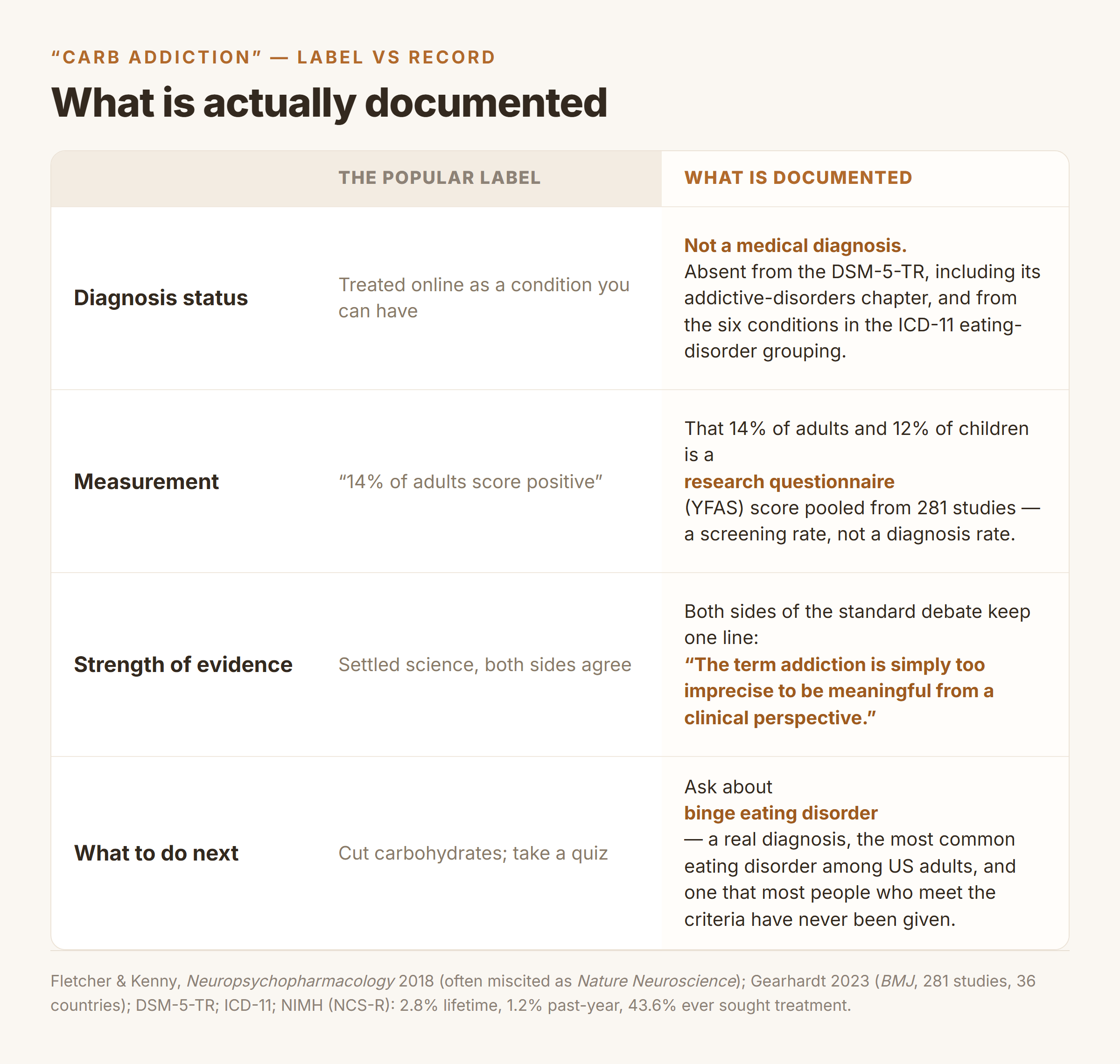
There is no food-addiction or carbohydrate-addiction diagnosis in the DSM-5-TR, including in its addictive-disorders chapter, where gambling disorder is the only recognized behavioral addiction. The ICD-11’s feeding and eating disorders grouping lists six conditions — anorexia nervosa, bulimia nervosa, binge-eating disorder, pica, rumination-regurgitation disorder, and ARFID. Food addiction is not one of them.
The Yale Food Addiction Scale gets quoted as if it settles the question. It does not. The YFAS is a research questionnaire that applies substance-use-disorder criteria to eating behavior, built for studies rather than clinics. Its own validation literature states that there are no formal diagnostic criteria for food addiction and no validated instrument to assess it.
You will also see a number: 14% of adults and 12% of children (Gearhardt et al., BMJ 2023, pooling 281 studies from 36 countries). That is how often people score positive on a research questionnaire — not a diagnosis rate.
Two researchers, one honest middle
The standard reference debate is Fletcher and Kenny, Food addiction: a valid concept?, published in Neuropsychopharmacology in 2018 — not, as it is often miscited, in Nature Neuroscience.
Fletcher’s case against: no addictive substance has ever been identified, the evidence for sugar addiction is “deeply unconvincing,” human neuroimaging does not show that the proposed brain changes underlie the behavior, rodent models depend on intermittent, restricted access rather than everyday abundance, and the construct overlaps heavily with an existing diagnosis. He also flags the scale’s criteria — eating more while enjoying it less, feeling anxious when abstaining — as too non-specific for an addiction diagnosis.
Kenny’s case for: some people struggle to control intake in a way analogous to substance use disorders, palatable food does stimulate striatal reward activity, and there are shared features such as deprivation feelings and relapse after abstinence. His most useful point for our croissant is that the likely culprit is not one macronutrient but “the combinations of macronutrients in palatable high-calorie food items that do not occur naturally” — fat plus refined carbohydrate together. Which is a croissant, and is not a bowl of plain rice.
Both agree on the line worth keeping: “The term addiction is simply too imprecise to be meaningful from a clinical perspective.” A third group (Hebebrand et al., 2014) called the term a misnomer and proposed “eating addiction” — a behavior, not a substance.
That retires one specific claim. Feeling anxious or drained on a day without bread or soda is not evidence of addiction. It has many other explanations, including simply not eating enough, and it rests on exactly the criterion the critics call non-specific.
So why the croissant, right after a full meal?
The useful distinction is not “real” versus “fake” hunger. It is homeostatic hunger versus hedonic hunger.
Homeostatic hunger is energy-need-driven — an empty stomach, rising ghrelin, a body asking for fuel. Hedonic hunger is pleasure-driven, and it can override homeostatic signals when the body has plenty of energy on board. That is the after-dinner bakery window exactly.
The two are not cleanly separable: they run on overlapping pathways, and ghrelin stimulates both. A craving is a genuine neurobiological signal, not an illusion — which is why craving is the accurate word, and why telling you your hunger is not real is both wrong and unhelpful.
As rough heuristics, not a test: a craving tends to be for one specific food, to arrive suddenly, to be keyed to mood or to seeing the thing, and to appear when your energy stores are demonstrably not empty. Ordinary hunger builds gradually, tracks time since eating, and is satisfied by a range of foods.
The blood sugar dip: what the study actually found
The mechanism you have read about comes mostly from one paper: Wyatt et al., Postprandial glycaemic dips predict appetite and energy intake in healthy individuals, Nature Metabolism 2021 (PREDICT 1), using continuous glucose monitors in a UK discovery cohort and a US validation cohort.
Its headline finding is that a glucose dip 2–3 hours after a meal predicts hunger and later intake better than the earlier peak does. Comparing the biggest dippers with the smallest — an analysis of 763 people, only 78 of them American — the biggest dippers reported 9% more hunger at 2–3 hours, waited 24 fewer minutes before the next meal, ate 75 more calories at 3–4 hours, and 312 more calories over 24 hours.
Those are the numbers that travel. Here is what gets left behind.
- The correlations are small. In the UK cohort, r = 0.16 to 0.27 — roughly 2.6% to 7.3% of the variance. The authors say it themselves: glucose dips are “just one part of the picture.”
- The US cohort mostly did not reach significance. Hunger change r = 0.12, p = 0.315. Time to next meal r = −0.16, p = 0.160. Only 3–4 hour intake held (r = 0.24, p = 0.032). After adjustment for fasting insulin, C-peptide and glucose rise, the US hunger association fell to r = −0.01, P = 0.904 — no association at all.
- Hold the food and the person constant and it nearly disappears. In the duplicate-meal analysis (same meal, same participant, days apart — 3,214 meal pairs), correlations fell to r = 0.06–0.08, and change in hunger was not significant (r = 0.04, P = 0.232).
- For the muffin, the prediction failed. The paper’s subgroup results state that for the High Carb muffin, the glucose dip was not significantly associated with energy intake at 3–4 hours (r = 0.04, p = 0.349). A high-carb muffin is the closest thing in that study to a croissant. For the single most on-topic food, the dip predicted essentially nothing.
- Generalizability is limited. The population was 97% white, by the authors’ own statement. No appetite hormones were measured, meal content was self-reported, and they could not check whether people compensated over weeks or months.
- There is a commercial interest. The sponsor, Zoe Global Ltd, which sells a CGM-based nutrition product, was directly involved in study design, data collection and analysis.
One more thing, because it affects what you read elsewhere: the paper says 24 minutes, not “about 30,” and the long-run weight-gain extrapolations circulating in news coverage appear nowhere in it. They assume exactly the months-long compensation the authors said they could not track.
The honest version: a post-meal glucose dip is real, common, measurable, and modestly linked to eating a bit more later. It explains a small slice of why you want the croissant.

A dip is not a “crash,” and it is not hypoglycemia
Hypoglycemia is conventionally defined as blood glucose below 70 mg/dL. A dip below your own post-meal baseline is a different thing, and in healthy people it usually stays well above that line.
One finding cuts against the intuition. In Defining and Characterizing Postprandial Reactive Hypoglycemia (Nutrients 2026), among 69 non-diabetic adults with obesity, 27.5% met the study’s reactive-hypoglycemia definition — and there was no significant difference in perceived hunger or fullness between them and everyone else. Even people whose glucose genuinely fell did not report feeling hungrier.
True reactive hypoglycemia is also uncommon, and review literature notes that self-referred patients frequently turn out to have something else. Shakiness, sweating, confusion, a racing heart or faintness after meals deserves evaluation, not self-diagnosis.
The diagnosis this label actually hides
This is the part I would keep if I had to cut everything else.
Binge eating disorder is a real diagnosis, it is the most common eating disorder among US adults, and most people who meet the criteria have never been diagnosed.
Its DSM-5-TR criteria, in plain terms: recurring episodes of eating an amount clearly larger than most people would eat in a similar time and situation, with a sense of loss of control during the episode; three or more associated features, such as eating much faster than usual, eating until uncomfortably full, eating when not physically hungry, eating alone from embarrassment, or feeling disgusted, depressed or very guilty afterward; marked distress about it; at least once a week for three months; and without the compensatory behaviors seen in bulimia nervosa.
Weight and appearance are not criteria. People of any body size can have binge eating disorder.
On prevalence, use one survey rather than blending several. NIMH, reporting the National Comorbidity Survey Replication, gives 2.8% lifetime and 1.2% past-year among US adults.
The gap is the point. Cossrow and colleagues (J Clin Psychiatry, 2016) found that the majority of people meeting DSM-5 criteria had never been formally diagnosed, and in the NIMH data only 43.6% of adults with binge eating disorder ever sought treatment for it — 50.8% of women and 28.9% of men.
That is why “I’m just addicted to carbs, I’ll handle it myself” is a costly conclusion. It ends the inquiry at the moment a clinician would start one.
Two lines from the Academy for Eating Disorders’ Nine Truths are worth carrying out of this article: eating disorders are not choices, but serious biologically influenced illnesses — and full recovery is possible, and early detection matters.

Photo: RDNE Stock project / Pexels
What is actually supported: add, don’t cut
Nothing here is a plan to remove carbohydrates. Current federal guidance prioritizes fiber-rich whole grains at 2–4 servings a day, and restriction is the very condition under which rodent models produce compulsive eating. Adding, not subtracting.
Sugar alone behaves differently from sugar inside a meal
In the same Wyatt study, the pure-glucose load produced a 19% dip, while every real mixed meal landed in a narrow 4–8% band — roughly a 2.4-fold gap, and the one large, unambiguous difference in that table. It converges with the current Dietary Guidelines’ instruction to “avoid sugar-sweetened beverages, such as sodas, fruit drinks, and energy drinks.” If you change one thing, that is the best-supported one.
The five mixed meals, ranked honestly
Among the five isocaloric mixed meals, high fibre ranked first on change in hunger (−18) and first on time to next meal (277 minutes), despite ranking only third on dip size. High fat ranked last of five on all five metrics — largest dip (8%), smallest drop in hunger (−10), shortest time to next meal (264 minutes), highest 3–4 hour intake (197 kcal), and the highest 24-hour intake in the study (2,267 kcal). High protein produced the smallest dip (4%).
Three caveats, and they are not decorative. The glucose drink was not isocaloric with the meals, so it cannot be compared with them on 24-hour intake. No significance tests between meal types are reported — this is descriptive ranking only. And the standard deviations dwarf the differences: 3–4 hour intake means of 131–269 kcal carry SDs of 220–286. Fibre also came fourth on 24-hour intake, so it is no clean sweep. No meal “beat” another here.
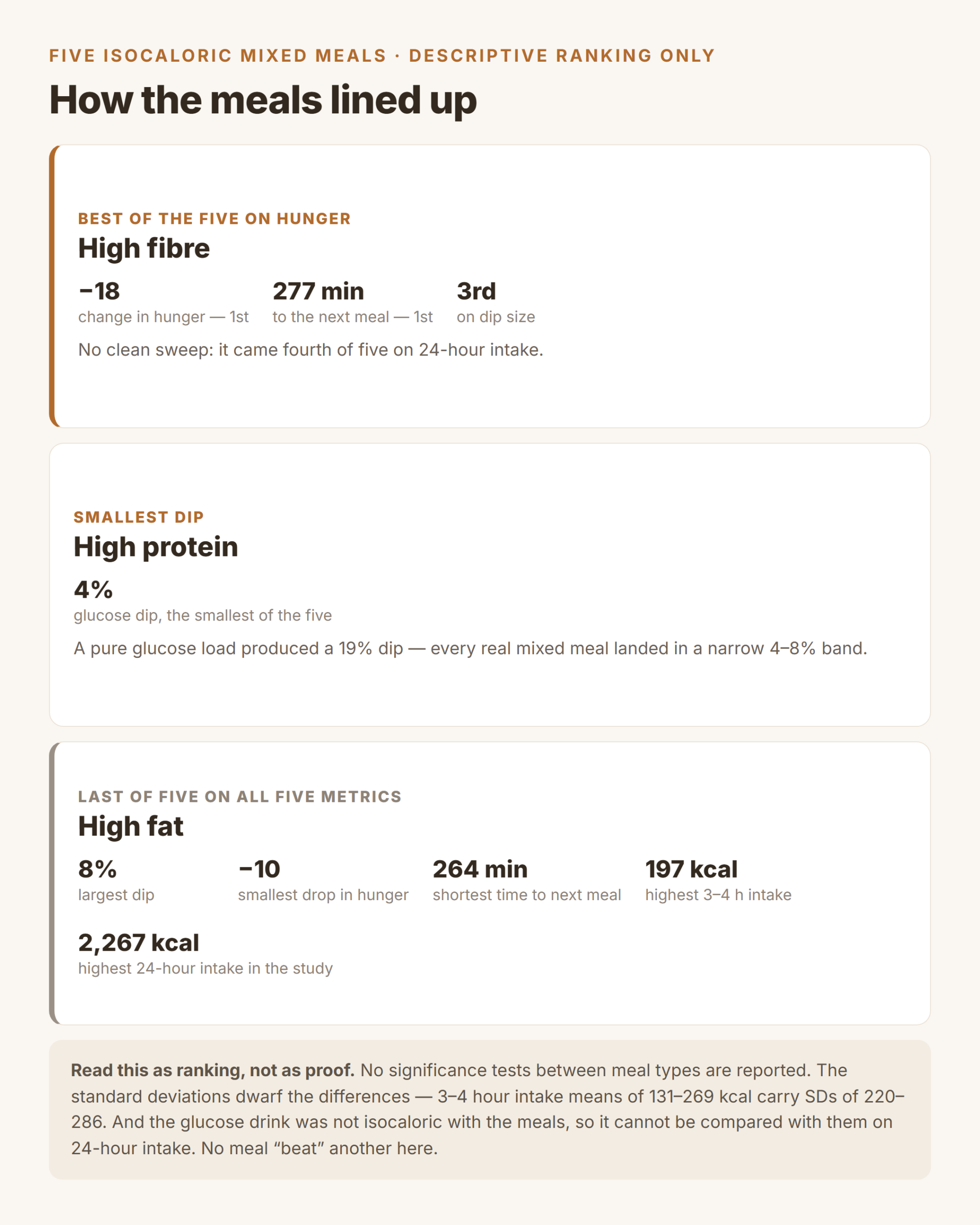

Photo: Heather Brock / Pexels
The current US added-sugar guidance, quoted whole
The Dietary Guidelines for Americans, 2025–2030, released January 2026, says:
“While no amount of added sugars or non-nutritive sweeteners is recommended or considered part of a healthy or nutritious diet, one meal should contain no more than 10 grams of added sugars.”
Both halves belong together, and it is a per-meal ceiling. This edition sets no daily gram cap and no percent-of-calories limit for added sugars, so converting it into a daily total is arithmetic, not federal advice.
For snacks — the moment this article is actually about — the Guidelines defer to FDA’s “Healthy” claim limits: grain snacks such as crackers should not exceed 5 grams of added sugar per ¾ ounce whole-grain equivalent, and dairy snacks such as yogurt 2.5 grams per ⅔ cup equivalent. Those denominators are FDA food-group equivalents, not the serving size printed on a Nutrition Facts panel.
For scale, the Guidelines’ Scientific Foundation reports that more than 80% of total carbohydrates in the US diet come from low-quality sources — added sugars, artificial sweeteners, refined grains and starches.
About the almond swap
The calorie discount is real. In a USDA crossover study of 18 adults (Novotny 2012), a 1-ounce serving of whole almonds delivered about 129 calories rather than the roughly 170 on the label, because almond cell walls leave some fat undigested. That applies to whole almonds — chopping, grinding, roasting and almond butter all increase available energy, so the discount should never be quoted without the form.
The craving claim does not hold up, though. In the best-controlled acute trial (n = 140, funded by the Almond Board of California), almonds versus an isocaloric carbohydrate snack showed no evidence of a difference in self-reported appetite and no significant difference in how much people ate at a later buffet. Almond research is heavily industry-funded, and this well-designed trial came out negative.
So a handful of almonds is fine. It is not craving control, and I would not sell it to you as one.
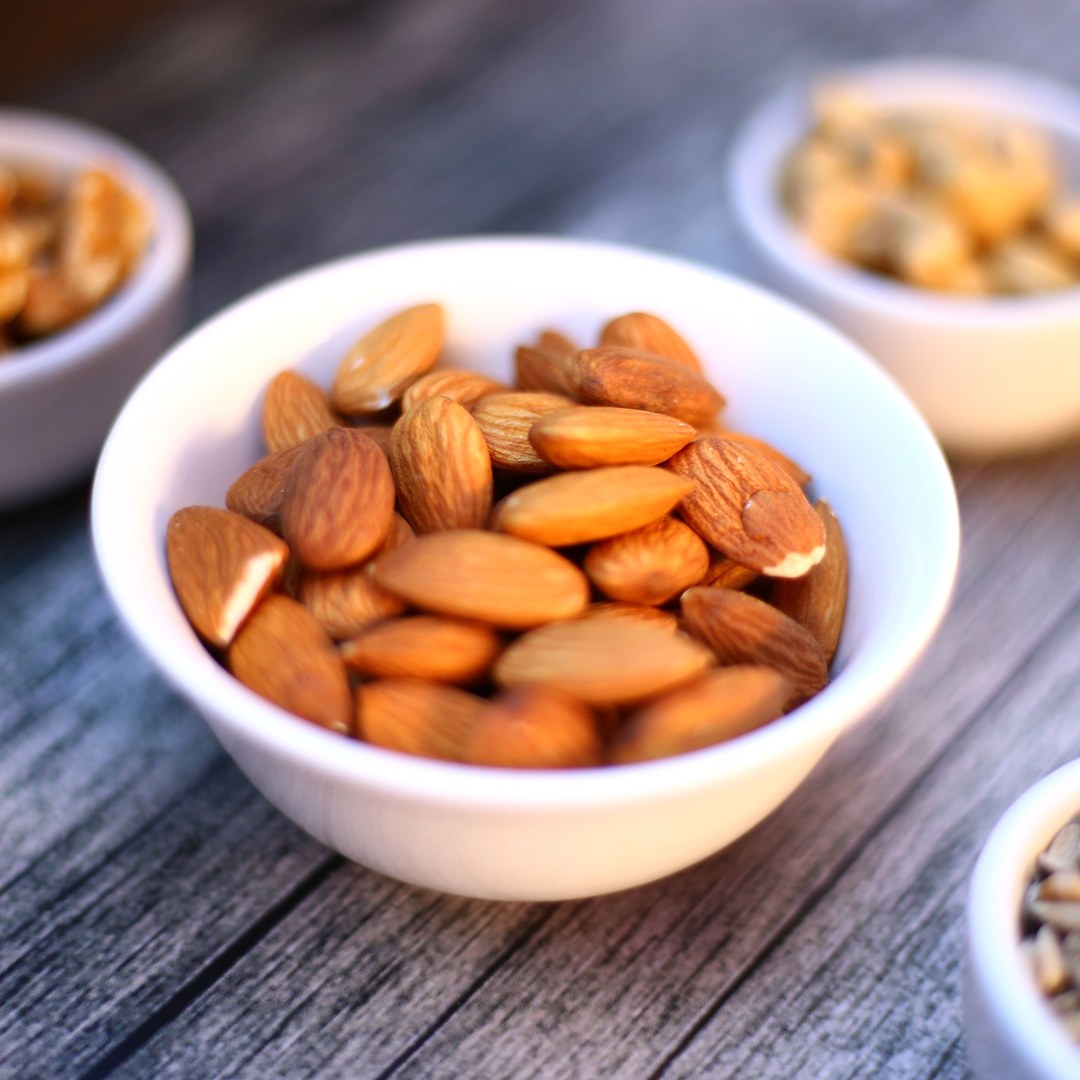
Photo: Lorena Galeano / Pexels
When to talk to a health care provider
Please treat this as a prompt to get assessed, not as a verdict about yourself.
- You eat an unusually large amount in a short period and feel a loss of control while doing it — especially about once a week or more, for three months or longer.
- You eat until uncomfortably full, eat rapidly, eat when not physically hungry, eat alone from embarrassment, or feel disgusted, depressed or very guilty afterward.
- Your eating patterns cause marked distress, or affect work, school, relationships or sleep.
- You are cutting out food groups, fasting, or compensating after eating.
- You get shakiness, sweating, confusion, a racing heart or faintness after meals.
- You have diabetes, prediabetes or PCOS, are pregnant, or take medication affecting blood sugar — do not change your eating pattern based on an article.
NIMH’s own first step is the right one: talk to a primary care provider.
US resources
| Resource | Contact | Details |
|---|---|---|
| National Alliance for Eating Disorders Helpline | 1-866-662-1235 | Mon–Fri, 9:00 am – 7:00 pm ET. Free, staffed by licensed therapists; treatment finder at findEDhelp.com. |
| ANAD Helpline | 1-888-375-7767 | Mon–Fri, 9 am – 9 pm CST. Free peer support; after-hours messages returned. |
| 988 Suicide & Crisis Lifeline | Call or text 988, or chat at chat.988lifeline.org | 24/7/365, free and confidential. |
| National Eating Disorders Association | nationaleatingdisorders.org | Free online screening tool. |
| NIMH | nimh.nih.gov/health/topics/eating-disorders | Overview of eating disorders and treatment. |
Related: what a late-night snack can and cannot do about evening cravings
Compressed into a few lines, it comes out like this.
Wanting a croissant an hour after dinner is a common feature of how human appetite works, not a character flaw and not a disease. The blood-sugar dip behind it is real and small, and for the muffin — the food in that study closest to a pastry — it predicted nothing at all. “Carb addiction” is not a diagnosis, and researchers on both sides of the debate agree the word is too imprecise to be clinically useful.
What deserves your attention is not the label. It is the loss of control, if that is present, and the distress, if that is present — because those belong to a diagnosis that is real, common, treatable, and that most people who have it never get named.
You do not need a verdict about yourself. You need someone qualified to look, which is a much smaller and kinder thing to ask for.
A note on what this article is and is not
This article is for general information only and is not medical advice, diagnosis, or treatment. “Carb addiction” is not a recognized medical diagnosis, and nothing here can tell you whether you have an eating disorder or any other condition. Persistent changes in appetite, energy, or mood have many possible causes, some of which need medical evaluation. If you have concerns about your eating behavior or your mental health, talk to a primary care provider or a licensed mental health professional.
References
- Fletcher PC, Kenny PJ — “Food addiction: a valid concept?” Neuropsychopharmacology. 2018
- Hebebrand J et al. — Neurosci Biobehav Rev. 2014;47:295–306 (“eating addiction”)
- Gearhardt AN et al. — BMJ. 2023;383:e075354 (pooled YFAS, 281 studies)
- Claudino AM et al. — ICD-11 feeding and eating disorders field study, BMC Medicine. 2019
- Wyatt P et al. — “Postprandial glycaemic dips predict appetite and energy intake in healthy individuals,” Nat Metab. 2021;3(4):523–529
- Sweatt SK et al. — Nutrients. 2026;18(5):822 (n = 69)
- “Reactive Hypoglycemia,” Endocrinol Metab Clin North Am; MedlinePlus / NIDDK (below 70 mg/dL)
- NIMH — Eating Disorders statistics (NCS-R, 2001–2003) and topic page
- Cossrow N et al. — J Clin Psychiatry. 2016;77:e968–e974
- Schaumberg K et al. — Nine Truths About Eating Disorders, Eur Eat Disord Rev. 2017;25(6):432–450
- Novotny JA, Gebauer SK, Baer DJ — Am J Clin Nutr. 2012;96(2):296–301 (n = 18, whole almonds)
- Acute almond vs carbohydrate snack RCT, 2022 (n = 140; Almond Board of California funding)
- Dietary Guidelines for Americans, 2025–2030 (January 2026) and its Scientific Foundation