

Diet-Friendly Restaurant Ordering: How to Eat and Drink Out Without Wrecking Your Progress
I’ll be honest with you.
For a long time, I thought eating out and staying on a diet were two things that couldn’t share a table.
Every dinner invite felt like a small negotiation with myself. Skip it, or give up for the night. Those seemed like the only two options.
But that isn’t really true. You can eat out and still lose weight. A diet-friendly restaurant order isn’t about ordering nothing. It’s about knowing which three things actually move the needle, and which “healthy” choices quietly work against you.
That’s what this guide is about. What to order at the chains you already go to. Which plates look light but aren’t. And how to handle the part most guides skip — the drinks.
One thing first. This is general information, not medical advice. Results vary by person, and anyone with a medical condition, a medication, or a pregnancy should talk to a doctor or a registered dietitian before making changes.

Photo: Deane Bayas / Pexels
The three levers that actually matter
Before the specific dishes, it helps to know what you’re actually steering.
Eating out on a diet really comes down to three levers.
- Cooking method. Grilled, baked, broiled, or steamed over fried.
- A lean protein as the centerpiece, with vegetables alongside.
- The hidden calories in sauces, dressings, mixers, and “extras.”
That’s it. Almost everything below is just one of these three, applied to a real menu.
The reassuring part is that you don’t have to memorize a calorie chart. You have to make three decisions well.
What to order at US chains
The good news is that mainstream chains give you honest options if you know what to look for.
Grilled and baked fish
Fish is one of the strongest low-calorie picks, mostly because it’s high in protein and low in carbohydrates.
Herb-grilled salmon, blackened tilapia, or a salmon-and-vegetable plate are the kind of dishes I lean on. For a sense of scale, Applebee’s blackened tilapia comes in under about 600 calories, and Red Lobster offers a 6-ounce sirloin or a salmon-and-veggie plate.
The number will drift by brand and portion, so it’s worth checking the chain’s current nutrition info when the exact figure matters.
Lean steak, like sirloin
Steak isn’t off the table either.
A top sirloin can land around 550 calories at chains like Applebee’s. It’s a high-protein, lower-carb centerpiece — as long as you skip the loaded sides that come with it.
That last part is the whole trick. The sirloin isn’t the problem. The pile of fries next to it is.
Grilled chicken and seafood plates
The pattern repeats across the menu.
Look for grilled, baked, or broiled protein as the main event. Swap the starchy side for vegetables or a salad. And ask for sauces on the side.
Say those three things and you can order almost anywhere.
Why protein-forward ordering helps
There’s a reason I keep pointing at the protein.
Protein has the highest thermic effect of the macronutrients. Roughly 20 to 30 percent of protein’s calories get burned just digesting and metabolizing it. It also keeps you full longer.
So a protein-centered plate does a little quiet work for you, on top of simply being satisfying.
A couple of small habits before you arrive
Two things I do before I even sit down.
I have a small protein snack about an hour before, so I don’t show up starving. And I decide in advance how I’ll handle the bread basket, the alcohol, and dessert.
A plan made on a full stomach beats a decision made when the bread is already in front of you. That’s most of the battle.

The plates that look healthy but aren’t
Here’s the part that surprised me most.
Some of the dishes that read as “the healthy choice” are the ones that quietly did the damage.
Salads drowning in dressing
A salad sounds safe. Then the dressing arrives.
Two tablespoons of ranch is about 145 calories, and restaurants often pour four to six. That alone can turn a roughly 150-calorie salad into a 500-plus-calorie meal. Caesar runs about 150 to 200 calories per two tablespoons, and Caesar, ranch, and blue cheese are the worst offenders.
Even “healthy” olive-oil dressing isn’t free. One tablespoon of olive oil is around 120 calories, and most people use two or three. And “low-fat” dressings often add sugar, stabilizers, and sodium to make up for the missing fat.
The fix is small and works. Get the dressing on the side, and dip your fork into it instead of pouring it over. A little vinaigrette goes a long way.

Photo: Farhad Ibrahimzade / Pexels
Sushi that’s lighter in theory than on the plate
Sushi is another one I misjudged for years.
Tempura rolls and spicy-mayo rolls add a lot of oil, which turns a “light” meal calorie-dense in a hurry. And the rice adds up fast across a lot of pieces.
So I prioritize sashimi and simple nigiri, keep the fried and mayo-heavy rolls to a minimum, and keep an eye on the total rice. Same meal, very different math.
The other quiet ones
Two more worth naming.
Large flavored coffee drinks can top 500-plus calories — as much as a full meal, in a cup you drink between meals. And bread baskets tend to disappear before the food even shows up, purely out of habit.
Neither is forbidden. They’re just worth spending on deliberately, not by accident.
Surviving the drinks
Now the part I said most guides skip.
I want to be careful here, because drinking isn’t just a calorie question.
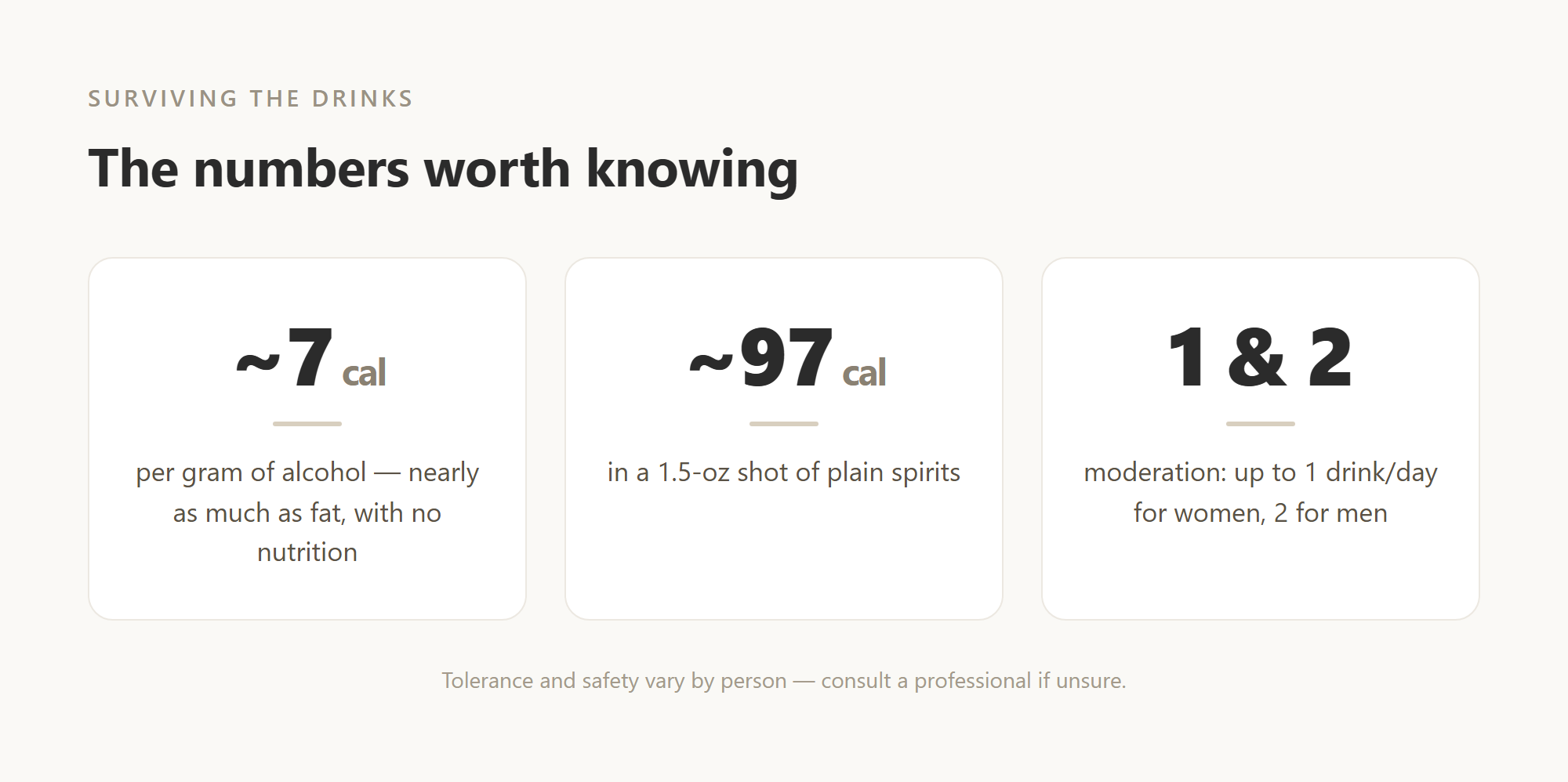
First, the facts. Alcohol delivers about 7 calories per gram — nearly as much as fat, which is 9, and more than carbs or protein at 4 each. And it comes with almost no nutritional value, which is why people call them “empty calories.”
Your body treats alcohol as a toxin. It prioritizes metabolizing it, which comes at the expense of other processes, including fat burning. And those drink calories usually stack on top of your meal rather than replacing it.
So I’ll say it plainly. There’s no weight-loss alcohol. There are only less-bad choices.
There’s also the health side, which matters more than the calories. Alcohol carries its own health risks, so the rule is moderation. Health authorities define that as up to one drink a day for women and two for men. Whether you should drink at all — and how much is safe — depends on the person, on medications, and on your health. If you’re unsure, that’s a conversation for a professional, not a blog.
With all of that on the table, here’s how to make the better choice when you do drink.
Pick the drink that isn’t secretly dessert
Plain spirits sit at the low-calorie end, because distillation removes nearly all the sugar and carbs.
A few rough counts: a 1.5-ounce shot of spirits is about 97 calories, a light beer around 103, a 12-ounce regular beer about 153, and a 5-ounce glass of wine roughly 121 to 125.
The trap is cocktails. They can run 200 to 500-plus calories, and mostly not from the alcohol — it’s the simple syrup, fruit juice, cream, and margarita or soda mixers doing the work.
So the smarter builds are the simple ones. A vodka soda. Gin with diet tonic. Whiskey with soda. Or a hard seltzer.
One caution worth repeating. “Spirits are low-calorie” is only true neat or with a zero-calorie mixer. The moment sugary juice or syrup goes in, the drink can rival a dessert.

Photo: prasannabaarathi / Pexels
Drink a little smarter
A few small moves that add up.
- Use low-calorie or unsweetened mixers — club soda, diet mixers — and add herbs or citrus for flavor.
- Adjust the spirit-to-mixer ratio instead of ordering something sweeter.
- Alternate each drink with a glass of water, ask for extra ice, and choose single measures over doubles.
- Pair drinks with a protein-forward snack rather than fried bar food.
And the honest bottom line, from the clinical sources rather than the fun ones: because those calories are extra and nutrient-poor, and because alcohol can loosen your restraint around food, the single biggest lever is just drinking less.

Photo: Thai Nguyen / Pexels
Putting it together
If you want the whole thing in one breath, it’s this.
Order grilled over fried. Make a lean protein the centerpiece and let vegetables fill the plate. Put the sauces, dressings, and mixers on the side, where you can see them.
None of it asks you to skip the dinner. It just asks you to make three or four decisions on purpose.
The numbers here are approximations. They shift with brand, cut, portion, and pour, so treat them as a compass, not a scale. When an exact figure matters, check the chain’s current nutrition info.
I still get the dinner invites. I still go.
I just don’t walk in without a plan anymore, because the plan is the only part I actually control.
Trusted sources
- MedlinePlus (NIH) — Weight loss and alcohol: https://medlineplus.gov/ency/patientinstructions/000889.htm
- UF Health — Weight Loss and Alcohol: https://ufhealth.org/care-sheets/weight-loss-and-alcohol
This article is general information, not medical advice. Calorie figures are approximate and vary by brand, portion, and pour. Individual results, tolerance, and safety differ — consult a doctor or registered dietitian for guidance specific to you.


