Puppy Vaccination Schedule: Why the Last Shot’s Age Matters
I went into this topic carrying five things I was fairly sure about. Parvo kills nine dogs out of ten. Five rounds of shots, two weeks apart, and you’re done. The coronavirus shot is part of the package. After that, titer every year and top up. And absolutely no walks until the last needle.
Every single one of them turned out to be wrong, or wrong in the part that matters.
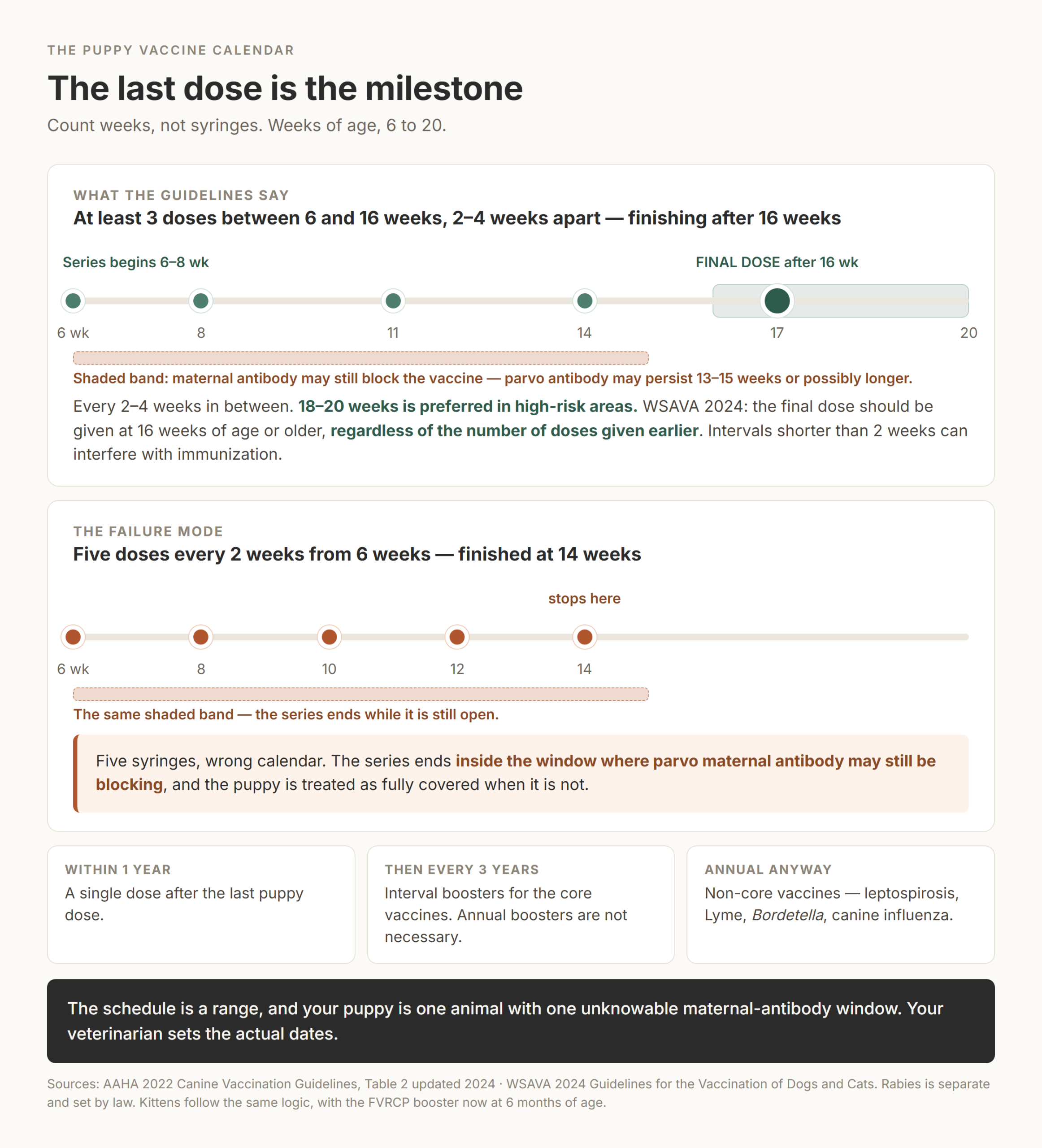
So let me put the correction that changes the most, first. The puppy vaccination schedule is not a count of shots. It is a calendar. AAHA, AAFP and WSAVA all specify a starting age, an interval range, and one thing they genuinely insist on — the final dose after 16 weeks of age. You can give five doses and still finish too early.
The rest of this is the other four, with the sources attached.
Photo: Snapwire / Pexels
The 90% parvo figure belongs to untreated dogs
This is the one I’d most want corrected, because the bare number does real harm in both directions. It terrifies people who don’t need terrifying, and it quietly convinces others that treatment is futile.
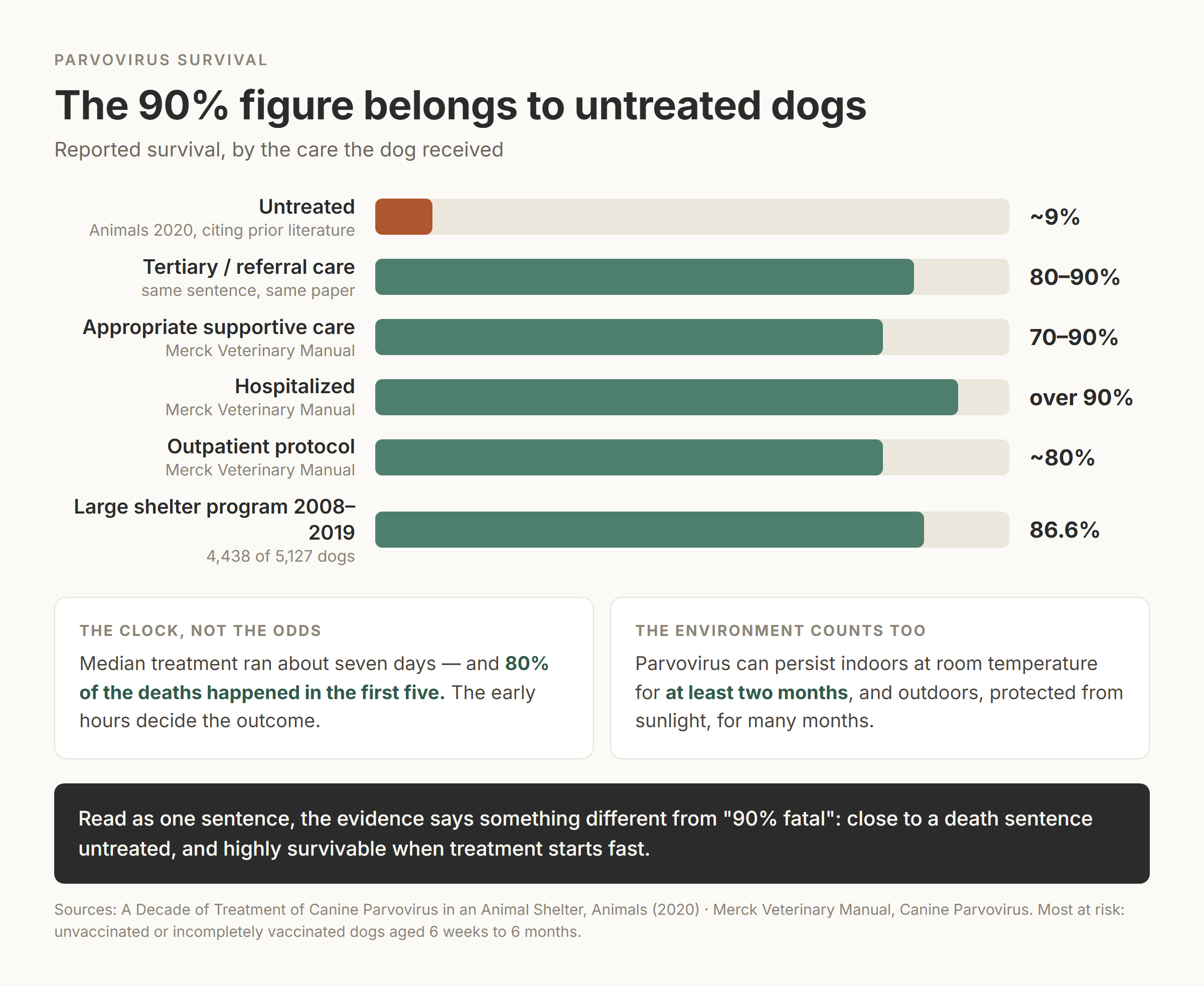
Here is the sentence the number comes from, in a 2020 study in Animals covering an 11.5-year shelter treatment program: “Survival rates are dependent upon treatment, with estimates ranging from 9% in untreated populations up to 80%–90% in tertiary care centers.”
Read the first half without the second half and you get “90% fatality.” Read the whole sentence and you get something else entirely.
| Situation | Survival | Source |
|---|---|---|
| Untreated | around 9% | Animals 2020, citing prior literature |
| Tertiary / referral care | 80–90% | same sentence |
| Appropriate supportive care | 70–90% | Merck Veterinary Manual |
| Hospitalized | over 90% | Merck Veterinary Manual |
| Outpatient protocol | around 80% | Merck Veterinary Manual |
| Large shelter program, 2008–2019 | 86.6% — 4,438 of 5,127 dogs | Animals 2020, Austin Pets Alive! |
A more recent limited-admission shelter study of 94 cases from 2022 to 2024 reported 12% mortality with standard treatment and 6% with a monoclonal antibody, though the difference was not statistically significant.
So the honest framing is two-sided. Parvo is close to a death sentence untreated, and highly survivable treated promptly. Which means the number is really an argument about how fast you get to a veterinarian, not about how doomed the puppy is.
One detail from that shelter study makes the point sharper than any percentage: median treatment ran about seven days, and 80% of the deaths happened in the first five. The early hours are where the outcome is decided.
Why the environment matters as much as the schedule
Merck notes infectious canine parvovirus “can persist indoors at room temperature for at least 2 months,” and outdoors, protected from sunlight and drying, “for many months and possibly years.”
That is the part most of us underestimate. A yard where a sick dog was months ago is not automatically clean.
Effective disinfection means specific chemistry — Merck lists dilute bleach at 1:30, or a peroxygen, potassium peroxymonosulfate, or accelerated hydrogen peroxide product. General household sprays are not on that list.
Most at risk, per Merck: young dogs aged 6 weeks to 6 months who are unvaccinated or incompletely vaccinated. Signs usually appear 5 to 7 days after infection, sometimes anywhere from 2 to 14.

Photo: SHVETS production / Pexels
The “measles” in this conversation is canine distemper
Worth clearing up plainly, because the wording circulates.
Canine distemper virus is a morbillivirus — the same genus as human measles virus. It is not human measles. It is a different disease in a different species, and this is not an article about a human vaccine.
Distemper spreads mainly through the air, Cornell’s Riney Canine Health Center explains — droplets from a nearby infected animal coughing, sneezing or barking — plus direct contact and bodily fluids.
And there is no cure. Cornell states there is no specific treatment and that antivirals are not recommended; care is supportive, and the outcome depends largely on the dog’s own immune response.
I’m deliberately not quoting a distemper fatality percentage. Cornell publishes none, and the figures floating around come from aggregated secondary literature with a wide spread. The qualitative statement is the reliable one: often fatal, no cure, supportive care only.
Survivors can carry it with them, too. Cornell notes some recovered dogs have residual muscle twitches or seizures, and that neurologic signs can surface weeks or even years later.
The puppy vaccination schedule: count the calendar, not the syringes
Now the part I had most confidently wrong.
“Five rounds at two-week intervals” appears in no US primary guideline I could find. It reads as regional or clinic practice. It isn’t forbidden — it falls inside the guideline range — but it is not what the guidelines say.
Here is what they actually say.
AAHA 2022 Canine Vaccination Guidelines, Table 2 (updated 2024), for the DAP combination:
- Dogs 16 weeks and under: “At least 3 doses of a combination vaccine between 6 and 16 weeks, 2-4 weeks apart.“
- Dogs over 16 weeks: two doses, 2–4 weeks apart.
- Then a single dose within 1 year of the last puppy dose, and boosters every 3 years after that.
- Rabies: “As required by law.“
The AAHA narrative adds the endpoint: start at 6–8 weeks, revaccinate “at 2 to 4 wk intervals until greater than 16 wk old,” with 18–20 weeks preferred in high-risk areas.
WSAVA 2024 says the same thing and then removes the escape hatch: the final dose should be given “at 16 weeks of age or older, regardless of the number of doses given earlier.” It explicitly rejects short “early finish” protocols marketed as a way to socialize sooner.
Why the endpoint age is the whole point
Maternal antibody. A puppy absorbs antibodies from its mother, and those same antibodies can block a vaccine from taking.
AAHA puts numbers on it. Maternal antibodies against distemper “decline exponentially over time and are usually absent by 12–14 wk of age.” Against parvovirus, they “may persist for 13–15 wk or possibly longer.”
That variability is unpredictable between individual puppies, and even between littermates. Nobody can look at your puppy and know when its window opened.
So the schedule isn’t repetition for its own sake. It’s coverage of an unknown date.
Which produces the failure mode worth naming clearly:
Five doses at two-week intervals starting at 6 weeks finishes at 14 weeks. That is before the guideline endpoint, inside the window where parvo maternal antibody may still be blocking. The owner counts five shots, believes the puppy is fully covered, and takes it somewhere it shouldn’t be.
Five syringes. Wrong calendar.
The rest of the canine core list
Core, in AAHA’s definition, means “recommended for all dogs irrespective of lifestyle, unless there is a specific medical reason not to vaccinate.” That is distemper, adenovirus, parvovirus, with or without parainfluenza, plus rabies.
Leptospirosis sits in the core block of AAHA’s Table 2, and the narrative says it “should be strongly considered for most dogs in North America” — it can be life-threatening, it is endemic across much of the continent, and it is zoonotic, meaning it transmits to people. Its schedule is different: two doses 2–4 weeks apart starting at 12 weeks, a dose within a year, then annually. AAHA suggests the later start because adverse reactions of any kind are more likely in smaller and younger dogs.
For a dog with unknown history, AAHA offers a line I appreciated for its bluntness: “When in doubt, vaccinate.“
Kittens: same logic, one change worth knowing
Feline core, per the 2020 AAHA/AAFP Feline Vaccination Guidelines, is FVRCP — panleukopenia, herpesvirus and calicivirus — plus rabies, plus FeLV for cats under 1 year old. FeLV becomes noncore after the first year.
The kitten series runs “every 2–4 weeks through 16–18 weeks of age” in the narrative, while the schedule table reads “revaccinate every 3−4 weeks until 16−20 weeks of age.” Same idea, compatible ranges. It starts no sooner than 4 weeks, because neonates respond poorly and are likelier to develop vaccine-organism-associated disease.
There’s a floor too, and it cuts against “just squeeze them closer together”: intervals of less than 2 weeks can interfere with successful immunization, especially with attenuated live vaccines.
The change most people miss: the old 1-year FVRCP booster has moved to 6 months of age. The reason is uncomfortable and important — “up to one-third of kittens may fail to respond to a final core vaccine at 16 weeks and may have blocking maternal antibody at 20 weeks.” After that 6-month visit, only FeLV and rabies boosters are due at the first annual appointment.
And indoor-only cats are not exempt. The AAFP client guidance is direct: cats living exclusively indoors “still may be exposed to diseases in many circumstances, such as when traveling or boarding, visiting a veterinary practice, interacting with other cats, or through viruses carried on the pet owner’s hands or clothing.” The guidelines go further and note strictly indoor cats may in theory be more susceptible to panleukopenia and calicivirus, for lack of natural boosting.
Photo: NaNa Photography / Pexels
The coronavirus vaccine isn’t part of the basic series
I assumed this one was standard. It isn’t — and the guidelines aren’t subtle about it.
WSAVA 2024 classifies the canine enteric coronavirus vaccine, killed and modified-live, as “Not recommended.” Their stated reasoning, condensed:
- Evidence that CCoV is an important primary pathogen in adult dogs is weak.
- Diarrhea associated with it in puppies is usually mild, and infection often happens before first vaccination anyway.
- Co-infection with parvovirus is handled by protecting robustly against parvovirus.
- There’s no evidence current CCoV vaccines protect against the rare pantropic variants.
WSAVA’s FAQ adds a mechanical objection: dogs vaccinated by injection “do not seem to develop a protective intestinal IgA antibody response.” The infection is in the gut; the shot doesn’t put antibody there.
And in US guidance it simply isn’t on the board. A full-text search of the 2022 AAHA canine guidelines returns zero mentions of coronavirus. It appears in neither the core nor the noncore list — AAHA’s noncore list is Lyme, Bordetella, parainfluenza, canine influenza H3N8/H3N2, and rattlesnake.
Two naming traps, since the word does a lot of work these days. Canine enteric coronavirus is unrelated to COVID-19 and SARS-CoV-2, and it is unrelated to feline infectious peritonitis. Different viruses, different species, unfortunate shared family name.
“Annual titer plus a yearly top-up” is not the gold standard
This was my most confident belief and my most thoroughly contradicted one.
On intervals, the guidelines converge. AAHA: after the 1-year booster, “interval boosters every 3 yr are recommended; annual boosters are not necessary.” WSAVA: revaccination “no more often than triennially,” adding that dogs which responded well to modified-live core vaccines “maintain solid immunity for many years in the absence of repeated vaccinations.” AAFP: injectable FVRCP every 3 years, though intranasal FVRCP is annual.
On titers, AAHA is more skeptical than I expected:
- Titers are “subject to intralaboratory and interlaboratory variation,” with “no readily available documentation of standardization” across labs.
- “No values for ‘protective titers’ are indicated in these guidelines,” though some commercial labs will supply them.
- “A titer, almost regardless of the amount, is not necessarily indicative of protection or susceptibility.“
- The bottom line: routine titer testing to decide whether to revaccinate “is not usually advised” — except for dogs with a history of adverse vaccine responses, suspected vaccine-related autoimmune disease, or owners who are hesitant about revaccination.
To be fair to titers, they do have real uses. WSAVA endorses serology after the puppy series as one way to confirm the pup actually responded, as an alternative to that 26-week revaccination. AAHA lists titers as useful for monitoring distemper, parvovirus and adenovirus immunity in defined situations, including shelter intake decisions.
What isn’t supported is titer-every-year-then-top-up as a routine protocol.
And there is a genuine exception on the booster side that deserves saying: non-core vaccines — leptospirosis, Lyme, Bordetella, canine influenza — really are annual. That’s the kernel of truth inside the “yearly shots” idea.
AAHA is also candid that the 3-year protocol rests on imperfect ground: it “is based on very limited population-based data,” and head-to-head challenge studies comparing annual against triennial vaccination “are lacking.” I’d rather report that than pretend the evidence is tidier than it is.
Rabies is law, not preference
This one sits outside the whole discussion, and it’s the exception people most often try to apply titers to.
AAHA states that rabies vaccination of dogs “is legally mandated in many jurisdictions,” with age at first dose, booster timing, formulation and whether exemptions exist all potentially stipulated in law — and mandates can exist at local, state and provincial levels. For cats, AAFP notes rabies vaccination is required by law in many but not all states, and that in many US states only a licensed veterinarian may administer it.
On the product side, AAHA notes all licensed canine rabies vaccines are inactivated, with 1-year and 3-year formulations available, all labeled for puppies 3 months and older, and a booster recommended one year after the initial dose regardless of formulation or age at first vaccination — specifically to catch animals that didn’t respond the first time.
The hard limit: “Antibody titer levels as correlates of protection have not been established for rabies, and serologic testing is not considered a substitute for vaccination.“
Rules genuinely differ by state and county. Check yours, or ask your veterinarian, and treat the NASPHV Compendium of Animal Rabies Prevention and Control as the reference point. Any exemption is a veterinarian-and-jurisdiction matter, never an owner’s unilateral call.
Photo: Tima Miroshnichenko / Pexels
The socialization rule is about surfaces, not confinement
Now the correction I think matters most for how the next three months of your puppy’s life actually go.
I believed the puppy stays home until the series is done. The American Veterinary Society of Animal Behavior takes the opposite position, in unusually strong language:
“The primary and most important time for puppy socialization is the first three months of life… the American Veterinary Society of Animal Behavior believes that it should be the standard of care for puppies to receive such socialization before they are fully vaccinated.“
And the sentence that reframed the whole risk calculation for me:
“Behavioral issues, not infectious diseases, are the number one cause of death for dogs under three years of age.”
AVSAB’s reasoning is a comparison, not a dismissal of disease risk. While a puppy’s immune system is still developing, “the combination of maternal immunity, primary vaccination, and appropriate care makes the risk of infection relatively small compared to the chance of death from a behavior problem.” Behavioral problems are also the leading cause of relinquishment to shelters.
There is evidence underneath it. Stepita, Bain and Kass at UC Davis, published in JAAHA in 2013, asked whether puppies attending socialization classes — vaccinated by a veterinarian at least once — had more confirmed parvovirus infection than puppies who didn’t attend. They found no greater risk. WSAVA 2024 cites that study and states it “strongly supports early socialisation.”
So the rule isn’t walk versus don’t walk. It’s where, and with whom.
Reasonably safe, per AVSAB and WSAVA:
- Puppy classes on “surfaces that are easily cleaned and disinfected (e.g. indoor environments).”
- Classes starting as early as 7–8 weeks, with “a minimum of one set of vaccines at least 7 days prior to the first class and a first deworming,” kept up to date throughout.
- Carried outings, car trips, a friend’s clean home with healthy, fully vaccinated adult dogs.
- Handling, and exposure to varied surfaces, tunnels, steps. Positive reinforcement only.
Avoid until the series is finished:
- “Visits to dog parks or other areas that are not sanitized and/or are highly trafficked by dogs of unknown vaccination or disease status.” AVSAB names this directly.
- Anywhere dogs of unknown status leave feces — pet store floors, rest stops, heavily used sidewalks.
- WSAVA’s version: socialize “under controlled conditions” while “carefully prevent[ing] exposure of their puppies to potentially contaminated environments outside of the home.”
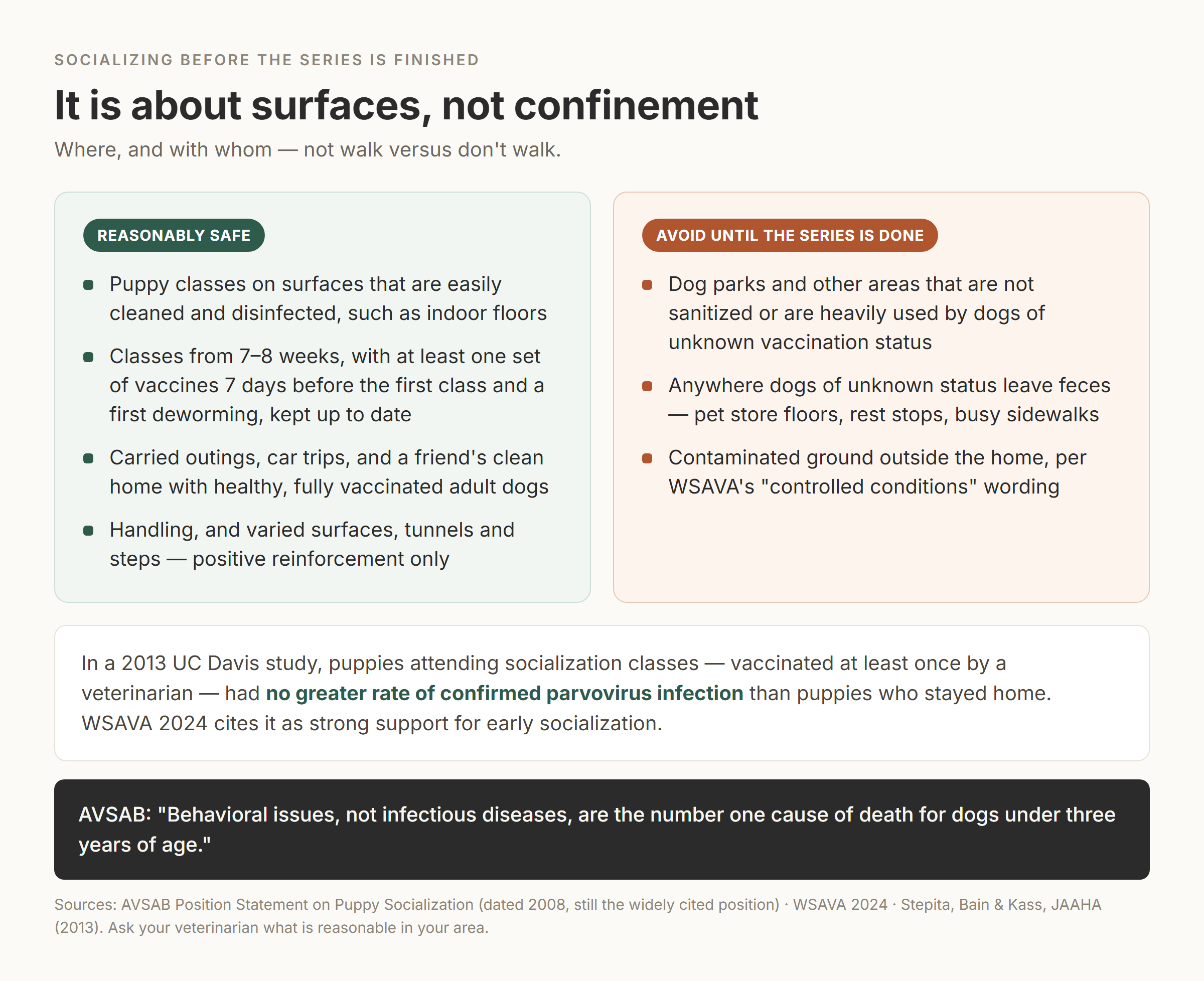

Photo: Evin Ng / Pexels
One honest caveat: the AVSAB statement is dated 2008. It remains the widely cited AVSAB position and is independently corroborated by WSAVA 2024 and the 2013 UC Davis study — but it isn’t new 2026 guidance, and I won’t dress it up as such.

Photo: Ivan Babydov / Pexels
Side effects: what’s normal, and what’s an emergency
Most reactions are minor. The AVMA describes injection-site tenderness, tiredness, mild fever and reduced appetite, typically resolving within about 24 hours, with a small firm lump at the site that should disappear over a few weeks. AAFP describes the same picture in cats — brief malaise that resolves without treatment.
Severe reactions are rare, but the rarity figure needs care. AAFP gives anaphylaxis in cats as approximately 1–5 per 10,000 vaccinations. For dogs, AAHA describes adverse events as “uncommon to rare” — and the specific “fewer than 53 adverse events per 10,000 doses” number that circulates is stated for leptospiral vaccines specifically, not as an all-vaccine rate. It shouldn’t be quoted as one.
A few things AAHA clears up that I’d assumed otherwise:
- Risk is individual, not breed-determined. Some breeds show increased risk, but “breed (a phenotype) is a crude indicator of genetics,” and “adverse event risk occurs at the individual patient level.”
- Reactions of any type are more likely in smaller and younger dogs.
- Combination vaccines don’t inherently carry more risk than single-component ones — culprits are often non-label components like fetal calf serum proteins, gelatin or casein.
Suspected adverse events can be reported to the vaccine manufacturer and to USDA APHIS, through the Center for Veterinary Biologics.
Feline injection-site sarcoma, honestly
FISS is real, and the 2020 feline guidelines are unusually frank about how much remains unknown — recognized since 1991, and “three decades later, much about them remains unknown.”
On how common it is, the guidelines decline to publish a single number, saying US incidence estimates, “although low, have varied by at least an order of magnitude.” So I won’t offer one either. Any article giving you a crisp “1 in X” is going beyond its source.
What the Task Force does recommend is practical and site-related: not vaccinating in the interscapular space between the shoulder blades, not reducing vaccine volume, and instead using distal limb sites, which allow surgical removal with wide margins if a sarcoma develops. Ventral abdominal and distal tail sites have also been described.
On adjuvanted versus non-adjuvanted, the guidelines report evidence that non-adjuvanted vaccines may be less likely to induce sarcomas, alongside a decline in fibrosarcoma diagnoses in one country after a non-adjuvanted product’s introduction — but they stop short of recommending a vaccine type. That’s an open question, not a settled one, and not a product recommendation from me.
The owner-side takeaway is simple: know where each vaccine was given, keep the record, and show your veterinarian any lump at an injection site that persists or grows.
On cost, and what I won’t give you
I looked for a defensible US price and didn’t find one worth printing.
The routine-care estimates in circulation trace to a 2021 basis and describe general wellness spending, not a per-vaccine price. The parvo treatment costs I found are from shelter settings, where economics differ substantially from private practice, and one relevant journal study sat behind a paywall I couldn’t verify.
So no numbers here. What I can say is supportable: treating illness costs far more than preventing it, and many local shelters, humane societies and municipal animal services run low-cost vaccine clinics — your local shelter or state veterinary association is the place to ask.
One more US-specific pattern worth knowing. AAHA notes that parvovirus diagnoses in dogs under a year old continue “particularly in dogs presenting to animal shelters,” and attributes many apparent vaccine failures to “failure to complete primary vaccine schedules or vaccine storage or administration errors.” A study of puppies moved through a US relocation-for-adoption program found post-transport parvovirus diagnosed in 2.3% of 4,088 puppies. A newly adopted or newly transported puppy deserves extra vigilance in its first weeks home.
If I could keep one line from all of this, it wouldn’t be a survival percentage.
It would be the calendar. Count weeks, not syringes, and know the date of the last dose rather than the number of them.
And the second thing, which surprised me more: the confinement I thought was responsible parenting was quietly costing something. Not disease risk — behavioral risk, which AVSAB says kills more young dogs than infection does. The answer wasn’t to stop protecting the puppy. It was to protect it on a clean floor instead of behind a closed door.
The guidelines are a range. Your puppy is one animal, in one county, with one immune system and one unknowable maternal antibody window.
Which is exactly why the schedule belongs to your veterinarian, and not to an article. Mine included.
Veterinary disclaimer. This article is general information about canine and feline vaccination, not veterinary advice, and it does not replace an examination. Vaccination schedules are an individualized veterinary decision based on age, health status, lifestyle, local disease prevalence, product labeling, and state and local law. This article contains no doses, no product or brand names, and no recommendation of a specific vaccine. Never skip, delay, or attempt to self-administer a vaccine — in many US states, only a licensed veterinarian may administer rabies vaccine. Rabies exemptions and any titer-based schedule are decisions for your veterinarian within your jurisdiction’s rules, not owner options. Guideline editions referenced here are AAHA canine 2022 (Table 2 updated 2024), AAHA/AAFP feline 2020, WSAVA 2024, and the AVSAB position statement dated 2008; newer editions may exist.
Emergency — contact a veterinarian immediately.
Suspected parvovirus in a young puppy: repeated vomiting · bloody or foul-smelling diarrhea · lethargy or collapse · refusing food and water. Seek same-day veterinary care. In a large shelter series, 80% of parvo deaths occurred within the first five days — survival with prompt treatment is high, and the delay is what costs.
Reaction within hours of a vaccine: facial swelling · hives · persistent vomiting or diarrhea · itching or scratching · difficulty breathing · fainting or collapse. Go to an emergency veterinarian now, day or night.
References
- American Animal Hospital Association — 2022 AAHA Canine Vaccination Guidelines (full text; Table 2 updated 2024)
- AAHA/AAFP — 2020 AAHA/AAFP Feline Vaccination Guidelines, and the AAHA Feline Vaccination Schedule for General Practice table
- World Small Animal Veterinary Association Vaccination Guidelines Group — 2024 Guidelines for the Vaccination of Dogs and Cats, J Small Anim Pract
- American Veterinary Society of Animal Behavior — Position Statement on Puppy Socialization
- Stepita ME, Bain MJ, Kass PH — Frequency of CPV infection in vaccinated puppies that attended puppy socialization classes, JAAHA 2013;49(2):95-100 (UC Davis School of Veterinary Medicine)
- A Decade of Treatment of Canine Parvovirus in an Animal Shelter: A Retrospective Study (Austin Pets Alive!, 5,127 dogs), Animals 2020
- Merck Veterinary Manual — Canine Parvovirus
- Cornell University College of Veterinary Medicine, Riney Canine Health Center — Canine distemper virus
- American Veterinary Medical Association — Vaccinations (pet owner guidance: core and noncore, series timing, side effects, emergency signs); JAVMA News — titers and revaccination
- Canine Parvovirus Monoclonal Antibody and Length of Treatment, Cost of Treatment, and Mortality in a Shelter Setting (94 cases, 2022–2024), Journal of Shelter Medicine and Community Animal Health
- Incidence and Predictors of Canine Parvovirus Diagnoses in Puppies Relocated for Adoption (4,088 puppies), Animals 2021
- NASPHV — Compendium of Animal Rabies Prevention and Control; USDA APHIS Center for Veterinary Biologics — adverse event reporting
- ⚠ Cost figures were deliberately omitted: available routine-care estimates are dated and non-specific, shelter treatment costs are not private-practice prices, and one relevant journal study could not be verified